




Abstract
Mobile charge problem describes a fleet of mobile chargers delivers energy to the sensor nodes periodically in wireless sensor networks (WSNs). In it, every sensor node has an asynchronous rest working time during a charging round. We consider the asynchronous rest working time and give the lower and upper bounds of the recharging cycle by the suitable total serving rate, to give the definition of time windows for the sensor nodes. In this paper, we model this problem in 2-dimensional WSNs as a vehicle routing problem with time windows (VRPTW). For solving the problem of multiple mobile chargers with different routing paths, we propose to transform the multiple routing problems into a single routing problem, by duplicating the sink into multiple virtual sinks. To optimize the routing path, we propose a local optimization algorithm by considering the collaborative charging among the mobile chargers. Through the simulations, we compare our proposed algorithm with the
1. Introduction
Recent breakthroughs in wireless energy transfer and rechargeable lithium batteries provide a promising support for the energy problem of WSNs. Experimental demonstration in [1] shows the energy can be efficiently transmitted between magnetically resonant objects without any conduction. Rechargeable lithium batteries own high energy densities and high charge capabilities as shown in [2].
Supported by these enabling technologies [3–5], some studies envisioned employing a mobile vehicle which carries a high volume battery as a mobile charger to periodically deliver energy to the sensor nodes. Minimizing the tour length of each mobile vehicle is a critical challenge because of its NP-hard property. Moreover, the total delay time above their energy threshold is also positive correlation with tour length while the velocity of mobile charger is fixed. The works in [6, 7] focused on minimizing the tour length and total delay time, respectively.
However, most of them assumed that a sensor node can be charged as long as its energy is consumed. It is obviously that charging a sensor node one time with the energy of
This problem can be described in detail as follows. WSNs, for all sensor nodes in WSN, own their time windows based on their residual energy. Our problem is to schedule a fleet mobile chargers, which have same battery capacity and velocity, to charge all sensor node in WSNs and back to charger station. The objective is to maximize the total energy level after one process of charging.
In this paper, we consider the prior studies and give our specific mobile charge problem as vehicle routing problem with time windows (VRPTW) with combining the problem of minimizing the tour length and time windows of the sensor nodes. We consider optimizing the total energy level after charging the WSNs one time. We add virtual charger station based on the number of the chargers and then transform the problem into a Hamilton cycle problem. The number of the chargers can be obtained based on the quantitative relationship of charger's property parameter. Then, we optimize the Hamilton cycle via specific local optimization and collaboration among mobile chargers.
The rest of our paper is organized as follows. Some related works are presented in Section 2. The problem formulation is given in Section 3. Section 4 presents our schedule scheme, and Section 5 evaluates it through simulations. Finally, Section 6 summarizes the paper and outlines the research perspectives.
2. Related Work
Many prior works prolong the lifetime of WSNs that supported and inspired our basic idea. We describe a subset of these related efforts in this section.
Supporting Technology. Energy harvesting extracts environmental energy to complements sensor nodes. Cammarano et al. [9] and Kansal and Srivastava [10] proposed energy prediction model for environment energy efficient utility. Voigt et al. [11] proposed solar aware routing manner. These works are showing great promise of addressing the energy problem in WSNs. Bhattacharya et al. [12], Wang et al. [13], and Dunkels et al. [14] consider energy conservation for slowing down energy consumption rate, but it cannot compensate for depletion. It may be efficient for combining the energy conservation and chargers' scheduling.
Existing Energy Transfer Algorithm. Peng et al. [15] and Li et al. [16] focused on maximizing network lifetime through finding an optimal charging sequence. Shi et al. [6] assumed that the mobile charger has unbounded energy and investigated the problem of periodically charging sensors to maximize the ratio of the chargers vacation time (time spent at the home service station) over the cycle time. They further considered the multinode simultaneous charging scenario [17, 18]. Fu et al. [7] focused on minimizing the total delay of replenishing all sensor nodes in a network. Louafi et al. [8] focused on maximizing the energy usage effectiveness through collaborate among chargers. These motivation related works born our specific problem VRPTW, to maximize the residual energy rate.
Before we give our problem formulation, we firstly give the general problem definition of mobile charging problem [8]. In general problem, they define the problem model as WSNs model with parameter X Y B T and define the solution model as charge model with parameter
3. Problem Formulation
The general mobile charge problem was described as WSNs(
3.1. Our Mobile Charge Model
We first give our specific mobile charge model: WSNs
It is easy to find that
3.2. Reasons of Our Specific Mobile Charge Problem
Before explaining the difference between our specific problem and the general problem, we give three practical conditions of WSNs and two assumptions.
There are three practical conditions. (1) If we need schedule mobile chargers to charge the WSNs frequently in a short time, it may be more reasonable to partition all sensor nodes into several groups and place a charge station at the center of each group to charge these sensors in the group periodic by wireless charge. (2) Each node consumes energy for sensing, data reception, and transmission. These processes frequently occur conducted by events they monitor which are obeying different parament value of exponential distribution in different environments. (3) The charge station gets the residual energy information of all sensor nodes before schedule mobile chargers to charge the WSNs.
There are two assumptions. (1) Short duration (SD): the duration of a charging is negligible compared to the traveling time of mobile chargers. (2) Long cycle (LC): the recharging cycle of a sensor node is longer than a charging round (it means any two consecutive charging rounds have no intersections). It is easy to find that these assumptions can be explained by practical condition (1).
3.2.1. Different Energy Consuming Rate
The work [19] aims at scheduling the work sequencing of sensor nodes to maximize the time of sustaining the WSNs work due to the condition (2). So, the energy consuming rate of each sensor node in WSNs is different in different environments according to the work addressed in [19].
3.2.2. Time Windows
With the assumption of long cycle (LC), the mobile charge problem focuses on a random time during a recharge cycle when some sensor nodes exhausted. Due to the different energy consuming rate, the residual energy of all sensor nodes must be not common when charge station decides to schedule mobile chargers. With an intuitive observation that charging a sensor node one time with
3.2.3. Radius of WSNs
Under a determined charge model
3.3. Number of Mobile Charger
The paper [20] has presented a method to estimate the number of mobile chargers. However, its hypothesis differs from our problem. Thus, we give our quantitative relationship of mobile charger number M.
Then, we give the low bound of mobile charger number. A clear understanding of relationship between mobile charger number M and mobile charger routing is that the better schedule of mobile charger, the less number of mobile charger necessary. So, it may be impossible to give an accuracy mobile charger number before scheduling the routing. An extreme situation is that mobile charger number M is equal to sensor node number n. Another challenge to give the mobile charger number is the constraint of time windows. Several sensor nodes cannot be served by one mobile charger in time because of their location distribution. So, we give an approximation of lower bound of M with these two aspects.
For Energy Consumption. First, we estimate the lower bound of M through the perspective of energy consumption. The energy consumed in replenishing a WSN contains two parts: the energy charging to sensors and the energy consumed by chargers' travelling. Although it is hard to exactly get the length of travelling distance, we can give the mean of all edges

This is just an approximation of lower bound
3.4. Objective Function and Constraints
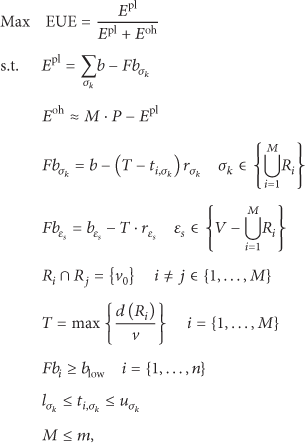
Now, we give the mathematical description of our specific mobile charge problem including objective function and constraints.
In a scheduling cycle, the energy consumed in replenishing a WSNs contains three parts: the energy eventually obtained by sensors, the energy consumed by chargers' travelling, and the energy loss during charging. The 1st part is defined as payloadenergy (

So far, we can give our brief mathematic model of this specific problem according to the above analysis result as 2.
We can describe our specific mobile charge problem as a selective vehicle routing problem with time windows. When the charger station schedules M mobile chargers simultaneously, charge all sensor nodes whose energy residual is lower than
4. Our Scheduling Algorithm
In this section, the scheduling algorithm will be given to solve our specific problem when WSNs model and charge model are determined with the above analysis.
4.1. Adding Virtual Node
Our specific problem can be translated into a vehicle routing problem with time windows (VRPTW). We perform this transform to improve the quality of solution and do local optimization after building solution, because the single routing problem is easier than multiple routing problem. So, we translate our multiple routing problem into single routing problem through adding virtual charger station. Figure 1 explain the processing intuitively.

Translation of the virtual nodes.
The left figure in Figure 1 is the initial routing, and the right figure is the routing after transform. The addition two charger stations (square) are virtual node, and it means a mobile charger arrives charger station in practical when it arrives virtual node in figure (the distance among virtual node and other sensor nodes is equal to the distance among charger station and other sensor nodes). With this transform, in our specific problem the left figure in Figure 1 is translated into Hamilton cycle that each node in graph must be visited if and only if one time. This transform is also prepared for the local optimization in Section 4.3.
4.2. Main Rules of Our Algorithm
To build a feasible routing which satisfied time windows and energy constraint, we design some building rules as follows.
First, we build a candidate set to provide mobile charger selecting a suitable sensor node to charge according to its current residual energy and time.

When the candidate set
(1) (2) calculate unvisited sensor nodes set (3) calculate feasible sensor nodes set (4) calculate feasible sensor nodes set (5) obtain the candidate feasible sensor nodes set (6) (7) (8) Add (9) Refresh paraments about (10) (11) (12) Add (13) Refresh paraments about (14) (15) (16) Using collaboration to optimize the solution R. (17) Calculate the objective function
With the transform in Section 5.1, the algorithm can be regarded as a greedy algorithm to solving a constraint
4.3. Collaboration between Mobile Charger
Finally, we use collaboration among mobile chargers to optimize the solution.
After we built a feasible routing and using 2-opt to improve the tour, we consider whether we should improve the solution further more. Such as the left picture in Figure 2, the routing

Processing of collaboration.
4.4. The Complexity of Algorithm
In Algorithm 1, lines 2–4 are the processes to calculate node sets. All of them are finishing in linear time
5. Performance Evaluation
Three different simulations would be done in this section, and we will give the analysis in detail.
5.1. Simulation Setup and Quantitative Check
We assume that sensor nodes are powered by a 1.5 V 2000 mAh Alkaline rechargeable battery, and then the battery capacity
We compare our
5.2. Compare Results in Energy Usage Effectiveness
Figure 3 expresses the EUE value with these four algorithms when sensor number, battery capacity of a charger, battery capacity of sensor node and moving cost of a charger changed. An obvious look is that algorithm with “2opt” is better than the algorithm simply and improvement of “2opt” on ScheduleAlgorithm is limited. It is because our algorithm ScheduleAlgorithm has already improved by local optimization and collaboration. With the result of Figure 3, our ScheduleAlgorithm is better than the HηClusterCharging

Performance comparisons for EUE.
In Figure 3(a), when the number of sensor nodes increases, mobile chargers may cost more time to finish a charging round; this means more energy would be cost by sensor nodes. According to this, all of the four algorithms perform worse when the number of sensor nodes decreases. A few wave will be shown because of the specificity of every example. In Figure 3(c), as the battery capacity of a sensor node increases, the EUE of all four algorithms also increases. This is reasonable, since charger can deliver more energy to a sensor node in one cycle. In Figures 3(b) and 3(d), the EUE is not changed with the increase of charger battery capacity and moving cost. It is because, there is no relevant among the variables EUE, moving cost and battery capacity. As the battery capacity of charger increases, it may decrease the charger number we used to charge, but it still cannot decrease the maximum travelling time of mobile chargers. So, there is no change for EUE with the increase of charger battery capacity.
6. Conclusion
In this paper, we investigate the mobile charging scheduling problem in WSNs. By introducing energy charging bound, we translate the problem into classic problem vehicle routing problem with time windows (VRPTW). We add M virtual base stations to translate the multiple routing problem into single routing problem and use local optimization and collaboration to optimize the solution. And the results of simulation validate the advantages of our algorithm.
Footnotes
Conflict of Interests
The authors declare that there is no conflict of interests regarding the publication of this paper.