The complexity of channel estimation algorithms is of critical importance in high mobility orthogonal frequency division multiplexing (OFDM) systems. To reduce the complexity of the algorithm, the existing channel estimation algorithms take advantage of the correlations between the channel coefficients. However, they do not take into account the variations of the correlations with the delay tap. In this paper, we consider the change in correlation between channel coefficients for different delay taps. By considering these variations, the number of computations needed for channel estimation can be decreased. This results in a reduction in the circuit energy. The simulation results show that the proposed scheme consumes less total energy per bit for transmission distances less than about 170 m when the mobile speed is 324 Kmph.
1. Introduction
Recently, OFDM has been adopted in many standards due to its improved performance in the presence of frequency selective channels. Channel state information (CSI) is required at the receiver to perform coherent detection. Pilot symbols are used to assist the channel estimation at the receiver. The fast variations in the channel state caused by the high speed of the transmitter and/or receiver demand that the channel estimation should be performed instantly. This suggests a reduction in the complexity of the channel estimation algorithm for highly mobile users.
Different channel estimation methods are proposed in the literature that use soft decoded symbols and interpolation between the time domain channel coefficients to assist the channel estimation. A low complexity iterative channel estimation technique is proposed in [1]. In this scheme, channel estimation is done by improving a priori information of the decoded data and the preamble by dynamically weighting the statistics according to reliability. However, the Doppler information is not taken into account by this method. The correlation between channel coefficients depends on the Doppler frequency and therefore this information can be exploited for channel estimation. Accordingly, Aboutorab et al. [2] have proposed an iterative Doppler assisted channel estimation for OFDM systems. A similar idea was used by Aboutorab et al. in [3] for MIMO OFDM systems. In these works, the interpolation coefficients depend on the Doppler information. For estimation of every channel coefficient, only two reference channel coefficients are used. Further improvement is done by using iterative estimates of data symbols as additional pilots. However, the variation of the correlation coefficients for different delay taps [4] is not considered in these studies. Moreover, the iterative method, although it improves estimates, can also lead to error propagation. In [5, 6] Doppler information is used to form the basis for basis expansion model (BEM) of the wireless channel and performance is enhanced by considering interference. Linear approximation of the variations of channel coefficients is used in [7]; however the performance of the channel estimation becomes poor for high mobility systems. In [8], the channel is assumed to be static over K OFDM blocks and channel estimation is performed on the basis of information acquired over the transmission of K OFDM blocks. However, as K increases the complexity of the system will increase, resulting in increased circuit energy.
The accuracy of channel estimation affects the transmission energy of the system. On the other hand, circuit energy also plays an important role in the lifetime of the battery operated nodes. Therefore, many authors [9–16] have considered circuit energy while assessing the energy efficiency of different schemes. The solutions discussed above only consider the transmission energy and do not take into account the circuit energy. Muñoz and Oberli in [17] and Yatawatta et al. in [18] present methods for computing the circuit energy of the channel estimation algorithm. The energy consumption depends upon the number of arithmetic operations needed for the algorithm to calculate the channel estimate. The number of arithmetic operations needed depends on the number of interpolation coefficients and the number of reference channel coefficients.
In this paper, we show that by utilizing the variations of correlation coefficients for different delay taps it is possible to reduce the complexity and subsequently the circuit energy consumption of the channel estimation algorithm. The circuit energy has a major impact on the overall energy consumption of the system [19] for small distance applications. Hence our proposed method is applicable for smaller range highly mobile systems.
To reduce the circuit energy of the channel estimation algorithm, we assume that every channel coefficient can be represented by a linear combination of reference channel coefficients. These reference channel coefficients are named as time domain markers. The coefficients of the time domain markers in the linear combination are the correlation coefficients. We assume that correlation among channel coefficients depends on the normalized Doppler. In this paper we design a new scheme that exploits the fact that correlation among channel coefficients for the same time differences of smaller delay taps is higher than their larger counterparts [4]. This helps in reducing the reference channel coefficients for smaller delay taps. Hence the arithmetic computations needed for least-square (LS) estimation will also decrease. This translates to reduced circuit energy. The simulation results show that the performance of the proposed scheme in terms of transmission energy is comparable to [2]. In terms of circuit energy the proposed scheme outperforms [2].
The contributions of this paper are summarized below.
The linear combinations of the time domain markers are used to estimate the channel coefficients.
The variation in the correlation coefficient for different delay taps is exploited to decrease the number of time domain markers in the estimation process.
The circuit energy analysis is done for the proposed scheme.
The overall energy consumption of the proposed scheme is compared with schemes in [1, 2].
The rest of the paper is organized as follows: Section 2 describes the system model. In Section 3 we present the proposed scheme for channel estimation and its energy analysis. Section 4 discusses simulation results and conclusions are drawn in Section 5.
Notation. In the following we will use bold face capital letters to represent matrices and bold face small letters to represent vectors, represents the transpose operation, represents the conjugation operation, represents the Hermitian transpose, represents the approximation of represents the Fourier representation of x, and represents the statistical expectation.
2. System Model
We consider an OFDM system, shown in Figure 1, with every symbol comprising L subcarriers. Let us assume that represents the OFDM symbol. Here represent the information sent on the ith subcarrier. The transmitter applies inverse fast Fourier transform (IFFT) on to get time domain representation ; that is,
where F is the fast Fourier transform (FFT) matrix of size L whose th entry is and . Moreover, cyclic prefix is added to x to avoid intersymbol interference (ISI) caused by the channel. The length of the cyclic prefix should be greater than or equal to the length of the channel impulse response . The receiver first removes the cyclic prefix to get
where is AWGN noise and is an circulant channel matrix given below [2]:
where represent the impulse response at time q caused by pth channel tap. Every entry of is assumed to be circularly symmetric complex Gaussian with unity variance. The receiver then performs FFT operation on y to get
where is the L-point FFT of n. After some simplification the ith entry of can be written as
(a) Transmitter of OFDM system. (b) Receiver of OFDM system.
3. Proposed Scheme
3.1. Using Doppler Information for Channel Estimation
In this section we review the problem of estimating the channel with the help of Doppler information and time domain correlations. We consider a channel matrix H with L rows and P columns whose th entry is represented by . Each column of H represents a delay tap and each row represents time index. To estimate this channel matrix we need to find LP values. This can be quite complex for larger values of L and P. Instead, we can approximate some rows of channel matrix with the help of some reference rows taken from channel matrix H. To do this, we observe that for Rayleigh channels the time correlation between row e and row f of H is given by [20]
where is the normalized Doppler, that is, the Doppler frequency normalized by subcarrier spacing, and is the Bessel function of first kind and zeroth order. Let us assume that the matrix of reference rows is that will be used to approximate the remaining rows of the channel matrix H. Here is the th row of channel matrix represent the uth reference row, and we are assuming a total of R reference rows. In [2] it is assumed that a channel matrix row is approximated with the help of two reference rows picked from . The approximation of row as a function of reference rows is given as follows:
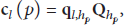
where is ith chosen reference row for lth row approximation and is the vector of interpolation coefficients. The interpolation coefficient vector, , is chosen in such a way to minimize the mean square error between and :
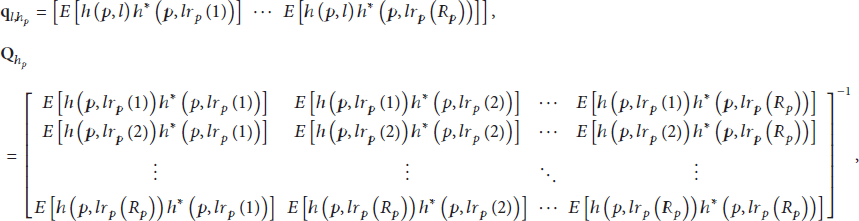
By applying orthogonality principle [21] we can obtain the following vector :
The vector and the reference rows can be used to approximate lth row of H with the help of (7). Combining the reference rows and the approximations of the remaining rows we will have , the approximation of H as a function of reference rows only. The approximation of circulant channel matrix, , can be obtained from . Now we can replace with in (4) and can estimate the reference rows using least square (LS) method. Assuming there are R number of reference rows then we need to estimate only RP elements of the reference rows. Hence the problem of estimating LP elements has been reduced to the problem of estimating only RP elements.
3.2. Delay Tap Dependence of the Correlations
In [2] it is assumed that time domain correlations are independent of the delay taps. This fact is depicted in (6). However, the channel gains of multipaths are inversely proportional to the path length and the distance for the higher delay taps is larger than the smaller delay taps. Therefore, the time domain correlations between the smaller delay taps will be higher than the time domain correlations for the larger delay taps. The dependence of the time domain correlations on delay taps is given by [4]
where
where is the delay for the line of sight (LOS) path and if the reflectors are assumed to be static then C is a constant. The dependence on delay taps suggests that less number of reference channel coefficients can be used for approximation of smaller delay tap channel coefficients while more reference channel coefficients may be required for approximation of higher delay tap channel coefficients. To account for the fact that correlations depend on the tap delays and different numbers of reference channel coefficients that may be needed for approximation of every delay tap channel coefficient, we make a matrix instead of a vector. The rows of represent the variation of the correlation coefficient with tap delay and columns represent the time domain variation of the correlation. In the following subsection we will discuss the procedure of constructing and its use for channel estimation.
3.3. Construction of Interpolation Coefficient Matrix and Channel Estimation
The elements of interpolation coefficient matrix depend on the reference channel coefficient selection. For smaller delay taps we will consider smaller number of reference coefficients and for higher delay taps we will use more number of reference coefficients. Furthermore, the reference channel coefficients are assumed to be distributed uniformly over the time index. We consider a channel matrix H with L rows and P columns. The definition of rows and columns of H is the same as that used in the preceding subsection. For this case we will have a total of L interpolation coefficient matrices and there will be P rows and L columns of each interpolation coefficient matrix . The pth row of lth interpolation coefficient matrix is given by
where
where can be found from (10). Now we can approximate in terms of and reference channel coefficients as below:
The number of the reference channel coefficients for delay tap , can be different for different delay taps and can be adjusted to improve the estimation. Next we will discuss LS estimation of the channel with the help of received signal.
The received signal in (5) can be written in terms of channel coefficient approximations as follows:
where represent the effect of AWGN noise and approximation error. Using (14), (15) can be written as
After some mathematical simplification can be written as
where
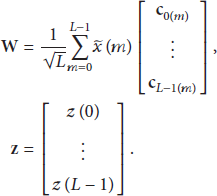
The proof of (17) is given in the Appendix. Combining for all subcarriers we get
where
The LS solution for is given by
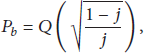
Now since the number of elements of is much less than the number of elements of H, the complexity of the channel estimation is decreased. The estimated channel can be used further for equalization and detection of the signal. Assuming a mean square error of in the estimation of channel frequency response then the corresponding bit error probability can be approximated by [22]
where
where are the noise variance and channel frequency response at ith subcarrier.
3.4. Energy Consumption of the Proposed Scheme
There are two types of energies involved in wireless communication systems, circuit energy () and transmission energy () [19]:
The transmission energy depends upon the noise levels, bit error rate (BER), bit rate (B), wavelength of the carrier, and the distance between the communicating entities. On the other hand, circuit energy depends on the complexity of the circuit. The transmission energy is given as
where is the required energy for attaining a particular BER, d is the distance, is the receiver antenna gain, is the transmitter antenna gain, is the link margin, λ is the carrier wavelength, η is the power amplifier efficiency, and ξ is the peak to average ratio (PAR) of the modulation scheme. The link margin and antenna gains are assumed to be equal to each other [23] and hence will cancel each other out in (28). We have considered a path loss exponent of 2 in our calculation which is suited for rural vehicle to infrastructure channels [24] where traffic density is quite low and higher speeds can be attained. The condition for BER is assumed to be which is acceptable for voice and video applications [25]. The circuit energy is given by
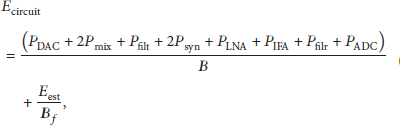
where , and are the power consumption of ADC, the filters at the transmitter side, the filter at the receiver side, intermediate frequency amplifier (IFA), low noise amplifier (LNA), DAC, number of bits in one OFDM symbol, and channel estimation energy. The power consumption values of different parts of the transmitter and receiver circuitry are given in Table 1 [19]. The channel estimation energy is given by [17]
where K represents the number of possible arithmetic operations performed during the estimation, is the number of times the kth operation is performed, is the number of arithmetic processing unit (APU) cycles taken by kth operation, is the APU frequency, is the biasing voltage of APU, and is the current through the APU. The values of these parameters are given in Table 2 [17].
System parameters.
Parameter
Value
15.4 mW
30.3 mW
2.5 mW
2.5 mW
50 mW
−174 dBm/Hz
20 mW
3 mW
6.7 mW
5 GHz
η
.35
ξ
1
APU parameters.
Parameter
Value
20 MHz
3 V
6.37 mA
6 cycles
13 cycles
To find the number of arithmetic operations for calculating the we need to know the size of the matrix and in (24). Assuming a size of of and of we need to perform complex products and complex sums to evaluate (24). However every complex product computation requires four real products and two real sums and every complex sum requires two real sums. So, in all we need to perform real sums and real products. The total energy can be written as
The complexity for Neda et al. [2] scheme for channel estimation can be found from using the method described above. The only difference will be the value of M which will be higher for Neda et al. scheme. However the complexity of the scheme in [1] depends on number of subcarriers L, number of pilots used, and a parameter pertinent to the algorithm. For given values of L, , and the number of complex multiplications required for the scheme is [1]. The value of depends on the coherence bandwidth which is usually high in rural areas due to smaller values of delay spread.
4. Simulation Results
For simulations, we considered an OFDM system with 512 subcarriers, subcarrier spacing of 5.12 KHz, QPSK modulation, and a carrier frequency of 5 GHz. Hence the value of is 1024 in (29). The channel is considered to have six taps. A total of 48 pilots are used within each OFDM symbol and they are distributed uniformly over the subcarriers. The number of reference channel coefficients used for the existing scheme in [2] is 48, while the number of reference channel coefficients for the proposed scheme is different for different speeds. Although we can optimize the selection of reference channel coefficients this will increase the complexity of the receiver because the optimal reference coefficients will vary for every block of channel realization. Further, as the channel varies from frame to frame, the optimal selection may be applicable to only a single realization of the channel and hence the selection may be optimized for every realization. Therefore, we have distributed the reference channel coefficients evenly along the time index. The value of is considered to be 30 for scheme in [1], which corresponds to a coherence bandwidth of about 180 KHz. Although the coherence bandwidth is higher than 180 KHz in practical highways [26] and we should choose a higher value for it will increase the complexity of the system. Three mobile speeds are considered for simulations: 81 Kmph, 162 Kmph, and 324 Kmph corresponding to normalized Doppler of 0.025, 0.05, and 0.1, respectively. Three types of results are discussed. First the BER performance of the existing scheme in [1, 2], perfect channel state information (CSI) case with static channel, and proposed scheme are considered. Second, the overall energy per bit requirement graphs are shown. Third, we compare the percentage of computation energy of the channel estimation process to the overall circuit energy for all the considered schemes.
Figure 2 shows the BER graphs for the proposed scheme and the existing schemes in [1, 2] for a mobile speed of 81 Kmph. We can see from the graphs that the BER graph of the proposed scheme is in between the two existing schemes [1, 2]. The performance degradation is due to the less number of reference channel coefficients used for channel estimation process than [2]. However the degradation is less than 1 dB.
BER performance with mobile speed = 81 Kmph.
Furthermore, Figures 3 and 4 show the BER graph for the case when the mobile speed is 162 Kmph and 324 Kmph, respectively. These speeds correspond to a normalized Doppler of 0.05 and 0.1, respectively. Again we can see that the performance of the proposed scheme is in between the schemes in [1, 2]. It can be observed from the graphs that the gap between the performances is again less than 1 dB.
BER performance with mobile speed = 162 Kmph.
BER performance with mobile speed = 324 Kmph.
With the results from Figures 2–4 we can expect the overall energy consumption performance of the proposed scheme to be better than both of the other schemes for smaller transmission distances. However, we can expect better performance from the proposed scheme than the scheme in [1] for all possible transmission distances. This is due to the better BER performance of the proposed scheme than the scheme in [1].
Now we compare the total energy per bit requirements as a function of the transmission distance for the proposed scheme, the scheme in [1], and the scheme in [2]. The transmission energy considered to find these graphs corresponds to a BER of 10−4. Figure 5 shows the graphs of total energy consumption per bit of the three schemes for the mobile speed of 81 Kmph. The required energy for all the schemes increases exponentially with the distance but the required energy for the proposed scheme is less than the schemes in [1, 2] for a distance of about 250 m. This reduction in energy consumption is due to the reduced channel estimation circuit energy.
Total energy consumption per bit for mobile speed = 81 Kmph.
Similar behavior of the total energy consumption can be observed in Figure 6, which shows the energy consumption per bit for mobile speed of 162 Kmph. However, for this case the gap between the energy consumption of the proposed scheme and [2] is less than the gap in Figure 5. This is because of slightly higher transmission energy gap between proposed scheme and existing schemes. This transmission energy gap starts dominating for longer transmission distances and hence the gap of the overall energy consumption starts decreasing for higher distances.
Total energy consumption per bit for mobile speed = 162 Kmph.
Figure 7 shows the total energy consumption graphs as a function of the transmission distance when the mobile speed is 324 Kmph. As expected, the energy consumption graph of the proposed scheme rises faster than the scheme in [2]. For distances less than about 170 m the energy consumption of the proposed scheme is less than the other two schemes.
Total energy consumption per bit for mobile speed = 324 Kmph.
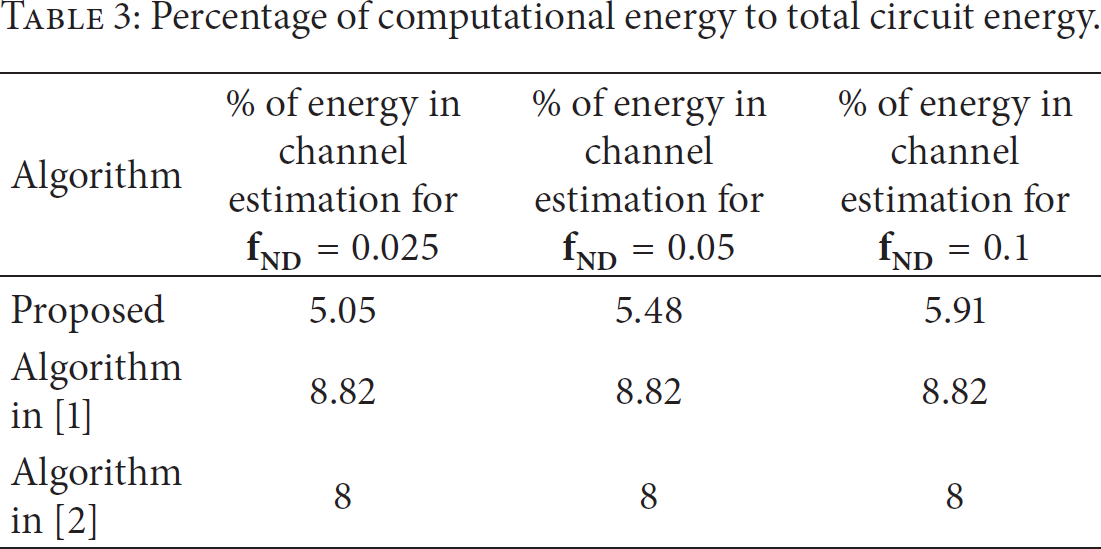
Table 3 shows the percentage of channel estimation energy for different schemes. It can be observed that the proposed schemes reduce the percentage of computational energy by about 32–42%.
Percentage of computational energy to total circuit energy.
An energy efficient channel estimation scheme for highly mobile OFDM systems is proposed. The Doppler information is used to assist channel estimation. The channel coefficients are represented as a weighted combination of the reference channel coefficients. The weights depend on the Doppler information and on the delay tap. The number of reference channel coefficients used for smaller delay taps is less than the number of reference channel coefficients for higher delay taps. This decreases the overall channel coefficients to be estimated and hence decreases the number of arithmetic operations required for channel estimation. The reduction in the number of arithmetic operations entails less circuit energy and consequently less total energy is required per bit. The simulation results show that the proposed scheme requires less total energy per bit for a transmission distance of less than 170 m when the mobile speed is 324 Kmph.
with the definitions of and provided in (18) and (20), respectively.
Conflict of Interests
The authors declare that there is no conflict of interests regarding the publication of this paper.
References
1.
ZhaoM.ShiZ.ReedM. C.Iterative turbo channel estimation for OFDM system over rapid dispersive fading channelIEEE Transactions on Wireless Communications2008783174318410.1109/twc.2008.0702282-s2.0-50049131961
2.
AboutorabN.HardjawanaW.VuceticB.An iterative Doppler-assisted channel estimation for high mobility OFDM systemsProceedings of the IEEE 23rd International Symposium on Personal, Indoor and Mobile Radio Communications (PIMRC ‘12)September 2012Sydney, Australia2095210010.1109/pimrc.2012.63627002-s2.0-84871977822
3.
AboutorabN.HardjawanaW.VuceticB.A new iterative doppler-assisted channel estimation joint with parallel ICI cancellation for high-mobility MIMO-OFDM systemsIEEE Transactions on Vehicular Technology20126141577158910.1109/tvt.2012.21895932-s2.0-84861159341
4.
SadowskyJ. S.KafedziskiV.On the correlation and scattering functions of the WSSUS channel for mobile communicationsIEEE Transactions on Vehicular Technology199847127028210.1109/25.6610532-s2.0-0001366160
5.
TangZ.CannizzaroR. C.LeusG.BanelliP.Pilot-assisted time-varying channel estimation for OFDM systemsIEEE Transactions on Signal Processing20075552226223810.1109/tsp.2007.893198MR25124202-s2.0-34247844340
6.
PanayirciE.SenolH.PoorH. V.Joint channel estimation, equalization, and data detection for OFDM systems in the presence of very high mobilityIEEE Transactions on Signal Processing20105884225423810.1109/tsp.2010.2048317MR27801812-s2.0-77954596177
7.
MostofiY.CoxD. C.ICI mitigation for pilot-aided OFDM mobile systemsIEEE Transactions on Wireless Communications20054276577410.1109/twc.2004.8402352-s2.0-17144389315
8.
SimonE. P.RosL.HijaziH.GhoghoM.Joint carrier frequency offset and channel estimation for OFDM systems via the EM algorithm in the presence of very high mobilityIEEE Transactions on Signal Processing201260275476510.1109/tsp.2011.2174053MR29194752-s2.0-84855947218
9.
QiaoG.SongG.ZhangY.ZhangJ.PengJ.Lifetime optimization of an indoor surveillance sensor network using adaptive energy-efficient transmissionInternational Journal of Distributed Sensor Networks201520151273901410.1155/2015/739014
10.
ShahidA.AslamS.KimH. S.LeeK.-G.CSIT: channel state and idle time predictor using a neural network for cognitive LTE-Advanced networkEurasip Journal on Wireless Communications and Networking201320131, article 20310.1186/1687-1499-2013-2032-s2.0-84894155768
11.
AshrafM.SohaibS.Energy-efficient delay tolerant space time codes for asynchronous cooperative communicationsTransactions on Emerging Telecommunications Technologies201425121231123710.1002/ett.2781
12.
ChuF.-S.ChenK.-C.Energy efficient OFDMA: trade-off between computation and transmission energyProceedings of the IEEE 22nd International Symposium on Personal, Indoor and Mobile Radio Communications (PIMRC ‘11)September 20119610110.1109/pimrc.2011.61401132-s2.0-84863263108
13.
HuangB.FangX.ChenY.Joint energy saving resource allocation and user scheduling in OFDMA relay networksProceedings of the IEEE/CIC International Conference on Communications in China (ICCC ‘13)August 2013Xi'an, ChinaIEEE48449010.1109/iccchina.2013.66711642-s2.0-84893274118
14.
IllankoK.NaeemM.AnpalaganA.AndroutsosD.Low complexity energy efficient power allocation for green cognitive radio with rate constraintsProceedings of the IEEE Global Communications Conference (GLOBECOM ‘12)December 20123377338210.1109/glocom.2012.65036362-s2.0-84877677086
15.
LiX.WangH.MengC.WangX.LiuN.YouX.Total energy minimization through dynamic station-user connection in macro-relay networkProceedings of the IEEE Wireless Communications and Networking Conference (WCNC ‘13)April 201369770210.1109/wcnc.2013.65546482-s2.0-84881563388
16.
WangT.HeinzelmanW.SeyediA.Link energy minimization in IR-UWB based wireless networksIEEE Transactions on Wireless Communications2010992800281110.1109/twc.2010.072110.0910382-s2.0-77956916940
17.
MuñozC.OberliC.Energy-efficient estimation of a MIMO channelEURASIP Journal on Wireless Communications and Networking20122012, article 35310.1186/1687-1499-2012-353
18.
YatawattaS.PetropuluA.GraffC.Energy-efficient channel estimation in MIMO systemsEURASIP Journal on Wireless Communications and Networking2006200602769410.1155/WCN/2006/27694
19.
CuiS.GoldsmithA. J.BahaiA.Energy-efficiency of MIMO and cooperative MIMO techniques in sensor networksIEEE Journal on Selected Areas in Communications20042261089109810.1109/jsac.2004.8309162-s2.0-4344710765
20.
JakesW.Microwave Mobile Communications1974Piscataway, NJ, USAIEEE Press
21.
KayS. M.Fundamentals of Statistical Signal Processing: Estimation Theory1993Prentice Hall
22.
LamC.-T.FalconerD.Effects of channel estimation errors on BER performance of DFT-precoded OFDM systemsProceedings of the IEEE Wireless Communications and Mobile Computing Conference (IWCMC ‘13)July 2013
23.
HolmaH.ToskalaA.LTE for UMTS OFDMA and SC-FDMA Based Radio Access2009John Wiley & Sons
24.
MecklenbraükerC. F.MolischA. F.KaredalJ.TufvessonF.PaierA.BernadóL.ZemenT.KlempO.CzinkN.Vehicular channel characterization and its implications for wireless system design and performanceProceedings of the IEEE20119971189121210.1109/jproc.2010.21019902-s2.0-79959373485
25.
PrasadK. V.Principles of Digital Communication Systems and Computer Networks2003Newton Centre, Mass, USACharles River Media
26.
ChengL.HentyB.CooperR.StancilD. D.BaiF.Multi-path propagation measurements for vehicular networks at 5.9 GHzProceedings of the IEEE Wireless Communications and Networking Conference (WCNC ‘08)April 2008Las Vegas, Nev, USAIEEE1239124410.1109/WCNC.2008.2232-s2.0-51649125658