




Abstract
In OFDM-based cognitive radio networks, minimizing the interference caused to the primary user (PU) by the substantial amount of out-of-band (OOB) emission is a great challenge. In this paper, we propose a dynamic interference control method using the additive signal side lobe reduction technique and genetic algorithm (GA) in CR-OFDM systems. Additive signal side lobe reduction technique is based on adding a complex array to modulated data symbols in the constellation plane for side lobe reduction in OFDM system. In the proposed method, GA generates optimum additive signal which can effectively reduce the OOB signal interference to the primary system. The GA also strives to keep the interference below a predefined tolerable limit and at the same time it maximizes secondary user's transmission opportunity. The results show that the side lobes of the OFDM-based secondary user signal can be reduced by up to 38 dB and the PU interference tolerable limit can be satisfied at the cost of a minor addition in bit error rate (BER). The results further show that the proposed method delivers better performance as compared to non-GA additive signal method in terms of side lobe reduction as well as BER.
1. Introduction
The inefficient usage of existing spectrum can be improved through opportunistic access to the licensed bands by secondary users (SUs) without interfering or keeping the interference under a tolerable level to the existing primary users (PUs). Cognitive radio (CR) technology enables the SUs to determine which portion of the spectrum is not used by the PUs [1]. The overall implementation of the cognitive radio network (CRN) consists of spectrum sensing, interference control, and dynamic spectrum access. Spectrum sensing and dynamic spectrum access techniques allow determining which portion of the spectrum is available, selecting the best available channel, coordinating access to this channel with other users, and vacating the channel when a licensed user is detected. The CR users also need to make sure that there is no harmful interference caused to the PUs with interference control [2, 3].
Orthogonal frequency-division multiplexing (OFDM) is considered an attractive candidate in CRNs because of having the quality of transmitting over the noncontiguous frequency bands. OFDM is also a good option for realizing a transmission system which does not require a continuous transmission band. Therefore, it is suitable for spectrum sharing in CRNs [4]. However, a major trade-off of CR-OFDM signals is their large out-of-band (OOB) side lobe power. The leakage power can greatly interfere with the existing neighboring primary transmissions. It is important to minimize these side lobes to keep the interference under the tolerable level in order to allow spectrum sharing with primary system.
Several techniques have already been proposed for OFDM side lobe suppression. In [4], subcarriers lying at the border of the OFDM spectrum are deactivated by inserting guard bands and windowing of the transmitted signal in frequency domain. However, inserting a guard band results in wastage of the available bandwidth, and windowing the OFDM transmitted signal results in prolonged symbol duration. In [5] and [6], techniques with cancellation carrier and weighting the subcarrier are proposed, respectively. Both of these techniques require complicated optimization, which makes them very hard to implement in real time. In [7], multiple choice sequence (MCS) technique is used for reducing the side lobe power level. However, the throughput of the system is reduced due to the amount of transmission of side information other than data.
In this paper, we propose a dynamic interference control technique for OFDM-based CR system. In additive signal method (ASM) [8], an additive complex signal sequence is added with the original transmit data sequence to be transmitted by the OFDM user. In the proposed technique, we used genetic algorithms (GA) to find an optimal additive sequence for major side lobe suppression. GA is a search technique used to find the best possible solution to optimization problems [9]. It is an evolutionary algorithm which utilizes evolutionary biological techniques like mutation, crossover, and survival of the fittest. The GA converges for an optimal additive sequence to be added with the symbols transmitted by the OFDM-based SU, with constraints like keeping the SU OOB transmission under PU tolerable limit and low BER. The main contributions of this paper are as follows:
We develop a dynamic interference control model using GA to efficiently reduce the interference at We propose a new fitness function of the GA to effectively manage the SU's interference to the PUs within the defined interference safe region. Using the proposed fitness function, additive complex signal is fast converged to the optimum parameter set. With the precise side lobe reduction control, we can not only avoid any harmful interference to the primary users but also reduce the possible BER loss due to the deviations in the constellation.
The rest of this paper is organized as follows. In Section 2, the system model is introduced. In Section 3, the proposed scheme is explained. Simulation results are shown in Section 4. Finally, we conclude this paper in Section 5.
2. System Model
We consider an OFDM-based CR system throughout this paper. In this section, first we describe the proposed dynamic interference control CR-OFDM model, followed by detailed explanation of the GA optimization model.
2.1. Interference Control OFDM-Based Cognitive Radio Model
OFDM has recently been considered as a preferred scheme to be applied in CR systems [2, 4]. In CR system, every CR node needs to sense the spectrum by using spectral analysis techniques. Fast Fourier transform (FFT) can be used for spectral analysis while at the same time acting as an OFDM demodulator. The shortcoming of OFDM is the large side lobes of the frequency response filters that characterize the channel associated with each subcarrier. The large side lobes result in significant interference to other SUs and PUs. To tackle this problem in CR, we design a dynamic interference control system for OFDM-based CR users. As shown in Figure 1, the side lobe suppression OFDM model proposed in [8] is further extended by using GA and applied to CRNs. An OFDM system with N subcarriers is considered. The input bits are mapped to symbols by applying quadrature amplitude mapping (QAM) or phase shift keying (PSK), thus having N complex-valued data symbols


OFDM system combined with proposed dynamic interference control model including GA and CR blocks.

Additive signal example in 4-QAM constellation.
To avoid causing harmful interference to the PU frequency band that is in operation, spectrum sensing is needed for the CRs [10, 11]. If primary signal structure is known, the usual way to detect a primary signal is coherent detection [12]. Current alternative techniques for primary detection are energy detection and feature detection. In practice, a combination of different techniques may be needed in order to handle a variety of situations. As shown in Figure 1, the primary signal detector performs spectrum sensing. In case of detection of PU, the primary interference threshold

OFDM-based CR coexisting with PU.
To bring the interference to the primary system below acceptable levels, further side lobe reduction is required. The GA is used to derive the optimum additive signal
In addition to the conventional OFDM technology, the proposed GA optimization method can be applied to other evolutional versions of multicarrier systems such as filter bank multicarrier (FBMC) and generalized frequency division multiplexing (GFDM) systems [15, 16]. FBMC systems are based on the orthogonal lapped transform [17] and filter bank theory [18]. GFDM systems add flexibility of choosing a suitable pulse, such as a rooted raised cosine (RRC) or raised cosine (RC). This pulse shaping technique brings about the advantage of out-of-band radiation. Like FBMC and GFDM, all the evolutional versions of OFDM involve mapping of bits into symbols to be transmitted. Therefore, similar to the OFDM system model, the information bits are first mapped to symbols X drawn from the complex QAM constellation which allows us to apply the proposed model effectively for the FBMC and GFDM systems by adding the additive vector d optimized by GA to the symbol vector X. Figure 4 shows the system of FMBC, in which the proposed optimization mechanism is cooperated.
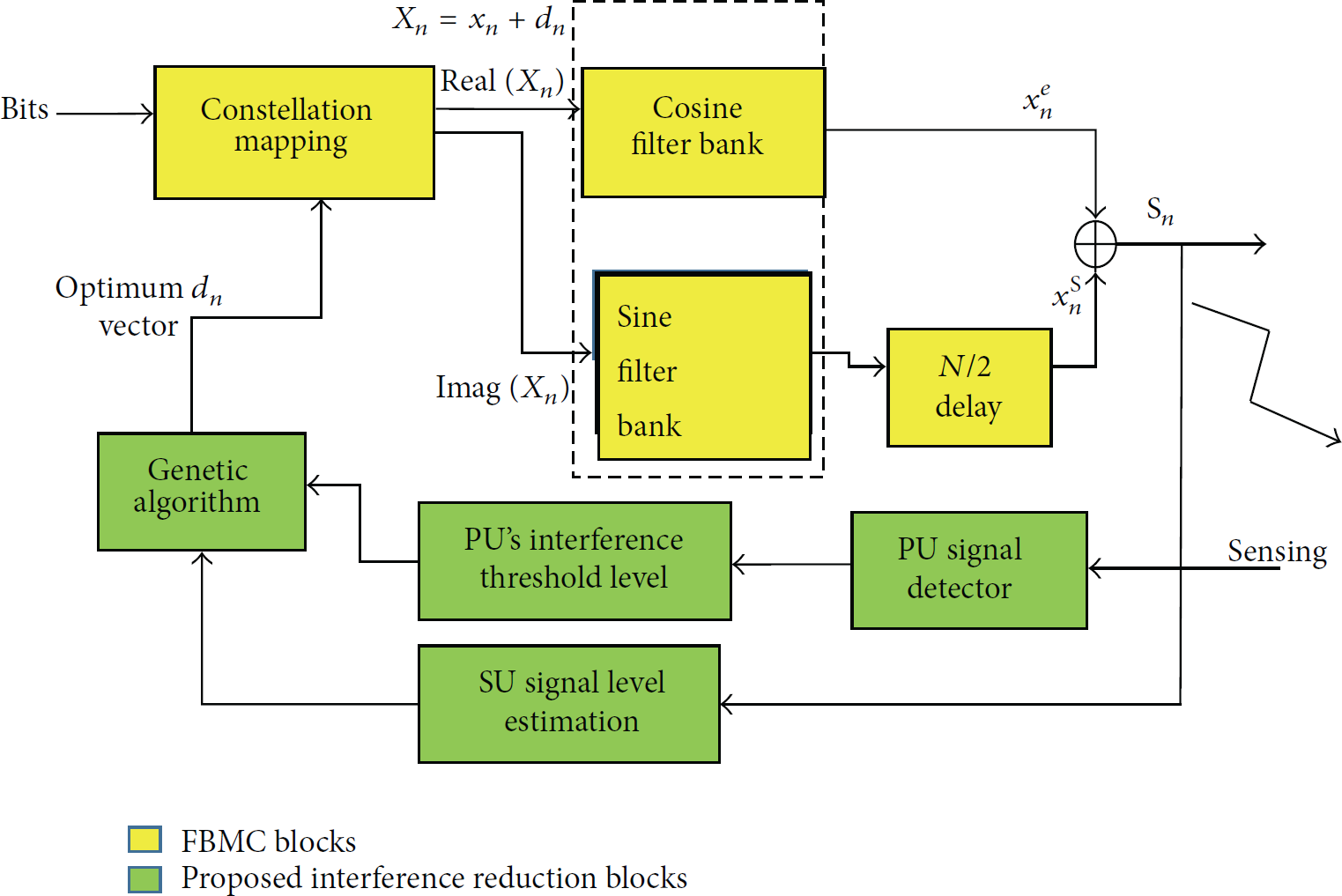
Block diagram of an implementation of the FBMC transmitter with proposed interference reduction scheme.
2.2. The Genetic Algorithm (GA) Model
GA is a type of feature selection algorithm based on the idea of natural selection and natural genetics [9]. This search is performed based on an objective function, also called a fitness function. The GA tries to generate results such that the fitness function reaches a minimum or maximum value and finds the solutions of variables for the best-possible result. Individuals or current approximations are encoded as strings (chromosomes), composed over some numbers referred to as genes, so that the genotypes (chromosome values) are uniquely mapped onto the real decision variables (phenotypic) domain. The representation used in this paper is binary numbers
The initial random population is subject to treat with crossover and mutation after being evaluated with the proposed fitness function. The evaluation of the population and the improvement of additive signal are continued until the stopping criteria are reached. The chromosome representation in our evaluation is

3. The Proposed GA-Based Interference Control Scheme
In the proposed scheme, the side lobe suppression of OFDM-based CR is achieved by adding the frequency domain value
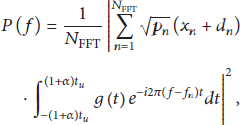
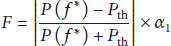
In this paper, we also propose a fitness function for the optimization of


Target frequency on primary band.
In general, the larger range diversity of

The entire procedure of the proposed GA-based interference control scheme is shown in Algorithm 1. At first, chromosomes are randomly initialized. The resultant chromosomes then transform to phenotypes (complex variables). The additive vectors are analyzed in OFDM system iteratively as illustrated in Figure 1. The GA converges to the optimum if if if
where Δ is the marginal range specified for GA to converse to the threshold and


Initialize GA parameters; (2) Initialize chromosomes; // create genotypes Convert chromosomes to phenotypes; (4) Initialize OFDM parameters (6) Generate bit stream; Modulate using 4-QAM; // (8) (10) Perform inverse fast fourier transform using newly created symbols; (12) Add cyclic prefix; (14) Compute (16) (18) (20) (22) (24) (26) Calculate the lowest (28) Calculate the best fitness value in current generation; Assign rank to individuals; (30) Select individuals on the basis of fitness; // Best individuals which flows throughout. Perform crossover; (32) Perform mutation; Reinsert the best individuals in current population; (34) Evaluate the chromosome in problem domain; // Repeat from line 8 to 27 Calculate the best fitness value in current generation; (36)

Minimizing fitness function versus
In recent 5G OFDM-based LTE (Long Term Evolution) and WiMAX (Worldwide Interoperability for Microwave Access) systems, one of the key components is the RF power amplifier. Mostly the RF amplifiers used commercially are not linear. There are several researches on the effect of nonlinear power amplifier on the spectral regrowth in wireless communication systems [19]. In general, for a closed-form expression for the autocovariance function of the PA output, its Fourier transform yields the output power spectral density function. Usual nonlinear effects on the transmitted OFDM signal are spectral spreading of the OFDM signal and warping of the signal constellation in each signal [20, 21]. We believe that our proposed scheme is generalized enough to incorporate with the nonlinear PA spectral models. The effect of nonlinear power amplifier only requires the change of the power spectral density function of (3). The implementation and analysis that consider the nonlinear power amplifier are left as a further study.
4. Simulation Results
A simple OFDM system scenario is considered. We used QAM modulation scheme applied on 128 subcarriers, whereas rectangular windowing is used.
The simulation parameters are shown in Table 1. There are 128 parameters
Simulation parameters.


Power spectral density of primary and secondary signals.
Figure 8 shows the change of fitness value as GA generations are moving on. The decreasing objective value shows the decrease of side lobe power at

GA fitness convergence versus the number of iterations at
Figure 9 shows the obtained fitness value when we vary
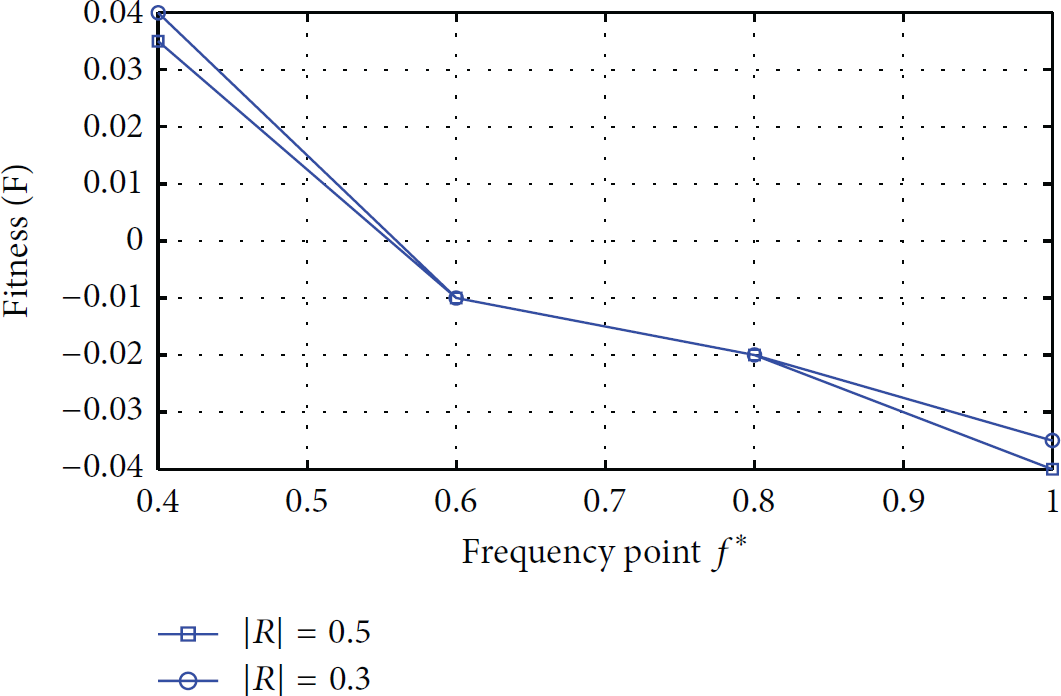
Acquired GA fitness (F) at last iteration on the respective target frequency
Figure 10 illustrates BER versus Eb/No curves of OFDM system with the effect of

BER versus Eb/No comparison of OFDM signal in Rayleigh fading with the effect of optimum
Figure 11 shows the BER values of OFDM system with the effect of acquired

BER versus
Figure 12 shows the comparison of the proposed scheme with ASM in power spectral density for the OFDM signal. The shortest primary appearance frequency point
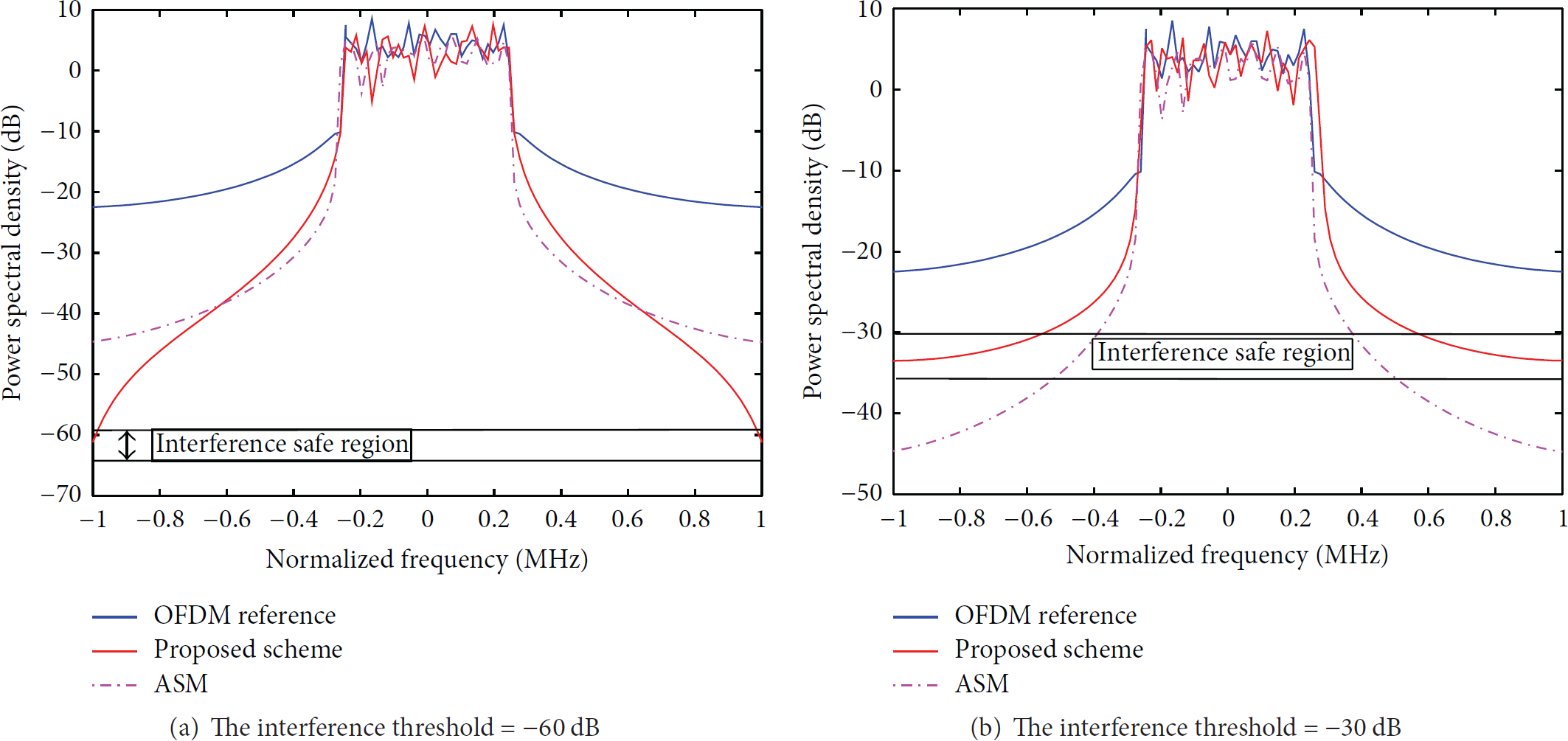
Comparison of the proposed method with ASM in power spectral density for the OFDM signal.
Figure 13 shows the BER comparison of the proposed scheme and ASM when the interference threshold is −30 dB. We can see that ASM scheme generates higher BER than that of the proposed scheme.

BER comparison of proposed scheme and ASM (the allowable interference threshold = −30 dB).
5. Conclusion
In this paper, a technique that can dynamically control interference to PUs caused by OFDM-based SUs is proposed. The method is based on a small shift of the symbol in the symbol constellation plane by the addition of an additive signal. This addition can lead to significant interference suppression of the OFDM-based SU to PUs. The interference to the primary user is avoided by the precise optimization of additive signal using GA, which helps satisfy the interference threshold defined by any licensed system. Simulation results show that our proposed scheme is effective in minimizing interference in OFDM-based CR systems. The overall achievable side lobe suppression is 38 dB. Additionally, the results show that increasing the radius of additive signal causes small loss in SNR performance but achieves better side lobe suppression. We observed that the dynamic additive signal optimization can successfully suppress the secondary system's side lobes and control the interference to the primary system under the allowable level with small loss in BER performance. The results further show that the performance of the proposed scheme is controlled as compared to non-GA ASM-based side lobe reduction scheme in terms of BER and also provides better side lobe reduction.
Footnotes
Conflict of Interests
The authors declare that there is no conflict of interests regarding the publication of this paper.
Acknowledgment
This research was supported by the MSIP (Ministry of Science, ICT and Future Planning), Korea, under the ITRC (Information Technology Research Center) support program (IITP-2015-H8501-15-1019) supervised by the IITP (Institute for Information & communications Technology Promotion).