




Abstract
Hilbert-Huang transform is widely used in signal analysis. However, due to its inadequacy in estimating both the maximum and the minimum values of the signals at both ends of the border, traditional HHT is easy to produce boundary error in empirical mode decomposition (EMD) process. To overcome this deficiency, this paper proposes an enhanced empirical mode decomposition algorithm for processing complex signal. Our work mainly focuses on two aspects. On one hand, we develop a technique to obtain the extreme points of observation interval boundary by introducing the linear extrapolation into EMD. This technique is simple but effective in suppressing the error-prone effects of decomposition. On the other hand, a novel envelope fitting method is proposed for processing complex signal, which employs a technique of nonuniform rational B-splines curve. This method can accurately measure the average value of instantaneous signal, which helps to achieve the accurate signal decomposition. Simulation experiments show that our proposed methods outperform their rivals in processing complex signals for time frequency analysis.
1. Introduction
IoT applications attract many researchers to develop techniques for time frequency analysis of signals. Smart factory is one of the typical applications based on IoT technology in industry, which is important for detecting the running states of the equipment [1]. If we can prejudge faults of equipment that have symptoms of failures, Smart factory can reduce the loss and avoid accidents [2]. The general prediction approach is to extract the vibration signals from the running equipment [3]. If the signals are complex nonstationary signals, people can make judgments through the analysis of the signals. Many researchers apply fast Fourier transform (FFT) and wavelet transform (VT) to the time frequency analysis of signals [4–8]. But FFT and VT are incompetent in processing complex signals.
In recent years, Hilbert-Huang transform (HHT) that was proposed by Norden E Huang was introduced to time frequency analysis of signals. Hilbert-Huang transform (HHT) applies empirical mode decomposition (EMD) technique to decompose the nonstationary signal into a series of intrinsic mode functions (IMFs) [9–11]. This ability makes HHT competitive in processing various composite signals [12–14]. With HHT, complex signals can be decomposed into multiple single-frequency signals that can further be processed by intrinsic mode function of EMD. After the nonstationary signals have been decomposed into IMFs through EMD, these signals can easily be obtained by Hilbert transform of each mode function. By doing so, researchers can obtain the instantaneous frequency and amplitude of each IMF. With the Hilbert spectrum and Hilbert marginal spectrum of IMFs, people can accurately get the joint distribution of energy with frequency and time and further predict whether IoT equipment is normal or not. Compared with FFT and VT, HHT is a strong adaptive time frequency analysis method.
However, there are inadequacies of traditional HHT [15]. For example, it is easy for traditional HHT to produce boundary error in EMD process because traditional HHT is not good at estimating both the maximum and the minimum value of the signals at both ends of the border. Although EMD is the most crucial process of Hilbert-Huang transform, the original EMD easily causes the end effect. On one hand, both ends of the signal data demonstrate the divergent phenomena during the EMD process. Since the first step of EMD is to seek the envelope of the analyzed signal, the upper and lower envelopes are based on the maximum and minimum of signals. The uncertainty that whether end of signal is a maximum value or minimum value will result in the distortion of the envelope and the destruction of further signal decomposition. On the other hand, negative end effect will be found at the Hilbert transform of IMF, which forms a spectral leakage that affects the data analysis.
To overcome this deficiency, this paper proposes an enhanced empirical mode decomposition algorithm of processing complex signal for IoT applications. First, we develop a technique to obtain the extreme points of observation interval boundary by introducing the linear extrapolation into EMD. We keep this technique simple but effective in suppressing the error-prone effects of decomposition. The method can determine the extreme of signal endpoint; thus, it makes the endpoint in the fitting envelope and ensures the integrity of the original data. Second, we propose a novel envelope fitting method for processing complex signal, which employs a technique of nonuniform rational B-splines curve [16–18]. This method can accurately measure the average value of instantaneous signal, which helps to realize the accurate signal decomposition. It adopts a piecewise curve fitting method to avoid fitting overshoot or fitting undershoot and thus makes the envelope smooth and can contain the entire data.
Finally, we used improved EMD to analyze the special signals, and simulation experiments show that our proposed method takes advantage over its rivals in processing complex signals for time frequency analysis.
Our work mainly focuses on two aspects. On one hand, we develop a technique to obtain the extreme points of observation interval boundary by introducing the linear extrapolation into EMD. We keep this technique simple but effective in suppressing the error-prone effects of decomposition. On the other hand, we propose a novel envelope fitting method for processing complex signal, which employs a technique of nonuniform rational B-splines curve. This method can accurately measure the average value of instantaneous signal, which helps to realize the accurate signal decomposition.
The paper is arranged as follows. Section 2 introduces traditional EMD decomposition algorithm and its inadequacies. Section 3 explains our method of inhibiting the end effect using linear extrapolation and discusses the signal envelope fitting novel method. Section 4 discusses related work in this paper. Section 5 verifies the validity of improved EMD with a simulation analysis. Section 6 concludes this paper.
2. Background and Issues
HHT is useful to analyze nonstationary signals, and EMD is the core of HHT, which directly affects the final analysis; however, there are some problems (such as end effect, envelope fitting) that need to be solved in EMD. The traditional EMD algorithm and its issues are introduced in the following.
2.1. Traditional Empirical Mode Decomposition Algorithm
The main idea of traditional empirical mode decomposition is an iterative sifting process that decomposes a given signal into a set of IMFs, and IMFs are simple oscillatory functions with varying amplitude and frequency and hence have the following properties.
Throughout the whole length of a single IMF, the number of extrema and the number of zero crossings must either be equal or differ at most by one (although these numbers could differ significantly from the original data set). At any data location, the mean value of the envelope defined by the local maxima and the envelope defined by the local minima are zero.
Given these two properties of an IMF, the sifting process for extracting an IMF from a given signal Identify all the local extrema (the combination of both maxima and minima) and connect all these local maxima ( The mean of the two envelopes is subtracted from the data to get their difference:
Let

The residue
At the end of this process, the signal
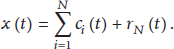
In formula (2), N is the number of IMFs,
(1) [ (2) (3) for (m = 1 : (4) { (5) (6) for (s = 1 : NS) (7) { % sifting iteration: (8) [ (9) (10) (11) (12) } (13) (14) (15) }
By the sifting process, the data are represented by intrinsic mode functions, to which the Hilbert transform can be applied. The Hilbert spectrum enables us to represent the amplitude and the instantaneous frequency as functions of time in a three-dimensional plot. The resulting time frequency distribution of the amplitude is called the Hilbert amplitude spectrum. The two-step procedure, EMD and its subsequent Hilbert spectral analysis, is called the Hilbert-Huang transform (HHT). The HHT method provides not only a more precise definition of particular events in time frequency space than wavelet analysis, but also more physically meaningful interpretations of the underlying dynamic processes.
2.2. The Issues of Traditional Empirical Mode Decomposition Algorithm
The traditional EMD algorithm can decompose complex signal into a series of IMFs, but it has the following issues.
First, traditional EMD will cause end effects for both sides of endpoints are not processed. On one hand, both ends of the data will show the divergent phenomena with the EMD process. The first step of EMD is to obtain the upper and lower envelope of the analyzed signal through the signal extrema. The signal end cannot be determined to be a maximum or a minimum, and it makes the envelope distorted and affects the EMD decomposition. For example, once the first decomposed component is fault, the latter decomposition will show the same results distortion. Thus, the obtained IMFs are false. On the other hand, serious end effect will appear in the Hilbert transform of IMF which will form a spectral leakage that affects the data analysis. To enable the Hilbert spectrum to reflect the characteristics of the original signals, we must solve this problem effectively.
Second, the cubic spline fitting in traditional EMD algorithm will cause the overshoot and undershoot phenomena; that is, the envelope is not complete, and this will lead to the decomposed IMFs which are not true.
3. Improved Empirical Mode Decomposition Algorithm
When HHT is used to analyse the signals, there will exist end effects and incomplete fitting envelope, which can affect the accuracy of analysis results. To overcome this deficiency, we must find a way to suppress the end effect and find a new envelope fitting method.
3.1. A Method of Inhibiting the End Effect
For a relatively long data sequence analysis, we can consider the distribution of the extreme points of the ends and discard some data that guarantee that both ends of the extreme value point are extreme value point of original data, thereby minimizing the distortion of signal envelope. However, such operations for the short data sequence analysis are not feasible.
Considering the system's real-time demand in actual applications, in order to solve the end effect and achieve a real and effective decomposition, this paper presents a novel linear extrapolation to determine the end extreme so as to make the fitting envelope contain the given data set.
This novel algorithm, which is used to determine the extreme of endpoint, is not necessary to predict and extend data and is judged based on the original data trends. The method is described as follows.
Based on the endpoint development trend, the method determines the end extreme, followed by a fitting operation on the upper and lower envelope of the data set. Signal envelope is made according to the extreme of the signals, but sometimes the signal endpoints cannot be determined to find maximums or minimums or are not extreme. In order to make the envelope as complete as possible to contain the entire signal data, we must make a deal with the endpoint of the signal.
The method which treated endpoint maxima is schematically illustrated in Figures 1 and 2. Two maxima, A and B, are closest to an end. A straight line AB is linearly extended to the end to find point C. If point C is smaller than the endpoint value E of the signal, the point E is considered as a new maximum for the upper envelope fitting (Figure 1(a)). Otherwise, if C is larger than the endpoint value E, point E is considered as a new maximum for the upper envelope fitting (Figure 1(b)).

Maximum of endpoint.

Minimum of endpoint.
The endpoint for the lower envelope fitting will be determined in the same way. There are two minima,
To determine the extreme endpoints, linear extrapolation is adopted in the novel method that does not need to predict and extend data. Based on the developing trend of the endpoint, the algorithm is straightforward and easy to be implemented.
3.2. A New Method of NURBS Envelope Fitting in EMD
The original EMD algorithm proposed by Huang used cubic spline function to fit upper and lower envelope of the signal and then calculated the mean of the fitted upper and lower envelope. Because the power is low and easy to calculate, cubic spline curve fitting is simpler than others; however, the cubic spline fitting will cause the overshoot and undershoot phenomena, so that the envelope fitting deviates from the actual signal envelope; that is, the envelope is not complete. In order to solve the overshoot and undershoot problem of cubic spline curve fitting, a lot of researchers proposed improvement method, such as high order spline function method, polynomial fitting, and piecewise power function interpolation method. These methods can solve the problem of the fitting overshoot or fitting undershoot based on their own characteristics.
In this paper, a nonuniform rational B-spline fitting method is used to fit the upper and lower envelope of signal, resulting in the mean envelope. We use the accumulative chord length parameterized algorithm, which is relatively simple, to achieve BNURBS curve fitting. The same simulation signal, for example, uses nonuniform rational B-spline (NURBS) curve fitting envelope compared with fitting envelope by cubic spline function.
As shown in Figure 3(a), we get the upper and lower envelope of original signal using cubic spline fitting (the dots are the upper envelop; dash-dotted line represents the lower envelope). As shown in the figure, envelope undershoot is very obvious, and the envelope of the signal is not complete. As shown in Figure 3(b), the envelopes are obtained by NURBS, and the envelope is fitted completely and there is no overshoot or undershoot phenomena.

Comparison of fitting envelope.
By the above comparison, we find that NURBS curve fitting can solve overshoot or undershoot caused by cubic spline fitting, so that the fitting effect is better.
4. Related Works
The traditional EMD algorithm has the problem of end effect and incomplete envelope fitting; in order to reduce or eliminate the end effect, many researchers have put forward a variety of methods, and the signal extension technology is the most commonly used one. Huang proposed adding characteristic wave to the two endpoints of the signal to suppress the end effect [19], but he did not give a specific approach; Yongjun et al. use neural network extrapolation algorithms to solve the endpoint problem [20]; Zhao put forward the mirror extension algorithm processing endpoint [21]. These methods have achieved some positive results in the inhibition of end effect. However, all methods are based on the hypothesis that signals are smooth and linear. Actually, most of the signals are nonstationary and nonlinear. In addition, the essence of all the continuation methods is data prediction. The existing methods are very difficult to predict the signal even for linear and stationary process. Linear extrapolation is adopted in the paper that does not need to predict and extend data. Based on the developing trend of the endpoint, the algorithm is straightforward and easy to be implemented.
Aiming at the problem of incomplete envelope fitting, researchers proposed improvement method. Literature [22] proposed piecewise power function interpolation fitting method; high order spline function was adopted to improve the precision of envelope fitting [23]. These methods can solve the problem of the fitting overshoot or fitting undershoot based on their own characteristics, but these algorithms are relatively complex. NURBS curve fitting can solve overshoot or undershoot and fitting curve has very good smoothness [24–28].
5. Simulation Analysis of Improved EMD
To verify the effectiveness of the improved EMD algorithm proposed in this paper, several special signals, such as mutation frequency signal and nonlinear attenuation signal, are decomposed by this algorithm, respectively. Then we can get the Hilbert spectrum from decomposition result and compare with the Hilbert spectrum obtained from the original EMD decomposition results.
5.1. Simulation Analysis of Mutation Frequency Signal
The inputting signal is a sinusoidal wave with a varying frequency over time. In detail, frequency will increase from 2 Hz to 5 Hz at the end of the first second. At the end of the 2nd second, it changes to 10 Hz, and 20 Hz at the end of the 3rd second. The time domain waveform as shown in Figure 4.

Time domain waveform of mutation frequency signal.
The above signal is decomposed, respectively, by using the EMD algorithm and the improved EMD algorithm, and the sampling frequency is

Decomposition results of signal.
With the decomposition results, it is obvious that the EMD algorithm does not separate out several frequencies from the original signal. The first decomposed component IMF1 contains basically all the frequency components. The improved EMD algorithm can decompose the signal completely into four different frequency components, and there is no mode mixing. Through the Hilbert transform, the Hilbert spectrums of IMFs are obtained as shown in Figure 6.

Hilbert spectrum of IMFs.
As shown in the Figure 6(a), frequency mutation point shows end effect obviously, which is Hilbert spectrum obtained from original EMD algorithm. From Figure 6(b), it can be seen that the Hilbert spectrum of IMFs which decomposed by improved EMD algorithm is more clear than that of the traditional EMD and end effect has basically been suppressed.
5.2. Simulation Analysis of Nonlinear Attenuation Signal
Nonlinear attenuation signal is as follows:

The signal frequency is 25 Hz, its amplitude decays with time, and the time domain waveform is as shown in Figure 7.
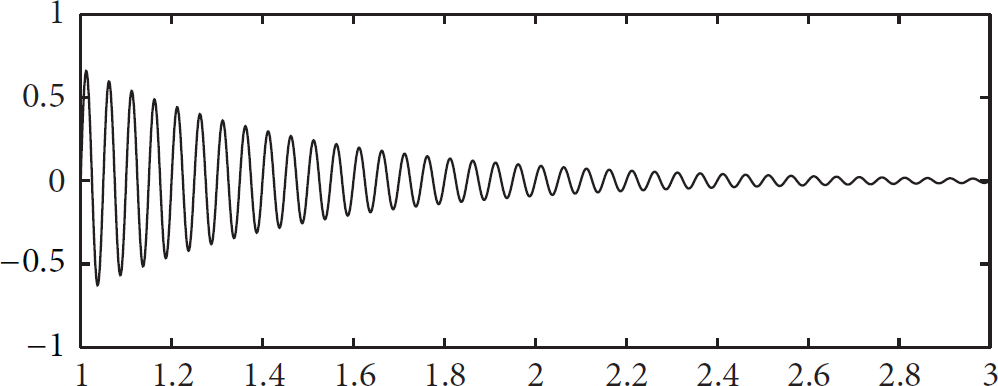
Time domain waveform of nonlinear attenuation signal.
We can, respectively, get the Hilbert spectrum which is decomposed by using the EMD algorithm and the improved EMD algorithm, as shown in Figure 8. We can see that the Hilbert spectrum of the traditional EMD algorithm has obvious end effect, while its end effect has been well suppressed by improved EMD algorithm.
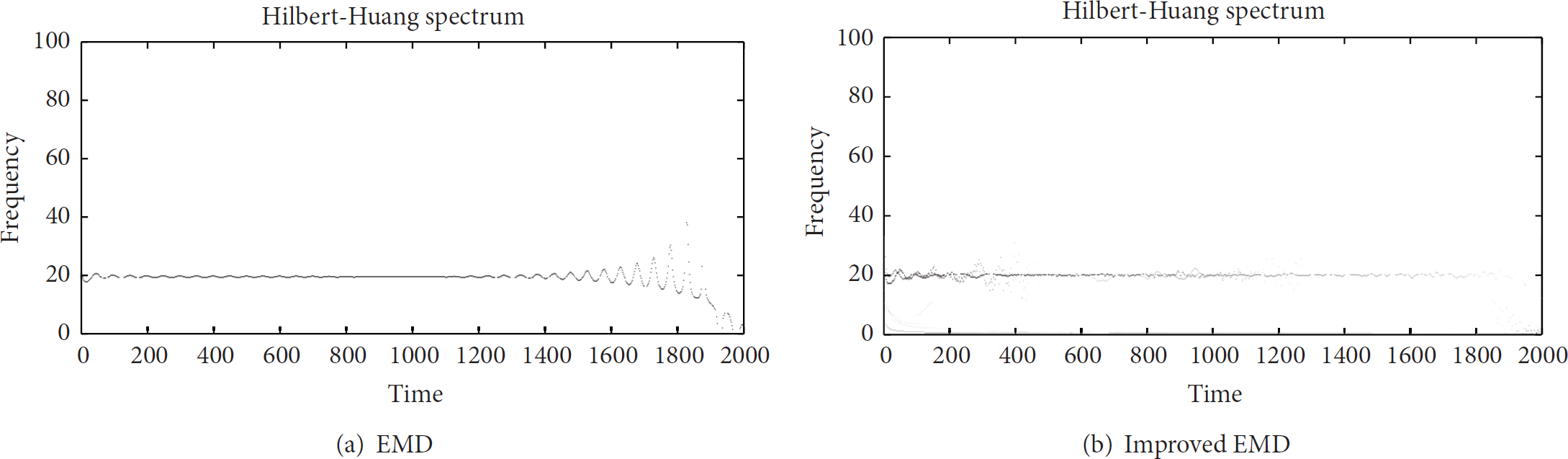
Hilbert spectrum of IMFs.
Above simulation analysis shows that the improved EMD algorithm has certain effect to restrain end effect.
6. Conclusions
As a method of analyzing nonstationary signal, HHT is widely applied in running states detection of factory equipment, the core of which is the EMD algorithm. Since the end of the intercept signal is not processed, end effect exists in the process of traditional EMD. In addition, the traditional EMD algorithm uses cubic spline curve fitting the envelope of the signal. It does not completely fit the envelope, which seriously affects the accuracy of analysis results. In order to address the problems in the original EMD, this paper proposes an improved EMD algorithm where the linear extrapolation method is used to handle signal endpoint extreme so as to obtain the observation interval boundary extreme. This method is simple and can effectively restrain end effect. Moreover, a new method based on NURBS is adopted to fit signal envelope. It can get more accurate instantaneous average value, thereby inhibiting meaningless signal fluctuation and avoiding fitting overshoot, undershoot, incomplete envelope, and so on. Through the simulation signal analysis, we find that the improved EMD algorithm fits the signal envelope more completely and inhibits the end effect to a certain extent. The experimental results demonstrate the effectiveness of the improved EMD algorithm.
Footnotes
Conflict of Interests
The authors declare that there is no conflict of interests regarding the publication of this paper.