




Abstract
We address the problem of authentication and secure communication between wearable devices. As people rely heavily on such mobile and wearable devices, the need for seamless and secure communication across these spectra of devices becomes increasingly important. In order to provide secure communication, mutually trusted authentication becomes the first line of protection to guard our personal information. We propose an acoustic-based signcryption mutual authentication (ASMA), which is a key-agreement protocol by employing timestamp and owning functions of multiple-times identity authentication, password change, and devices addition and alteration. Through series of experiments verifying the reliability and accuracy, the protocol shows that it can ensure secure data transmission and data sharing for multiwearable devices.
1. Introduction
With the popularization of Wi-Fi and Internet connection, multiwearable devices and other intelligent terminals are wildly used in our daily life as a part of the Internet of Things (IoT) [1]. Glasses and wrist watches are no longer simply what they used to be. They are now more intelligent and are able to track your eyeball, identify your voice, and even record your heart rate and breathing rate. These devices become someone who knows you best.
As digital device usage becomes more widespread in various domains [2], such as education, management information systems, and healthcare [3, 4], Internet security is becoming an increasingly important issue. Any unreliable connections can cause the leaking of important personal information stored in digital devices. But what can be done to handle this problem? The answer is authentication.
What is authentication? Authentication is the process of determining whether someone or something is. In fact, who or what it is declared to be. In traditional authentication, the identity usually belongs to a person, but, in digital authentication, it belongs to a device, which is the main difference between the traditional and the digital ones. In private and public computer networks (including the Internet), it is hard for our machines to tell whether the physical identity corresponds to the digital one. For this reason, a stringent authentication process is needed. The purpose is to provide secure communication between the desired devices. It also helps to break the barriers that a mobile could only communicate with the wearable devices of the same company.
This paper aims to propose an acoustic-based signcryption mutual authentication (ASMA) scheme for wearable devices and movable terminals. Figure 1 shows the authentication scheme. It is about a key agreement protocol by employing timestamp and signcryption which owns functions of multiple-times identity authentication, password change, and devices addition and alteration. The scheme belongs to noncontact biometrics authentication which is different from 2D barcodes-based [5] and some other visual-channel-based [6] authentication. Meanwhile, as a wireless communication technology with short range and low power consumption, it is also different from Bluetooth or NFC (near-field communication) [7] technology which requires users to spend extra cost on inbuilt NFC chip or external NFC tags. With the support of cell phone, earphone, and other cheap wearable devices, the protocol can effectively resist the MITM (man-in-the-middle) attack [8], replay attack [9], and nonsynchronous attack [10].

Acoustic-based mutual signcryption authentication for multiwearable devices.
Apart from the ASMA scheme for wearable devices and movable devices, an agreed-upon shared key is generated which can be applied in the mass data transferring like long strings, text files, and video streams. With the help of shared key, we can achieve data delivering via Bluetooth address and data sharing among the wearable devices and moveable devices in a secure condition.
The main contributions of this paper are summarized as follows.
This paper proposes an ASMA scheme, supporting authentication and secure communication between multiple wearable devices. In this scheme, an agreed-upon key agreement protocol is created by signcryption, employing timestamp for mutual authentication and data transmission. This paper further presents the architecture, design, and security analysis of ASMA. It shows that ASMA will automatically complete certification in less than 10 seconds, significantly reduce cost, and increase efficiency. The proposal is also achieved and verified in practice and a positive feedback is received. People could make the mutual authentication and transmit data about their health, bodily functions, text messages, schedules, and videos between their multiwearable devices.
The rest of this paper is organized as follows. The related works are given in Section 2. System design and problem statement are given in Section 3. The authentication protocol is described in Section 4. Security analysis is performed in Section 5. The implementation is demonstrated in Section 6. Finally, the conclusions are presented in Section 7.
2. Related Works
How to authenticate devices’ identities is a long time issue. Two main problems should be solved to make two mutually distrusted devices establish key agreement to achieve identity authentication and provide secure communication.
What kind of contact channel can transmit authentication information? Which method or protocol can ensure the security of contact channel?
2.1. Contact Channel
To solve the first problem, Stajano and Anderson introduced a “resurrecting duckling” model [11]. They use secret data exchanged over a contact channel (usually a physical contact) to bootstrap a particular authentication and key exchange protocol. Such an exchange directly captures the user's intention that the user wants to communicate with that device. To some extent, QR (quick response) code, which is widely used currently, is based on this model. QR code is a readable bar code which uses black and white rectangular patterns to signify binary data. They can be preconfigured and printed on labels that are attached to devices, or they can be generated on demand and shown on a screen. A device with Internet access and cameras can complete the whole authentication steps. However, its disadvantage is that a user must visually identify the desired device. And it also brings problems when users read the wrong QR code or in the areas without network signal.
Compared with QR code, NFC [12] and the Bluetooth have some advantages. NFC has characteristics of high reliability and its authentication method is very simple, which is evolved from RFID (radio-frequency identification) [13]. NFC is suitable to exchange important data such as financial information and personal information, while the Bluetooth is more suitable for a longer distance data communication. Hence NFC and the Bluetooth can complement each other. However, these two techniques have a disadvantage: they are dependent on inbuilt chips.
As mentioned above, we adopt acoustic wave contact channel to make identity authentication, which can avoid both component redundancy and dependence on Internet access.
2.2. Protocol
The second problem is mainly solved by encryption systems and digital-signature techniques.
In encryption systems, public-key cryptography (PKC) is a significant technique to ensure the security of network and information. Traditional PKC requires certification authority (CA) to issue certificate to bind users’ identity and public key, which brings about problem with certificate management. However, it is solved by Shamir's public-key scheme based on identity [14], which was introduced in 1984. This scheme set users’ identity such as name, student number, and ID number as the public key. However, it needs an authentic private-key generation center (KGC), which brings about problem with private-key escrow. To solve the problems of certificate management and private-key escrow, Al-Riyami, and so forth, first put forward certificateless public-key cryptography scheme [15], which can make users’ public key authenticated without certificate and only make a part of users’ private key known to KGC.
As to digital-signature techniques, Diffie and Hellman initially proposed the digital-signature method [16] in 1976. Then other scholars have developed the well-known methods such as RSA, ElGamal, and DSS. To meet the demand, more digital signatures are developed, such as group signatures, ring signatures, proxy signatures, threshold signatures, and signcryption [17–20].
In practical application, users often need to implement signature and encryption at the same time. To achieve this purpose, firstly we sign the information and then encrypt the signature. In 1998, Zheng and Imai [21] introduced a new password scheme, signcryption, which combines digital-signature and public-key encryption into one process. It led to a new signcryption scheme based on identity which has been further developed by the later scholars [22–26]. Barbosa and Farshim [27] first initially proposed the signcryption concept based on certificateless public-key cryptography. In recent years, some improved certificateless digital signcryption schemes have been put forward.
Along with the development of signcryption theory, signcryption is extensively adopted to achieve security efficiently in areas such as e-payment, ad hoc network, ATM network, and VoIP network. As a result, key-agreement protocol on the basis of signcryption technology was instantly introduced. Based on the point of Kim and Youm onwards, we have achieved the key-agreement protocol [28] on the basis of timestamp and signcryption technologies to guarantee the trusted authentication and security between devices.
Apart from that, our scheme requires wearable devices and mobile devices to authenticate at the beginning and end of data transmission, respectively, to ensure its security. When false identity is detected, the system will destroy the data ciphertext immediately. Additionally, the scheme also provides the mechanisms for password change and multiple devices addition as well as their alteration, which increases convenience.
3. System Design and Problem Statement
In this paper, we consider the problem of authentication between mutually distrusted devices. We assume that there is a many-to-many relationship among US (user), MT (mobile terminal), and WD (wearable device), and their pairings are random. That is, one MT or WD can be paired with several mutually trusted MTs or WDs at the same time. Many MTs and WDs can be found around US when we use them, which could lead to their mutual distrust and cause confusion. In this environment, the identity and trust authentication as well as data transmission between MT and WD can be realized via the key agreement.
Usually, an authentication process has three entities: MT, WD (it can also be replaced by other devices such as sensors and actuators), and US (with the ownership of MT and WD). We also assume that both MT and WD, equipped with Bluetooth, acoustic wave transmitter, and absorber, can process encryption/decryption algorithms.
The first subproblem of this paper is to choose a contact channel, which should be costless and convenient.
The second subproblem of this paper is to find a protocol to adapt to the channel we choose, which will complete the authentication part and generate an agreed-upon shared key for the following data transmission.
Based on these two problems, we propose a new acoustic-based authentication, which consists of three parts: authentication protocol, data transmission, and additional function.
4. Proposed Protocol
We have started the research project to create an innovative ASMA system according to the two key problems. This section provides detail of system functions, design, and architectures.
Our system consists of three parts: authentication protocol, data transmission, and additional function. In the protocol, we will use acoustic channel to obtain session key, which is of great importance in the following data transmission. The additional function contains device addition, device alteration, and change of password. For a better understanding, Figure 2 displays an overview of this scheme.

Mutual authentication infrastructure.
The authentication protocol is presented in Figure 2.
4.1. Definitions
Here are the definitions of symbols used in our protocol shown in definitions of symbols used in our protocol section.
4.2. Authentication Protocol
Step 1.
Setup
Enc is a deterministic encryption algorithm, which takes data m of any length and a shared key K of some predetermined length as input and outputs an encryption Dec is a deterministic decryption algorithm, which takes a ciphertext C of any length and a shared key K of some predetermined length as input and outputs either data US sets the Compute: MT and WD generate key If MT and WD are pairing for the first time, the device must be initialized at first. After the mutual authentication, US, MT, and WD are mutually trusted devices. MT and WD can transmit data under the successful connection and authentication. Once the connection is interrupted or abnormal, go to Step 3.
Step 2.
Communication Preparation
Because the factory settings of CB in MT and WD are the same, MT encrypts the CB in MT and WD compute When MT makes a request to WD for connection and authentication, WD sent MT sent For multiple pairs of trust devices, different pairs generate different SB, which is the foundation of mutual authentication communication. When US wants to use MT or WD, For a better understanding, the workflow of encoding and decoding is shown in Figure 3.

Encoding and decoding for acoustic waves.
Step 3.
Mutual Authentication
MT and WD are mutually trusted devices which own timestamp-based key-agreement protocol that can generate the shared key The scheme of MT is as follows.
Choose a 32-bit element k randomly, Compute
MT transmits the data
WD verifies the identity of MT and computes the shared key
If Otherwise, compute Otherwise, compute Otherwise, randomly choose a 32-bit element Get a timestamp Compute
WD returns data
MT verifies the identity of WD and computes the shared key
If Otherwise, compute Otherwise, compute Otherwise, compute Otherwise, compute MT and WD are successfully verified. They become mutually trusted devices and transmit data by agreed-upon shared session key
4.3. Data Transmission
MT and WD are mutually trusted devices. MT transmits data m, which should be signcrypted by keys with a sign, to WD via the Bluetooth. After receiving the data, MT and WD will hold a mutual authentication again. Upon successful authentication, data will be decrypted to ensure that it is sent to the trusted receiver. Otherwise, the data will be self-destructed and a “reject” acoustic wave will be sent to the receiver. Then the session will be ended and the linkage between them will be interrupted.
MT gets the Bluetooth address of WD.
WD computes After reviving γ, MT computes MT signcrypts and transmits the data.
If Signcrypt the data via shared key to produce signcrypted ciphertext: Send WD unsigncrypts the data.
When receiving ciphertext Compute If there is a mismatch between Otherwise, if Otherwise, compute Display the computing results in terms of the data type (characters, string, picture, video, etc.) of m. Return m to MT via the Bluetooth and finish the session. If more data should be transmitted, perform the data transmission part again. Perform until data transmission completes.
(4) Complete data transmission.
4.4. Devices Addition or Alteration
Both MT and WD are supported by multi-USs as people tend to possess more than one of them in modern society. In other words, one MT or WD might simultaneously match with other trusted MTs or WDs. For instance, when Initialization: US should store an eight-digit initial password Key generation: Generation of acoustic wave database: perform Step 2 to produce Device mutual authentication: perform Step 3 to authenticate that Data transmission test: perform the data transmission part. Transmit test data between Complete the
4.5. Change Password
Change the password of MT.
US changes the password of MT as follows.
Otherwise, if US inputs wrong initial password more than many times (US can set) in valid time, output “Password rejects change,” delete Otherwise, change the password successfully and the new password is MT regenerates its key MT regenerates its Device mutual authentication: perform Step 3: the device authentication of MT and WD. Then generate the shared key Data transmission test: perform the data transmission part. Transmit test data between MT and WD via the shared key MT password is successfully changed. Change the password of WD.
US needs to change the password of WD in the procedure as follows.
Otherwise, if US inputs wrong initial password three times in valid time, output “Password rejects change” and end the current session and delete Otherwise, perform Step 3; if MT and WD are not successfully mutually authenticated, output “Password rejects change.” Otherwise, change the password successfully and the new password is WD regenerates its key WD regenerates its Device mutual authentication: perform Step 3: the device authentication of MT and WD. Then generate the shared key Data transmission test: perform the data transmission part. Transmit test data between WD and MT via the shared key WD's password is successfully changed.
5. Security Analysis
The security of our system is mainly to ensure the authentication and communication between our devices. It contains the integrity, confidentiality, and effectiveness of data we transmit through acoustic waves. Besides, it also needs to prevent the acoustic channel from recording, replaying, and interfering so as to avoid illegal access to data. So, in this section, we will analyze the security of our scheme. Firstly, the security mechanism in mutual authentication and key-agreement protocol will be introduced. Secondly, we will verify that our scheme is immune to the replay attack. At last, we also demonstrate the resistance to man-in-the-middle attack, which is mostly concerned by consumers. Through these arguments, it is easy to conclude that this scheme has a good security.
5.1. Mutual Authentication
In this system, the relationship between US and MT, WD is pairwise and mutually trusted. In this way, a mutual authentication can be implemented among devices. In the process of mutual authentication between MT and WD, the acoustic waves they use are those with sole device identifier and key encryption. (Taking MT as an example,
During the mutual authentication and data transmission, the system firstly judges whether the transmitting acoustic waves between the two devices belong to SB or not; if not, the system would terminate the session immediately, and then ensure each other's identity to make sure it is trusted.
5.2. Key-Agreement Protocol
MT and WD have established a timestamp-based key-agreement protocol. After the authentication, the shared key
5.3. Replay Attack Resistance
(1) Suppose that an attacker attempts to replay the acoustic wave used in the process of the device authentication and data transmission; this would cause interferences such as multiple acoustic sources, unidentified acoustic source, and inappropriate wavelength. Once the interferences are detected, exceptions would occur in the system and the current session ⊥ would be terminated immediately. So the attacker in this scheme would fail to get the relevant information by replaying any acoustic wave.
(2) Suppose that an attacker attempts to intercept the transmitting ciphertext
(3) In each connection between MT and WD, the system would choose random
5.4. Man-in-the-Middle Attack Resistance
(1) Suppose that the attacker gains
(2) Suppose that, in the process of the mutual authentication between MT and WD, attackers record the data
Suppose that the attackers record data
(3) Suppose that, in the data transmission between MT and WD, attackers get γ, which is transmitted by WD to MT. However, the Bluetooth device address cannot be obtained because γ is encrypted. Thus the attack cannot be implemented. Therefore, this scheme is secure and reliable because it can resist the man-in-the-middle attack.
6. Implementation
6.1. Experiment Environment
Openness is the characteristic of Android system, which is the mainstream OS for intelligent mobile. So we choose it as the main experiment OS. To test the stability, we use various devices with different versions of Android. Other details of our experiment environment are shown in Table 1.
Experiment environment.

6.2. Experimental Process
We develop an app to implement our scheme, which is called “VoiceBluetooth.” It has 6 modules: “Bluetooth open,” “Bluetooth close,” “Enable search,” “Traditional search,” “VoiceBluetooth Client,” and “VoiceBluetooth Server.”
“Bluetooth open” and “Bluetooth close” are for data transmission and data sharing between multiwearable devices after mutual authentication. “Enable search” allows multiple devices to search for a connection and connect. “Traditional search” is for Bluetooth search, authentication, and connection. “VoiceBluetooth Server” and “VoiceBluetooth Client” are flexible for devices to select as a role to connect to one another, enabling sharing of data between any two devices.
The app should be running on both MT and WD. One is acting as a server; the other is a client.
In the authentication process, MT will use the app to emit authentication acoustic wave, while WD will receive it. Data can only be transmitted when the devices are authenticated as trusted devices by each other. Mutual authentication and data sharing process workflow are shown in Figures 4, 5, 6, 7, 8, 9, and 10.

The first step of experimental process. (a) First MT screen; (b) first WD screen.

The second step of experimental process. (a) MT computes

The third step of experimental process. (a) MT gets
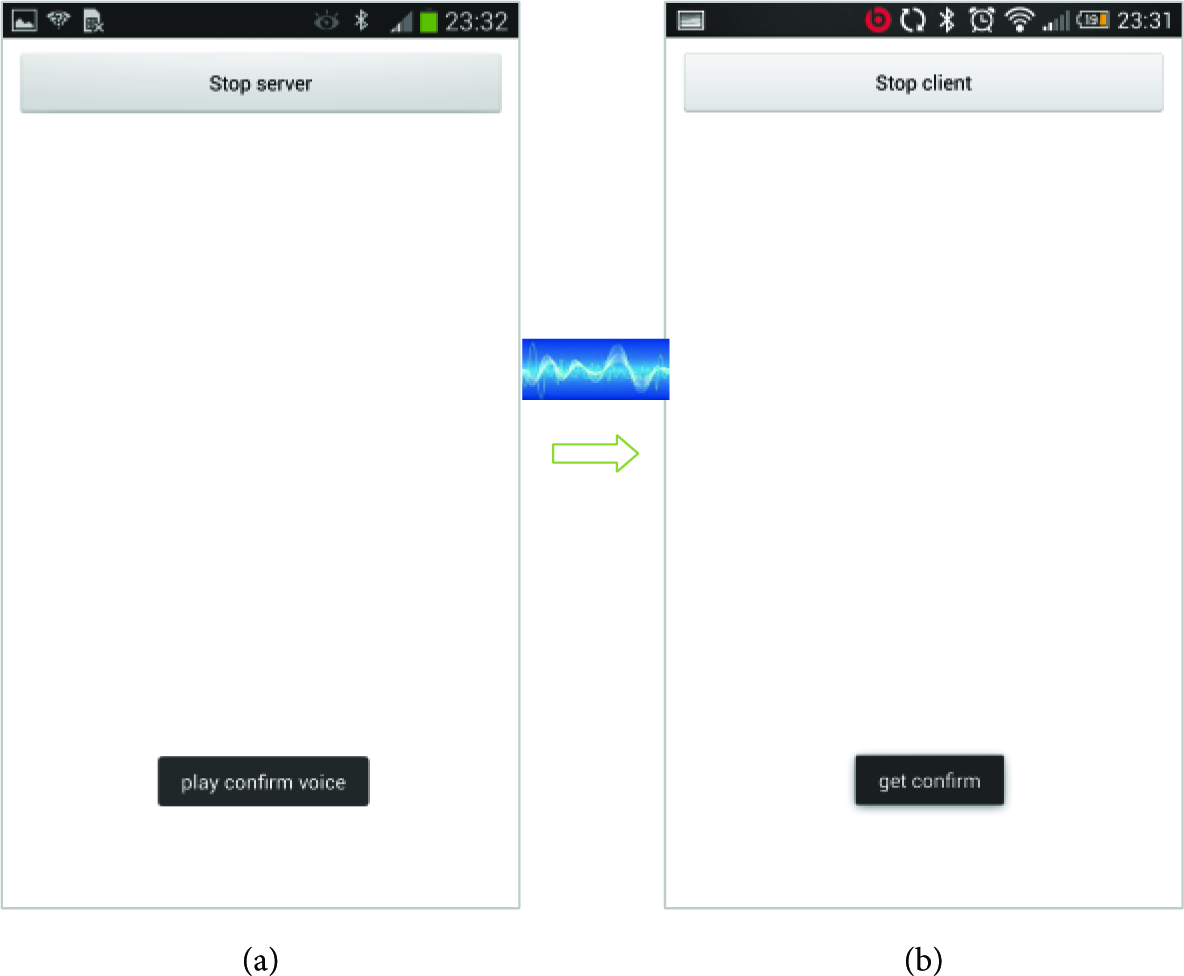
The fourth step of experimental process. (a) MT verifies the identity of WD, computes

The fifth step of experimental process. (a) Transmit the Bluetooth address, (b) WD gets the Bluetooth address of MT.
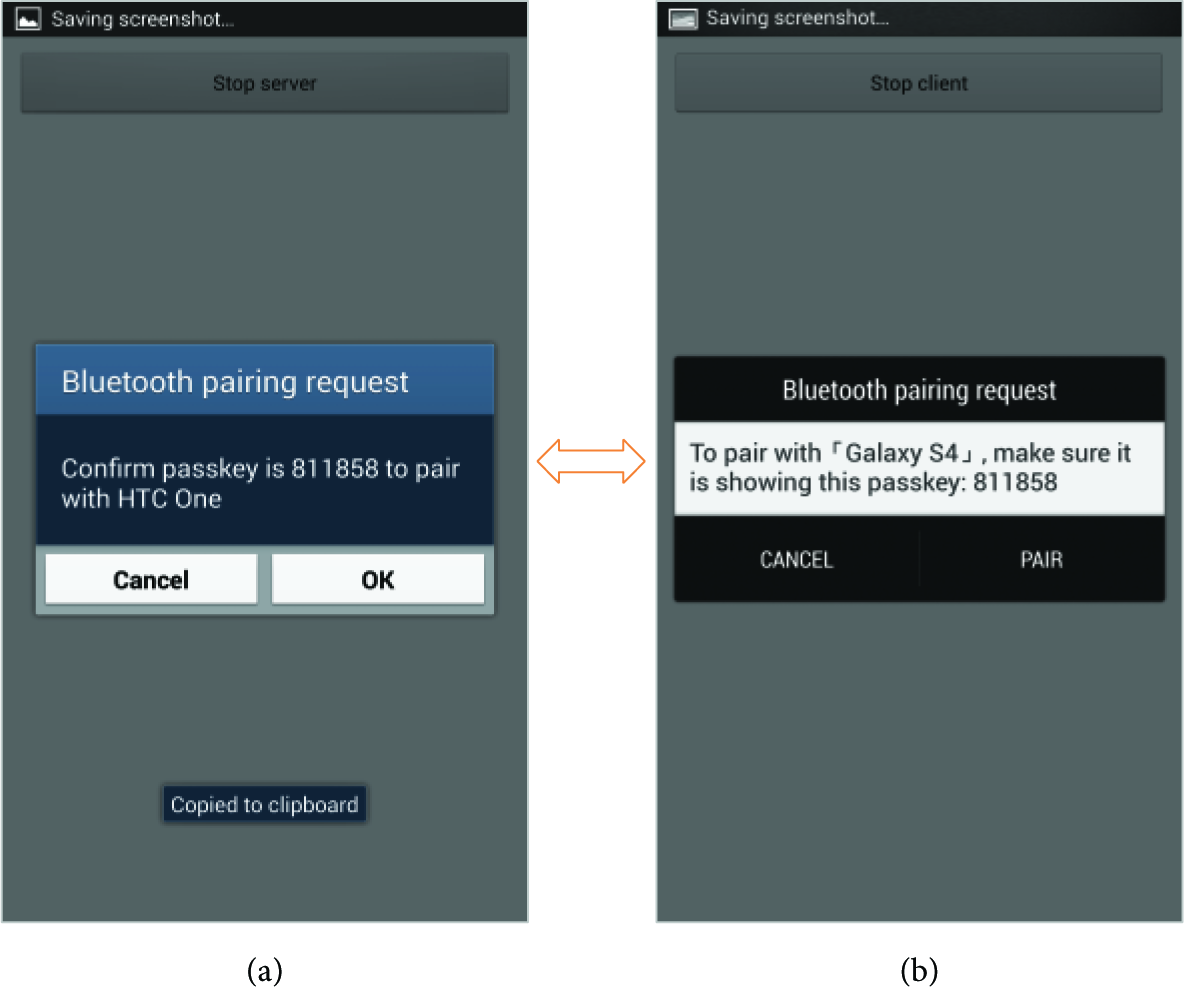
The sixth step of experimental process. (a) Bluetooth pairing; (b) Bluetooth pairing.

The seventh step of experimental process. (a) MT signcrypts and transmits the data; (b) WD unsigncrypts the data and completes data transmission.
In the experiment, by changing the conditions from a relative quiet environment to a noisier one, we repeatedly tested the device authentication and data transmission, probing into MT and WD's encryption towards
6.3. Experimental Data and Conclusion
In a not absolutely quiet environment where the experiment is conducted, mobile phones and wearable device can identify each other in a distance less than 20 cm well, while, in a distance beyond 20 cm, the recognition rate is slightly lower. This distance rightly matches the secure distance of a person who has multiple mobile phones and wearable devices. Within the distance, people can make the mutual authentication and data sharing possible between their devices. For example, people can transmit data about their health and bodily functions saved in the wearable devices to mobile phones and then to computers or the Internet. Likewise, data such as text messages, schedules, and videos can also be transmitted to the wearable devices, which is convenient for reminding and reading.
In order to let people have a better acoustic experience and know that their devices are communicating with each other, the range of frequency of acoustic wave used in our experiment is mainly from 588 Hz to 4419 Hz. They are called coloring ring back tone (CRBT) [29]. According to the recognition rate in our experiment, using acoustic waves of too high or too low frequency is temporally not recommended. The highest frequency of the acoustic waves used in this experiment is 15 KHZ, which is beyond the identification of experimenters’ hearing. However, that still can be authenticated by experimental devices, though the authentication rate is slightly reduced. If the frequency is increased to 20 KHz or more, we can realize the ultrasonic wave transmission. Ultrasonic propagation is not affected by environmental noise interference; it is more stable, directionally stronger, and easier to concentrate, and it can shorten the time for certification. Because the human ear cannot hear ultrasonic, it is more concealed and could spread farther, so the authentication will be better and achieve the desired distance. Based on this, a conclusion can be made that if ultrasonic wave transmission is used, the hardware of devices such as loudspeakers and microphones should be equally matched.
In the experiment, the increase of volume can lower the influence of noise from external environment within a certain range and improve the authentication rate.
The range of per unit play time of the frequency corresponding to each acoustic wave is from 30 ms to 150 ms. When the play time is 100 ms, the time used in transmitting an IMEI code with 15 bits via acoustic wave is less than two seconds, and a mutual authentication time is about 10 seconds, processed automatically, so the recognition rate is high. When the play time is at the shortest 30 ms, the recognition rate is a little bit lower. But if the distance between experimental devices is cut short, it can still remain a good recognition rate.
After experimental devices are mutually authenticated through acoustic waves, data transmission, password updating, and adding and changing
In the experiment, after MT and WD are mutually authenticated,
This scheme makes it possible that mutually trusted authentication can be realized via acoustic waves and that data can be transmitted through Bluetooth among multiple wearable devices. The scheme can also protect private data, making sure they can be shared.
6.4. Characteristic Analysis
We would like to attain the following characteristic analysis in Table 2. It is obvious in Table 2 above that the time complexity of our algorithm in the process belongs to
Performance of computations.
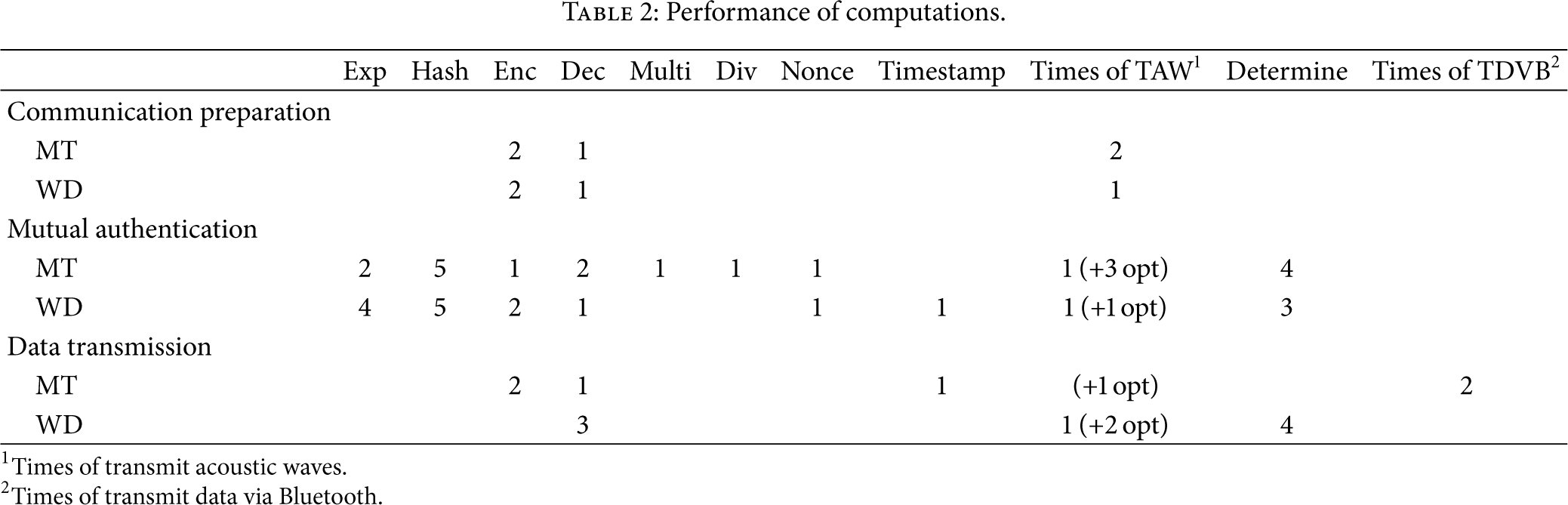
2Times of transmit data via Bluetooth.
7. Conclusions
In this paper, we presented new schemes for mutual authentication between multiwearable devices based on acoustic channel. We have designed an authentication protocol to ensure that the acoustic wave authentication is secure and efficient. In the process of the authentication, by adopting multiple-times identity authentication, agreed-upon shared key, and on-the-fly password change, we have realized the secure data transmission and sharing among mutually trusted devices and effectively precluded the unauthorized third-parties or third-party devices from stealing the data. In addition, the protocol brings convenience for the users in the case that they have multi-MTs, multi-WDs, and multi-laptops. In addition, the protocol brings convenience for the users because it can enable the automatic data synchronization and sharing among their multiple devices.
Compared with other transmission technologies like NFC and Bluetooth, acoustic wave transmission can reach more people due to lower hardware requirements and implementation costs because only the hardware included in each mobile phone or wearable device such as microphone and loudspeaker is needed to fulfill the mutually trusted identification authentication and data transmission. So we can see how acoustic wave technology is widely used in the market and its tremendous development potential.
In the future, we would endeavor to make some further optimizations and improvements such as making per unit play time of the frequency shorter and recognition rate more accurate, improving the security and confidentiality of the scheme by reducing the hardware requirements, and employing ultrasonic wave to transmit data.
Footnotes
Definitions of Symbols Used in Our Protocol
Conflict of Interests
The authors declare that there is no conflict of interests regarding the publication of this paper.
Acknowledgments
The authors wish to thank the anonymous reviewers for their insightful and invaluable suggestions and comments. This work was in part supported by 973 Program (Grant no. 2011CB302400), Natural Science Foundation of Guangdong Province, China (Grant no. S2013010013728), Educational Commission of Guangdong Province, China, Project no. 2013KJCX0131, and Guangdong University of Petrochemical Technology's Internal Project no. 2012RC0106. Wei Sun is the corresponding author.