




Abstract
Human resource capability is valuable, rare, irreplaceable, and difficult to imitate; therefore, it is crucial for creating sustainable competitive advantages. Human resource capability can be appropriately used to improve the performance of an organization. This study adopted a process perspective to propose an integrated model that comprehensively considers the key variables of human resource capability and organizational effectiveness. In addition, empirical research was conducted by using a state-owned Company-A as an example. The theory of service-profit chain posits that internal customer satisfaction and loyalty influences customer satisfaction and loyalty before affecting a company's profitability and growth. Consequently, we explore the effects of human resource capability, internal customer satisfaction and commitment, and organizational effectiveness. Based on research findings, insightful and practical guidance is suggested for leveraging human resource capability to enhance organizational performance.
1. Introduction
The relationship between human resource management (HRM) and organizational performance has been the major concern of academia scholars [1–4]. Numerous studies have confirmed the positive causal relationship between the HRM and performance of an organization. However, the key mediating variables of these two factors have often been considered to be a “black box” and, thus, only few of these variables have been investigated. Scholars have separately explored the relationship between HRM and organizational performance and between HRM and employee performance, overlooking the interaction between these factors. Traditionally, organizational performance was typically measured based on the level of improvement in the financial performance of an organization [5]. Nevertheless, increasing number of scholars have questioned the accuracy of such method and, therefore, focused on using human resource- (HR-) related outcomes, such as employee incentives, commitment, reduced turnover, and rate of absenteeism [6, 7].
In the field of quality management, relevant research has steered from studying physical products toward analyzing intangible services as service industry becomes increasingly critical and influential in economic systems. Marketing management and HRM simultaneously emphasize the interaction between frontline employees and customers in a service industry [8]. Moreover, internal marketing strongly supports the relationship between HRM and service quality [9, 10]. Because service quality is closely related to the intention and ability of internal customers (i.e., employees) to provide specific services [11], the levels of internal customers’ satisfaction and commitment toward organization, which is highly representative of employee willingness, are aspects worthy of in-depth investigation.
A specific state-owned enterprise (called Company-A in this study), with more than 28,000 employees in Taiwan, holds substantial amounts of resources. Previously, because of its advantages in exclusivity, Company-A experienced low levels of stress in terms of management effectiveness. However, with the liberalization and globalization trends of the economic development, Company-A is currently facing intense competition and challenges in continually enhancing its organizational effectiveness. In addition, Company-A's employees are protected with lifetime employment benefits. Thus, whether the results of the causality between HRM and organizational effectiveness and the relationships among crucial variables are consistent with those obtained based on private for-profit organizations is a focal topic of exploration and comparison.
Based on the aforementioned assertions, this study focused on the following objectives to address the problems mentioned above:
to propose an integrated model that effectively delineates the causal variables of HR capability and organizational effectiveness from a process perspective; to investigate the subjective perception of employees on HR capability and job satisfaction and its impact on variables related to organizational performance (i.e., organizational commitment, service quality, and organizational effectiveness); to verify the nature of the relationship between organizational commitment and service quality; to understand the current subjective perceptions of Company-A employees on the variables relevant to HR capability and organizational performance; to confirm the variables relevant to HR capability and organizational effectiveness and compare the results of using Company-A as the study subjects with the findings of previous research; to recommend strategies that can effectively improve the organizational effectiveness of Company-A.
2. Literature Review and Hypotheses
2.1. Human Resource Capability
Resource-based view regards competencies, capabilities, and skills or strategic assets as key sources of sustainable competitive advantages [12] because they are valuable, rare, difficult to imitate, and irreplaceable [13]. Capabilities can reconfigure and recombine resources and feature essential properties such as tacitness, being context specific, and temporality. A firm can leverage its HR policies and practices to acquire, cultivate, and retain the capacity to deploy human resources, and this capacity constitutes the basis of HR capability. Human resource has been widely researched in various fields, such as the related literature [14–16].
Numerous studies have proposed various perspectives on the specific activities of HR capability and categorized these activities differently. For example, Schuler and Jackson [17] compiled the activities of HRM, which include planning, employment, evaluation, rewards, and development. Pfeffer [18] outlined seven categories of HR practices: employment security, selective hiring, self-managed teams, high compensation contingent on company performance, extensive training, reduced status distinctions, and information sharing. Based on the concept of building blocks of competitive advantages, Jones and Hill [19] emphasized four crucial HRM activities: hiring strategy, employee training, self-managing team, and paying for performance. By comparison, McDonough [20] advocated that three crucial, closely related, and highly complementary HR practices are the key for innovation-oriented organizations to develop cross-functional teams: (a) training, in which skills and human capital are invested; (b) pay for performance, which emphasizes rewarding employee contributions and achievements; and (c) team development, in which team-based activities are actively developed and promoted.
2.2. Internal Customer Satisfaction
2.2.1. The Nature of Internal Customer Satisfaction
In the literature, internal customer satisfaction can be explained based on two philosophical perspectives, namely, marketing (i.e., internal marketing) and total quality management (TQM; i.e., internal service). Marshall et al. [21] asserted that internal marketing focuses on a firm serving its employees, whereas internal service emphasizes employees serving each other. Therefore, these two concepts are distinct. However, Mohrw-Jackson [22] argued that these two concepts are complementary and are capable of facilitating business success. Internal marketing and internal service are both characterized by common core concepts (which involve customer orientation, cross-functional cooperation, and profitability) and both highly value customer satisfaction as the key to attaining organizational goals.
2.2.2. Internal Customer Satisfaction and Human Resource Capability
The relationship between HR capability and internal customer satisfaction has received considerable attention. For example, Mohrw-Jackson [22] investigated how HR employees can develop and maintain a customer-oriented attitude and implement marketing perspectives into the internal process of their organization. Bowen [23] considered that HR function can simultaneously, positively influence internal and external customer satisfaction. Yeung and Berman [24] proposed a model to verify the capability of HR to improve employee satisfaction and the competency of an organization, which subsequently influences customer and shareholder satisfaction. Bowen [23] also confirmed the effect of HR capability on the satisfaction of internal and external customers. Thus, we propose the following hypothesis:
H1-1: HR capability significantly positively influences internal customer satisfaction.
2.3. Organizational Commitment
2.3.1. The Nature of Organizational Commitment
Organizational commitment is defined as the extent to which an individual identifies and is involved with its organization [25]. Therefore, organizational commitment is related to the attitude that employees exhibit toward their organization. Previously, organizational commitment has been evaluated based on a single dimension; for instance, Porter et al. [26] maintained that organizational commitment represents the relative strength that an individual exerts to identify with and commit to its specific organization. Becker [27] emphasized that organizational commitment is the accumulated involvement that an individual has with its organization and the consequence they must face when leaving the organization.
From a macro-perspective, Meyer and Allen [28] proposed a multidimensional three-component model of organizational commitment that comprises the following dimensions:
Affective commitment, which refers to employees’ emotional attachment to, identification, and involvement with their organization. Normative commitment, which is the sense of responsibility that employees perceive toward organizational obligation. Continuance commitment, which refers to commitment generated based on the cost of leaving the organization as perceived by the employee.
Meyer and Allen's [28] model postulates that the three components of commitment enhance an employee's work performance; therefore, organizational commitment is highly likely to exert various degrees of influence on work performance, absenteeism, and organizational citizenship behavior. Similarly, Meyer et al. [29] maintained that an individual can expect that the job performance of employees with affective commitment at work is distinct from that of employees who are attached to their organization based on continuance commitment.
2.3.2. Organizational Commitment and Human Resource Capability
The positive relation that HR capability has with employee's organizational commitment has been supported by numerous empirical studies. Gong et al. [30] found that performance-oriented HR system influences the affective commitment of middle managers and thereby enhances organizational performance. By contrast, maintenance-oriented HR system influences the continuance commitment of middle managers; however, no significant relationship was observed between affective commitment and organizational performance. Shagholi et al. [31] verified that participatory management significantly influenced organizational commitment. In a study that focused on Japan and South Korea, Magoshi and Chang [32] asserted that diversity management significantly positively influenced the organizational commitment of employees. Steyrer et al. [33] confirmed that the leadership of top managers significantly influenced the organizational commitment and performance of their subordinates. Therefore, this study proposed the following hypotheses:
H2-1: HR capability significantly positively influences employee's affective commitment. H2-2: HR capability significantly positively influences employee's normative commitment. H2-3: HR capability significantly negatively influences employee's continuance commitment.
2.3.3. Organizational Commitment and Internal Customer Satisfaction
Most studies have stated that the satisfaction of internal customers influences organizational commitment [34, 35]. Organizations gaining recognitions from their employees with shared common values have great potentiality to create customer values. Because satisfaction is one of the core values that employees expect their organization to maintain, we can expect that affective commitment is one of the positive outcomes generated from internal customer satisfaction [36, 37]. Thus, this study proposed the following hypothesis:
H3-1: Internal customer satisfaction significantly positively influences affective commitment.
Internal customer satisfaction can enhance employees’ sense of responsibility or obligation toward their organization, which strengthens their normative commitment. Consequently, satisfied employees are not concerned with the gains or losses of leaving the organization. Thus, we propose the following hypotheses:
H3-2: Internal customer satisfaction significantly positively influences normative commitment. H3-3: Internal customer satisfaction significantly negatively influences continuance commitment.
2.4. Service Quality
2.4.1. The Nature of Service Quality
Service quality critically influences customer-related variables, such as customer satisfaction [38, 39] and loyalty [11], both of which facilitate the retention of customers [11] and elicit repurchase behaviors [9]. Because service marketing is characterized by intangibility, perishability, heterogeneity, and inseparability [40], service quality is comparatively more complex than is the product quality. Therefore, measuring service quality is extremely challenging. In contrast to other models, the SERVQUAL model is the most widely accepted and applied model in relevant domains [41]. SERVQUAL scale is developed based on five dimensions: tangibles, reliability, responsiveness, assurance, and empathy.
SERVQUAL model is also known as the gaps model, which defined service quality as the gap between customers’ expectation of a service and their actual perceptions. There are four major service quality gaps, namely, (a) Gap 1: between management perception and customer expectation; (b) Gap 2: between management perception and service quality specification; (c) Gap 3: between service quality specification and service delivery; and (d) Gap 4: between service delivery and external communication. Because this study focused on employee's service quality, only Gap 3 was investigated.
2.4.2. Service Quality and Internal Customer Satisfaction
From an internal marketing perspective, satisfied employees yield satisfied customers [42]. Employees with a positive attitude are inclined to demonstrate altruistic, assisting, and considerate behaviors [43]. By contrast, unhappy and dissatisfied employees are unlikely to deliver excellent services that would satisfy customers [44].
Heskett et al. [45, 46] proposed the service-profit chain model, which concretely describes the relationship between internal customers (employees) and external customers. This model postulates that the satisfaction and loyalty of internal customers first influence customer satisfaction and loyalty and then affect a firm's profitability and growth. Because internal customer satisfaction is typically regarded as an antecedent of a customer-oriented behavior [47], we propose the following hypothesis:
H4: Internal customer satisfaction significantly positively affects service quality.
2.4.3. Service Quality and Organizational Commitment
Multiple studies have confirmed the significantly positive relationship between affective commitment and service quality under varying contexts [11, 48, 49]. Thus, this study proposed the following:
H5-1: Affective commitment significantly positively affects service quality.
The willingness of employees to contribute to their organization varies according to the commitment they perceive [28]; therefore, not all forms of organizational commitment can lead to improved job performance [50]. Typically, because affectively committed employees honestly wish to maintain a positive employment relationship with their organization, they would devote more effort to serving their organization than would employees who exhibit normative or continuance commitment. Several studies have advocated that normative commitment is significantly positive related to job performance [51], whereas few scholars observed no significant relationship between the two variables [52]. Many empirical studies have shown a significantly negative relationship between continuance commitment and performance [28, 53], whereas no such phenomenon was observed in certain studies [51, 52]. However, Suliman and Iles [54] identified a significantly positive relationship between these two factors. Because continuance commitment is based on the consideration of gains and losses, we assert that this type of commitment exhibits a negative relationship with job performance. Therefore, H5-2 and H5-3 are proposed as follows:
H5-2: Normative commitment significantly positively affects service quality. H5-3: Continuance commitment significantly negatively affects service quality.
2.5. Organizational Effectiveness
2.5.1. The Nature of Organizational Effectiveness
Organizational effectiveness refers to the level of success that an organization achieves during the process of pursuing its mission [55]. Because organizational effectiveness involves an organization's mission, the measurement of organizational effectiveness is based on the distinctive ability that the organization displays to ensure its success. Jamrog and Overholt [56] considered crucial unique abilities to encompass HR values. Previously, scholars have measured organizational performance using indicators related to financial performance, such as profitability, return on investment, and earnings per share [5]. However, according to Eccles [57], practitioners and academia experts believe that accrual-based performance indicator is outdated and ineffective. Therefore, scholars have subsequently used subjective psychological well-being as the basis of measurement, focusing on emotional indicators such as involvement, satisfaction, and commitment. Harnesk [58] asserted that an employer does not just employ one element of an individual but the entire individual, including personal, social, and professional qualities. Past researchers have held distinct views on the variables for measuring organizational effectiveness; for example, Robbins [59] recommended using productivity, absenteeism, turnover rate, organizational citizenship behavior, and job satisfaction, whereas Huselid [3] and Sun et al. [60] have suggested using employee productivity and turnover rate.
2.5.2. Organizational Effectiveness and Human Resource Capability
According to theories developed in HRM domains, HR capability is the key factor that directly influences organizational effectiveness. Furthermore, empirical studies have yielded consistent results [2, 3, 66, 67]. Therefore, H6 is proposed as follows:
H6: HR capability significantly positively influences organizational effectiveness.
2.5.3. Organizational Effectiveness and Internal Customer Satisfaction
Internal customer satisfaction is a crucial topic in the philosophy of TQM. Through internal customer satisfaction, HR positively influences organizational effectiveness. The relationship between internal customer satisfaction and organizational effectiveness has been supported in multiple empirical studies. For example, Molina and Ortega [68] indicated that additional training positively impacts organizational performance through employee satisfaction and customer loyalty. Similarly, Matzler et al. [69] found that satisfied internal customers are conducive to increasing productivity. Therefore, we propose the following hypothesis:
H7: Internal customer satisfaction significantly positively influences organizational effectiveness.
2.5.4. Organizational Effectiveness and Service Quality
According to the service-profit chain proposed by Heskett et al. [45], employees’ efforts are particularly essential to delivering high-quality service to satisfy customers and improve business performance. In addition, Yee et al. [70] empirically proved the positive relationship between the service quality and organizational performance of 210 service companies in Hong Kong. Hence, this study proposes hypothesis H8:
H8: Service quality significantly positively influences organizational effectiveness.
3. Research Method and Design
3.1. Research Model
Based on the aforementioned literature review, this study developed a research framework as shown in Figure 1.

The research framework.
3.2. Conceptual Definition and Measurement of Research Constructs
In this study, the variables were measured according to prior studies with modifications based on the context of this study. Table 1 summarizes the conceptual definitions and the references for each construct. The questionnaire of this study comprised five sections, namely, demographic data, items pertinent to HR capability, organizational commitment, service quality, and organizational effectiveness. Regarding the questionnaire, a 7-point Likert scale was adopted, where a score of 1 represents strongly disagree and 7 denotes strongly agree. After completing the questionnaire design, we conducted a pretest to make sure the wordings of questionnaire will be clear enough and respondents fully understand the content.
Conceptual definition of the constructs in this study.

3.3. Research Subject and Data Collection
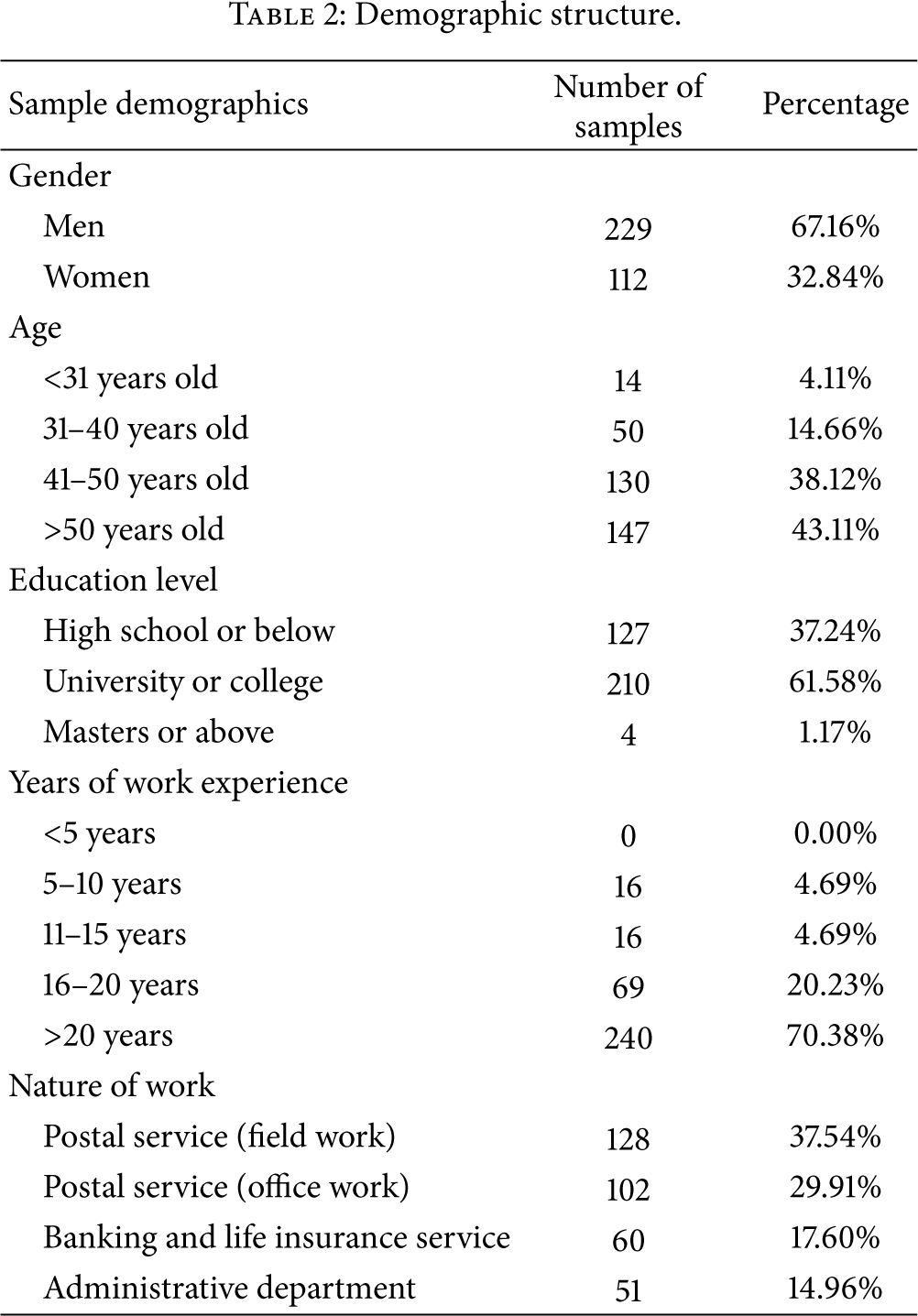
This study adopted employees of Company-A as the population; convenient sampling was used to distribute 400 questionnaires via mail to employees of Company-A in Taichung branch. Overall, excluding 59 invalid questionnaires, we obtained 341 valid questionnaires, yielding a response rate of 85.25%.
4. Analysis and Results
4.1. Demographic Data Analysis
Table 2 presents the demographic information of the samples summarized based on the valid responses.
Demographic structure.
4.2. Measurement Model Analysis
By using the Smart PLS 2.0 software, we employed the partial least square (PLS) method to test the measurement model and the structural model of this study. For the path analysis, the level of significance was examined using the bootstrapping method. In recent years, the PLS analysis has been widely applied in research related to information management, and its application is continuously increasing in number [71]. Table 3 presents the items of the measurement model that were tested in this study.
Reliability and validity tests.

4.2.1. Reliability Analysis
The study conducted confirmatory factor analysis (CFA) on the results obtained from the questionnaire; the analysis results are shown in Table 4. The factor loading, Cronbach's α, CR, and AVE all meet the criteria, indicating a favorable consistency among the variables of corresponding measurement items.
CFA results.

4.2.2. Validity Analysis
In this study, the constructs used have been verified and supported by relevant theories and studies; therefore, they meet the requirement of content validity. The questionnaire items for each variable were modified according to the context of the Company-A. In addition, pretest was conducted, in which three experts and 10 Company-A employees of the Taichung region were invited to complete the draft questionnaire, requesting them to provide opinions regarding the meaning and syntax of the questionnaire items. Subsequently, we interviewed these respondents to determine potential problems, the results of which were used to modify the questionnaires. Therefore, the face validity of the questionnaires was satisfactory. According to Table 4, the AVE and factor loading of all the variables ranged between 0.54 and 0.94 and between 0.58 and 0.97, respectively, suggesting that the constructs used in this study's model have satisfactory convergent validity.
Table 5 presents the correlation coefficient matrix for the constructs used in this study; the numbers along diagonal line represent the square root of the AVE for the constructs. In the table, the minimum square root of the AVE is 0.87, which is greater than the maximum correlation coefficient. This shows that the items of the variables in the measurement model are distinct; thus, all constructs have satisfactory discriminant validity.
The correlation coefficient matrix of the constructs.

Note: bolded numbers along the diagonal line represent the square root of AVE, whereas the remaining numbers are the correlation coefficient between each variable.
4.3. Structural Equation Modeling
The test results for the hypotheses proposed in this study are summarized in Table 6. Overall, the primary factors influencing internal customer satisfaction (explained variance:
Results of the hypothesis testing.

Note: *P < 0.05; **P < 0.01; ***P < 0.001; ns denotes not significant.
5. Conclusion and Recommendation
5.1. Conclusion
Based on a process perspective, this study proposed an integrated model that comprehensively considers crucial constructs relevant to HR capability and organizational effectiveness. In this study, empirical research was conducted, in which a state-owned Company-A was used as an example. Research results reveal the internal customer satisfaction, which is highly valued in internal marketing, was primarily influenced by team orientation, affective commitment, and normative commitment. However, the effects of training, pay for performance, and continuance commitment were not as strong as expected. This is possibly because Company-A is a state-owned enterprise, with employees protected with lifetime employment benefits, the nature of work is fixed, and the salary system is inflexible. Thus, its salary system cannot influence employees’ work performance. Hence, the constructs of training and pay for performance cannot exert an effect similar to that in private enterprises.
The service-profit chain model postulates that the satisfaction of internal customers influences customer satisfaction and loyalty before affecting the profitability and growth of the company. In this study, we extended this model by investigating the mediating effects of organizational commitment on the relationship between internal customer satisfaction and service quality. The results indicated that internal customer satisfaction significantly positively influenced affective and normative commitments, whereas these two types of commitment did not significantly positively influence service quality. This can be explained by the lifetime job assurance that employees possess, which limited the effects of organizational commitment. Furthermore, the affective commitment and normative commitment that employees exhibit toward their organization predominantly originate from job satisfaction rather than HR practices.
Service quality is the crucial construct relevant to employees’ productivity and the sustainable competitiveness of Company-A. Internal customer satisfaction and team orientation are the key factors influencing service quality. This finding verifies the benefits of teamwork as supported by numerous studies (e.g., De Leede et al. [72]; McDonough, [20]). Overall, this study concludes that team orientation and internal customer satisfaction are among the most essential factors that influence Company-A's effectiveness.
5.2. Recommendation
5.2.1. Recommendations for Company-A
The vision of Company-A is to be a trustworthy company in its domain area that provides excellent services to customers. To achieve this goal, its HR capability with valuable, rare, irreplaceable, and difficult to imitate in essence, is crucial for creating sustainable competitive advantages and should not be neglected.
Since research findings reveal the importance of team-orientation and internal customer satisfaction, by offering extensive training to improve employees’ skills and implementing team-oriented pay-for-performance system, employees’ engagement and commitment with their company can be greatly improved, hence enhancing their ability to achieve company's goals and mission. To adequately utilize human resources, Company-A should actively promote cross-functional teamwork activities. Under this approach, Company-A employees can improve their work performance, thereby enhancing their affective commitment and normative commitment to their organization.
Moreover, the nature of work in Company-A is generally fixed; therefore promoting teamwork provides the opportunity for infusing flexibility and vitality into employees’ jobs. This would facilitate the reform of Company-A, thereby providing better diversified and innovative services that would improve customer satisfaction effectively.
5.2.2. Recommendations for Subsequent Studies
This study explored HR capability from the perspective of sustainable competitiveness and focused on three dimensions, namely, training, pay for performance, and team orientation. Subsequent studies can extensively investigate other possible HR dimensions, such as the effects of specific HRM functions. Moreover, since Company-A is transforming from state-owned to private enterprise, newly hired employees are managed by different HR system and no longer viewed as civil servants as their senior counterparts. By using a flexible and highly effective pay-for-performance system, Company-A can effectively improve the motivation and attitudes of employees toward their job. In this circumstance, subsequent studies can thoroughly analyze and compare the effects that the constructs studied in this study have on the cognition and performance of senior and new Company-A employees. Finally, the dynamic relationships of research constructs can be analyzed by other approaches, such as qualitative research, multiple criteria decision making analysis, and fuzzy set qualitative comparative analysis.
Footnotes
Conflict of Interests
The authors declare that there is no conflict of interests regarding the publication of this paper.