




Abstract
With the popularity of IEEE 802.11 based wireless fidelity (Wi-Fi) portable devices, it becomes increasingly significant to support the mobile users carrying Wi-Fi devices to access the Internet of Things (IoT) so that the communications between the mobile users and the smart objects deployed in the IoT stay uninterrupted when the mobile users are in movement. A scheme using Extended Service Set- (ESS-) based architecture is presented to implement the proxy mobile IPv6 protocol, that is, PMIPv6, for IEEE 802.11 infrastructure Wireless Local Area Networks (WLANs). The key signaling packets together with their time sequences for the mobility management in the proposed scheme are proposed. Moreover, the handoff delay in the proposed scheme is derived, through which the performance of the proposed scheme is analyzed. Numerical analysis indicates that the proposed scheme considerably outperforms the existing scheme that uses the Basic Service Set (BSS) based architecture in terms of handoff delay in the case when the delay between Mobile Access Gateway (MAG) and local mobile anchor (LMA) is relatively large.
1. Introduction
Wireless Local Area Network (WLAN) interfaces or Wi-Fi are increasingly incorporated in multimedia portable electronic devices such as portable computers and smart phones. These interfaces enable these devices to access the Internet wherever WLAN Access Points (APs) are located. Most IEEE 802.11 WLANs operate in the infrastructure mode, in which each node is associated with an AP to access the Internet [1].
In Internet of Things (IoT), it is required to attach IP addresses to everyday objects allowing people to remotely communicate with and control networked devices. Having the advantages of easy integration with existing infrastructure, built-in IP-network compatibility, and familiar protocols and management tools [2], Wi-Fi enabled sensors have been used in IoT [3–5]. The Wi-Fi enabled sensors have the feature of at least two wireless interfaces: one is the Wi-Fi interface used to access IEEE 802.11-based WLAN and the other is the low-power interface to support IEEE 802.15.4 standard. Thus, data packets can be transmitted with high data-rate via the Wi-Fi interface while the communications between low-power devices go through the low-power interface [1].
Nowadays, Wi-Fi enabled portable smart phones equipped with some sensors have become increasingly popular. For example, the Samsung Galaxy smart phone includes more than 10 kinds of sensors, such as temperature and humidity sensors, accelerometer, and gyroscope, and so forth. Many applications have been developed to use the sensors embedded in the smart phones, in which the data collected by the embedded sensors from the environment are transmitted via the Wi-Fi interface connecting to the AP in the WLAN.
Internet Protocol Version 6 (IPv6) [6], which has been widely used in the Internet, was applied in wireless sensor networks (WSNs). For instance, IPv6 was used in the WSN for ambient monitoring [7]; the double adaptively clustering hierarchy (DACH) algorithm used IPv6 in WSN [8]; and IPv6-based all-IP WSNs were investigated in [9]. To support delivering IPv6 packets over low-power and low-rate WSNs, 6LoWPAN protocol [10] was developed by the Internet Engineering Task Force to enable nodes in the IP network to communicate with the low-powered WSN nodes operating at low data rates [11]. The adaptation layer introduced in 6LoWPAN is located between the medium access (MAC) layer and the network layer in the protocol stack [10].
With the rapid growth in the number of portable electronic devices, it becomes urgent to support the users carrying these devices to access the IoT when the users are moving, which inspirits researchers to investigate the problem of implementing mobile IPv6 (MIPv6) in the infrastructure WLANs. MIPv6 is a technology which allows users to stay connected to the Internet when they are moving. MIPv6 protocols can be classified into two categories: the host-based protocol, such as MIPv6 [12] and HMIPv6 [13]; and the network-based protocol, such as PMIPv6 [14].
IEEE 802.11 standard supports link-layer mobility; that is, it supports mobile node (MN) to move across the boundary of radio coverage of an AP within the same WLAN. But, it does not support network-layer mobility [15], which supports the MN to move across an IP subnet. As a result, we need the network layer mobility protocol that supports the MN to seamlessly move in different WLANs such that the MN keeps its ongoing communications uninterrupted when moving across the boundary of IEEE 802.11 WLANs. Considering that the PMIPv6 has many advantages (e.g., MNs are free from handling mobility management), Gundavelli [16] presented in 2010 the idea of implementing PMIPv6 protocol in WLANs. Unfortunately, this idea has not been finalized as a standard up to date although it has undergone six times of improvements [17].
There are two core functional entities in PMIPv6 protocol. That is, the local mobility anchor (LMA) and the Mobile Access Gateway (MAG). According to Gundavelli's suggestion, relationship between MAG and AP can be as follows: (1) a MAG manages only one AP, referred to as single AP architecture” below; and (2) a MAG manages more than one AP, referred to as “multi-AP architecture” below. In 2012, Chai et al. [18] proposed a scheme to implement PMIPv6 for single AP architecture. To the best of our knowledge, there is still a lack of the implementation scheme for multi-AP architecture, which motivates us to address the problem. We extend our previous research [19] in this paper, which has the main contributions as follows.
A novel scheme to implement PMIPv6 using Extended Service Set (ESS) based architecture, that is, ESS-based architecture, is presented. The signaling commands used in mobility management and their timing diagrams for the proposed scheme are designed. Delay and signaling traffic in the proposed scheme are derived, based on which performance analysis is conducted.
The remainder of this paper is organized as follows. Our scheme is presented in Section 2 and performance analysis is given in Section 3. We conclude the paper in Section 4.
2. Implementing PMIPv6 Using ESS-Based Architecture
In PMIPv6 protocol, LMA and MAG manage mobility on behalf of an MN, releasing the MN from the burden of handling mobility-related signaling. LMA maintains the MN's home network prefix (HNP) and records entries relevant to the associations between MAG and MN, and it acts as the home agent (HA) of the MN, while MAG is used to detect the MN's movement and reports its current position to LMA when necessary. A packet destined to the MN from corresponding node (CN) is first delivered to its LMA using IP protocol and then, via the tunnel between the LMA and the MAG, the packet is tunneled to the MN's MAG through which it is delivered to the MN using the point-to-point link between the MN and the MAG. Compared to MIPv6, HMIPv6, and the other host-based mobility management protocols, PMIPv6 has the following advantage in addition to saving bandwidth [20]: mobility management is transparent to the MN (i.e., the MN is not involved in mobility management). This strength frees the MN from installing or updating the software to support mobility. Thus, PMIPv6 is highly likely to be widely used.
2.1. The ESS-Based Architecture
In an infrastructure IEEE 802.11 WLAN [15], nodes access the Internet via an AP and the radio coverage of the AP is known as basic service area (BSA). Each node must be associated with one AP before joining the WLAN. The AP and all its associated MNs form a Basic Service Set (BSS) and multiple BSSs form an Extended Service Set (ESS).
The key to implement PMIPv6 in WLAN lies in handling the relationship between MAG and AP. That is, how many APs should be managed by a single MAG. The structure in which one MAG manages only one AP (i.e., the MAG manages one BSS) is illustrated in Figure 1, where each AP is collocated with a MAG. This structure will be referred to as BSS-based architecture below. In this paper, we present the ESS-based architecture shown in Figure 2, where a MAG manages an ESS containing multiple APs. For the sake of easy description, an AP that is collocated with a MAG is called a “MAG-AP” hereinafter. Thus, in Figure 1, each AP is a MAG-AP; whereas, in Figure 2, only one of the APs in the same ESS is chosen as MAG-AP (e.g., AP1 and AP8 are MAG-APs). In both architectures, all APs are wiredly connected.

The BSS-based architecture.

The ESS-based architecture.
In the BSS-based architecture, whenever an MN crosses the boundary of a BSA, a handoff operation is triggered, which sends a proxy binding update (PBU) message to the LMA from the MAG in order to update the MN's new location [14]. For example, in Figure 1, when the MN moves from the BSA of AP1 to that of AP2, the MAG related to AP2 sends a PBU message to the LMA. In the proposed ESS-based architecture, a PBU message is sent only when the MN goes across the boundary of the radio coverage of the ESS. Moreover, when the MN moves within the radio coverage of the same ESS, no PBU message is needed no matter how many BSAs are crossed. For instance, when the MN moves from the BSA of AP3 to that of AP4, no PBU is needed. But, when the MN moves from the BSA of AP4 to that of AP5, the MAG collocated with AP8 (i.e., MAG2) sends a PBU to the LMA.
In the proposed scheme, in every MAG-AP, a cache called “AssocTable” is set to record the information of current APs of MNs. AssocTable contains two fields: “MN_ID” and “Curren_AP,” which are used to save the MN's unique identifier and the currently associated APs, respectively.
2.2. Mobility Management Strategy for the ESS-Based Structure
In infrastructure WLAN, the MN uses active scanning or passive scanning to find existing networks in the area. With active scanning, the MN sends probe frames to solicit responses instead of awaiting the announcement of the network. With passive scanning, the MN searches in each of the preset channels for at least a beacon interval (BI) to receive a possible beacon frame from an AP. The default value of BI is 0.1 s. Therefore, the time consumed in passive scanning can be up to a couple of seconds, which is far greater than that in active scanning. Hence, in this paper, we assume that the MN uses active scanning to detect APs. After scanning, the MN has obtained all necessary information including MAC addresses and signal strengths of the scanned APs, which enable the MN to choose a desired AP to associate with.
The MN judges whether it has entered the area of a new ESS by comparing its buffered service set identifier (SSID) with the SSID carried in the received beacon frame. Before association with a new AP, authentication is needed to verify the identity of the MN. In the case when open system authentication is in use, only one set of authentication request (AuReq) and response (AuRes) exchange suffices for the authentication process [21]. After that, the MN is associated with the new AP by exchanging reassociation request (RAReq) and response (RARes). Considering the above handoff process is only involved in MAC layer, we call it “L2 handoff.”
The events occurring after L2 handoff are as follows.
(1) Association with an AP in Different ESS. In this case, the MN sends a router solicitation message (RtrSol) to the MAG. After receiving RtrSol, the MAG sends a PBU to the LMA. Once the LMA accepts the PBU, it sends back to the MAG a proxy binding acknowledgment (PBA) message, which contains the MN's home network prefix option, and then it sets up a route over the tunnel to the MAG. After successfully receiving the PBA, the MAG sends router advertisement message (RtrAdv), from which the MN constructs its IP address using the carried HNP. The above process happens in network layer, which will be referred to as “L3 handoff” in the sequel. The events involved in the L2 and L3 handoffs are illustrated in Figure 3. Furthermore, the signaling exchanges among the MN, the new AP, the MAG-AP, and the LMA are shown in Figure 4(a). There exists an exception that happens when the new AP is also a MAG-AP such that the signaling exchanges of RtrSol and RtrAdv can be omitted, which is shown Figure 4(b).

Events in L2 and L3 handoffs.

Signaling exchanges when the MN crosses the boundary of an ESS.
(2) Association with AP in the Same ESS. In this case, the MN neither sends a RtrSol message nor updates its IP address. The only thing it needs to do is to let the new AP inform the MAG-AP of updating its AssocTable. The events in this case are shown in Figure 5. Additionally, the signaling exchanges among the MN, the new AP, and the MAG-AP are illustrated in Figure 6(a), in which the UAT-Req and UAT-ACK represent the message of updating AssocTable and the acknowledgement, respectively.

Events when MN moves in the same ESS.

Signaling exchanges when MN moves in the same ESS.
2.3. Other Specifications
The MAG acts as the default router of the MN and emulates the MN's home link [14]. As a mobility entity, the MAG can access the policy profile of the MN, which includes a set of configuration parameters for the MN. When PMIPv6 is implemented in an infrastructure WLAN, the configuration parameters such as the MN's identifier and the LMA address can be piggybacked in association request message, thus saving the time required to access the policy profile. Apart from the MN's static HNP in the policy profile, the MAG can get a dynamically allocated HNP from PBA message. With the HNP and its identifier in hands, the MN can use stateless address configuration method to build its IP address.
In the infrastructure IEEE 802.11 WLAN, upon receiving a frame destined to the MN, the AP uses the distribution service provided by the distribution system to deliver the frame to MN. But, IEEE 802.11 standard does not specify how to implement the distribution system. In this paper, the APs in an ESS are wiredly connected to form the distribution system. When a frame from the wired network is forwarded to the 802.11 WLAN, its format has to be converted before it is delivered to the MN [15]. In addition, some mobility signaling messages sent by the MN should be treated as a new kind of control messages defined according to IEEE 802.11 standard. For example, following IEEE 802.11 standard, we assign new control frame subtype values of “0001” and “0010” in the header of IEEE 802.11 MAC frame for the RtrSol and RtrAdv messages, respectively.
In PMIPv6, the Access Technology Type option is mandatory. We set it to 4, which means that the access technology is 802.11 [14].
3. Performance Analysis
3.1. Handoff Delay
In this section, we use handoff delay as a metric to compare our scheme that uses the ESS-based architecture shown in Figure 2 with the BSS-based architecture shown in Figure 1. Similar to [22], we use a square to represent a BSS. As shown in Figure 7, each small square represents a BSS and several small squares constitute a big square with bold box to represent an ESS. The MN in a BSS is allowed to move into any of the 8 adjacent BSSs. The lower left corner in Figure 7 shows the 8 possible moving directions if the MN is located in square X.
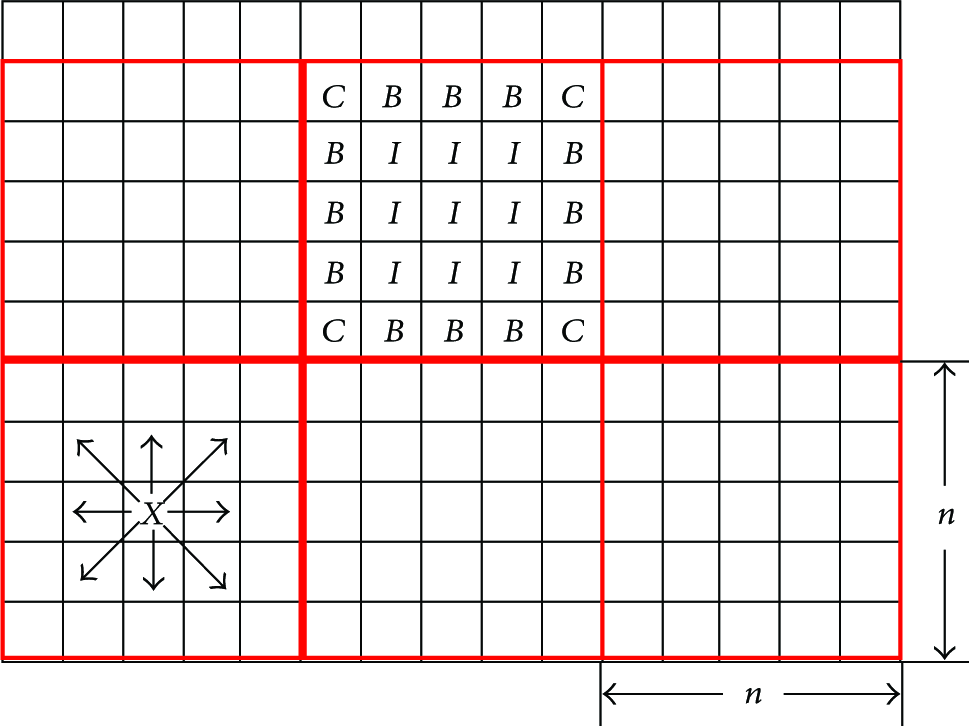
BSS with small square and ESS with bold square.
Noting that an ESS is formed by

When the MN is at the corner of an ESS (refer to the BSS labeled with letter “C” in Figure 7), the probability that the MN also crosses the boundary of the ESS when it crosses a BSS is 5/8; when the MN is in the BSS with “B,” the probability of ESS boundary-crossing is 3/8; and when the MN is within an ESS, the probability of ESS boundary-crossing is 0 as it does not cross the boundary of an ESS when the MN crosses a BSS. Thus, the probability that the MN crosses the boundary of an ESS after the MN crosses a BSS is

Let

The cases of the MN's crossing a BSS.
Case 1.
The MN is currently located at the corner of ESS0 as shown in Figure 8(a). There are two subcases for Case 1: (1) when the MN crossed the boundary of ESS0 (with probability 5/8), the probability that the new AP (i.e., the AP the MN is newly associated with when the MN enters a new BSS) is a MAG-AP is
Case 2.
The MN is currently located at edge “B” as shown in Figure 8(b). Similarly, we can obtain the probability that the MN moves into an area of a MAG-AP is
Case 3.
The MN is currently located at inner “I” as the square with “X” shown in Figure 7. In this case, only when the MN is not in a MAG-AP, that is, the MAG-AP is collocated with one of the other
In summary, no matter where the MN is located in ESS0, the probability that the MN moves into an area of a MAG-AP is the sum of the probabilities derived in the above three cases, which equals (3) using (1). Consider

Let

Obviously, the BSS-based architecture shown in Figure 1 is a special case of the ESS-based architecture shown in Figure 2 when

It can be seen from (4) and (5) that the key to finding
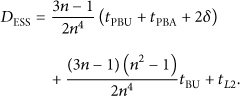

Let θ be the probability of successful packet transmitting (PSPT) over the wireless link between the MN and an AP. As positive acknowledgement is applied in IEEE 802.11 WLAN, a transmission failure means that either packet transmission fails or the ACK message is lost. Thus,

The peak data rates that IEEE
Delay of signaling frames.

Assume that the physical layer of WLAN applies direct sequence spread spectrum (DSSS). According to [15], we set σ = 20 μs, short frame interval 
Before transmitting, the node must sense the medium idle for period of 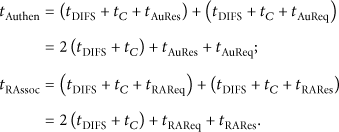
From Figures 3 and 5, (10), and Table 1, we have
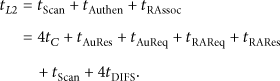
Using Table 1 and (9), we obtain


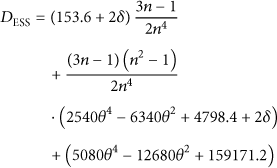


Next, we investigate influence of n, θ and δ on

Influence of n and θ on
To clearly observe the tendency of

Influence of n on

Influence of θ on
Influence of δ on

Influence of δ on
In fact, by solving the following optimization problem, the optimal n can be found for our scheme using the ESS-based architecture such that the handoff delay is minimized. Consider

3.2. Signalling Traffic from Handoff
Now, we turn to analyze the signaling traffic (in bits) incurred in a handover. From Figures 4 and 6, the expectation of handoff traffic in the ESS-based scheme can be calculated as


First, we calculate the traffic for transmitting a packet over wireless link. As positive acknowledgement (ACK) scheme is adopted in the IEEE 802.11 standard-based WLAN, only when a packet together with its ACK is successfully received, the packet is considered being successfully delivered. As in the previous subsection, we ignore the probabilities of three or more consecutive failure transmissions for the same packet. Thus, for a given packet, say packet a, all of its possible transmission/retransmissions and its ACK can be listed in Table 2, where a,
Events, Probabilities, and Traffic at the first three transmission trials.

Now, we explain the contents in Table 2. We use pair
From Table 2 we obtain the average traffic to transmit the packet (i.e., packet a) over a wireless link as follows:

As mentioned earlier, the handoff process on L2 (i.e., the link layer) contains three phases: scanning, authentication, and reassociation. We assume that the MN adopts active scanning to identify the best AP. To do so under IEEE 802.11 standard, the MN multicasts a probe request frame at Channels 1, 6, and 11 to its neighboring APs for the designed AP with which the MN intends to associate. Each time the AP receives the probe request, it responds with a probe response frame. Thus, 3 probe request frames are multicast and 9 probe responses from the neighboring APs in both the proposed scheme shown in Figure 2 and the BSS-based architecture shown in Figure 1 because we adopt scenario in Figure 7 in which an AP has 8 neighboring APs. Considering the length of the probe request message 
Recall that a bidirectional tunnel is established between the LMA and the MAG. Let 
Note that the RS, RA and UAT messages are delivered over both wireless and wired links. We assume the number of hops between the AP and the MAG is
Using (21) and (23), we get


To simplify the above expression, we introduce the following notations:

Then, using (22)–(26), we can rewrite (19) and (20) as follows:

To compare the proposed scheme with the BSS-based architecture in signaling traffic, we introduce the traffic ratio as follows:

The traffic ratio reflects the proposed scheme is better than the BSS-based architecture when η> 1.
Finally, we investigate influence of n, θ, and
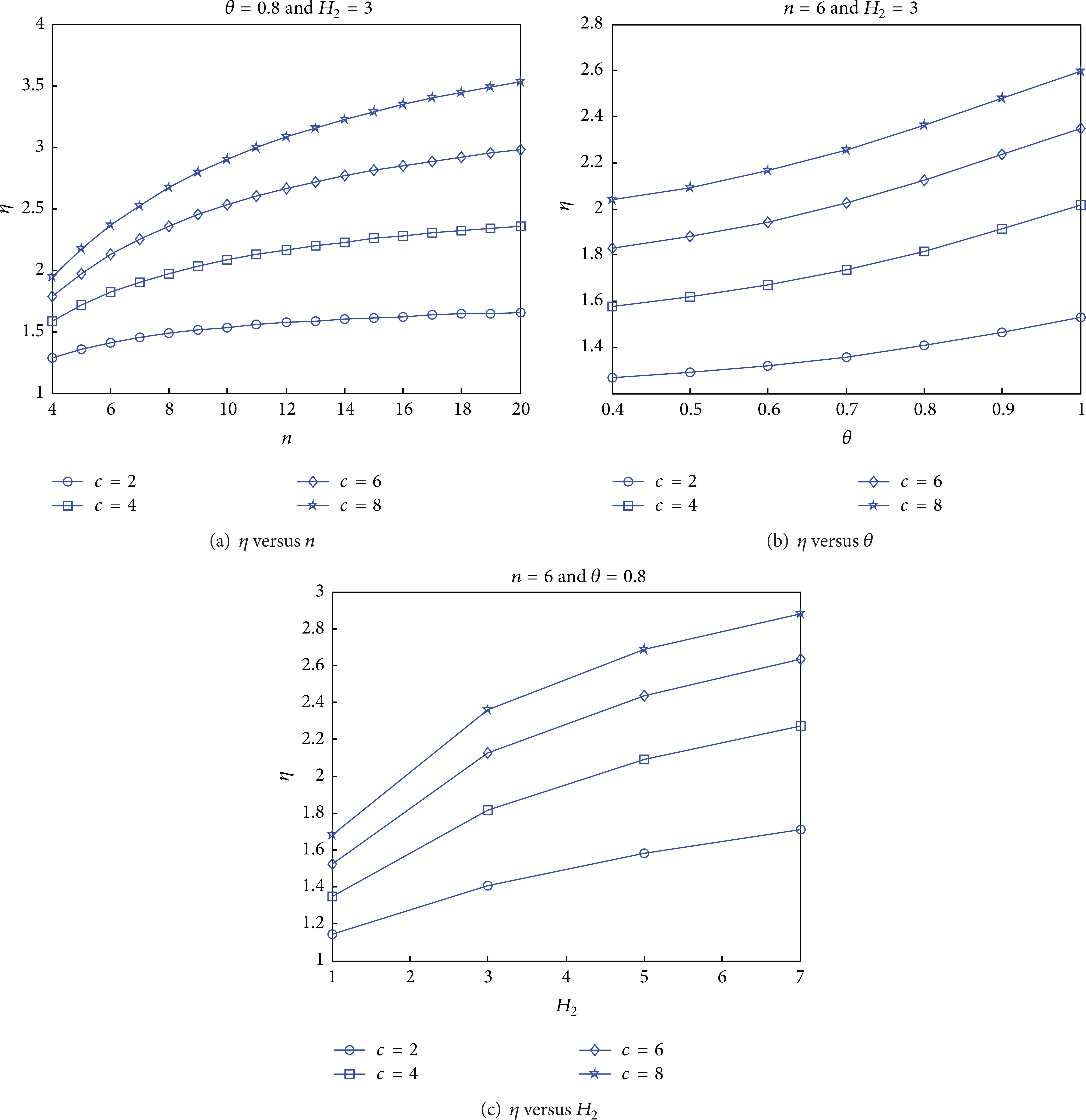
Influence of n, θ, and
4. Conclusion
In this paper, we present the scheme that uses the ESS-based architecture shown in Figure 2 to implement PMIPv6 for IEEE 802.11 infrastructure WLAN. The numerical analysis results show that, in the case when the propagation delay between LMA and MAG is relatively large (e.g., LMA are far away from MAG), the proposed scheme outperforms the existing scheme using the BSS-based architecture shown in Figure 1 in terms of handoff delay. Moreover, the proposed scheme prefers more APs being included in one ESS so that handoff delay is reduced. Though we arrive at the conclusion by using a square to represent a BSS as shown in Figure 7, the same conclusion holds when regular hexagon [25] is used to represent a BSS.
Footnotes
Conflict of Interests
The authors declare that there is no conflict of interests regarding the publication of this paper.
Acknowledgments
This work was partially supported by the National Natural Science Foundation of China (no. 61379124), the Natural Science Foundation of Zhejiang Province, China (no. LY13F020031), the Ph.D. Programs Foundation of Ministry of Education of China (no. 20123317110002), and the Scientific Research Fund of Zhejiang Provincial Education Department (no. Y201328875).