




Abstract
With the improvement of technology and the increasing demand for convenience and comfort, new interests have emerged in commercial and entertainment service in VANET. The downloading service of large popular files has played a crucial role for those commercial and entertainment service application. In this paper the author proposed an efficient scheme to help vehicle nodes download the large popular files from the Road Side Unit (RSU). Due to the constraint density of RSU and high mobility of vehicle nodes, vehicle nodes cannot download the whole large files from RSU before they move out of the communication range. To deal with this problem, we proposed multiple access modes downloading schemes: vehicles download files from RSU directly, vehicles download files through relay vehicles, and vehicles download files through other vehicles. We give credit-based incentives for relay vehicle selection to guarantee the stability and quality of the link bandwidth. We also proposed a game theory-based way to control number of neighbors reply packets, which does not cost additional bandwidth resource and ensure integrity of the files. Finally, simulations show that our proposed schemes performed well in high mobility VANET environment and ensure the data integrity.
1. Introduction
In vehicular ad hoc network (VANET), safe navigation and congestion avoidance has been the main driver in the early years. With the improvement of technology and the increasing demand for convenience and comfort, new interests have emerged in commercial and entertainment service in VANET. The downloading services of large popular files have played a crucial role for those commercial and entertainment service applications. Such information downloading service requirement may contain a series of cases: vehicles update the latest version of local Global Positioning System (GPS) maps [1], business may issue a notice or broadcasting some multimedia advertisements [2], drivers want to access the real-time road congestion information [3], and travels may need the information about local attractions or snapshots of nearby resort areas and passengers may play games [4], listen to the music [5], use all kinds of entertainment application service, or watch a variety of popular video [6].
Domestic and international institutions have done some research about the download technology of large popular files. Peer-to-peer (P2P) is a mature downloading service of large popular files which has been widely applied on the Internet [7]. Due to the high performance of scalability and date rate, BitTorrent software based on P2P technology was accepted and used by more and more people over the last few years [8]. But such mechanism cannot be applied to VANET directly [9]. Compared with wired network, vehicles move fast and are unpredictable; it cannot establish a stable or long duration relation between vehicle nodes in VANET. Thus the intermittent and unreliable wireless link in VANET greatly affected the performance of P2P service. Content distribution network [10] is another important type of downloading service which is widely used in wireless network. SPAWN [11] has been proposed as a cooperative content downloading service, which uses proximity for piece selection and was shown to outperform the rarest first criterion of Internet schemes. By extending SPAWN, CarTorrent and Code torrent [12] were born; they are a BitTorrent-style content swarming protocol applied to the vehicular scene.
In this paper, the author proposed efficient downloading services of large popular files in VANET based on 802.11p. The vehicle nodes download the large files from the Road Side Unit (RSU). Considering the constraint density of RSU, the communication range of RSU cannot cover all the road areas. Due to the the high mobility of vehicle nodes, vehicle nodes cannot download the whole large files from RSU before they move out of the communication range. To deal with this problems, our downloading services include three stages: vehicles download files from RSU directly, vehicles download files through relay vehicles, and vehicles download files through other vehicles. In this paper, we define the files as large popular files; that is, data of the files are too large so that the downloading cannot finish in a short time, and the files are popular to lots of the vehicles which make it possible to transmit the file between vehicles. The first stage is traditional which has been discussed by some institutions for academic research. Most of the data are downloaded in this stage. In the second stage, we focus on how vehicles find a relay vehicle to continue files downloading. The relay vehicle needs to guarantee the stability and quality of the link bandwidth [13, 14]. Meanwhile forwarding large files may consume lots of bandwidth so the incentive scheme is needed [15]. The final stage relies on nodes that cooperate to ensure the integrity of the files. In this stage, vehicles send a request to their neighbors to receive the missing files packet. The number of neighbors reply packet has a big influence on the performance of our system. Too many replies cost additional bandwidth resource and too little replies cannot ensure the integrity of the files. We proposed a game theory-based way to deal with this problem. In addition the packet collision may bring error to the result of the game; we propose a method to calculate the probability of collision to modify the game results.
The rest of the paper is organized as follows. We give the main framework of the efficient downloading services of large popular files in Section 2. Section 3 shows the details of the efficient downloading services of large popular files scheme. The simulation results and performance evaluation will be discussed in Section 4. We conclude the contribution in Section 5 finally.
2. System Model
2.1. Problem State
In this paper, we consider that the VANET consist of RSU and large numbers of vehicle nodes. The RSU transmit all kinds of popular contents to the nearby vehicle nodes within the communication range. Meanwhile, we consider the popular large files as advertising, video, parking information, electronic map, and other information which has a large amount of data information. We divided such large files into lots of small pieces and named them with specific rules according to the ICN (Information Centric Network) and named them as popular content. The popular content consists of large numbers of popular content fragments. The vehicle nodes receive the popular content through the RSU in communication range. Considering the deployment density of RSU is not big enough in some of the regions, its communication range cannot completely cover the vehicle roads; such connectivity between RSU and vehicles is intermittent. And due to the high mobility of the vehicles, the RSU cannot transmit all of the popular content fragments to vehicles in finite time within the scope of the communication range. When vehicle nodes travel out of the RSU communication range, the RSU cannot continue to transmit date to vehicles. And the integrity of data cannot be guaranteed.
2.2. VANET Model
Vehicle nodes are self-organized network which is composed of mobile vehicles using wireless communication links. We assume that each vehicle is equipped with an on-board unit (OBU) with the strong performance and adequate power supply. The Global Positioning System (GPS) can be used to determine the geographical coordinates of the vehicle. Network protocol stack supports 802.11p in which the CSMA/CD Carrier Sense Multiple Access/Collision Detection is used in the Media Access Layer to avoid collision. And Dedicated Short Range Communications (DSRC) standard is used to communicate while SCHs (Service Channels) can be utilized for message interaction between vehicle nodes.
We presume that each vehicle is equipped with an omnidirectional antenna which means vehicle can only communicate with one goal at the same time in any direction with one of the selected channels. So the bandwidth is limited and precious. Some incentives should be proposed if we want to encourage vehicles to participate in information forwarding and data sharing. Vehicles transfer the popular content that include tremendous information at once will cost lots of bandwidth resource. So we divide the content into lots of small and continuous packets. The divided packet of the content is named according to the named ICN (Information Centric Network) content naming scheme. In ICN, when a node is interested in named content, it issues an Interest Broadcast Packet carrying that name [16]. When the content is found by matching the name, it is delivered back to the nodes [17]. The content is cached at intermediate nodes to speed up future searches [18]. The packet uses the prefixes and suffixes to locate its serial number in the contents.
2.3. Solution Outline
In this section, we give the outline of our novel scheme. It is shown as in Figure 1 that green vehicles denote vehicles that are in RSU communication range. And yellow vehicles denote the vehicles that receive large files through a forwarding vehicle. Red vehicles denote the vehicles out of one hop range which receive data by vehicle to vehicle way. The popular fragments are divided into

System model of our scheme.
When the vehicle continues driving out of the one hop limited range (in this case, most of the data has been transferred, but still incomplete), Data Exchanging Dilemma Game (DEDG) is proposed to ensure the integrity of the big data. Here, unlike the traditional conception, big date refers to the date with large amounts of data. The popular content is widely used in the vehicle nodes, so the vehicles can get their lost packets of the popular content from other vehicles easily. Vehicles will collect their neighbors’ information through beacon packet which shows every popular content packets they have. To ensure the integrity of the final data, they will exchange their needed content packets through P2P transmission technology between vehicles in the 6 authorized channels (the broadcast channel is not available). The multihop relay vehicles is not appropriate in our popular content distribution scheme which will be discussed in detail later.
3. Forwarding Vehicle Selection Algorithm and Data Exchanging Dilemma Game
3.1. Requirement Analysis
Due to the high mobility of the receiving vehicle node, RSU cannot transmit the integral popular content data to the vehicle node. When the vehicle is driving away from RSU communication range and still in one hop limit, a forwarding vehicle should be selected to forward the left data to the vehicle. The forwarding vehicle locates within the communication scope of the RSU and receiving vehicle which ensures a reliable link quality and high transmission efficiency.
While, in a general way like a WSNs (Wireless Sensor Networks) scene, the optimal forwarding node can be selected from the link sate and physical vehicle parameter that will help the receive node to get the rest of the data. This scheme can be programmed and written to the forwarding nodes. But in our VANET model, quite different from the traditional WSNs, drivers can reject to obey the routing protocols. In particular, for the popular content, the volume of the popular content like video is quite huger than the control message and safety message. Relay vehicle will consume lots of bandwidth resource to receive the data from RSU and transmit the data to another vehicle.
So we decide to design an incentive scheme to promote vehicles involved in forwarding behavior and then form a dilemma game model. There are two kinds of incentive mechanisms in WSNs: reputation-based method and credit-based approaches. Since it is quite difficult to establish a stable relationship of trust between the high speed of the vehicle nodes, we promote the relay vehicles to behave actively in a credit-based way.
In detail, we assume each vehicle is equipped with only one antenna, which means that vehicle can establish only one wireless connection at the same time. In order to ensure the consistency and integrity of data, once the relay vehicle is chosen, these attach relations will not be changed arbitrarily. Therefore, the receiving vehicles are mapping to the relay vehicles with a one to one model.
3.2. Forwarding Vehicle Nodes Selection
We consider our VANET scenario consisting of N vehicle nodes which are involved in the data receiving and information forwarding. The large volume of the data like advertising and video is divided equally into M packets. The




Single transmission time of the packet depends on the used MAC layer protocols. Such popular content like video need requires a better quality of service (QOS). Hence we use the 802.11P MAC protocol with the Enhanced Distributed Channel Access (EDAC). EDAC defines 8 User Priority and 4 Access Category ways include the voice, video, best effort, and background to guarantee QOS. According to that, variable

To solve the


When the two vehicles are moving ahead with the same direction,
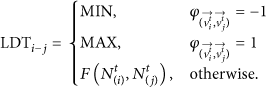
And the

Similarly, the link duration time between forwarding vehicle j and the nearest RSU is expressed in the following:


In another way, we use the bandwidth factor (BF) to describe relation between the popular content bandwidth request and the actual bandwidth size the forwarding vehicle and RSU can provide. User quality of service (QoS) must be taken into consideration when providing such a popular video content. So the service provider must match the bandwidth request. Here, RSU facilities equipped with advanced wireless transmitter are powerful enough to guarantee the popular content bandwidth request. And the value bandwidth factor (BF) is dependent on the bandwidth processing ability of forwarding vehicle which can be expressed as follows:

As we have mentioned, quite different from the traditional WSNs, drivers play a crucial role in the VANET model. If the drivers are not willing to assist other vehicles to forward information, they can reject to obey the routing protocols. Such as turning off the wireless transceiver and refuse to obey the routing policy. In another way, the volume of the popular content like video is quite huger than the control message and safety message. When the connection is established, relay vehicle will consume lots of bandwidth resource to receive the data from RSU and transmit the data to another vehicle. Considering the selfishness of the drivers, such connection is quite unstable and unreliable. So we provide an incentive compensation mechanism to give the forwarding vehicle j with credit. According to Sigmoid function given in Machine Learning theory, we use it to give the credit function (


As shown in Algorithm 1, we first predefine some flag in beacon packet to finish our proposed algorithm. Flag.ContentReceive denotes the vehicle requirements of popular content, Flag.Fused reflect whether the vehicle has been chosen as a relay by other vehicles. If Flag.ContentReceive are set to i, the vehicle will first receive the popular content from RSU. When it moves out of the communication range, vehicle will find a relay vehicle to continue content transmission by sending Forwarding Data Collect to vehicle j,
( ( ( ( ( ( ( ( ( ( (11) (12) (13) Send Forwarding Request To Vehicle j (14) (15) (16) (17) Send Forwarding Accept Reply (18) (19) ( ( ( ( ( ( ( ( ( ( ( ( ( ( ( ( ( ( ( ( ( ( (
3.3. Data Exchanging Dilemma Game (DEDG)
In this stage, we assume most of the packets are transmitted to the vehicle by using V2R (vehicle to RSU) communication directly and V2F2R indirectly (vehicle to RSU with a forwarding vehicle). When the vehicle leaves the one hop communication range of RSU, vehicle will complete the popular content transmission by V2V communication. Such presumption is based on the factor that the transmission ability of RSU is more powerful than vehicle. Some of the packets may be lost in RSU transmission due to the mobility and intermittent connectivity of vehicle nodes. So the V2V communication in vehicles is an auxiliary means to guarantee integrity of the data. Based on that assumption, our scheme is more advanced than multihops forwarding vehicle transmission way because receiving vehicle needs to pay huge cost reputation and decrease the utility and performance of the system which will be discussed in the next chapter.
This stage can be modeled as vehicle finishes the popular content received in finite V2V transmission times. Using of CSMA protocols, we take the probability of packet collision into consideration, while receiving vehicle may lose crucial packet in V2V transmission due to collision; thus the data integrity can not be guaranteed. Considering the random link in V2V transmission may shorten the transmission efficiency; we propose a cooperation and mutual information to make sure the link is established with the active neighbor. According to (4), the number
In this section, we divide the Data Exchanging process into two part: popular content assist request and popular content reply. Receiving vehicle sends the popular content assist request to his neighbors with a content retrieval label. The content retrieval label reflects the resource index of remaining popular content. Receiving vehicles check the missing content packet and embed their name prefix into the popular content assist request. Neighbor vehicles receive the request and search for the corresponding popular content fragments according to the content retrieval label. Neighbors who restore such content fragments send the popular content reply to receiving vehicle. And the receiving vehicle gains the content fragments to ensure the integrity of a data packet.
In popular content assist request stage, the message broadcasting mechanism is a kind of effective solution way, while transmitting content packet request with broadcast mode will emerge a myriad of copies of the request message in VANET, resulting in a large number of energy consumption and longer communication time delay. To deal with this, we adopt a message broadcasting mechanism based on the hop count limit threshold. The number of hop limit decreases when neighbor vehicles forward the request. Neighbor vehicles stop forwarding and drop content packets when the hop limit reduces to
We put the focus on the popular content reply section. In this section, neighbor vehicles receive the content request and search for the corresponding popular content fragments according to the content retrieval label. The number of neighbors which chose to send a reply directly affects the performance of the system. The integrity of final content data cannot be guaranteed if the number of reply packets is not enough. And it may cost too much extra network overhead when there are excess reply packets. Meanwhile, neighbors may choose not to send a reply due to the neighbors’ own selfishness. To solve this problem, we use a Data Exchanging Dilemma Game (DEDG) mechanism based on Game Theory [19–21].
We presume k neighbors involved in the game dilemma process and each neighbor has two opposite strategy choices: reply and refuse. The former imply neighbors send the popular content reply while refusing means of the rejection behavior of neighbors. The payoff matrix is depicted in Table 1. The row player represents any vehicular node that receives the content request. Relatively, other


Payoff matrix for data exchanging dilemma game.

If we denote 
According to the equation above, if neighbor vehicles who received popular content request meet the popular content requirements, each of them will send the popular content reply by the probability p. Thus, an appropriate probability p can ensure the integrity of data while not costing too much additional communication overhead and bandwidth. The probability p depends on the ratio of
4. Simulation Results and Performance Evaluation
We evaluate our proposed downloading service approach for popular and large files in the OMNeTpp simulator [22]. To better describe our scenes proposed in our scheme, we need to use SUMO (Simulation of Urban Mobility) software [23] to generate a corresponding map scenario that includes roads, intersections, vehicles, and RSUs. In order to simulate a large amount of popular content data transmission, we will divide the popular content date into about
Simulation parameters.

The simulation consists of two parts, the first part compares the proposed forwarding vehicle forecast selection scheme with the hop limit-based broadcasting. We mainly compared the total processed packets and average processed packets between our proposed schemes in the first part and hop limit-based broadcasting. Simulation analyzes focus on the main trunk of the forwarding vehicle transmission scheme, namely, by predicting vehicle behavior, choosing the optimal bandwidth vehicle to deliver popular content. Meanwhile, give the forwarding vehicle a reputation reward, which is granted for more bandwidth use priority.
In Figure 2, we show the total processed packets of all the vehicles versus the number of vehicles. According to the figures, we can see that with the number of vehicles increasing, the number of total processed packets increase rapidly. And our proposed algorithms can handle more packets than the hop limit-based broadcasting. For instance, when the number of vehicles equals

Total processed packets.
Figure 3 plots the average processed packets with different numbers of vehicles. This figures shows us when the network node density changes and how will our proposed schemes performe correspondingly. It can be shown that our proposed scheme performs better than the hop limit-based broadcasting in any situations. When the number of vehicles increases, the density of network nodes increases accordingly and network links become very unstable. In this situation, our proposed scheme still performs better, but the hop limit-based scheme decreases rapidly. It is because the unstable link environment limits the performance of hop limit-based scheme. But our mechanism can predict future road conditions and select an optimal forwarding vehicle to receive the fragments form RSU continuously.

Average processed packets.
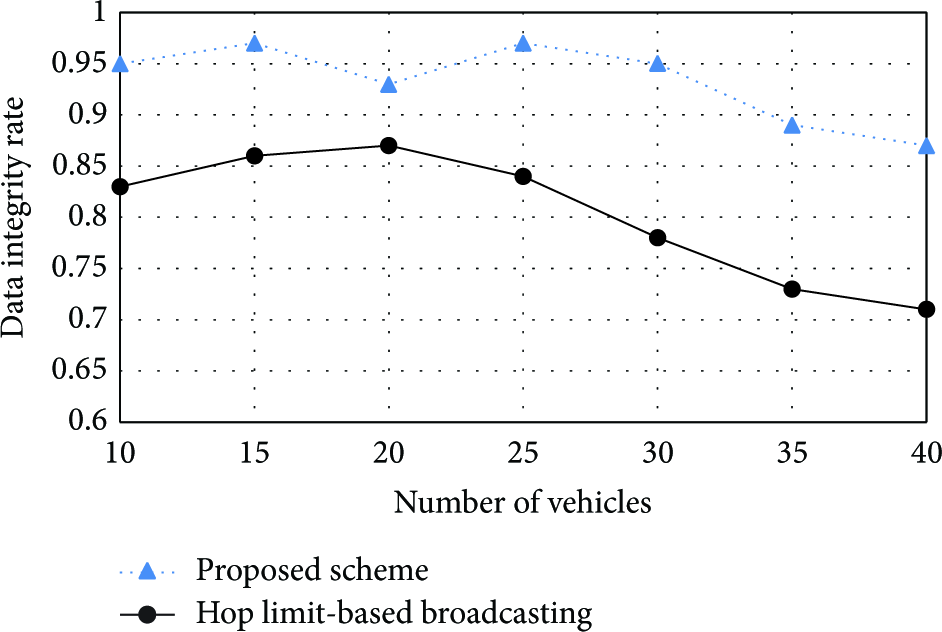
In the second stage, we compare the proposed popular content date download mechanism with other non-V2V transmission schemes according to the network performance analysis. In this stage we compared the performance like successful transmission rate and date integrity rate to show how our schemes help to improve the network performance. Figure 4 compares transmission success rate with the influence of vehicle number. Our proposed scheme obtains a higher transmission success probability than the traditional one. It proves three transmission models: V2R directly, optimal relay vehicle forwarding with bandwidth prediction V2V, and cooperatively in our proposed scheme improve the transmission success rate in the high mobility VANET environment.

Successful transmission rate.
In Figure 5, we show the data integrity rate as a function of number of vehicles. For our schemes, the average data integrity rate gets
Date integrity rate.
5. Conclusions
In this paper, we proposed an efficient scheme to improve the network performance when vehicle nodes download the large popular files from the Road Side Unit (RSU). Due to the constraint density of RSU and high mobility of vehicle nodes, vehicles cannot download the whole large files from RSU before they move out of the communication range. To solve this problem, we proposed a multiple access modes downloading scheme: vehicles download files from RSU directly, vehicles download files through forwarding vehicles, and vehicles download files through V2V communications. Additionally, we adopt the content naming schemes which are introduced in ICN to improve data retrieval and matching speed. And we give credit-based incentives for relay vehicle selection to guarantee the stability and quality of the link bandwidth. We also proposed a game theory-based way to control number of neighbors reply packet, which does not cost additional bandwidth resource and ensure integrity of the files. Finally, we prove our performance and date integrity in high mobility VANET environment by simulations results and analysis.
Footnotes
Conflict of Interests
The authors declare that there is no conflict of interests regarding the publication of this paper.
Acknowledgments
The authors gratefully acknowledge the support of the National Natural Science Foundation of China (NSFC) (61272504, 60833002, and 61271201), the support of National S&T Major Program (2012ZX03005003), the support by Research Fund for the Doctoral Program of Higher Education of China under Grant no. 20130009110010, and the Fundamental Research Funds for the Central Universities (2014JBM006 and 2015YJS011).