




Abstract
An opportunistic network is a network where the nodes need to communicate with each other even if existing routes between them may not permanently exist due to the nodes’ random movement. Most routing algorithms employ a paradigm by which a node can keep the receiving messages, carrying the messages with them when moving and then forwarding the messages to the opportunistic meeting nodes when possible. This routing model works well in the networks with high-to-moderate node density in which the opportunity that the moving nodes can meet with each other is rather high. On the other hand, the delivery ratio becomes remarkably low in the sparse network environment especially when there is a strict constraint on message delivery deadline. In this paper, we introduce the novel concept of rendezvous place where the passing nodes can announce, deposit, or pick up their own messages without having to meet the other nodes carrying the desired message. The rendezvous place can be detected automatically and its area's shape is dynamically changed according to the interaction among nodes. The results from extensive simulations show that our routing algorithm can achieve higher delivery ratio and utilize lower energy consumption than traditional opportunistic routing algorithms especially in sparse network environment.
1. Introduction
An opportunistic network (OppNet) is an extreme type of delay tolerant networks (DTNs) where the source and destination nodes might never be fully connected at the same time. Thus there is no guarantee of the existence of a complete path between two nodes wishing to communicate [1]. This intermittent connections may result from several factors such as high node mobility, low node density, environmental interference and obstruction, short radio range, and malicious attacks [2]. The node movement in OppNet is extremely random in some networking environment; thus the probability of message delivery from source to destination is difficult to ensure. Examples of such networks are sparse mobile ad hoc networks [3], military tactical networks [4, 5], or sensor networks, such as ZebraNet [6], SWIM [7] in which nodes move throughout an environment, working to gather and process information about their surroundings. Commonly, the key differentiating factors among these scenarios are the levels of predictability and control over the contacts between the message carriers [8]. A key concept behind opportunistic routing (OR) is overhearing and cooperation among relaying nodes to overcome the drawback of unreliable wireless transmission [9]. Since the mobile nodes are not always connected to each other, the forwarding algorithms in such networks commonly follow a store-carry-forward (SCF) paradigm. This SCF employs storage space and node mobility to overcome the intermittent connectivity [10]. The messages sent from the source node are carried by intermediate nodes to other geographical areas and transferred to adjacent nodes until the destination node receives this message. Since this fundamental SCF routing model realistically requires a certain sufficient occasion of direct encounter among moving nodes to exchange messages, its routing performance will highly degrade in the low-node-density sparse network [11]. Although there are several existing OppNet routing solutions [5, 12–16] proposed in the literature, very few proposals address the problem in this sparse network environment especially when the OppNet nodes are energy-constrained [17, 18] and the direction of their movement cannot be controlled.
In this paper, we proposed a novel dynamic rendezvous based routing algorithm (DRRA) to increase message exchanging opportunity even in the sparse network environment. We utilize the fact that there should be some node-gathering (rendezvous) places forming somewhere at some specific time in the real network. These rendezvous places may be either predictable such as mobile command post in military tactical network applications or nonpredictable such as disaster and emergency networks. An energy-constrained node should maximize its resource usage to communicate with the others only when entering into the rendezvous area. In the proposed scheme, the rendezvous place is dynamically marked by the help of a special controllable rendezvous node and the proposed rumor protocol to let nodes in the rendezvous area exchange messages more efficiently without having to directly meet with the other nodes.
The rest of the paper is organized as follows. In Section 2, we discuss the overview of OppNet routing model applications and existing works. The detail of rendezvous based routing model is elaborated in Section 3. In Section 4, we present the result of our simulation and show the performance of our scheme under different conditions. We conclude the paper and point out some future research directions in Section 5.
2. The OppNet Routing Model Applications and Existing Works
2.1. OppNet Routing Model and Its Applications
In OppNet, the messages are delivered using store-carry-forward routing by which the nodes can exchange data whenever they come close. If there is no direct connection from source to destination, data holding nodes will discover their nearest neighbor nodes to forward messages toward the destination node as shown in Figure 1. There are several existing works in the literature [5, 16, 19–23] with the aim of 100% delivery ratio which is quite difficult to achieve especially in sparse networks with constraints in energy consumption and message delivery deadline. In addition, it has been reported that most recent well-known opportunistic routing [23–29] is unable to always achieve 100% delivery ratio [30].

Store-carry-forward routing model.
An OppNet routing is designed to address an extreme network environment where the source and destination node might never be fully connected at the same time. The OppNet routing can be used in several recent applications such as Social Mobile Network, Disaster Recovery Networks, Military Tactical Network, and Movable Sensor Networks as described in the recent books [31–33].
Social Mobile Network [34–37]: the OppNet nodes are represented by mobile application utilizing available nearby communication channels to relay the messages toward the destination. Disaster Recovery Networks [38–41]: when a stable infrastructure is destroyed by a natural disaster, the mobile agents are utilized to exchange the messages between victims, first responders, or rescue teams without long range wireless transmission. Military Tactical Network [42–44]: the OppNet nodes are represented by soldiers equipped with communication devices to communicate with each other and mobile command post to facilitate the data exchange in the operational area. Movable Sensor Networks [45–47]: the data collection is done utilizing stationary sensor node and movable sensor node.
The key characteristics in the OppNet environment are
uncontrollable nodes, difficulty of predicting the movement path, limited short length communication channel.
2.2. Existing Works
Vahdat and Becker [16] proposed the epidemic routing using the uncontrolled flooding algorithm in which the replication of source data is not restricted with any limits in order to route the message from source to destination in the intermittently connected network. However, this type of routing incurs a significant demand on both bandwidth and buffer capacity. To address the excess traffic overhead, Harras et al. [19] proposed a controlled flooding scheme which can limit the flooding by three parameters: willingness probability, time-to-live, and kill time. Nevertheless, flooding based routing performance degradation has been reported in a very sparse network [20].
Lindgren et al. [21] proposed a prediction based routing called PROPHET (Probabilistic Routing Protocol using History of Encounters and Transitivity) by estimating the delivery predictability to indicate the probability of success in delivering a message to the destination from the local node. In this prediction based routing category, Burns et al. [22] also proposed a protocol utilizing the motion vector of mobile nodes to predict the future location of mobile nodes by using the knowledge of relative velocities of a node and its neighbor nodes to predict the closest distance between two nodes. Although the prediction based approach can reduce traffic overhead in the network, it fails to improve the performance in an extremely low-node-density scenario and, in some cases, results in the delivery ratio reduction.
To refine the prediction based routing, Boldrini et al. [23] proposed the history based routing (HiBOp) which exploits current context information for data forwarding decisions. Even though this context based routing approach can reduce the resource consumption in terms of network traffic and storage, its delay performance is significantly inferior to that of the epidemic algorithm. Kerdsri and Wipusitwarkun [5] proposed the DORSI protocol with the concept of content based routing which aims to classify the data in the network by messages’ significance level in order to guarantee the delivery of more important data.
The concept of passive relay node can be found on several recent research proposals such as throwbox [48–51], FINs (fixed infrastructure nodes) [12], fixed point [52], or passive relay points [53]. These relay nodes are stationary wireless devices injected into the infrastructure of network in order to create additional contact opportunities and increase the connectivity between mobile nodes.
Some proposals such as WSNs [54–57], data mules [58, 59], or message ferries [60–63] use a similar approach of path planning to program mobile robots to collect information from sensor nodes. However, it may be effective only in the case that sensor nodes are stationary.
Nevertheless, the decreasing in network performance under sparse environment is not mentioned in this proposed protocol. Overall, the performance of most existing algorithms is degrading in very sparse node density, and the energy consumption is not taken into consideration which is a crucial factor in mobile devices.
3. The Proposed Rendezvous Based OppNet System
3.1. System Model
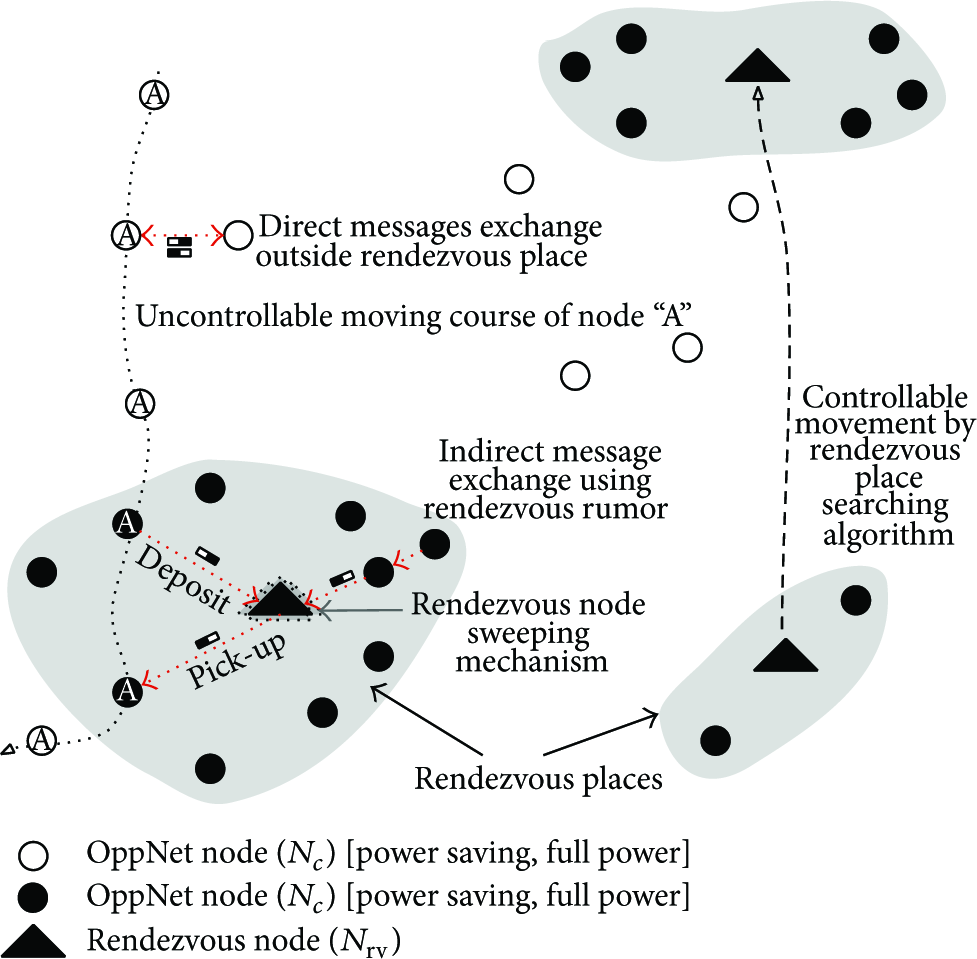
The proposed system is designed to efficiently use the node-gathering area, that is, rendezvous place, for depositing the delivered messages as much as possible so that the messages can be picked up by the destination node without requiring the exact timing of direct contact between the node carrying a message and the desired destination node. In addition, all nodes should reserve their energy as much as possible when they are out of the rendezvous area.
As shown in Figure 2, the OppNet node,
System model.
3.2. OppNet Node's Operational Modes: “Full Power” and “Power Saving”
The OppNet node (
(
1) Full Power Mode. In this mode, the node will use its full transmission power,
(
2) Power Saving Mode. The node, by default, operates in this mode if it is outside the rendezvous place. In this mode, it will alternately change its transmission range between

Operational modes.
3.3. Rendezvous Place and Its Rumor Protocol
The rendezvous place is a dynamic area centered by a special controllable rendezvous node,
The area in a rendezvous place is not fixed as the maximum radio range,
When an OppNet node detects the rendezvous area
Once the rendezvous node receives the keep-alive rumor message which contains the sending node ID, it will gather all data messages destined to the node with that ID from its message storage, encapsulate those found messages into the created pick-up rumor message, and then broadcast the pick-up

Rendezvous place.
In addition to the rendezvous rumor protocol, the rendezvous node implements the rumor message sweeping algorithm in order to increase the chance to collect as many rumor messages as possible. Instead of always being stationary at the center location of the rendezvous place, the rendezvous node will periodically move to its four cardinal directions (north, east, west, and south) by the distance of its radio transmission range as shown in Figure 5. This design lets the OppNet nodes on the edge of rendezvous node's radio range, whose radio signal may not reach to the rendezvous node due to the difference in their radio transmission range, be able to speak back to the rendezvous node.

Sweep mechanism.
3.4. Rendezvous Place Searching Algorithm
In the proposed system, the rendezvous node should move to find the node-gathering area corresponding with the real behavior of OppNet nodes.
( 1) Predictable Behavior OppNet Nodes. In some applications, the movement of OppNet nodes is somehow predictable. For example, the movement of human during the day can be predicted in the opportunistic mobile social network environment [33]. In these applications, the rendezvous nodes can be programmed to be stationed at those areas at the proper time in order to maximize the effectiveness of the proposed system.
(
2) Nonpredictable Behavior OppNet Nodes. Without any a priori knowledge about OppNet nodes, the proposed dynamic rendezvous place searching algorithm can be used to guide the rendezvous nodes to the node-gathering area. The rendezvous node will decide to move to the new node-gathering location if the number of OppNet nodes in the current rendezvous place (


The rendezvous node will decide to stop at the expected node-gathering area when the number of OppNet nodes in the current rendezvous place (

Rendezvous place searching.
Note that, the rendezvous nodes will keep moving until they meet the desired conditions. In addition, in the process of moving, the rendezvous node will keep broadcasting the rendezvous area (
In fact, the ratio of rendezvous node movement (in searching) time and stop (sweeping) time might be an indicator for the sparseness of the OppNet nodes in the network.
4. Evaluation
The objective of the evaluation is to analyze the performance of our proposed protocol on the sparse network environment comparing with traditional OppNet protocols. We compare both predictable and nonpredictable behavior OppNet nodes with the commonly well-known epidemic protocol [16] under different node-density environments.
4.1. Simulation Setup
We set up a simulation environment using ONE (opportunistic network environment) [64], which is a powerful tool designed for running opportunistic network simulation with various routing protocols and different movement models. All the results are obtained by averaging over a few hundreds of independent simulation runs with different seeds. For the OppNet simulation model, the main parameter that largely affects the evaluation performance is the movement model. In our evaluation, we deploy the group movement model instead of the most commonly used random way point (RWP) model [65], to correctly capture the actual behavior of node movements. In fact, several multihop wireless network scenarios are most realistically represented using the group movement model [66] which represents the random motion of a group of mobile nodes as well as the random motion of each individual mobile node within the group. This is the vital case for modeling the routing simulation in OppNet since the movements in several cases are in swarm behavior, in which nodes are aggregating together and moving in some directions, such as the movement of humans in disasters or military tactical operations. The other parameters that mainly affect the evaluation performance are the area of operation, the wireless range of the nodes, node velocity, and spatial locations of the nodes [65]. In our simulation, we fix the number of nodes while increasing and decreasing the area of operation which results in a wide range of node-density parameters for evaluation. Node density (λ) is defined as the number of nodes per unit area. If N nodes are distributed in a square grid of size
Simulation variables.

4.2. Metric
Opportunistic routing protocols are commonly evaluated by delivery ratio, median latency, and network overhead. In this paper, we focus on delivery ratio and network overhead in terms of energy consumed to deliver a message within a specific message deadline. We assume that all messages delivered within the deadline have no difference in protocol performance.
(a) Delivery Ratio (

(b) Energy Consumption (

As a result, the energy consumption (
Note that
(c) Protocol Performance (

In this equation, P is the target protocol while B is the baseline protocol (epidemic protocol, e.g.) to be used as comparative energy reference.
4.3. Simulation Results
This section shows the results of the different sets of simulation runs that have been performed to study the performance of the proposed routing protocol and its behaviors when changing the protocol's key parameters.
(
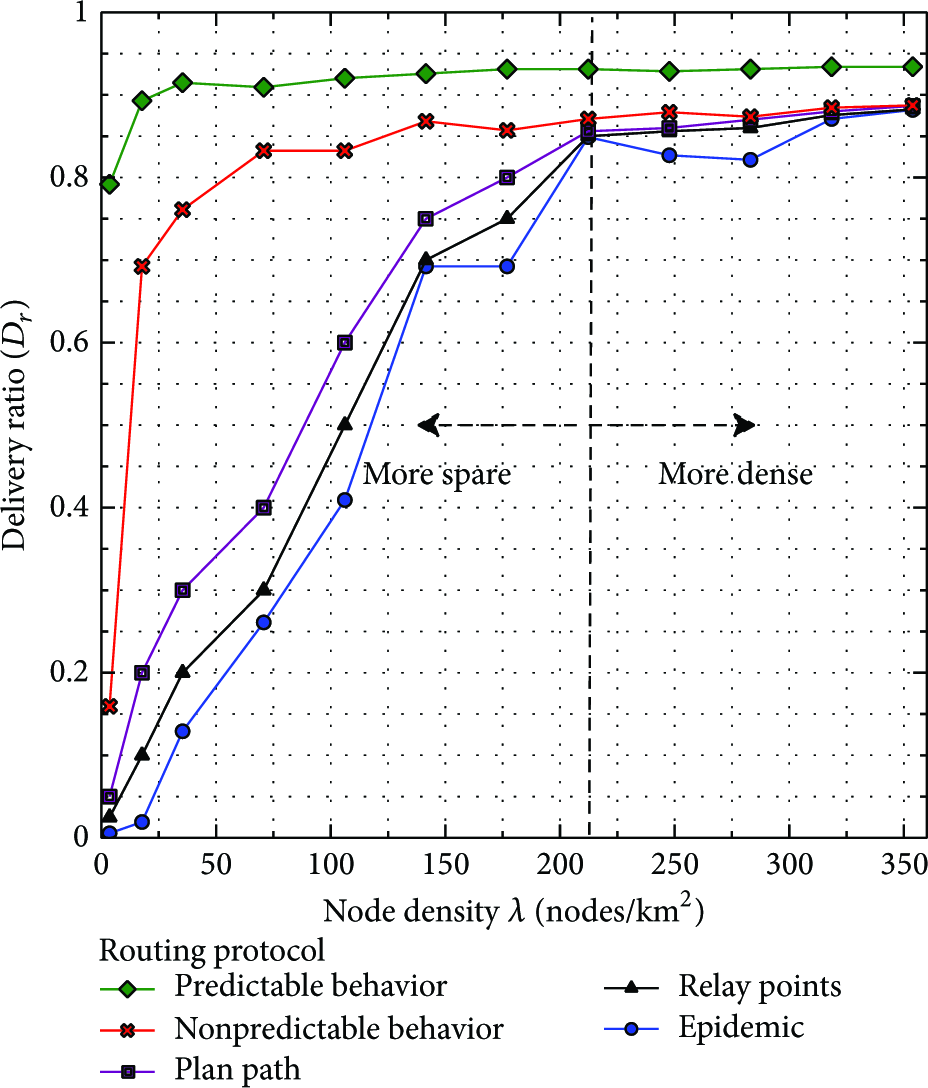
1) General Protocol Performance. Firstly, the comparison of delivery ratio is shown in Figure 7, where the x-axis represents the node density (the number of nodes in the area of one km2) and the y-axis shows the delivery ratio. In our simulation, we assume the environment of one rendezvous node and the ratio of time interval between full power and power saving,
Delivery ratio per node density.
The reason behind this is that the proposed rendezvous concept can facilitate a message exchanging process between nodes passing through the same area but on the different timeline as designed. Those nodes cohabiting on both time and space domains are more likely to appear in dense networks but less likely to emerge in sparse networks. In addition, with the knowledge of node-gathering areas (predictable behavior), the delivery ratio of the proposed protocol can be further increased especially in the extremely low-node-density scenario.
Additionally, if the nodes passively wait for the target node to enter the rendezvous place, it can harm the efficiency of packet delivery as in Figure 7. The relay points algorithm is a relay node implemented from the concept of recent relay node protocol [50, 51] such as throwboxes which is a passive stationary node waiting for the target node to encounter. The result shows that the relay point gains slightly higher delivery ratio than epidemic protocol but significantly lower delivery ratio than rendezvous protocol especially in the sparse area. The reason behind this is because rendezvous protocol can increase the zone of transmission range, thus facilitating gaining efficient node contact opportunities. In plan path, the relay nodes are moving according to the designed plan. In the simulation, the plan path is a zigzag path which can cover all coverage area in a certain time. The result from Figure 7 shows that the plan path presents a similar trend to epidemic protocol while gaining slightly delivery ratio than fixed relay points. However, it cannot achieve delivery ratio as high as that of the proposed rendezvous based protocol due to the dynamic nonstationary movement of OppNet node and the lack of contact activity enhancement like rendezvous protocol.
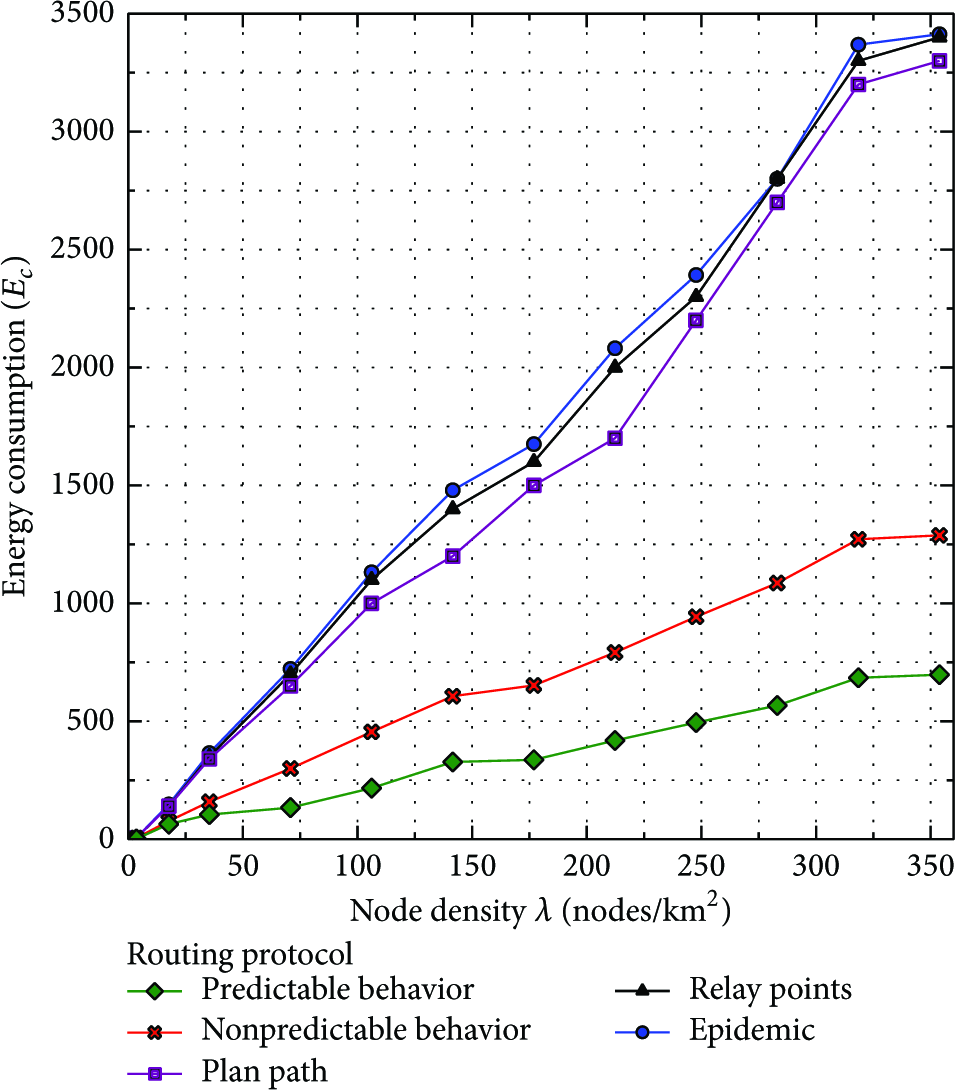
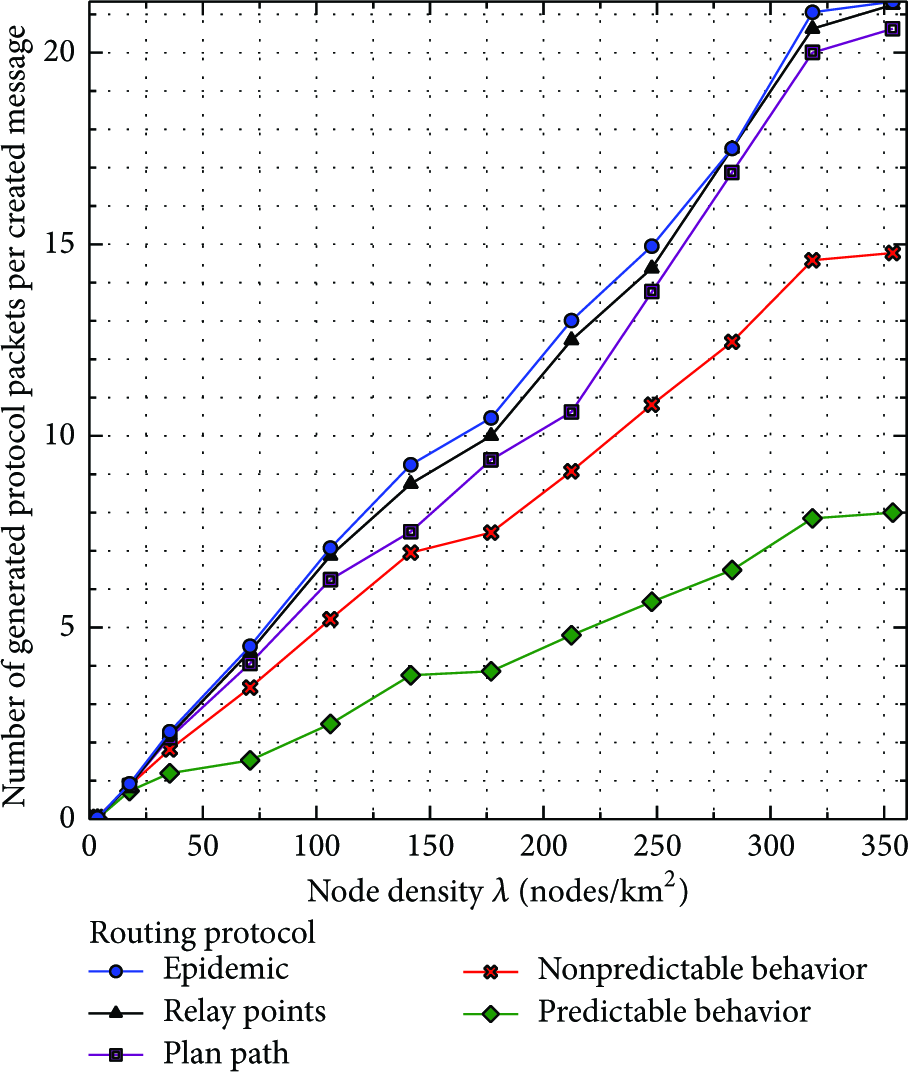
Secondly, the energy consumption (
Energy consumption per node density.
Number of generated protocol packets per created message on node density.
Combining both gains in delivery ratio and energy consumption savings, the proposed general protocol performance can be seen in Figure 10. The epidemic protocol is used as the baseline protocol in

General protocol performance per node density.
(
2) Impacts of the Power Saving Factor. In this subsection, we study protocol parameters relevant to the power saving factor and the tradeoffs between power consumption and delivery ratio. We define the power saving factor, 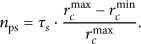
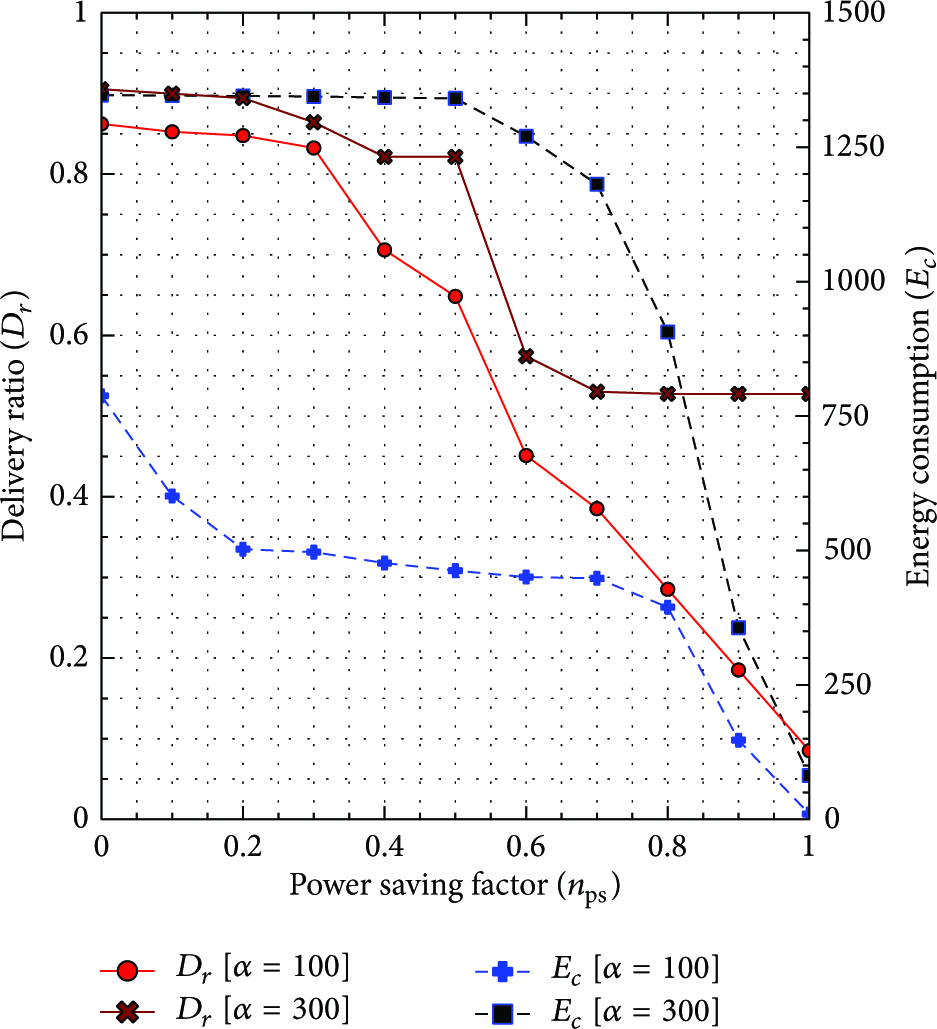
Delivery ratio and energy consumption on power saving factor.
(
3) Other Network Environment Parameters. In this subsection, we investigate other protocol and environmental parameters which may have effects on the proposed protocol performance. Figure 12 presents the variation on the number of rendezvous nodes to analyze the impacts on delivery ratio per node density. This graph shows that more rendezvous nodes can achieve more

Multiple rendezvous nodes.


Movement model comparison.
5. Conclusion
Opportunistic routing techniques can be applied in a plentiful variety of scenarios such as Social Mobile Network, Disaster Recovery Networks, or Military Tactical Network. In this paper, we investigate the use of rendezvous points in opportunistic network routing to increase the delivery ratio in extreme sparse network environment. This novel protocol proposes the two new types of nodes, rendezvous node and OppNet node, which can help in maintaining the messages in one place as long as possible in order to bridge the gap of time and space domains. In this rendezvous place, the passing nodes can announce, deposit, and pick up their own messages without meeting with other nodes that carried desired messages. The size and shape of a rendezvous place can be adapted to the environment of OppNet nodes in the area. We define our routing model in two functions: predictable and nonpredictable behavior OppNet node functions. The results suggest that our protocols perform significantly higher in terms of general protocol performance which is the tradeoff of delivery ratio per energy consumption. This implies that if the location of rendezvous place can be predicted, we can achieve the highest overall performance. In the future work, this concept of smart nodes can be further extended to increase the intelligence of the node since the technologies can be rapidly advanced.
Footnotes
Conflict of Interests
The authors declare that there is no conflict of interests regarding the publication of this paper.
Acknowledgments
This work was supported by Sirindhorn International Institute of Technology, Thammasat University, Thailand, and Basic Research Program from Data Communication Laboratory, Research and Development Department at the Defense Technology Institute, Thailand.