




Abstract
We present an automated verification methodology of the security events, that is, IDS alerts, based on heuristic analysis. The proposed verification methodology aims to automatically identify real cyberattacks from the security events and filter out false positive, so that the security analyst is able to conduct security monitoring and response more effectively. For the proposed verification methodology, we used the 1,528,730,667 security events that were obtained from Science and Technology Security Center (S&T-SEC). We then extracted the core security events that were caused by the real cyberattacks. Among the core security events, we selected the top 20 types of the security events in the number of the real attacks that they raised. By analyzing the top 20 types of the security events, we discovered essential elements and optional elements for using in the automated verification of the security events. The evaluation results showed that the proposed verification methodology could contribute to the reduction (about 67%) of the meaningless security events. Furthermore, we demonstrated that the proposed verification methodology contributed to the detection of 140 true negatives that were not identified by the security analyst and the total accuracy of the proposed verification methodology was 96.1%.
1. Introduction
Intrusion Detection System (IDS) is one of the most powerful security appliances to respond to cyber threats on the Internet [1]. The main purpose of the IDS is to detect cyberattacks using predefined signatures that were made by security experts. Although IDS has been an important role to improve the security level of organizations, it has two main drawbacks. Firstly, it is unable to detect unforeseen cyberattacks, that is, 0-day attack, whose signatures were not made by the security experts. Secondly, the IDS raises not only a tremendous amount of alerts, but also most of them are false positives, i.e., misdetected attacks. Because of this, security analyst who carries out the security monitoring and response suffers from analyzing all the IDS alerts and finding out meaningful alerts related to real cyberattacks from them.
In order to cope with the problems, there have been many efforts on effectively removing meaningless IDS alerts [2–7], extracting attack scenarios [8–11], identifying unknown attacks [12], and visualizing IDS alerts [13, 14]. Although these approaches can contribute to improving performance of the IDS and helping security analyst for efficient analysis of IDS alerts, there is a limitation in that they do not focus on identifying whether the IDS alerts are caused by real cyberattacks or not. Because of this, the security analyst has to carry out additional analysis for the IDS alerts in order to identify real cyberattacks.
In this paper, we present an automated verification methodology of the security events, that is, IDS alerts, based on heuristic analysis. This research is an expansion of our pervious approach [15]. The proposed verification methodology aims to automatically identify real cyberattacks from the security events and filter out false positive, so that the security analyst is able to conduct security monitoring and response more effectively. For the proposed verification methodology, we used the 1,528,730,667 security events that were obtained from Science and Technology Security Center (S&T-SEC) [16]. It is providing security monitoring and response service for the Korean government research institutes and has deployed Threat Management System (TMS) into the boundary network of each organization. TMS is similar to the IDS. The S&T-SEC collects all of the security events, that is, TMS events, obtained from TMSes of Korean government research institutes and security analyst analyzes them to identify which security events are associated with real attacks or false positives.
Among the 1,528,730,667 security events, we extracted the core security events that were caused by the real cyberattacks. Among the core security events, we selected the top 20 types of the security events in the number of the real attacks that they raised. By analyzing the top 20 types of the security events, we discovered essential elements and optional elements for using in the automated verification of the security events.
In order to evaluate effectiveness of the proposed verification methodology, we used 1,528,730,667 security events. The evaluation results showed that the number of security events which should be analyzed by the security analyst was reduced by 33% of the entire security events if we apply the proposed verification methodology to only the top 20 security events. This means that the proposed verification methodology contributes to improving the rapidity of the security monitoring and response. Also, we recognized that the proposed verification methodology contributed to detection of 140 true negatives that were not identified by the security analyst. Finally, the total accuracy of the proposed verification methodology was 96.1% with respect to the top 20 types of the security events.
The rest of this paper is organized as follows. In Section 2, we give a brief description for the existing approaches based on IDS alerts. In Section 3, we describe the proposed verification methodology in detail. In Section 4, we provide experimental results of the proposed verification methodology. Finally, we present concluding remarks and suggestions for future work in Section 5.
2. Related Work
Many approaches have been proposed for managing and analyzing IDS alerts effectively. They can be categorized into four groups by their purpose. The first group is that they focus on the reduction of IDS alerts that are false positives [2–7]. In order to reduce the meaningless IDS alerts, they mainly use machine learning and data mining techniques, especially clustering algorithms such as K-NN, based on comparison of similarity among IDS alerts. For example, Giacinto et al. proposed a clustering method of IDS alerts so as to make unified description of attacks and attain a high-level description of cyber threats. Treinen and Thurimella made meta-alarms to identify known attack patterns in IDS alerts and used a data mining technique, that is, association rule. The main purpose of the second group is to build attack scenarios from IDS alerts and to find out real cyberattacks that were matched to the predefined attack scenarios [8–11]. Thus, there is a limitation in that they only deal with the previously known cyberattacks. The third group focuses on the detection of unknown attacks from IDS alerts [12]. To this end, it extracts seven statistical features from IDS alerts and finds out 0-day attacks whose statistical values are different from the normal IDS alerts. The last group is based on visualization of IDS alerts to intuitively detect remarkable cyber threats from usual IDS alerts [13, 14].
3. Proposed Methodology
3.1. Overall Architecture and Procedure
Figure 1 shows the overall architecture and the procedure of the proposed methodology for automated verification of security events that were detected by TMS. The proposed methodology is composed of three main phases: selecting data types, feature extraction, and automated verification process. During the phase of selecting data types, it first collects security events recorded by TMS and classifies them into two types. One is the type of core security events related to real cyberattacks while the other type is false positives that are not related to real cyberattacks. By investigating the core security events, it extracts 7 data types that are used for the second phase. See Section 3.2 for more detail.
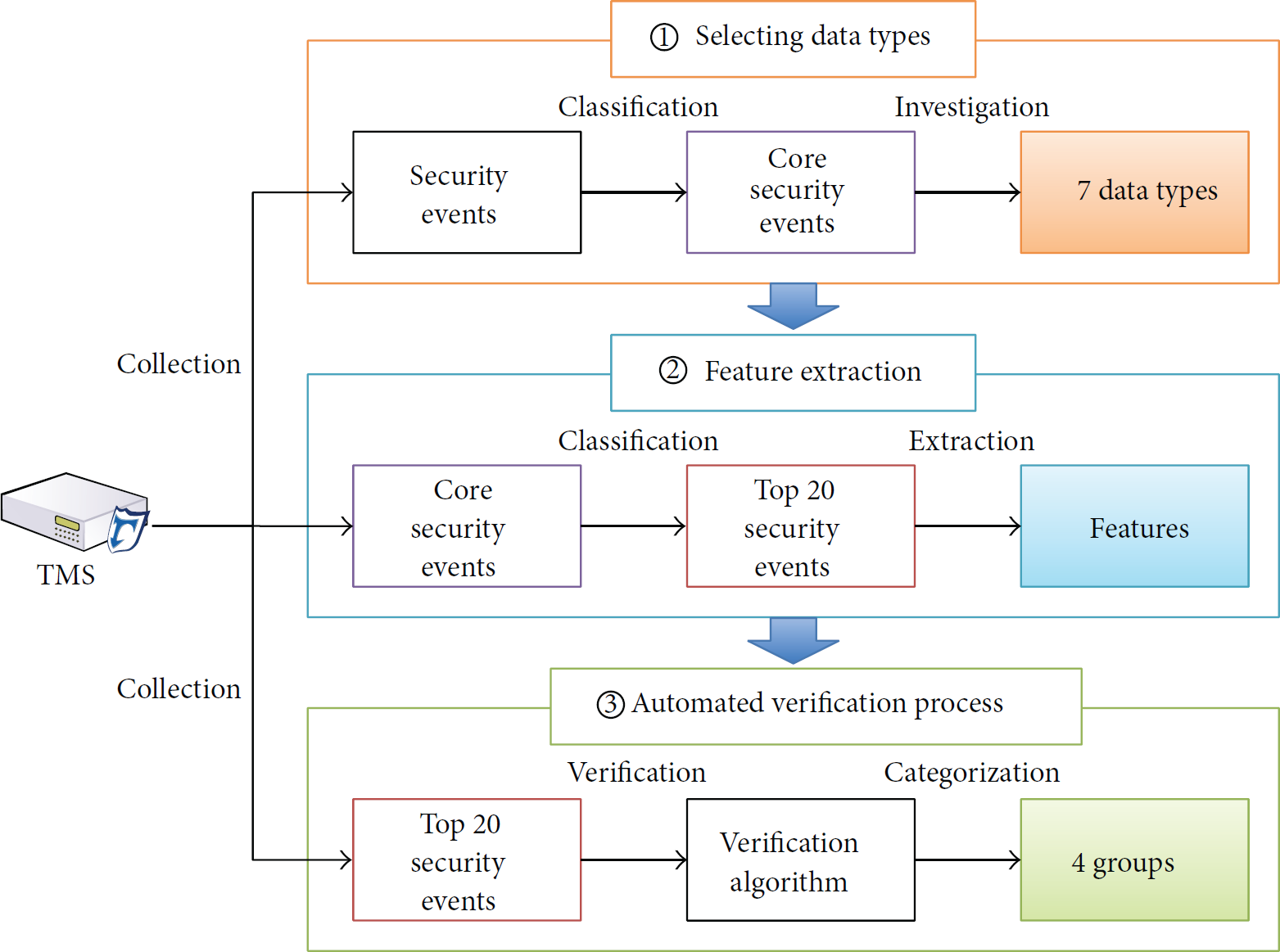
Overall architecture and procedure of the proposed methodology.
The feature extraction phase starts with classifying top 20 security events from the core security events. It then extracts features for using the automated verification with respect to each type of top 20 security events. Since TMS records the security events using two types of detection mechanism (i.e., signature and threshold based detection mechanisms), the features are also divided into two types. See Section 3.3 for more detail.
Finally, the automated verification process makes the verification algorithm using the features that were extracted from the second extraction phase. It then categorizes top 20 security events into 4 groups automatically. See Section 3.4 for more detail.
3.2. Selecting Data Types
Figure 2 shows the overall procedure of the first phase, that is, the selecting data types, which consists of three main steps: Collection, Analysis, and Extraction. The main purpose of this phase is to determine data types that are useful for the verification of the security events. For this phase, we used the security events of 7 years and 3 months (March 10th, 2006~May 31st, 2013) that were detected by TMSs of S&T-SEC. Among the security events, we observed that there were 9,036 real attacks and collected the core security events that were related to them. Also, the core security events have 799 types of the security events. Note that we sanitized the name of the security events due to the security problem. We analyzed the core security events based on the know-how of the analyst in S&T-SEC, the past accident history, related papers, and cooperation with the related external security institutes. As a result, we extracted 7 significant data types for using the verification of the security events as follows.
SRC/DST IP. Source and destination IP addresses that were used for the session. SRC/DST PORT. Source and destination port numbers that were used for the session. NETWORK. Type of networked systems such as WEB server, SMTP server, and DNS server. PROTOCOL. Protocol used for the communication such as TCP, UDP, and ICMP. Number of SECURITY EVENTS. Number of the security events with the same source IP address. PACKET SIZE. Size of the packet attached in the security event. PAYLOAD. Payload of the packet attached in the security event.

Overall procedure of the phase for selecting data types.
3.3. Feature Extraction
3.3.1. Overall Procedure
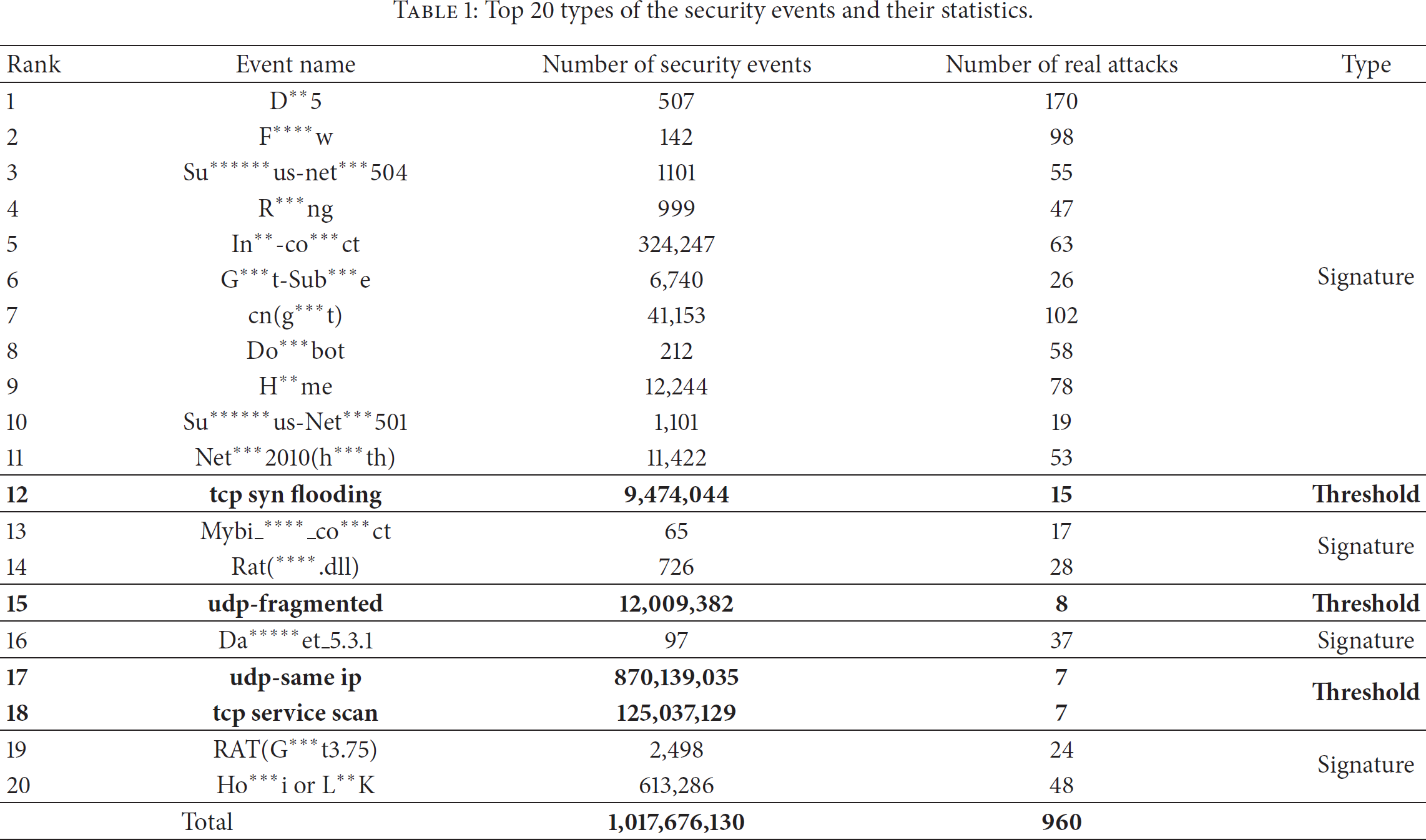
Figure 3 shows the overall procedure of the second phase, that is, the feature extraction, which consists of three main steps: Classification, Extraction, and Verification. The main purpose of this phase is to extract features that are used for the verification of the security events. For this phase, we used the security events of 8 months (May. 1st, 2012~December 31st, 2012) and 7 months (January 1st, 2013~July 31st, 2013) that were detected by TMSs of S&T-SEC. The total number of the security events was 1,528,730,667. Among the entire security events, we selected the top 20 types of the security events in the number of real attacks that they raised as shown in Table 1. Note that we sanitized the name of the security events due to the security problem. The total number of the real attacks caused by the top 20 types of the security events was 960. Also, 923 real attacks were related to the 16 types of the security events detected by signature based detection mechanism while the rest of real attacks were related to the 4 types of the security events detected by threshold based detection mechanism. We then analyzed all of the security events related to the top 20 security events based on the 7 data types extracted in the first phase. From the analysis, we extracted three types of features (i.e., essential elements, optional elements, and parameters) with respect to each type of the top 20 security events. Finally, we verified the security events using the three types of features, so that we are able to divide them into four groups: true positive group (i.e., real attacks), false positive group, unverified group, and verified group. In case of unverified and verified group, security analyst needs to carry out additional analysis for the security events in order to determine whether they are related to the real attacks or not, while the security events that belong to the rest of two groups do not require additional analysis by the security analyst.
Top 20 types of the security events and their statistics.

Overall procedure of the feature extraction phase.
3.3.2. Signature Based Security Events
In case of the 16 types of the signature based security events, we focused on only the security events which are directly related to the real attacks and analyzed them based on the 7 data types of the first phase in Section 3.2. During the analysis, we checked which data types are useful for determining the real attacks with respect to each type of the signature based security events. As a result, we observed that only 2 data types, “SRC/DST IP” and “PAYLOAD,” are the most significant while the 5 data types (i.e., “SRC/DST PORT,” “NETWORK,” “PROTOCOL,” “NUMBER of SECURITY EVENTS,” and “PACKET SIZE”) do not contribute to determination of real attacks almost. In addition, in case of the data type of “PAYLOAD,” we extracted common strings that are included in the security events of the real attacks and recognized that there are two types of common strings. The first type is that they appeared in all the security events of the real attacks. The second type is that they appeared in the subset of the security events of the real attacks. Because of this, we divided the common string into essential elements (i.e., the first type) and optional elements (i.e., the second type). Also, the essential and optional elements have their parameters as unfixed strings or values. In case of the data type of “SRC/DST IP,” it represents only source and destination IP addresses of the security events. Thus, they do not have common strings (including parameters) like the data type of “PAYLOAD.” So, we only checked whether the location (i.e., inside or outside of the organization) of the IP addresses in the security events is important or not for determining real attacks. With respect to their significance, they are also divided into essential elements or optional elements. Table 2 shows an example of features that were extracted from the 507 security events of
Example of features of D

3.3.3. Threshold Based Security Events
In case of the 4 types of the threshold based security events, the corresponding packets do not have payload data in most cases. Even though they contain some data, it represents a form of garbage, that is, meaningless strings like “AAAAA.” Because the main purpose of the cyber threats related to the threshold based security events is to send a lot of packets to the target hosts or networks in a short time (e.g., one second), the victims cannot provide their service or work normally anymore. Thus, it is not able to extract meaningful strings (i.e., essential and optional elements) from payload data of the security events. Instead of the common strings, therefore, we adopted the characteristics of the threshold based security events for verifying them in an automated manner.
Due to the detection mechanism of the threshold based security events, they have the following two main characteristics. Firstly, there are lots of the security events that were caused by the same source IP address if they are caused by a real attack, because attackers have to send a tremendous amount of packets to the victim(s) in order to succeed in their attack. In this situation, it is obvious that the number of the security events caused by the specific source IP address is very large. Therefore, we use the number of the threshold based security events as an essential element for verifying them automatically. See Section 3.4 for more detail.
Secondly, the location of the destination IP addresses in the security events is distributed on the wide range. Because attackers tend to send their attack packets to the victims at random when they aim to search and probe their targets, we use the destination IP addresses of the threshold based security events as the second essential element for automated verification for them. See Section 3.4 for more detail.
3.4. Automated Verification Process
Figure 4 shows the overall verification process of the signature based security events and the threshold based security events. In case of the former, the verification process is as follows.
Classification. In general, new types of the security events are provided by the security vendors periodically. Thus, it is unable to verify all types of the security events in practice. This classification step aims to check whether the security event fed into the verification process is verifiable or not. If the corresponding security event can be verified, then it is sent to the essential comparison step. Otherwise, it is sent to the group of unverified events which should be analyzed by the security analyst. Essential Comparison. With respect to each security event sent from the classification step, we compare the corresponding essential elements with its real data. If it satisfies all the essential elements, then it is sent to the optional comparison step. Otherwise, it is regarded as false positive which should not be analyzed by the security analyst anymore. Optional Comparison. With respect to each security event sent from the essential comparison step, we compare the corresponding optional elements with its real data. If it satisfies one of all the optional elements at least, then it is regarded as true positive, that is, real attack. Otherwise, it is sent to the group of verified events. The security analyst needs to check whether it is caused by a real attack or not using the verification results obtained from the essential and optional elements. This means that the security analyst does not have to analyze it anymore.

Overall verification process of the security events.
In case of the threshold based security events, the verification process is as follows.
Classification. This classification step aims to check whether the security event fed into the verification process is verifiable or not. If the corresponding security event can be verified, then it is sent to the Extracting step. Otherwise, it is sent to the group of unverified events which should be analyzed by the security analyst. Extracting. It extracts source IP address from the original security event sent from the classification step. The source IP address is sent to the history comparison step. History Comparison. With respect to the source IP address sent from the extracting step, we compare it with that of the other security events in which the time interval is one day. If a security event exists in that its source IP address is the same with the original security event, then the original security event is regarded as true positive, that is, real attack. Otherwise, it is regarded as false positive which should not be analyzed by the security analyst anymore. Darknet Comparison. With respect to the source IP address sent from the extracting step, we compare it with a set of unused IP addresses (i.e., darknet). If the source IP address matches to the darknet, then it is regarded as true positive, that is, real attack. Otherwise, it is regarded as false positive which should not be analyzed by the security analyst anymore.
4. Performance Evaluation
In order to evaluate effectiveness of the proposed verification methodology based on heuristic analysis, we first estimated the reduction rate of the security events by the proposed verification methodology. For this evaluation, we compared the number of the entire security events with that of the top 20 security events which can be applied to the proposed methodology. Figure 5 shows the number of the entire security events and the top 20 security events and their ratio. From Figure 5, we can easily see that the entire security events numbered 1,528,730,667 and the number of the top 20 security events was 1,017,676,130 which are responsible about 67% of the entire security events used in our experiment. This result means that the number of security events which should be analyzed by the security analyst was reduced by 33% of the entire security events if we apply the proposed verification methodology to the top 20 security events. Therefore, it could be said that the proposed verification methodology contributes to improving the rapidity of the security monitoring and response.

Comparison of the entire security events and the top 20 security events.
Secondly, we estimated the accuracy of the proposed verification methodology. For this evaluation, we further investigated the security events that belong to the true positive (real attacks) by the proposed verification methodology. As described in Section 3.3, the total number of the real attacks that were identified by the security analyst of S&T-SEC was 960. However, when we applied the verification methodology to the entire security events, we observed that there are 140 additional candidates for real attacks as shown in Table 3. In other words, 131 signature based security events were matched to the essential and the optional elements and they are grouped into the true positive. Also, 9 threshold based security events were satisfied with one of the two conditions (i.e., event history and darknet) and, consequently, they were identified as real attacks. In our further analysis, we recognized that the 140 candidates are related to real attacks. This result means that the proposed verification methodology can contribute to detection of true negatives that were not identified by the security analyst. Some examples of the 140 true negatives can be referred from our previous work [17].
Number of the real attacks unidentified by the security analyst.

Finally, we estimated the accuracy of the proposed verification methodology using new set of the security events (May 1st, 2012~December 31st, 2012 and January 1st, 2013~December 31st, 2013). Table 4 shows the evaluation results. Note that the evaluation period of each type of the security events is different because the corresponding real attacks were caused by different periods. We applied the proposed verification methodology to the top 20 security events and estimated the verification accuracy by identifying whether the true positives by the verification methodology are real attacks or not. From Table 4, we can easily see that the total accuracy of the proposed verification methodology is 96.1%. In addition, only 5 types of the security events among the top 20 security events have less than 100% of the accuracy and the other 15 types of the security events have 100% of the accuracy. In order to improve the accuracy of the 5 types of the security events, it is needed to verify them by using additional dynamic features, not only static features, that is, the essential and the optional elements, proposed in this paper.
Accuracy of the proposed verification methodology.

5. Conclusion
In this paper, we have proposed the automated verification methodology of the security events based on heuristic analysis. The proposed verification methodology aims to automatically identify real cyberattacks from the security events and filter out false positive. During the heuristic analysis, we used the 1,528,730,667 security events that were obtained from Science and Technology Security Center (S&T-SEC) [14]. Among the 1,528,730,667 security events, we extracted the core security events that were caused by the real cyberattacks and selected the top 20 types of the security events in the number of the real attacks that they raised. By analyzing the top 20 types of the security events, we discovered essential elements and optional elements for using in the automated verification of the security events.
The evaluation results showed that the number of security events which should be analyzed by the security analyst was reduced by 33% of the entire security events if we apply the proposed verification methodology to only the top 20 security events. This means that the proposed verification methodology contributes to improving the rapidity of the security monitoring and response. Also, we recognized that the proposed verification methodology contributed to detection of 140 true negatives that were not identified by the security analyst. Finally, the total accuracy of the proposed verification methodology was 96.1% with respect to the top 20 types of the security events. Furthermore, it is very important that the collection terms of the security events used in this paper never affect the verification quality of the proposed methodology. Because each security event is raised when a specific cyberattack happened, it always corresponds to the same cyberattack. Therefore, if we apply the proposed methodology into the top 20 types of the security events, its verification quality is always the same even if the collection terms are different.
In the future work, we first consider analyzing the cyberattacks in which they use encrypted payload. Because the signature based security devices, for example, IDSs, cannot detect such cyberattacks, the proposed methodology deals with only the security events detected by them. In addition, it is needed to estimate the verification quality of the proposed methodology when we apply it into the security events that were collected in the different terms, because the top 20 types of the security events will be changed for each term according to the alteration of the attack fashion.
Footnotes
Conflict of Interests
The authors declare that there is no conflict of interests regarding the publication of this paper.
Acknowledgments
This research was supported by “Construction and Operation of Science and Technology CyberSecurity Center” Program funded by the Ministry of Science, ICT, and Future Planning (G-14-GM-IR02) and “A Study on Advanced Autoverification Technology of Large-scale Security Events” Program funded by Korea Institute of Science and Technology Information (K-14-L06-C15-S01).