




Abstract
One-slot link scheduling is important for enhancing the throughput capacity of wireless sensor networks. It includes two aspects: maximum links scheduling (MLS) and maximum weighted links scheduling (MWLS). In this paper we propose two heuristic algorithms for the two NP-hard problems with obvious power assignments under the SINR (signal-to-interference-plus-noise-ratio) model. For MLS, we propose an algorithm MTMA (maximum tolerance and minimum affectance), which improves the currently best approximation algorithm by 28%–62% on average. For MWLS, we give an effective heuristic algorithm MWMA (maximum weighted and minimum affectance), which performs better on improving the throughput and reducing the running time. The correctness and performance of our algorithms are confirmed through theoretical analysis and comprehensive simulations.
1. Introduction
During the past two decades, wireless networks have obtained a fast and comprehensive development due to low cost, low power, and self-organization. The application areas ranged from military to civil, enterprise to home, wide area to short distance, and so on (e.g., [1–4]). In a wireless network, a fundamental problem is how many communication links can be concurrently transmitted. This problem has attracted tremendous attention. Link scheduling determines which transmitter-receiver pairs (links) can be simultaneously activated at a given time slot. It is widely acknowledged that efficient scheduling can enhance the capacity, decrease delay, and prolong the lifetime of wireless networks. Link scheduling is one of the major performance bottlenecks in wireless multihop networks, especially after the pioneer work of Gupta and Kumar [5]. As transmissions utilize common medium in wireless communications environments, mutual interference among concurrently transmission links is an important issue. In order to characterize the interference, two models have been commonly used: one is the graph-based interference model and another is the physical interference model. The signal-to-interference-plus-noise-ratio (SINR) model reflects physical reality more accurately and is therefore often simply called the physical model. Link scheduling problem under both models has been proved to be NP-hard [6]. The choice of the interference model has a significant impact on the difficulty of developing algorithms with performances close to being optimal. For graph-based model, a node can receive a message correctly if and only if no other nodes in physical proximity transmit at the same time. However, this model has deficiency; for instance, if the power levels of the nodes are chosen properly, then a node may successfully receive a message in spite of being in the transmission range of other simultaneous transmitters. It has been recognized that graph-based interference models may be overly simplistic because they ignore the cumulative effect of wireless interference. Compared to the graph-based model, the physical interference model has been recognized as a more realistic and accurate model for interference in wireless communications. In this model, a communication is successful if and only if the ratio of the received signal to the total interference caused by all other concurrently transmitting nodes plus noise at the receiver is beyond a threshold.
One-slot link scheduling includes maximum link scheduling (MLS) and maximum weighted link scheduling (MWLS), which have been proved to be NP-hard. It is possible to design heuristic algorithms with better realistic performance. Given a set of links, MLS is to compute the largest possible subset of links that can be scheduled simultaneously without interference. Given a set of links and given that each link is assigned a weight, MWLS is to find a set with maximum total weight which can be scheduled simultaneously without interference.
In wireless communication networks with limited resources, efficient resource allocation (e.g., power control, link scheduling) plays an important role in achieving good performance. Resource allocation in wireless networks involves solving a joint link scheduling and power allocation problem which is very difficult in general. Due to this difficulty, most of the existing works in the literature consider a simple setting where all nodes in the network use fixed transmission power levels where the resource allocation problem degenerates into simply a link scheduling problem. There are two variants of the link scheduling under the physical interference. In link scheduling with power control, the power assignment is part of the solution. In link scheduling with fixed power assignment, the power assignment is prespecified. Typically, the prespecified power assignment is oblivious; in other words, the transmission power of the sender of each link depends only on the path loss factor of the link.
In this paper, we use oblivious power assignments and the most basic oblivious assignment is uniform power, where each link
The main contributions of the problem are as follows. First, we give two effective algorithms for MLS and MWLS under the SINR model, respectively. And we prove the correctness of our algorithms through theoretical analysis. Second, we confirm the good performance of the two algorithms by comprehensive simulations. We also verify the importance of choosing the right power assignment and find out which power assignment performs better on our algorithms by simulation.
The rest of the paper is organized as follows. In Section 2, we briefly review related work. In Section 3, we present our system model and formally define MLS and MWLS problems. We give effective heuristic algorithms for MLS and MWLS problems in Sections 4 and 5, respectively. In Section 6, we verify the efficiency of our algorithms by simulation. Finally, we conclude this paper in Section 7.
2. Related Works
In this section, we only review the previous work related to the one-slot link scheduling problem. Most of the existing works in this context adopt the graph-based interference models, where transmissions on any two links in the network are assumed to be conflict or conflict-free. The inefficiency of graph-based protocols is well documented and has been shown theoretically as well as experimentally [7, 8]. These models are simple to analyze but are too simplistic, while the physical interference model (referred to as the SINR model) is considered much more realistic. And link scheduling in the SINR model is more difficult than that in graph-based models. In 2000, Gupta and Kumar first presented the physical model, analyzed the total capacity of wireless networks, and gave some upper bounds [5]. In 2006, Moscibroda and Wattenhofer presented an algorithm that successfully schedules a set of links in polylogarithmic time, even in arbitrary worst-case networks [9]. In another paper, Moscibroda et al. first defined the link scheduling problem [10].
In [6], Goussevskaia et al. proved MLS problem is NP-hard and presented an
In [17], Xu and Tang proposed a maximum weighted link scheduling algorithm with approximation ratio of
The relation between scheduling using oblivious power and scheduling using arbitrary power was first studied in [22]. The works of Halldórsson [22] and Kesselheim and Vöcking [23] are particularly relevant: the first in the context of oblivious-arbitrary comparison and the second in the context of oblivious power. In [24], Halldórsson and Mitra studied how well oblivious power assignments can handle the power control problem and provide tight characterization (upper and lower bounds) for certain cases. They also proved that the mean power assignment is optimal for capacity maximization of bidirectional links. However, they assumed that the ambient noise N is neglected. In our paper, we study the scheduling problem with oblivious power assignments and take the noise into consideration.
3. Model and Definition
Given a set
Choosing an appropriate interference model is crucial when studying scheduling problem in wireless networks. We use the standard signal-to-interference-plus-noise-ratio (SINR) model, where a message can be transmitted successfully depending on the ratio of the received signal strength and the sum of the interference caused by nodes sending simultaneously plus noise level.
Assume that the nodes can transmit with different power. Let
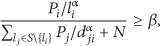
where N is the ambient noise,
Next we formally define the MLS problem and MWLS problem.
MLS Problem. Given a set
MWLS Problem. Given a set
The notion of affectance was introduced in [11] and refined in [24], which has many technical advantages. The affectance
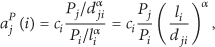
where
The tolerance

The residual tolerance

A link
4. Maximum Tolerance and Minimum Affectance Based MLS Algorithm
In this section, we give an effective heuristic algorithm to solve the MLS problem under the SINR model, which can achieve significantly better results in practice. Our proposed algorithm MTMA (maximum tolerance and minimum affectance) is an improved version of MTIR (maximum tolerance-to-interference-ratio) given by Yang et al. [25].
The basic idea of MTMA is as follows. Firstly, we add a link with maximum link tolerance into the time-slot and update the residual tolerance of other links. Then we greedily schedule a feasible link with minimum
(1) (2) Compute (3) Select a link (4) (5) (6) (7) (8) (9) (10) (11) (12) Select a feasible link (13) (14) (15) (16) (17) (18) (19) (20) (21) (22) (23) (24)
The key of MTMA is to choose the link with minimum
Next, we prove the correctness and the time complexity of Algorithm 1.
Theorem 1.
MTMA can compute a feasible link set with time complexity of
Proof.
The feasibility of each link in S can be directly guaranteed by Lines 5–10, Line 12, and Lines 17–22. In those steps we check whether the selected links constitute a feasible schedule by making the links update the residual tolerance of other links. The definition of residual tolerance transforms from the formula of the SINR model. If residual tolerance of unscheduled links drops below 0, we remove it from L, because it does not satisfy the SINR constraints. Hence, we can obtain a feasible link set at last. Next we analyze the time complexity of MTMA. Line 2 takes
5. Maximum Weighted and Minimum Affectance Based MWLS Algorithm
In this selection, we propose effective heuristic algorithms with good performances for MWLS. It is easy to know that the key step of the algorithm is to greedily select an appropriate link to schedule. When we choose the links, if we take maximum weight into consideration only, a set of links may not satisfy the feasible link condition since link tolerance is too small. If we consider link tolerance and affectance only, it is meaningless for solving MWLS problem. In order to choose the optimal links, we combine the maximum weighted link tolerance and minimum affectance into consideration. The pseudocodes for MWMA are provided in Algorithm 2.
(1) (2) For each link (3) Select a link (4) (5) (6) (7) (8) (9) (10) (11) (12) (13) Select a feasible link (14) (15) (16) (17) (18) (19) (20) (21) (22) (23) (24) (25) (26) (27) (28) (29) (30) (31) (32) (33)
The basic idea of Algorithm 2 is as follows: we first compute the
Theorem 2.
All links in
Proof.
Let
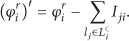
After the joining of

The residual tolerance of

From (1), then

Therefore all links in
Theorem 3.
The time complexity of MWMA is
Proof .
MWMA takes
6. Numerical Results
In this section, we evaluate the performance of our algorithms by comparing them with existing algorithms. For the maximum links scheduling problem, we implemented Algorithm 1 (denoted by MTMA) under the uniform power assignment and compared it with algorithms in [5, 12, 25] (denoted by GSINR-OS, MISL-OS, and MTIR, resp.). We also implemented Algorithm 1 with three different obvious power assignments. For maximum weighted links scheduling problem, we implemented Algorithm 2 (denoted by MWMA) with three different obvious power assignments and compared it with algorithm in [19] (denoted by PMWSL).
It is easy to know that the length of link would affect the performance, because we focus on oblivious power assignments, where the received signal strength depends on the length of link. In the SINR model, a message can be transmitted successfully depending on the ratio of the received signal strength and the sum of the interference caused by nodes sending simultaneously plus noise level. Hence, the propagation distance, one-hop transmission range, distribution of nodes, and nodes density can affect the performance of the algorithms. As in [25], we uniformly distributed links in a 1000 × 1000 square region. The length of each link is randomly chosen between 1 and 30. The number of nodes (twice the number of links) was chosen to be
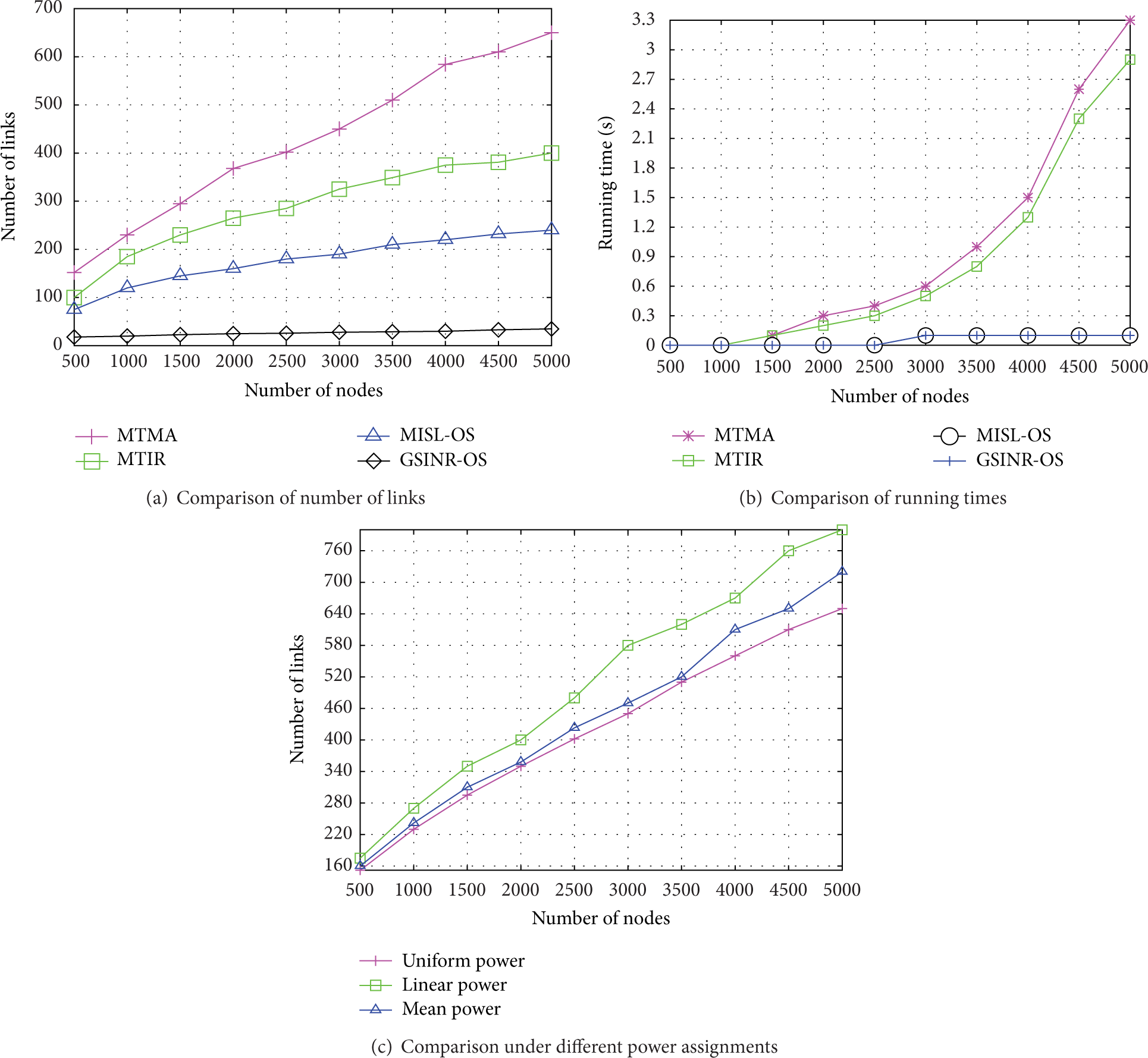
Performance comparison of MLS algorithms.
Figures 1(a) and 1(b) show the average number of links scheduled by MTIR, MISL-OS, GSINR-OS, and MTMA and the corresponding average running times with the increase in the density of nodes. We observe that MTMA schedules more links in one slot than MTIR, MISL-OS, and GSINR-OS by 28%–62%, 103%–122%, and 912%–995%, respectively. Moreover, our algorithm performs better along with the number of links increasing. As shown in Figure 1(b), GSINR-OS runs very fast since it is a linear time algorithm. Surprisingly, MISL-OS with a theoretical time complexity of
Figures 2(a) and 2(b) show the total weight of links scheduled by MWMA and PWMSL and the corresponding average running times with the increase in the density of nodes. From Figure 2(a), we observe that the total weight obtained by MWMA is almost twice as many as the corresponding schedule weight computed by PWMSL. This is what we expected, since more accurate information is used by MWMA for selecting the next link. We take maximum weighted and minimum interference into account and MWMA can find a better feasible set to schedule. From Figure 2(b), we can see our algorithm takes less time than PWMSL. Hence. MWMA performs better on both improving the throughput and reducing the running time. Figure 2(c) shows the influence of the three different oblivious power assignments for MWMA; our Algorithm 2 performs better with the linear power assignment than mean power assignment and uniform power assignment. Hence, linear power assignment is the best alternative for our algorithm.

Performance comparison of MWLS algorithms.
7. Conclusion
In this paper, we study the link scheduling problem with oblivious power assignment and propose two algorithms for one-slot link scheduling. For the maximum links scheduling problem, we designed an effective heuristic algorithm MTMA, which improves the currently best approximation algorithm by 28%–62% on average. For maximum weighted links scheduling problem, we designed an effective heuristic algorithm MWMA, which performs better on improving throughput and reducing the running time. As a following work, we will study scheduling problem under other interference models such as various fading models and explore distributed SINR based scheduling algorithm for wireless networks.
Footnotes
Conflict of Interests
The authors declare that they do not have any conflict of interests.
Acknowledgments
This work is partially supported by the NNSF of China for Contract 61373027 and NSF of Shandong Province for Contract ZR2012FM023.