




Abstract
In wireless sensor network, two scenarios are combined which involve either short-range or long-range communications. IEEE 802.15.4g and IEEE 802.11 are considered in machine to machine environments, because they can utilize the identical frequency band. The performances of the physical modes of the IEEE 802.15.4g and the IEEE 802.11 standards are presented and are compared in terms of the bit error rate and throughput when additive white Gaussian noise, shadowing, and multipath fading channels are assumed. The numerical results show that IEEE 802.11 is more vulnerable than IEEE 802.15.4g in the shadowing channels when compared to the AWGN channel. For the multipath fading channel, IEEE 802.11 performs better than IEEE 802.15.4g. It is necessary that adequate communication is configured depending on the required performance characteristics,
1. Introduction
The Korea Communications Commission has defined machine to machine (M2M) services as those that intelligently collect, process, and communicate information through machines as the communication, broadcast, and internet infrastructure expand to the man to machine and machine to machine domains. M2M communications can use all types of wired and wireless networks depending on the purpose and requirements for a wide variety of applications [1]. M2M communication may transmit data using short-range wireless technology such as Zigbee, Bluetooth, or Wi-Fi Direct. In addition, this scheme can be combined with existing communication methods such as wireless LAN or cellular 2G/3G/4G [2]. When M2M communications operate over a cellular network, the system can communicate with an assigned IP address or through the short message services (SMS) to efficiently use the energy and network resources. The communication method that is used for M2M networks needs to be optimized in order to meet the requirements of specific applications. IEEE 802.15 and IEEE 802.15.4 standards specify communication systems for a wireless personal area network (WPAN). IEEE 802.15.4g defines a Smart Utility Network (SUN) as a network in which the physical layer is included within the WPAN that operates at a low data rate while the MAC layer reflects changes over the existing IEEE 802.15.4 network [3]. The SUN is a next-generation utility sensor network that efficiently controls and manages utilities through an information network, including electricity, water, gas, and sewage services. This network employs sensors that measure data from the environment. This data is used to monitor machines and to transmit commands over an unlicensed frequency band. For such applications, network technology is essential to properly transmit and receive the measured data and the control messages.
The Wi-Fi Alliance published the Wi-Fi P2P (peer-to-peer) standard for peer-to-peer communications [4]. Wi-Fi P2P may be used to transmit data through a direct connection between different machines. This transmission differs to a traditional centralized system where devices must connect to an access point (AP). When compared with the existing direct-communication technologies such as Zigbee or Bluetooth, Wi-Fi P2P can achieve a faster data rate for transmissions and can also construct a wider network with a longer distance between nodes. In addition, a firmware upgrade and middleware transplants to Wi-Fi-embedded equipment can support Wi-Fi P2P because this standard supports most wireless LAN specifications except for IEEE 802.11b. As most Wi-Fi chips support IEEE 802.11g or IEEE 802.11n, Wi-Fi P2P can widely achieve direct-communication between devices [5].
Figure 1 illustrates the use of M2M communications for public facilities. Due to the disparate and geographically dispersed nature of the public facilities, it is practically impossible to connect all facilities through a wired network. Instead, the network is organized through a combination of short- and long-range communication technologies. Figure 1 shows how communications among public facilities within a specific region can be constructed: in addition to short-range communications, public facilities use long-range communications between controllers in different regions or between a controller and a server in a region [6]. The efficiency of the transmission of information, power consumption, and safety in an M2M network depends on how the network is built, either as a uniform or as a mixture-type network.
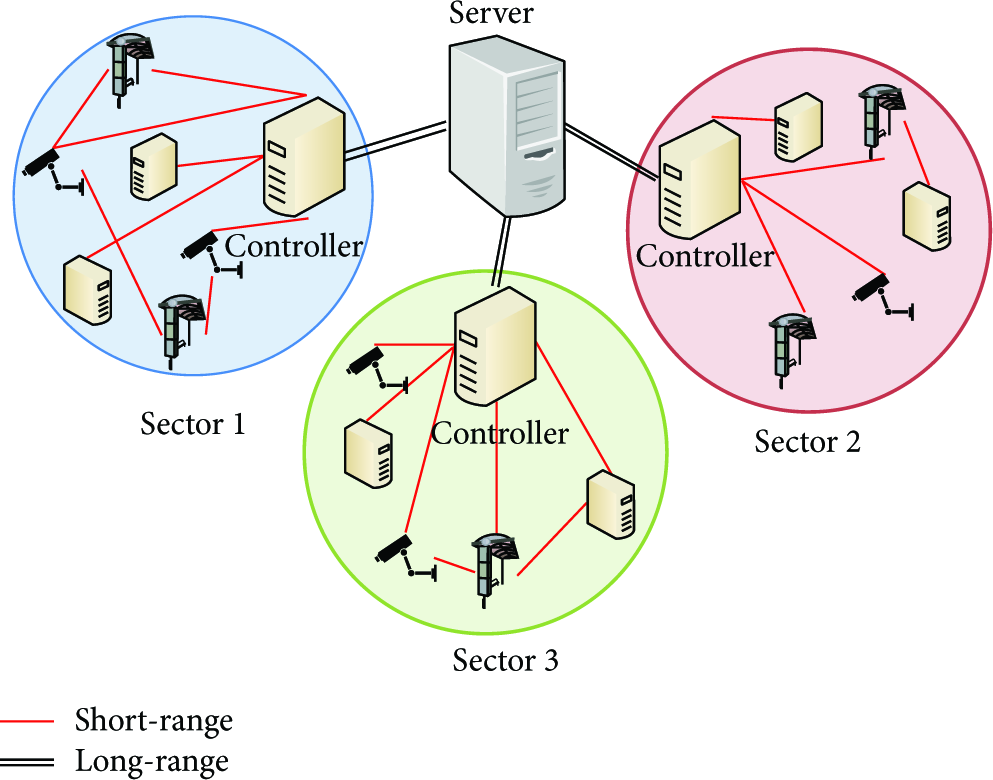
WSN of public facilities with M2M communication.
To improve the efficiency of M2M wireless sensor networks (WSNs), the transmission data rate, distance, reliability, system complexity, and cost should be considered, because a combination of various communication methods has usually been employed rather than a single scheme. Therefore, communication methods in common frequency bands should be investigated to determine the optimum M2M communications methods that can be selected depending on the expected performance and transmission distance. In this paper, a computer simulation for M2M environments is used to compare the performance of the IEEE 802.15.4g and the Wi-Fi P2P WSNs standards. The channel model is assumed to have additive white Gaussian noise (AWGN), shadowing, and multipath fading. We selected several physical (PHY) modes of the orthogonal frequency division multiplexing (OFDM) in IEEE 802.15.4g and IEEE 802.11 to investigate the impact of different parameters on their performance. This paper is organized as follows. Section 2 introduces SUN and Wi-Fi P2P WSN in an M2M environment. In Section 3, the numerical results are presented and discussed. Finally, Section 4 concludes this paper.
2. Wireless Sensor Networks in M2M Environments
2.1. Smart Utility Network (SUN)
The IEEE 802.15.4g standard defines Smart Utility Networks of various bandwidths and data rates. The frequency band for SUN ranges from 700 MHz to 1 GHz and operates at 2.4 GHz for nonlicensed usage. In addition, various PHY standards have been proposed as a result of the different frequencies and channels in different regions. SUN encompasses three types of PHY layers, including MR-FSK, MR-OFDM, and MR-O-QPSK, where MR can indicate being either multirate or multiregion. The bandwidth ranges from tens of kHz to several MHz in order to support a data rate of about 40 kbps to 1 Mbps. This standard also supports a wide range of distances from about tens of meters to a maximum of 20 km [3].
2.1.1. MR-FSK PHY
MR-FSK PHY can provide a data rate of 50 to 400 kbps. MR-FSK PHY achieves high power efficiency with low implementation complexity because it transmits a constant signal. However, MR-FSK PHY is weak against interference due to its low bandwidth efficiency. Therefore, it can fulfill its expected performance at a low cost and with a relatively simple structure when the data rate is slow. MR-FSK supports various frequency bands in various regions, including the U.S.A., China, Japan, and Korea. For MR-FSK PHY, a level 2 or 4 filtered FSK modulation scheme is used. Table 1 provides the MR-FSK modulation and channel parameters in the 900 MHz and 2.4 GHz frequency bands.
MR-FSK modulation and channel parameter.

2.1.2. MR-O-QPSK PHY
The design of MR-O-QPSK PHY is simple because it shares common characteristics with IEEE 802.15.4-2006. Its performance can be improved in the presence of multipath fading when applying an FEC with a code rate of 1/2. MR-O-QPSK supports direct sequence spread spectrum (DSSS) and multiplexed direct sequence spread spectrum (MDSSS) depending on the spreading mode. The DSSS scheme operates at frequency bands that are defined while the MDSSS scheme can only operate at 900 MHz and 2.4 GHz frequency bands.
2.1.3. MR-OFDM PHY
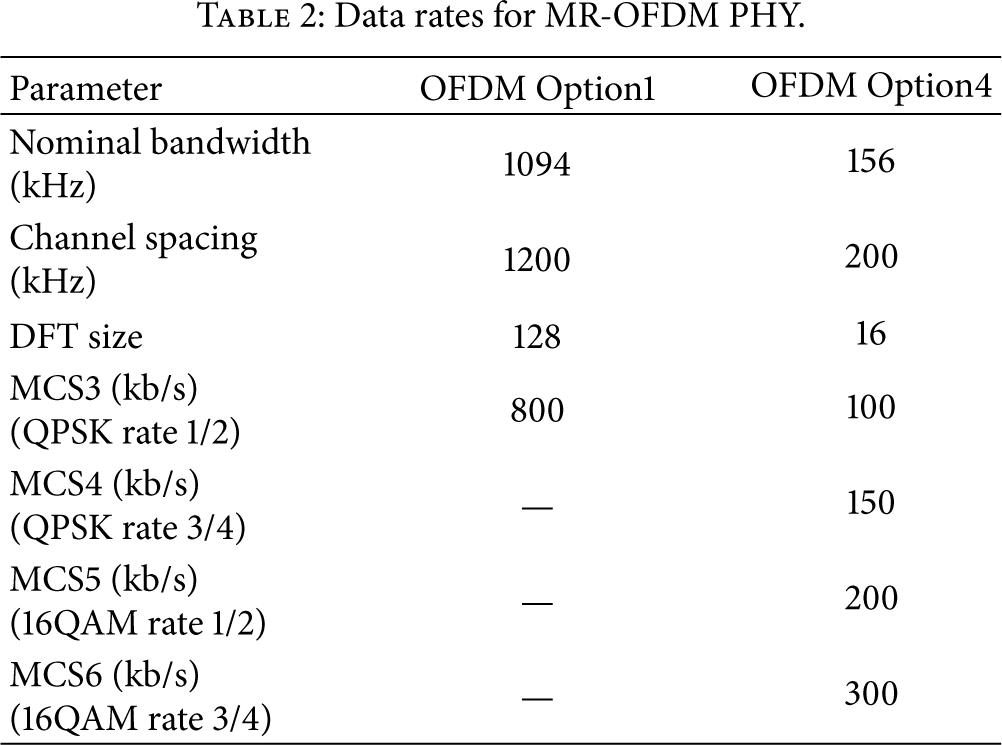
MR-OFDM PHY can provide reliable data communication, even in a poor wireless environment with multipath fading and shadowing. In addition, it offers a high-speed data transmission and good bandwidth efficiency. However, it has a complex structure and thus means that implementation is difficult and costly. The MR-OFDM PHY offers the date rate of 50 to 800 kbps. Table 2 lists options 1 and 4 for MR-OFDM PHY.
Data rates for MR-OFDM PHY.
2.2. Wi-Fi P2P
Published by the Wi-Fi Alliance, Wi-Fi P2P is a standard that provides direct-communications between devices that implement the P2P functionality through wireless communications without joining separate networks [4]. Wi-Fi P2P can provide a higher data rate and a longer range for the network when compared to Zigbee and Bluetooth. Simultaneous connections are available for up to eight devices without an AP. Wi-Fi P2P can communicate with most PHYs, except those that rely exclusively on IEEE 802.11b. At present, most Wi-Fi chips support IEEE 802.11g or 802.11n, and Wi-Fi P2P can be used in devices with existing Wi-Fi chips by applying a middleware implantation and a firmware upgrade. The standard supports a data rate of between 3 Mbps and 300 Mbps by using 2.4 GHz and 5 GHz frequency bands. The maximum coverage for this standard is about 450 m. OFDM PHY is used for both IEEE 802.11n and IEEE 802.11g in Wi-Fi P2P. Table 3 shows the data rate for IEEE 802.11 OFDM PHY with a channel bandwidth of 5 MHz.
Data rates for IEEE 802.11 OFDM PHY.

3. Numerical Results
The IEEE 802.11 and 802.15 series can be used over the 2.4 GHz frequency band. Table 4 shows various communication systems that can operate using the 2.4 GHz spectrum. Zigbee and three PHYs for 802.15.4g use the same frequency band at 915 MHz because different communication systems can cooperate over a single frequency band, although this depends on the frequency band. Therefore, it is necessary to use a suitable communication system that considers various parameters, including the data rate, distance, and bandwidth, rather than a single communications system. Table 5 shows the systems and parameters that are considered with MR-FSK and MR-OFDM for IEEE 802.15.4g and OFDM for IEEE 802.11 in Wi-Fi P2P. The bit error rate (BER) and throughput are investigated through a simulation. The channel is modelled with AWGN, shadowing, and multipath fading [7]. Basically, the channel models in the M2M environments include AWGN and shadowing because the machines are assumed to be located at a fixed position without mobility. Shadowing is considered by using the Suzuki channel model [8]. In addition, fading channels are considered with four types of channels for rural area, typical urban area, bad urban area, and hilly terrain, as shown in Table 6 [7]. The 2-path Rayleigh fading channel is assumed to have the same Doppler frequency. 
Communication systems in 2.4 GHz.

Considered systems and parameters.

Two-ray channel model.
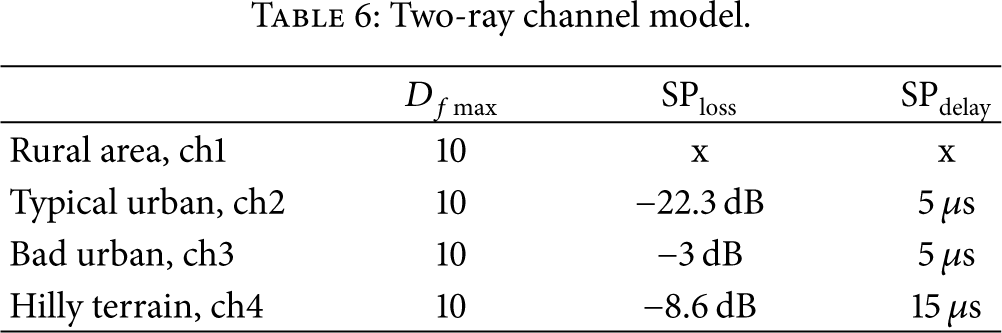
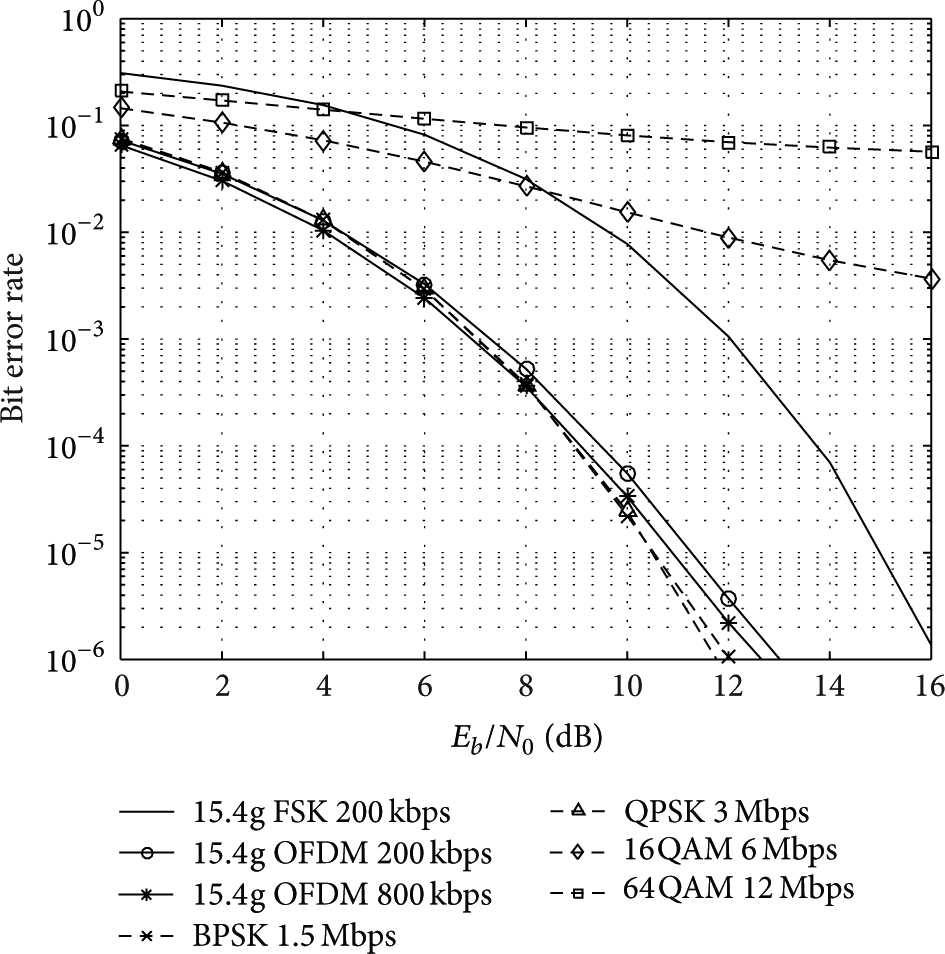
Figure 2 presents the BER performance for each of the PHY modes in the AWGN channel. In Figure 2, the OFDM performance at a data rate of 200 kbps and 800 kbps in IEEE 802.15.4g shows a similar tendency. Meanwhile, FSK needs an additional 5 dB in order to maintain a BER of 10−3 in comparison to the OFDM. It is beneficial to use FSK when a low complexity and an inexpensive structure are required, and OFDM when system performance needs to improve. When a high throughput performance over various traffic characteristics is required, one of the PHY modes in the IEEE 802.11 standard (BPSK, QPSK, 16QAM, and 64QAM) can be considered because the BER performance of each is distinct. Figure 3 presents the throughput performance of each PHY mode in the AWGN channel, and the OFDM in IEEE 802.15.4g provides more than 90% throughput at an
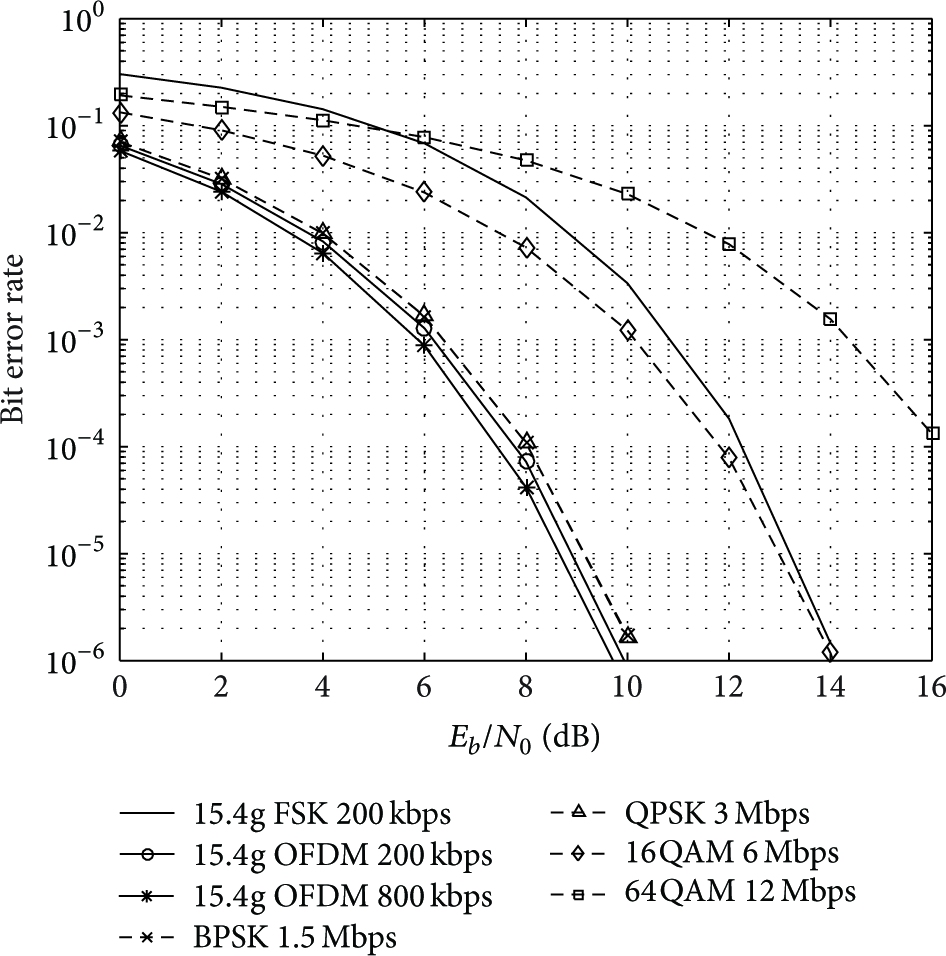
BER versus

Throughput versus
Figure 4 shows the BER of each PHY mode in the shadowing channel. In contrast to the AWGN case shown in Figure 2, the performance of the IEEE802.11 OFDM configuration becomes worse than that of the IEEE802.15.4g OFDM configuration. This is because the higher modulation, such as 16QAM and 64QAM, is vulnerable to the shadowing channel. Note that the performance of 16QAM for IEEE 802.11 crosses that of FSK for IEEE 802.15.4g at an 8 dB SNR. Figure 5 presents the performance of each PHY mode in the shadowing channel in terms of throughput. When compared with Figure 3 in the AWGN channel, IEEE 802.11 appears more vulnerable than IEEE 802.15.4g in the shadowing channels. Therefore, the FSK in IEEE 802.15.4g provides reasonable performance even for the shadowing channel. In addition to its simple structure, this performance makes FSK in IEEE 802.15.4g an appealing choice. Furthermore, the OFDM exhibits the best performance, unlike the BER in Figure 4, because the average frame lengths of the IEEE 802.11 OFDM are longer than those of the IEEE 802.15.4g. As
BER versus

Throughput versus
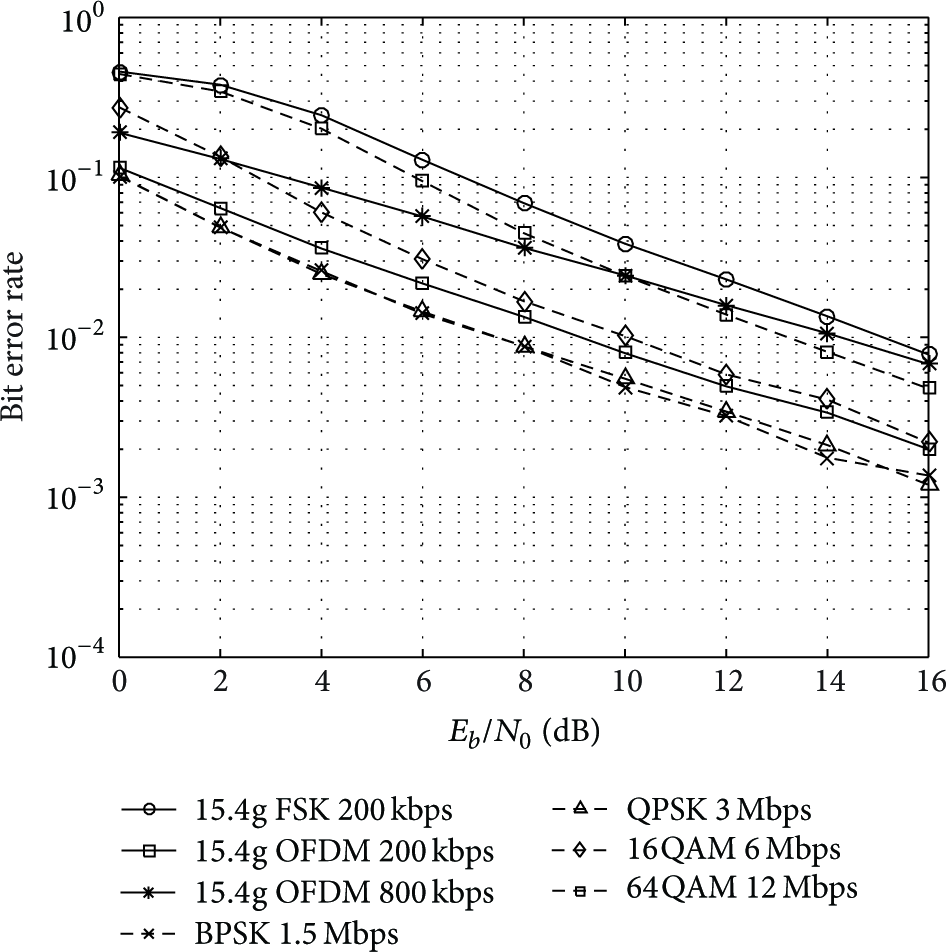
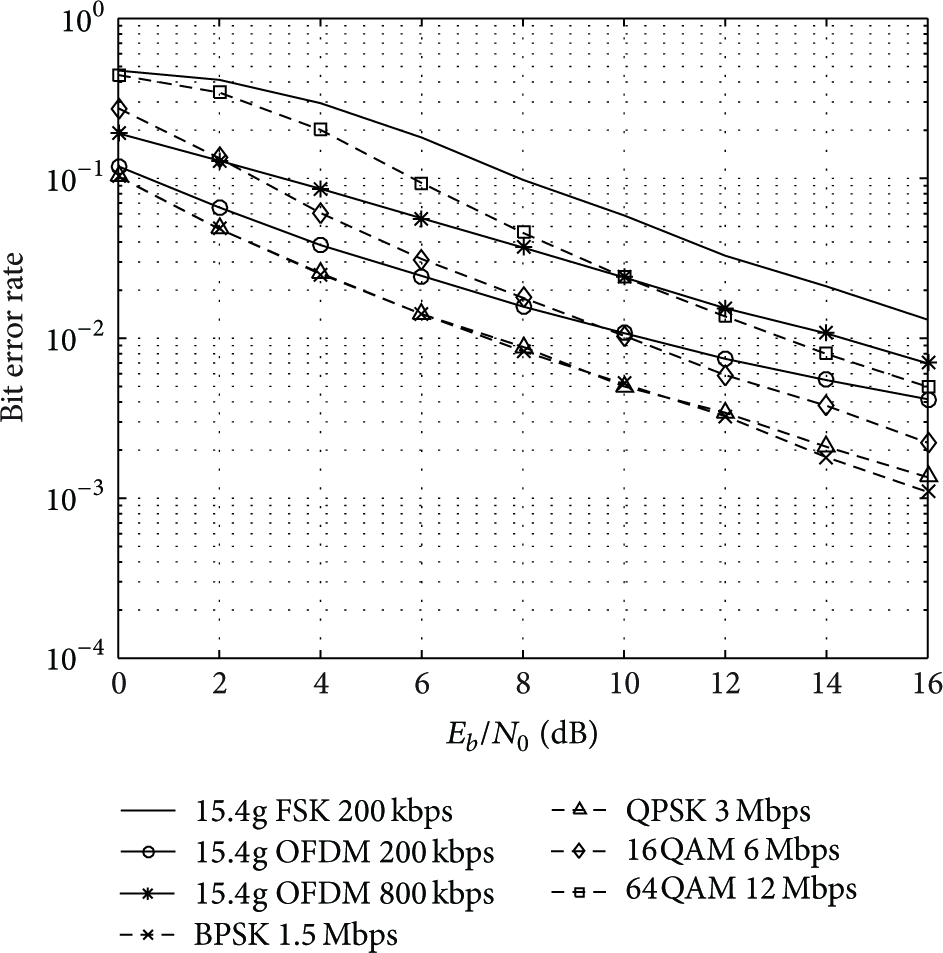
Figures 6, 7, 8, and 9 show the BER performances for each PHY mode in the fading channels. In general, the difference in the performance of the PHY modes decreases, and, more specifically, IEEE 802.11 exhibits better performance than IEEE 802.15.4g because IEEE 802.11 has been designed to reduce the fading effects due to its mobility, for example, in the design of the interleaver for the FEC. As the channel deteriorates from Figures 6 to 7 and 8, a crossing point occurs between the OFDM in IEEE 802.15.4g and the 16QAM in the IEEE 802.11. This means that the benefit that IEEE 802.11 provides in terms of multipath fading becomes even stronger. The BER performance of the OFDM for the IEEE 802.15.4g in the multipath fading channels 1, 2, 3, and 4 in Table 6 is shown in Figure 10. In Table 6, channel 1 represents a rural area without a multipath component. Channel 2 represents a typical urban area where path loss for the second-path is very large. Therefore, the multipath component can be neglected, and thus channel 2 seems to be similar to channel 1. Channel 3 represents a bad urban situation where the second component has a small path loss. This means that the effects resulting from multipath signals may severely affect the channel models. Channel 4 shows hilly terrain where the delay in the second component is different from that of others. In Figure 10, the performance for channel 3 becomes better than the others, which is similar to what happens in channel 1. The reason why channel 3 shows good performance is that channel 3 can provide more diversity gain in the frequency domain rather than in the time domain.
BER versus

BER versus

BER versus
BER versus

BER comparison at 200 kbps in IEEE 802.15.4g with OFDM.
4. Conclusion
In this paper, we compared the performances of each PHY mode for IEEE 802.15.4g (SUN) and IEEE 802.11 (Wi-Fi P2P) WSN in various M2M environments. The performance of the different configurations was investigated in terms of the BER and throughput with AWGN, shadowing, and multipath fading channels. The numerical results show that IEEE 802.11 is more vulnerable than IEEE 802.15.4g in the shadowing channels relative to the AWGN channel. Therefore, the FSK in IEEE 802.15.4g is very attractive. In the multipath fading channel, IEEE 802.11 performed better than IEEE 802.15.4g because IEEE 802.11 has been designed to focus more on reducing the fading effects of mobility. It has been shown that a suitable communication mode can be selected based on required performance,
Footnotes
Conflict of Interests
The authors declare that there is no conflict of interests regarding the publication of this paper.
Acknowledgment
This study was financially supported by the Industry-University Research Collaborative Technology Development (Project no. C0033649) of the Small and Medium Enterprise Agency, Korea.