




Abstract
Compressed sensing (CS) recently turns out to be an effective approach to alleviate the sampling bottleneck in wideband spectrum sensing. However, the computation overhead incurred by compressed reconstruction is nontrivial, especially in a power-constrained cognitive radio (CR). Moreover, additional information, which is generally unavailable in practice, is needed in conventional CS-based wideband spectrum sensing schemes to improve the reconstruction quality as well as the detection performance. To address these issues, this paper proposes a novel decentralized scheme for cooperative compressed spectrum sensing in distributed CR networks. Our key observation is that the sparse signals are unnecessary to be reconstructed since the task of spectrum sensing is only interested in the spectrum occupancy status. The major novelty of the proposed scheme relates to the use of Karcher mean as a statistic indicating the spectrum occupancy status, thereby eliminating the compressed reconstruction stage and significantly reducing the computational complexity. Considering limited communication resources per CR, a decentralized implementation based on alternating direction method of multipliers is presented to calculate the Karcher mean via one-hop communications only. The superior performance of the proposed scheme is demonstrated by comparing with several existing decentralized schemes in terms of detection performance, communication overhead, and computational complexity.
1. Introduction
Spectrum sensing, whose objectives are detecting the presence of primary users (PUs) and identifying the spectrum holes for dynamic spectrum access, is an essential task for enabling cognitive radio technique, a leading choice for efficient utilization of spectrum resource [1]. Furthermore, wideband spectrum sensing has received significant attention since more spectrum access opportunities can be attained in wideband regime. However, spectrum sensing over a wide frequency band confronts several practical challenges [2, 3] and the major one lies in the wideband spectrum acquisition implementation.
Aiming at alleviating the heavy pressure on the conventional analog-to-digital converter (ADC) technology, CS theory [4, 5] has been recently introduced into the application of wideband spectrum sensing, which stems from the recognition that the radio spectrum is inherently sparse due to the low percentage of spectrum occupancy by active radios [1–3], a fact that motivates dynamic spectrum access. Different types of implementation structure for compressed wideband spectrum sensing have been developed in [6–8]. Since spectrum sensing on a per CR basis is quite susceptible to channel fading/shadowing and ambient noise, cooperative spectrum sensing (CSS) [3] that exploits the built-in spatial diversity among multiple CRs has been proposed for CR networks. Based on how cooperative CRs share their sensing data in the network, CSS can be classified into two categories: centralized CSS and decentralized CSS. In centralized CSS scheme, a fusion center (FC) is required to collect measurements from all CRs and to make centralized sensing decision. Centralized CSS schemes using CS theory are presented in [9, 10]. The reconstruction performance can be globally optimal, but the incurred power cost and communication workload in transmitting local information to the FC and conveying sensing results back to CRs are significantly high. Alternatively, decentralized schemes are quite attractive because of their low communication overhead. CS-based decentralized CSS schemes have been studied in [11, 12]. Here, CRs only communicate with their neighboring CRs within a short one-hop range to reduce the transmission power consumed during communications and converge to a unified decision on the spectrum occupancy by iterations, in the absence of a FC.
As stated above, the spectrum sensing process of most CS-based schemes is first acquiring compressed measurements, then reconstructing the signals involved, and lastly performing thresholding on the reconstructed signals to obtain the spectrum occupancy status [6–12]. CS theory shows excellent ability in reducing wideband signal acquisition cost. However, the computation overhead incurred by compressed reconstruction is nontrivial and makes the CS-based schemes difficult to implement, especially in resource-constrained scenarios. Moreover, additional information, such as the upper bound of ambient noise energy (for convex relaxation algorithms) or the sparsity order of received sparse signal (for greedy algorithms), is often needed in compressed reconstruction stage to improve the reconstruction quality as well as the detection performance. However, the additional information is usually beyond the ability to obtain in practice. In this paper, we focus on solving these two problems and propose a novel decentralized scheme for cooperative compressed spectrum sensing in distributed networks. In the proposed scheme, a compressed sensing mechanism is used at each CR by utilizing the inherent sparsity of the monitored wideband spectrum. More specifically, the received wideband signal of each CR is fed into a number of wideband filters and the outputs of the filters, which are actually the linear combinations of energies of the received signal in different channels, are served as compressed measurements. Our key observation is that the fundamental task of wideband spectrum sensing is not reconstructing the wideband signal, but determining the spectrum occupancy information. Therefore, the compressed reconstruction stage could be completely eliminated. To achieve this, we propose the use of Karcher mean of energy vectors of multiple CRs to estimate the spectrum occupancy directly from compressed measurements. The computational complexity is expected to be reduced significantly due to the avoidance of compressed reconstruction. Moreover, to save the limited communication resources per CR, a decentralized implementation based on alternating direction method of multipliers (ADMM) is presented to calculate the Karcher mean via one-hop communications only. The superior performance of the proposed decentralized scheme is testified by comparing with CS-based decentralized schemes reported in [11, 12], in terms of detection performance of the CR network, communication overhead, and computational complexity per CR. Moreover, the impacts of scheme parameters and system parameters are also investigated through simulations.
The remaining part of this paper is organized as follows. The signal model and the spectrum sensing problem of interest are introduced in Section 2. Section 3 presents the details of the proposed decentralized scheme to cooperative compressed spectrum sensing. Numerical simulations are given to demonstrate the performance of the proposed scheme in Section 4 and some conclusions are drawn in Section 5.
2. Signal Modeling
Suppose that the monitored wideband spectrum is divided into N nonoverlapping, equal-bandwidth channels whose center frequency and bandwidth are denoted by
To overcome the sampling limitations of ADC hardware while acquiring wideband signal, compressed sensing mechanism is applied at each CR by using wideband frequency-selective filters [10, 13]. More specifically, each CR is provided with a random matrix

In order to mix different channel sensing information, we feed the received wideband signal into the frequency-selective filters and measure the energy of the output signal of each filter to get an

In the matrix form, the compressed measurements collected at CR i can be represented as

Many investigations show that the radio spectrum in a particular time and geographical area is in a very low utilization ratio [1–3] suggesting that
Now, the goal of CS-based scheme to cooperative wideband spectrum sensing is to determine the spectrum occupancy status by using compressed measurements collected from all CRs and to detect spectrum holes for dynamic spectrum access.
3. The Proposed Scheme for Cooperative Compressed Spectrum Sensing
While CS-based schemes show powerful ability in breaking the sampling bottleneck in wideband spectrum sensing, the resulting increase in computation/complexity is nontrivial, especially in resource-constrained scenarios. Furthermore, additional information is often needed in the compressed reconstruction stage. However, this information is usually beyond the ability to obtain in practice.
Aiming to solve these problems, a novel decentralized scheme to cooperative compressed spectrum sensing is proposed in this section. The major novelty of this scheme relates to the use of the Karcher mean of the joint-sparse signals to infer the spectrum occupancy directly from the compressed measurements, without reconstructing the signals involved. Moreover, considering the limited communication resources, a decentralized implementation based on alternating direction method of multipliers (ADMM) [16, 17] is presented to calculate the Karcher mean via one-hop communications only.
3.1. Compressed WSS Based on Karcher Mean
The Karcher mean of joint-sparse signal ensembles

The optimization problem in (4) can be viewed as a minimization of the sum of the squared distances in low-dimensional spaces between the compressed measurements and the Karcher mean. To explain the reason why the Karcher mean is introduced into the application of wideband spectrum sensing, we analyze the relationship between the Karcher mean in (4) and the common support of joint-sparse signal ensembles
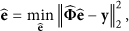
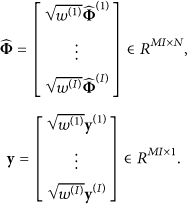
Since the sensing matrices

Using the matrix form of compressed measurements in (3) and recalling the definition of

After obtaining the Karcher mean

3.2. Decentralized Implementation via the ADMM
Computing the Karcher mean in a centralized manner requires a fusion centre to collect compressed measurements
Assume that the distributed network containing I CRs can be described as an undirected graph
In order to solve (4) in a decentralized way, we let each CR i keep a local copy of the Karcher mean

To reformulate the optimization problem (10) in the form that can be solved by ADMM [16], we define
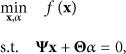
ADMM for problem (11) can be derived directly from the augmented Lagrangian. Consider

The resulting ADMM algorithm at iteration

Inspired by the recent work in [17], the updates in (13) can be simplified and distributed to CRs. If all the local objective functions are convex,



Using (16) to eliminate the term


Splitting the variable

Recalling the definition of matrix

With the splitting strategy of β, (16) splits into two equations related to variables μ and ν, respectively. Summing and subtracting these two equations result in

By using (21), we can eliminate the auxiliary variable α and the term

To simplify the expression, we introduce
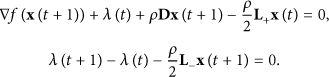
Here it is noteworthy that some starting conditions [17] are needed to guarantee the equivalence between the updates in (14)–(16) and those in (23). However those conditions can be satisfied by initializing
In (23), the introduced matrices
Note that

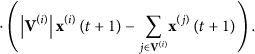
As shown in (24) and (25), this algorithm is fully decentralized since the two updates only rely on local and neighboring information.
3.3. The Proposed Decentralized Scheme Based on Karcher Mean
Without loss of generality, suppose the distance function in (4) to be Euclidean distance in practice. Therefore, the local objective function of CR i is given by


Based on the above studies, we propose a new decentralized scheme for cooperative compressed spectrum sensing in distributed networks which is summarized in Algorithm 1.
Algorithm 1 (the decentralized scheme for cooperative compressed spectrum sensing based on Karcher mean).
Initialization. Each CR obtains its local objective function
Iteration
Decision. Upon convergence, each CR obtains the Karcher mean
As shown in Algorithm 1, additional information, such as the upper bound of ambient noise energy or the sparsity order of received sparse signal, is not needed. Therefore, the proposed scheme is more flexible than the traditional CS-based CSS schemes in practice.
4. Simulations
This section presents Monte Carlo simulation results that verify the effectiveness of the proposed scheme. First, the simulation setup and relevant performance metrics are described. Then we compare the detection performance of several CS-based decentralized schemes and investigate their communication overhead and computational complexity. Lastly, the impacts of scheme parameters and system parameters are also studied through simulations.
4.1. Simulation Setup and Performance Metrics
Consider a monitored wideband which is equally partitioned into
Unless explicitly stated otherwise, some parameters are set as follows. The number of Monte Carlo trials is set to be 300. For the distributed CR network, we set the number of CRs
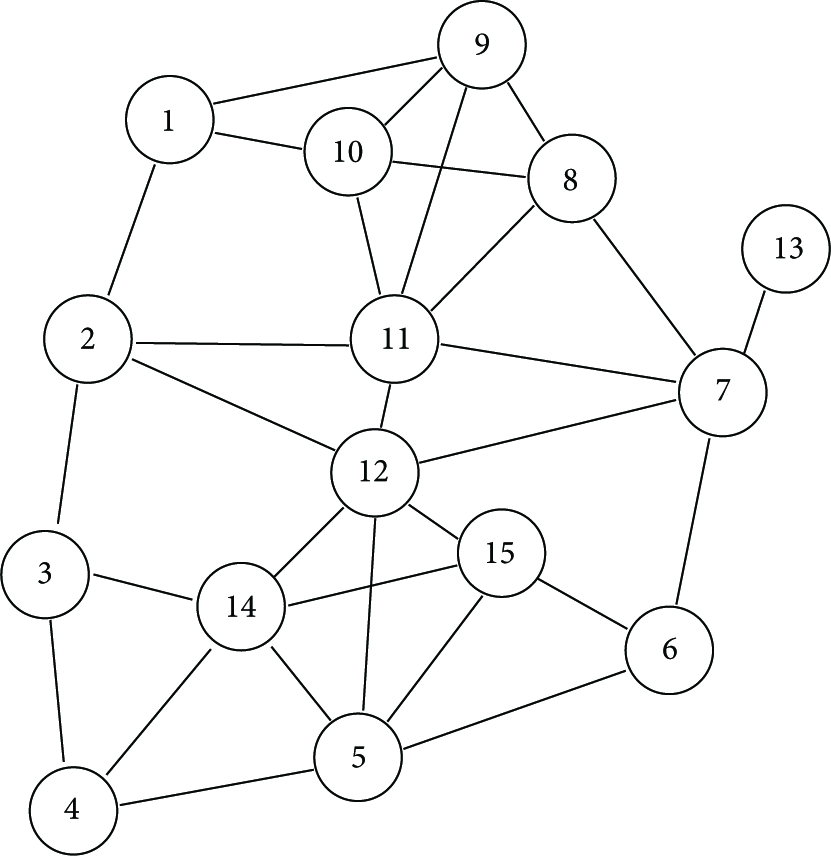
Connectivity of CR network with 15 nodes (both ends of each line segment are one-hop neighbors and local communications are allowed between them).
The signal to noise ratio (SNR) is defined as the ratio of the average received signal to noise power over the entire wideband spectrum. Suppose that the received signal at each CR is corrupted by additive white Gaussian noise (AWGN) and all CRs have the same received SNR. The compression ratio

4.2. Performance Comparison of Three Sensing Schemes
For the sake of contrastive analysis, two existing CS-based decentralized schemes are chosen as benchmarks. One is the fusion consensus scheme developed in [12], and the other is a consensus averaging scheme for decision fusion which is developed in [11]. In the former, based on the joint sparsity structure of the received signals, a mixed
Figure 2 depicts the detection performance of the three schemes. When the upper bound of ambient noise energy is unknown, our proposed scheme performs the best at all SNR. To illustrate the effectiveness of the proposed scheme, the performance of those two benchmark schemes with prior information on the upper bound of ambient noise energy is also given in Figure 2. As shown in Figure 2, the introduction of prior information on the upper bound can indeed improve the detection performance since it can improve the reconstruction performance. However, even if this prior information is available, those benchmark schemes cannot perform better than our proposed scheme which does not need this prior information.

Detection probability versus SNR for
To evaluate the communication overhead, we introduce the metric of communication step. When all the CRs transmit a vector of size

Comparison among various schemes in terms of communication overhead.
To evaluate computational complexity of each scheme, we use the metric of CPU time. All codes are written in MATLAB and tested in a computer with Processor Intel Pentium Dual-Core E5300 running at 2.6 GHz with 2 GB of RAM and a Windows-based operating system. Figure 4 shows the CPU time per CR of those schemes. Apparently our proposed scheme has the least computational complexity since it only involves some arithmetic operations shown in Algorithm 1 while other two schemes have to solve a series of convex optimization problems.
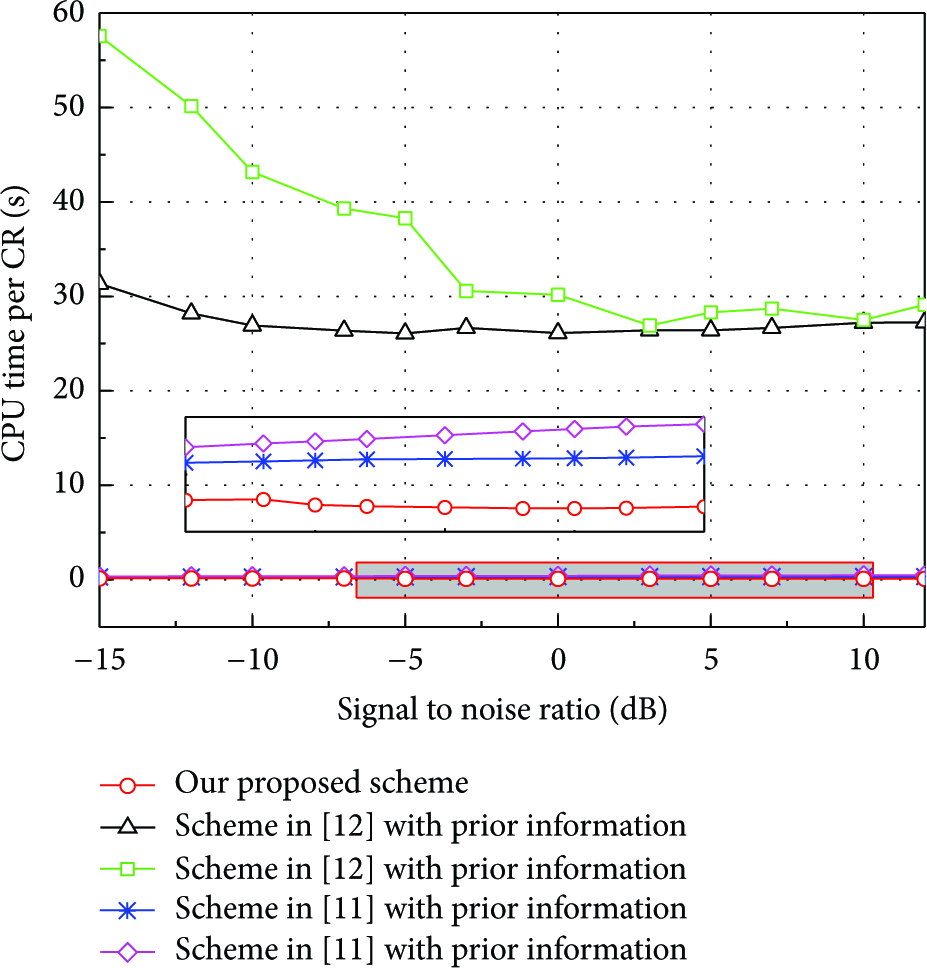
Comparison among various schemes in terms of computational complexity per CR.
In summary, Figures 2–4 demonstrate the superior performance of the proposed scheme in terms of detection performance, communication overhead, and computational complexity.
4.3. Sensitivity to the Choice of Scheme Parameters
Obviously, the scheme parameters of Algorithm 1, that is, ρ and ε, affect the performance of the proposed scheme. In this subsection, we measure the sensitivity of the proposed scheme to the choice of these parameters.
4.3.1. Sensitivity to the Choice of ρ
Figure 5 and Table 1 show the influence of the parameter on the detection performance and iterative time of the proposed scheme, respectively. As shown in Figure 5, while choosing in a proper range, different ρ can lead to similar detection performance since all these choices of ρ can lead to convergence of the proposed scheme. However, it can be seen from Table 1 that the iterative time varies widely for different ρ. Since more iteration means more communication overhead and computational complexity, parameter ρ has to be properly chosen.
Iterations of proposed scheme for different ρ.

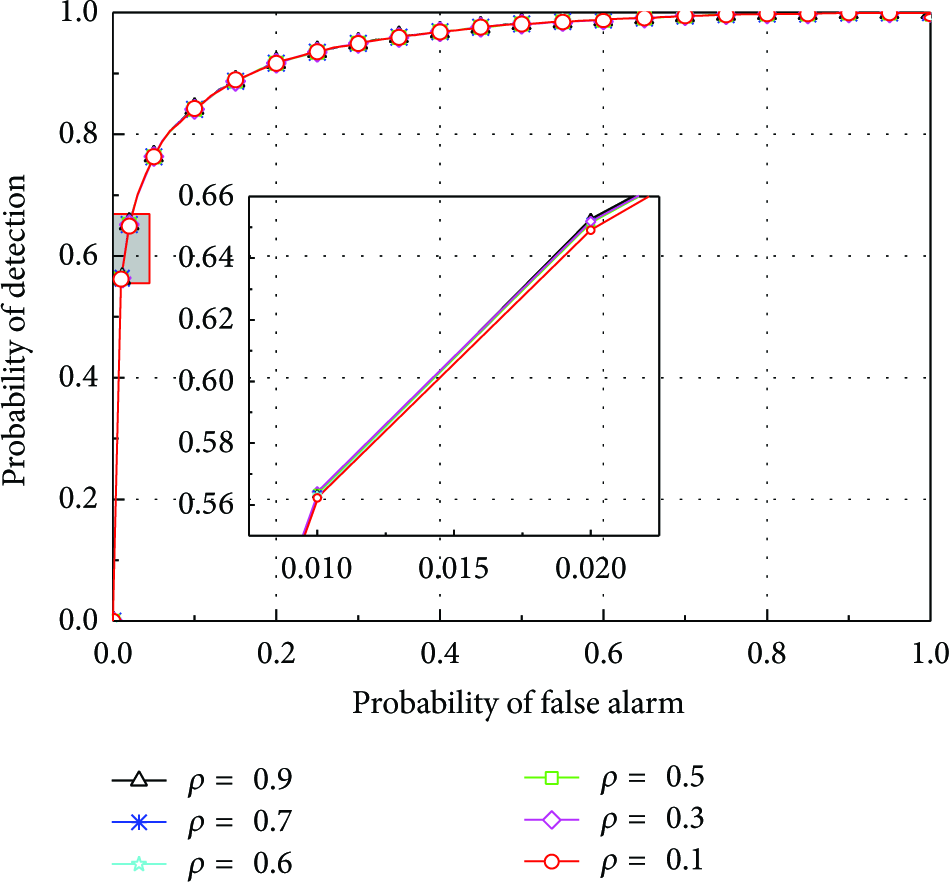
ROC performance of the proposed scheme for different ρ (SNR = −5 dB;
4.3.2. Sensitivity to the Choice of ε
Figure 6 and Table 2 show the influence of the parameter ε on the detection performance and iterative time of the proposed scheme, respectively. It is shown in Figure 6 that different ε choosing in a proper range leads to similar detection performance. Meanwhile, the iterative time varies widely for different ε, which can be seen from Table 2. Smaller ε leads to stricter stopping criterion; therefore, more iteration times are needed to converge for the proposed scheme. As mentioned above, more iteration means more communication workload and computational complexity. Therefore, parameter ε is not needed to be set too small.
Iterations of proposed scheme for different ε.

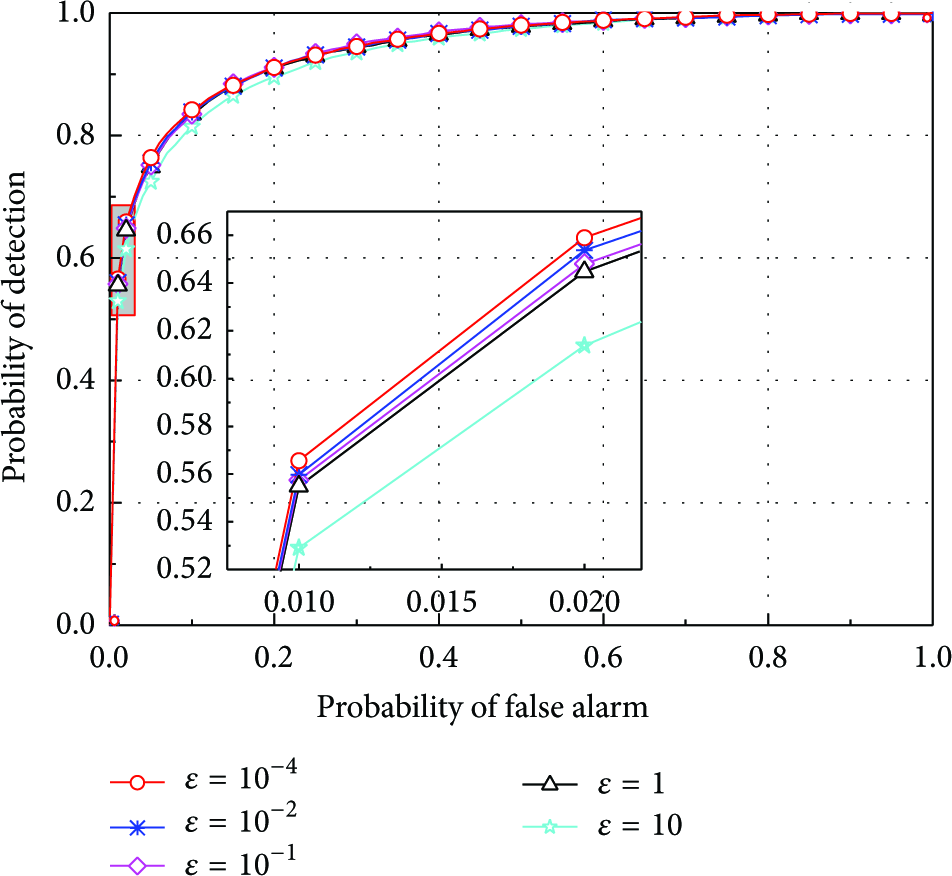
ROC performance of the proposed scheme for different ε (SNR = −5 dB;
4.4. Impact of System Parameters
Parameters of CR networks, such as the number of cooperating CRs and the compression ratio, significantly affect the detection performance of the proposed scheme. In this subsection, we investigate the impact of those system parameters.
4.4.1. Performance versus Number of CRs
Cooperation among multiple spatially distributed CRs offers cooperative gain. It is an attractive and effective approach to combat multipath fading and shadowing and to mitigate the receiver uncertainty problem. Figure 7 depicts the ROC curves for various numbers of collaborating CRs, under the parameter setting as follows: SNR = −5 dB;

ROC performance of the proposed scheme for different numbers of collaborating CRs (SNR = −5 dB;
4.4.2. Performance versus Compression Ratio
In the proposed scheme, compressed sensing technique is introduced to break the bottleneck of ADC technique in wideband regime, such as sampling rate, fidelity, and power consumption; however, this also incurs performance degradation. Figure 8 depicts the ROC performance for various compression ratios, under the parameter setting as follows: SNR = −5 dB;

ROC performance of the proposed scheme for different compression ratios (SNR = −5 dB;
5. Conclusions
Recognizing the joint sparsity structure of received signals at CRs, this paper has developed a decentralized scheme for cooperative compressed spectrum sensing based on Karcher mean. The major novelty of this scheme relates to using the Karcher mean of joint-sparse signals to estimate the spectrum occupancy directly from compressed measurements collected at CRs, thereby eliminating the compressed reconstruction stage and significantly reducing the computational complexity. To save the limited resources per CR, a decentralized implementation based on alternating direction method of multipliers is presented to calculate the Karcher mean via one-hop communications only. Moreover, additional information, which is generally unavailable in practice, is not needed in the proposed scheme. The superior performance of the proposed scheme is demonstrated by comparing with several existing CS-based decentralized schemes in terms of detection performance, communication overhead, and computational complexity. Lastly, the robust performance of scheme parameters and the impacts of system parameters are also investigated through simulations.
Footnotes
Conflict of Interests
The authors declare that there is no conflict of interests regarding the publication of this paper.
Acknowledgments
The authors wish to show great appreciation for the support offered by the National Major Scientific and Technological Special Project (no. 2012ZX03006003-004).