




Abstract
An experimental investigation is conducted into the indoor formaldehyde decomposition performance of an atmospheric plasma reactor with an airflow rate of 200 L/s, discharge power of 50 W, and operating voltage of 8.5 kV, utilizing a sensor network. It is shown that, given an initial formaldehyde concentration of ∼0.2 ppm, the reactor removes 15∼80% of the formaldehyde at a height of 107 cm and 20∼73% at a height of 180 cm after 5.5 hours. Moreover, it is shown that, in decomposing the formaldehyde, the reaction process does not generate O3. Finally, it is shown that the reduction in the formaldehyde concentration is particularly significant near the outlet of the plasma reactor and between the reactor and the door.
1. Introduction
Volatile organic compounds (VOCs) are widely used in household materials and are associated with many health risk factors, including sick building syndrome (SBS) [1]. SBS sufferers exhibit a range of symptoms which appear to be related to the time spent in a particular building [2]. The specific origins of SBS are not yet clear. However, it is thought that VOCs, chemical and biological contaminants, and inadequate ventilation all play a contributory role. Of the many VOCs emitted by the upholstery, carpeting, and wood and plastic products used in indoor environments, formaldehyde is one of the most common [3–5]. Consequently, the World Health Organization (WHO) has set a 30-minute exposure limit for formaldehyde of 0.08 ppm [6], while the US National Institute for Occupational Safety and Health (NIOSH) has established a maximum long-term exposure limit of 0.016 ppm (time weighted average, TWA) [7].
Traditional methods for measuring ambient formaldehyde concentration levels include spectrophotometry [8], gas chromatography (GC) [9], high-performance liquid chromatography [10], ion chromatography [11], and polarography [12]. However, these methods require expensive and bulky instrumentation together with the services of well-trained operators. Consequently, their use is limited to professional, well-equipped laboratories. Thus, various researchers have proposed low-cost, portable systems for measuring the formaldehyde concentration in situ (i.e., without the need to collect samples and transport them to a remote laboratory for testing purposes) [13–17]. Among such systems, those based on the detection of changes in conductivity caused by the adsorption of formaldehyde gas, or the use of metal-oxide semiconductors (MOXs) to induce formaldehyde oxidation, are the most commonly used [18].
In addition to the problem of detecting ambient concentration levels of formaldehyde, that of actively improving the indoor air quality has also attracted significant interest in recent decades [19–21]. Various researchers have demonstrated the removal of acetaldehyde or formaldehyde using atmospheric pressure nonthermal plasma reactors [22–25]. Storch and Kushner [26] performed a theoretical investigation into the removal of formaldehyde from atmospheric pressure gas streams using a dielectric barrier discharge system with a discharge gap size of 2 mm and a supply voltage of 40 kV. The results showed that the removal efficiency scaled approximately linearly with the initial gas temperature and formaldehyde concentration.
Several studies have used the emission spectrum of plasma discharge in N2 with water vapor to predict the reaction kinetics associated with the decomposition of indoor air [27–30]. It has been suggested that the decomposition process commences with the formation of OH and H radicals as a result of the electron impact dissociation of H2O vapor [25, 31]. The detailed reactions responsible for the formation of these radicals are summarized in the following.
First, the dissociated electrons collide with the water molecules and form protons and hydroxide; that is,














The present study performs an experimental investigation into the decomposition of formaldehyde in a closed room using an atmospheric plasma reactor suspended from the center of the ceiling. The reactor comprises four electrodes with a discharge power of 50 W and a supply voltage of 8.5 kW. The formaldehyde concentration at various positions in the room is measured at heights of 107 cm and 180 cm, respectively, using a network of commercial MOX sensors. It is shown that, for an initial formaldehyde concentration of ~0.2 ppm, the reactor removes up to 80% of the ambient formaldehyde after 5.5 hours.
2. Experimental Method
Figure 1 illustrates the closed room considered in the present study. As shown, the room has a suspended PVC tile floor with a thickness of 0.3 mm and a height of 75 cm relative to the ground. Furthermore, the room has an airtight door designed to isolate the interior from the external environment and is constructed using walls comprising tempered glass (outside) and lumber plywood (inside, thickness: 10 mm). Finally, the ceiling is fabricated of calcium silicate board (thickness: 5 mm). Of the various materials used in constructing the room, the main contributor of formaldehyde is the lumber plywood used to realize the interior surfaces of the walls. The room is used for architecture material testing and is situated on the third floor of the College of Agriculture at National Pingtung University, Pingtung, Taiwan. As shown in Figure 2(a), the atmospheric plasma reactor was suspended from the ceiling in the central region of the room. In performing the experiments, the formaldehyde concentration was measured at two different heights relative to the floor, namely, 107 cm and 180 cm, corresponding to the average breathing heights of sitting and standing individuals, respectively [32]. The formaldehyde concentration was measured using commercial semiconductor-based formaldehyde detectors (PFD03, Universal Sensing Technologies Co., Taiwan) with an accuracy of ±2%, the lowest detection limit of 0.001 ppm, and resolution of 0.001 ppm. As shown in Figure 2, the formaldehyde detectors were arranged in the form of a 4 × 4 array (with a pitch of 100 cm). To ensure the reliability of the measurement results, the formaldehyde concentration was measured periodically at 25°C and 85% R.H. over a period of 60 min after the plasma reactor was activated for 30 min.
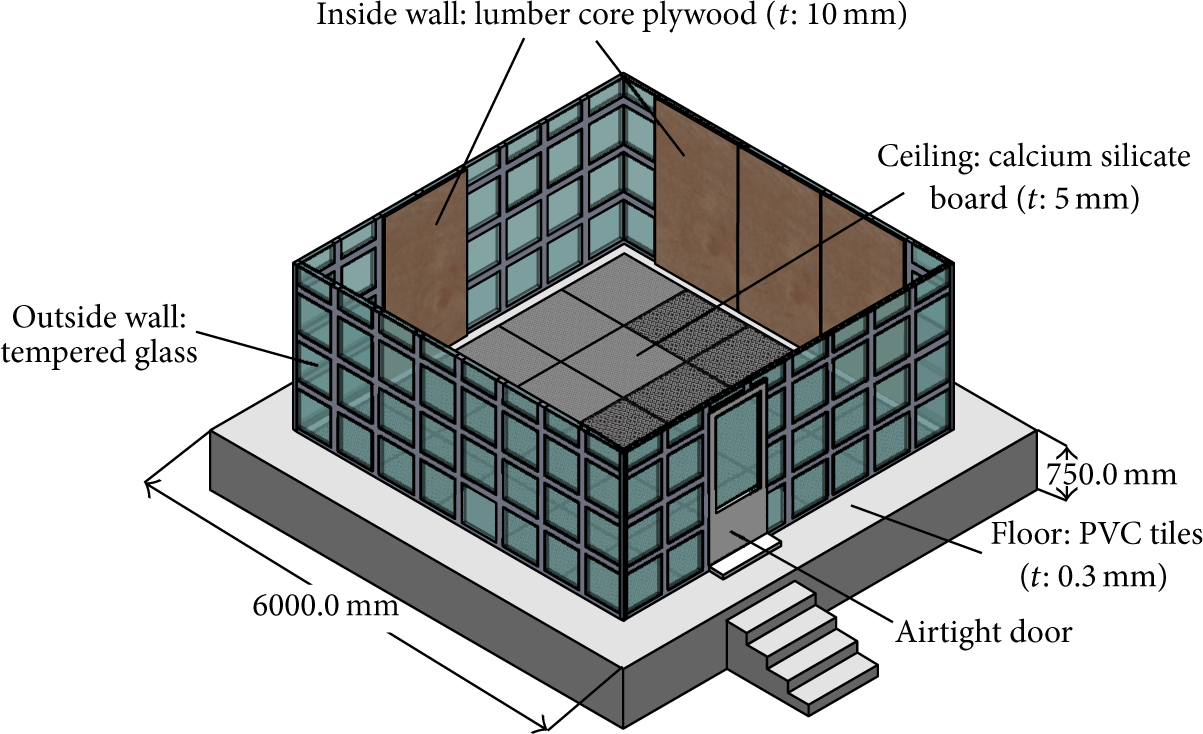
Schematic illustration of the room used for experimental purposes with dimensions of 400 (L) × 400 (W) × 240 (H) cm3.

(a) Photograph showing atmospheric plasma reactor and single row of formaldehyde detectors in 4 × 4 measurement array and (b) locations of formaldehyde detectors within closed room.
Figures 3(a) and 3(b) present a photograph and schematic illustration, respectively, of the atmospheric plasma reactor used in the present study. As shown, the reactor incorporated four electrodes with a discharge length of 5 mm. The electrodes were energized with a discharge power of 50 W and a voltage of 8.5 kV, resulting in an electric field intensity of 1.7 × 10⁶ V/m and a power consumption of 0.05 kW-hr. The plasma reactor which worked continuously and quietly had a total length of 650~1200 mm, including a flexible (extendible) outlet tube. A fan was installed at the outlet end of the reactor in order to induce an ingress airflow with a flow rate of 200 L/s.

(a) Photograph of atmospheric plasma reactor and (b) schematic illustration showing cross-sectional view.
As shown in 9, O3 is an inevitable by-product of the formaldehyde decomposition process. The product has an adverse effect on human health and should therefore be carefully controlled. Accordingly, a test is necessary to make for the presence of O3 using a commercially available electrochemical gas detector (GAXT-G-DL, BW Technologies, Canada) with a measurement range of 0~1.00 ppm and resolution of 0.01 ppm in the current study.
3. Results and Discussion
The formaldehyde concentration prior to activating the plasma reactor was measured using the sensor network, interpolated utilizing the Gnuplot software, and found to be 0.197~0.200 ppm and 0.189~0.193 ppm at heights of 107 cm and 180 cm, respectively (Figure 4). The higher concentration of formaldehyde at a lower height can be expected since the density of formaldehyde is slightly greater than that of air (i.e., 1.03 versus 1.00).
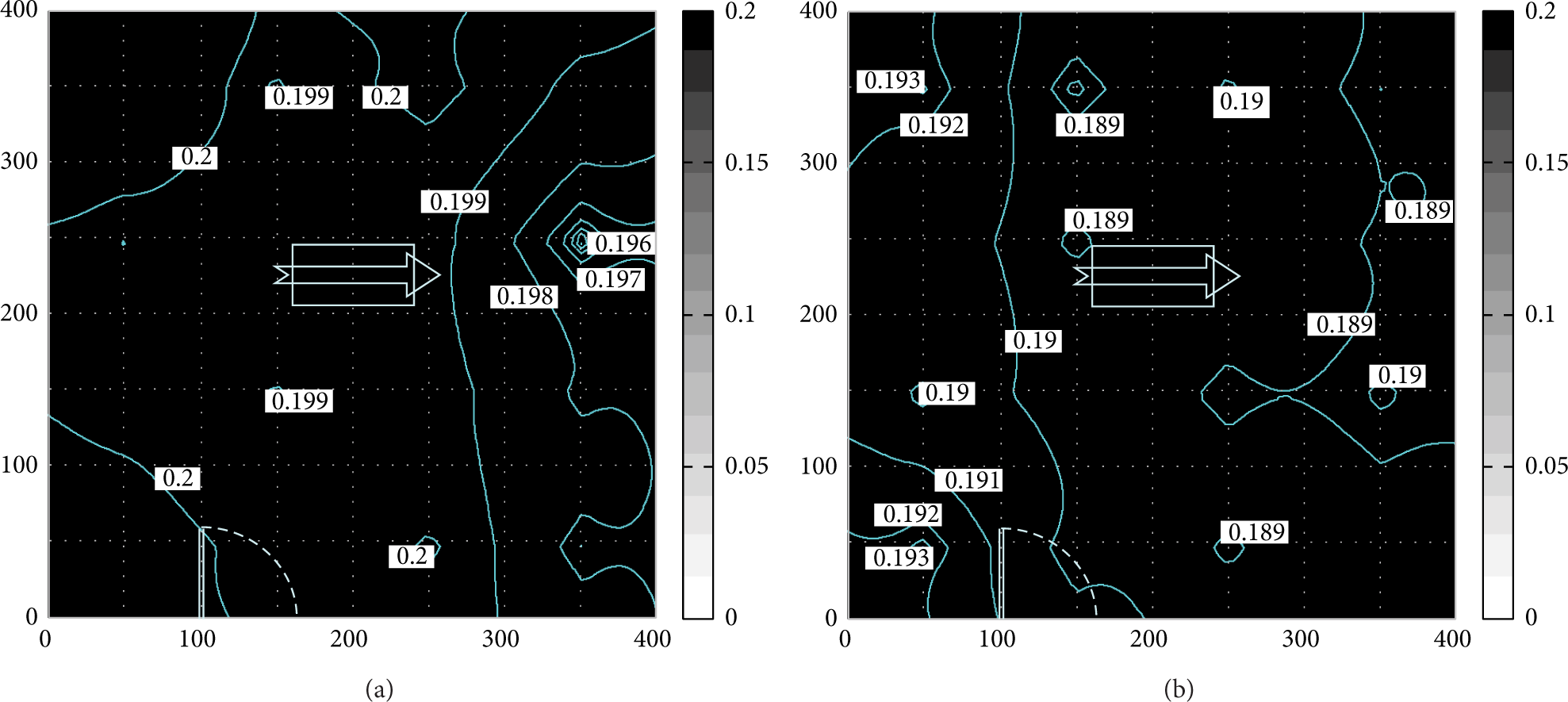
Formaldehyde concentrations at (a) 107 cm and (b) 180 cm prior to activation of the atmospheric plasma reactor.
Figures 5(a) and 5(b) show the formaldehyde concentration contours within the closed room at heights of 107 cm and 180 cm, respectively, after 30 minutes of activating the plasma reactor. As shown, the formaldehyde concentrations at the two heights are in the ranges of 0.160~0.182 ppm and 0.172~0.190 ppm, respectively. In other words, the formaldehyde removal ratios are equal to 9~20% and 5~14%, respectively. The higher removal ratio at a lower height of 107 cm indicates that the intensity of the formaldehyde decomposition reaction increases at lower heights within the room. This finding is consistent with the observation in [26] that the removal efficiency increases with an increasing formaldehyde concentration. Furthermore, for a constant height, it is seen that a greater removal efficiency occurs near the outlet of the plasma reactor and in the region of the room close to the door as a result of a higher density of radicals and air exchange caused by leakage, respectively.

Formaldehyde concentrations at (a) 107 cm and (b) 180 cm after 30 minutes of activating plasma reactor.
Figures 6, 7, 8, and 9 show the measured formaldehyde concentrations at heights of 107 cm and 180 cm after 90, 150, 210, and 270 minutes, respectively. The average removal ratios are found to be 25%, 30%, 41%, and 50%, respectively, at a height of 107 cm and 14%, 30%, 41%, and 43% at a height of 180 cm. In other words, the results confirm that a greater formaldehyde decomposition occurs in the lower region of the room. Furthermore, for both heights, the formaldehyde concentration reduces within an increasing activation time due to the greater cumulative number of decomposition reactions. From inspection, the maximum removal ratio at a height of 107 cm is equal to 40%, 48%, 68%, and 80% after 90, 150, 210, and 270 minutes, respectively. Observing the four figures, it is seen that the regions of low formaldehyde concentration surrounding the reactor outlet and door, respectively, gradually expand over time and merge after 90 minutes to form a single low-concentration region between the outlet and the door.
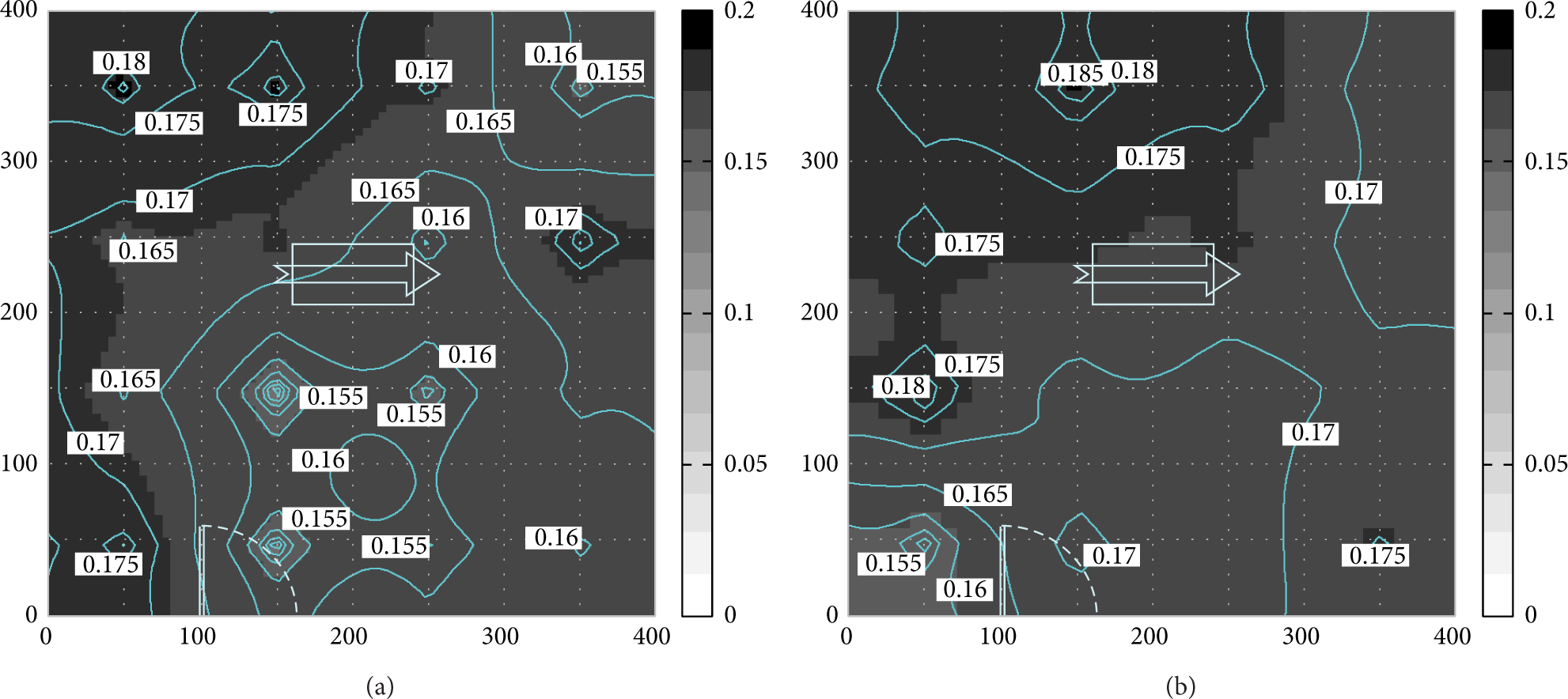
Formaldehyde concentrations at (a) 107 cm and (b) 180 cm after 90 minutes of activating plasma reactor.
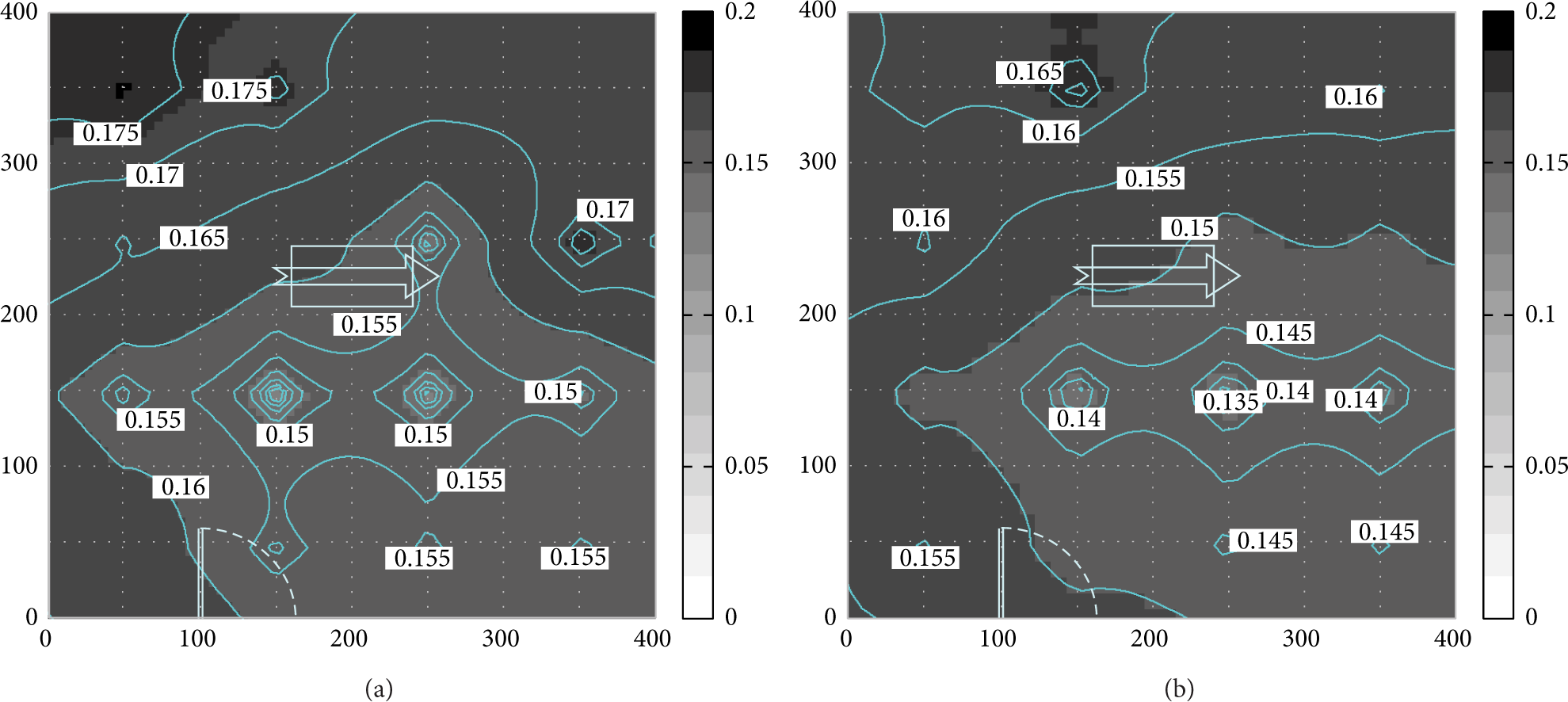
Formaldehyde concentrations at (a) 107 cm and (b) 180 cm after 150 minutes of activating plasma reactor.

Formaldehyde concentrations at (a) 107 cm and (b) 180 cm after 210 minutes of activating plasma reactor.

Formaldehyde concentrations at (a) 107 cm and (b) 180 cm after 270 minutes of activating plasma reactor.
Figure 10 shows the formaldehyde concentrations at heights of 107 cm and 180 cm, respectively, 5.5 hours after activating the reactor. It is seen that the concentration at a height of 107 cm ranges from 0.040 to 0.170 ppm, while that at a height of 180 cm ranges from 0.054 to 0.160 ppm. In other words, the removal ratios at the two heights are equal to 15~80% and 20~73%, respectively. The results confirm that, following prolonged decomposition, the greatest formaldehyde destruction effect occurs toward the floor of the room in the region between the reactor outlet and the door. In the central region of the room (i.e., beneath the plasma reactor), the removal ratio is found to have a value of 34~80% at a height of 107 cm and 34~73% at a height of 180 cm due to stronger formaldehyde decomposition effect. Furthermore, the formaldehyde concentration in one of the inner corners of the room (near the inlet of the plasma reactor) is seen to be almost 0.16-0.17 ppm at both height locations throughout the entire experiment due to a lack of movement in the air (i.e., the formation of dead zones).

Formaldehyde concentrations at (a) 107 cm and (b) 180 cm after 330 minutes of activating plasma reactor.
Figure 11 shows the reduction and the removal ratio over time of the formaldehyde concentration in the central region of the room. It is seen that the concentration at sensors (2,2) and (3,2) is less than 0.08 ppm (more than 60% of formaldehyde removal ratio) (i.e., the 30-minute exposure limit prescribed by the WHO [6]) after 3.5 hours (210 minutes). In other words, for closed rooms constructed (or decorated) with high-formaldehyde-emitting materials and equipped with a plasma reactor system, it is recommended that living/working activities be conducted principally in the regions of the room between the reactor and the door. Notably, the formaldehyde concentration within this “safe” region falls below the prescribed limit of 0.08 ppm at both the sitting height (107 cm) and the standing height (180 cm) within 4.5 hours (270 minutes) of activating the plasma reactor.

Reduction in formaldehyde concentration and removal ratio over time at different heights and positions around plasma reactor.
In the study, the concentration of by-product O3 was also measured. It was found that a null detection result was obtained, indicating that the concentration was less than the detection limit of the respective sensor, that is, 0.01 ppm.
4. Conclusions
This study has performed an experimental investigation into the formaldehyde destruction efficiency of an atmospheric plasma reactor utilizing a sensor network within a closed room with dimensions of 400 (L) × 400 (W) × 240 (H) cm3. It has been shown that removal ratios of 15~80% and 20~73% are obtained in the central region of the room at heights of 107 cm and 180 cm, respectively, following 5.5 hours of plasma activation. In addition, it has been shown that the formaldehyde decomposition process results in a negligible formation of undesirable O3 by-product. Finally, the results have suggested that, in a closed room containing formaldehyde-emitting materials and equipped with an atmospheric plasma reactor, living- and work-related activities should be confined principally to the region of the room between the reactor and the door.
Footnotes
Conflict of Interests
The authors declare that there is no conflict of interests regarding the publication of this paper.
Acknowledgment
The authors would like to thank the financial support provided by the National Science Council in Taiwan (NSC 103-2221-E-020-031-MY2).