




Abstract
The energy balancing capability of cooperative communication is utilized to solve the energy hole problem in wireless sensor networks. We first propose a cooperative transmission strategy, where intermediate nodes participate in two cooperative multi-input single-output (MISO) transmissions with the node at the previous hop and a selected node at the next hop, respectively. Then, we study the optimization problems for power allocation of the cooperative transmission strategy by examining two different approaches: network lifetime maximization (NLM) and energy consumption minimization (ECM). For NLM, the numerical optimal solution is derived and a searching algorithm for suboptimal solution is provided when the optimal solution does not exist. For ECM, a closed-form solution is obtained. Numerical and simulation results show that both the approaches have much longer network lifetime than SISO transmission strategies and other cooperative communication schemes. Moreover, NLM which features energy balancing outperforms ECM which focuses on energy efficiency, in the network lifetime sense.
1. Introduction
Extending the lifetime of wireless sensor networks (WSNs) is critical due to the limited energy supply of sensor nodes. Much research effort has been devoted to addressing this challenge through improving energy efficiency. Recently, the energy hole problem has been regarded as another key factor that seriously confines the network lifetime [1–3]. The cause of energy hole lies in the intrinsic many-to-one traffic pattern of WSNs. Nodes nearer to the sink carry heavier traffic loads, leading to more energy consumption. This unbalanced energy consumption phenomenon results in an energy hole around the sink. When the energy hole appears, no more data can be delivered to the sink. The network lifetime ends prematurely while a large amount of energy is unused. Experimental results in [4] show that up to 90 percent of the energy of a network would be left unused when the network lifetime is over.
Several approaches have been proposed to mitigate the energy hole problem in WSNs. Works in [5–7] deploy more nodes in heavy-loaded areas, which is known as the nonuniform deployment scheme. Another form of this scheme is to equip nodes closer to the sink with more initial energy [8]. Topology control strategies are proposed in [9–13], in which nodes collaboratively adjust their transmission power and form a proper network topology to balance energy consumption. In all above approaches, the data are transmitted through the single-input single-output (SISO) method.
Recently, cooperative communication has been applied to WSNs to enhance network performance, such as reliability, throughput, and coverage [14–16]. Energy efficiency can also be improved through this technique by exploiting the spatial diversity gain generated [17–20]. Moreover, since it allows the distributed nodes to cooperate with each other in data transmission, the energy consumptions of cooperating nodes can be properly balanced. Some existing approaches focus on balancing energy consumption among cooperative relay nodes in dual-hop relaying networks, such as the probabilistic path selection method in [21] and the optimal power allocation strategy in [22, 23]. These approaches do not aim at solving the energy hole problem and uneven energy dissipation still exists between source nodes and relay nodes, which would cause a reduction in lifetime. As for multihop networks with cooperative communication, a nonuniform node deployment scheme to mitigate energy hole problem is proposed in [24], which is similar to the nonuniform deployment schemes for networks with SISO transmission, as in [5–7]. In [25], the transmission BER of each cluster is adjusted according to the hops between the sink and the cluster to mitigate the energy consumption in the hotspots, as well as keeping the promised reliability. In these schemes, cooperative communication is adopted to achieve high energy efficiency rather than energy balancing. Cooperative communication is usually utilized to obtain high energy efficiency for network lifetime extension in the previous works. If cooperative communication can be applied in WSNs to solve energy hole problem by its energy balance capability and meanwhile to improve energy efficiency, network lifetime can be further extended. However, to our knowledge, cooperative communication has not been applied to mitigate energy holes so far.
This paper utilizes the energy balancing capability of cooperative communication to mitigate energy holes and consequently extend network lifetime in WSNs. In our proposed cooperative transmission strategy, when one node is relaying data transmitted from the node further away from the sink, these two nodes would cooperate with each other to forward the data towards the sink. The data are transmitted through cooperative multi-input single-output (MISO) method, so that the energy burden of nodes closer to the sink can be shared by those further away. Here, a cooperative MISO system refers to a virtual antenna array contributed by multiple sensor nodes with each having a single antenna, instead of a cooperative system with nodes equipped with multiple antennas. In this way, energy consumption can be balanced over the network to solve the energy hole problem.
Our method can be applied to the networks with arbitrary node distribution, while schemes proposed in [5–7] require manual deployment with a prohibitive cost and restricted access to the network area for sensor node deployment. The topology control strategies in [9–13] are confined by the maximum transmitting power limitation of wireless sensor nodes when building the topology. This limitation can be relaxed in our method as for a certain transmission distance; lower transmitting power is required in cooperative communication compared to that in SISO transmission. Our method can also solve the problem of the uneven energy consumption between source nodes and relay nodes, which is ignored in [21–23]. Although cooperative communication is also exploited in other works such as [24] to improve energy efficiency, it is different from our approach since the energy hole problem is mitigated in [24] by using a nonuniform node deployment scheme rather than cooperative communication itself.
To enhance the network lifetime performance of the proposed cooperative transmission strategy, optimal power allocation among cooperative nodes is investigated. Two optimization approaches aimed for network lifetime maximization and energy consumption minimization are studied, respectively, and compared with SISO transmission strategies for energy hole mitigation and other cooperative communication schemes. We also intend to show the performance difference between the two approaches under the same cooperative communication strategy for network lifetime extension. Numerical and simulation results show that the proposed cooperative transmission strategy with both optimization approaches can effectively mitigate the energy hole problem and achieve considerably longer network lifetime than the SISO transmission strategies for energy hole mitigation and other cooperative communication schemes. In addition, it is demonstrated that the optimal power allocation approach for network lifetime maximization outperforms the approach for energy consumption minimization in terms of network lifetime extension performance.
The rest of this paper is organized as follows. Section 2 states the energy hole problem and proposes the cooperative transmission strategy for energy hole mitigation. The energy model for the proposed strategy is described in Section 3. The optimal power allocation is studied in Section 4. Section 5 presents the performance analysis. Finally, we conclude our work and give an outlook for future research in Section 6.
Some of the notations that will be used in this paper are summarized here.
2. Energy Hole Mitigation
2.1. Energy Hole Problem
Consider a wireless sensor network, where sensor nodes dispersed over a monitoring area report their sensed data to a sink. It is assumed that all the nodes are uniformly deployed with density ρ. The monitoring area is divided into N concentric coronas
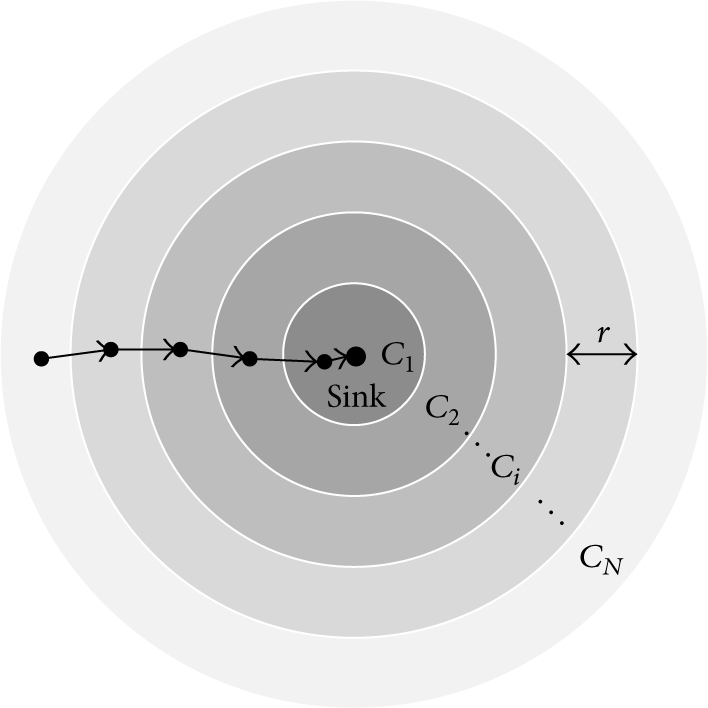
A network consisting of N coronas.
Every node in the network generates and sends data to the sink hop by hop and the hop distance is
In the conventional SISO transmission strategy, all data are transmitted through the SISO method. Nodes in


In corona

2.2. Cooperative Transmission Strategy
In a multihop network, each node transmits the data generated by it and forwards the data from the previous-hop node to the next-hop node. We propose a cooperative transmission strategy, in which each node transmits its own data to the next-hop node by SISO method, but, for the data from its previous-hop node, it forwards the data to the next-hop node with the help of the previous-hop node by cooperative MISO method. The cooperative MISO method can reduce the energy consumption and balance it among the nodes in different coronas. The energy hole problem will be mitigated and the network lifetime can be improved.
The Alamouti space-time code and the maximum ratio combining technique are used for cooperative MISO transmission to achieve the spatial diversity gain. The details of the proposed strategy are illustrated in Figure 2. There are five phases for the data reception and transmission process of our proposed cooperative transmission strategy.
Phase 1: nodes in Phase 2: nodes in Phase 3: instead of forwarding Phase 4: nodes in Phase 5: nodes in
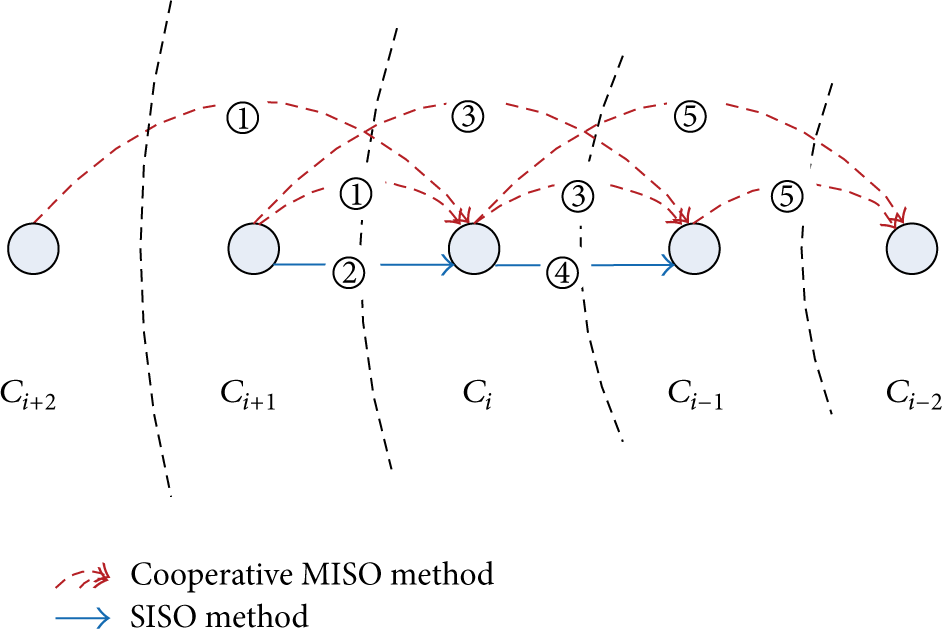
Cooperative transmission strategy.
Note that nodes in
In our cooperative transmission strategy, nodes in
3. Energy Model
According to the description of the proposed cooperative transmission strategy in the previous section, the energy consumption of nodes in

The energy consumed during reception comes from circuitry only. Similar to [17], the energy consumption of nodes in


The energy consumed during transmission is contributed by PA and other circuitry. In Phase 3, the energy consumption of nodes in

Under BPSK modulation, the average BER received at a node in


By substituting (7) into (6), the average BER
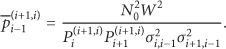
In Phase 4, energy consumption
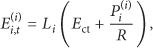


The minimum value of
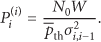
In Phase 5, nodes in
In summary, the energy consumption of nodes in
4. Power Allocation
In this section, we study the optimal power allocation among cooperating nodes to enhance the performance of the cooperative transmission strategy we propose. The optimization problems for network lifetime maximization and for energy consumption minimization are considered, respectively.
4.1. Power Allocation for Network Lifetime Maximization (NLM)
The primary motivation of mitigating energy hole in WSNs is to prolong the network lifetime. Therefore, we first formulate the power allocation of
The network lifetime is generally defined as the duration from the very beginning of the network operation until the first node exhausts its energy. In our discussion, nodes in the same corona have the same rate of energy consumption and would completely deplete energy simultaneously. Let ϵ denote the initial energy of each node, whereas the sink has no energy limitation. The network lifetime measured by the number of time slots is given by

Then, the NLM problem can be formulated as follows:

Considering that maximizing the minimum of

Proposition 1.
The necessary conditions for the optimality of problem (16) are



Proof.
See Appendix A.
We choose


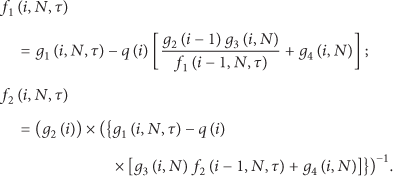

Substituting

When the solution that satisfies the KKT conditions does not exist, there will be no optimal solution to the NLM problem. No optimal solution means that the perfect energy balance among the nodes in different coronas cannot be achieved; that is, (17a) in KKT conditions cannot be held. Consider that the nodes in the outermost corona




Thus, we have a solution subspace constricted by conditions in (22a)–(22d). To obtain suboptimal solution in the subspace, a searching algorithm is proposed, in which we keep decreasing τ through the following iteration procedure. The details of the algorithm are described as follows.
Step 1: initialize Step 2: given Step 3: if conditions in (22c) or (22d) cannot be met, the minimum
4.2. Power Allocation for Energy Consumption Minimization (ECM)
We then present another optimization problem for power allocation aiming at minimizing the energy consumption of the network. The optimization problem for ECM is formulated as follows:

Proposition 2.
Based on KKT conditions, the optimal power allocation for ECM is given by

Proof.
See Appendix B.
With the optimal power allocation for ECM, the network lifetime is given by

For SISO transmission, the nodes in the innermost corona


5. Numerical and Simulation Results
In this section, numerical and simulation results of the proposed cooperative transmission strategy are presented. Based on [5, 17], the system parameters are assigned and listed in Table 1.
System parameters.

In Figure 3, we compare the network lifetime achieved by the cooperative transmission strategy with that by the conventional SISO transmission strategy. The network lifetime is plotted against the number of coronas N in the network. It can be found that the cooperative transmission strategy achieves much longer network lifetime than the conventional SISO transmission strategy over the entire range of N, as the cooperative transmission strategy can balance energy consumption as well as improve energy efficiency of data transmission. It can also be observed that, under the cooperative transmission strategy, NLM power allocation outperforms ECM in network lifetime extension, since NLM puts the emphasis on energy balancing (see (17a)) while ECM focuses on energy efficiency improvements. Besides, the network lifetime drops as the network scale expands. In a lager network, the distance to the sink from nodes in outer coronas is longer; thus more energy is required to transmit data to the sink. On the other hand, the traffic load unbalance among coronas is greater and the energy hole problem is more serious for a larger network. From Figure 3, we can see that the network lifetime obtained by simulation is lower than that by calculation. In calculation, the sensor nodes are assumed to be perfectly evenly distributed while in simulation they are randomly deployed in the monitoring area. Therefore, the transmission distance used in simulation cannot be the same throughout the network and the traffic loads of the nodes in the same corona are not identical either, which results in a reduction in network lifetime for both SISO and cooperative transmission strategies.
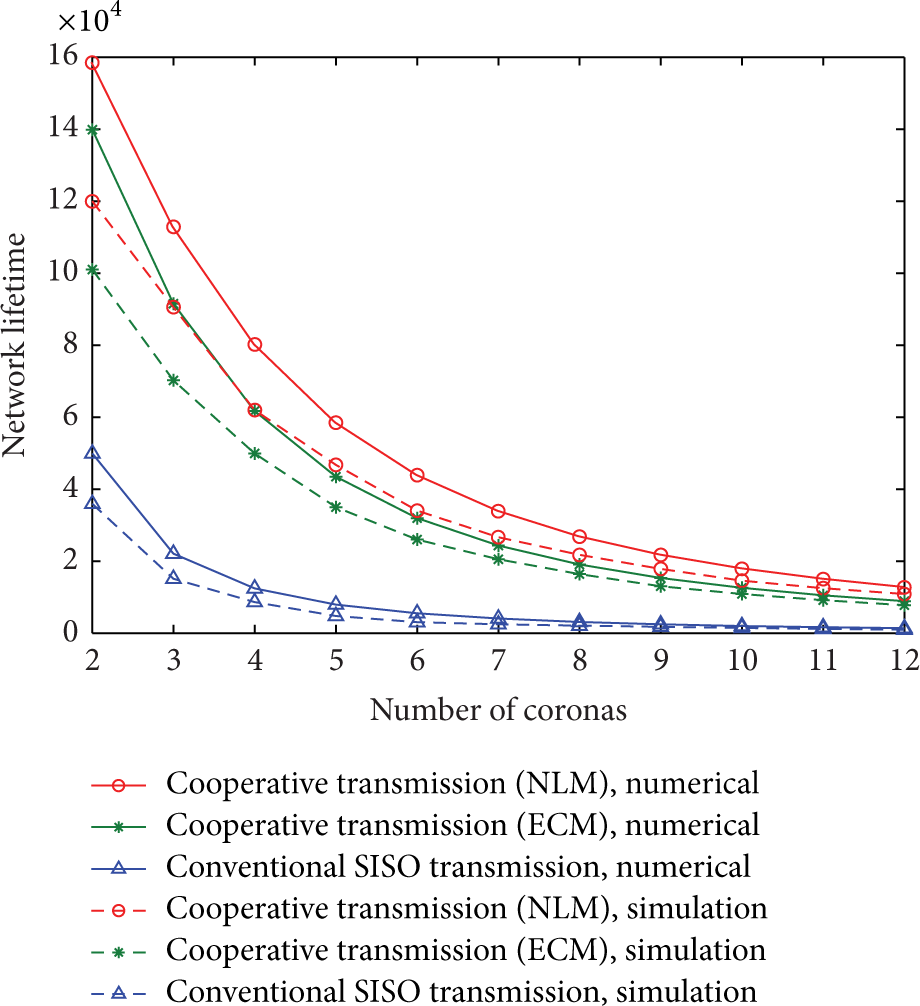
Network lifetime versus number of coronas.
To better illustrate the performance of network lifetime extension, we plot the ratio of the network lifetime achieved by the cooperative transmission strategy to that achieved by the conventional SISO transmission strategy versus the number of coronas N in Figure 4. It can be seen that the cooperative transmission strategy achieves larger extension of network lifetime as the scale of the network expands. Furthermore, the lifetime extension of NLM power allocation is higher than that of ECM, and the gap between them increases when network becomes larger. In a 10-corona network, the ratio of lifetime by NLM to that by SISO is up to 9 and that of ECM is about 6. It implies that balancing energy consumption is more effective than improving energy efficiency in terms of network lifetime extension, especially in large-scale networks. From Figure 4, we can also see that the lifetime extension of NLM and ECM obtained by simulation is higher than those by calculation, since in simulation the uneven node distribution results in the reduction in network lifetime of SISO transmission is more notable than that of cooperative transmission due to the uneven node distribution.
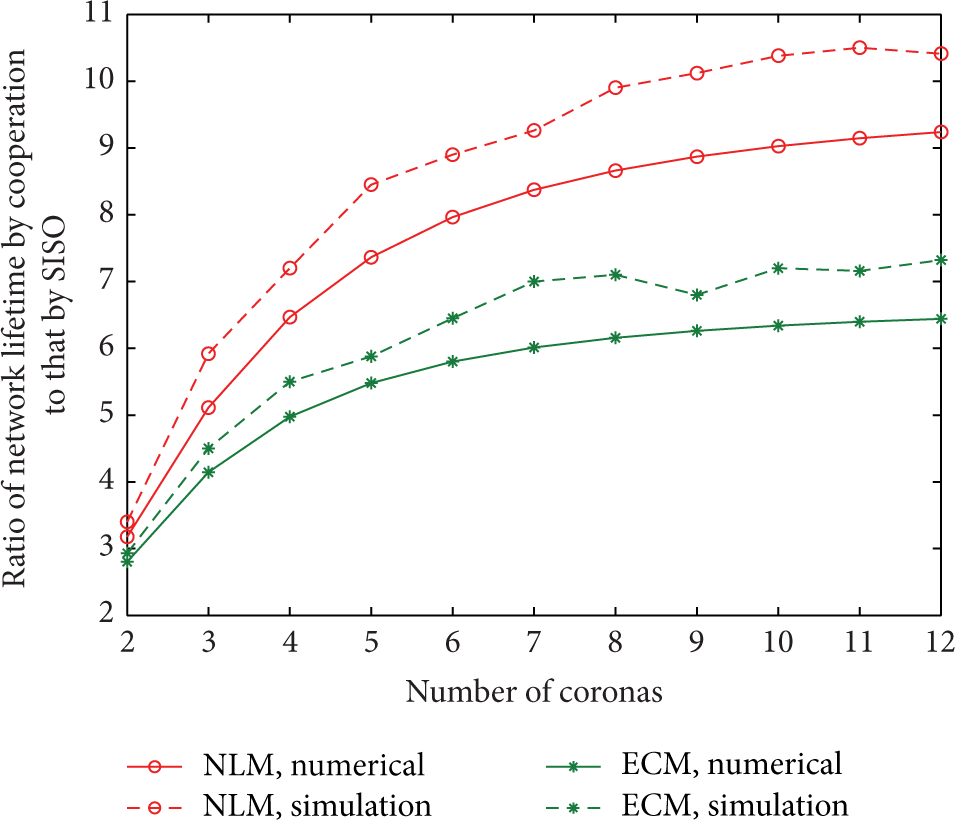
Ratio of the network lifetime achieved by cooperative transmission to that achieved by SISO transmission versus number of coronas.
The residual energy ratio is plotted in Figure 5, which is the ratio of energy remained when the network lifetime ended to the sum of the initial energy of all the nodes in the network. We only present the numerical results in Figures 5–7 and the simulation results are similar and hence omitted. From Figure 5, we can see that the residual energy ratio of the conventional SISO transmission strategy exceeds 90% in the networks with more than 7 coronas. That is consistent with the experimental results in [4]. It can be observed that the residual energy ratio under the cooperative transmission strategy with ECM is lower than that under the conventional SISO transmission strategy. This is due to the intrinsic energy balance capability of the cooperative communication. Moreover, the residual energy ratio of the cooperative strategy with NLM is the minimum among the three methods, since NLM further balances the energy consumption by proper power allocation to mitigate the energy hole problem.
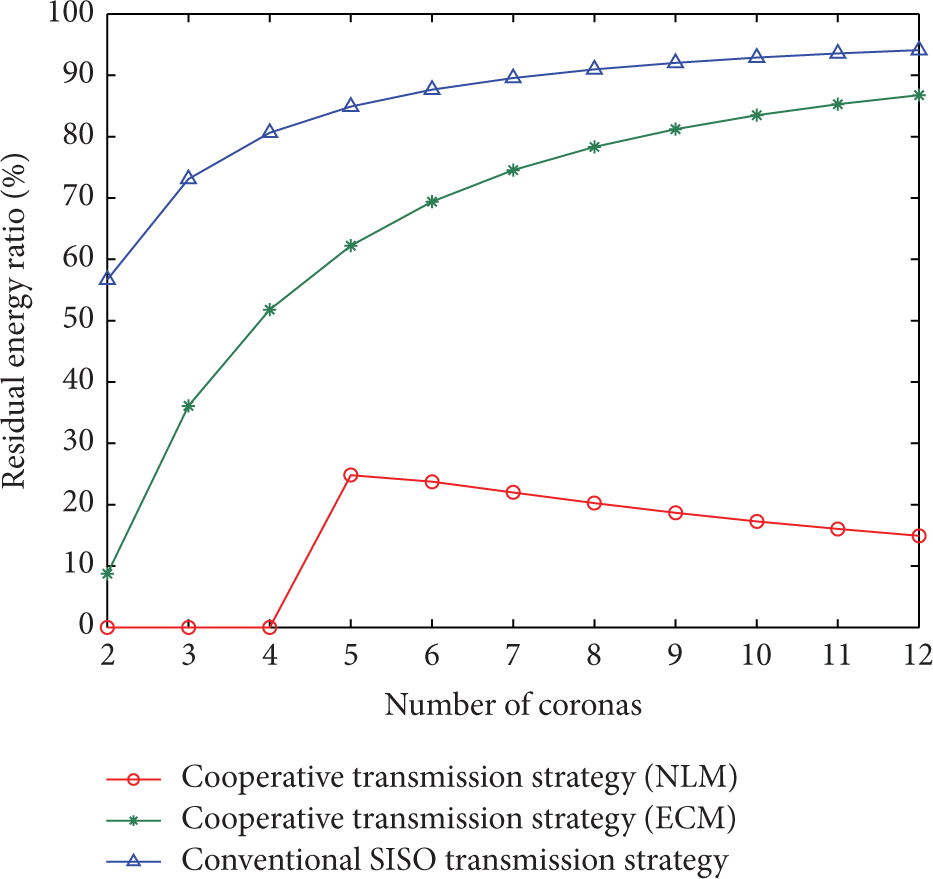
Residual energy ratio versus number of coronas.
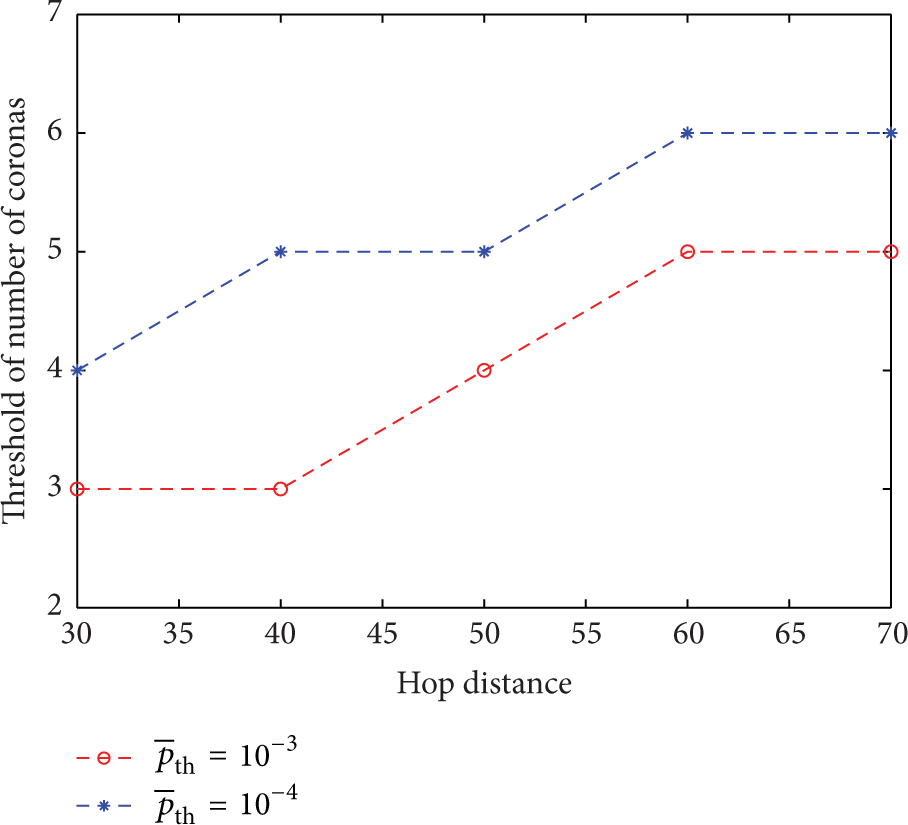
Threshold of number of coronas versus hop distance for different BER requirements.

Residual energy per node of each corona. (a) 4-corona network and (b) 6-corona network.
It can be found that the residual energy ratio of NLM is
There is a threshold of the number of coronas, denoted by
We further study the residual energy distribution in the network when the network lifetime ends. Considering that the energy hole problem can be avoided when the number of coronas
In the cooperative transmission strategy, each node participates in two cooperative MISO transmissions, that is, the transmissions in Phases 3 and 5, as described in Section 2.2. The power allocation of one node between these two cooperative MISO transmissions,

Power allocations of nodes in each corona which participate in two cooperative MISO transmissions in a wireless sensor network. (a) ECM and (b) NLM.
In the above discussions, the hop distance is fixed. It is valuable to study the influence of hop distance on network lifetime, as shown in [18]. In our study, the hop distance is chosen as the width of each corona, and it would decrease with increasing the number of coronas N in a fix-radius network. In Figure 9, we plot network lifetime versus the number of coronas in a network with radius of 500 m. Network lifetime increases firstly and reduces afterwards as N increases for both the cooperative and the conventional SISO transmission strategies. To show the performance of the cooperative transmission strategy clearly, the decrease side of network lifetime in the conventional SISO transmission strategy is omitted in Figure 9. We can explain this as follows. In a fix-radius network, the increase of the number of coronas leads to the decrease of the hop distance. Short hop distance decreases the energy consumption of a single hop. Thus, the network lifetime increases with the number of coronas increasing. On the other hand, as the number of coronas increases the traffic load in the inner coronas will increase. Thus, the network lifetime will decrease after the number of coronas exceeds a certain value. The impact of hop distance on the performance of cooperative transmission strategy implies that hop distance can be optimized to further extend the network lifetime.

Network lifetime versus number of coronas in a network with radius of 500 m.
We compare network lifetime performance of the proposed cooperative transmission strategy with SISO transmission strategies used for energy hole mitigation. Two typical algorithms under the topology control strategy are considered, for example. One of them is the probabilistic data propagation algorithm, which allocates traffic load between hop-by-hop transmission mode and direct transmission mode, as in [9, 10]. Another one is the transmission range adjustment algorithm which adjusts the transmission distance of each hop to balance the energy consumption, as in [11, 12]. Figure 10 demonstrates the network lifetime achieved by the cooperative transmission strategy and the topology control strategy with noncooperative SISO transmission. The results shown by the solid line are obtained by assuming a fixed hop distance

Network lifetime versus network radius for proposed cooperative transmission strategy and different SISO transmission strategies.
Finally, the proposed cooperative transmission strategy for energy hole mitigation is compared with two other cooperative communication schemes. One of them is cooperative MIMO proposed in [17], where individual single-antenna nodes cooperate to form multiple-antenna transmitters and cooperatively transmit the information to a relay node; then multihop-based routing is used to forward the data to its final destination. The other is the EE-LEACH-MIMO scheme, which integrates MIMO technology into the LEACH algorithm, and considers the location and the residual energy of each node when the cluster heads for clustering and cooperative nodes for the MIMO system are selected [19]. In Figure 11, the network lifetime of NLM, ECM, and cooperative MIMO is shown by the solid line, and its alternative one with OHD is shown by the dashed lines. It can be seen from the figure that when the network radius is larger than 400 m, the proposed cooperative transmission strategy outperforms other cooperative communication schemes, regardless of whether or not the hop distance is optimized. In a network with radius of 1000 m, the lifetime of NLM without OHD is 300% and 1600% higher than that of cooperative MIMO without OHD and EE-LEACH-MIMO, respectively, and the lifetime of ECM without OHD is 170% and 1100% higher than that of cooperative MIMO without OHD and EE-LEACH-MIMO, respectively. In the EE-LEACH-MIMO scheme, the cluster head and its cooperative nodes transmit the data directly to the sink no matter how far they are from the sink. As a result, its lifetime in a large network is extremely low and even lower than that of SISO transmission. When the network radius is small, the lifetime of the proposed cooperative transmission strategy is lower than that of cooperative MIMO and EE-LEACH-MIMO. In a small network with very few hops, the energy efficiency of the proposed cooperative transmission strategy is low since the data from the first coronas are transmitted to the sink directly with the SISO method. However, in a larger network with more hops, where the traffic unbalance is more severe, the proposed cooperative transmission strategy can perform better than cooperative MIMO and EE-LEACH-MIMO in terms of lifetime extension since it can balance energy consumption effectively throughout the network.

Network lifetime versus network radius for proposed cooperative transmission strategy and other cooperative communication schemes.
6. Conclusion and Future Works
In WSNs, both energy efficiency and the energy hole problem are key factors affecting network lifetime. In this paper, a cooperative transmission strategy is proposed to mitigate energy hole problem by exploring the network energy balancing capability and improving energy efficiency simultaneously. Optimal power allocations for NLM and ECM are studied. Numerical and simulation results show that network lifetime achieved by the cooperative transmission strategy is much longer than that by applying SISO transmission for energy hole mitigation and other cooperative communication schemes. In the proposed cooperative transmission strategy, NLM power allocation outperforms ECM in terms of network lifetime extension. In a 10-corona network, the ratio of lifetime by NLM to that by SISO is up to 9, compared to about 6 for ECM. The unique feature that makes the NLM approach superior to other schemes or algorithms in mitigating the energy hole problem is the two-tier power allocation strategy, that is, uneven power allocation between two cooperative MISO transmissions for nodes in a specific corona and uneven power allocation for intercorona nodes as well. NLM also utilizes cooperative communication which has higher energy consumption efficiency inherently than noncooperative transmission. Our method can be applied to the networks with arbitrary node distribution and the maximum transmitting power limitation can be relaxed since cooperative communication is introduced here.
The implementation of proposed cooperative transmission requires a central controller to collect channel information and conduct power allocation. The additional overhead for the central control can be reduced by introducing a distributed control method at the cost of a slight performance degradation. As we have seen, combining cooperative transmission with optimized hop distance can achieve better performance in network lifetime extension. When allowing the distance of each hop to be adjustable, we will be able to further improve the performance in conjunction with the cooperative transmission strategy.
Footnotes
Appendices
Conflict of Interests
The authors declare that there is no conflict of interests regarding the publication of this paper.
Acknowledgments
This work was supported by the National Basic Research Program (973 Program) under Grant nos. 2011CB707000 and 2010CB731803, Foundation for Innovative Research Groups of National Natural Science under Grant no. 61221061, National Natural Science Foundation of China under Grant no. 61231013, and Program for New Century Excellent Talents in University (NCET). The authors would like to express their gratitude and regards to the editor and all reviewers for their insightful suggestions and comments that improved this paper.