




Abstract
Many researchers in various fields are seeking solutions to such problems through political and administrative measures. However, concrete solutions have yet to be presented. Researches that seek solutions to the said problems using new technologies are increasing. In this study, a solution for changing and improving society was proposed by investigating social issue solutions and technologies centered on social organizations and systems. To do that, the types of social issues were analyzed by defining them through the analysis in the preceding studies and using a metaresearch technique. I suggested a crime prevention security system to prevent crimes in deteriorated areas. The system is integrated with the IOT, which differs from the existing manual camera.
1. Introduction
Korean society is facing a significant turning point. It is growing slowly, and only competitive fields are developing, which is resulting in unbalanced growth. Furthermore, low fertility and an aging population are fast emerging, and diseases, natural disasters, and catastrophes are ensuing from climate changes. Thus, aggressive responses are required.
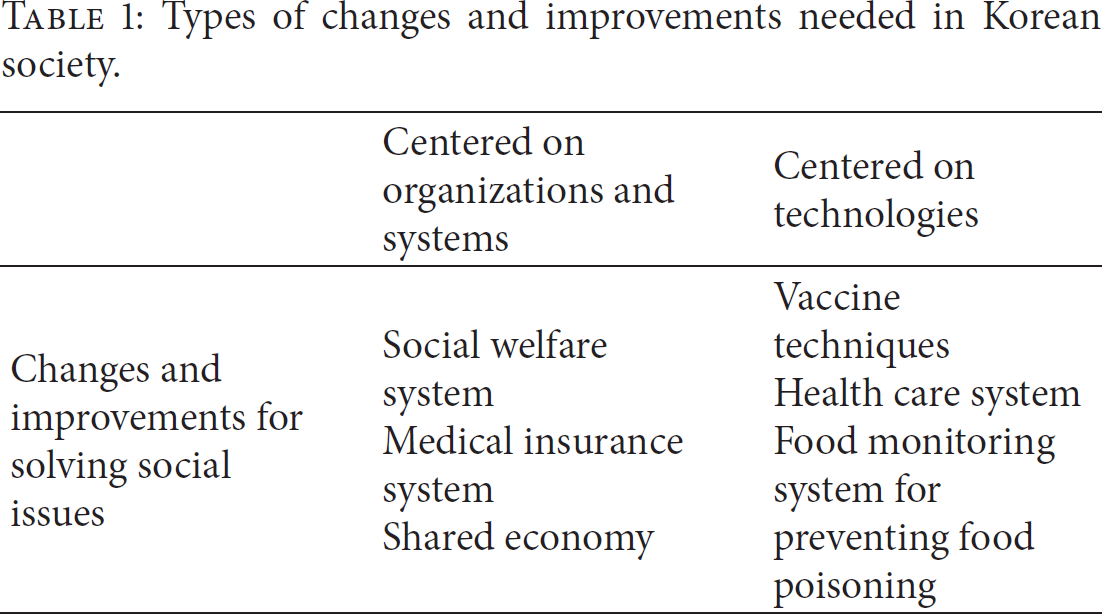
Therefore, it is very important to propose solutions for the protection of the national welfare and the resolution of social problems. In particular, despite Korea's remarkable economic growth, Koreans' national satisfaction with their quality of life appears to be very low, with the country ranking 27th among 36 countries in the 2013 OECD Better Life Index, although South Korea boasts the 10th largest trading size in the world with an over 5,000-fold increase in imports in the last 50 years [1]. Even though many researchers are striving to solve the country's political and administrative problems, they seem to have reached their limit. Therefore, to solve South Korea's social issues, its society should be changed and improved. That is, the needed social changes and improvements can be achieved through changes and improvements in organizations and technologies. Table 1 shows types of changes and improvements needed in Korean society.
Types of changes and improvements needed in Korean society.
However, in these days, considering technologies, more and more attention is required to identify scientific technology solutions as an alternative measure. Today, the researches on social roles of scientific technology are not comprehensive or systematic and people's concerns for them are also relatively low. Moreover, since the purpose of scientific technology is to focus on economic growth, systematic research to improve the social roles of scientific technology is not being conducted. Nevertheless, according to the survey conducted by the 2013 NSTC (National Science & Technology Council), 60.2% of the people still consider that scientific technology could play a significant role for resolving social problems and become an important measure that improves the quality of life, including national health and safety, beyond a mere measure of economic growth [2]. Advanced countries such as the US, EU, and Japan are continuously conducting research with huge budgets in order to identify solutions for social issues using scientific technology. In addition, the government and the department of education have been recently expanding the paradigm of R&D on scientific technology that focuses on both economic growth and improvement in quality of life. Moreover, the necessity of convergence technology has been recognized more than ever before in order to lead to innovations for future societies and sculpt a human-oriented and creative society for sustainable life.
However, scientific technology is still supplier-oriented (the government, corporations, researchers, etc.) and solitarily compartmentalized; therefore, it is difficult to expect the effects of convergence. Thus, convergence researches are required to vitalize convergence scientific technology, using cooperation of collective intelligence, such as consumers like citizens, humanity scientists, and the government or corporations.
Hence, even if the government and research institutes are conducting research that could solve social problems and create human-oriented values through scientific technology, there has not been any notable result produced by research so far. Therefore, in order to overcome such limit, social issues should be resolved through research on convergence social and scientific technology and a model that can produce profits should be studied by ensuring business markets.
Thus, this paper suggests a solution to crime prevention that can practically resolve social issues. Table 2 shows examples of social and scientific technologies from NSTC research.
Examples of social and scientific technologies.

(Source: NSTC, 2013 [2]).
2. Related Works
2.1. Government Activities for Solving Social Issues
As the development of national-level research that only concentrate on economic and technical growth are recognized as a problem, various forms of research are coming up to surface to improve national convenience from a perspective of balancing the social ecosystem. In this context, major companies and nations are showing interest in national convenience services for everyone, responding to various social issues and improving the comprehensive quality of life while encompassing welfare, environment, and safety. In South Korea, such activities are being promoted through technology development projects for solving social issues. These projects aim to “improve citizens” quality of life by solving social issues that significantly affect peoples' lives through science technologies, and to create products and services that are used in citizens' daily lives in the light of the developments in technologies, legal systems, service delivery, and so forth. To sum up such existing discussions, social technologies can be defined as technologies that create products and services using a fusion technology, as a subset of the national welfare technology.
2.2. A New Paradigm for Demand-Oriented Science Technologies
The latest improvements in physical living standards and new social issues such as crime and environmental pollution are being spotlighted as affecting quality of life. Therefore, technologies for solving social issues should be determined after classifying technology development and utilization areas as a social problem sector and defining the roles of the applied technologies. In other words, many researchers have insisted on the first technology-driven products. However, such approach has shown that the demanded products are yet to be developed or have not yet been distributed even though they have already been developed [3]. In addition, studies for solving social issues through technologies require different approaches because their aims and directions differ from those of the existing problem solution methods. This is because in the problem-solving process, the social issues must be understood; and to investigate the goals of the problem solutions, the major performers and the technical characteristics and revolution patterns of the solution of such problems must be determined. In addition, the government, which has been leading the solution of social issues, should convert its “supply-oriented policy” to a “demand-oriented policy” to discover the demands of civil society and satisfy them. Furthermore, the government should combine new and unique technologies with existing technologies to come up with newly designed technologies.
2.3. Social Services and Problems
Kotler et al. (2010), who is a business management scholar from the US, suggested that, in the current Market 3.0, corporations are performing activities to resolve “social problems” and consumers are actively engaging in the market based on advanced information and technology [4]. It implies that social problems are not just issues of the government, but a common issue that corporations and citizens should participate to solve together; therefore, it becomes possible for such activities to evolve into actions that create added values. In addition, the importance of social services is increasing in order for the government to resolve social problems that occurs within the fields of welfare, health and medical treatment, education, employment, housing, culture, and environment. Chang (2012) developed an innovative, new social service using scientific, engineering, and systematic methods and introduced social service R&D policies as an effective political measure that can improve the existing social service distribution system and customer interface [5]. In the paper, I have studied about crime prevention system through the conceptual model shown in Figure 2. However, since the existing social service distribution system is focusing on development-oriented research, balanced support and development are required for fundamental application studies on social services. Moreover, Song (2012) said that technology innovation is required to resolve social problems such as safety, health, and environment issues resulting from rapid social changes, while the advancement of social services through social technology is important as a measure that reduces financial burden and improves the quality and efficiency of social services [6].
2.4. Definition of Social Problems
To address social issues, the concept of a social issue is herein defined. Kim et al. (2011) stated in their study that the term “society” refers to a group composed of more than two individuals who interact or have exchanges, and the term “problem” represents a state wherein a basic desire has not been satisfied, or a negative state. Therefore, social problems cannot be absolutely or objectively defined but should be relatively clarified according to special criteria [7]. In this study, the common elements of the definitions of social problems are deduced based on the previous researches, as presented in Table 3. According to the previous researches, first, social problems diverge from social values (norms or order); second, they are determined as problems that need to be solved by majority of people or a few influential people; third, they are caused by the society itself; fourth, social or group activities are required to solve them; and fifth, they have negative effects on many people.
Previous researches that defined social problems.
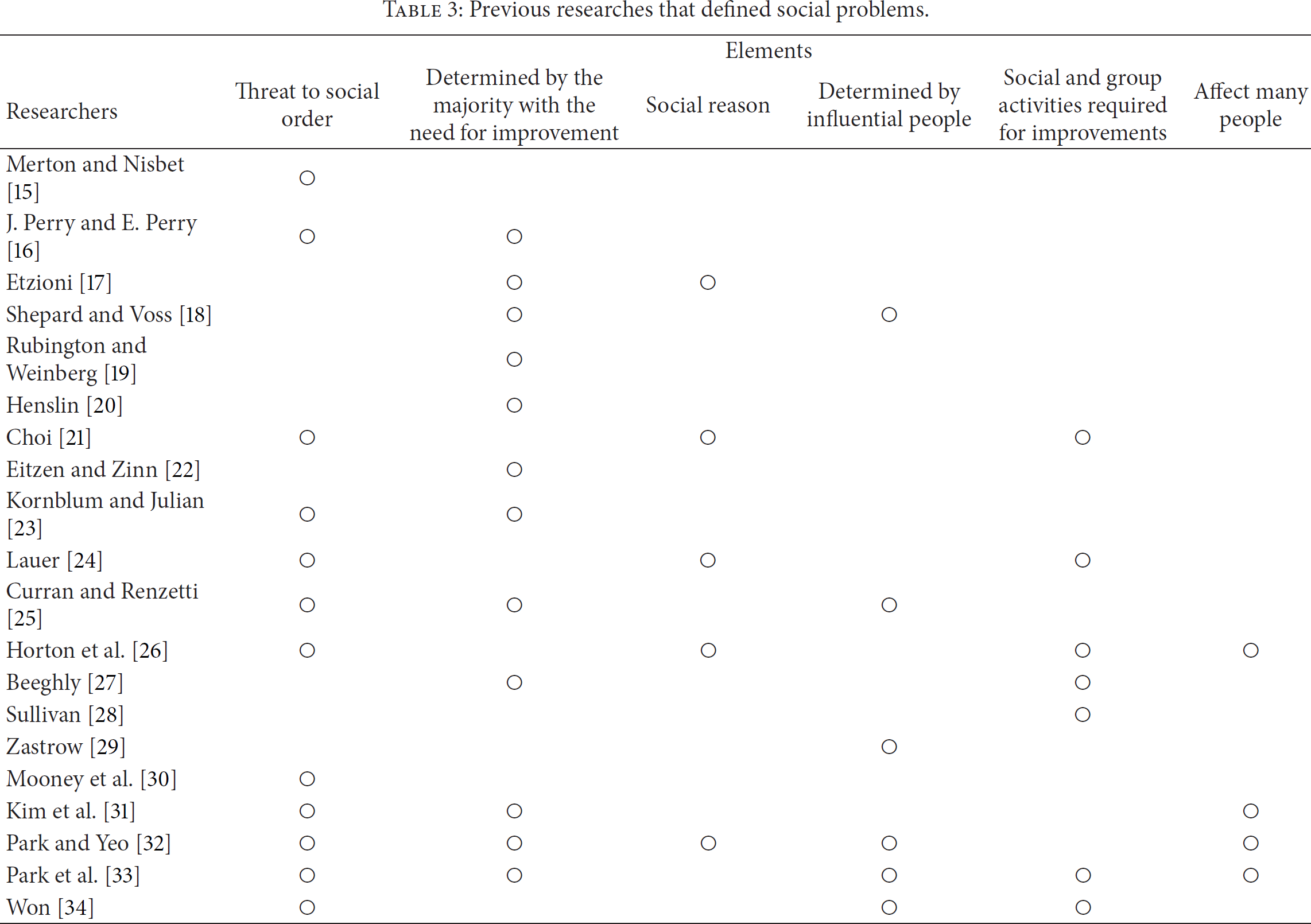
In addition, Kim et al. (2011) suggested that social problems are evaluated differently depending on the particular era, society, culture, value, and so forth [7]. Therefore, social problems can be classified depending on the technological environment, reserved resources, and levels of values that citizens aim for. Thus, the conceptual characteristics of such social problems are reflected to this study on the different types of social problems and their solutions.
2.5. Classification of Social Problems
Social problems, which used to be classified in the previous research based on the individual criteria of the researchers, can be classified according to their causes, properties, or types. The types of social problems can be based on an academic viewpoint or determined for application in national policies. These two viewpoints were reflected in this study to organize the details of the preceding studies promoted from the academic viewpoint. Table 4 shows the viewpoints of scholars on social problems.
Analysis of preceding studies to draw out the types of social problems.

In the paper, I analyzed literature reviews through metaresearch analysis. Table 4 shows that many researchers studied about crimes as important social problems.
2.6. Korean Ranking of Quality of Life
In this paper, the priorities of South Koreans in terms of quality of life in the OECD's report in 2014 are investigated by sector. The housing sector showed a low level of satisfaction. Therefore, the South Korean government is introducing the CPTED program to improve the deteriorated housing environment and solve Korea's public security issues. However, the current CPTED program is being used only to improve the housing environment. Table 5 shows ranking of quality of life in South Korea.
Ranking of quality of life in South Korea.

(Source: http://www.oecdbetterlifeindex.org, 2014 [1]).
2.7. Service Types for Social Problem Solutions
In this study, to deduce the services needed to solve social problems in health care, food, energy, education, the environment, crimes, disasters and calamities, housing, traffic, and leisure and culture, which correspond to the life quality elements, among the types of social problems revealed in preceding studies, the preceding studies were investigated to analyze the required services based on the problems in each field, as presented in Table 6.
Services required by social problem type.

2.8. Physical Design for Crime Prevention
Crime and the fear of crime are pervasive and endemic concerns in modern postindustrial society and criminal justice systems are clearly failing to tackle both issues [8].
Brantingham and Brangtingham (1991) have argued that there are four dimensions to any crime, namely, the law, the offender, the target, and the location [9].
As a place-based crime prevention strategy, crime prevention through environmental design (CPTED) emerged as an independent theory and is now increasingly fashionable and is being implemented worldwide [10].
CPTED is an acronym for crime prevention through environmental design which asserts that the proper design and effective use of the built environment can lead to a reduction in the fear and incidence of crime, and an improvement in the quality of life [11].
Also, physical design for crime prevention has the capacity to promote informal or natural surveillance opportunities for residents and their agents and surveillance is part of capable guardianship [12].
If offenders perceive that they can be observed, they may be less likely to offend, given the increased potential for prevention, apprehension, and prosecution.
Thus, considering the previous research, I suggested mechanical surveillance strategies (e.g., street lighting and CCTV) for crime prevention in the paper.
2.9. Safer School
For safer schools CCTV cameras, perimeter fences, metal detectors, and alarm systems need to be in place. An alarm system can have GPS coordinates, so that when it goes off the control center can easily locate the site. Electronic fences can either be wireless or in-ground [13]. Wireless fences have an electronic base unit that emits radio waves up to a certain range. A receiver and transmitter send an alert to the relevant body [13]. In-ground fence picks up radio waves and beeps once someone crosses the fence [13]. Perimeter security can have fiber optic stretched along the fence. An optical time reflectometer (a type of radar for light) attached to the fiber optic would locate the spot, within about a meter, where the twist or bend took place and a search light could be instantly aimed at the point [14].
3. Development of Social Issue Solutions
3.1. Introduction of a Crime Prevention Solution
In this study, the social issues that should be solved first were selected and their solutions were deduced, considering the types of social issues analyzed in the preceding studies and according to the OECD-reported (2014) priorities of South Koreans as to quality of life. To do so, a crime prevention solution for improving the housing environment, which was presented as a social issue in preceding studies, and for which the South Korean government showed great concern, was developed and proposed. That is, in this study, a security camera system that uses the Internet of Things (IoT) was developed to improve the housing environment by preventing crimes. Therefore, a solution for social issues is proposed after using the research approach shown in Figure 1.

City crime prevention solutions.

Conceptual model for crime prevention system using IOT.
3.2. Use of the Internet of the Things
The term “Internet of Things” (IoT) was first introduced by an MIT RFID (Radio Frequency Identification) specialist, Kevin Ashitton, who said in 1999 that “The IoT will be constructed because RFID and other sensors are mounted on things in daily life” [45]. That is, the IoT can be defined as a system wherein sensors and communication modules are mounted on things to enable real-time data exchange and communication via the Internet. Such connection of things through the Internet and other appliances can have greatly expanded ranges in real time in (1) collecting (sensing) information, (2) transferring the collected information (data), (3) storing the information (data), and (4) converging the information and generating new data. Therefore, the IoT environment can be defined as a society that is interconnected via the Internet or mobile networks. In other words, in the IoT, people, processes, data, and things are interconnected by an intelligent network, and therefore, the society becomes a place where new values and revolutions can be created. In addition, technology developments reduce technology costs and make technologies sophisticated. As such, the IoT technology is likely to bring about successful outcomes in the public sector (e.g., information from CCTVs, GPS, etc. helps improve crime prevention effects and criminal arrests).
4. The Crime Prevention Security Camera System Used with the IoT Technology
In this study, to prevent crimes in deteriorated areas, a crime prevention security system integrated with the IoT, which differs from the existing manual camera systems, was developed. Figure 3 shows the crime prevention security camera system used with the IoT technology. The current crime prevention cameras are being used to monitor crimes and quickly arrest the criminals. However, because the existing cameras cannot monitor incidents that occur far from the camera's fixed position, such cameras are increasingly failing to detect crimes. Therefore, in this paper, a system was developed with the following function: (1) when it detects a pedestrian's movement in alleyway, it automatically turns on LED lamps using its sensors installed on the fences of buildings and houses in deteriorated areas and (2) its camera follows the pedestrian's moves (camera moving steadily a track on the fences). As such, the system can lighten dark areas and advise pedestrians that they are being actively monitored, to prevent crime. Moreover, the system can quickly recognize (tracking shot by cameras) the field situation and transmit related information to related agencies to solve problems.

The Crime Prevention Security System.
5. Conclusion and Future Studies
In this study, a solution for changing and improving society was proposed by investigating social issue solutions and technologies centered on social organizations and systems. Therefore, the types of social issues were analyzed by defining them through the analysis in the preceding studies and using a metaresearch technique. In addition, the social issue solutions implemented in South Korea were investigated based on the OECD's analysis data (2014). From the results of this study, a new-concept security camera that uses the latest IoT technology to prevent crimes in deteriorated areas was proposed. The system can detect pedestrian movements, unlike the existing security cameras, because its camera follows the pedestrian's moves.
Thus, it is likely to actively prevent crime. The system can also be used to actively monitor crime scenes. However, to increase the practicability of the results of this study in the future, this system must be used in deteriorated areas to investigate its performance and the problems that can occur after it is introduced.
Footnotes
Conflict of Interests
The author declares that there is no conflict of interests regarding the publication of this paper.
Acknowledgment
This work was supported by the GRRC program of Gyeonggi province (GRRC).