




Abstract
Oil and natural gases have been developed, being the most convenient and high-quality resources for human. Offshore plant means design, production, installation, and operation of drilling equipment for natural energy in the deep ocean. BOP gantry crane is the essential equipment of Drilling System Package for drillship/rig. It is used to move BOP stack in drilling platform using BOP trolley. In this research, CFX analysis was used to consider wind pressure, and structure analysis was used to consider dynamic coefficient, rolling, pitching, and self-weight. As a result of crane analysis, even though it is a weight-lightened model, it is observed that the pressure, deformation, and stress value caused by the wind load are stably maintained above those of the previous model. Therefore, the structure is thought to be safe.
1. Introductions
In the past centuries, oil and natural gas have been developed, being the most convenient and high-quality resources for human. In 1859, drilling was started for oil discovery in United States and now developed more than 3000 m in the deep sea. Even technology development and drilling are begun in very low temperature and harsh environment [1, 2].
Offshore plant means design, production, installation, and operation of drilling equipment such as drillship, LNG-SPSO, or LNG-FSRU for digging up crude oil, natural gas, or other energies in the deep sea instead of land [3].
As the offshore plant market develops, the market of offshore equipment is expected to expand too, but only a minimum number of companies produce a portion of products in Korea compared to the world market.
Recently, up to 55-ton level is being commercialized in case of professional manufacture in other countries; however, there is none in Korea.
BOP (blow out preventer) gantry crane is the essential equipment of Drilling System Package for drillship/rig. It is used to move BOP stack in drilling platform using BOP trolley.
In this research, as a domestic manufacturing of BOP gantry crane which is an offshore plant equipment, ANSYS is applied into the analysis of rolling and pitching due to wave and wind load due to drillship, and the crane's self-weight and structural analysis were implemented. ANSYS is used for optimal design of BOP gantry crane to FSI analysis and fatigue life evaluation.
2. BOP Gantry Crane Modeling
2.1. 3D Modeling
As shown in Figure 1, 3D modeling made by CATIA (detailed and simplified model) was used to structural analysis. The structure analysis consisted of structure situation, some small parts like a bolt connection, a winch fix point, and simplified traveling part. Plate's thickness, width, length, and height are 12 mm, 10.4 m, 5.7 m, and 21.6 m, respectively.

3D modeling of CATIA.
2.2. Mesh
Mesh is a process of creating a three-dimension geometry model to a finite element model that consisted of element and node. Mesh of high density improves the result of structural accuracy; however, it increases the analysis time and the mount of a memory. Therefore, it is important to consist of regular size mesh overall because each node proceeds the structure analysis as a value. Because of the differences between the internal and external reinforcing plates of the BOP gantry crane, mesh the size of mesh is applied differently as mesh sizing.
3. Boundary Condition
BOP gantry crane operates on drillship/rig at sea, so the environment load should be applied more than general land crane. Case 1 is the FSI analysis and Case 2 is the structure analysis. Case 1 and Case 2 divided environmental conditions of the BOP gantry crane are analyzed and the results are compared. In each case, stress value, deformation, fatigue life, and safety factors are evaluated [4].
The safety factor is calculated by a standard of a yield strength of 360 Mpa, DH-36.
3.1. Boundary Condition of CFX Analysis
In order to apply wind load to a BOP gantry crane, the analysis was conducted using the FSI (fluid-structure interaction) technique [5].
The boundary condition is shown in Figure 2 first, the fluid field was organized in the form of a box, and air was set up to be inside the box. Next, the fluid field plane at the front of the crane was set up as the inlet of 63 m/s, with the plane facing it as the outlet, and all other planes as openings. The bottom of the fluid field and the surface of the crane were set up as walls to enable the value of the pressure resulting from the fluid to be drawn.

Boundary condition of CFX analysis.
Mesh size is very important in a fluid analysis. However, if the inside of the entire fluid field is densely meshing, it will delay analyzing the part which does not have a big impact on the structure. Accordingly, the mesh in the area far away from the structure was organized coarsely and that in the area close to the structure was organized densely using the edge sizing function.
3.2. Boundary Condition of Structure Analysis
Figure 3 shows the structure analysis of the boundary condition of BOP gantry crane. A is import pressure due to wind from CFX analysis result, B, C are working load, D is fix point, and E is acceleration of rolling and pitching. It makes two kinds (Case 1 and Case 2) of structure analysis result according to the working environment of crane explained in the next sentence.

Structure analysis boundary condition of BOP gantry crane.
A is wind pressure from CFX analysis. Wind load means the load that occurs on the structure when wind hits the structure. BOP gantry crane has wind speed of 63 m/s and 20 m/s according to API 2C register of regulation when Drillship moved or crane worked. The wind pressure on the Drillship was applied with maximum wind speed 63 m/s toward −X direction.
B and C are working load (SWL). In order to express the environment force, 200 ton (operation load) was multiplied by 1.6 (dynamic figure). So 320 ton were applied 160 ton of the force on each B, C parts for express the winch.
D is fix, pin hole part in the bottom of crane, it is connected with traveling device which moves as the rail, so fixed support was applied.
E is standard earth gravity. In order to put self-weight E of the crane, standard earth gravity is applied as −Z direction.
F is rolling and pitching (acceleration). BOP gantry crane operates on Drillship so the motion of Drillship should be applied on the analysis model.
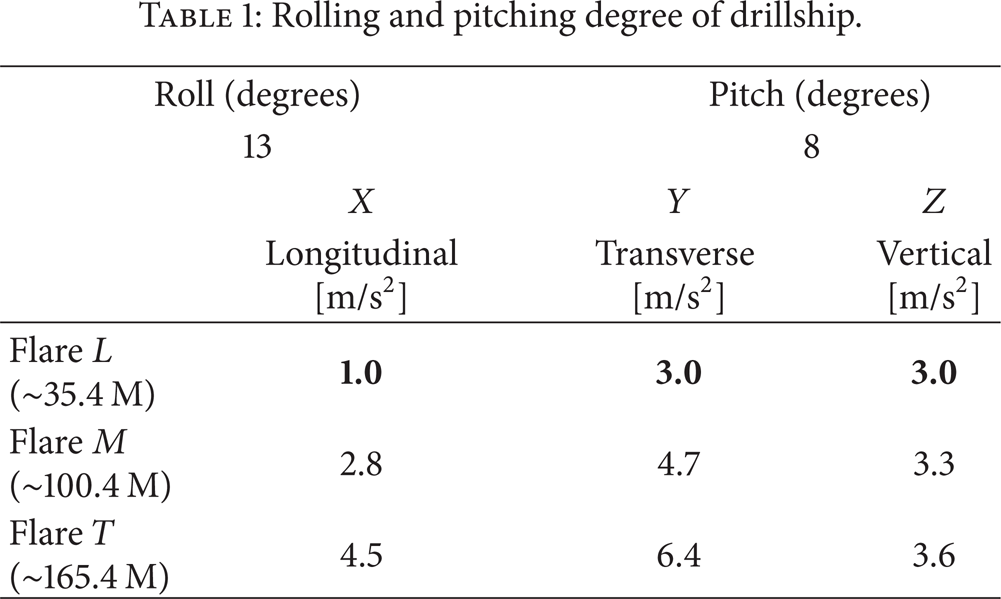
Table 1 shows rolling and pitching values of Drillship according to the height. Due to height 21.6 m of BOP gantry crane, flare L value is applied to consider rolling and pitching. So, acceleration is applied to F as X, Y, and −Z (reverse gravity direction).
Rolling and pitching degree of drillship.
3.3. Fatigue Analysis
Structure can be destroyed, if the number of mechanical and thermal load is repeated. We call this situation fatigue [6, 7].
In the case of BOP gantry crane, fatigue limit curve is applied as a Goodman curve suitable for structure steel. A compressive load happens overall so a repetitive analysis of compressive load supply and removal is progressed. Figure 4 is S-N curve of DH-36 steel which is the most important for fatigue analysis.

S-N diagram of DH-36 steel [8].
4. Result
4.1. CFX Analysis Result
Figure 5 shows the result of the wind load analysis of BOP gantry crane. Figure 5(a) is shown in vector to express the movement and intensity of the wind, and it can be seen in which direction and at what intensity the wind moves when it hits the structure. It is confirmed that more turbulence is generated immediately after it hits the structure than before, and the wind pressure also increases greatly.

CFX analysis result.
As shown in Figure 5(b), the stream line where that much turbulence can be seen is generated between the legs of the crane. Many reinforcing plates were added for stable structural form, and it was confirmed that much turbulence was generated.
Figure 5(c) shows the contour result, and it appears mostly at the front which directly faces the wind. While it can be seen in the previous model that the load is partially concentrated on the front side of the crane, we can see that the wind load is evenly acting on the surface in totality through change in the gradient of the structure legs.
As it can be seen from the overall observation result, though reinforcing plates may be helpful in the aspect of structural stability, it could be confirmed that reinforcing plates rather increase the stress applied to the structure by the wind if only the amount of pressure generated is compared. A conclusion was made whether the structure was stable or not through a structural analysis.
4.2. Structure Analysis Result
Figure 6 shows the structural analysis result of the crane. Figure 6(a) is the deformation, of which the maximum value is about 32 mm. As most of it is compressive load, it appears at the top of the structure. It is presumed that the deformation has increased as the plates used have become thinner. However, as 32 mm is very small when the structure total size of 21 m is considered and far below the specified deformation (length/800), the structure is thought to be safe.

Structure analysis result.
Figure 6(b) represents the stress value, and the maximum stress value of 177 MPa has occurred at the bottom of the reinforcing plates designed for the structure. The reason why the stress distribution has been changed while the basic load of the structure other than the wind load is the same is presumed to be because of the change in the form of the structure. However, there is no big change in the maximum stress value in comparison to that of the previous model. As the safety factor (2.03) is higher than the specified safety factor (1.5), the structure has been designed for safety.
4.3. Comparison with the Analysis Result of Previous Model
In comparison to the previous model which used 16 mm thick plates, 2 reinforcing plates and leg angle was vertically located, the new model used 12 mm thick plates, 4 reinforcing plates and the leg has little tilt angle.
Due to these reasons, the result of fluid analysis showed generation of much turbulence between the added reinforcing plates [9]. Nevertheless, as a result of the structure analysis, the stress values have been found almost similar while the deformation has increased by 5-fold. Even though the load has increased due to the turbulence and deformation, the stress values are thought to be almost similar thanks to the stable structure, and the structure is thought to be stably designed as, when compared, the safety factor is found to be higher than the specified safety factor of 1.5. The results of the analysis and structure comparison are put in order and shown in Table 2.
FSI analysis result of each modeling.

4.4. Fatigue Analysis Result
To determine the number of uses per day when 320 tons is applied on the crane, a fatigue analysis is conducted. The result implies a minimum cycle of 108300 of use while there is a fracture that occurred at the same point. And, except for the minimum cycle point where fracture occurred, structure cycle life is 1000000 which is about 137 times of use per day if the structure is objected to use for 20 years.
5. Conclusion
In this paper, a fluid analysis and a structure analysis have been conducted to evaluate the stability of BOP gantry crane against external environmental force, and the following conclusions can be obtained compared with the model before the design change.
As a result of the crane fluid analysis, it is confirmed in the contour result that the stress concentration phenomenon of the previous model has been resolved. Therefore, much turbulence is generated, which is thought to be because of the reinforcing plates added for stability of the structure.
For the structural analysis crane, even though it is a weight-lightened model having deformation of 32 mm and stress value of 177 MPa in comparison to the previous model, we could observe that the pressure, deformation, and stress value caused by the wind load are stably maintained above those of the previous model. Thus, it was confirmed that a safety factor is higher than the specified safety factor that was maintained. Therefore, the structure is thought to be safe.
According to the comparison of the previous model and the changed new model, the result of the structural analysis and the stress values have been found to be almost similar while the deformation has increased by 5-fold. Even though the load has increased due to the turbulence and deformation, the stress values are thought to be almost similar thanks to the stable structure, and the structure is thought to be stably designed.
As a result of fatigue analysis, minimum cycle is almost 1,000,000 cycles higher than 250,000 of regulation fatigue life. The maximum life was measured to be of same point of maximum stress. If the crane is used during 20 years, it can be used 4167 times a month. From this study, we expected that these results can be used for future BOP gantry crane technology development for making of actual model.
Conflict of Interests
The authors declare that there is no conflict of interests regarding the publication of this paper.
Footnotes
Acknowledgments
This is the result of the study conducted as a Wide Economic Region Leading Industry Fostering Project of the Dongnam Institute for Regional Program Evaluation supported by the Ministry of Knowledge Economy (no. A002201167) and the Korea Institute for Advancement of Technology.