




Abstract
In VANETs, a clustering algorithm can be used to partition the network into smaller segments. Therefore, the clustering algorithms provide not only limited channel contention but also fair channel access within the cluster. In addition, they also increase spatial reuse in VANETs and efficient control for the network topology. The main concern in the clustering algorithm is the cluster stability. The major challenge is to elect a cluster head and to maintain the membership of member nodes in a highly dynamic and a fast-changing topology. Therefore, the major criterion for cluster formation is to form a stable cluster. In this paper, a clustering algorithm to affect organization and cooperative ADHOC MAC for cluster-based TDMA system in VANETs (ECCT) is proposed. The cooperation is used to help a cluster head update each neighbor cluster's information which helps each cluster head to avoid collision when two clusters move into each other's cluster's transmission range. This efficiently utilizes a time slot. We use the lowest-ID algorithm to achieve organization. The analytical and simulated results show that not only the average number of time slots for electing a cluster head but also total number of time slots before data can be successfully transmitted is less than the existing cluster-based TDMA system and IEEE 802.11p.
1. Introduction
Vehicular Ad hoc NETwork (VANET) consists of moving vehicles creating a very dynamical network. VANET is one of the special types of Mobile Ad hoc NETworks (MANET) but it does not have an existing infrastructure or centralized administration. VANET supports many applications in safe entertainment and vehicle traffic optimization. A typical VANET is classified into a set of vehicles equipped with communication device, that is, Global Positioning System (GPS) receiver, called On-Board Unit (OBU), and a set of stationary units along roads, called Road Side Units (RSUs). Based on OBU and RSU, VANET has two essential communications: Vehicle-to-Vehicle (V2V) and Vehicle-to-RSU (V2R). To support V2V and V2R communications, the United States Federal Communication Commission (FCC) dedicated 75 MHz radio spectrum in the 5.9 GHz band for Dedicated Short Range Communications (DSRC) spectrum [1]. The DSRC spectrum is divided into seven 10 MHz channels: six Service CHannels (SCHs) and one Control CHannel (CCH), as shown in Figure 1. A sync interval (SI) comprises a CCH interval (CCHI), 50 milliseconds, and SCH Interval (SCHI), 50 milliseconds. Both CCHI and SCHI have guard interval 4 milliseconds to switch between the CCH and the SCH, as shown in Figure 1.

DSRC spectrum allocation.
One important service is the high priority safety application proposed for VANETs. Each vehicle broadcasts its information within one-hop neighborhood [2] for the V2V applications such as precash, blind spot warning, emergency electronic brake light, and cooperation forward collision avoidance [3]. In V2R application, such as the curve speed and traffic signal violation warnings, RSUs broadcast to all vehicles which approach them [4]. To support the high priority safety application in VANET, the Medium Access Control (MAC) protocol is designed to provide efficient broadcast services. For instance, HER-MAC [5] supports more reliability in the safety message broadcast and efficiency in the service channel utilization. E-VeMAC [6] solves the parallel transmission problem in the VeMAC protocol.
In VANET, vehicle (also called node) frequently enters or leaves transmission range of neighbor nodes. Therefore, frequent connections and disconnections are observed by the vehicles which creates the high mobility model of VANET. To limit the mobility, in VANET, vehicles are organized into clusters with at least one Cluster-Head (CH) node. CH is responsible for coordination tasks of a cluster. VANET is divided into networks of smaller and more stable clusters. Thus, vehicles moving in a similar pattern form a cluster which affect less the mobility model compared to the whole network.
VANET is particular case of MANETs. The differences with MANET are variable network density, large-scale networks, predictable mobility model, and rapid topology changes. Many clustering algorithms proposed in MANET are not suitable for VANET because of these properties. Many clustering algorithms for MANET and VANET are proposed [7]. VANET clustering algorithms focus mostly only on position and direction of vehicle and are derived from MANET. Therefore, to enhance the stability, clustering algorithms need to be refined in order to account for location, direction, and speed.
The major concerns in designing the cluster-based MAC protocol for VANETs are delay bounds (i.e., limited time), bandwidth efficiency (i.e., the network resource), mobility (i.e., vehicles leave and join cluster at high speed), scalability (i.e., high and low density scenarios), and fairness (i.e., every vehicle should get a fair chance to access the channel). Employing clustering algorithm in IEEE 802.11p degrades the performance especially when the number of nodes increases in a cluster. To improve the transmission efficiency as the number of nodes increases, recently a cluster-based TDMA is proposed, such as in [8–10]. A CH needs to be selected to serve as the network coordinator in a cluster-based TDMA. The elected CH is responsible for allocating time slots for data exchange among its cluster members (CMs). CMs can avoid collision and achieve fairness due to careful scheduling of time slots. In this paper, we propose a new clustering algorithm to elect CH faster than existing clustering algorithms by using the lowest-ID algorithm.
In cluster-based TDMA system, two clusters move into the transmission range of each other due to the dynamic nature of VANETs. The vehicles using the same time slots can collide at the intersection area. Cooperation avoids collision by utilizing an idle time slot to forward a packet transmitted by a cluster head to each neighboring cluster head. In this paper, by using idle time slots for cooperative relay transmission, the ECCT can avoid collision, increase the lifetime of cluster head, and avoid reorganizing a new cluster when the gateway did not overhear the cluster head packet.
The rest of the paper is organized as follows. Section 2 presents the relation works. Section 3 gives information about cluster-based TDMA system. Section 4 is dedicated to presenting the lowest-ID algorithm used to elect CH. Section 5 presents cooperative MAC protocol for intercluster communications. The analytical and simulated results are presented in Section 6 and we conclude and suggest some future works in Section 7.
2. Related Work
To support Quality-of-Service (QoS) for timely delivery of real-time data and increase the throughput for non-real-time traffic over Vehicle-to-Vehicle (V2V) in VANET, Su and Zhang [11] and Su and Chen [10] develop the cluster-based multichannel communications scheme based on the infrastructure-free VANET environments. The Cluster Range Control (CRC) (channel 172) is used for CMs to broadcast their packets on their predefined slots. The Intercluster Control (ICC) (channel 178) uses CSMA/CA technique for CHs to broadcast their cluster information, as shown in Figure 2. The scheme [11] reduces data congestion and supports QoS for real time of safety message while efficiently utilizing wireless bandwidth over V2V network. However, this scheme only has 4 channels (channels 176, 180, 182, and 184) to exchange data in intravehicle communications.

Time structure in ICC and CRC channels.
Ding and Zeng [9] proposed a clustering-based multichannel V2V communication system to provide traffic accident avoidance mechanism. This system employs a self-organized cluster by assuming two different channels: multiple control channels and a single data channel. The elected CH is a highest candidate probability node. Unfortunately, the author did not address time slots in TDMA.
Sheu and Lin [8] proposed a cluster-based TDMA (CBT) system for intervehicle communications. When the CM increases, the waiting time to elect CH is less than IEEE 802.11p. However, this system applies in the small-sized cluster. A TDMA time slots and MAC-frame format in slot 0 is depicted in Figure 3.

Time structure in [8].
In TDMA system in VANETs, due to the fact that the number of time slots of a frame is constant, the TDMA MAC protocols may lead to wastage of time slots. The wastage of time slots occurs when there are not enough nodes in a neighborhood to use all the time slots of a frame. In addition, upon a transmission failure, the source node has to wait until the next frame for retransmission, even if the channel is idle during unreserved time slots. In CAH-MAC [12], neighboring nodes cooperate by utilizing unreserved time slots, for retransmission of a packet which failed to reach the target receiver due to a poor channel condition. Using CAH-MAC protocol, the packet transmission delay (PTD) and packet dropping rate (PDR) decrease through mathematical analysis and computer simulation [13]. However, in the presence of relative mobility among nodes, cooperative collision occurs between reservation packets from the nodes attempting to reserve the unreserved time slot and the cooperative transmission. An enhanced CAH-MAC (eCAH-MAC) [14], the cooperative relay transmission phase, is delayed, so that cooperative collisions can be avoided and time slots can be efficiently reserved. For cooperating in clustering VANETs, a novel cooperative MAC [15] and a multichannel cooperative clustering-based MAC [16] are proposed. Each node in CAH-MAC in its own time slot transmits a packet, as shown in Figure 4. On the other hand, a novel cooperative MAC [15] and a multichannel cooperative clustering-based MAC [16] add an ACK domain in the header packet. The ACKs in this domain will help the CH and CMs to verify the reception of a packet, as shown in Figure 5. By using this structure, a novel cooperative MAC [15] can improve the reliability of broadcasting and multichannel cooperative clustering-based MAC [16] can improve the reliability of transmission and provision QoS for different application in VANETs.

Structure of a packet in CAH-MAC.

Structure of a packet in clustering VANETs.
In [17], we presented a new scheme to elect CH which inherited the time division in TDMA frame and MAC-frame format [8]. We used the lowest-ID algorithm to reduce average number of time slots to electing a CH. Therefore, the cluster is efficiently organized. In this paper, we use cooperative MAC for intercluster communication to avoid the collision when two clusters move to the transmission range of each other.
3. Cluster-Based TDMA System
3.1. Cluster Communications
In intravehicle communications, cluster-based TDMA system uses simple transmit-and-listen scheme to quickly elect CH and it allows each CM to randomly choose each time slot for bandwidth request (BR) without limiting the number of CMs. The transmit-and-listen scheme means that a node will occupy a time slot if and only if only a node transmits a HELLO packet and others receive this packet. In [8], CBT algorithm is proposed. A node is elected to be a CH if and only if a node gets random “1” and all others get random “0” (“1” means sender; “0” means receiver). When a CH is elected, all other nodes use the same transmit-and-listen scheme to randomly choose time slots for bandwidth request (BR) without limiting the number of CMs. In a cluster, CH announces its cluster information to CMs. Upon receiving CH's packet, CMs know about CH's MAC address and the other CMs in a cluster. CMs can transmit data together without collision by announcing a broadcast data packet on their assigned time slots.
A cluster structure has at least one CH. In Figure 6, CH communicates with CMs within its transmission range
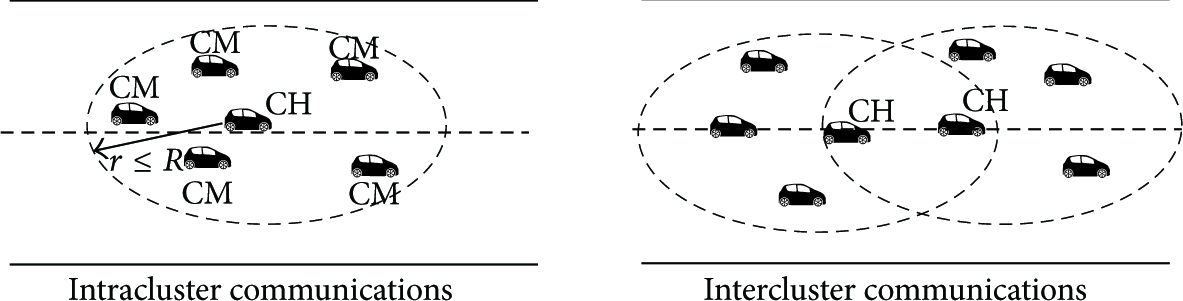
Intra- and intercluster communications.
3.2. TDMA Time Slots
To propose cluster-based TDMA system, we design TDMA time slot structure and the associated MAC-layer frame format, as shown in Figure 7. Slots

A new time structure.
In Figure 7, CHP is comprised of the following fields:
CH MAC address (6 bytes): the MAC address of a CH. CH slot number allocated (1 byte): the ID of the CH's allocation slot. Inform cooperation (7 bytes): CH informs the helper node and the idle slot to transmit when there is more than one helper node. CM MAC address (6 bytes): the MAC address of a CM. Slot numbers allocated (1 byte): the ID (from 1 to CRC (4 bytes): to protect CHPs.
For each CM, they broadcast HELLO packets during their assigned time slots to announce their existences, as shown in Figure 8. If a node is an initial node, it only broadcasts its ID address. Upon receiving this packet, the CH can handle CMs and know about CM's ID addresses and allocated CM's slot number. If a node hears more than one CHP packet from CHs, it becomes a gateway node (GW). Once it detects multiple CHs, GW compares the CH's ID addresses and it decides belonging to a CH which has lower ID among multiple CHs.

A HELLO packet structure.
4. Efficient Organization by Using the Lowest-ID Algorithm to Elect CH
The operation of the lowest-ID algorithm to elect CH is as follows:
In the initial state, each time slot uses mechanism to access the medium which is Distributed Coordination Function (DCF). For each packet transmission, the backoff time is uniformly chosen in the range (0, CW). The value CW is called contention window. When the backoff time reaches zero, a node transmits a HELLO packet as shown in Figure 10. The received nodes compare their ID with the source's ID. They know its ID is lower or greater than source's ID. Then, we have two ID sets: lower and greater sets. Because we use the lowest-ID algorithm, the lower set is chosen and the greater set is dismissed. Nodes with higher ID than the sender do not participate in CH selection process anymore. All nodes in the lower set will attempt to become a CH in the next time slot using the DCF mechanism. This step will repeat from step [3–5] until no node transmits at the current time slot, t. A node broadcasts a HELLO packet in time slot
The operation that CMs choose time slots for bandwidth request is the same as the the operation of the lowest-ID algorithm to elect CH. Hence, a node exists in one of the four states: initial, quasi-CH, CH, and CM, as shown in Figure 9.

State transition of intracluster communications.
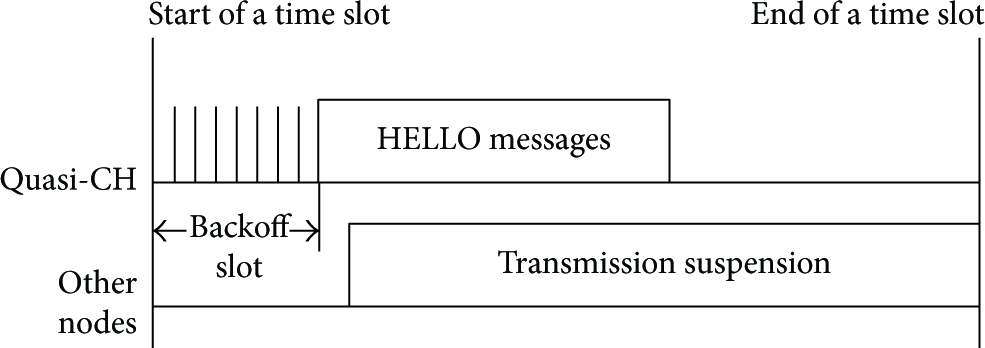
The procedure for becoming a quasi-CH.
5. Cooperative MAC Protocol for Intercluster Communications
We assume that the source and destination nodes are in the transmission range of a helper node. Each node can receive the packet transmitted by other nodes in the one-hop neighbors. For increasing the lifetime of the cluster, each node in a cluster has to move in the same direction [7–10]. Because a node in the VANET moves in and out of the cluster very frequently, a node which is moving in the opposite direction of a CH can be affected to a stable cluster. To improve stability of a cluster, each cluster in two different directions uses a different CDMA. Consider S and D nodes as the source and destination nodes with the sth and dth time slots and node C as the helper node. Cooperation decision and cooperative relay transmission are performed only if all the following conditions are satisfied.
(1) The Helper Successful Receives a Packet for Retransmission. A helper node must receive the packet successfully from the source node S during the sth time slot.
(2) A Destination Node Is Source's Neighbors. Helper node can relay packet if node D is within its transmission range. Hence both the source node S and destination node D must be listed as one-hop neighbors in node C's neighbor-table.
(3) There Is an Available Time Slot. Helper node, when satisfying conditions (1)-(2), can offer and perform cooperation if there exists at least one reservation time slot which it can transmit.
In addition, from [18], for a certain node x, the following sets are defined:
If the preceding conditions are satisfied, the helper node C offers cooperation to the source and destination and the cooperative transmission is performed in the time slot c. We consider a scenario depicted in Figure 12. Two clusters are moving in the same direction and there exist CMs in the boundary of a cluster's transmission range, as shown in Figure 12(a). Upon receiving a HELLO packet transmitted by node e, node b adds node e into its neighbor-table,
In the other scenario, if node CH x uses the same time slot with CH y, node x switches to a free time of 2 time slots allocated for transmitting CHP. Based on this condition, CH of 3-hop neighbor set can reuse 2 time slots for transmitting CHP, as shown in Figure 11. If node x’ CM uses same time slot with node y’ CM, node x will assign a new time slot and include its into CHP to broadcast. Once CMs receive CHP transmitted by its CH, CMs will update its cluster information and whether or not to change CH's time slot.

Reusing time slots of cluster heads in a TDMA frame.
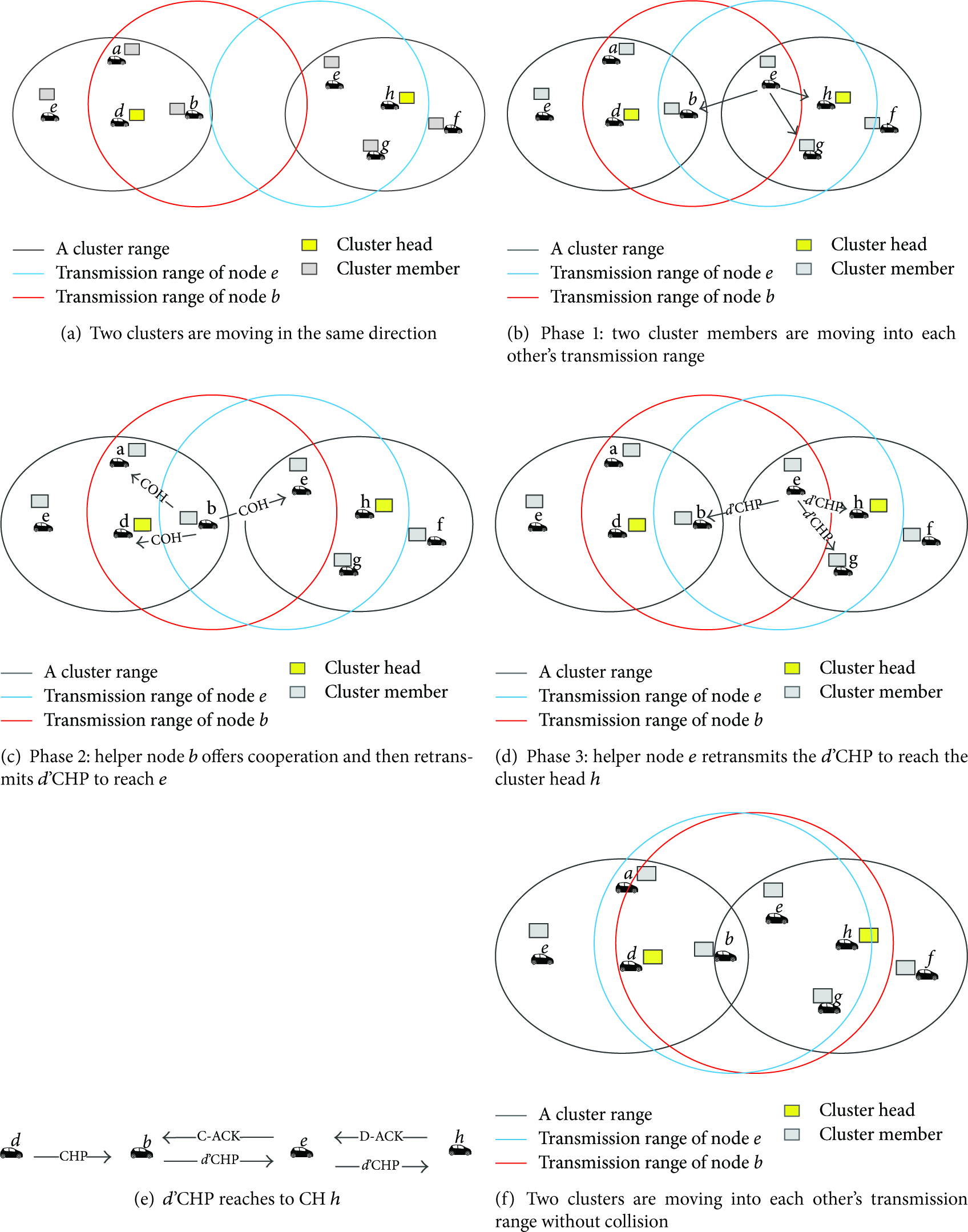
Information exchange in the ECCT.
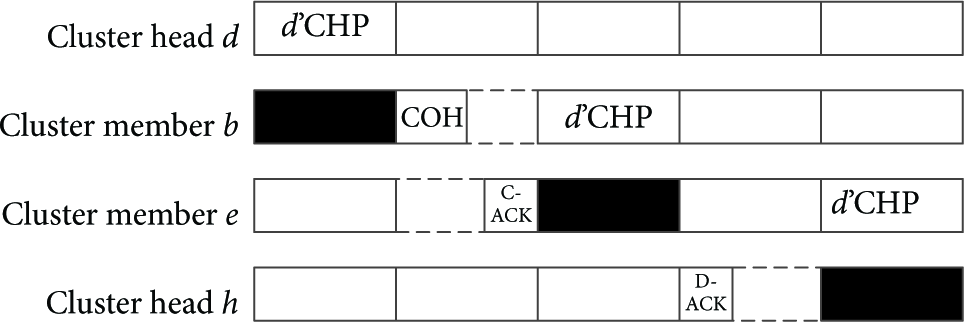
Information exchange in the ECCT follows time slots.
6. Numerical and Simulation Results
The parameters are listed in Table 1. See [19] for details and general description of the IEEE 802.11 MAC protocol; each node transmits with probability τ:


Simulation parameters.

The scheme of the lowest-ID algorithm is depicted in Figure 17. In the first state, we have K nodes attempting to be a cluster head. In the first time slot, one node transmits a HELLO packet. Upon receiving this packet, K nodes are divided into two sets:
Theorem 1.
The average time 
Proof.
Let 

We have the average time 


Similar to 
From (10), based on the value m, we have another value of

The time slots required for electing a CH.

A tree diagram of 4 nodes.

A set of average number of time slots for electing a CH.
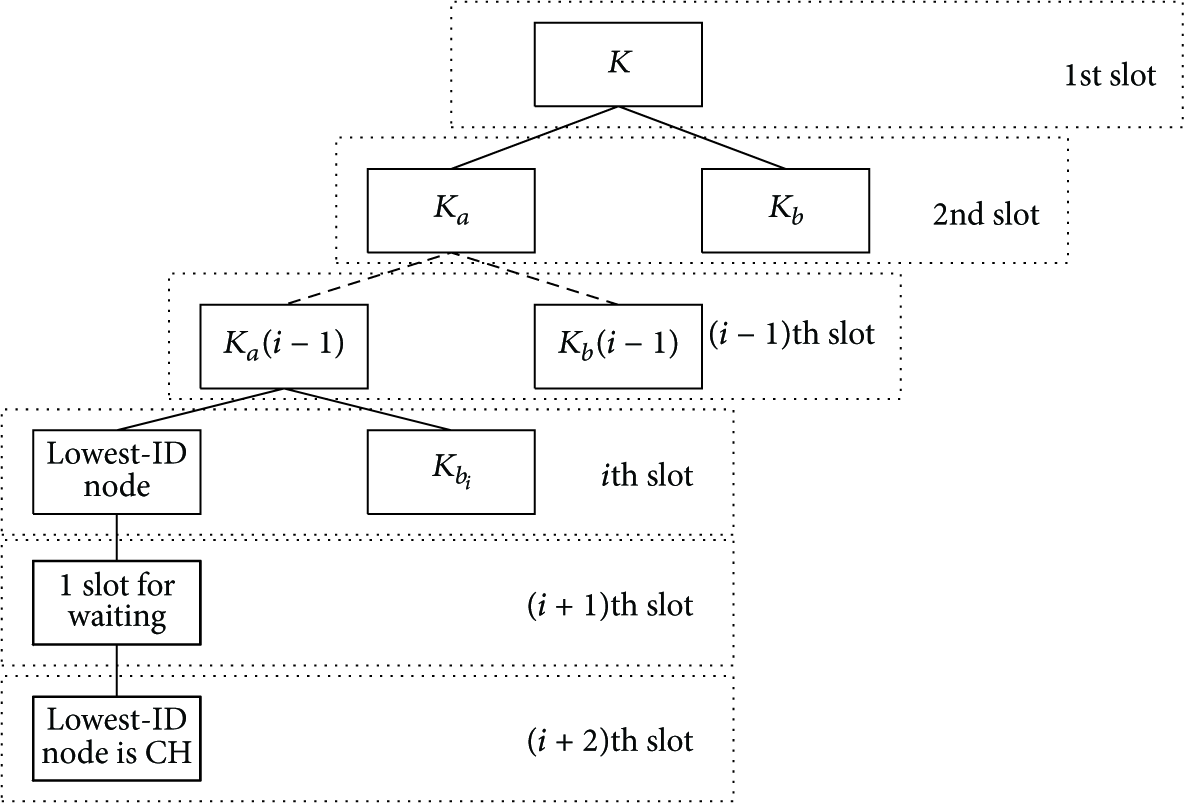
The schedule of the lowest-ID algorithm.
After CH is elected, CMs will assign their time slots to transmit data. To calculate the average number of time slots required for the successful BR, we take an average number of 

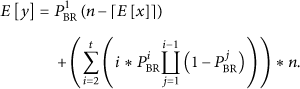


To evaluate our proposal and CBT in [8], we use MATLAB to compute and simulate the average number of time slots for electing a CH, the average number of time slots required for BR, and average number of time slots counting the time electing a CH to the time when a node is ready to transmit its data. We ran the simulation 100 times to obtain the mean value of the final performance metric. We choose R = 18 Mbps, which is one of the rates supported by the IEEE 802.11p OFDM physical layer for the 5 Ghz,
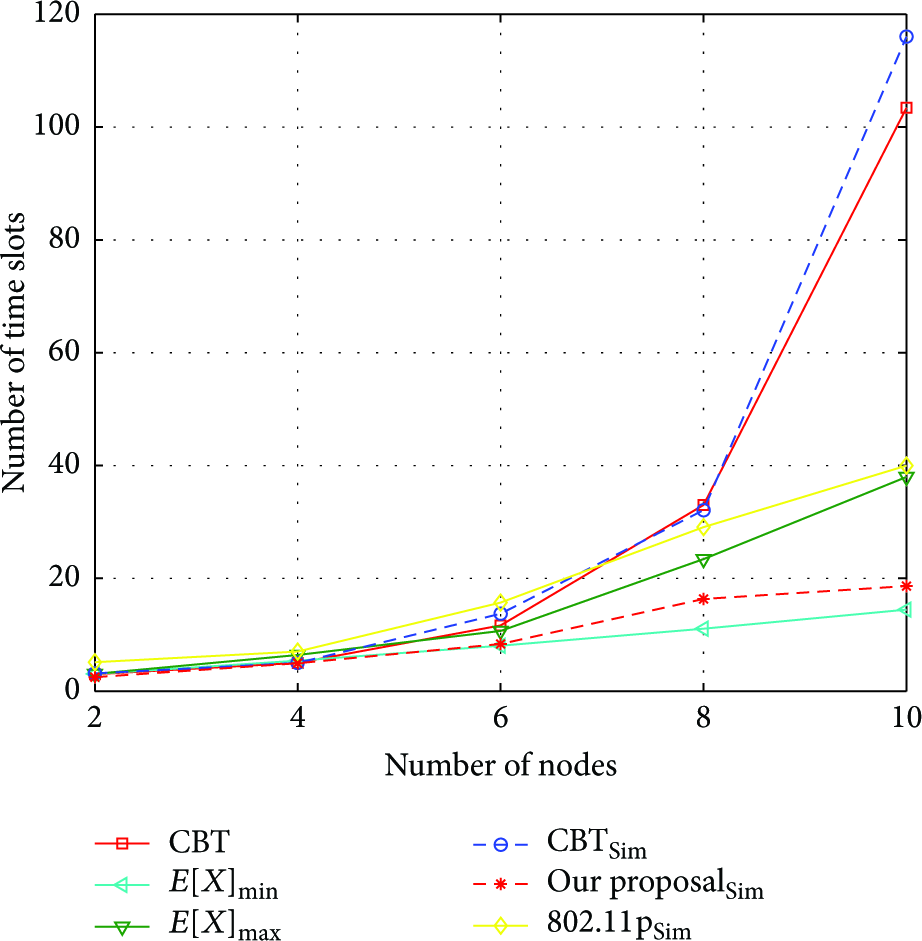
Average number of time slots for electing a CH.
When the number of CMs in a cluster equals 2, 4, and 6, both our proposal and CBT are the same time slots required to assign BR. But when the number of CMs increases, our proposal requires time slots less than CBT, as shown in Figure 19. Because the average number of time slots for electing a CH in our proposal is less, the number of free time slots remains more in the first frame and CMs can assign BR in the first frame more than CBT.

Average number of time slots for bandwidth request.
We can compute the average number of time slots counting the time electing a CH to the time when a node is ready to transmit its data. When the number of CMs in the cluster increases, the total number of time slots also increases. As shown in Figure 20, the total number of time slots in our proposal is less than that in CBT for different cluster sizes. Our proposed scheme elects a CH faster, and thus there are more free time slots remaining in the first frame. Therefore, the CMs can assign BR faster than CBT to transmit data.

Total number of time slots required before data transmissions.
7. Conclusion
In this paper, a novel algorithm to elect a CH for cluster-based TDMA system in VANET is proposed. By using the lowest-ID algorithm, not only the average number of time slots for electing a cluster head but also total number of time slots before data can be successfully transmitted is less than the existing cluster-based TDMA system and IEEE 802.11p. For intercluster communication, we use cooperation ADHOC MAC for VANETs to avoid collision when two clusters move into each other's transmission range. The cluster head knows a neighbor cluster's information and reassigns cluster members’ time slots before two clusters intersect together. If two or more nodes in boundary of two clusters transmission ranges use the same time slot, the broadcast safety application packets transmitted from a cluster do not reach to another cluster because the collision takes place. As the future work, we are going to extend our proposal by considering variable speed models and enhance our current work to help the node in the boundary of two clusters transmission ranges to avoid the collision when they use the same time slot.
Footnotes
Conflict of Interests
The authors declare that there is no conflict of interests regarding the publication of this paper.
Acknowledgments
This research was supported by Basic Science Research Program through National Research Foundation of Korea (NRF) funded by the Ministry of Education (NRF-2014R1A2A2A01005900).