




Abstract
A Fiber Bragg Grating (FBG) based wind pressure sensor (WPS) for structural surfaces is introduced, and wind pressure-strain conversion model as well as temperature compensation method is established. By using finite element analysis, the design of the wind-bearing carrier of the WPS is optimized such that the nominal measured values by the FBGs are maximized under the action of fundamental wind pressures suggested in codes. Furthermore, sensing characteristics of the WPS, as well as its static wind safety, pressure stability, and dynamic stability during operation, are investigated. Results demonstrate that the design scheme for the WPS, which is of good object sensing properties and working performance, is technically feasible. The final prototype of WPS is developed according to the proposed optimized design scheme.
1. Introduction
Evaluation of the effects of wind loads on modern super-high-rise buildings and long-span bridges is an important design consideration. Some extreme events have shown that wind loads can cause excessive vibration, static deflection, and even damage. These have a significant impact on the safety and reliability of structures. Therefore, it is important to accurately monitor wind loads acting on structures during their service life for evaluation of safety and for the purposes of structural control [1]. Monitoring wind loads thus becomes an important component of structural health monitoring [2].
Currently, wind tunnel experiments, numerical wind tunnel simulations with computational fluid dynamics (CFD), and field measurements are the main methods to assess wind loads on structural surfaces. The first two approaches establish the relationship between wind field (wind) and wind loads to achieve an indirect estimation of the wind loads acting on real structures. However, due to the “scale effect” of wind tunnel experiments [3–5] and lack of simulation methods for CFD based numerical wind tunnel studies [6–8], the accurate wind loads are difficult to be acquired. On the other hand, the field measurement, which is the most reliable, direct, and effective way, includes measurements of wind speeds and direction and structural surface pressures. Since sensors need to be attached to structural surfaces, it is still difficult to obtain accurate measurements of wind speeds and directions [9]. In contrast, monitoring structural surface pressures, which not only simplifies measuring procedures, but also overcomes the drawbacks during wind speed and direction measurements, is a very efficient field measuring approach [10–12].
Field wind pressure measurement generally can be classified into two categories, namely, buried-tubing pressure measurement system and front-end pressure sensor measurement system (PSMS). The former is based on the principle of wind tunnel experiments, where holes need to be drilled on structural surfaces. This method not only damages surfaces but also creates more difficulties such as wire distribution, instrument installation, and system calibration. As a result, it is only appropriate for wind load monitoring of experimental structures, but not that of real structures [13, 14]. In contrast, PSMS has the advantages of prevention of wire distribution, easy installation, and no damage to surfaces. Therefore, it is a highly efficient wind pressure monitoring technology. It can measure the structural surface pressure directly so as to improve the quality of measurements [8, 15]. Unfortunately, at present, there are no mature front-end pressure sensor technologies which are suitable for adverse exposure conditions.
We developed a new FBG based WPS [16, 17], which does not have the limitations of conventional monitoring systems. In this paper, the prototype design of the WPS is introduced and its sensing mechanism is studied followed by numerical analysis on mechanical characterization of proposed wind-bearing barrier, with the aim to demonstrate the technical feasibility of proposed WPS.
2. Conceptual Design of FBG Based WPS
2.1. Design Optimization for Basic Structure of Sensor
Wind pressures on civil engineering structural surfaces are in a micropressure range and have the characteristics of fluctuating. Thus, there are many factors influencing WPS design, such as temperature, waterproofing, stability of reference pressure, installation method, and data transmission. These factors must be considered in pressure sensor design. Therefore, sensors, which have a micropressure measuring range, can measure positive and negative pressures, and are suitable for adverse exposure conditions, are adopted for WPS systems.
Studies have shown that FBG sensors have the advantages of antielectromagnetic interference, anti-zero-drift, repeatability, good reliability, durability, and excellent performance in hostile environments. Furthermore, these sensors can achieve multiparameter and (quasi)distributed measurements. Thus, they are well suited for long-term and real-time monitoring of structure wind pressures. In this study, an FBG based WPS [16] which is suitable for real-time monitoring and consists of force-bearing system, sensing system, and displacement-limiting system, is developed as shown in Figure 1.

Diagram of the WPS structure (1: shell, 2: fiber and spring, and 3: base).
The FBG based WPS is based on the principle of curved arch structures. Deep thin spherical shell (DTSS) is used as the main force-bearing structure that directly bears wind pressure. This sensor consists of a base, wind-bearing surface (thin spherical shell), and transition system, which is composed of spring and FBGs. The DTSS is attached to the base by a fixed connection system (fixed bearings and expansion bearings). The basic principle is that the spring is extended or shortened by deformation of the DTSS under the action of wind pressures, and strains can be sensed by the FBGs connected. Thereby, the wind pressures can be calculated by mechanical relationship between pressures and strains.
In order to simultaneously measure the attack angle of wind, the transition system was designed as shown in Figure 2, three FBGs intersect at an angle of 60° in the center of DTSS bottom, and three groups of fixed bearings and expansion bearings are arranged apart from each other. The attack angle of wind can be estimated by the differences among the measured values of three strains of FBGs.

Arrangement of FBGs and layout of fixed and expansion bearings.
Generally speaking, sensors should work in linear range and its conversion relationship should remain linear within its work scope. For proposed WPS, it means the large deflection of DTSS should be limited to a neglected extent and the relationship of force-strain should maintain linearity. The design of DTSS should meet the requirement of linearity firstly. As numerical analytical tools, the finite element model of WPS should also have the ability to deal with nonlinearity behavior. By simulation with this nonlinear FEM model, we can obtain the right parameters of DTSS which have a linear conversion relationship within the range of nature wind speed.
The SHELL63 in ANSYS has both bending and membrane capabilities. Both in-plane and normal loads are permitted. Stress stiffening and large deflection capabilities are also included. A consistent tangent stiffness matrix option is available for use in large deflection (finite rotation) analyses. Accordingly, the DTSS was modeled using the shell element SHELL63, and the FBGs were modeled using the link element LINK8, which ensure that the model has the ability to consider the geometric nonlinearity.
The fundamental parameters of the wind-bearing surface of the DTSS are shown in Figure 3(a). Finite element model of the WPS was developed in ANSYS (Figure 3(b)).
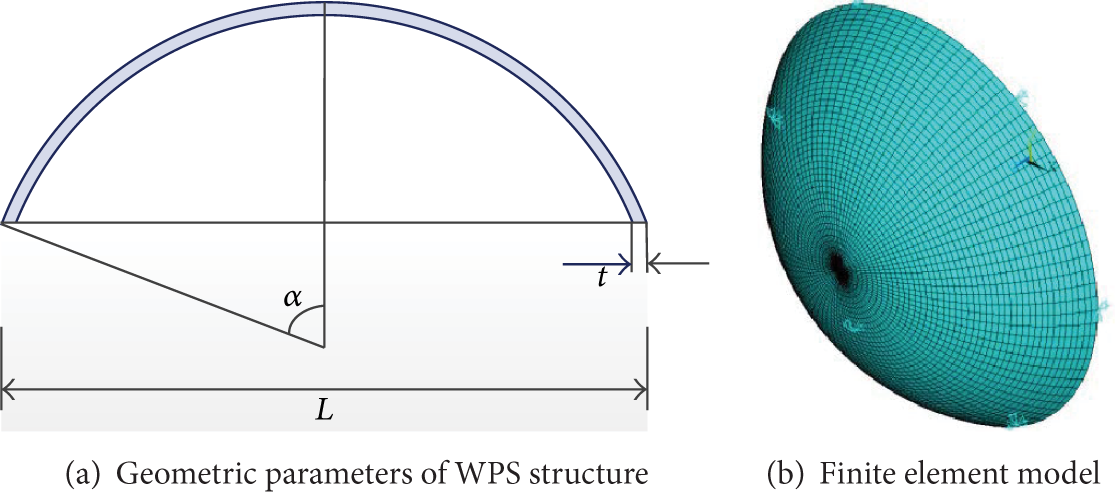
Diagrams of geometric parameters of WPS structure and finite element numerical model.
According to the wind-bearing characteristics of the sensor, the spatial wind load, q, at any angle is decomposed into three orthogonal-direction loads,

Sketch of the action of decomposed wind loads at any angles.
Let us assume that
When doing optimization design, we set perpendicular wind pressure
According to the “General Code for Design of Highway Bridge and Culverts (JTG D60-2004),” the designed fundamental wind pressure positively acting on WPS was 500 Pa, and the extreme wind speed in nature is 80 m/s. So we let
Correspondingly, we can get a series of simulated strain responses of

And the values

Another objective function brings the definition of degree of linearity of simulated WPS δ;

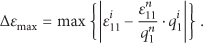
Considering the requirements for monitoring sensitivity of fundamental wind pressures, processing technology, the linear force-stain conversion relationship, and the limitations of selectable engineering materials, a reasonable range of values of the fundamental design parameters was considered; let us denote this design parameters feasible region as

under the constraint conditions as follows:

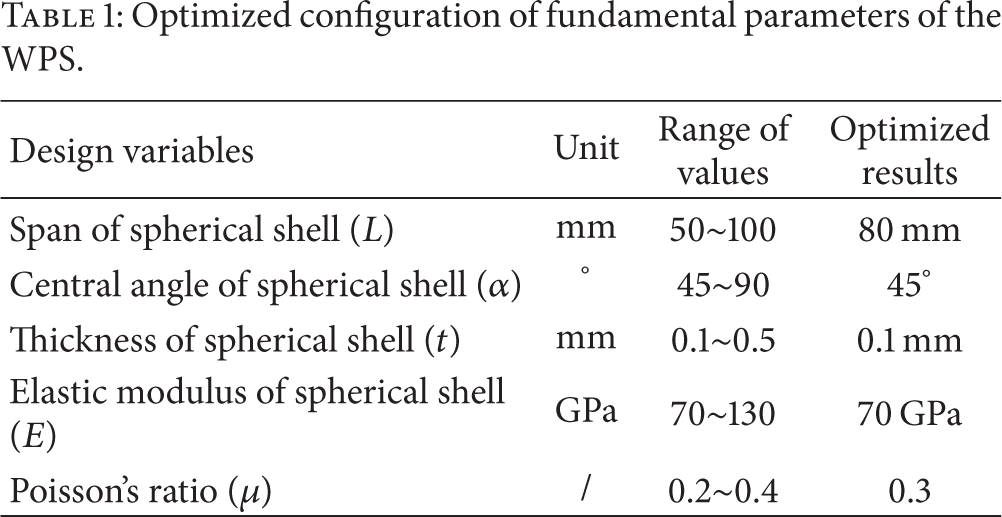
When the values of the fundamental parameters change, the corresponding strains of three FBGs can be calculated by using the finite element model and the values of the objective function can be determined. Furthermore, the parameters can be optimized by the first-order optimization algorithm. In this study, aluminum alloy was adopted as the wind-bearing surface material due to its mechanical characteristics and metal processing properties. The optimized configuration of fundamental parameters of the WPS is shown in Table 1.
Optimized configuration of fundamental parameters of the WPS.
It is worth mentioning that the constraint condition ensures that no material nonlinearity can be occurring during the normal work scope of WPS. And the optimization on second objective function ensures that no geometric nonlinearity can occur during the normal work scope of WPS. The optimization on first objective function ensures the best sensitivity of the designed WPS. So the final optimized design of WPS (or DTSS) will take a good linear force-deformation conversion relationship theoretically, as shown in Figure 5.

Relationships between components of wind pressures and corresponding independent strains.
2.2. Mathematical Model for Wind Pressure-Strain Conversion of Optimal Designed WPS
Now let us give a mathematical model for wind pressure-strain conversion of the above optimal designed WPS, which can be obtained using mechanical analysis.
Consider the most general case that the wind pressure with arbitrary direction is applied to the surface of DTSS. For the linear elastic structure,
Taking into account the symmetry of structure and loads,
The effect of wind loads in any direction can be determined from the individual loads in the above three directions. Furthermore, since under natural conditions the maximum wind speed does not exceed 80 m/s, wind pressures (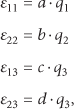

Upon calculation of the three components of the pressure from the above equation, the pressure in any direction can be computed as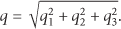
Thereby, the angle, 
The wind pressure-strain conversion model of the WPS is defined by (10), (11), and (12).
The relationship between strain and wind pressure was obtained as shown in Figure 5, through finite element analyses using the optimized parameters of the design variables given in Table 1. It is evident that the sensor has good linear performing characteristics. By curve fitting, the proportionality coefficients a, b, c, and d are 0.1318, 0.063, −0.073, and 0.036
2.3. Implementation of Temperature Self-Compensation
The FBG sensing technology utilizes the photosensitive properties of optical fibers to embed in the measurand by a change in the fiber-optical wavelength. If coupled effects are ignored, the change in the FBG wavelength caused by the temperature and axial force can be expressed as
A temperature compensated grating 
During doing temperature compensation of each gratings strain, if the wavelength changes due to the temperature change are deducted, the wavelength changes caused by the actual strains of structures can be obtained by
3. Mechanical Behavior Analyses and Parameter Optimization of Wind-Bearing Component of WPS
Although the optimized WPS has a linear and predictable performance, it is worth the effort to further investigate the safety and stability under long-term effects of static and fluctuating wind.
3.1. Safety Analysis of Wind-Bearing Surface of WPS under Static Wind Loads
Safety analysis of the wind-bearing shell under static wind loads can be conducted by applying wind pressures in three directions in the finite element model discussed above. Taking into account possible maximum wind speed in nature being less than 80 m/s (pressure less than 3,920 Pa), the pressures in three directions, that is,
Figure 6 shows Von Mises stresses of the spherical shell under the maximum levels of wind pressures in three directions. It is clear from Figure 6 that, under the action of

Von Mises stresses of the spherical shell under the maximum level loads of wind pressure (3920 Pa).
Figure 7 shows the relationship between maximum stresses of the spherical shell and the corresponding pressures under all levels of pressure loads,

Relationship between maximum stresses and corresponding wind pressures.
3.2. Elastic Buckling Analysis of Wind-Bearing Device under Static Wind Pressure
In order to investigate the stability of the optimized structure of the WPS and to avoid buckling failure, stability analysis of the structure under the wind loads in three directions was carried out by assuming the maximum wind pressure of 3,920 Pa (design fundamental wind pressure is 500 Pa). The first fourth-order stability coefficients of the structure and the first-order buckling mode are shown in Table 2 and Figure 8, respectively. These results indicate that the stability coefficients of the structure are very high and the buckling failure does not occur. Therefore, the structure is safe and highly stable under the action of wind loads from all directions.
Stability coefficients of WPS structure.
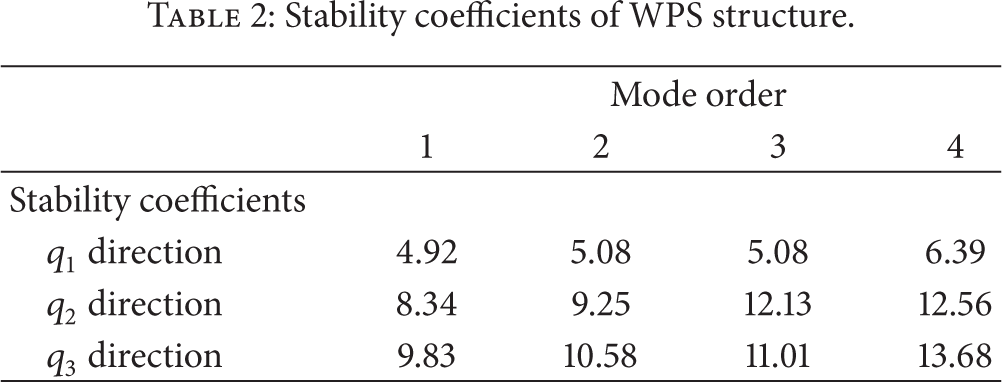
Note. Stability coefficient = ultimate wind load of structure buckling failure/design wind load.
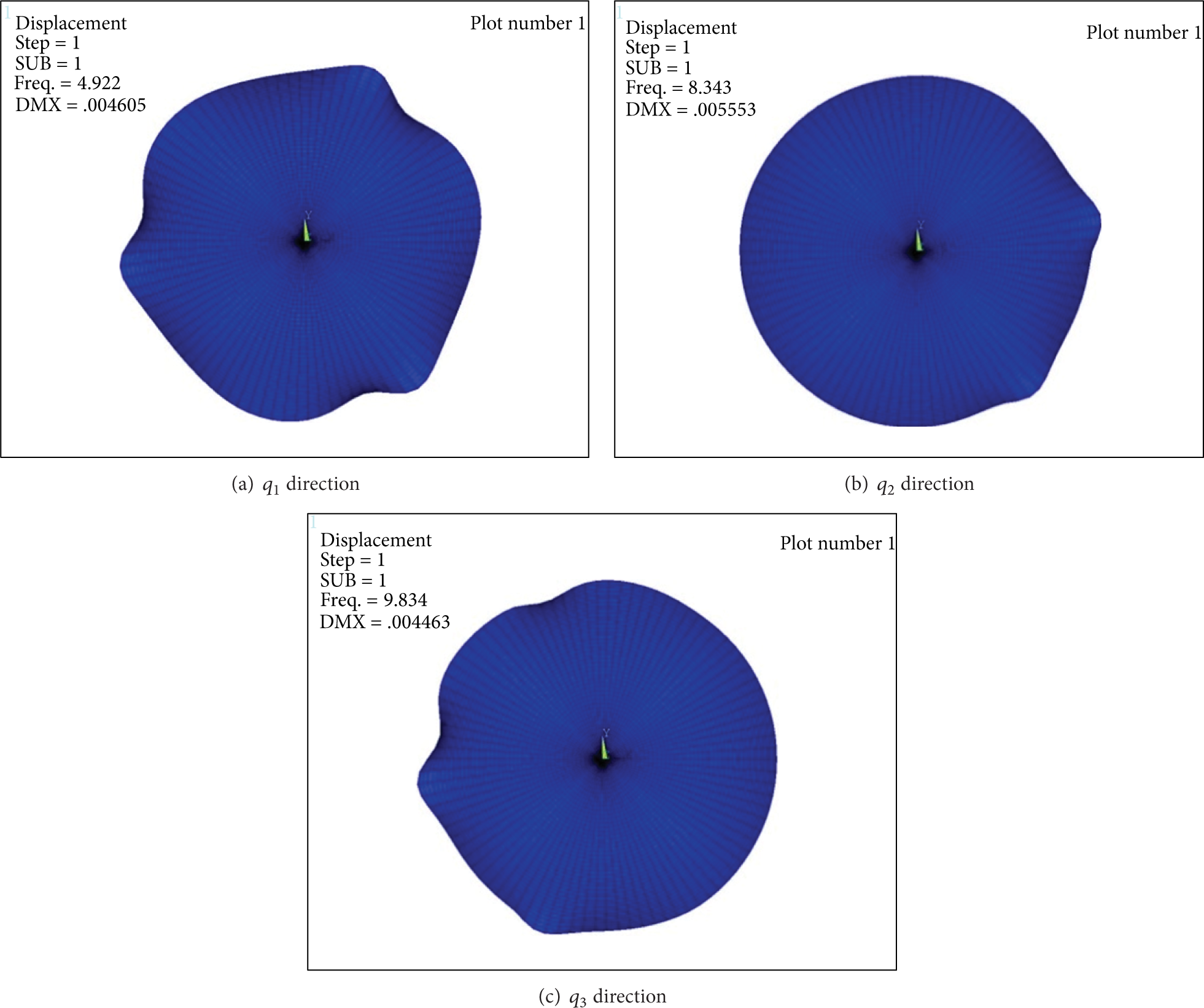
First-order buckling modes of directions of
3.3. Vibration Stability Analysis of Shell under Fluctuating Wind
Vibration will occur when the wind-bearing barrier of the WPS is excited by fluctuating wind component. In extreme cases, the resonance takes place, which not only affects the quality of wind pressure monitoring data, but also, more seriously, causes dynamic instability resulting in the damage of wind-bearing barrier. Therefore, vibration characteristics of the design-optimized WPS structure must be investigated. For this purpose, modal analysis was carried out using the finite element model described above. The results of first fourth-order modal frequencies and mode shapes of variation are shown in Table 3 and Figure 9, respectively. They show that the natural frequencies of the wind-bearing barrier are much higher than that of fluctuating wind in nature. Consequently, the possibility of the occurrence of resonance is very low, which demonstrates that the dynamic stability of the design-optimized WPS meets the engineering requirements.
Modal frequencies of WPS structure.


The first fourth-order modes of variations of WPS structure.
4. Prototype Trial
According to the optimized configuration of fundamental parameters of the WPS above, we give a prototype trial by choosing Aluminum alloy 1060 as the optimal material for the pressure-bearing DTSS and its processing, which has the best metal processing properties, was finally adopted and meets the requirements of conventional processing (stamping and stretching). Stamping technique by using stamping mould was adopted for the alloy processing. And then, prelocating FBGs, gluing, and heat curing are required to achieve the bonding of FBGs and connecting-aluminum. In order to simultaneously measure pressures and suctions, during adhering connecting-aluminum to the spherical shell, pretensioning of the FBGs should be conducted.
All the FBGs (including unstressed one for temperature compensation) were welded to each other in series via tail fibers and coiled around and fixed underneath the DTSS. Figure 10 shows the optical circuit with FBGs, the base, and the final prototype of WPS.

The prototype of WPS.
On the basis of prototype of WPS shown in Figure 10, the next study should focus on its corresponding calibration scheme, and its sensing mechanism and performance should also be investigated experimentally in order to verify its technical feasibility.
5. Conclusions
Monitoring wind pressures acting on surfaces of engineering structures is of vital significance in assessment and control of structural suitability and safety during their service life. In this paper, an FBG based WPS for the monitoring of wind pressures on structures was introduced. Finite element analysis was used to establish the wind pressure-strain conversional model, the methodology for temperature compensation, and the design optimization of the wind-bearing device. Furthermore, sensing characteristics of the WPS were investigated, and its static wind safety, pressure stability, and dynamic stability during operation were verified.
Results showed that the design-optimized WPS has the ability to simultaneously measure wind pressure as well as the attack angle and has a very good temperature-compensation capability due to the existence of unstressed temperature grating. Meanwhile, within wind speed range in nature, the sensor has good linear-proportional sensing properties. Furthermore, its wind-bearing device is safe under static wind action, even under extreme pressure conditions, and buckling failure does not occur. The possibility of resonance occurring under the excitation of fluctuating winds is also very low and dynamic stability is high. This indicates that the design-optimized WPS presented in the paper has a good sensing function and working performance, so that the design scheme is technically feasible and can be a reference for further research and development of prototypes.
Footnotes
Conflict of Interests
The authors declare that there is no conflict of interests regarding the publication of this paper.
Acknowledgments
This work is supported by the State High-Tech Research and Development Plans (863) (Grant no. 2014AA110402), the Project of National Key Technology R&D Program in the 12th Five-Year Plan of China (Grant no. 2012BAJ11B01), National Nature Science Foundation of China (Grant no. 50978196), the Fundamental Research Funds for the Central Universities, and State Meteorological Administration Special Funds of Meteorological Industry Research (Grant no. 201306102).