




Abstract
Private property refers to something carrying private information, or expensive items; these items are very important for companies or individuals. The proposed private property protection system uses adaptive sensing technology to protect private materials in real time. In this paper, we propose an adaptive sensing private property authentication scheme which can be applied in the cloud computing. Considering a relatively safe room with a remote reader, there are several valuable items in the room. Each item is labeled with a unique tamper-evident adaptive sensor and the reader can simultaneously read a plurality of sensors. Encrypted information of items, sensors, and readers is stored in the cloud. The reader reads sensors and uploads the collected data to the cloud for further processing in real time. The proposed scheme is under the cloud environment to protect the user privacy and prevent synchronized attacks. Compared with some traditional schemes, our scheme is economical, practical, and easy to be expanded. Furthermore, it pays attention to privacy protection with real-time monitoring.
1. Introduction
Nowadays the network information developed well enough, and the requirement of property security has also been raised to a new level. Personal privacy is usually under a great threat, especially private valuable property, such as antiques, gold, jewelry, and, many well-known pictures. Under normal conditions, valuable private property may be managed by insurance company, as a result, the user information leaks easily. Considering a situation where customers want to keep security of private property but do not want more persons to know, first, insurance company managers cannot access the private property easily, because many items are easy to damage, but when something abnormal occurs, the manager can locate sensor accurately [1]. Secondly, even though many hackers have attacked the management system, they cannot obtain any useful information. Although the RFID system has wide prospect, it has to face huge challenges because of potential security risks, privacy problems, and efficiency because of its restrictions on processing, storage, and power in RFID tags [2]. WSANs contain static sensors that are energy-constrained and actors that cannot communicate with each other directly. These unique characteristics make the data dissemination problem in WSANs extremely challenging [3]. By analyzing the above reasons, adaptive sensing technique and cryptography are the key techniques in private property protection system. Sensing technology is safer and has more economic means of monitoring; it is more reliable than the traditional access control and authorization technology [4].
Due to the rapid development of wireless communication and hardware device technology, Wireless Sensor Networks (WSNs) are expected to be widely applied in security areas such as intrusion detection, border surveillance, and fire detection [5]. Because the sensors are mobile devices, they may encounter various issues when providing ongoing services. For instance, they may suddenly disconnect from the network, since the mobile devices carried by people could change their point of attachment very frequently. That may cause significant packet loss and degrade the quality-of-experience (QoE) of consumers [6]. The scheme we propose uses adaptive sensor to collect information; it can prevent forgery and has a higher transmission speed than a bar code and a two-dimensional code. Also, it can operate stably at the condition of low temperature, high temperature, and humidity [7]. The tamper-evident adaptive sensors embedded in the valuables are not easily found by the illegal user, so they will not affect the appearance of goods and does not harm the customer's property. But how do we deploy them? The first approach, namely, random deployment, assumes that sensors are abundant and randomly distributed. Clearly, the random deployment may result in suboptimal network topology and thus degrades the barrier coverage performance [8]. Therefore, it is of great interest to deploy as few sensors as possible while ensuring the desirable performance.
The other fundamental question is how to deploy readers in a network to ensure that the WISP (wireless identification and sensing platform) tags can receive harvest sufficient energy for continuous operation. Point provisioning uses the least number of readers to ensure that a static tag placed in any position of the network will receive sufficient energy. Path provisioning exploits the potential mobility of tags (e.g., those carried by human users) to further reduce the number of readers necessary: mobile tags can harvest excess energy in power-rich regions and store it for later use in power-deficient regions [9]. By exploiting the physical characteristics of wireless sensor, point provisioning can greatly reduce the number of readers compared with those assuming traditional coverage models. Reader placed in the room reads adaptive sensors in real time. The reader cannot read sensor information correctly when the sensor is opened or the property was taken from within the read range. Then, the clouds will give alarm information to the security guards. If additional items will be placed in the room, just store items information in the clouds. If the client took the item away, simply delete the corresponding records from the cloud information. Since this system is long-term real-time monitoring, which would generate a lot of data, the system also has to process data with a high speed. So it is not suitable to use the backend server to store and process data locally.
Cloud computing has brought a new round of information revolution; the technology which combines traditional adaptive sensing with cloud computing is promising. Because the cloud itself is open, the cloud security is a serious problem. Adaptive sensing technology can adaptively change sensing time and sensing frequency without affecting the sensing quality; the benefits of this technology are that we can reduce power consumption and facilitate the coordination between the sensors [10]. Adaptive sensing technology has been applied to government departments, military, and financial protection, but there will be privacy and security issues while using this technology [11]. The scenario in this paper is assumed for the security of companies, customers, and items information which is required to be absolutely private. While traditional safety protection is mostly done manually, it is inefficient and unsafe. We can use the bar code and two-dimensional code technology to protect the valuables, but bar codes and two-dimensional codes are easy to fake and are fragile. In addition, when many bar codes are present simultaneously, there is too much interference between the multiple bar codes, especially in the case where the multiple bar codes are overlapped [12].
We move data storage and processing from the traditional backend servers to the cloud. By using the new technique, only legitimate users know the account name and password, so they can manipulate the data, no matter when and where customers are; they can obtain the adaptive sensing information as long as the readers which can be fixed or mobile are connected to the network [13].
The rest of the paper is structured as follows. In Section 2, including the review content, we also detail the reasons that current adaptive sensor authentication schemes are incapable to work in cloud-based scenarios and provide primary requirements to design a cloud-based adaptive sensing authentication scheme. The scheme is proposed in Section 3. It applies a global EHT (encrypted hash table), mobile reader, or fixed reader, and the first adaptive sensing authentication protocol against database keepers is proposed in detail. In Section 4, we provide the analysis and evaluation of our scheme. We give our conclusions and the following work in Section 5.
2. Related Work
2.1. Cloud Computing
Cloud computing is a model for enabling convenient, on-demand network access to a shared pool of configurable computing resources (e.g., networks, servers, storage, applications, and services) that can be rapidly provisioned and released with minimal protection effort or service provider interaction. Many services are migrating to the cloud for its better scalability, cost efficiency, and other benefits. Cloud computing also offers an appropriate environment for deploying evacuation services [14]. Cloud computing is a new computing model which comes from distributed computing, parallel computing, virtualization technology, and other computer technologies and it has many advantages such as large-scale computation and data storage, virtualization, high expansibility, high reliability, and low price service [15].
Cloud computing has three service models including Cloud Software as a Service (SaaS), Cloud Platform as a Service (PaaS), and Cloud Infrastructure as a Service (IaaS); Cloud computing has four deployment models including Private Cloud, Community Cloud, Public Cloud, and Hybrid Cloud. Key enabling technologies include the following: (1) fast wide-area networks, (2) powerful, inexpensive server computers, and (3) high-performance virtualization for commodity hardware. The security problem of cloud computing is very important and it can prevent the rapid development of cloud computing. Single security method cannot solve the cloud computing security problem and many traditional and new technologies and strategies must be used together for protecting the total cloud computing system [16].
2.2. Adaptive Sensor
Adaptive sensor is a wireless automatic identification technology. Unlike traditional static sensors, adaptive sensors have locomotion and are thus able to autonomously improve network performance by adjusting their initial status to desired ones [17]. Compared to other existing wireless technologies, it has some advantages such as strong adaptability, low power consumption, high sensitivity, strong storage and data processing capabilities, and stable performance [18]. Sensors can recognize specific target via wireless signal; it does not need the establishment of mechanical or optical contact between recognition system and a specific target. The technology has been widely used in Internet of Things (IoT), health care, logistics protection, environmental monitoring, military, and food security [9]. In the IoT systems, physical things in our environment and people will be connected anyplace and anytime via any service. These connections can be made with intelligent sensors, GPS, adaptive sensing systems or any sensing devices which can exchange data between two objects [19]. The ubiquitous availability of devices such as smartphones, tablets, and other portable devices enables the collection of massive amounts of distributed data from the daily lives of citizens. These types of emerging mobile networks can provide new forms of valuable information that are currently not available on this scale via any traditional data collection methods [20].
Adaptive sensing system is usually protected by authentication and encryption in terms of privacy and safety. If the two parties are not certified before beginning a communication, the system will be likely attacked by some ways such as interception, counterfeiting, replay, denial of service, and desynchronization.
Traditional adaptive sensing system has two typical ways which are as shown in Figures 1 and 2.

The backend-server-based architecture.
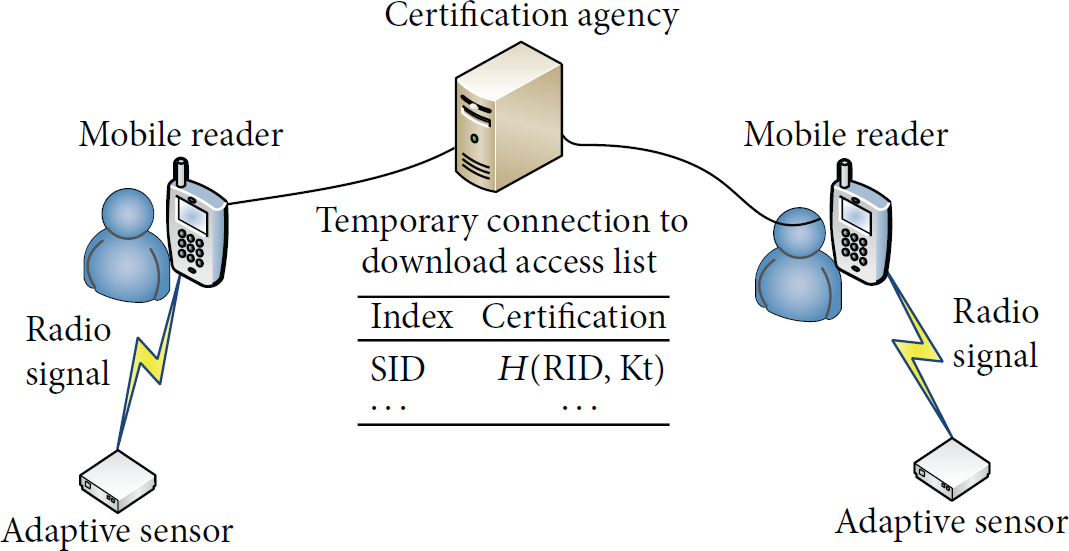
The server-less adaptive sensing authentication architecture.
The architecture consists of sensor, reader, and the backend server [21]. Reader delivers the message from the sensor to the backend server in this architecture, and sensor is certificated through the background database. Because it is special cable connection between the reader and the server, the channel is considered to be safe. When designing authentication protocol, the security of the frontend communication between adaptive sensor and the reader needs to be considered; however, the backend security issues do not need to be considered. But the weakness of the architecture is that the reader uses a special cable network, which limits the reader's mobility. In addition, a backend server's storage and computing power are limited, so the presence of large amounts of data is likely to lead to system crash.
The model in Figure 2 can be used offline via mobile reader to authenticate the adaptive sensor [21]. The system consists of adaptive sensor, reader, and CA and is divided into two phases: initialization and certification. In the initialization phase, reader downloads AL (access list) from CA through secure channel, and then the reader becomes a portable device, which can have the ability of offline authentication. During authentication phase, the reader sends RID to sensor, waiting for the sensor response
In recent years, some authentication schemes for adaptive sensing system are put forward, but the common weakness is that the data between these protocols is plaintext form, it is easy to expose sensors and readers information, and an attacker can track sensor. It is extremely dangerous for the security system, because the attacker is likely to implement the theft once determining the item information. At present, most authentications cannot resist synchronization attacks, which is a fatal flaw in the real-time monitoring system. As a result, the previous authentication cannot be directly applied to the scenario.
2.3. Requirements of Cloud-Based Adaptive Sensing
Cloud has a capacity of powerful computing and storage and can allocate storage space dynamically. In addition, robustness is an important reason for its popularity, so this system makes use of these advantages. The private property protection system consists of sensor, reader, and cloud, the cloud instead of the traditional server to store data and query record. It is necessary to consider the security of communication between sensors and reader, and the security of communication between the reader and the untrusted cloud.
The present work mostly focuses on functional applications. However, it is apt to ignore the problem of security and privacy; the research on the authentication protocol is not enough [22]. The proof whether cloud-based adaptive sensing system is better than the traditional adaptive sensing scheme remains to be solved.
As the privacy of the special needs of asset protection, the system should choose the reader that has the abilities of long-distance identification, multiple target recognition, and highly reliable identification. The size and shape of the adaptive sensor can be selected according to different needs [15, 23]. Under normal circumstances, the adaptive sensor is within the scope of the reader; the reader can read the adaptive sensing information and then upload the information to the cloud. After the cloud processing the data, we can determine whether the current adaptive sensors are in normal work. If the adaptive sensor is lost or damaged, the cloud will make an alarm decision (Figure 3).

The architecture of the proposed protocol.
3. The Adaptive Sensing Private Property Protection Protocol Based on Cloud
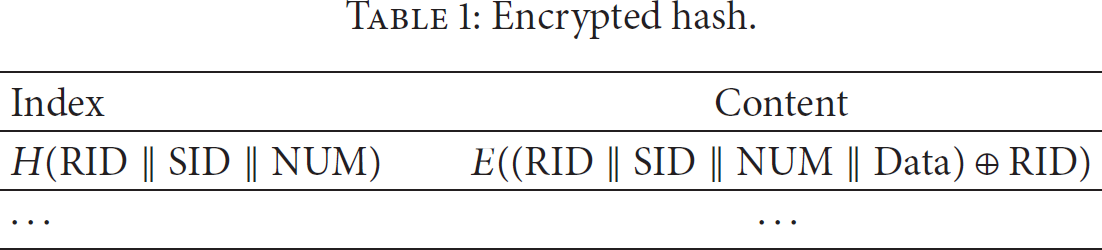
As it is shown in Table 1, the sensor and the reader identity information is processed by one-way hash function instead of plaintext form. In this case, we can protect the reader and adaptive sensor privacy from leaking to untrusted cloud. We introduce adaptive sensor and reader privacy, authentication protocol against untrusted database.
Encrypted hash.
3.1. Notations and Assumptions
Notations in this paper are listed in Notations section. Reasonable assumptions are listed as follows:
Adaptive sensors are with middleweight computing capacity of XOR, PRNG, and hashing processes. Readers are with middleweight computing capacity of XOR, PRNG, and hashing processes. The frontend communications between sensors and readers are on public radio channels. Attackers are able to eavesdrop, manipulate, delete, and replay frontend messages. Cloud obtains computing capacity of XOR, PRNG, hashing processes, and symmetric encryption and decryption. The cloud provider as the database keeper is not trusted. It may be malicious or vulnerable.
3.2. Encrypted Hash Table
Encrypted hash table is used in the scheme that can prevent the private information of customers from leaking to the cloud; it can also promise client's anonymous access. The structure of encrypted hash table is shown in Table 1; NUM denotes the current maximum number of sessions between the reader and the sensor, after the session between reader and sensor is completed successfully, the value of NUM will be plus one. The index of
The proposed authentication protocol as shown in Figure 4.
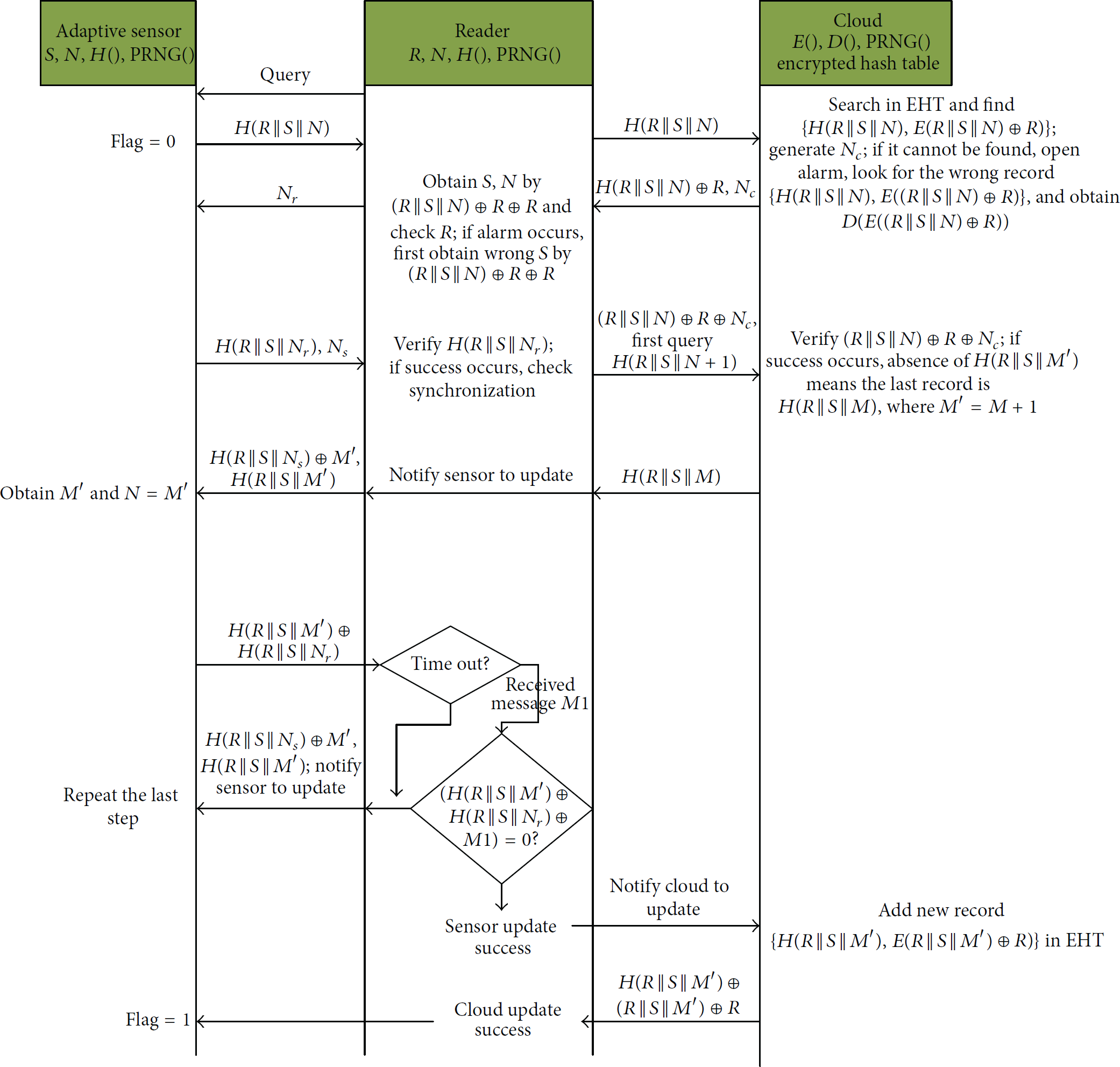
The adaptive sensing private property protection protocol based on cloud.
The proposed protocol is as follows.
The 1st step of the proposed protocol is for the reader to obtain N and S. The reader initiated inquiry signal “query,”
The 2nd step is to authenticate the adaptive sensor. The reader generates a random number
The 3rd step is to check the synchronization of N between the sensor and the EHT. In addition, reader must respond to the challenge of cloud. The reader calculates
The 4th step is to update the adaptive sensor and response to the challenge of sensor. The reader calculates
The 5th step is to confirm the adaptive sensor update successfully. Adaptive sensor sends
The 6th step is to update the cloud EHT. The cloud writes
The 7th step is to confirm the cloud updates successfully. A message of
4. Analysis and Evaluation
The proposed protocol is analyzed and evaluated in this section.
4.1. Security and Privacy
In this section, we compare with two classical authentication schemes. One is backend-server-based scheme of Chien and Chen [24]. The other one is the first server-less authentication protocol proposed by Padmavathi and Shanmugapriya [25]. These two protocols are very typical; this has attracted much attention. Comparison in performance is listed in Table 2.
Performance comparison.

Mutual authentication typically means that a sensor authenticates a reader while the reader authenticates the sensor. In addition, mutual authentication is also considered between the reader and the cloud in our protocol. It is useful for access control of sensors. The server-less protocol [26] only achieves unilateral authentication. The protocol [24] achieves mutual authentication which is essential for a protocol, but it lacks mobility. It is feasible for attackers to pretend to be an authorized reader successfully sending fake messages without mutual authentication [25, 27].
The proposed authentication protocol can protect against synchronization attack. It is vital to the protocols applied to real-time monitoring system. In particular, the system is based on cloud. It is clever to use “Flag” which is very convenient to determine the state whether it is of desynchronization or not. In our protocol, the step of confirmation is indispensable after the sensor or the cloud updates. We also add a delay judging device in protocol innovatively when we confirm the success of update. To the best of our knowledge, the proposed protocol is invulnerable to all existing types of desynchronization attacks. The protocol [20] is put forward in a typical scheme which can protect against desynchronization. But it has two fatal mistakes; the first is that mutual authentication is absent between the reader and the untrusted cloud; this will be directly related to the synchronization problem. Because the reader is always giving a wrong
Anti-dos attack is also indispensable in an adaptive sensing private property protection system. In the information processing system based on the cloud, the cloud is usually an important target in the anti-dos attack [28]. In our proposed authentication protocol,
Database security is a crucial but widely neglected issue in current adaptive sensor researches [29]. The issue is about how to keep privacy of sensors/readers even if the database keeper is malicious. In the proposed cloud-based protocol, data in the EHT is either encrypted or hashed, and the cloud is malicious, even if the decryption is executed by the cloud but the data is the result of XOR. The frontend communications between sensors and readers are composed of random challenges and hashing function. The use of challenge-response technology provides the frontend communications with freshness, defending against replaying attacks. The hashing functions are used in order to protect the privacy of RID, SID, and NUM, defending against eavesdropping and manipulating. The EHT is composed of hashed and encrypted data, infeasible to be eavesdropped on or manipulated. The database security in the protocol [24] entirely depends on the assumed-trustworthy and assumed-invulnerable backend server. Although an AL is partly hashed in the server-less protocol [26], the SID field is stored in plaintext form. Once the reader which is with AL is stolen, attackers are able to trace all sensors listed in the AL.
4.2. Complexity and Authentication Mode
The least numbers of calculation between complete sessions are listed in Table 3. We compare with two classical authentication schemes again.
Calculated comparison.

The operation of encryption and decryption usually requires a lot of computing resources. The scheme of encryption and decryption is accomplished by the cloud. This greatly reduces the burden of the reader and adaptive sensors. The scalability of this scheme is also very attractive. In the proposed protocol,
Offline authentication is to authenticate sensors with an offline reader without connecting to a backend database. The protocol [26] is specially designed for offline authentication; meanwhile, the protocol [24] based on a database in a backend server and the proposed protocol based on the EHT in the cloud cannot work in offline scenarios.
The developments of pervasive computing and mobile networking, however, make offline scenarios less and less. Pervasive authentication will allow reader authenticates sensors wherever and whenever the reader is and the users login the sensing system with constant user names. The proposed protocol that utilizes cloud computing is unrelated to the user's reader. It is only related to the user's identity (RID); therefore, it is ubiquitous. The protocol, like most backend-server-based protocols, depends on private intranet connections to the database [26]. Lacking of mobility makes the backend-server-based protocols unsuitable to the requirement of pervasive authentication. The protocol replaces the backend database with an AL downloaded into a specific reader [26]. It is not allowed that a legal user uses another reader's device to identify sensors if the original reader storing the AL is missing. It indicates that the server-less authentication is not ubiquitous too.
According to the above comparisons, we evaluate the proposed cloud-based adaptive sensing authentication scheme as follows. Compared to the classical authentication schemes, the proposed scheme's advantages lie in the following: (1) the pay-on demand resource deployment greatly meets the requirements of large enterprises; it is cost-efficient; (2) the cloud-based adaptive sensing authentication is offered as a pervasive and customized service unrelated to device, location, or time; (3) the proposed protocol is about cloud as owner. However, the proposed scheme has higher requirements for application conditions than the traditional schemes. Cloud is required to support symmetric encryption algorithm like AES or DES. The requirement is higher than other protocols, but it is easy to achieve in cloud [30].
5. Conclusions
In this paper, a novel authentication protocol is proposed and used properly in cloud-based adaptive sensor private property protection system. The reader reads sensors and uploads the collected data to the cloud for further processing in real time. The cloud will give alert with a simple LED warning device if the sensor works abnormally; it will present alarm information to the administrator to make protective measures quickly as long as the system does not work properly and then decrypts data to determine abnormal adaptive sensor, the staff immediately open the antitheft door to ensure the security of customers' property. The cloud is employed in the new property protection protocol; this is an innovation but also a challenge. Private property should be protected from being known by others, so the SID and the RID must appear in encrypted form; in this way, privacy of the SID and the RID can be protected. There is no need to worry about leakage of information to the cloud. In the protocol, many valuable advantages are available, such as the authentication between sensors and readers being mutual and having the ability to resist synchronized attack. Because data storage and query and data encryption and decryption are performed in the cloud, the system does not support offline authentication. Accurate index
The key points of our work in the future are as follows: (1) designing a lightweight authentication protocol; (2) stating how to protect the system from attacking caused by malicious cloud and malicious sensor in a perfect way; (3) proving the safety of the authentication protocol.
Footnotes
Notations
Conflict of Interests
The authors declare that they have no conflict of interests.
Acknowledgments
This work has been financially supported by the National Natural Science Foundation of China (no. 61303216 and no. 61373172), the China Postdoctoral Science Foundation funded project (no. 2013M542328), and the National 111 Program of China B08038.