




Abstract
For the purpose of overcoming economic crisis resulting from continuing growth and employment recession recently, various convergence policies and strategies are being established and implemented. However, there is a lack of consented concept on the definition and scope of ICT convergence in the existing studies. In the case of considering convergence as an “innovation activity” in particular, there is a limitation of not being able to quantify it. In spite of the social consent and consensus on its importance, basic data, particularly quantified base data, is relatively lacking. Accordingly, this study examined the concept of the existing convergence and summarized the concept of ICT convergence based on which a methodology for researching the ecosystem of ICT convergence was designed. The significance of this study is in the fact that it proposed systemized research design and methodology for all industries for quantitative estimation of ICT convergence market scale. In the future, there is a need to research areas that were not included in this study and for gradual improvement of elements that need further specified criteria.
1. Introduction
For the purpose of overcoming economic crisis resulting from continuing growth and employment recession recently, various convergence policies and strategies are being established and implemented. Such process is bringing about core changes throughout the society and nation upon advancing into multiarea convergence such as humanities and arts upon undergoing convergence between heterogeneous technologies and industries [1].
In the case of ICT convergence often being discussed as an object (subject matter) of convergence, it is creating new value that includes product servitization or service productization phenomena through convergence of various technologies/industries [2]. In particular, support system for ICT convergence new product/service is being quickly prepared and, also in the aspect of industry, innovation activity with new value is being conducted in various areas such as automotive, shipbuilding, and textile. Based on collaboration between Korea's carmakers and ICT companies, new added values were created as voice recognition technology and multimedia related technology for vehicles was produced as well as convergence outcomes. In the case of shipbuilding site, the application of ICT technology has allowed real-time verification of process for manufacturing intelligent ship for smart sailing as a representative example of innovation activity [3, 4].
To continuously allow such innovative change process, there is a need for timely identification of the present condition of ICT convergence along with enactment of related law [5]. In addition, related policy development is required to allow proactive response to the possibility of change in the future. In the policy development for important phenomenon that leads to changes in the overall economy, accurate estimation and forecast of market scale and phenomenon are required [6, 7].
However, there is a lack of consented concept on the definition and scope of ICT convergence in the existing studies and in the case of considering convergence as an “innovation activity” in particular; there is a limitation of not being able to quantify it. In spite of social consent and consensus on its importance, basic data, particularly quantified base data, is relatively lacking. Accordingly, the purpose of this study is to examine the concept of the existing convergence and summarize the concept of ICT convergence.
2. ICT Convergence Framework
2.1. Convergence Concept
Lexical-semantic meaning of convergence is “the task of combining into indistinguishable one upon melting different kinds”. Specifically, convergence can be specified into a phenomenon of more than two different products/services/processes being created into one new product/service/process through chemical bonding.
Depending on the degree of convergence of objects, convergence can be summarized into three types: “package,” “hybrid,” and “fusion.” First of all, “package” is also referred to as bundle. It refers to a form of providing functions of multiple products into one product/service. For example, while selling computer or hardware, necessary software (bundle software) is provided together. Next, “hybrid” refers to a form of combining functions that could be obtained from various products/services into one product/service. For example, there are products that can provide both notebook laptop and tablet PC functions through one device. Lastly, “fusion” refers to a form of providing new value by combining functions received from various products/services. Examples include photoelectron that combines optics and electronic technology, bioengineering that combines biology and cutting-edge device technology, and digital computing in which photocommunication technologies are integrated (See Figure 1).

Change of conceptual definition according to level of convergence.
Accordingly, convergence can be defined with a comprehensive meaning of intermixing of technologies/studies/products/industries of different areas rather than being limited to a particular area of industry and technology. Specifically, it refers to an innovation strategy and an implementation method of creating bigger value in life and industry compared to that of the past by combining the existing technology, product/service, and industry through creative method. In addition, convergence can be defined as a technology that leads to future economy and sociocultural changes by creating new creative value through ascending combination between new technologies or between new technologies and the existing study/industry [8]. Based on a classification according to the usage purpose of convergence technology, it can be divided into “original technology creation type,” “new industry creation type,” and “industry advancement type” and it can be segmented into “ICT-based,” “NT-based,” “CT-based,” “ET-based,” and “BT-based” according to the area of convergence technology.
According to the scope of the object being fused, convergence can be divided mainly into technology convergence and industry convergence. Technology convergence is a phenomenon of more than two technological elements combining chemically to perform a new function for the existing technology [9]. Industry convergence indicates an activity of innovating existing industry or creating an industry with new social/market value through creative combination and complexation between industries, between technology and industry, and between technologies.
In addition, the concept of convergence can be divided into “product servitization” and “service productization” through the process applied to product and service. Product servitization refers to adding service to product or providing product in a form of service. Service productization refers to a recombination of mass-producing service through service standardization, service process conversion, and service automation by reinforcing service upon releasing product by service provider or adding product to reinforce service [10].
2.2. ICT Convergence Concept Design
Recently, ICT convergence is occurring rapidly centering on areas with high possibility of ICT technology application and areas with high possibility of online conversion such as web and mobile. Accordingly, it is creating outcomes such as product combination effect, economy of scale effect, creation of new profit source, and resolution of socioenvironmental issues. Upon integrating the concept of convergence explained earlier, ICT convergence is being defined in various studies.
In Seo Dong-hyuk's study [11], ICT convergence is seen as a phenomenon of developing/producing technologies/products with new characteristics upon losing the characteristics of individual technological elements through mechanical/chemical combination of ICT technology and another technological element. In National IT Industry Promotion Agency's study [12], ICT convergence is being defined as a phenomenon of granting new value such and continuity/intelligence upon applying or embedding ICT technology to the existing product/service industry to improve growth/efficiency of function. Accordingly, industry-specific processes were separated into common area and distinct area according to the industry to examine ICT technology and process measurement method and ICT technology and product/service measurement method (see Figure 2).

ICT convergence and value creation.
In addition, it is also seen as a phenomenon of enhancing the existing added value or creating new added value by innovating product/service/process of another industry upon embedding ICT product (computer, semiconductor sensor, electronic parts, software, ICT service, and communication service) as a part or module [13, 14].
In addition, it is being summarized as creating new industry or product/service by integrating ICT advantages of intelligence, embedded nature, mobility, real-time nature and integration into traditional manufacturing or service industries [15]. Additionally, it is also seen as a phenomenon of devices and functions being combined as devices and services in computer/communication/broadcasting areas evolve. Namely, it is being considered as a loss of individual technological elements and a creation of product/service with new characteristics [16].
Accordingly, there is a certain level of consensus on the definition of ICT convergence by experts in related areas, but the existing ICT technology centered definition is being described as a narrow concept that cannot be explained specifically or macroscopically.
Definitions and studies on ICT convergence are based on the premise of theories and studies and consensus of experts in related areas. However, the majority of definitions are being defined with ICT technology centered contents or as a phenomenon too comprehensive to be specific.
First, ICT technology centered definitions have the advantage of being very specific, but it is difficult to research convergence throughout all industries, as they are described as a narrow concept that cannot macroscopically explain convergence between industries. On the other hand, recent definitions of ICT convergence describe it as a comprehensive and abstract phenomenon, thereby causing difficulties in establishing reference point to design scope to research ecosystem. Accordingly, there is a need for a specific and separate operational definition for researching ICT convergence ecosystem throughout all industries.
To create operational definition of ICT convergence, a discussion is first needed on how to distinguish ICT convergence from the existing ICT utilization. The majority of previous studies focused on distinguishing between ICT utilization (of applying ICT technology to product/service process) and ICT convergence (of combining or embedding ICT technology to product/service) and the purpose was to research with such distinction as much as possible.
ICT utilization subject to the process and ICT convergence process of products and services have been promoted with the change of ICT utilization index (process innovation → creation of new value). On the other hand, the concept of ICT convergence is advanced in the course of discussion of recent industrial convergence. In particular, ICT convergence can be summarized as the course of innovating existing products and services or creating a new value upon embedding ICT sensing, networking, computing, and actuating technologies as a component or module. Accordingly, it is defined as a creative and innovative activity and phenomenon that creates new social value and market value by integrating technologies between information communication or information communication and other industries.
In detail, a wide concept of ICT convergence can be again divided into ICT utilization and a narrow concept of ICT convergence. ICT utilization means that the process for the production of products and services is applied to IT system (creation of trapped value). A narrow concept of ICT convergence can be described as intelligent process by integrating IT element technology into the product and service itself (creation of new value).
ICT can be recognized as one of the elements constituting ICT system with HW, NW and a person (IT system manager and user), and so forth, so that the attribute of ICT convergence is also applied like the concept of ICT convergence. Therefore, the wide concept of ICT convergence can be divided into ICT utilization and the narrow concept of ICT convergence. For reference, it is not easy to clearly distinguish the concept of ICT convergence with that of ICT utilization in the service industry unlike the manufacturing industry. For example, it is not clear to distinguish whether a reservation of hotel service with ICT is ICT utilization of process or ICT convergence of the product. In this study, we defined that ICT convergence is the upper level concept including ICT utilization based on related studies and several panel discussions with experts (see Figure 3).

Comparison of ICT utilization and ICT convergence concepts.
In short, ICT convergence means developed and utilized ICT for the creation of convergence between industries and innovative services, not ICT itself. It can be classified in the form of industrial process + ICT, industrial product + ICT or service + ICT, and so forth.
3. Analysis of ICT Convergence Ecosystem
3.1. Perspective on ICT Utilization
In general, the framework for ICT utilization index is composed of seven evaluation areas such as resource, governance, acceptiveness, leadership, process, performance, and environment (see Figure 4). Estimating ICT utilization index in the view of “in department (in function),” “between department (between function),” “between business,” and “new business creation and strategic operation (strategic management),” about the process area among this evaluation framework, ICT utilization index could be calculated. For the investigation of the current situation of ICT utilization, it surveyed 3000 companies which have more than 10 employees.
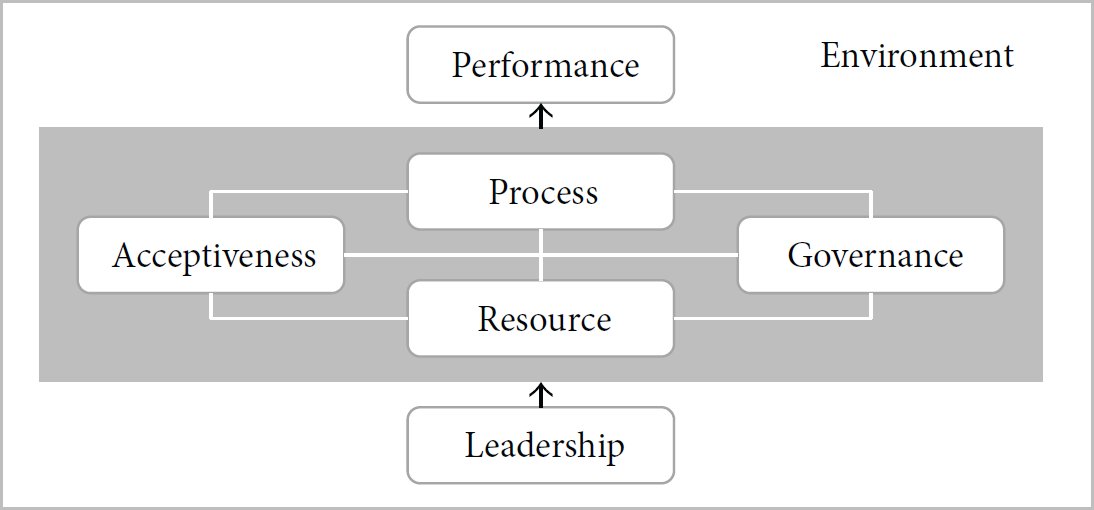
ICT utilization index evaluation framework.
ICT utilization index could be calculated for 4 process areas utilized for work with ICT. As a result, total ICT utilization index showed 57.7 points and was seen by areas to show “in function (72.6P) > between function (67.2P) > between business (52.4P) > strategic management (38.6P)” in this order. 57.7 points of ICT utilization index indicated that it was the step to be accomplished to share the information and electronic cooperation. It was investigated to show ICT utilization by ERP (38.4%), CRM (22.4%), SCM (15.7%), and smart office (29.0%) in detail. It is analyzed that companies would utilize ICT in business production and sales activity aggressively above the step of ICT utilization for work efficiency.
3.2. Perspective on ICT Convergence Ecosystem
In general, ecosystem refers to a space in which biological communal system and surrounding environment interact and ICT convergence ecosystem form industry-specific new ecosystems through the process of convergence with different industries centering on ICT industry. The purpose of ecosystem analysis is to identify positions of interest parties within the industry and to examine how continuous advancement and evolution of industry proceed. Based on such perspective, the purpose of this study was to analyze such phenomenon according to the roles of various constituents (components) of ICT convergence ecosystem (see Figure 5).

Composition of ICT convergence ecosystem (0 level).
To specify the scope research of ecosystem in ICT convergence industry, elements such as supplier and purchaser were simplified and structured based on product/service flow as shown in Figure 6. First, for the purpose of creating ICT convergence product/service, necessary elements need to be supplied (input element supplier) through which ICT convergence product or service is developed (convergence product/service producer/developer) and such product or service created is purchased and used by company/individual/government (output purchaser/user). For transaction of such element and product/service, secondary market such as wholesale/retail and distribution exists, and environmental elements such as legal/system/policy/infrastructure affect the surrounding of every market transaction and production/development during which company, organization, and individual are all included in supplier, producer/developer, and purchaser/user.

Decomposition of ICT convergence industry ecosystem (1st Level).
First, the area of input element supply of ICT convergence is as follows. Among elements used for ICT convergence product production and service development, ICT elements were mainly divided into four types of (1) embedded software, (2) IT devices/parts, sensor such as SoC, (3) software except for embedded software, and (4) digital contents. In addition, the remaining elements that cannot be segmented and distinguished or that with insignificant meaning for research were combined as (5) others (see Figure 7).

Decomposition of ICT convergence ecosystem research model (2nd Level).
Next, the area of ICT convergence product/service production/development is as follows. In the case in which produced products or provided services that generate sales for company are ICT convergence outputs, they were all included in the research. In addition to companies that produce/develop convergence product and service through combination (convergence process) of five input elements mentioned in previous supply area, the cases of creating new ICT convergence output by using ICT convergence output as another input element are also included in this area. For example, smart phone is a representative ICT convergence product. Accordingly, production of various parts and contents to create smart phone will be researched in the area of supply and smart phone production will be researched in this area. Likewise, the cases of producing new product or service for which smart phone is provided as an input element are also researched in this area.
Lastly, the area of ICT convergence product/service purchase/use is as follows. Whether to include the research of purchaser/user of ICT convergence product/service requires a multidimensional review. In the case of a company that makes cars by purchasing tires attached with sensor, it becomes a purchaser of ICT convergence product as well as a producer of another ICT convergence product. Such case should be clearly included as research object and it would be more reasonable to include it as producer/developer instead of purchaser/user.
Accordingly, in the area of purchase/use, whether to include in research was determined based on the characteristic of utilizing the purchased ICT convergence output instead of the characteristic of output of the corresponding company. In the case of a company utilizing ICT convergence output to produce/develop product/service, it was included in research, while excluding the case of using it simply for the company's work support activity. The reason is because although ICT utilization besides production process can be seen as internal innovation of company, it is an “efficiency through improvement of the existing process” instead of “new value creation” since it is not directly related to output.
The sales amount values of ICT convergence compared to the total sales amount of research object companies showed 17.7% in 2012 and it is expected to increase by 1.4% to 19.1%. On the scale of total sales amount, the increase rate of company total sales amount compared to 2013 reaches 0.7%, but sales amount of ICT convergence is expected to show comparatively high increase rate, which is 8.8%. The company can make a plan to invest new product, service development, and process innovation through ICT convergence in the future. The scale of research and development budget invested in ICT convergence showed entirely a total of 9 trillion and 359 hundred billion wons among research object companies in 2012 and it is expected to reach 10 trillion and 442 hundred billion wons which is an increase by 7.3%. Compared to manufacturing company and nonmanufacturing company, the scale of research and development investment about ICT convergence reaches 4 times in 2012. The difference of investment sale like this is expected to maintain almost the same level and manufacturing company (7.9%) is expected to have a more highly investment increase rate of research and development in ICT convergence in 2013 compared to 2012 than nonmanufacturing company (4.9%). This means that manufacturing company is putting much more effort in ICT convergence to improve competitiveness than nonmanufacturing company. Average research and development investment scale in ICT convergence per companies by firm size is about 21 billion and 7 hundred wons for big company and 7 hundred million wons for small and medium-sized company. In 2013, the research and development investment scale is expected to increase by 7.6% in big company and 3.2% in small and medium-sized company. We can know (figure out) that the capacity for research and development investment in small and medium-sized company for ICT convergence is vulnerable.
4. Future Evolution of ICT Convergence Ecosystem
4.1. Analysis and Forecasting of ICT Convergence Industry
To understand the scale of ICT convergence industry from national economy level, the entire industries need to be included as a research object. In the midst of a situation of not knowing how ICT convergence will appear in which industry, there is a high probability of distorting information upon estimating the national ICT convergence market scale focusing on certain industries where ICT convergence outcome has been drastically revealed, or representative convergence case companies.
In the midst of current circumstance where a separate ICT convergence industry classification system that can include national ICT convergence market does not exist, it would be difficult to understand the ICT convergence industry market scale of the country upon researching only certain strategic industries. In addition, it would be necessary to estimate industry-specific ICT convergence sales amount by researching the ICT convergence sales records of companies in the entire industry. Additionally, selecting research objects needs to be based on MECE (Mutually Exclusive and Collectively Exhaustive) standard for the entire industries. To satisfy the MECE standard, it would be ideal currently to set population based on the Korean standard industrial classification system.
The existing research studies on convergence industry status and outlook were conducted partially focusing on industries that are considered important in terms of policy and it is also difficult to compare among industries for ICT convergence level as the layer of major large scale classification, medium scale classification, and small scale classification is intermixed for industrial classification standard according to the purpose of research study. In comparative studies on industrial competitiveness among countries, it is common to be based on classification system consistent with international standard industrial classification system such as the OECD and UN. To conduct time-series research study in the future, it is necessary to maintain the continuity and consistency of statistics for which the maintenance and renewal of population based on consistent standard is an important assignment. Accordingly, it would be desirable to conduct national level based on standard industrial classification system.
For the purpose of forecasting total sales amount of Korean companies and ICT convergence sales scale, research object companies were instructed to respond with their expected growth rate for 2014 and 2016 based on 2013, based on which forecast figures were estimated. Accordingly, estimated total sales amount of Korean companies in 2016 was estimated to be 1.9451307 quadrillion wons, which is an increase by 29.7% (6.7% annual mean) from 1.4997618 quadrillion wons in 2012, among which sales amount in the area of ICT convergence was estimated to be 424.1147 trillion wons, which is an increase by 59.7% (12.4% annual mean) from 265.6323 trillion wons in 2012. Namely, Korean companies will continue to actively implement ICT convergence based on the forecast that sales amount in the area of ICT convergence will show nearly twice higher growth rate compared to the sales amount of the entire companies (see Figure 8).
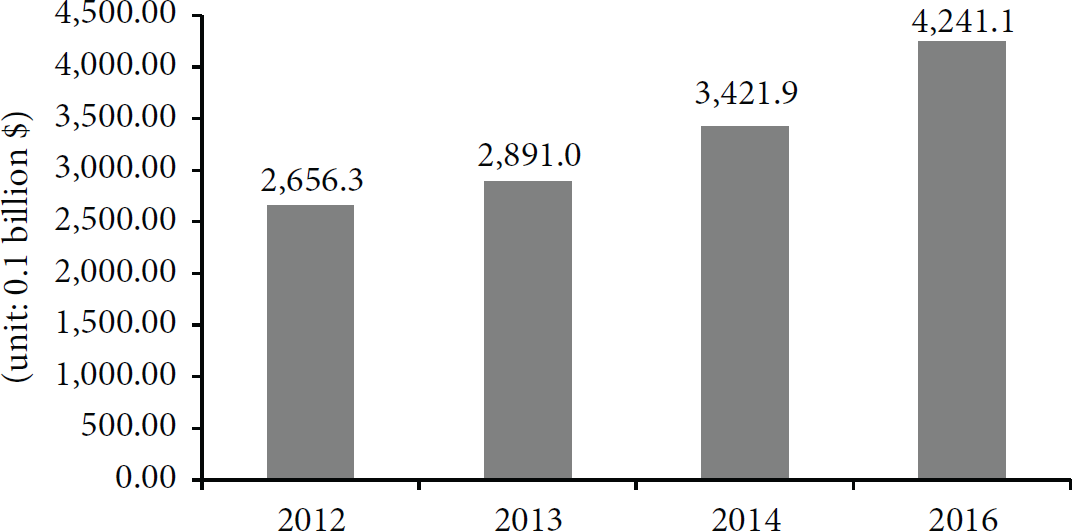
Forecast of ICT convergence sales amount.
4.2. ICT Convergence Business Design
Efforts to innovate business model are needed instead of technology. The chronic ill practice of Korean companies that have been competing through price or quality has not been resolved because they have been implementing only process innovation (fast follower) for ICT convergence product/service developed overseas instead of innovation of ICT convergence product/service (first mover). Accordingly, it is necessary to make efforts of business model innovation (BMI) to overcome technological weakness.
Assessment of value of convergence study is needed among school systems. Considering that significant outcome can be created in convergence through significant difference and variety of input elements, social structure and related policy of our country that has long been pursuing homogeneity and excluding variety are becoming fundamental hindrance. In this sense, opportunities of collaboration and success are lacking. Accordingly, it is necessary to form social sentiment of accepting heterogeneity in hiring/placement/promotion of staff in organization while expanding variety. In addition, efforts are needed from the governmental level to support the promotion of convergence industry (funding, human resources, education, promotion, etc.) based on the existing related regulations.
In the area of public sector, creation of ICT convergence market is also needed. It is necessary to establish new product/service that can increase customer (people) benefit and deduce ICT convergence cases in various public sectors such as firefighting, disaster prevention, crime prevention, water resources, transportation, and pharmaceutical control that can lead private sector of ICT convergence. Furthermore, classification system and research activities also need to be researched.
4.3. ICT Convergence R&D Design
Establishment of demand centered ICT R&D strategy is needed. Since the approach of cultivating market after developing technology while developing ICT convergence product/service is being used (due to lack of consideration of commercialization or marketing), it is necessary to establish and implement the strategy of developing both technology and customer. In particular, there is a need for an approach that involves planning/developing ICT convergence product/service not from technician/supplier perspective but user/consumer perspective and releasing product/service according to market/customer demand or developing initial market.
It is necessary to establish industry's common/specialized ICT convergence platform. In the state of investing a significant amount of cost and effort for developing ICT convergence product/service according to company/industry, it is necessary to develop national level ICT convergence platform (technology, service, business, and information) and support the development of distinct convergence module considering the characteristics of certain industries. Based on this, it is expected to perform not only collaboration among supply companies but also interconnection between supply companies and demand companies relatively easily.
There is a need to conduct research on leading technology centered ICT convergence. It is necessary to define and deduce representative technologies related to ICT convergence such as RFID and M2M and annually research and summarize their status of technology and utilization to observe the type of technology around which convergence proceeds. From the standpoint of supplier of convergence, such work can present R&D direction to technology developer, product/service developer, and product/service provider and can be used as a basic information in designing a new classification system centering on convergence technology and convergence product/service.
5. Conclusion and Future Study
The significance of this study can be found in the sense that it proposed and applied systemized research design and methodology for the entire industries for quantitative estimation of ICT convergence market scale. In specific, significance of this study can be summarized into the following three types:
consensus on specific ICT convergence definition and research scope; design of present condition research methodology for entire industries based on Korean standard industrial classification; estimation and forecast of market scale based on research result.
The existing researches on ICT convergence have been conducted based on the premise of somewhat abstract definition of ICT convergence through the method of conducting research upon selecting representative item within the corresponding area after separately defining a few representative areas in which ICT convergence is occurring actively. During the estimation and forecast of market scale, research data or macroeconomic index and expert prospects have been used as main methods in addition to research result. In this study, it performed the work of setting the measurable scope of ICT convergence through individual object (company) unit research, based on which present condition was researched while also forecasting market based on research result. Accordingly, the biggest significance of this study is in the fact that it created basic frame for calculating and estimating quantitative index of ICT convergence of individual element unit research.
In summary, the significance of this study is in the fact that it performed quantitative measurement according to relatively common standard and method rather than changing based on particular time or standard for ICT convergence of entire industry. It can be expected that the study result can be utilized in the future in the sense that it became basic work that allows accurate calculation of quantitative index through gradual improvement in the future of elements that need more specific standard and research on areas that were not included in this study.
Footnotes
Disclosure
Soyoung Sung is the first author.
Conflict of Interests
The authors declare that there is no conflict of interests regarding the publication of this paper.
Acknowledgments
This work was supported by the Human Resources Development (no. 20154030200860) of the Korea Institute of Energy Technology Evaluation and Planning (KETEP) Grant funded by the Korea Government Ministry of Trade, Industry and Energy. This research was supported by the MSIP (Ministry of Science, ICT and Future Planning), Korea, under the CPRC (Communication Policy Research Center) Support Program (R0880-15-1007) supervised by the IITP (Institute for Information & Communication Technology Promotion).