




Abstract
To derive the critical density for exposure-path prevention in three-dimensional wireless sensor networks (3D WSNs), a bond-percolation-based scheme is proposed, which can generate the tighter lower and upper bounds of critical density. Firstly, the exposure-path prevention problem and system models based on Gaussian distribution are introduced in this paper. Then, according to percolation theory, we present a bond-percolation model to put this problem into a 3D uniform lattice. With this model, the lower and upper bounds of critical density for 3D WSNs are derived in the light of our scheme. Extensive simulations and contrast experiments also validate our developed models and evaluate the performance of the proposed schemes. Therefore, our scheme can be applied to determine a practically reliable density and detect intruders in sensor networks.
1. Introduction
Over the past decades, wireless sensor networks (WSNs) have represented one of the most outstanding technologies, and several research disciplines, such as communication protocols, and hardware platforms, have appeared to cover the special requirements of these systems. Many applications of WSNs need the intrusions being detected by sensor nodes in the interested region [1], like military applications, healthy environment monitoring, seism surveillance, and so on. The intrusion detection problem belongs to node coverage issue that is vital in the area of WSNs. Moreover, if nodes detect intrusion paths, the intrusions can be detected. Namely, coverage of intrusion paths has important influence in detecting intrusions.
Generally, coverage reflects QoS (quality of service) provided by sensor nodes of networks [2]. It creates collaborations among the nodes in covering an interested region for monitoring specific information. The researchers have studied the coverage problem from many different perspectives based on different requirements [3, 4]. As shown in the majority of references [2–4], if each point in the region is sensed by at least one sensor node, this region is defined as covered region. However, if the objective of coverage is to detect moving targets or phenomena, the traditional full coverage model [2–4] may be unnecessary. Full coverage means that everywhere in the deployment area is covered by nodes, which is at the cost of resource wastes and high complexity [5]. But coverage for intrusion detection only needs partial coverage ensuring that no moving targets or phenomena can pass through the interested region without being detected [6]. If an intruder can traverse through the deployment area and the resulting path is not covered by nodes, we name the traversed path as the exposure path. It reflects the ability of intrusions moving through the deployed area [7]. Preventing the exposure paths belongs to the exposure-path prevention problem. On account of the full coverage, network coverage is rather poor if there exists an exposure path in WSNs [8]. Hence, this paper considers the problem of no exposure path in 3D WSNs.
To address the exposure-path problem, this paper adopts percolation theory [9–11] to compute the optimal density in order to make the probability of an exposure path existing converge to 0 and satisfy the minimum density of sensor nodes. In [12], Broadbent and Hammersley first introduced percolation theory to model the disordered media and simulate the percolation process of immersed rocks. Since this theory reveals the vital relationships between probabilistic and topological characteristics of graphs, it is attractive to researchers [13] and has been used to study connectivity of WSNs [14–16]. In this paper, we exploit the percolation theory to obtain the optimal density for coverage inomnidirectional sensor networks.
On the basis of percolation theory [10, 13], if p is the average degree of connectivity between various subunits of some arbitrary system, there exists a percolation threshold, denoted by
The remainder of our paper is structured as follows. Section 2 introduces the related works, and based on Gaussian distribution, Section 3 presents the system models and problem formulation about exposure-path prevention in 3D WSNs. Section 4 describes the bond-percolation theory to derive and analyze the optimal critical density for exposure-path problem. In addition, the mutual dependence among edges of the proposed scheme is dealt with in this section. In Section 5, extensive simulation results evaluate the models and schemes we proposed, and the last section concludes this paper.
2. Related Works
In this section, we introduce the related works of percolation theory and exposure-path problem in WSNs. Due to coverage of exposure paths belonging to barrier coverage, this section also presents recent results about barrier coverage.
The coverage of WSNs can be classified into three types: area coverage, barrier coverage, and point coverage in terms of the different covered objects [17]. Area coverage is full coverage, while barrier coverage and point coverage are partial coverage. Area coverage needs every point within the target area covered by at least one node [18]; barrier coverage measures the detection ability [19]; point coverage requires the coverage of several discrete targets [20]. In this paper, barrier coverage contains the mentioned exposure-path problem. Next, we introduce the related researches on exposure-path problem.
In [21], the authors provided formal yet intuitive formulations, established the complexity of the exposure-path problem and developed practical algorithms for exposure calculation. They also investigated the relationship and interplay of exposure problem with other fundamental wireless sensor network tasks and in particular with location discovery and deployment. After elucidating the importance of the exposure problem, Megerian et al. [22] formally defined exposure paths and studied exposure-path properties. Meanwhile, they developed an efficient-effective algorithm for exposure calculations in sensor networks, specifically for finding minimum exposure paths. Veltri et al. [23] proposed an efficient localized algorithm enabling a sensor network to determine its minimum exposure path. Theoretical highlight of this reference is the closed-form solution for minimum exposure in the presence of a single sensor node. Moreover, they introduced a new coverage problem, the maximum exposure path, which was proved NP-hard and could be resolved by heuristics to generate approximate solutions. The concept of information exposure was came up in [24], and an approximation algorithm was presented to solve the problem of finding the worst (best) information exposure path in WSNs. In [25, 26], an approximation algorithm was suggested by Djidjev to solve the minimum exposure-path problem and guaranteed the network performance. Ferrari and Foderaro [27] introduced an artificial-potential approach that designed the minimum exposure paths of multiple mobile objects (including sensor nodes) in dynamic networks. In addition, this approach can be used in heterogeneous wireless sensor networks (HWSNs). The authors of [28] exploited a new optimization algorithm, the physarum optimization, for solving the shortest path problem. This algorithm is with low complexity and high parallelism. Liu et al. [29] applied the percolation theory to solve the exposure-path problem with a two-dimensional (2D) Poisson process in Internet of Things (IoT).
Using percolation theory to find the critical density of networks could date back to 1961. Gilbert [30] firstly raised the concept of continuum percolation to find the critical density of a Poisson point process. This model is the foundation of wireless networks with continuum percolation. Percolation threshold is also applied to investigate the connectivity of wireless networks. In [31], Penrose indicated that the critical range for the probability of establishing overall connectivity is close to 1, as the number of nodes goes to infinity. This range results in every node connecting to its neighbors on average. Gupta and Kumar of [32] adopted the correlation percolation results to derive the sufficient condition on communication distance for asymptotic connectivity in wireless networks. However, the loose lower and upper bounds on the critical density impose restrictions on the applications of continuum-percolation theory.
Bertin et al. [33] put forward the existence of site and bond percolation for both Poisson and hard-core stationary point processes in the Gabriel graph. Besides, the simulation results demonstrated the critical bounds corresponding to the existence of two paths—open sites and open bounds, respectively. In [34], the authors determined the critical densities of a Poisson point process in different classes of coverage algorithms. Furthermore, based on the ratio of the connectivity range of base stations to the clients, they showed the almost sure existence of an unbounded connected component. Glauche et al. [35] raised a distributed protocol to guarantee strong connectivity and find the critical communication range of mobile devices in ad hoc networks. An ad hoc network graph could be surely connected above this range. For efficient topology control of wireless networks, Liu and Towsley [36] recommended the concept of monotone percolation based on the local adjustment of communication radii of sensor nodes. Simultaneously, they illuminated some algorithms to guarantee the existence of relatively short paths between any pairs of source and destination nodes. The authors considered both Boolean and probabilistic sensing models to characterize fundamental coverage properties of large-scale sensor networks in [37]. Due to the dependency between coverage and connectivity, Ammari and Das [38] proposed an integrated concentric-sphere model to address coverage and connectivity of 3D WSNs in an integrated way. In [39], through some assumptions and simplifications, Deng et al. gave a simple formula to estimate the minimum number of sensor nodes that the system needed to ensure opportunistic encounter between nodes and made the data forwarded. Khanjary et al. [40] proposed an approach to calculate the density of nodes at critical percolation by using continuum percolation in aligned-orientation directional sensor networks.
However, from the above pieces of literature, we can conclude that most existing percolation-based schemes [34–40] apply the common continuum-percolation theory, enduring the loose lower and upper bounds on the critical density. The tight asymptotic expressions for individual and system outage probabilities are presented in closed form through investigating the performance of time division broadcast (TDBC) protocol in bidirectional cloud networks in the presence of channel estimation errors (CEEs) [41, 42]. To obtain the tighter lower and upper bounds of critical density and make percolation theory more apt to 3D WSNs, we propose a bond-percolation-based scheme that maps the exposure-path prevention problem into a bond-percolation model in a 3D WSN. Depending on the deployment of sensor nodes obeying a 3D Gaussian process, the lower and upper bounds of critical density for 3D omnidirectional WSNs are derived.
3. System Models
Firstly, this section introduces the deployment and sensing models of 3D omnidirectional sensor networks. Then, we adopt the continuum-percolation theory [43] to formulate exposure-path prevention problem. Meanwhile, a bond-percolation scheme is proposed to map the proposed problem into a bond-percolation model.
3.1. System Models
3.1.1. Deployment Model
In a vast 3D WSN, sensor nodes are deployed randomly and their locations are uniformly and independently distributed, modeled as a stationary 3D Gaussian distribution [44] with a random variable X and

In any subregion V, the number of sensor nodes

3.1.2. Sensing Model
In this paper, we adopt the sphere model


Omnidirectional sensing model.
This paper just considers the omnidirectional sensing model other than the directional sensing model [40]. The directional sensing model in 3D WSNs is the circular cone with one offset angle. Future works of our research focus on the study of the directional sensor network that is more commonly in practice.
3.2. Problem Formulation
In a 3D WSN
Definition 1 (exposure path).
A continuous strip S (or curve S) from one side to the other side of the deployment region is said to be an exposure path if it belongs to any vacant region W; see Figure 2(a).

Relationship between exposure path S and sensor node density
Sensor nodes may be spread in an arbitrary pattern, such as certain sensor deployment strategies, airdropped or launched via artillery in battlefields or unfriendly environments. As shown in Figure 2(a), there exists an exposure path in the 3D network if λ is not larger than the critical threshold
As a result, we formulate the exposure-path prevention problem as the calculation of the critical density
3.3. Bond-Percolation Model
In this section, to resolve the exposure-path prevention problem, the 3D sensor network is partitioned into a 3D uniform lattice, as shown in Figure 3. Then, we define the number of lattices in the regions C and W as the sizes of C and W,

The unit cube region with a virtual lattice.
For simplicity, in Figure 3, let one unit cube region contain n vertexes,
Definition 2 (closed/open edge).
For edge


Then, (1) if
Definition 3 (coverage lattice).
In a 3D lattice
Definition 4 (closed/open path).
In a 3D lattice
According to Definitions 2–4, it is simple to conclude that (a) if edge
4. Bounds of Critical Density
In this section, since the probability p of an arbitrary edge in the 3D lattice is closed, there exists a threshold value
4.1. Critical Density
Firstly, a new operation

Covered region division of the edge
Theorem 5.
No sensor node within
Proof.
There are two steps to prove the theorem as follows.
From the concept of On the contrary, if one point on edge
To sum up, the proof of Theorem 5 is finished.
Theorem 6.
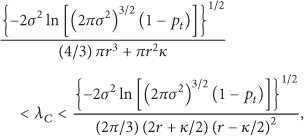
In a 3D omnidirectional sensor network, we have
Proof.
There are three processes to demonstrate this theorem.
(1) Based on (2), we have

Then,

Therefore, it is clear that
(2) By the above analysis, we can know that it is difficult to compute the explicit expression of the probability that all points on edge

Clearly, one sensor node covers all points on
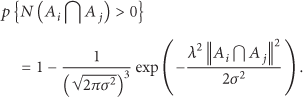
Let the volume of

In conclusion, we choose
(3) Equation (5) can be turned into

If
4.2. Dependence among Neighbor Edges
On the basis of (6) and Gaussian distribution, the different values of κ and r can generate the different bounds. The probabilities of all edges
In this section, we illustrate the quantitative measure of the dependence between
(1) Firstly, the mutual information in information theory [48] is employed to measure the mutual dependence between

In 3D omnidirectional sensor networks, we discuss the mutual dependence between

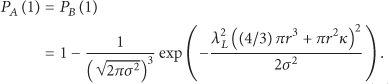
What is more,


Putting these above equations (14)–(18) into (13), we can obtain
(2) Similarly, the case of

In Figure 4(b), we use


Putting the formulas (20)–(24) into formula (19),
(3) Finally, when

Comparison between
5. Simulation Evaluations
In this paper, plentiful simulations are conducted to evaluate the effectiveness and characterize the performance of our models and analytical analyses by MATLAB (version 7.7). In a 3D omnidirectional sensor network, we set the deployment space as a 100 × 100 × 100 m3 cube and deploy all the homogeneous sensor nodes under a stationary 3D Gaussian process. Based on the covered space of sensor nodes, L-coverage lattice and U-coverage lattice are built, and we analyze the experimental critical densities in the two kinds of lattice, respectively.
Let
In the experiments, we calculate the ratio

Relationship between λ and
Let

Relationship between
Similarly, we conduct the experiments with different r and κ and get the corresponding curves of
In Figure 7(c), we set
If the lower and upper bounds of critical density the lower and upper bounds of the lower and upper bounds of
Furthermore, in order to demonstrate the effectiveness of our scheme, we compare the proposed scheme with the existing scheme [16]. For simplicity, we adopt the scheme of [16] into our proposed 3D omnidirectional network model and denote it by CDWMN (critical density of wireless multihop networks). Our scheme is abbreviated to CDEPWSN (critical density for exposure-path prevention in wireless sensor networks). When
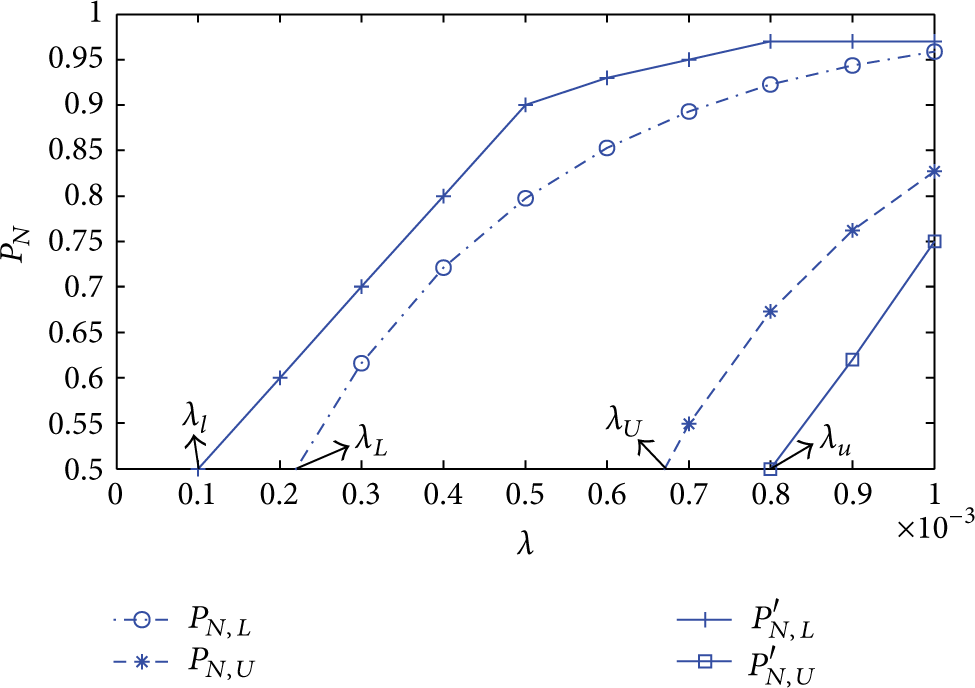
Comparison of λ between CDEPWSN and CDWMN with
In Figure 8, we have
6. Conclusions and Future Works
In this paper, we consider the exposure-path problem that an intruder traverses through a deployment region and the resulting path is not covered by sensor nodes. The network coverage is rather poor if there exists an exposure path in WSNs. To address this problem, we put exposure path into a 3D uniform lattice and propose a bond-percolation-based scheme to calculate the lower and upper bounds of critical density. The proposed models and simulation results show that our scheme can generate reliable and tighter bounds of critical density in 3D wireless sensor networks.
In a practical application, the sensing model of sensor nodes is not omnidirectional but directional. Consequently, our research is still in relatively ideal circumstances. In 3D directional sensor networks, the sensing area of a sensor node is a circular cone, which can be available for consultation in literature [49]. There are lots of difficulties to study the exposure-path prevention in a directional sensing model, such as the setting conditions, distributions, and multifarious calculation. However, this study has a practical significance. Based on the existing works, our future work is to solve the exposure-path prevention in 3D directional sensor networks.
Footnotes
Conflict of Interests
The authors declare that there is no conflict of interests regarding the publication of this paper.
Acknowledgments
This work is supported by the Important National Science & Technology Specific Projects of the Ministry of Science and Technology of China (no. 2013ZX03006001) and New Century Excellent Talents in University (NCET) (no. NCET-11-0593), the National High Technology Research and Development Program of China (“863” Program, no. SQ2015AA0102085), and the National Natural Science Foundation of China (no. NSFC61471064). The authors also gratefully acknowledge the helpful comments and suggestions of the anonymous reviewers.