




Abstract
Continuous capacity increase of distributed grid-connected photovoltaic (PV) system produces more obvious disturbance on the grid. Monitoring network technology can provide protection for the safety and stability of power grid operation, but sensor nodes of the monitoring network will fall to failure due to environmental interference. According to the performance degradation problem caused by nodes failure in PV monitoring network, particle swarm optimization (PSO) of natural selection based on random weight is proposed in this paper to optimize monitoring performance. This method can restore the monitoring network by arousing redundant nodes. Simulation results show the effectiveness of the proposed algorithm.
1. Introduction
The distributed photovoltaic technology is developing rapidly [1, 2]. With the connected capacity increase of distributed photovoltaic power generation system, the inherent randomness and uncertainty can lead to fluctuations to active power in power system [3]. The construction of a flexible and reliable monitoring network can guarantee the safe and stable operation of power grid. In the field of condition monitoring, WSNs are a kind of low-complexity, low-power, and low-cost monitoring technology [4]. According to the dispersion and the random, intermittent characteristics of photovoltaic power generation system, scholars have conducted research aiming at building a reliable WSN monitoring network for photovoltaic power generation system [5, 6]. WSNs-based PV system monitoring network consists of sensor nodes (referred node), which carry finite energy and cannot continue to work due to environmental interference. The depleted nodes will result in failure of a monitoring network. Therefore, it is necessary to study the restoration techniques of monitoring performance; there is still a lack of research in this field.
At present, the research on monitoring network restoration is mainly focused on network coverage and connectivity [7–9]. When the communication radius of nodes is at least twice the sensing radius, complete coverage of network implies connectivity of working nodes [10, 11]. Hence, the monitoring network failure nodes will result in reduced coverage, which will seriously affect the perception ability of the monitoring network, communications, and other properties [12, 13]. Whether nodes are in optimal placement will largely influence the operation and performance of the network [14]. We can start from the studies of monitoring network coverage optimization. Among all the coverage solutions, hexagonal method uses the least number of nodes, but if it is used for PV monitoring, nodes must be manually placed [15]. Additionally, the monitoring restoration methods using relay nodes are proposed, such as Spider Web approach [8]. Normally the relay node is responsible only for communication, which impacts the overall information collection of PV power system. Furthermore, virtual force algorithm (VFA) can be applied to fill the coverage holes and it has the high convergence [16]. However, compared with common nodes, mobile nodes take large volume and high cost. Besides, the PV array often has to be settled in a certain angle, and it is difficult for nodes to move. Therefore, the implementation of mobile nodes cannot be suitable for the deployment on the photovoltaic array. To solve the coverage problems of monitoring network, heuristic algorithm, especially intelligent algorithm, has evident advantages over VFA or other algorithms [7, 8, 17]. Based on multiobjective of node position and energy, a coverage optimization method of PSO for the monitoring network is proposed in [18]. But this method is a process of non-Pareto optimal (multiobjective optimization) solution; it is difficult to obtain a monitoring coverage optimal solution, and there is always a “premature” problem. To overcome the premature problem, the chaotic PSO is used in [19]. But the algorithm takes a long time, not suitable for the fast performance restoration to monitoring network [20].
This paper presents for the first time the PSO method of natural selection based on random weight, which is improved from PSO method. The improved method can arouse redundant nodes in monitoring network to improve network monitoring coverage with the purpose of achieving ultimately monitoring performance restoration. According to different node failure conditions of the monitoring network for PV array, this paper conducts a simulation analysis. Simulation results show the effectiveness of the proposed algorithm.
2. Failure Analysis of PV Monitoring Network
2.1. Coverage Ratio Model of Monitoring Network
Coverage ratio of monitoring network refers to dividing all nodes’ sensing area on PV array by the area to be monitored. To facilitate the study, the PV array can be divided into pixels; that is, the region of PV array is firstly divided into
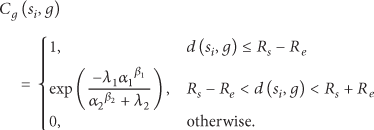
In formula (1),
All pixels g are jointly perceived by all valid nodes with the following result:

In formula (2), joint sensing result is greater than a predetermined threshold value equal to

Based on formula (3), coverage model of photovoltaic monitoring network is defined as the ratio between the number of cells having a

2.2. Redundant Nodes in Monitoring Network
To ensure the reliability of monitoring network operation in photovoltaic system, generally a certain number of redundant sensor nodes need to be deployed on photovoltaic array. As used herein, the redundant node is defined as follows. If the sensing range of sensor node can be completely covered by at least one node which is different from itself, then the node is a redundant node, as shown in Figure 1.
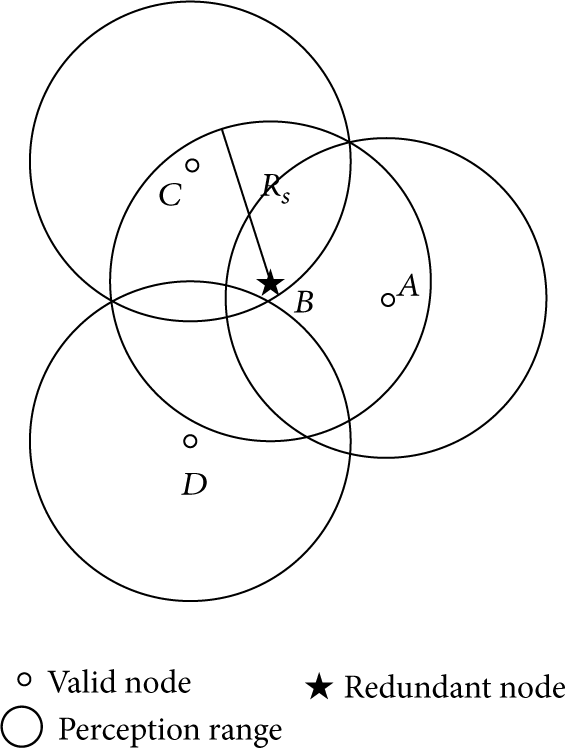
Redundant sensor node in WSN.
In Figure 1,
In this paper, one method of the coverage restoration is proposed through rational use of the redundant nodes when nodes failure occurs. In the situation of monitoring network failure, the number of remaining active nodes is supposed to be p and the number of redundant nodes involved in the network coverage restoration is supposed to be q. s represents a node set Communication radius of each node is equal to twice the communication radius of node perception radius; that is, There are three types of nodes in PV monitoring network: sink node, ordinary node, and cluster head node. The sink nodes are responsible for data processing, algorithm operation, and order transmission. Cluster head nodes in distributed systems are used for gathering data of ordinary nodes, data transmission, and data preprocessing; they can be selected from ordinary nodes. The main task of ordinary nodes is to gather information of PV system and to transmit data. The sink nodes and the cluster head nodes have their own and other nodes’ position and energy information.
The photovoltaic system has a plurality of rectangular solar arrays, a certain number of nodes on PV arrays form a cluster, and each cluster comprises a cluster head node and a number of ordinary nodes. A sink node has more energy and greater ability of information processing than an ordinary one, and it can regain the boundary information of monitored region, based on which it can estimate the number of ordinary nodes.
The sink node should judge the boundary and the amount needs of nodes for the monitoring region [24]. Based on data quality analysis of sensor managements, one online node fault detection method is proposed in [25]. When the nodes failure occurs, the sink node firstly determines coverage ratio of the monitoring network and then determines the amount of redundant nodes required to participate in coverage restoration of monitoring network. If the coverage ratio is γ%, then the monitoring network has an area of covering holes:

In formula (5),


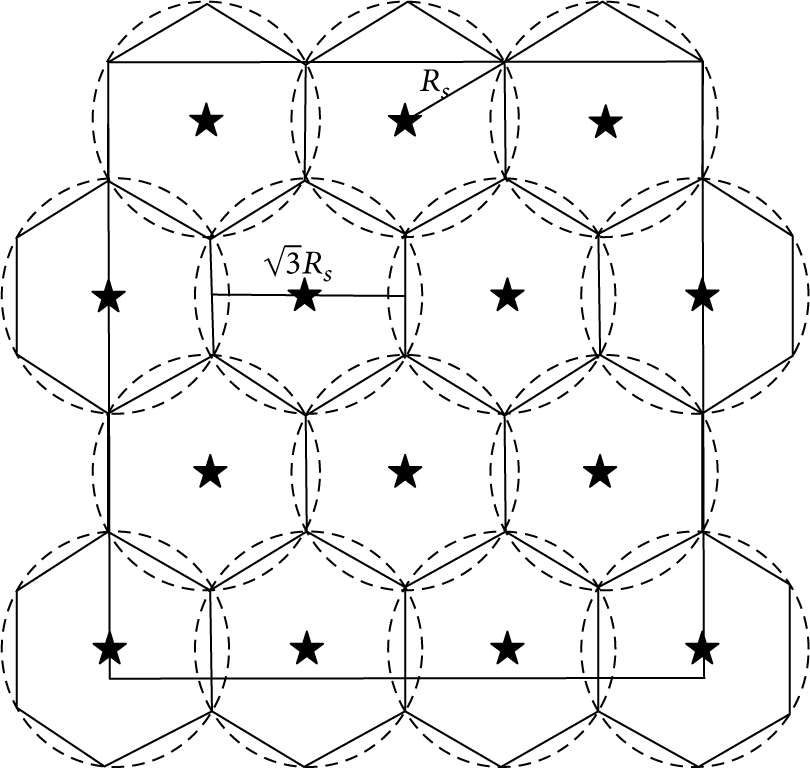
Equivalent sensors for coverage holes.
There may be some small monitoring coverage holes; in this case, there is no need to wake up redundant nodes to cover. Therefore,
3. Coverage Restoration Algorithm of PV Monitoring Network
To solve the coverage decrease problem caused by the nodes failure of PV monitoring network, we use PSO algorithm with fitness function of the monitoring coverage model as shown in (4). The algorithm can determine the best locations of redundant nodes to wake up, improve coverage ratio of the monitoring network by waking up redundant nodes, and ultimately achieve the purpose of monitoring performance restoration.
3.1. Standard Particle Swarm Optimization
There are N particles in PSO algorithm and each particle has a m-dimension. The individual particle

In the above two formulas,
3.2. Hybrid Particle Swarm Algorithm of Unvalued Weights
A large inertia weight ω is conducive to jump out of local optima and easy for global search; the smaller ω favors the convergence. Thus, the inertia weight is usually not a constant value. Under normal circumstances, PSO uses the method of linear decreasing weight or random weight [26].
Linear decreasing weight is as shown in the following formula:
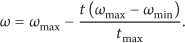
In formula (9), usually take
The random weight inertia obeys the standard normal distribution, as shown in formula (10). The method based on random weight can make the particles have a chance to get a larger or smaller weight during the early and later evolution period. Consider
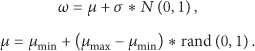
In formula (10),
For fast and effective restoration for the monitoring network, it is necessary to overcome the “premature” problem and the slow convergence problem of PSO algorithm. So this paper proposes the PSO algorithm based on natural selection. During the iteration period, the particle will be sorted according to the fitness value. The best alternative velocity of half the particles will take position of the worst half ones, preserving the best historical value of each individual.
3.3. Algorithm Flow
In the field of PV monitoring, sensor nodes can have the following power supply ways. (1) Powered up by the PV system with access to the underlying grid: this way has strong operability and sufficient energy supply but seriously affects the flexibility of nodes placement. (2) A solar panel or an induction device is installed in the node: because of the instability of the power supply, the allocation of a certain battery is required; thus, the total cost of a node increases. (3) Powered up by the battery alone: this way has been generally adopted; the battery can ensure sufficiently long lifetime [27]. After comprehensive consideration, the first power supply way is used for sink nodes and the third way is for ordinary nodes and cluster head nodes in this paper. In order to prevent the situation where redundant nodes with lower energy are awakened in the monitoring network, the energy threshold

Since the photovoltaic system is composed of different PV arrays, the number of failed nodes will be different for different PV array. For this case, with the combination of formula (6), the number of involved redundant nodes for coverage restoration of monitoring network is different. Therefore, there is the need to limit the number of redundant nodes; namely,

Basic steps of the hybrid PSO algorithm based on natural selection with the fitness function in formula (4) are as follows.
Random initialization of position and velocity of each particle swarm: the initialization scope of the position falls in PV monitoring area. The particle dimension initialization is referring to formulas (6) and (12); the dimension is twice the number of all active nodes; that is, if the number of remaining effective nodes is According to formula (4), calculation of the fitness value Update the particles velocity and location according to formula (8), to obtain a new Sorting of the updated particles depending on fitness value: replace the worst half of particles by the best half of particles (the related replacement of the location and velocity). If the termination condition is satisfied, then exit. When
4. Simulations and Analysis
In this paper, the photovoltaic modules for distributed photovoltaic systems are constructed by Trina PC14. The establishment of a
4.1. Analysis for Failure Conditions of PV Monitoring Network
The distributed PV system has the feature of dispersion; failure situation will be different depending on different PV array. Therefore, to verify the effectiveness of the algorithm mentioned in this paper, in the following examples, the size of different PV array will be different and the number and location of failure nodes will also be different.
4.1.1. Situation of Regular Failure Region
For the PV array with

Regular failed network.
For all of the following simulation figures, “∘” is on behalf of remaining effective monitoring network node and “★” is on behalf of awakened redundant nodes of monitoring network.
4.1.2. Situation of Irregular Failure Region
For the PV array with
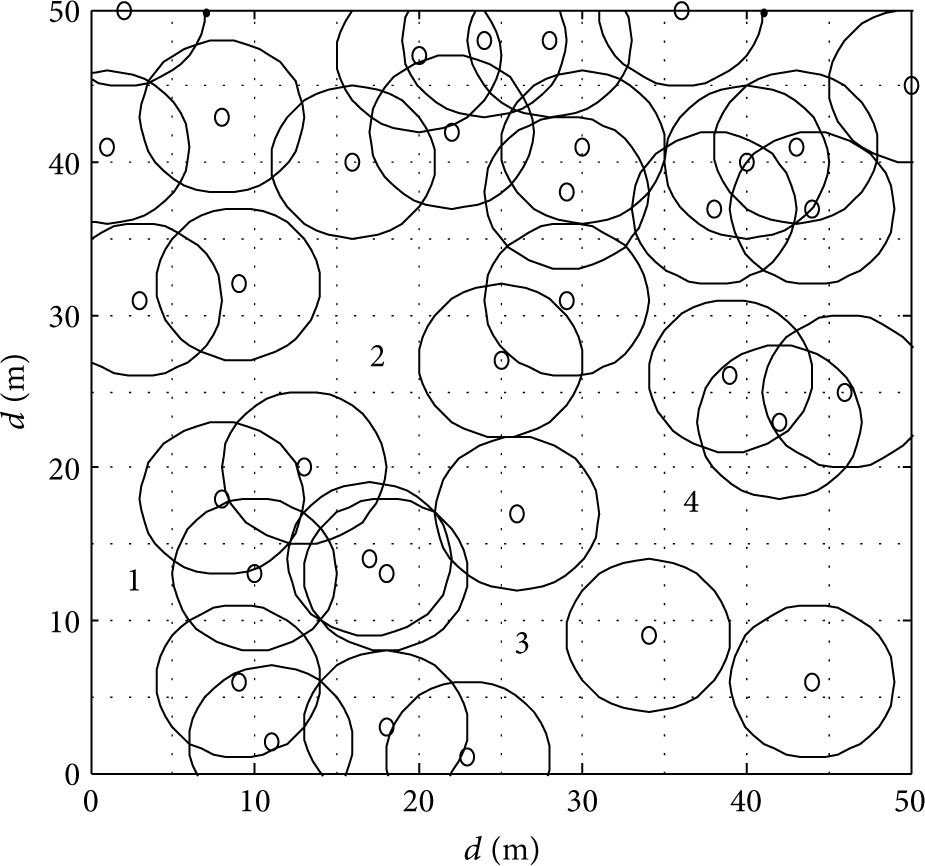
Irregular failed network situation.
4.2. Coverage Restoration for Monitoring Network
In the case where there are a large number of failure nodes appearing, it is usually considered to redeploy new nodes in order to rebuild the monitoring network; this paper will not consider this situation. This paper makes the following assumption: if the coverage ratio of monitoring network can be increased by 50% on the basis of coverage ratio of the current failure network, then monitoring network performance will be restored.
Aiming at the regular failure situation,
In order to improve coverage of the monitoring network, run the PSO algorithm of natural selection based on random weight. The result is as shown in Figure 5; when 21 iterations end with a time of 147.70 s, the coverage ratio reaches 65.61%; from (65.61% − 43.29%)/43.29% = 0.5156, we can know that the monitoring network coverage is improved by 51.56%, meeting the performance restoration requirements for monitoring network. Because the sensor nodes are used by a jointly perceptual model, the monitor network coverage is not just calculated in accordance with perception of a circle of radius
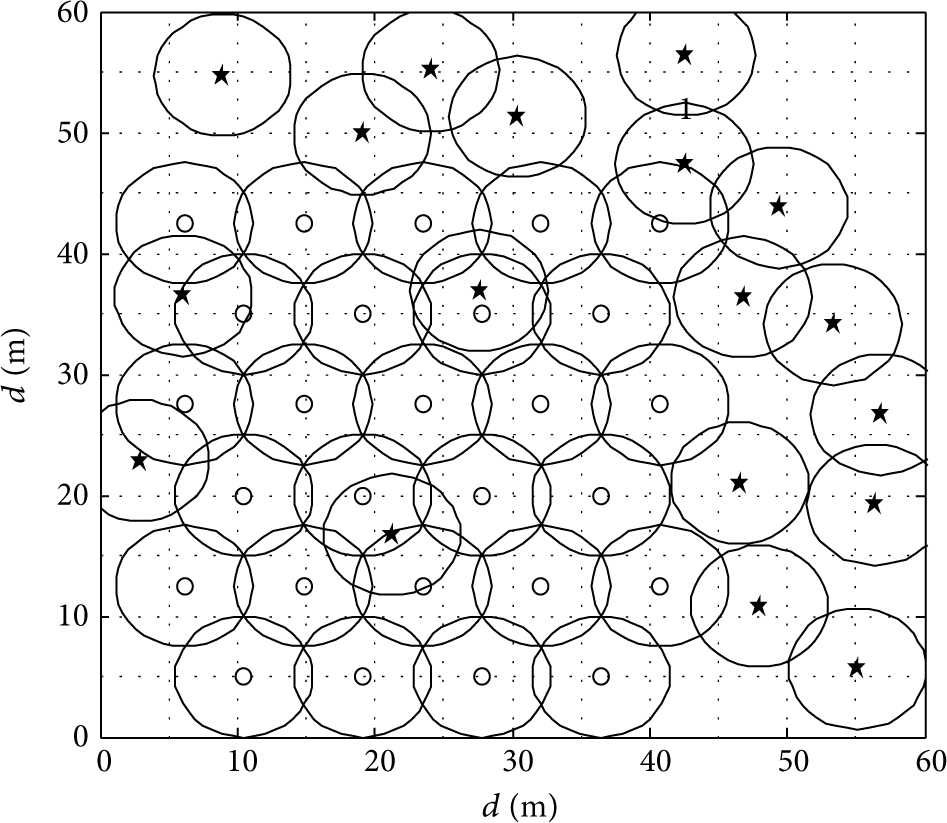
Restoration in regular failed situation.
For the irregular failure situation,
Run the PSO algorithm of natural selection based on random weight. The result is as shown in Figure 6; when 31 iterations end with a time of 116.58 s, the coverage ratio reaches 78.05%; from (78.05% − 51.94%)/51.94% = 0.5026, we can know that the monitoring network coverage is improved by 51.56%, meeting the performance restoration requirements for monitoring network.

Restoration in irregular failed situation.
4.3. Consuming Time of Coverage Restoration for the Monitoring Network
Coverage of photovoltaic monitoring network has to be restored quickly; the equipped computer has the Core Duo with a processing frequency 2 GHz, and the simulation is run on the MATLAB platform. Therefore, under the same configuration conditions of running computer, we should choose the algorithm with a less computing time.
Obviously, since the irregular failure simulation can represent the random node failure situation of PV array, it has a more general applicability. The algorithm running time for the case of irregular failure is as shown in Table 1. From Table 1, for either the random weight method or the linear weight method, the PSO based on natural selection takes shorter time than the standard PSO; for either the PSO or the hybrid PSO, the random weight method takes shorter time than the linear weighting method; for these four methods, the natural selection PSO based on random weight takes the shortest time.
Comparison of operating time.

After having run 1000 times for all above algorithm methods, the results of comparing the average running time of the above four kinds of methods are shown in Table 2. The results show that PSO algorithm of natural selection based on random weight can recover the monitoring network coverage with the fastest speed.
Comparison of time for monitoring network restoration.

5. Conclusion
In this paper, aiming at the coverage decrease problem of PV monitoring network based on WSN due to sensor nodes failure, the particle swarm optimization of natural selection based on random weight is firstly proposed. Combining the different failure conditions for different PV array monitoring network, simulation analysis for the coverage restoration of monitoring network is executed. Results show that the PSO of natural selection based on random weight can quickly find the best position needed to arouse the redundant nodes. After the nodes’ participation in the restoration process, the monitoring network coverage can be improved; as a result, the monitoring network performance can be restored.
Footnotes
Conflict of Interests
The authors declare that there is no conflict of interests regarding the publication of this paper.
Acknowledgments
This work is supported by the National Natural Science Foundation of China (no. 51307044) and the Natural Science Foundation of Jiangsu Province of China (no. BK2012409).