




Abstract
The wireless resources required by users have increased in parallel with and above improvements in WLAN technology, requiring even more accurate and practical resource management. Research on medium utilization, which is fundamental to resource management, has supplied insufficient evidence to apply it in real environments. This paper proposes a hybrid measurement approach to medium utilization using both a signal-level register monitor and a frame-level frame parser. We redefine medium utilization in terms of Medium Occupied Time (MOT) to describe the status of the medium in more detail. The proposed approach enables us to measure the classified MOT occupied by 802.11 frames, wireless interference, and a MAC protocol. We implement our approach by modifying a Linux device driver of an off-the-shelf 802.11n NIC. In addition, an indoor test bed is built to verify the approach's support for various traffic patterns, quantitative measurement of wireless interference, and backoff time estimation. We conclude that our hybrid measurement approach is accurate and deployable in a real environment.
1. Introduction
In an IEEE 802.11 network, the required resources of a wireless node vary with link capacity. In other words, the link capacity of a wireless link connected to two nodes is determined by the predefined data rate. The nodes have a transmission opportunity achieved by MAC contention over a shared medium. Consequently, a node can only use the remaining resources after the portion consumed by other nodes in a given link capacity.
Channel Busy Time and medium/channel utilization are well-known metrics commonly employed in methods to obtain consumed resources. Methods using these metrics quantitatively measure the proportion of time for which the medium is busy on a certain channel. They are also helpful in effectively managing limited resources and guaranteeing quality of service to resource-aware applications such as available bandwidth estimation [1, 2], channel assignment [3, 4], routing metric [5, 6], handoff process [7], and rate adaptation mechanism [8].
In the case of channel assignment scenario, an access point (AP) assigned to an appropriate channel, the clients must make the intelligent decision about the AP selection. If the medium utilization of the channel used by the AP is high, then the available bandwidth of clients will be lower. Furthermore, the channel affected by wireless interference leads to worse performance.
The 802.11k standard provides wireless clients with various reports for radio resource management [9]. Among them, a channel load report collects the channel utilization periodically, and a noise histogram report indicating wireless interference records only the channel utilization generated by non-802.11 devices. These reports specify the medium's status to discover the best available access point. However, the method of information gathering falls outside the scope of the standard.
MOT is the amount of time for which an observing node cannot access the shared medium on a certain channel per unit time. In this paper, we adopt 1 s as the unit time. Figure 1 shows the three components of MOT and their relations with the measurement tools. Figure 1(a) shows the observed physical status of the link, which is occupied by interference and frames. Figure 1(b) illustrates corresponding DBT, SBT, and PBT. Sense Busy Time (SBT) is defined as the time duration during which a radio signal is sensed but is not decodable to a frame by an observing node. Data Busy Time (DBT) is the time duration during which a radio signal is sensed and the signal is decoded to frames. DBT and SBT are categorized as physical MOT in which both of them are occupied by physical radio signals. Lastly, Protocol Busy Time (PBT) is defined as the time gap necessary for MAC protocols, which is categorized as logical MOT. The frame parser that resides in the MAC layer and the register monitor that resides in the PHY layer, as shown in Figure 2, are typical tools used for link measurement. The frame parser makes use of the received MAC frame headers and allows us to assess DBT and PBT separately, as shown in Figure 1(c). However, we are unable to measure SBT with the frame parser, because the interference is not decoded to a frame. The register monitor allows us to measure the overall physical MOT as shown in Figure 1(c), but we cannot separate DBT and SBT. Besides, it does not provide any information for assessing PBT. Consequently, the frame parser and the register monitor alone cannot measure all the three components of MOT.

The relationship between MOT and measurement tools.
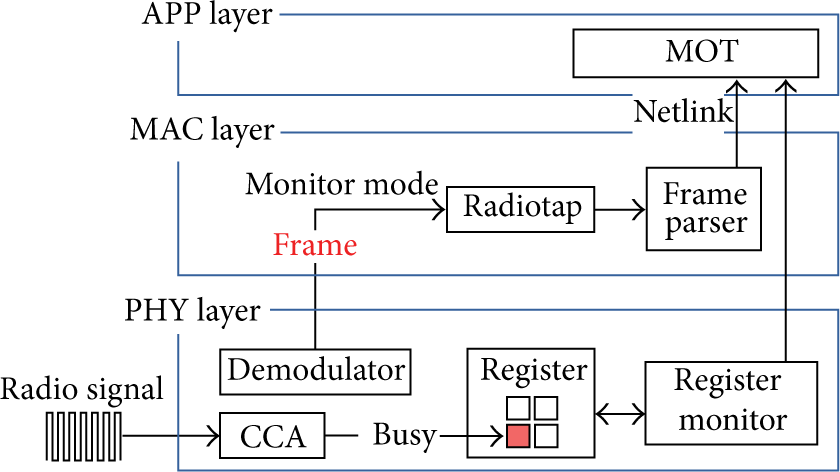
Overview of the hybrid measurement approach.
Similar to existing wireless link measurement studies, MOT is basically designed to measure how much resource of a wireless link is being consumed, so that one can estimate the remaining available resource of the link being observed. However, knowing only the overall consumption is not enough in many cases. Consider two links that a node can choose. For the first link, it is observed that 65% of the link resource is being consumed, while, for the second one, it is observed that 70% is consumed overall. Which is the better link for the node? It seems that the first link is better. However, if we find out that the resource consumption for the first link is mostly due to interference from unknown sources while that of the second link is mostly due to traffic from neighbor nodes that the node can cooperate with for fair sharing, then which is the better? This example shows that it is very important to identify sources or causes of resource consumption.
The proposed MOT aims at accurately measuring the resource consumption of a link while identifying the causes of consumption. MOT classifies the consumed resource into DBT, SBT, and PBT. We can assess the interference level of a link by examining its SBT and the congestion level by examining its DBT and PBT.
We make the following contributions in this paper.
We present a hybrid approach to measure the entire composition of MOT. The approach uses both frame parser and register monitor as measurement tools and allows us to quantitatively represent wireless interference. In addition, we show the impact of wireless interference on the available resource in a test bed. We develop a passive measurement method using off-the-shelf 802.11n NICs. To improve accuracy and extendibility of the measurement, features such as frame aggregation and channel bonding are taken into account. We conduct experiments to identify the contention level by analyzing the gap time between successfully received frames. The elapsed backoff time of each received frame is closely related with the contention level. The proposed frame parser is designed to efficiently estimate the backoff time based on the contention level.
2. Related Works
We assume that SBT and PBT make MOT measurement very difficult. SBT is commonly generated by hidden nodes, nodes on adjacent channels, and non-802.11 devices. However, the measuring node cannot detect them. Furthermore, it is difficult to measure a random backoff time of PBT. Even some hardware vendors do not comply with the minimum contention window defined in the IEEE 802.11 standard [10]. An empirical analysis for SBT and PBT is required to exploit MOT in a real environment.
Most studies use a frame parser to measure MOT [1–7]. The measuring node operating in the monitor mode calculates the transmission time denoted as DBT using the received frames. Then after analyzing the type and subtype of a frame, the PBT comprising Interframe Space (IFS) and backoff time is calculated as the constant values based on Distributed Coordination Function (DCF) in the IEEE 802.11 standard. Assigning a constant value to the backoff time for a received frame is a trivial approach because the elapsed backoff time may be decreased by contending nodes, even though a transmitter sets a backoff counter as a uniform random number. For more information, refer to Section 3.3. A frame parser can recognize neither the corrupted frames nor wireless interference, with the result that it cannot measure SBT structurally [2].
Recent wireless chipsets support channel status registers [8]. They are able to measure physical MOT by monitoring the specific register periodically without any calculation. However, this means it cannot also measure PBT, which requires frame-level analysis. The following researches are very similar to the proposed measurement approach in that the register monitor is used to measure the physical MOT and they consider the partial logical MOT.
Dely et al. [11] present an analytical model to study the channel busy fraction in nonsaturated IEEE 802.11 networks. In order to validate the model, they compare the MOT derived from the model with the measured MOT. The model is designed under the assumption of noninterference channel. So the measured MOT does not contain SBT. Besides, statistics information such as the number of received frames is used to calculate logical MOT. As a result, the logical MOT except for analyzing the relationship between the frames cannot identify the contention level.
Lakshminarayanan et al. [12] propose the framework using an off-the-shelf wireless NIC to construct a time map of how the medium is utilized. They especially focus on identifying the cause of interference from non-802.11 devices. The tcpdump and the kernel log tracer are synchronized and merged. The framework compares busy regions identified by the register (from kernel log) with the packet reception regions (from tcpdump) and determines the presence of non-802.11 transmitters. The 802.11n 40 MHz channel, consisting of the primary and secondary 20 MHz channel, cannot decode 802.11 frames detected by the secondary channel [13]. So, it is not suitable for identifying non-802.11 sources in IEEE 802.11n networks. We found that some subframes within one A-MPDU have the same timestamp. It makes the synchronization between two log tracers difficult. In addition, this approach incurs substantial overheads for trace merging at the granularity of two microseconds. Moreover, the frameworks do not take the backoff time into account.
The measurement approach is dependent on measuring the wireless NIC, especially in the case of MOT. Most studies measure MOT using a legacy 802.11abg NIC in a different way. Obviously, this card does not receive 802.11n frames because it cannot detect an 802.11n PHY preamble. As a result, frame parsers and register monitors using legacy 802.11 devices cannot reflect 802.11n MAC enhancements such as frame aggregation and channel bonding and lead to inaccurate results in some cases.
In summary, previous studies make use of either the frame parser or the register monitor alone to assess the consumed resource of a link. However, neither can the frame parser alone measure SBT nor can the register monitor alone measure PBT. We explain the necessities and usefulness of identifying the three components of MOT, which are DBT, SBT, and PBT, in Section 1. However, previous studies do not identify the three components of MOT and their methods cannot measure them distinguishably. These indistinguishable and inaccurate measurements limit our understanding of wireless link status. For example, when a node observes a fully consumed link, it cannot determine whether the resource is consumed because of congestion from competing nodes or wireless interference from unknown sources.
Previous methods also have limitation in supporting newly adopted standard MAC protocols such as the frame aggregation protocol of IEEE 802.11n. This limitation leads to substantial error in PBT assessment, which is shown in our experiments in Section 4.2.
3. Hybrid Measurement Approach to MOT
The proposed hybrid approach uses both the frame parser and register monitor for accurate and effective MOT measurement. Figure 2 illustrates the overall implementation structure of the proposed hybrid measurement approach. The register monitor is located in the PHY layer and the frame parser is located in the MAC layer. In the PHY layer, for each time slot, the Clear Channel Assessment (CCA) checks whether the medium is busy by sensing for radio signals. The number of busy slots is stored in a counter called the channel status register. We can measure the total physical MOT by periodically looking up the channel status resister. If a sensed radio signal is decodable, it is decoded to a frame and sent up to the MAC layer. Through the frame parser in the MAC layer, we can calculate/estimate DBT and PBT by parsing the MAC and radiotap header of the received frames. Besides, we can obtain the SBT by extracting the DBT from the total physical MOT measured by the register monitor. Therefore, we can measure all of DBT, SBT, and PBT.
We modified the mac80211 operating in MAC layer and ath9k operating in PHY layer for the implementation of the proposed hybrid approach. The mac80211 is the wireless stack of the Linux kernel and ath9k is the device driver for Atheros AR9xxx chipsets supporting 802.11n radio.
In the following subsections, we describe one by one how DBT, SBT, and PBT can be measured in detail.
3.1. Data Busy Time Measurement
DBT is the transmission time of 802.11 frames, which are composed of a PHY header and a MAC frame. The PHY header consists of a Physical Layer Convergence Protocol (PLCP) preamble for bit synchronization and a PLCP header to help decode the MAC frame. The MAC frame consists of a MAC header and a payload for application data.
In order to obtain DBT, the frame parser must operate on the monitor mode. This mode can promiscuously capture 802.11 frames sent on the current channel and forwards both the captured frame and an additional header for per-frame information to an upper layer. The radiotap header, called an additional header, identifies the status of a received frame containing the attribute of timestamp, RSSI, channel, modulation coding scheme (MCS), and frame aggregation [14, 15]. The frame parser calculates DBT described by (1) using this information [16]:

The OFDM PHY encoding parameters.
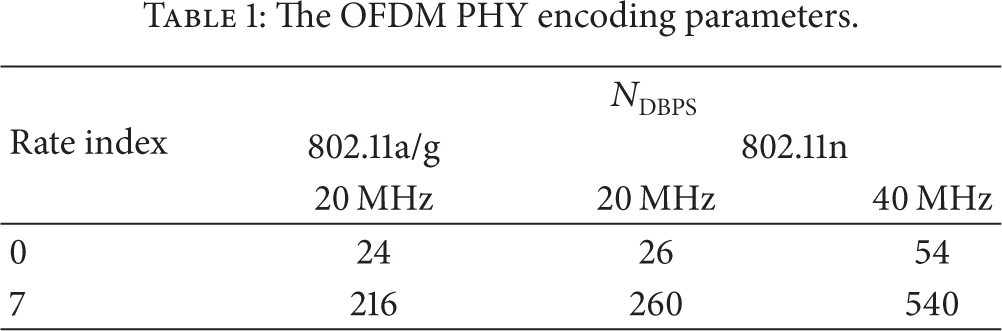
When a MAC Protocol Data Unit (MPDU), which denotes a MAC frame, is transmitted over a wireless medium, a PHY header is attached to the MPDU. The Aggregated MPDU (A-MPDU) suggested in the IEEE 802.11n standard is able to transmit multiple MPDUs in a single transmission. In order to obtain
3.2. Sense Busy Time Measurement
SBT refers to a time duration in which a wireless NIC cannot decode a radio signal into an 802.11, even if the Clear Channel Assessment (CCA) function indicates that the status of the medium is busy. This is commonly described as wireless interference. The research implicates hidden nodes, nodes on adjacent channels, and non-802.11 devices as the main causes of SBT [17].
It is difficult for an off-the-shelf wireless NIC to measure SBT directly. A spectrum analyzer measures the FFT duty cycle in a specific frequency band. The FFT duty cycle is the ratio of the time that the analyzer receives the RF signal, including the 802.11 signal as well as wireless interference, to the total time, given as a percentage [18]. It is conceptually similar to physical MOT, but the spectrum analyzer cannot extract SBT from the measured FFT duty cycle. Moreover, as shown in Figure 3, the FFT duty cycle per frequency is also difficult to convert into a channel number defined in an IEEE 802.11 standard.

The FFT duty cycle measured by the spectrum analyzer according to a channel bandwidth.
We assert that SBT can only be measured by the hybrid measurement approach using the following two tools simultaneously. The register monitor periodically monitors a specific channel status register to measure physical MOT. Then the frame parser calculates DBT based on the received frames as mentioned in Section 3.1. Therefore, SBT is easily defined as the time obtained by subtracting DBT from physical MOT.
Table 2 shows the channel status registers provided by the Atheros chipset. Ath5k is a FOSS wireless driver for the Atheros-based wireless 802.11abg chipset version in the Linux kernel. Ath9k is also a device driver for newer Atheros wireless NICs including those with 802.11n hardware support.
The channel busy registers supported in Atheros chipsets.

First of all, the physical MOT is calculated by dividing the observed CBR by the clock rate. The Channel Busy Register (CBR) represents the number of clock ticks that the wireless medium is busy due to the CCA function. The device driver specifies the clock rate according to the IEEE 802.11 radio and wireless configuration. For example, a 40 MHz channel width has twice the clock rate of a 20 MHz channel width. The listen time is calculated by dividing the cycle by the clock rate. The cycle refers to the total number of clock ticks. The register monitor also stores listen time as well as physical MOT because the time may differ from the measurement period of MOT due to transient errors.
3.3. Protocol Busy Time Measurement
PBT is a time duration in which the channel is physically idle but logically occupied or consumed by a MAC protocol. This time is divided into a deterministic Interframe Space (IFS) and a nondeterministic backoff time. The IFS is the fixed waiting interval to defer access to the wireless medium and is classified into short IFS (SIFS) and distributed IFS (DIFS) according to the transmission priority of a frame. The backoff time is the random waiting time to prevent frame collisions. It is uniformly chosen in the range [0, CW], where CW stands for Contention Window.
In order to measure PBT, the frame parser uses the Interframe Gap (IFG), which is calculated with two consecutive frames, while most relevant related work uses type/subtype of a frame. The IFG is the time difference between the end of the timestamp of a previous MPDU and the start of the timestamp of a current MPDU. Here, start/end timestamp is the time in microseconds at which the first/last data symbol arrives at the wireless NIC. The wireless chipset supports only an end timestamp. So, we can obtain a start timestamp by subtracting the transmission time already calculated in DBT from the end timestamp of a current MPDU.
The IFG may include unused time as well as PBT. Therefore, the frame parser takes the approach of extracting an IFS and a backoff time from the IFG step by step.
We simplify the procedure for determining IFS without classifying the frame type. If the IFG is approximately equal to SIFS then SIFS is assigned to the IFS. Response frames such as acknowledgement frames and association/authentication response frames do not require a backoff time, so in this case the frame parser does not proceed to estimating a backoff time. If the IFG is bigger than DIFS, then DIFS is assigned to IFS. Next, the residual IFG is used to estimate the following backoff time.
The backoff time for the receiver side, as shown in Figure 4, is related to the medium contention level. Suppose that two nodes attempt to transmit a frame at the same time, and the assigned backoff time of each is 4 and 6. In this case the average backoff time is 5. First, the frame having the lowest backoff time is transmitted over the wireless medium. Then the other frame is transmitted after the two residual backoff times are decreased to zero due to the DCF function. As a result, the average backoff time decreases from 5 to 3 by the medium contention. Therefore, fixed backoff time is not suitable for congested wireless networks.

The impact of medium contention on the backoff time.
Keeping in mind the issue of medium contention, we present a simple and accurate method for estimating backoff time using IFG and minimal information about the received frames. If the residual IFG is larger than
If the frame parser detects a retransmission frame through the retry field of the 802.11 MAC frame, then the frame parser assigns the residual IFG to a backoff time because unused time cannot exist in this interval. Furthermore, the frame parser additionally includes an observed average backoff time and a DIFS in PBT. This is because even though the retry field does not indicate the number of retransmissions, the retransmission frame has already been retransmitted more than once.
4. Performance Evaluation
In this study, Ubiquiti SR71-15 wireless NIC based on AR9220 chipset is used. This card provides 802.11an radio of 5 GHz band and can support a maximum data rate of 300 Mbps with two spatial streams. As for the embedded board, Alix 3d2 is used, which runs with AMD Geode 500 MHz and supported two miniPCI slots. The openWrt is run as the operating system. The test bed was configured by the infrastructure topology where three clients are connected on one AP in indoor environments.
4.1. The Impact of Wireless Interference on Available Resource
The purpose of this experiment is to verify the feasibility of classifying physical MOT into DBT and SBT. To demonstrate this, we designed two experiment cases that have very similar physical MOT but have different sources for the physical MOT. Actually, we designed experiments such that the physical MOT of the first case is mostly attributed to DBT and that of the second one to SBT.
The scenario of the experiment is shown in Figure 5. We construct a topology that consists of two wireless links: Link A and Link B, with four nodes: N1, N2, N3, and N4 in an indoor environment. N2 generates background traffic over Link A using Iperf [20] until the end of the experiment. N4 generates ingress traffic over Link B at time 10 for 10 s. During the entire duration of the experiment, N3 measures only physical MOT over the channel configured by the link. The following two cases are designed for the purpose of the experiment. In Case 1, both links are set to channel 149. In Case 2, Link A and Link B are set to channel 153 and channel 149, respectively. Each case performs the above procedures. Before generating ingress traffic, we adjust the amount of background traffic to match the physical MOT of Case 1 and Case 2.
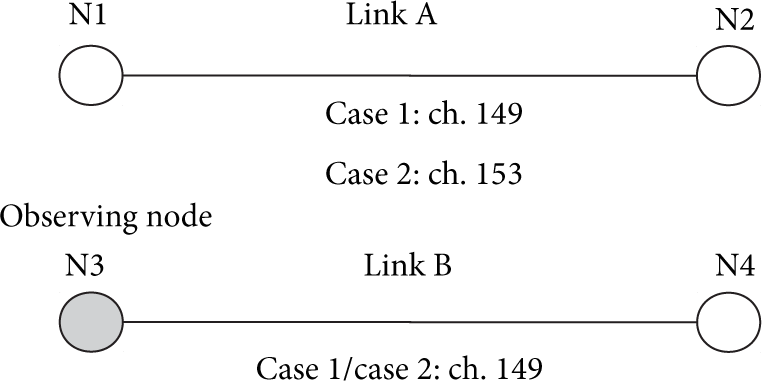
The experiment setup.
Figure 6 shows the result of the experiment. The top of Figure 6 represents the physical MOT measured by the register monitor of N3, and the bottom represents the number of retransmission frames collected by the frame parser of N3.

The necessity of classifying physical MOT into DBT and SBT.
The result of this experiment shows that even though the same amount of traffic is transmitted by N4 in each case, Case 2 consumes more resources for ingress traffic than Case 1. This is because of the increased retransmission due to packet loss. The wireless interference, including Adjacent Channel Interference (ACI) [21], plays a role in interfering with the transmission; therefore, N4 exposed to such interference may suffer from packet loss by collision. In conclusion, the classification of the physical MOT helps us better understand the mediums status and manage wireless resources effectively. The detailed descriptions of the experiment are summarized as follows.
Before generating ingress traffic, the physical MOT of both cases is 208 ms. On the other hand, the sources of the physical MOT are different from each other. For example, the physical MOT of Case 1 consists of only DBT, because N3 can successfully receive the frames for background traffic over Link A. On the other hand, the physical MOT of Case 2 consists of only SBT, because N3 cannot decode background traffic over Link A into frames owing to ACI.
After generating ingress traffic in each case, the average of the physical MOT for each case is 550 ms and 618 ms. The physical MOT of Case 1 is increased by 274 ms, an amount corresponding to ingress traffic. This is a reasonable result in that the sum of 280 ms on background and 274 ms for ingress traffic is 554 ms. On the other hand, the physical MOT of Case 2 increases to 27% of the ingress traffic. Note that the impact of ACI such as the increased consumed resource may differ depending on the transmitter power of the nodes on the adjacent channel and the gap between a current channel and an adjacent channel [22].
4.2. The Hybrid Measurement Approach in Saturated Medium
The purpose of this experiment is to verify the accuracy of MOT measurement. Actually, we verified the accuracy of MOT on its physical components by making use of tools such as spectrum analyzer. However, there is actually no reference measurement tool that can accurately measure all the physical and logical components of MOT as it includes PBT, which can be only logically estimated. Therefore, we have to take a special approach to demonstrate the accuracy of our PBT measurement. For this, we carry out experiments by making the wireless link saturated. We can make a link saturated by generating more traffic than the physical link can carry. Then, the link is fully consumed by the traffic. In this situation, the measured MOT should be equal to the unit measure time, which is 1 s in this paper. We can make various saturating traffic patterns that have different PBTs by applying different data rates and MAC protocols. However, in any traffic pattern that makes the link saturated, the sum of the measured physical MOT and PBT should be close to 1 if the MOT measurement is accurate.
In order to make the medium saturated in an indoor test bed, the node generates an amount of traffic that is more than the predefined data rate per traffic pattern. We use six different traffic patterns. The first two patterns configure the data rate of 6 Mbps and 36 Mbps in 802.11a. The others are set to one spatial stream and Long Guard Interval (LGI) for wireless configuration in 802.11n. The frames at the data rates of 65 Mbps (HT20 MHz) and 135 Mbps (HT40 MHz) are transmitted by a legacy mode and an aggregation mode, respectively.
Figure 7 represents the MOT according to traffic patterns and the throughput measured by Iperf. The results of this experiment are summarized as follows.

The measured MOT according to the different traffic patterns.
First, the MOT of the saturated medium is approximately 950 ms in every pattern. Therefore, we assume that the proposed hybrid measurement approach provides an accurate MOT measurement using the off-the-shelf 802.11n. However, despite the measurement period of MOT being only 1 s, the MOT measured by every pattern is less than 1 s. The reason is the listen time as mentioned in Section 3.2. The listen time is the maximum observed time that could be measured in the wireless NIC; it is also the maximum MOT. We check that the listen time of 802.11n NIC used in the experiment is 975 ms for both the HT20 and HT40 channels. In addition, considering minimal measurement error, we assume that the MOT of the saturated medium is about 950 ms with empirical analysis.
Second, the PBT has a high variation depending on the MAC protocol characteristic. Among the traffic patterns, the minimum and maximum values of PBT are 27 ms and 389 ms, respectively. The difference of 362 ms is a significant portion of MOT. To summarize, it is not accurate to analyze medium status with only physical MOT. In particular, PBT of the patterns with frame aggregation mode is significantly low compared to other patterns. In general, the PBT is generated when a node accesses the medium for the frame transmission. The frame aggregation mode can transmit multiple frames in one medium access, so that the throughput is high and PBT is lower.
4.3. The Estimation of Backoff Time
The purpose of this experiment is to verify the accuracy of estimating the backoff time of PBT. To achieve this, we make the shared medium saturated while increasing the number of competing nodes. During this time, we monitor whether MOT is maintained at the level of saturated medium regardless of the number of competing nodes. As described in Section 3.3, it is likely that the elapsed backoff time decreases as contending nodes increase over the shared medium. Therefore, we expect that PBT will decrease and DBT will increase by the same amount.
In an indoor test bed, we maintain the status of the saturated medium for 30 seconds. Starting with one node at 0 s, an additional node participates in the competition for medium access every 10 seconds. The three competing nodes have only one traffic pattern in which the data rate is fixed to 36 Mbps in 802.11a. In each interval, the corresponding node continuously sends an amount of traffic at a rate of more than 36 Mbps.
In Figure 8, we show the result of the empirical relationship between MOT and the medium contention level. First, contrary to our expectations, DBT is consistently maintained at 740 ms. The average throughput is 23 Mbps for all intervals, and competing nodes equally distribute this throughput. Second, SBT accounts for 10% of MOT in the interval having three competing nodes. The medium contention, like ACI, causes a frame collision according to the DCF function. Hence, a high level of contention on the channel results in a number of retransmission frames. Third, PBT decreases by about 30% due to contention. The backoff time considerably decreases from 127 ms to 42 ms. On the other hand, the IFS measurement shows a slight increase, because the frame parser considers the IFS of corrupted frames using the retransmission frame. If the backoff time for a received data frame is assigned a constant value as an average backoff time on the minimum contention window [23], then the measurement tool overestimates the backoff time as shown by the solid red line in Figure 8. The proposed frame parser thus provides accurate measurement for PBT based on contention level.

The measured MOT with increasing the contending nodes.
5. Conclusion
The rapid progress of WLAN technology allows its users to provide significant resources. In parallel, the amount of resources required by users has also increased. Accordingly, a method for managing limited resources is necessary. To achieve this, identifying the amount of consumed resources is essential; however, the existing research on resource-aware applications focuses on applying the available resources without identifying the consumed resources. Moreover, there is not enough evidence to exploit well-known methods in real environments.
We redefine channel utilization to identify consumed resources as MOT, which is composed of DBT, SBT, and PBT. We present a hybrid measurement approach to MOT using an off-the-shelf 802.11n device. A frame-level frame parser and a signal-level register monitor accurately measure real-time MOT. In addition, an indoor test bed is built to verify the approach's support for various traffic patterns, quantitative measurement of wireless interference, and backoff time estimation. As a result, our hybrid approach, which has a level of 5% measurement error, should be accurate and deployable in a real environment.
The issue of radio resource management relates to the distribution and allocation of limited resources. We already attained experimental results that measured a consumed resource. Next, the measurement of the consumed resource would be analyzed through various experiments to find out its relation with available resources. Further, MOT would be applied to resource-aware applications such as routing metric and channel assignment.
Footnotes
Conflict of Interests
The authors declare that there is no conflict of interests regarding the publication of this paper.
Acknowledgment
This research was supported by the MSIP (Ministry of Science, ICT and Future Planning), Korea, under the ITRC (Information Technology Research Center) support program (IITP-2015-H8501-15-1017) supervised by the IITP (Institute for Information & communications Technology Promotion).