




Abstract
The construction blasting in a new tunnel will undoubtedly influence the structure of existing tunnel. In order to monitor the effect of the blast-induced vibration on the structure of existing tunnel, a wireless sensor network (WSN) was established, which included the blast vibration monitoring system and the wireless remote data acquisition system. An existing railway tunnel was monitored during the construction of a new tunnel in Shaanxi, China. Concrete strain and peak particle velocity (PPV) were adopted to evaluate the influence of new tunnel construction blasting on the structure of existing tunnel. The monitoring results indicated that the concrete strain was different before and after the two tunnels crossing, which was much larger in front of the excavation face, and then it decreased gradually after the crossing. The PPV at the side wall of existing tunnel toward the blasting source was quite higher, and the location of maximum PPV changes with the process of tunnel excavation. When the distance between the existing and new tunnels was 4 m, the PPV reached 11.83 cm/s, which was already beyond the safe value, so the explosive charge should be reduced.
1. Introduction
With the rapid development of China's transportation construction, increasing amounts of tunnels have come into construction. The vibration generated by new tunnel construction blasting will lead to the redistribution of surrounding rock stress and undoubtedly affect the safety of the existing tunnel. Thus, it is important to monitor the influence of construction blasting on the existing tunnel.
The stability of tunnel under new tunnel construction blasting had been monitored by various researchers. Wang et al. [1] and Shao et al. [2] conducted a blasting vibration monitoring on the Xiaopiaogou 2# tunnel, respectively. The layout scheme of monitoring point in the existing tunnel was plotted, and the best scheme of blasting explosive during the new tunnel construction was analyzed. While Shin et al. [3] tested the blasting vibration in a soft tunnel, a two-dimensional blasting load was evaluated by modifying the detonation pressure formula based on the results of field tests. Tunnel behavior due to the blast-induced vibration was investigated in terms of particle velocity, displacement, and stress of the linings. Ye et al. [4] monitored the vibration effects on the existing tunnel caused by blasting of an adjacent cross tunnel. Xia et al. [5] and Li et al. [6] studied the effects of tunnel blast construction on the surrounding rock and the lining systems of adjacent existing tunnels, respectively. And the measures of vibration control were also put forward to ensure the safety of the existing tunnels. Singh [7] conducted site investigations for several coal mines in India to analyze the effect of blasting on adjacent coal mines.
However, the above research of blast-induced vibration mainly used the traditional monitoring methods. Its process of cables arrangement and data collection was tedious and time-consuming. With the development of modern monitoring technology, wireless sensor technology has been commonly applied in the vibration monitoring of bridge, subway, and mine [8–10]. However, the application in tunnel blasting vibration monitoring was rare. In this paper, a wireless sensor network (WSN) was established and the blasting vibration monitoring on an existing railway tunnel was conducted in Shaanxi, China. The monitoring data was real-time transmitted by wireless local area network (WLAN), and the instrument was also remote controlled by WLAN. Thus, the process of cables arrangement and data collection became much easier and the feedback speed of monitoring information was greatly improved.
2. The Establishment of WSN
The WSN includes the blasting vibration monitoring system UBOX-5016 and the wireless remote data acquisition system SZYC. UBOX-5016 is developed by Sichuan Top Measurement & Control Technology Co., Ltd., which includes blasting vibration monitor UBOX-5016, telemetry module WLS9600, three-axis velocity sensor, and analysis software BMView (Figure 1). SZYC is developed by Institute of Acoustics and Vibration (Beijing), which is composed of strain sensor, wireless digital telemetry recorder (it contains the data acquisition instrument USB4B and the wireless data transmission module SZWX), and host computer (Figure 2). The principle of WSN is shown in Figure 3.

The blasting vibration monitoring system UBOX-5016.

The wireless remote data acquisition system SZYC.

The principle of WSN.
The wireless data transmission of the monitoring system adopts the mode of point to multipoints. Every WLS9600 and SZWX support four different addresses. They can also be set to “master” and “slave” modules. The “master” module connects with the computer. The “slave” module connects with UBOX-5016 and SZWX. Each “slave” module has its unique ID. Then, the “master” module can access the data from the different “slave” module.
After setting up, the monitoring system can automatically record and transfer the dynamic waveform of the entire blasting process. The “master” can receive data 1000 m away from the blasting site simultaneously.
3. An Overview of the New Tunnel
The new tunnel is located in the existing line K64+300~K67+700, Xi'an, Shaanxi Province, with a length of 10860 m and the maximum depth of 605 m. The form of rocks where the tunnel goes across is mainly metamorphic rocks, and the surrounding rock is mainly grades III and IV.
The intersection between new tunnel and the existing railway tunnel locates at the D1 K66+298. The angle between the two tunnels is 29°23′28′′, and the length of the new tunnel undercrossing the existing tunnel is 26.1 m. The depth of the crossing area is 200 m, and the minimum distance between the two tunnels is 8 m. The relative position of the two tunnels is shown in Figure 4.

The relative position of the new tunnel and the existing tunnel.
4. Monitoring of Blasting Vibration Using WSN
4.1. Monitoring Indexes and Evaluation Criteria
The blasting damage to the concrete structure was monitored by strain gauges which were pasted on the lining of tunnel, and the data was collected by USB4B [11–13]. In this project, the safety concrete strain is
4.2. Monitoring Scheme
Three monitoring sections (K64+742, K64+752, and K64+762) were arranged in the cross section of the two tunnels. The three sections were defined as A, B, and C, respectively. And two measuring points were set in each section. The monitoring points were located at both side walls of the tunnel about 1 m up to the grounds, which were named as A1, A2, B1, B2, C1, and C2, respectively.
4.2.1. Concrete Strain Monitoring of the Existing Tunnel
Because the tunnel horizontal strain belongs to a plane strain problem, the longitudinal strain (X direction) can be ignored, while the existing results showed that the concrete strain in the Z direction (the direction perpendicular to the side wall) was much smaller than that of the Y direction (the vertical direction) [15, 16], so the maximum strain values of the Y direction of the 6 measuring points were taken as the judgment of concrete damage.
4.2.2. The Blasting Vibration Velocity Monitoring
The existing results showed that the PPV of the side wall towards the blasting source of new tunnel excavation was higher than the other side, and the maximum PPV occurred in the Y direction [17, 18]. Therefore, monitoring points were distributed on the side wall towards the blasting source and at the position of A1, B1, and C1. Velocity sensor was distributed to each measuring point, and the vibration velocity of the Y direction was monitored during the blasting construction of the new tunnel [19, 20]. The layout of blasting vibration measuring points is shown in Figure 5.

Layout of blasting vibration measuring points.
4.3. Data Preprocessing
To get more effective vibration signal, the monitoring signal must be processed. Signal preprocessing includes the following: removing the direct current (DC), denoising, and filtering.
4.3.1. Removing the DC
The DC component signal was estimated by using mathematical expectation when the parameter conversed, and it should be removed from the original signal. Assume the vibration signals as follows:

And its mean value could be got from

The signal sequence after removing the mean value is as follows:

4.3.2. Denoising
The signal should be denoised to decrease the influence of the interference signals and smooth the vibration curve. This paper deals with the vibration signal by using average method, and the calculation formula is as follows:


Make the five-point weighted average (

So we can get the calculation formula as follows:

4.3.3. Digital Filtering
The digital filter can filter out the noise signal or false signal and improve the signal-to-noise ratio, reduce the interference signal, and separate the frequency components. Frequency-domain analysis is adopted in the digital filtering. The expressions for the frequency-domain analysis method are


According to (8)-(9), the interference signal can be filtered by establishing a MATLAB program.
4.4. Analysis of Monitoring Results
For the convenience of analysis, the distance of tunnel blasting face to the cross section of the two-tunnel centerline was defined as L. The direction parallel to the tunnel side wall (vertical) was defined as the Y direction.
4.4.1. Analysis of Strain Signal
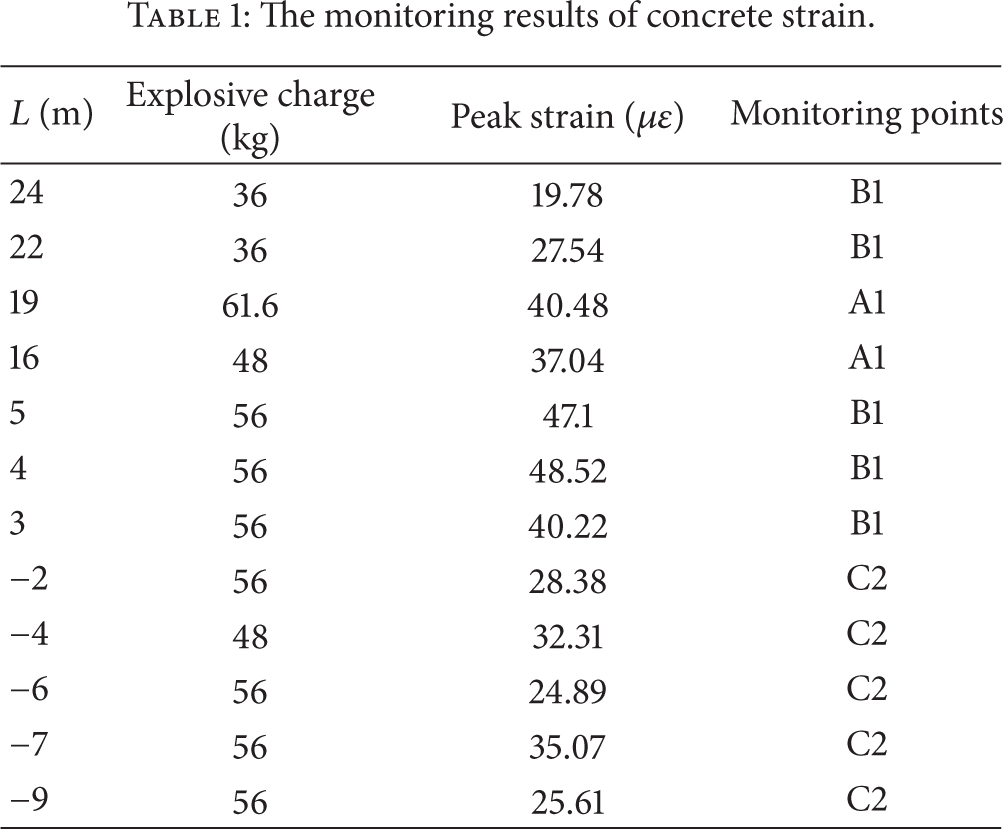
The strain of B1 point (
The monitoring results of concrete strain.

The strain of B1 point (
As the results show that the maximum strain locates in B1 when L is more than 19 m (Figure 6 and Table 1), then the location of maximum strain changes from A1 to B1 and finally appears at the C2 point.
The distribution of concrete strain is different before and after the tunnel crossing. The concrete strain increases gradually from
4.4.2. Analysis of Speed Signal
The monitoring results showed that the PPV in the direction perpendicular to the side wall was far less than the direction parallel to side wall [21–24]. Therefore, this paper only studies the PPV in the direction parallel to side wall (the Y direction). The vibration velocity of B1 point (
The monitoring results of PPV.


The vibration velocity of B1 point (
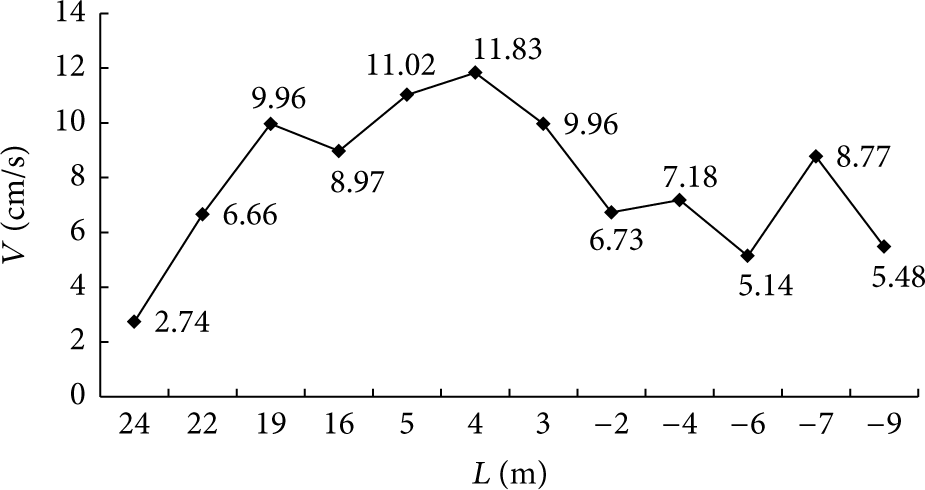
The change laws of PPV versus the distance of two tunnels.
As Figures 7 and 8 show that the distribution law of blasting vibration velocity is different before and after the two tunnels crossing, the PPV was large in front of the excavation face, while it decreased gradually after the two tunnels crossing. It is because that the facing-blasting face of the monitoring points changes into back-blasting face with the excavation of the new tunnel.
Results show that the PPV increases from 2.74 cm/s (
5. Conclusions
A WSN was established to monitor the concrete strain and PPV in an existing tunnel, which included the blasting vibration monitoring system UBOX-5016 and the wireless remote data acquisition system SZYC. This system realized remote monitoring, wireless data transmission, and information management in tunnel construction blasting. The detailed results are as follows. The distribution of concrete strain is different before and after the tunnel crossing. The concrete strain is larger in front of the excavation face. And the strain values are related to explosive charge and distance to blasting face. The maximum concrete strain is The PPV in the facing-blasting face is much larger than that in the back-blasting face and the change of maximum velocity location responds to that of the excavation face. And the PPV is quite large in front of the excavation face as well. The PPV are 11.02 cm/s (
Footnotes
Conflict of Interests
The authors declare that there is no conflict of interests regarding the publication of this paper.
Acknowledgments
This work is partially supported by National Natural Science Foundations of China (Grant nos. 51478044 and 51178052) and the Special Fund for Basic Scientific Research of Central Colleges of Chang'an University (no. CHD2012JC072). The authors also gratefully acknowledge the helpful comments and suggestions of the reviewers, which have improved the presentation.