




Abstract
As everything is integrated with smart IT technologies due to their rapid growth and enhancement, smart IT technologies and environments have been pervading business environments in the way of intelligent environment computing and have been embedded in them. Accordingly, it is expected that the number of information devices used and utilized in industry would be increased significantly. Therefore, intracompany smart IT management becomes more important to efficiently utilize information devices increased rapidly due to introduction of intelligent environment computing. In addition, there is a need of understanding corporate smart IT management levels in the intelligent environment computing to establish information strategies for flexibly responding to internal and external environment factors being varied rapidly by corporate policies. Therefore, this study would like to analyze management levels for smart IT to improve corporate smart IT application capabilities in the intelligent environment computing. In detail, it designed a conceptual system for analyzing smart IT management levels to analyze 282 companies. And it suggested a direction of utilizing smart IT efficiently and properly in the intelligent environment computing through comparative analysis of the smart IT management level cases analyzed by other organizations.
1. Research Background
As enterprise business and smart IT technologies have been converged due to rapid growth and enhancement of smart IT technologies, smart IT technologies have been embedded in corporate environments to be utilized in the way of intelligent devices [1–3]. The intelligent environment computing is an environment creating new values by applying new devices equipped with network functions such as RFID and USN to be embedded into the business in the present environment where PCs are used to do business on the Web or consumer applications and services are used [4, 5]. In other words, it means a world where numerous intelligent devices such as mobile phones, PDAs, set-top boxes, and refrigerators are completely connected with Internet so that companies are connected with customers, partners, products, and employees anytime and anywhere [6–8].
Based on these features, companies are urgently introducing the intelligent environment computing into their industrial sites to be different from their competitors [9, 10]. Accordingly, it is expected that the number of information devices used and utilized in industry would be increased significantly [11, 12]. Recently, the manufacturing industry has introduced pervasive devices for reducing costs by efficient product manufacture enabling rapidly responding to consumer need and demand trend and by reduction of product stock and so forth, as the life cycle of multiple-product tends to be shortened [13, 14].
The smart IT management level means a smart IT support environment level forming the basis for utilizing smart IT, which is mainly composed of smart IT environmental, organizational, and technological factors. In addition, the smart IT utilization level is shown as company's economic finance results and operational ones such as reduction of production-delivery-distribution time and decrease of manpower waste. Therefore, establishing of a strategy to understand the status of smart IT management level, which is the most fundamental to company's sustainable development, and to improve its weak sectors is becoming as an essential requisite.
Therefore, this study would like to analyze company's smart IT management levels in the intelligent environment computing. In detail, we would like to design a model to analyze company's smart IT management levels and to carry out an empirical analysis on the smart IT management level for large companies which could easily perform their smart IT management in proportion to their degrees of smart IT possession.
2. Smart IT Utilization Index
The smart IT utilization index applies a systematic smart IT utilization index evaluation method at the national level to scientifically diagnose and measure company-wide smart IT utilization levels and corporate smart IT utilization levels for each business type and size. Consequently, companies with low smart IT utilization for each business type and size and the areas with insufficient utilization could be identified to establish a smart IT utilization support policy and to promote balanced information development throughout the society. In addition, it could be used as basic data for establishing directions of smart IT utilization related policies and could provide basic data for analyzing effectiveness of smart IT utilization policy implementation and related investment. And guidelines could be provided for promoting the future smart IT utilization policies by diversely drawing various systematic and comprehensive indexes related to smart IT utilization.
The smart IT utilization index understands an objective smart IT utilization level at the company's level and provides companies with the smart IT utilization measurement benchmarking data comparable for each business type and size. Therefore, a current smart IT utilization level of companies could be diagnosed and evaluated objectively to provide a basic data for establishing an information strategy to flexibly respond to internal and external environment factors rapidly changed. It has an effect of supporting to secure continuous competitiveness by comparing and evaluating company's smart IT utilization levels with the same industry or competitors to continuously develop advanced fields and to find insufficiencies to complement.
The integrated evaluation framework for smart IT utilization indexes is composed of seven evaluation areas such as resource, governance, acceptance, leadership, process, performance, and environment. Smart IT resources such as smart IT infrastructure and systems are used properly in the process to produce as a performance. As capabilities of promoting to properly use smart IT resources in the process, it evaluates a governance capability in terms of smart IT supporters assisting actual smart IT utilization and an acceptance capability in terms of smart IT acceptors actually exploiting smart IT. And, of the smart IT acceptor's perspectives, in the management's leadership for smart IT, the management's intent is recently discussed as the most important factor having the biggest effect on the smart IT investment and performance, so it is drawn as an evaluation area and considered as having an effect on the whole resources, capabilities and utilization. The environment has an effect on the whole smart IT resources, capabilities, and performance, so it is separated to the outside. In other words, the smart IT resource is built by the management's smart IT leadership within the company in the smart IT environment being changed, and the smart IT process application level and smart IT performance are determined by the smart IT acceptance and governance capabilities of members within the company under the built smart IT resource.
3. Smart IT Management Level Measurement and Its Result
3.1. Smart IT Management Level Measurement Model
To measure the smart IT management level of domestic companies, this research first analyzed the maturity models of the existing studies and then developed a new questionnaire based on the Gartner model which could be compared internationally in the future and had experience in analyzing smart IT management levels empirically [8].
The conceptual system for analyzing the smart IT management level was classified into four areas such as people (smart IT enterprise and education), technology (smart IT system implementation), process (smart IT system management process), and business management (smart IT investment and performance management) as in Figure 1 and Table 1. And, evaluation items were redeveloped from step 1 to step 5 in accordance with the domestic smart IT management level.
Survey items for the smart IT management.


Conceptual system for analyzing the smart IT management level.
To measure the smart IT management level and assess its maturity in the intelligent environment computing, the development stage was classified into step 1 (awareness), step 2 (committed), step 3 (proactive), step 4 (service aligned), and step 5 (business partnership) based on the precedent studies and experts' conference.
Step 1 (awareness): it is a stage that starts to reflect the smart IT system implementation and operation, in other words awareness that the smart IT management is important for carrying out business, in actual behavior (control). Step 2 (committed): it is a stage that develops the operating actions for smart IT into the managerial environment. Step 3 (proactive): it is a stage that the management for smart IT secures its efficiency and quality through the policy development and standardization process and so forth. Step 4 (service aligned): it is a customer-oriented competitive smart IT management stage that could be provided also as a separate business form. Step 5 (business partnership): it is a reliable smart IT management stage that could increase values and competitiveness of the whole business being carried out by a company.
Based on these conceptual system and evaluation items, an empirical analysis is carried out for a total of 282 domestic large companies including 203 large companies having 1,000 or more regular employees and 79 large companies having less than 1,000 regular employees. And, the overall result of the measured smart IT management level is relatively compared with the result of surveying 118 international member companies by the U.S. Gartner in January, 2011.
3.2. Analysis of the Smart IT Management Level Result
The smart IT management level of the surveyed companies was 2.66 based on the 5-point scale, which was shown as higher than 2.35, the international level. It was analyzed that the overall level of domestic cases was a moderate degree, and more than half were progressed from step 2 (committed) to step 3 (proactive). In comparison, it was analyzed that the international level was an insufficient level less than 2.5, the middle, which was still at an early stage of step 2.
In addition, the levels of people (smart IT enterprise and education), technology (smart IT system implementation), process (smart IT system management process), and business management (smart IT investment and performance management) were investigated as 2.80, 2.69, 2.59, and 2.58, respectively as shown in Table 2, so it was investigated that the people (smart IT enterprise and education) level were relatively higher than other survey areas and the business management (smart IT investment and performance management) level was relatively lower than other survey areas. When comparing this result with the international survey one, it also showed the same trend.
Analysis of the smart IT management level.
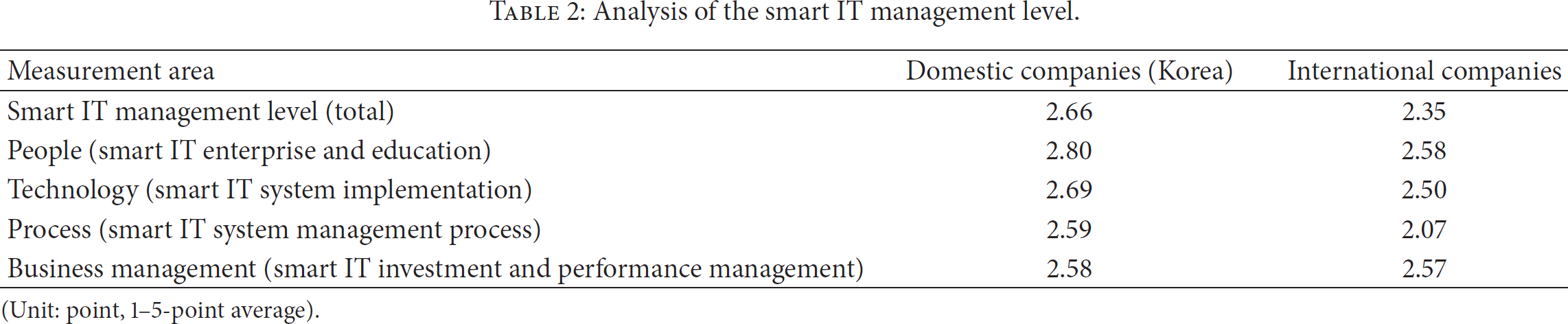
(Unit: point, 1–5-point average).
In detail, domestic companies' process evaluation area level showed a low one below average; however, it was investigated as the most different area when comparing with international companies (
As it was investigated that 57% and 39% of the surveyed companies were placed at steps 1~2 and 3 of the smart IT management, respectively, it was measured that they were placed at the relatively higher state than the international level at which most companies were still placed at step 2 or less. However, it was investigated as a level that yet reached step 3 of carrying out actual company level's smart IT management as shown in Figure 2.

Distribution of companies by the smart IT management level.
4. In-Depth Analysis for Each Smart IT Management Area
4.1. Smart IT Management People Area
It was investigated that the education level required for the smart IT utilization was higher than the level of other items within this area and that the effort level for developing abilities of smart IT personnel to provide user-oriented smart IT services was relatively lower. In detail, it was investigated that the management's compulsory regulations of IT utilization education and whether to carry out it were a little more insufficient than the smart ICT professional manpower and smart IT users (general employees) in the education level area required for the smart IT utilization. In the effort level area for developing abilities of smart IT personnel to provide user-oriented smart IT services, it was investigated that formal procedures for developing abilities of current smart IT personnel were not prepared. In the capability management level area of smart IT companies, it was investigated as a state roughly defined for the smart IT rank and duty; finally, the user department's awareness level for capabilities currently possessed by smart IT companies was that the quality of smart IT department services was slightly poor but it was a department to examine and research excellent cases in the industry for improving its abilities (3.14 point) as shown in Table 3.
Results of measuring the people area's level.
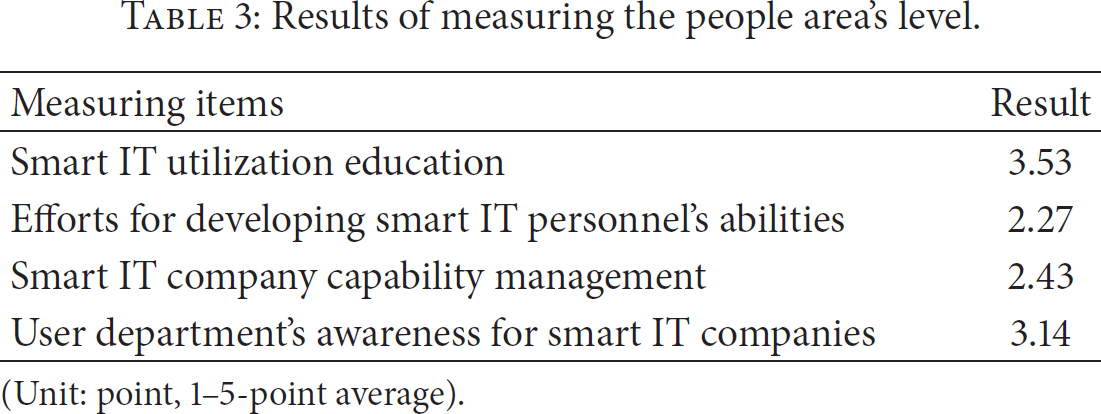
(Unit: point, 1–5-point average).
4.2. Smart IT Management Technology Area
It was investigated that the level of establishing a standard for new purchase, change management, and control of smart IT (hardware and software, etc.) was higher than the level of other items within this area and that the problem recognition and recovery level for smart IT was relatively lower. In detail, in the standard establishment level area for new purchase, change management and control of smart IT, it was investigated that an enterprise standard was established for new purchase, but it was not completely fulfilled, and the standard for change management was only partially established. In the measurement level area for the smart IT utilization, it was investigated that the utilization level was measured for major core smart IT, but the utilization level for the whole smart IT was not realized, and the range of measuring the smart IT utilization was gradually expanded. In the problem recognition and recovery level area for smart IT, it was investigated that only a simple automatic warning system notifying the smart IT problem was implemented, and spare resources (storage, etc.) were possessed for meeting problems frequently occurring. Finally, in the retention level area for smart IT management tools, it was investigated that the monitoring and operating tools (personal computer management level) were implemented for the simple or basic level smart IT status as shown in Table 4.
Results of measuring the technology area's level.

(Unit: point, 1–5-point average).
4.3. Smart IT Management Process Area
It was investigated that the coordination/integration level for smart IT management processes was higher than the level of other items within this area and that the quality measurement level for smart IT management processes was relatively lower. In detail, in the process operation level area for smart IT management, it was investigated that there was no effort for formally defining and documenting smart IT management processes, or the smart IT backup/recovery processes and virus handling processes and so forth got out of the state of substituting for actual smart IT management processes to operate the smart IT customer satisfaction evaluation and the smart IT help desk and so forth, or it was trying to formally document the preventive level of management processes to operate for personal computers and so forth. In the level for the smart IT service process standardization and automation degree, it was investigated that there was no formal/standardized definition for smart IT services but automation tools were used for managing repetitive processes, and in the coordination/integration level area for smart IT management processes, it was investigated that individual smart IT service processes were defined and developed but the integration between processes was still insufficient. Finally, in the measurement level area for the smart IT management process quality, individual smart IT management tools were used to measure performance without formal measurement methods as shown in Table 5.
Results of measuring the process area's level.

(Unit: point, 1–5-point average).
4.4. Smart IT Management Business Management Area
It was investigated that the level of complying with regulations for smart IT management/use was higher than the level of other items within this area and that the smart IT performance index management level was relatively lower. In the smart IT strategic plan establishment level area, it was investigated that a short-term plan within the next 1~2 years was established, and in the smart IT budget and investment design level area, it was investigated that the planning was gradually progressed from establishing only rough higher expenditure items divided into operation and capital expenses and so forth. To establish a detailed-level plan, the level of complying with regulations for smart IT management/use was that the smart IT management system was temporary and the related regulation was partially observed only by the working group, but the regulation was also becoming a standard for major business departments as the smart IT management system was gradually formalized. The smart IT purchase (procurement, supplier/product selection) operation level area was that the smart IT resource procurement or supplier/product selection was carried out for each project, external services were carried out only when absolutely necessary, and only the smart IT project managers played a leading role of managing smart IT programs. Finally, the smart IT performance index management level area was that only the technological index (performance) in the smart IT department was measured, evaluated, and tracked as shown in Table 6.
Results of measuring the business management area's level.
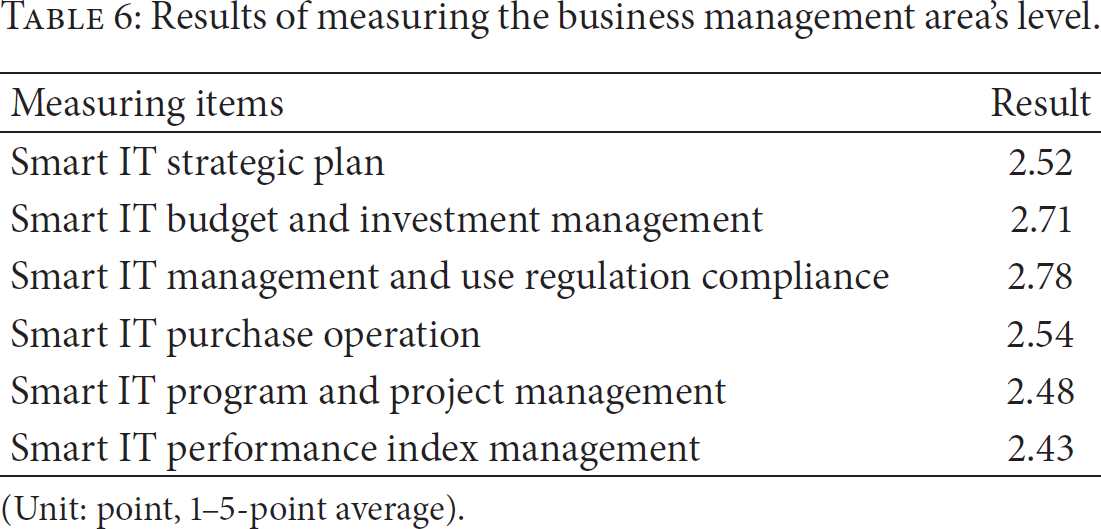
(Unit: point, 1–5-point average).
5. Conclusion and Future Studies
As everything is integrated with smart IT technologies due to their rapid growth and enhancement, smart IT technologies and environments have been pervading business environments in the way of intelligent environment computing and have been embedded in them.
The intelligent environment computing is recognized as a universal tool for improving efficiency of enterprise management and business processes and for creating new business opportunities and values. There are increasingly large number of cases of using the intelligent environment computing for improving efficiency, effectiveness, and accuracy of corporate management activities by using electronic networks and information technologies for purchase-manufacture-distribution-sales services which are companies' business processes based on this recognition. In such an intelligent environment computing, companies' performance improvement by enhancing the smart IT utilization capability is influenced by the smart IT management level which is the most important basis.
Therefore, this study empirically analyzed the management level on smart IT for improving the smart IT utilization capability by companies. In detail, it measured the smart IT management level for 282 large companies. And, it carried out comparison with the internationally comparable smart IT management level analysis cases. As a result, the findings are as follows.
The companies' smart IT management level was 2.66 based on the 5-point scale, which was shown as higher than 2.35, the international level, and in detail, it was analyzed that the smart IT investment and performance management level should be improved for enhancing domestic companies' smart IT management level. In the people evaluation area, it was investigated that the smart IT utilization education capability was high, but the smart IT personnel's effort for developing their abilities was insufficient. In the technology evaluation area, it was investigated that the level of smart IT management control methods was good, but the level of recognizing problems for smart IT was insufficient. In the process evaluation area, it was investigated that there was no formal/standardized definition for smart IT services but automation tools were used for managing repetitive processes, and in the coordination/integration level area for smart IT management processes, it was investigated that individual smart IT service processes were defined and developed but integration between processes was still insufficient. Finally, in the business management evaluation area, it was analyzed that the level of complying with regulations for smart IT management/use was that the smart IT management system was temporary and the related regulation was partially observed only by the working group, but the regulation was also becoming a standard for major business departments as the smart IT management system was gradually formalized.
It is expected that this analysis result could lead to providing areas where companies should place greater emphasis for improving business performance through the smart IT management in the intelligent environment computing and their effective information-oriented promotion methods.
Footnotes
Conflict of Interests
The authors declare that there is no conflict of interests regarding the publication of this paper.
Acknowledgments
This research was supported by the MSIP (Ministry of Science, ICT and Future Planning), Korea, under the ITRC (Information Technology Research Center) support program (NIPA-2014-H0301-14-1023) supervised by the NIPA (National IT Industry Promotion Agency). This research was supported by the Technology Commercialization Support Program, Ministry of Agriculture, Food and Rural Affairs.