




Abstract
This paper reports the design of a randomly deployed heterogeneous wireless sensor network (HWSN) with two types of nodes: a powerful node and an ordinary node. Powerful nodes, such as Cluster Heads (CHs), communicate directly to the data sink of the network, and ordinary nodes sense the desired information and transmit the processed data to powerful nodes. The heterogeneity of HWSNs improves the networks lifetime and coverage. This paper focuses on the design of a random network among HWSNs. In the design of a random HWSN, this paper uses algorithms based on the binary-valued versions of swarm intelligence, such as Particle Swarm Optimization (PSO), Artificial Bee Colony (ABC), and Ant Colony Optimization (ACO). The design is then considered to be an optimization problem of how many powerful and ordinary nodes will combine to minimize the network cost, while guaranteeing a desired coverage during a given period. Simulation results show the performance of each algorithm for solving the defined optimization problem.
1. Introduction
A heterogeneous wireless sensor network (HWSN) consists of more than two types of devices (or sensor nodes) to improve the network's lifetime, coverage, and scalability. The HWSNs lifetime can be effectively prolonged [1], especially for cases when powerful nodes that play a role as Cluster Heads (CHs) exist in a relatively large HWSN.
This paper focuses on the effective design of WSNs constructed by randomly deploying sensors, thus solving the optimization problem of how many powerful and ordinary nodes will combine to minimize the network cost while guaranteeing a desired coverage during a given period. Almost all of the sensors used in randomly deployed WSNs are constrained by their energy use because they have an embedded battery. Therefore, in studies on randomly deployed WSNs, the issue of how to effectively establish and efficiently manage the WSNs is very important and has been actively studied [2–13]. In particular, the researches of approaching this problem with metaheuristics have increased in recent years [2, 3, 5–14].
In previous research [4], the authors had simplified this design problem by assuming that only ordinary nodes sense the area to solve the problem through the mathematical analysis. Our previous paper [7] designed the HWSN with nodes and CHs that are able to sense information by defining the constrained integer optimization problem, converting it to the unconstrained problem and solving this problem using the discrete binary version of the PSO algorithm known as the Discrete PSO (DPSO) algorithm [15]. In this study, we solve this optimization problem with more realistic and efficient approaches at the expense of an increase in complexity by applying other metaheuristic methods based on swarm intelligence, such as binary Artificial Bee Colony (binABC) [16] and binary Ant Colony Optimization (
The remainder of this paper is organized as follows. In Section 2, we define the sensor system model and provide its coverage analysis. This section also defines the integer optimization problem with some constraints for the design of HWSN and briefly introduces Deb's method that converts a constrained optimization problem to an unconstrained one and converts the defined problem to the unconstrained integer optimization as in [7]. In Section 3, the binary-valued optimization algorithms based on swarm intelligence are introduced. In Section 4, we show the comparative results between algorithms obtained from the simulation, designing several HWSNs. We then conclude this paper in Section 5.
2. Randomly Deployed Heterogeneous WSN Design
2.1. System Model
The proposed heterogeneous wireless sensor network (HWSN) is constructed by uniformly and randomly deploying M powerful nodes (hereafter CHs) and N ordinary nodes (hereafter nodes) over a large area

For nodes and CHs, we assume that nodes have an initial energy of
One objective of this paper is to find proper M and N so that any arbitrary point in area
2.2. Coverage Analysis
Like in [4], we first find an initial coverage in terms of the number of nodes in a HWSN deployed randomly over the area from coverage theory [18]. Then, we transform the survival and lifetime of nodes during
We will consider two cases: in the first case, only nodes sense the area; and in the second case, CHs also sense the area. The latter case is more realistic and effective than the former. Finally, with these results, we establish the network design in Section 2.3 as an integer program to minimize the network cost while keeping the desired network coverage over a desired period.
2.2.1. Case Sensed by Only Nodes
For the first case above, from the results of coverage process theory [18], the mean and variance of the probability
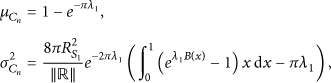


To determine the final coverage

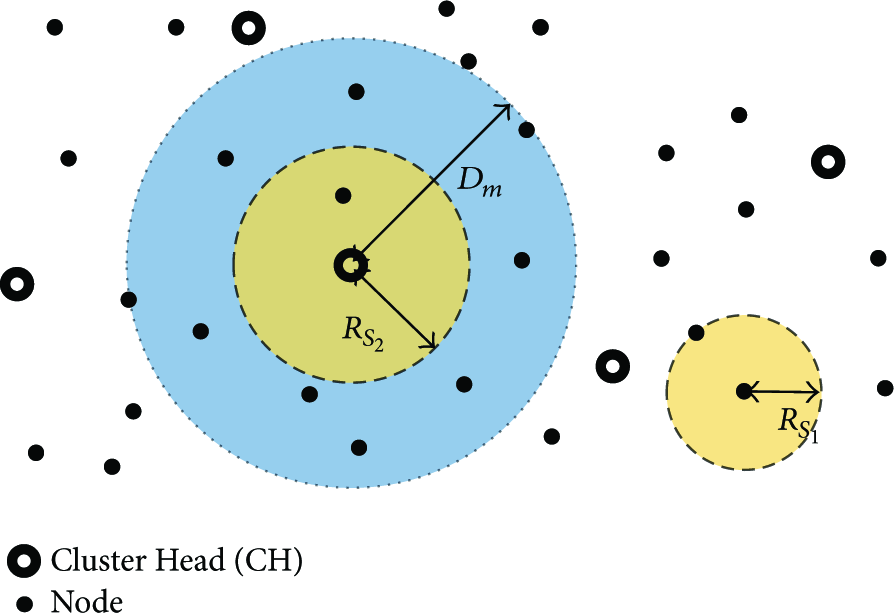
Example of HWSN deployed randomly over an area.
Thus, if a node has no CH closer than

The boundary effect is negligible because the sensing range of a node is much smaller than

2.2.2. Case Sensed by CHs and Nodes
In the more practical case where CHs also sense the area, we can determine the probability of covering an arbitrary point by CHs in a similar fashion to the first case as follows:


We can assume


2.3. Heterogeneous WSN Design
This section provides a nonlinear integer optimization problem derived from the above coverage analysis with which we can predict the final network coverage with known parameters as a method to design a randomly deployed HWSN.
In previous research [4], the authors had simplified this design problem by assuming that only nodes sense the area to solve it through the mathematical analysis. This paper, however, is going to solve this optimization problem with more realistic approaches at the expense of increased complexity by applying optimization algorithms based on swarm intelligence. As in our previous work [7], we also consider the second case above because the case where CHs with rich energy resources also sense the area is efficient and effective in practical use.
We formulate the optimization problem to minimize the implementation cost while keeping at least guaranteed coverage


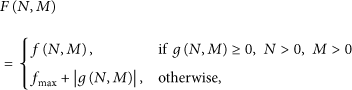
As in [7], we can apply the binPSO algorithm to the above problem by first converting this constrained optimization problem into an unconstrained problem using the method of handling constraints. There are many methods for accomplishing this task: the penalty function method, the Lagrange multiplier method, the gradient projection method, and so forth. However, these methods are unfavorable because they require proper values for their control parameters to achieve satisfactory performance. So, like in [7], we apply Deb's method [20] based on the penalty function approach, which does not require any penalty parameter. The details about this method can be found in [20].
By Deb's method, the former problem is converted as follows:
3. Binary Optimization Algorithms Based on Swarm Intelligence
As defined in Section 2.3, the HWSN design becomes an integer optimization problem with an integer-valued solution. To solve this problem, we use several optimization algorithms based on swarm intelligence, such as PSO, ABC, and ACO, because the more practical problem is more difficult to solve via mathematical analysis. However, the original forms of these algorithms are ill-suited to the integer optimization problem because these algorithms were first proposed to solve continuous-valued problems (by PSO [21] or ABC [22]) or combinatorial problems (by ACO [23]). Hence, we use the binary versions of each algorithm, that is, binPSO [15], binABC [16], and
3.1. Binary Particle Swarm Optimization (binPSO) Algorithm
The Particle Swarm Optimization (PSO) algorithm is an optimization algorithm inspired by the movement of schools of fish and flocks of birds. In the PSO algorithm, a particle's position is a candidate solution for the given optimization problem and the particles, or swarm, are iteratively moved in the search space of an optimization problem according to information about each particle's previous best position,
Most variants based on the first PSO [21] have operated with continuous values in continuous search space, where the particles’ trajectories are determined by changes in position across some number of dimensions of the problem. In the binary version of the PSO algorithm (i.e., binPSO [15]), trajectories are defined as changes with the probability of whether the particle's coordinate will take on a zero or one value. In the binPSO, although the velocity


3.2. Binary Artificial Bee Colony (binABC) Algorithm
The Artificial Bee Colony (ABC) algorithm is a population-based and stochastic optimization algorithm inspired by the intelligent foraging behavior of honeybees. In the ABC algorithm, artificial bees search for rich artificial food sources, that is, good solutions for a given optimization problem. The artificial bee colony consists of three groups of bees: employed bees associated with specific food sources that exploit their food sources, onlooker bees that watch the dance of employed bees within the hive to select a food source and help the employed bees find richer food sources, and scout bees that search food sources randomly. Likewise, their cooperative and iterative behaviors find the optimal solution to a given problem.
Most of the variants based on the original ABC [22] operate with continuous values in the continuous search space like the PSO. In contrast, the binary ABC algorithm (binABC [16]) finds a binary-valued solution in the binary-valued search space. The binABC borrows concepts from the binPSO. As mentioned above, in the binPSO, each component of the velocity vector,


3.3. Binary Ant Colony Optimization (binACO
) Algorithm
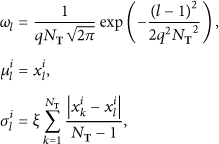
The Ant Colony Optimization (ACO) algorithm is a metaheuristic based on the foraging behavior of real ants. While moving, real ants that find food deposit pheromones on the way to their nests. The other ants then follow these deposited pheromones. Although pheromones evaporate as time passes, they open up new possibilities as ants can choose to follow a path heavily laden with pheromones. In this way, ants can search for the shortest path from their nest to a food source with only pheromone information. In ACO algorithm, a set of virtual ants searches for optimal solutions to a given optimization problem in the search space.
The first ACO algorithm [23] was proposed to solve a Traveling Salesman Problem (TSP) that is a representative combinatorial problem of finding the shortest path that traverses all cities exactly once and then returns to the starting city. Since then, the ACO for continuous domains, called
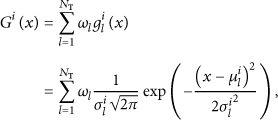

4. Simulation Results and Discussions
In this section, we solve several HWSN design problems with the second sensing condition from Section 2.2.2 using the above three binary optimization algorithms and compare their performances. The simulation was implemented in MATLAB on a PC running Windows 8.1, with an Intel Core i3 CPU 540 operating at 3.07 GHz and 4 GB of RAM. The parameters used for each algorithm are shown in Table 1. The termination criterion of all algorithms in all of the scenarios is reaching the maximum number of the evaluation,
Parameter setting for each algorithm in the simulation.

Parameter setting for the environment and the desired HWSN in each scenario: least guaranteed coverage (
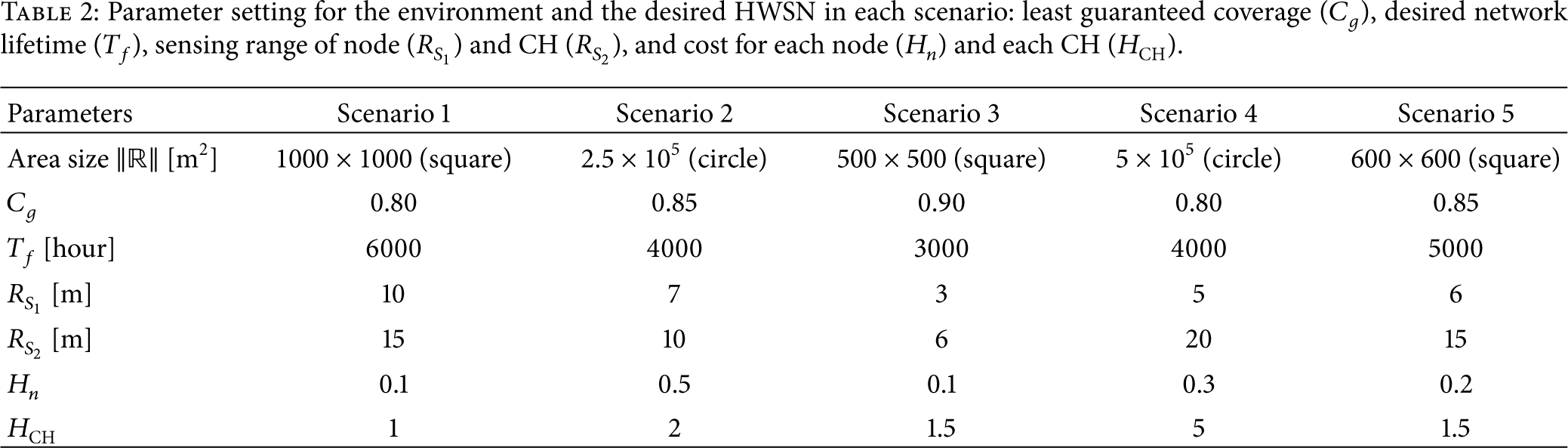
Table 3 shows the statistical results of the simulations with CH and node sensing in five different environments, and Figure 2 is the boxplot of three algorithms for each scenario. In all scenarios, the binPSO algorithm shows the best performance among the three binary optimization algorithms. The binPSO obtains near-optimal solutions with similar costs in all scenarios. As a statistical significance test, the two-sample t-test was conducted between the binPSO and the others. The significance sign “(+)” in the table means that the binPSO is significantly better, the sign “(~)” means no significant difference, and the sign “(—)” means significantly worse. The results of the t-test also showed that the binPSO is significantly better than the other algorithms. The
Simulation results with sensing of CHs and nodes in five different environments: the listed values are the statistics of the costs of five scenarios for each algorithm for the 30 runs. Q1 and Q3 are the 25th and 75th percentiles, respectively. For median and mean values, the numbers in square brackets indicate the rankings of the three algorithms. The p values are the results of the two-sample t-test between the binPSO which has the best performance among three algorithms and the others for each scenario. The significance sign “(+)” means that the binPSO is significantly better, the sign “(~)” means no significant difference, and the sign “(—)” means significantly worse.

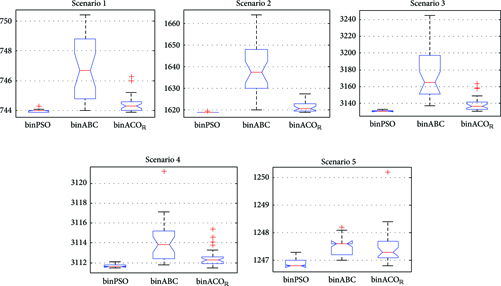
Boxplot of three algorithms for each scenario.
5. Conclusions
In this paper, we designed a heterogeneous wireless sensor network (HWSN) with nodes and CHs that are all able to sense information. We accomplished this by defining the constrained integer optimization problem, converting it to the unconstrained problem and solving this problem using the binary optimization algorithms based on swarm intelligence, namely, binPSO, binABC, and
Footnotes
Conflict of Interests
The authors declare that there is no conflict of interests regarding the publication of this paper.
Acknowledgment
This research was supported by Basic Science Research Program through the National Research Foundation of Korea (NRF) funded by the Ministry of Science, ICT, and Future Planning (Grant no. 2010-0023035).