




Abstract
Cloud data centers are facing increasingly virtual machine (VM) placement problems, such as high energy consumption, imbalanced utilization of multidimension resource, and high resource wastage rate. In order to solve the virtual machine placement problems in large scale, three algorithms are proposed. Firstly, we propose a physical machine (PM) classification algorithm by analyzing pseudotime complexity and find out an important factor (the number of physical hosts) that affects the efficiency, which improves running efficiency through reduction number of physical hosts; secondly, we present a VM placement optimization model using multitarget heuristic algorithm and figure out the positive and negative vectors of three goals using matrix transformation so as to provide the mapping of VMs to hosts by comparing distance with positive and negative vectors such that the energy consumption is saved, resources wastage of occupied PM is lowered, multidimension resource utilization is optimized, and the running time is shortened. Finally, we consider the poor placement efficiency problem of large-scale virtual serial requests and design a concurrent VM classification algorithm using the K-means method. Simulation experiments validate the performance of the algorithm in four aspects, including placement efficiency, resources utilization balance rate, wastage rate, and energy consumption.
1. Introduction
Cloud data center is a new development trend of Internet data center [1] that is a combination of data center and cloud computing. Cloud data centers provide varieties for on-demand computing services consisting of three service models including software as a service (SaaS), platform as a service (PaaS), and infrastructure as a service (IaaS) [2] for users, which is called data center revolution. Currently, data centers benefit a lot from virtualization technology and it has become one of the core technologies of the cloud data center. However, the placement problems of VMs on PMs have always been a huge challenge at the cloud data center.
VM placement problems [1, 3] in cloud data center are a physical resources mapping process of VMs to PMs according to the reasonable allocation rules. The whole processing services are facing many decision objectives and other constraints, which is a complex combinatorial optimization placement problem and it has no optimal mathematical solution in theory. Heuristic algorithm or approximate algorithm is commonly regarded as the useful choice to solve the VM placement. In recent years, a great number of works have been devoted by many scholars to optimize the VM placement algorithm and they have made some great achievements. However, the management of cloud data center is still facing many problems, such as the VM placement efficiency, energy consumption of data center, the balance of the multidimension resources of the physical machine hosts, and the efficiency of serial placement under large-scale virtual requests.
Most traditional VM placement algorithms only consider a single target such as physical host resource utilization or energy consumption, while the motivation of this paper is to put forward new heuristic algorithms for improving the VMs placement efficiency, enhancing virtual machine placement performance, increasing the balance rate of dimension physical resources, and reducing the resource wastage rate of physical host under heterogeneous cloud data center environment. For considering the physical hosts resource utilization, we hope to improve the equilibrium degree of multidimensional resources and reduce resource waste rate of physical host. For considering energy consumption, we need to select the physical hosts which have low energy consumption but strong computing capacity, thus accelerating placement time.
The main contributions can be summarized as follows: (1) we propose an ISPMC (iterative self-organizing physical machine classification) based on ISODATA (iterative self-organizing data analysis techniques algorithm) [4] which improves VM placement efficiency of large Internet data center using the idea of reduction dimensionality. The physical servers can be divided into K classes by ISPMC algorithm according to the number of the PM's CPU and memory, which ensures that the similar physical machines will be divided into similar class. The algorithm improves the virtual machine placement efficiency and reduces the PMs' scanning number by actual mapping of virtual machine requests to available physical machines. (2) We design a multitarget heuristic decision algorithm: MTAD (multitarget approach decision). The algorithm considers multiple objectives at the same time and uses approximate approach to calculate the positive and negative ideal vectors of three objectives. The MTAD realizes the optimal placement of VM by comparing realistic and positive and negative ideal solution approach degree. (3) We propose a k-means algorithm for balancing resource rate, which is called RBRC (resource balance rate classification) for considering the problem of the large-scale VM serial placement efficiency. RBRC algorithm sorts all virtual machine requests to queue in nonincreasing order in terms of resource balanced degree and divided the virtual machine requests into k classes according to the request number and balancing degree to improve the placement efficiency. In addition, if the different dimensions VM resources have a better balance degree, the mapping workload will be a balance status, such that improving the PMs' utilization rate.
The rest of this paper is organized as follows. Section 2 presents related work of the VM placement problem. Section 3 presents VM placement model; in Section 4, we propose three algorithms for optimizing VM placement: SPMC, MTAD, and RBRC, and Section 5 evaluates the performance of the algorithm. Finally, Section 6 summarizes the work and looks forward to the next work.
2. Related Work
Currently, the majority of existing VM placement algorithms in cloud data center can be divided into two categories according to the placement algorithm in terms of server object: (1) the placement algorithm based on the server-side level. It works by using a variety of advanced technologies to improve the power consumption or performance. (2) The placement algorithms based on cluster level mainly consider the global optimization and coordination of the VM placement aiming at using various strategies or theories to reduce the energy consumption and improve performance. For goals, the existing virtual machine placement algorithm can be allocated into two categories: (1) a virtual machine placement algorithm based on energy consumption and emissions reduction which aims to save energy and reduce CO2 emissions so as to achieve “green” cloud data center. The placement algorithms mainly concentrated on server level, such as dynamic voltage FM technology DVFS and new cooling technique. (2) The second category is a virtual machine placement algorithm based on resource utilization; the purpose is to maximize the physical resource utilization for ensuring application of quality of service (QoS) and meeting the needs of application service-level constraints. We focus on the cluster level on the VM placement algorithm. The current common VM placement algorithms include bin packing stochastic [5], integer programming [6], constraint programming [7, 8], random greedy algorithm [9], simulated annealing [10], genetic algorithm [11, 12], and ant colony optimization algorithm. At present, most of these algorithms are trying to solve the imbalanced use of multidimension resources utilization problem, high energy consumption problem, hyperbole resources wastage problem, and other issues.
The resource utilization rate of PM's different dimensions refers to the imbalanced utilization between different dimensions resources (CPU and memory) in the process of virtual machine placement. Sun et al. [14] build up a two-objective optimization model and propose a virtual machine placement algorithm based on matrix transformation. Two-objective optimization model takes the balance of different dimensions in minimizing number of physical machines and resource utilization into consideration. The two-objective optimization model firstly sets up corresponding virtual machine requests queue matrix, cluster matrix, and the corresponding initialization placement matrix by considering virtual machine placement algorithm based on matrix transformation and then looks for the best result meeting the two goals by the corresponding matrix transformation. We reduce the dimension of physical machine resources by using the concept of vector distance. However, the model does not take the heterogeneous of physical servers into account and complexity of solving balancing rate based on vector distance. Wang et al. [15] put forward a multiobjective genetic evolution VM placement algorithm. Firstly, the algorithm constructs the model by considering multiobjective such as balancing utilization rate of PM's different dimensions or maximizing resource usage and then considers the average inequality and position constraint conditions to solve the virtual machine placement problem using the genetic evolutionary algorithm by way of heuristic iterative mutation virtualized allocation. However, the resource usage algorithm is poor and has low time efficiency with a large number of VM requests. In [16], Lu et al. propose a two-stage virtual machine consolidation placement algorithm. In the first stage, they use a polynomial approximate load balance scheme PTAS and adjust the different VM placement and then migration and integration to maximize the maximum resource utilization. In the second stage, they balance the load differences of physical servers using queuing model and reduce the imbalance of different dimensions resources. The two-stage algorithm is the objective process of virtual machine migration and integration, but the adjustment of dynamic resource takes a long time and has poor flexibility.
Energy saving [3, 17] is another main developing direction of VM placement algorithm. Shi et al. [18] put forward a kind of vector packing algorithm; PMs can be seen as a box and VMs can be seen as items into box, using the greedy thought to allocate virtual machine placement with the minimum possible physical machine and shut down the other unused physical machine so as to reduce the number of physical machines used to achieve the purpose of saving energy. However, the algorithm does not take heterogeneous physical servers constraints, and greedy placement methods cannot achieve the optimal global solution. In [19], Wu et al. firstly attempt to solve the VM placement problem by using the simulated annealing to achieve the energy saving. On this basis, Dhingra and Paul [20] use optimized simulated annealing for VM placement process, looking for energy consumption by random iteration better physical host servers. It ensures virtual machine's SLA server degree, increases the resources utilization, and reduces the energy consumption. Tang and Pan [13] propose a virtual machine placement algorithm based on genetic algorithm. Such algorithms consider the energy consumption of data center's physical host and the energy consumption of network communication by generating a random initial population and then use multiple gene mutations to look for minimum energy consumption of physical hosts and network communication. However, the algorithm just considers one network structure and has high computational complexity and low allocating efficiency. In [21], Song et al. propose a large-scale convex optimization algorithm for virtual machine placement. The algorithm improves the virtual machine placement by using the theory of convex optimization to convert the VM placement problem into multiobjective optimization problems according to the actual data center network architecture.
Currently, most optimization virtual machine placement algorithms are converting multiple allocation objectives into several single-objectives and rarely simultaneously optimize multiple targets. Therefore, most of them just obtain a local solution rather than the global optimization solution.
3. Virtual Machine Placement Model
3.1. Notation Used in Virtual Machine Placement
Before giving the multitarget approximating virtual machine placement model, some notations used in subsequent section are listed in Notations section.
Notations used in virtual machine placement are shown in Notations section.
3.2. A Multiobjective Approximating Virtual Machine Placement Model
The VM placement process in multiobjective approach way is as follows. According to the multitarget decision-making (wastage rate, balance rate, energy consumption, etc.), a series of multidimensions (CPU, memory, etc.) of random VM requests conduct periodic optimization of the decision-making process to determine the physical placement programs. Multiobjective approximating virtual machine placement model considers the following objectives:
improve placement algorithm efficiency; balance physical servers load, reduce wastage rate of cluster resources, and improve resource utilization; optimize resource balance rate on different dimensions; reduce the number of high-consumption physical machines used and improve energy-efficiency and scalability of data centers.
3.2.1. Improve Placement Algorithm Efficiency
Optimal placement algorithm efficiency and reducing placement time. VM placement is NP-hard problem, which cannot be solved in polynomial time but in a pseudopolynomial time.
Theorem 1.
Pseudopolynomial time of virtual machine placement problem is
Assumptions 1.
We have the following The set of virtual machines request is
The set of physical host servers is
The objective function set of virtual machines placement is


Proof.
The time complexities of virtual machine placement problem can be expressed as follows.
Firstly, scan the virtual machine requests i,
Let
So, the maximum time complexity of virtual machine is allocated as follows:
According to Theorem 1, we can solve the objective function itself from the beginning and reduce the used number of physical servers to improve the VM placement algorithm efficiency.
3.2.2. Balance Physical Servers Load, Reduce Wastage Rate of Cluster Resources, and Improve Resource Utilization
Wastage rate

Reduce wastage rate of cluster resources; on one hand, we need to improve resource utilization of single physical machines; on the other hand, we need to strengthen the resource balance rate on different dimensions of physical servers. Optimized cluster resource wastage rate can be expressed as

3.2.3. Optimize Resource Utilization Rate on Different Dimensions
Considering multidimensional PM's resources (CPU, memory, storage, etc.), resource utilization rate on different dimensions should be taken into account with placement virtual machines, ensuring similarity load among multidimensional resources, to maximize improving resource utilization of physical servers. Resource placement balancing comparison is shown in Figure 1.

PM multidimensional resource balance.
As Figure 1(a) shows, PM's CPU utilization has been up to 90%, with only 22% of memory utilization. The virtual machine requests include (CPU and memory) resources due to full capacity utilization of the PM's CPU which cause PM not to carry more virtual machines, and 68% of the memory resources are idle wasted. Figure 1(b) shows that CPU and memory resources are up to 90% utilization; all dimensions resources have a balanced utilization, and PM's different dimensions reached the best benefit. As time goes by, the virtual machines demise; CPU and memory utilization can maintain a good balance, which ensures the full use of different dimensions resources and maximizes PM resource utilization. However, due to the randomness of the virtual machines requests and randomness of the demand for resources in each dimension, which could not ensure accuracy balancing of different dimension resources. Therefore, the more the balanced utilization of each dimension resources is, the more PM's resources are fully used.
In order to ensure balance utilization of PM's different dimensions resources, the physical server must try to host a similar virtual machine request with their remaining resources, so we use vector angle to measure the similarity between virtual machines and physical server. Without considering the physical storage attributes, we handle virtual machine requests as a two-dimensional vector
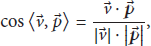


Therefore, in order to optimize resource balance rate of physical machines, we need to minimize the vector angle between virtual machines and physical machines; objectives are as follows:

3.2.4. Saving the Energy Efficiency
Physical hosts in cloud data center present heterogeneous structure, usually composed by a variety of different structures physical hosts. If we only reduce the PM usage number for saving energy consumption, usually it is inefficient because small amounts of high-performance energy PMs may cause far greater energy consumption than multiple low-power physical hosts. Therefore, multiobjective approach model of this paper for energy saving includes two aspects as follows.
(1) Reducing the Number of High Energy Physics Hosts. In virtual machine placement process, the multitarget approach models will choose smaller power consumption physical host among the physical hosts that meet virtual machine request. Placement principles are as follows: as far as possible to assign virtual machines to physical host that already carried other virtual machines to achieve multiple virtual machines sharing physical host; when a new physical host is needed to open, try to select the low power consumption physical host. Therefore, energy savings objective function can be defined as follows:

(2) Extend the Physical Host Opening and Closing Cycle. Due to the randomness of the virtual machine requests and randomness of life cycle, the frequent switching physical hosts will inevitably lead to additional energy consumption and cause long switching machine cycle, seriously affecting the placement efficiency and performance of virtual machines. Therefore, the hosts need a certain degree of extending the switching cycles. The model proposes a solution by using a fixed waiting period. We the expert database to determine the physical host's closing period T as a fixed waiting time so as to avoid frequent switching the servers. During the wait period, the physical host is idle, waiting for the arrival and placement of virtual requests.
3.2.5. The Objective Function
Therefore, the objective function of multiobjective approach virtual machine placement model is as follows:

4. A Multitarget Heuristic Algorithm for Virtual Machine Placement: MTAD
4.1. Physical Host Classification Algorithm (ISPMC)
The VM placement problem in cloud data center is NP-hard problem; it cannot be solved in polynomial time. From Theorem 1, we know that pseudopolynomial time of virtual machine placement problem is
The main function of ISPMC classification algorithm is to classify the heterogeneous PM hosts according to the cluster resource types. So divide the large number of physical hosts into K set that have similar structure. When the virtual machine is allocated, we use a single physical set as target groups so as to reduce the number of placement algorithm for computing the physical host n and accelerate virtual machine requests placement rate.
Due to the heterogeneous characteristics of the cloud data center physical host, the classification parameters of physical host will be determined by actual number of physical machines Type U and other information, and dynamically construct parameters expert database that managed by the system maintenance people. Also, the number of classification U in expert library has great subjective and arbitrary, which may cause to lower actual classification performance. Therefore, we propose a physical host classification algorithm ISPMC based on the ISODATA clustering algorithm. Compared with ISODATA, ISPMC algorithm focuses on the following optimization.
(1) To achieve PM classification, we use the number of physical host CPU and memory as clustering properties and calculate coordinates in ISPMC algorithm. The amount of memory is enormous magnitude units which need to be reduced correspond, we can divided it by 512 as a clustering criterion.
(2) Compared to the ISODATA algorithm, ISPMC algorithm reduces the input initial parameters according to the actual situation of physical hosts. The reducing initial parameters are as the following: (1) initialize the cluster center. Because the ISPMC algorithm parameters expert database has already stored species quantity U of physical host, ISPMC algorithm can randomly obtain different types hosts to composite initialize cluster centers. (2) Reduce the complexity of the sample standard deviation calculation according to threshold
(3) Adjust the splitting standard of ISODATA. When the number of clusters is two times larger than the predicted number of U, ISODATA algorithm will not conduct data division; for PM classification, the actual classification of the data should not exceed two times the predicted number. SPMC algorithm adjusts the splitting of the original ISODATA algorithm standard
(4) ISPMC algorithm improves the classification time by abandoning standard deviation calculation for all clusters between samples and classification standards, greatly reduces the classification of computing time, and improves the classification efficiency.
Table 1 shows the initial parameters of ISPMC algorithm which includes four stages, through repeatedly self-organization iteration to achieve physical host classification.
ISPMC placement algorithm parameters.

Pseudocode for ISPMC algorithm is shown in Algorithm 1.
(1) Read expert parameter database, get pre-classification number U. (2) The set of physical hosts For Iterations I do (1) According to the Euclidean distance to get the nearest neighbor clustering, calculate the cluster domain- related information, the cluster center and the average distance between the category and the global average distance For Initial cluster do IF jump out of loop. ELSE IF ELSE IF iterations are even times or then merge, jump out of loop. ELSE IF iterations reach then End IF End For End For
Stage 1: Initialize the Environment and Calculate Clustering Information.
Step 1. Initialize the physical environment, read expert parameter database to obtain preclassification number U, input physical host set
Step 2. According to the Euclidean distance of initial cluster centers, classify the physical host.
Step 3. According to (12), correct each cluster domain center 


Stage 2: Splitting Determination and Merging Operations.
Step 4. Cluster splitting determination, merger and iteration.
If the number of iterations has been reached i times: the last iteration, then If the host number in cluster If If the number is an even number of times of the iteration or If it is the last iteration, the algorithm ends; otherwise, if it is changing the input parameters, go to Step 1; if not, go to Step 2.
Stage 3: Cluster Splitting.
Step 5. Judge whether the cluster meets one of the following two conditions.
If this is true, split
Stage 4: Cluster Merging.
Step 6. According to formula (15), calculate the distance of all cluster centers as follows:


Step 7. Compare
Step 8. According to formula (16), merge the two cluster centers
4.2. A Multitarget Heuristic Algorithm for Virtual Machine Placement: MTAD
In Section 3, we present a multitarget heuristic virtual machine placement model; MTAD algorithm includes three objectives: resource wastage rate, different dimension resource utilization rate of physical hosts, and reducing the energy consumption, using approximate approximation method to sort all solutions, select the fit highest multiattribute physical host as the mapping entity, and complete the virtual machine placement. The basic idea of MTAD algorithm is based on the resources of the virtual machine requests; select hosts which meet the conditions of physical host and solve the three dimensions targets by forming a raw data matrix. According to the different sizes of three targets data, normalize the original matrix to get a normalized matrix and work out the best and worst schemes that have the maximum positive closeness and minimum negative closeness.
Pseudocode for MTAD algorithm is shown in Algorithm 2.
(2) Input the physical host set For virtual machine requests set do (1) According to the virtual machine requests, select the proper physical hosts (2) Form the original decision matrix according to the three properties of the target (3) Normalize the original decision matrix to form a matrix of normalized (4) According to the attributes weights to form the judgment matrix. (5) Looking for the positive and negative ideal solution of multi-attribute (6) Calculate closeness between attributes and ideal solution to determine the final placement End For
The basic steps of MTAD algorithm are as follows.
Step 1. Traverse the virtual machine placement request queue
Step 2. Select the physical hosts set
Step 3. According to the three decision attributes of multitarget approach model, for physical hosts set 
Step 4. Because the attribute values may have different units, the original decision matrix needs to be normalized according to formula (19); form a normalized matrix 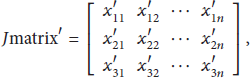

Step 5. Form a weighted judgment matrix Z according to the target attributes weights as

Step 6. Get the positive ideal solution and negative ideal solution which are used for evaluating targets according to the weighted comparison matrix Z as follows:
positive ideal solution:
negative ideal solution:


Step 7. Calculate the Euclidean distance between the ideal solution values of positive and negative solution as

Step 8. Calculate the relative closeness of each target as

Step 9. Use the relative closeness
4.3. Virtual Machine Classification Algorithm Based on Balancing Rate: RBRC
With the continuous development of cloud computing technology and the expanding size of the cloud data center, the virtual machines concurrent placement requests are becoming increasingly huge. Large-scale virtual machine placement requests have brought unprecedented challenges to the traditional serial placement algorithm. So, we propose a K-means virtual machine classification algorithm (RBRC) based on balancing utilization rate; the algorithm ensures the balancing rate degree of virtual machine requests and dynamically divides the virtual machine requests into K-class according to the K-class physical host partition achieved from ISPMC algorithm so as to improve the efficiency of virtual machines placement and load balancing between different classified physical hosts.
Definition 2 (K-means).
Input parameter k, divide the set of n objects into K clusters, ensure within the clusters having high similarity, such that the clusters having low similarity.
Definition 3 (Euclidean distance).
Euclidean distance is defined as follows:

RBRC algorithm process is as follows.
Step 1. Input the virtual machine requests. Set
Step 2. Convert the virtual requests into two-dimensional vector
Step 3. Ascend order
Step 4. Loop from Step 5 to Step 6 until the cycles do not change in each cluster anymore.
Step 5. Traverse V and perform neighbor clustering according to the virtual machine requests and Euclidean distance of K center point (25) to form k clusters.
Step 6. Recalculate the center vector of each cluster; each component of the vector is the average value of all objects' component in cluster.
Pseudocode for RBRC algorithm is shown in Algorithm 3.
IF number of V is bigger than K then (1) Convert the virtual requests into two- dimensional vector angle (2) Ascend order point in stepwise way. While K clusters have changed do (3) re-clustering according to the Euclidean distance (4) Calculate the center point of each cluster. End While End IF
5. Experimental Simulation
In this paper, we use cloud computing platform CloudSim3.5 [22] as a simulation tool to compare ISPMC, MTAD, and RBRC algorithms with several VM placement algorithms and verify the placement efficiency of ISPMC and RBRC algorithms. At the same time, we evaluate the performance of the MTAD algorithm by considering placement efficiency, resource wastage rate, multidimension resources balance rate, and physical machine energy consumption; simulation results are illustrated; the MTAD algorithm has better performance than other algorithms.
5.1. Simulation Environment
In the CloudSim platform, physical machine requests and virtual machine placement are generated in the random way. We design multiple classes, such as the data center, host, VM, and DataCenterBroker, and implement the simulation of the VM and PM. We optimize CloudSim simulation so as to submit repeatedly virtual machine allocation requests in multibatch way by using the multithread. Therefore, we can simulate the placement of virtual machine requests on more reality environment (because real virtual machine placement is a dynamic change process, physical machine hosts may have already loaded some virtual machine requests). Strategies generated for the physical and virtual machine placement are listed as follows.
5.1.1. Physical Machine
Random generation is adopted to define class DataCenterCharacteristics for generating the corresponding DataCenter and main physical machine hosts. To approach more approximately real circumstances, four types of physical hosts are generated to simulate heterogeneous environment, as shown in Table 2.
Parameters of physical host machine.

Again, random strategy is applied under the condition of four-type physical machines to generate multiple physical host machines. Machines of the first type are equipped with ordinary and larger amount of parameters. Similarly, host machines have smaller amount when they are more highly equipped. Main random generation lists are given in Table 3.
Random generation lists of physical hosts.

5.1.2. Virtual Machine Placement Requests
Random strategy is used for the second time to generate the placement queue of VM requests based on the number of physical hosts generated so as to form VM queue that meets CloudSim and DataCenterBroker. In this study, random parameters of placement requests were chosen from 10 to approximately 3500, where CPU cores were generated randomly from 1 to 6 and memory from
5.2. Simulation Result
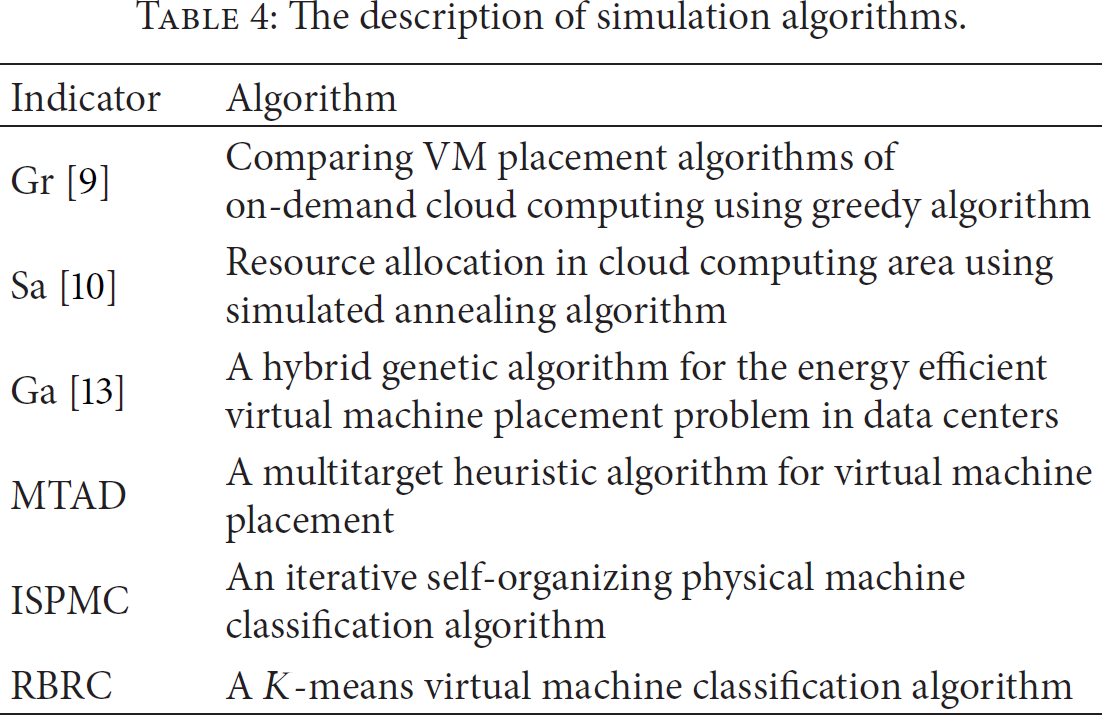
On CloudSim, many demonstrations were given for ISPMC, MTAD, and RBRC algorithms. Experiments simulation and performance analysis were shown in Table 4, where placement efficiency, wastage rate, balance rate, and energy consumption were taken as the performance indexes. Table 4 depicts diagram of the six algorithms.
The description of simulation algorithms.
5.2.1. Simulation Results of ISPMC Algorithm
The main purpose of ISPMC algorithm is to classify the physical hosts and narrow the scanning dimension of physical host machines. On basis of genetic revolution placement, the experiment has compared the placement efficiency difference by using ISPMC and analyzed its performance. In Figures 2 and 3, it can be clearly known that ISPMC further accelerates the placement efficiency rate and improves placement performance. Figure 2 displays the acceleration condition of ISPMC genetic placement algorithm when the number of host machines is 5000 and placement requests are ranging from 10 to 700. With the number of virtual machine requests being increased, it is more obvious for ISPMC to improve the placement efficiency. In Figure 3, we fixed the number of virtual machine requests to verify the acceleration performance of ISPMC placement efficiency by changing the number of the physical hosts. As seen from Figure 3, when the numbers of physical hosts become larger, ISPMC can better accelerate the placement efficiency. Through the classification of ISPMC algorithm, we reduced the physical host dimension and shortened virtual machine placement time; however, when the numbers of physical hosts become smaller, the acceleration performance of ISPMC is a bit poorer than that of the genetic algorithm. Because physical hosts dimension is too small, if it is classified again, physical host dimension decreased slowly. Besides, the ISPMC algorithm itself needs classification for some time. Therefore, when the physical host number is small, the acceleration performance of ISPMC algorithm is poor. In addition, the ISPMC algorithm is to classify the physical hosts so that virtual machine placement requests will relatively concentrate on mapping on the same type of physical host, which promotes regional balanced performance and provides convenience for conservation and management of energy consumption.
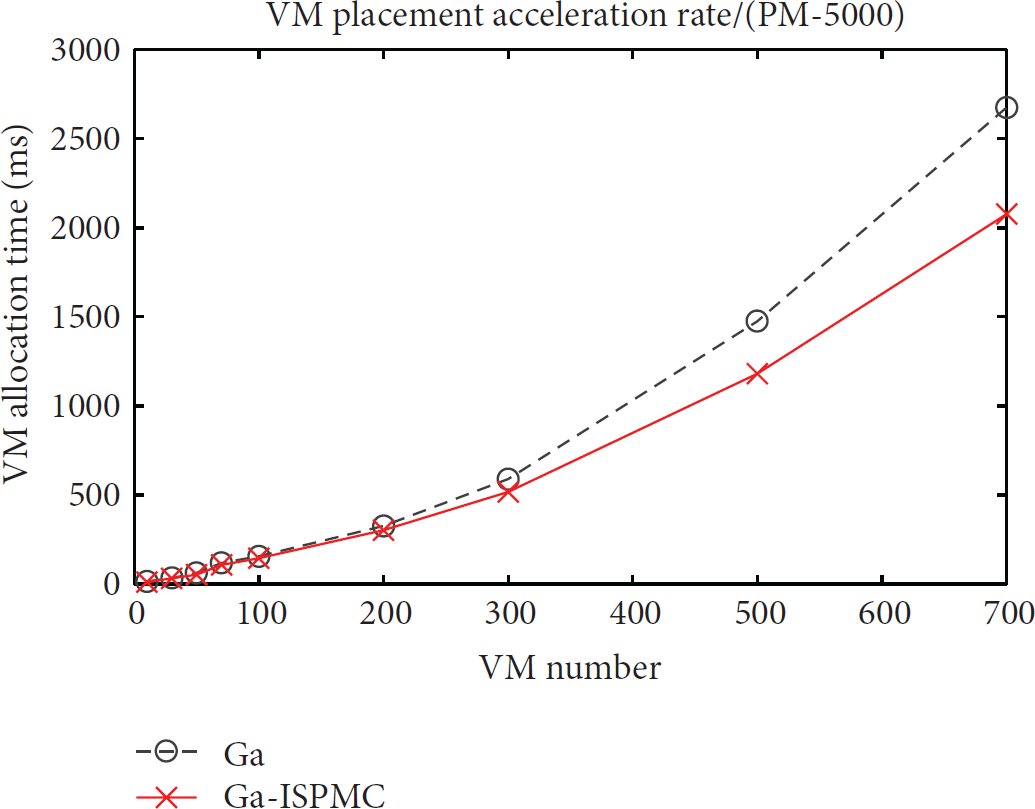
The acceleration rate on genetic algorithm (a).

The acceleration rate on genetic algorithm (b).
5.2.2. Simulation Results of MTAD Algorithm
The experiment verifies MTAD algorithm in many aspects. We verify performance between MTAD algorithm and several other algorithms including algorithm placement efficiency, wastage rate, resource balance rate, and energy consumption.
Figure 4 shows the placement time difference of various algorithms. Placement efficiency of MTAD algorithm is better than that of other algorithms. As shown in Figure 4, with the increase of the virtual machine requests, placement time increases gradually. Time efficiency of MTAD algorithm is between greedy algorithm and genetic algorithm; the simulated annealing algorithm is the worst, because the greedy algorithm only needs to randomly select the large resource in physical host set and has the faster time. In the physical hosts, MTAD algorithm is required to extract positive and negative solutions, which meet multiple objectives (properties), and then approximately chooses a suitable physical host. MTAD algorithm is slightly worse than the greedy algorithm over time aspect. When using genetic algorithm and simulated annealing, which need many time iterations in the initial solutions to obtain more optimal physical host, the longer iteration is, the longer time consumption is. In addition, with the number of virtual machine requests being increased, greedy algorithm needs to traverse longer scope, and time consumption becomes longer; with the number of virtual machine requests being increased, MTAD algorithm supported by ISPMC will exceed greedy algorithm.
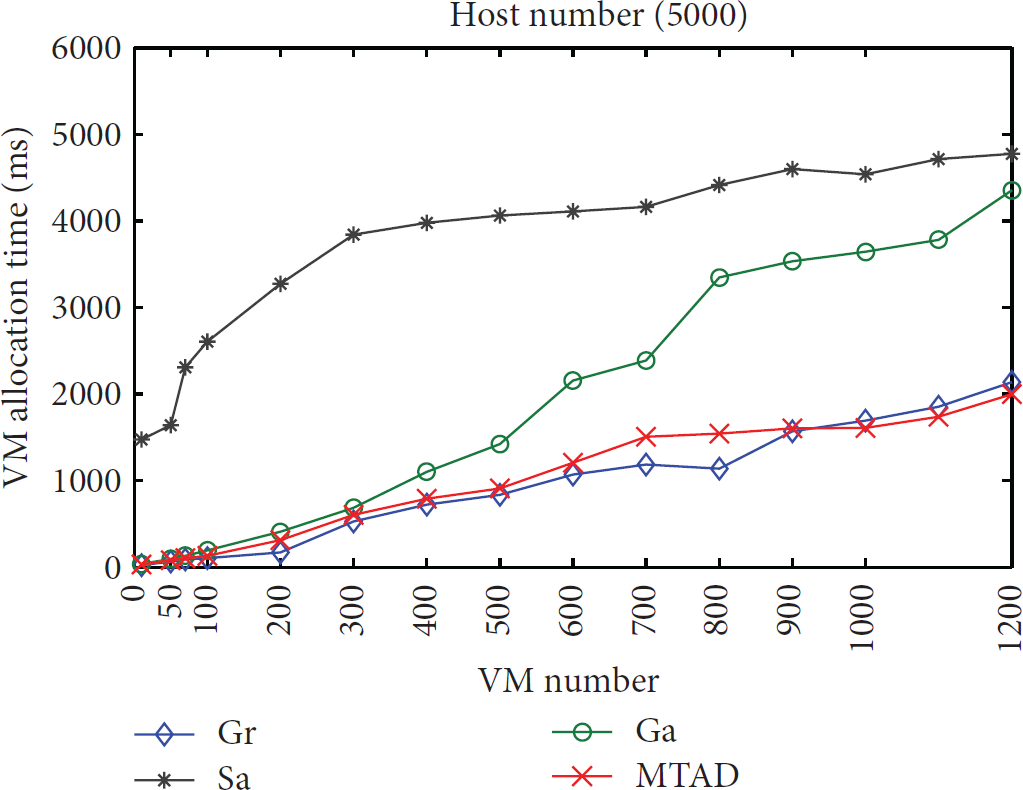
The running time.
The resource utilization rate of PM's different dimensions (balance rate) has been verified in Figure 5. Utilization balance rate refers to angle value between CPU and memory utilization and reflects difference degree on different dimensions of physical hosts. Balance rate is higher and the available extended resources of different dimensions are greater, which increase overall resource utilization of physical hosts. As seen from Figure 5, the resource utilization of MTAD algorithm is optimal; Ga algorithm takes second place, and greedy algorithm is the worst. When carrying out virtual machine placement, firstly, MTAD algorithm traverses physical hosts set to calculate the physical hosts set which meets virtual machine requests by using the approach method. Then, we get the approximate positive and negative solutions in the physical host set according to multiple targets restricted. Finally, we find the suitable physical hosts through the global approach degree of multiple targets. We fully consider virtual machine placement agent that affects PM's different dimensions resources balance rate when MTAD algorithm carries the virtual machine placement and choose smaller difference balance rate as assignment target and therefore improve the overall balance level of PM hosts. Ga intelligent placement algorithm uses self-organizing repeated iterative; it also considers local resource balancing degree. Greedy algorithm does not consider different dimensions resources balance rate, so its efficiency is the worst.

Resource balanced rate.
The resource wastage rate refers to wastage degree average value of different dimensions resources for virtual machines hosted by physical machine (in this paper, we only consider CPU and memory), and it is another measure index of the resource utilization rate. Figure 6 compares various algorithm differences of a PM's resource wastage rate. As known from Figure 6, with the VM requests being increased, physical host resource wastage rate gradually decreased and stabilized. Among the algorithms, resource wastage rate of MTAD algorithm is the lowest, Ga algorithm and Sa algorithm are approximate, and greedy algorithm is the worst. From Figure 6, it is not difficult to know that resource wastage rate of MTAD algorithm is optimal. Firstly, the MTAD considers the current balance rate approximation degree of virtual machine requests and physical host, the closer of the degree is, the more balancing of the physical host resource utilization will be; the available degree of different dimensions resources becomes larger, and the PM's wastage rate will be smaller; secondly, use ISPMC algorithm to classify virtual machine placement; virtual machines will relatively concentrate on a classification physical host so as to enhance the physical host area utilization rate. However, through repeated iteration, Ga algorithm and Sa algorithm, which take the whole physical machine set as the placement area for improving the virtual machine placement efficiency, yet the overall resource rate is weaker than that of MTAD algorithm. However, the greedy algorithm does not consider any optimization for virtual machine placement, so the resource waste rate is the highest.

Resource waste rate.
Figure 7 shows the energy consumption performance of different placement algorithms. Due to heterogeneous structure of data center physical hosts, it is not proper if we simply compare energy performance according to the physical hosts used number. We consider the used number of different type of physical hosts under the condition that the size of physical hosts is fixed; different virtual machine placement requests are carried out so as to statistical the quantity of different type physical hosts. From Figure 7, we can see that four algorithms placement 200~1200 virtual machine requests in 5000 physical hosts. The used number of four different physical hosts can be seen from left to right as follows.

Physical machine usage.
(1) The first class physical host: with the number of virtual machine placement requests being increased, the used number of physical hosts of GA algorithm and MTAD algorithm is relatively larger; Ga algorithm is slightly higher than MTAD algorithm. Compared with two previous algorithms, the used number of Sa algorithm is smaller and the greedy algorithm does not have any physical host. (2) The second class physical host: a large number of the second class physical hosts are used by MTAD algorithm, followed by Sa algorithm, Ga algorithm, and the GR algorithm. The GR algorithm also does not use any second host. (3) The third class host: among the four kinds of algorithms, Sa algorithm and MTAD algorithm used more physical hosts; Ga algorithm and Gr algorithm are less. (4) The fourth class host: with the number of virtual machine requests being increased, greedy algorithm used almost all of the fourth class physical hosts; Ga algorithm is the second, and Sa algorithm is the medium. MTAD algorithm almost does not use any fourth class physical host. From Figure 7, we summarize that when MTAD algorithm carries the virtual machine requests, it tends to use lower energy consumption (low configuration) physical hosts. Sa algorithm and Ga algorithm are the random balancing placement, while greedy algorithm is likely to use the high energy consumption physical host (high configuration).
5.2.3. Simulation Results of RBRC Algorithm
With the continuous development of the cloud computing model, the number of virtual machine placement will be gradually expanded; the current serial placement will inevitably become a bottleneck of virtual machine placement algorithm. We present RBRC algorithm that aims at solving the above problem; the main idea is to use classification thought to classify resource demand similar to virtual machine based on large-scale virtual machine requests and achieve the concurrent placement way. We take the demand balance degree of different dimensions resources as core classification idea. According to ISPMC algorithm, physical hosts will be divided into K class by using K-means classification. Figure 8 is an assigning time efficiency acceleration diagram of RBRC algorithm.

Placement time efficiency of RBRC.
As shown in Figure 8, with the number of virtual machines being increased, RBRC algorithm can greatly improve the placement efficiency of MTAD algorithm. Because of RBRC classification algorithm concurrent placement virtual machine requests, the algorithm greatly reduces the whole placement time and improves the performance. However, when the quantity of virtual machine placement is few, the classification degree of RBRC is relatively small; the used time is almost the same and does not change too much.
6. Conclusion
We put forward three optimal algorithms for virtual machine placement by analyzing the related work and defects of virtual machine placement algorithms in cloud data center. (1) ISPMC is a physical hosts classification algorithm. Taking the heterogeneous nature of the physical host constraints, we classify the physical hosts by clustering so as to reduce the dimensions of the physical hosts and optimize the placement efficiency of virtual machine requests. (2) MTAD is a multitarget heuristic virtual machine placement algorithm. MTAD considers virtual machine placement problems, such as “different dimensions resources imbalanced,” “high wastage rate,” and “high energy consumption.” We use multiobjective optimization theory, traverse the set of physical hosts, and get the multiple objectives positive and negative ideal solutions. Thus, we can obtain a reasonable placement solution by comparison of approach degree between multiple objectives and positive and negative ideal solutions. MTAD algorithm enhances the balance rate of different PM's dimensions resources and the overall resources utilization; it is effective to request heterogeneous physical hosts with lower energy consumption. (3) There is a VM classification algorithm RBRC based on K-means. We divided the virtual machines into several similar demand groups and used concurrent placement model to achieve the goal of rapidly allocating virtual machines. The main target of RBRC algorithm is to solve low efficiency problem of large-scale virtual machine placement in serial way.
All three kinds of optimization algorithms focus on the physical machine hosts and have no considering of the network factors and other special applications (QoS quality, etc.), which will be the future work.
Footnotes
Notations
Conflict of Interests
The authors declare that there is no conflict of interests regarding the publication of this paper.
Acknowledgments
This work was supported by the National Key Technology Support Program of China Grant no. 2012BAH09B02 and the Key Science and Technology Project of Changsha City Grant no. K1204006-11-1.