




Abstract
This paper describes the last mile communication system solutions realized in PLC/RF hybrid technology, which is dedicated to Smart Grid communication subsystems, mainly for Smart Metering and Smart Lighting applications. The use of hybrid technology makes the system more efficient and more secure (still being of low cost, in terms of both implementation and operation). This paper proposes a novel parameter, PDR, to describe the performance of the communications in the last mile network. The communications are realized with the use of the narrowband power line communications technique, the low power wireless communications technique, and the combination of them. The cost analysis for the proposed solution is also done. Theoretical considerations, contained in the paper, are the result of the author's experience in the design, implementation, and operation of the last mile Smart Grid communication systems, realized in the narrowband PLC or 433/868 MHz radio technology. These communication systems were developed for data acquisition and distribution between specific terminals, which are Smart Meters or Smart Lanterns. The aim of this paper is to outline superiorities of the hybrid technology, from which the most important is a low layer protection of the sensitive critical infrastructure, which undoubtedly is a last mile Smart Grid communication network.
1. Introduction
As it is reported in [1–3], most of the coordinated cyberattacks on modern electric grids are realized via the Internet. In particular, the core of the Smart Grid, for example, power stations or SCADA (Supervisory Control and Data Acquisition) systems, is attacked. According to [4], these types of attacks are qualified as type I and type II. A type I cyberattack targets power plants and aims at disrupting or taking over the operation of generators. A type II cyberattack targets power distribution and control. These two types of attacks can cause damage not only to electric grids but also to other critical infrastructures [2]. In this work, type III cyberattacks are considered. These cyberattacks are classified as attacks against the consumption sector part of the grid, which nowadays are mainly Smart Metering and Smart Lighting systems. This part of the critical infrastructure is more vulnerable to attacks, which can occur more often than those in the core part of the Smart Grid. Moreover, they may have the same catastrophic social impact [1] though a smaller economic one. This is also the least-examined yet important class of intrusion plans [4]. Currently, the main problem, in the implementation of Smart Grid communication systems, is the solution of the last mile, part of Smart Grid communication networks. This part of networks has a decisive impact on the cost of implementation and operation of the whole communications system. Thus, very cheap short-range devices (SRDs) have been used to deploy last mile wireless or PLC (power line communications) networks. Using such technical solution, two problems occurred at once, namely, transmitting data security and the transmission reliability.
The second difference occurs in comparison to the attacks on the core of the Smart Grid. This difference is a greater volume of unintentional attacks. Using wireless technology, they may be caused by amateur radio activities, an improper use of remote controllers, use of the same ISM (industrial, scientific, and medical) radio subband by other systems, and so forth. While using PLC technology, they may be caused by additive noises and a decrease of the LV (low voltage) network impedance, where its capacitive character is particularly disadvantageous for the PLC transmission. In the close future, the percentage of unintentional attacks will probably decrease as a result of the increased number of intentional attacks with the use of the same technical methods based on imperfections of PLC and radiocommunications. Thus, it can be stated that today's last mile part of Smart Grid communications network is a difficult to protect part of the critical infrastructure due to the applied technologies. In the next section, both ISM radio and PLC employed in Smart Metering and Smart Lighting systems will be characterized. Knowing these systems' behavior allows us to explain the role of the PLC/RF hybrid solution. PLC/RF hybrid solution should not be treated as two independent means of communications but rather as one technology, which is more secure and more efficient than single PLC or single ISM radio or simultaneously using single PLC and single ISM technologies.
This work is the result of many years of experience, first in the creation, implementation, and development of wireless distributed telemetry system for smart electricity meters (in the years from 2009 to 2011), then in PLC-PRIME implementation (in the years from 2012 to 2014), and currently in the creation, implementation, and development of the Smart Lighting system dedicated to the lighting of streets and roads.
2. State of the Art and the Problem Definition
The first problem, pointed out at the end of the penultimate paragraph of the previous section, has been solved in a relatively simple way by employing AES (Advanced Encryption Standard) cryptographic algorithms [5, 6], whilst solving the second problem is still a challenge. In recent years, the continuous development of the narrowband PLC systems (due to the Smart Metering standard establishing process [7, 8]) resulted mainly in significant bit rates increase (while spreading the transmission spectrum) but communication reliability is still the same: low. Additionally, spreading the signal with the use of the OFDM (Orthogonal Frequency Division Multiplexing) method causes the transmission to be exposed to minor narrowband noises. In Figure 1, as an example, the spectrum of the narrowband noise is presented.

An example of the narrowband noise spectrum in the CENELEC band, where green curve represents mean values and blue one represents peak values.
Occurrence of the interference signal has continuous nature as it can be observed by comparing green and blue curves in Figure 1, which made it impossible to establish communications between PLC-PRIME modems located at a distance of 25 meters from the noise source. It is worth noting that the interference signal power does not exceed the maximum signal strength defined in the specifications [7, 8]. Carrying out further experiments which consisted of replacing the continuous interference signal by periodical one (with the period of 10 ms and duration of 0.5 ms), it turned out that communication establishing was still impossible. The second reason and the third reason which make PLC transmission unreliable are undefined, changeable LV network impedance, which means that the transmission is always realized under mismatching conditions, series unbalance of the European LV power lines (in North America they are balanced) [9], which brings an additional attenuation component.
With the development of ISM radio modules, the situation is similar. Here, as the main achievements, the miniaturization of radio modems and their lower power consumption may be mentioned. It can be assumed that the quality of wireless communications in the bands 433 MHz and 868 MHz will be worse and worse, due to more and more common occupation of these frequency bands and the presence of an increasing number of devices which generate noises. In Figure 2, the spectrum of two signals is presented as an example. In the centre, there is a spectrum of the narrowband, −50 dB signal coming from the Smart Lighting system under test, whilst in almost the whole background there is a spectrum of the spread, −68 dB signal coming from the unknowing source or sources.
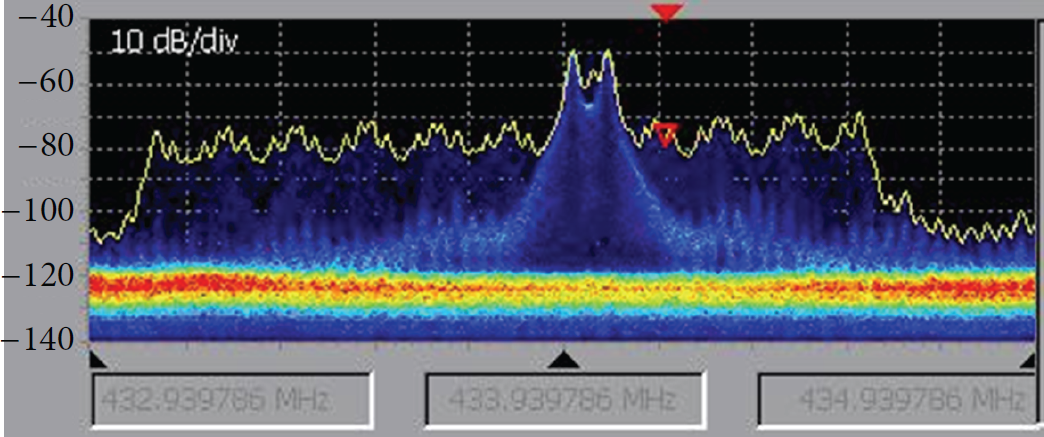
An example of 433 MHz band occupancy (a fragment of the screen of the radio spectrum analyzer).
Both the Smart Metering and the Smart Lighting, last mile communication systems based on PLC or RF technology, create a specific kind of the distributed sensor network. Solutions based on RF technology are very similar to Wireless Sensor Networks (WSNs) [10] in both their topology and their hardware solutions. The specificity of the Smart Metering and the Smart Lighting communications is that, unlike in WSNs, the problem of nodes supplying does not exist. Using SRDs generates the problem of coverage. For all, Smart Metering, Smart Lighting, and WSN, this problem is solved in the same way, using the technique of multihop. The drawback of the multihop technique is its low reliability.
In WSNs, the problem of low reliability is solved by an appropriate selection of links [11], as the consequence of energy issues in these kinds of networks, of course still remembering about the traffic balancing necessity. Another well-known method for increasing the transmission reliability over an unreliable medium is in-link retransmission technique. The purpose and application areas of retransmission mechanisms in WSNs were widely discussed in [12]. In principle, the retransmission subject in WSNs is rare, both theoretically and practically. As an example, a quite popular article is [11], which describes in detail the various routing techniques but it does not mention the topic of retransmission at all.
Using the fact that energy issues do not exist in the last mile Smart Grid networks, it is possible to increase the transmission reliability by employing the old, well-known or the new, sophisticated methods, for example, the ones described in [10]. The most effective method seems to be multipath [10, 13] especially for the PLC, where even the storm effect is harmless. Thus, it can be stated that the reliability of the last mile Smart Grid communications systems is better than the reliability of the WSNs. The reliability of the Smart Metering and the Smart Lighting communications will be discussed further; at this stage of consideration it is emphasized that, unlike WSNs, faulty Smart Meters or faulty Smart Lantern cannot be supported by data from neighbouring nodes [14] either in the data reading process or in the controlling process. That is why even though Smart Metering and Smart Lighting communications are more reliable than WSNs, they are still not reliable enough when they are based on a single SRD technology and are expected to act as a part of the critical infrastructure.
The aim of this paper is to show that the PLC/RF hybrid technology allows creating a reliable last mile communication system still being of low cost to implement and operate. Only when the Smart Lighting and Smart Metering systems are guaranteed the efficient communication, their security can be improved. Demonstrating it, in a measurable way, is the main problem of this study.
The hybrid PLC/wireless devices, mostly in the area of the Smart Metering, get more and more popular but their areas of the application completely differ from that described in this work. They are [15, 16] as follows:
Combining a narrowband PLC and the various IEEE 802.11 standards in the 2.4 GHz and 5 GHz frequency band, where PLC is responsible for last mile Smart Grid communications whilst Wi-Fi is responsible for HAN (Home Area Network) communications. Combining a narrowband PLC, a broadband PLC, and Wi-Fi to build architectures with PLC backbone and IP distribution of the radio type. Combining a narrowband PLC and the Bluetooth where PLC is responsible for last mile Smart Grid communications whilst Bluetooth is responsible for communications to other, nonelectricity meters.
The basic difference, between the three above solutions and the one described in this paper, is that in the proposed solution the communication between any two nodes may be realized with PLC/RF technology simultaneously and does not only act as a communication bridge, for example, for the MV/LV transformer hopping [17].
3. Reliability of the Last Mile Communication Network and Its Descriptors
The architecture of the last mile Smart Metering and Smart Lighting networks is not complicated; it consists of a single traffic concentrator and multiple terminals (meters or lamps). Sometimes repeaters are used, which are a specific type of terminals; they have communication module only and do not have any actuator.
It is assumed that the nodes of the last mile communication network are highly reliable, so they do not need to be taken into account in assessing the reliability of the whole network. The links between the nodes based on SRDs are unreliable. To describe their unreliability, the Packet Error Ratio (PER) is used. The PER is defined as the ratio of the number of error packets to the total number of them. The PER value is high for communications between sensor-based devices compared to other types of communication media, for example, optical fiber. The authors of the papers evaluate radio propagation with sensor-network style radios; for example, [12] already ten years ago observed in their experiments that over 10% of links are asymmetric and one-third of the links have PER greater than
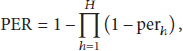
Formula (1) describes how unreliable a multihop connection is; for example, assuming that there are three hops with the same per =
There are two well-known methods to solve the problem of the low reliability: an in-link packet retransmission and a multipath technique [12, 13]. Because of the differences between Smart Metering and Smart Lighting in last mile network topology, the first method is more suitable for Smart Lighting, whilst the second one is more suitable for Smart Metering.
In practice, the path consists of at least two links and three nodes, for example, node A, node B, and node C (if there are only two nodes, then the path between them is actually a link). Assuming that there are connections between A and B and B and C, it is possible to establish a connection between A and C, via B, so that A-C path is a one-hop path. If there is more than one path between nodes A and C, for example, via additional node D, then information can be sent at the same time not only over one path. In the last mile networks in which the coverage problem does not occur multihop technique is not applied, because in such a case the use of multipath technique is impossible.
The simultaneous use of more than one path enables the realization of communications with the value of reliability, expressed by

Employing the in-link retransmission enables the realization of communications with the value of reliability, expressed by the following equation:
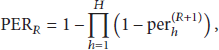
These two methods are independent of each other; thus, it is possible to apply both of them. In such a case, using (2) and (3), the reliability described as

Even the use of two methods of reliability improving may be insufficient; the best example is typical, topological layout of Smart Lighting last mile network. The simple 12-terminal network is presented in Figure 3.
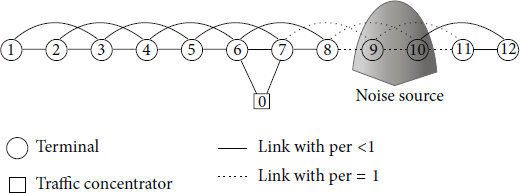
An example of the Smart Metering last mile network, disturbed by the noise source.
The noise source was placed close to nodes 9 and 10, which made it impossible to receive packets by nodes 9 and 10. In this scenario, the retransmission is inefficient, even with large values of R; the multipath technique also does not solve the problem because it is impossible to set any alternative path to nodes 9, 10, 11, and 12. The PER for all paths to these nodes is 1. If the last mile network is realized in RF technology, the noise source may be an external radio transmitter working in the same or overlapping frequency band, whilst when the last mile network is realized in PLC technology the noise source may be an internal or external device that does not meet the compatibility standards.
The above example does not only demonstrate inefficiencies of the system-realized transmission improvement but also signal the problem of the reliability description for the whole last mile network, not only single paths. The set of PER values could be a good network reliability descriptor but it would be rather inconvenient to use. The average value of PER, in most cases, is useless because if it is bigger than zero it does not give information about the diversity of the quality of individual paths.
In the operation of Smart Metering systems two metrics of the effectiveness of the reading process are used [19]: the first is a reading rate and the second is a reading speed. Both of them describe the performance of the system for the particular network in the services layer. The Reading Rate Indicator (RRI) is a percentage value which indicates how many of all the nodes were readout successfully whereas the Reading Speed Indicator (RSI) is the total read time of all nodes to the number of them in the examined network. The RSI describes the average value of the readout time of a single, not particular node. The unit of RSI is seconds per node. There are the same problems with their use as with the use of the average PER. In fact, the RRI is 1 minus average PER obtained from the bidirectional test.
To demonstrate and compare PLC/RF hybrid solution with others in a measurable way, a novel metric is proposed, namely, Persistent Deactivation Ratio (PDR). Similarly to PER, PDR value is a statistical parameter obtained from the sample. The difference between PER and PDR is that PER, according to its definition, has its packet error counter (numerator of PER) incremented on every failure event, whilst PDR, as it is described by (5), has its numerator increased by

Product of the n and p is the size of the statistical material. PDR can have value from 0 to 1, and the smaller it is the better (only PDR(p) values with the same p can be compared). PDR is an averaged value for all paths of the whole network.
Similarly to PER, PDR can be designated for a specific node; such a PDR will be denoted as

To demonstrate the superiority of the PDR metric over PER metric, the following example is given: there are two paths: between a traffic concentrator and node X and between a traffic concentrator and node Y. The PER of both paths is the same and equals 0.5; the passed/failed distributions over

Exemplary passed/failed distributions over
For the assumed value of PER = 0.5, examples in Figure 4 represent two extreme cases, that is, the best for the path X and the worst for the path Y; the higher value of PDR indicates the possibility of reducing the system reaction. Smart Grid communications systems, the same as traditional telecom or computer networking systems, cope better with the transmission errors distributed in time rather than with grouped ones. This is because it is assumed that only two attempts of data sending, from third or upper layers, are performed. It is a feature of most upper communication protocols transferring signaling, for example, DSS-1, all V.5s, or PRIME. This feature is a consequence of the services for which the specific signaling has been developed. Therefore, path X is better than path Y even though they have the same values of PER. That is why PDR is proposed.
The RRI values presented in [19] hardly differ from my own results (98,7%), obtained under similar conditions. The only difference is that in our own test the RRI values got from the RF last mile network are even more similar to those got from PLC one. In turn, PDR values for PLC and RF (of course from our own test) differ significantly; they were PDR(10) =
4. Efficiency of the Last Mile Network Realized in the PLC/RF Hybrid Technology
To examine the efficiency of the last mile network realized in the PLC/RF hybrid technology, a long-term, outdoor experiment was performed in the Smart Lighting system located on the campus of the UTP University in Bydgoszcz, Poland. The experiment consisted of collecting communication traffic data together with the lighting and electrical states of all lamps. The variable in the experiment was the state of the street lighting. The PLC/RF hybrid last mile network consisted of thirty-six lamps and one traffic concentrator in the middle of the network; its schemes (for RF and for PLC) are presented in Figures 5 and 6, respectively. The whole hybrid network topology can be acquired by imposing Figures 5 and 6 at each other. The experiment was performed only during the nights in the period from September 26, 2014, to March 14, 2015.
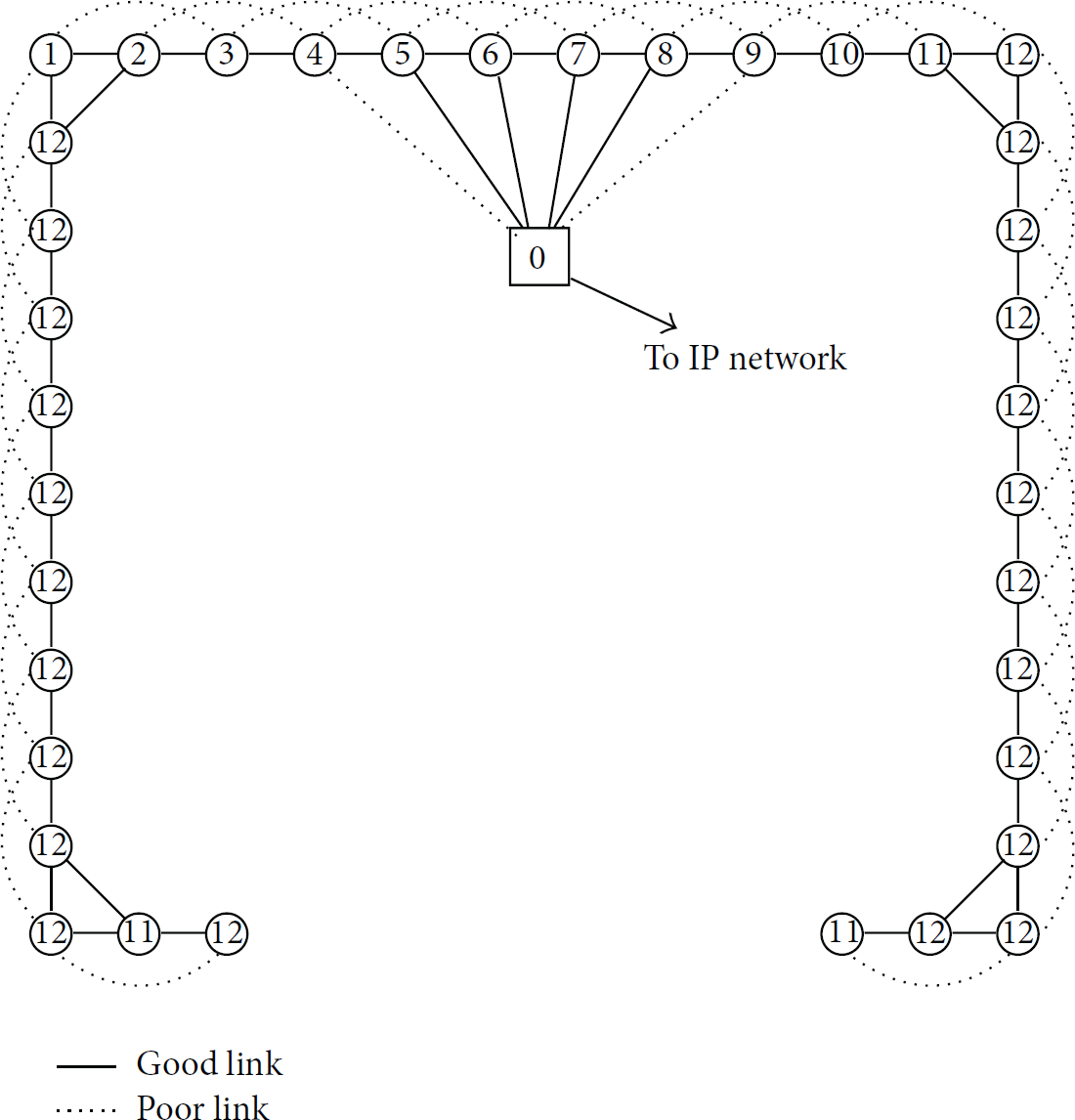
Scheme of the last mile RF Smart Metering network used in experiment.

Scheme of the last mile PLC Smart Metering network used in experiment.
A good link is a link that was always working during the whole test and was never unidirectional; a poor link is a link that at least once was unidirectional. To get the network with a presented topology, the power of radio transmitters was reduced from 10 dBm to 0 dBm and the power of PLC transmitters was reduced from 120 dBμ to 90 dBμ. The other transmission parameters are bit rates of 10 kbit/s, the radio worked in the transmission band of 433 MHz, and the PLC band worked in the transmission band of 100 kHz.
The 2nd layer communication protocol enabled setting one of three transmission modes of frames relaying to every frame, injected into the network:
RF only mode; that is, RF frame injected into the network is relayed only with the use of the RF technology. PLC only mode; that is, PLC frame injected into the network is relayed only with the use of the PLC technology. Hybrid mode; that is, RF or PLC frame injected into the network is relayed with the use of RF and PLC technologies.
Using the third mode gives two possibilities: the injected frame (not copied) is RF or PLC. To perform the test under the same conditions, each terminal was queried in alternative manner. Generated traffic was a consequence of the assumed lamps controlling scenario. This scenario is described by the diagram presented in Figure 7.
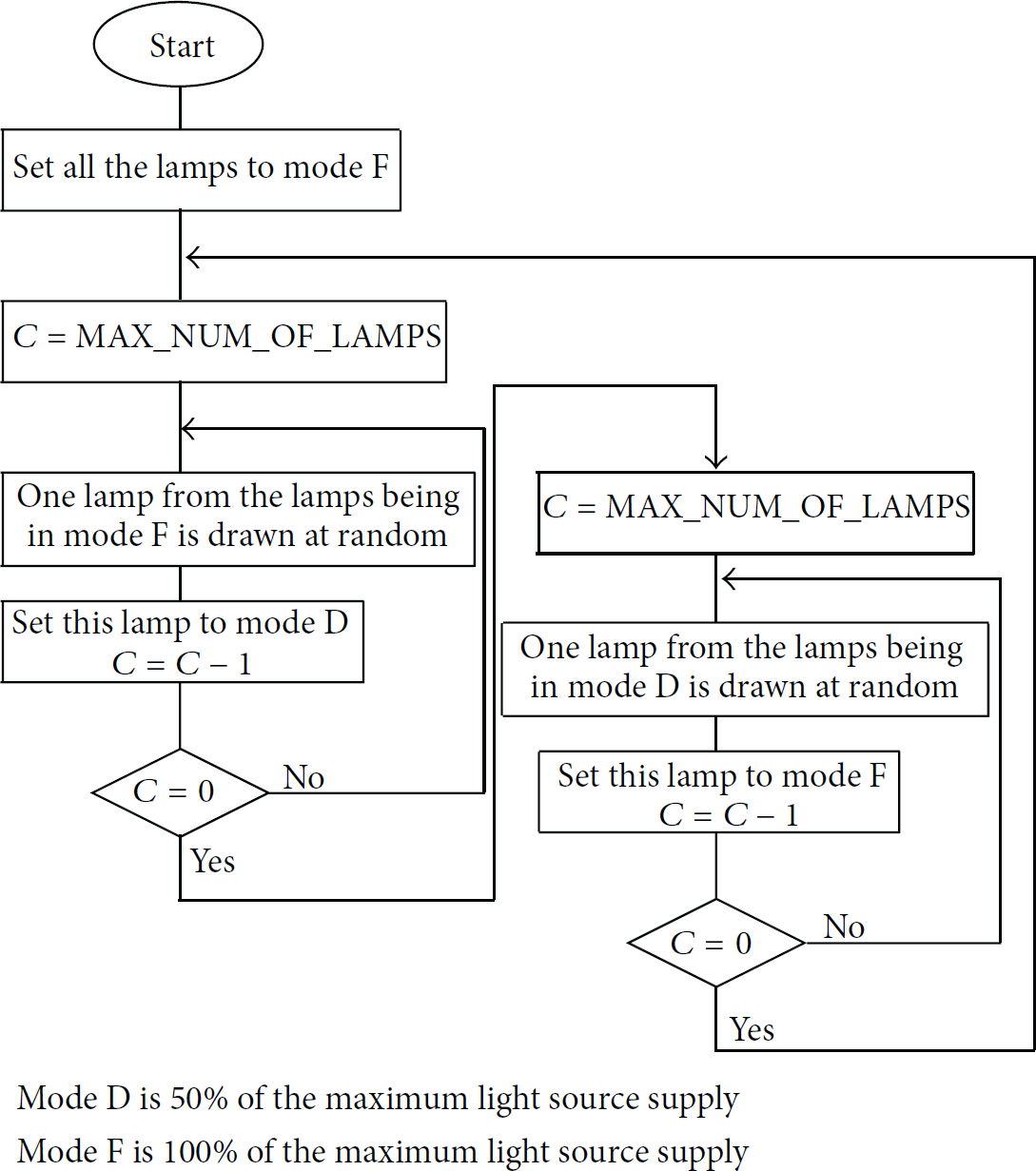
Diagram of the lamps controlling scenario.
The quality of the PLC transmission depends on lighting state of the 3-phase power lines. For scenario presented in Figure 7, the total number of states for 36 lamps is equal to 68, 719, 476, and 736. It was calculated from

Even assuming very short time of the lamp state setting process (hundreds of ms), it is impossible to get all the states during one night; therefore, the lamps were controlled at random. To be sure that tested Smart Lighting system was also working under the worst condition, the scenario algorithm always started having all the lamps set to mode F.
The efficiency of the tested last mile Smart Metering communication network is described by RRI and PDR parameters. The results do not differ in day by day comparison but they differ, significantly, comparing RRI and PDR, which were obtained for the three different technologies. One-week exemplary results (7 records) are presented in Table 1.
Daily RRI and PDR(8) results from one-week observation (under the “winter” test).

Comparing the average values of RRI for RF and PLC technologies, it can be concluded that the PLC technology is only a bit more efficient than the RF one, even though the average number of hops in the RF network is almost 2.5 times greater than the average number of hops in the PLC network, so according to (1) the result for RF should be worse even more significantly. The reason why the difference in RRI values between RF and PLC is so small is that RF transmission did not depend on the lighting state of the lamps whilst PLC transmission did. The second reason may be that in the PLC network the first step effect can occur whilst that in the PLC network rather cannot. The first step effect occurs when there is the lack of good links between the traffic concentrator and terminals. This effect is not uncommon for Smart Metering systems when the traffic concentrator is located in the MV/LV transformer so that the first step is quite long. Additionally, for the PLC transmission, the transformer impedance adversely affects the transmission quality parameters [20]. Comparing the average values of PDR for RF and PLC technologies, it can be concluded that the RF technology is a bit more efficient than the PLC one, whilst comparing the average values of RRI, it can be concluded that the PLC technology is a bit more efficient than the RF one. Thus, comparing the two solutions (using two methods: RRI and PDR) the different results were given. It is because RRI does not include occurrences of a series of failures in the reading process (in the presented case via PLC network) and is not so good as PDR for evaluation purposes.
Analyzing the average values of RRI and PDR obtained for the PLC/RF hybrid technology, it can be concluded that they are much better than the worst case, which could be (using data presented in Table 1 before rounding)


The explanation of this situation is that RF and PLC networks have a completely different topology and also that hybrid technology is not the simultaneous use of two technologies but their mutual support in each hop.
5. Analysis of Hybrid Technology Implementation Costs
Smart Lanterns and Meters are equipped with a microcontroller. The same microcontroller can handle the actuation module and communication modules.
The cost analysis is very simple and comes down to the valuation of the cost of electronic components. The typical cost of the radio module is $4, including the on-board or external PCB antenna. The PLC module is more expensive and amounts to $9. The difference in price is due to two facts: PLC technology is not as popular as RF and a PLC chip requires more external RLC components (400 V including) and also requires the line coupling transformer. It is worth noting that these prices are not the costs of expanding existing solutions. It is generally accepted that the cost of a modern Smart Lantern should not be more expensive than $100 compared to the traditional lantern. The price of the average 3-phase electricity counter is $240. In the author's opinion, nowadays all the electricity counters should be equipped with both the PLC and the RF modems. Taking into account the price of the RF modems, all lanterns in which PLC modems are provided should be additionally equipped in the RF modems, because it is only 4% of the “being smart” costs. The increase in costs by almost 10% is significant, so the use of PLC modems in Smart Lighting may be debatable; nevertheless, there are two arguments about it doing so: they are last mile communications efficiency and marketing attractiveness.
6. Toward More Secure Last Mile Smart Grid Communication Systems
High reliability and in most cases doubled throughput of the presented communication system may be utilized in various areas of application. One of the areas may be security. Information may be deteriorated by erroneous data delivery or unreliable channel conditions, which leads to an incorrect control process [21].
First distinct feature, which allows stating that the proposed hybrid solution is more secure, is that two technologies must be deployed to make it impossible to find an alternative path in hybrid last mile network. Additionally, it must be disturbed in at least two physically different locations as is apparent from the analysis of the schemes shown in Figures 3, 5, and 6.
There can be many scenarios for the network protection. This section describes in part the possible scenario, planned for implementation in our own solution dedicated for Smart Metering and Smart Lighting. For safety reasons, some elements of the scenario are not presented.
The first element is a traffic concentrator redundancy. This important node may be disabled because it is out of order, was attacked from IP network or was turned off for planned maintenance, and so forth. In such a case, a neighboring traffic concentrator can take control over the nodes previously supported by disabled one if only one of these nodes is adjacent to at least one node of the in-service last mile network. Using PLC/RF hybrid technology, such a solution is feasible because the throughput is sufficient enough.
The second scenario element is a Terminal Equipment Identifier (TEI) negotiation. It depends on using the dynamic, changeable address of the nodes instead of using hardware fixed ones. This feature was implemented according to the ITU-T Q.921 recommendation [18]; moreover, TEI management procedures can be served using two independent technologies, for example, commands over PLC whilst responses over RF. The changeable addressing significantly impedes the deployment of spoofing. In the case of low reliability TEI negotiation would be impossible.
The next scenario element also impedes spoofing as well as sniffing and depends on extra traffic generating between virtual, inexistent traffic concentrators and terminals.
Other important elements of the proposed security scenario are efficient anomalies detection and the ability to implement remote management via independent channels and not ECC (Embedded Communication Channels), which is imported during remote settings of transmission parameters.
An important feature of the PLC/RF hybrid communication is related to Smart Metering services and depends on current electricity consumption data acquisition on time that is being useful for short-term electricity consumption forecasting, which is of great importance for the energy security.
7. Conclusion
The use of hybrid technology made it possible to increase last mile Smart Grid network security. In this paper, only a few methods of the security improvement were presented. They refer to those presented in [21].
It can be stated that possibilities which are offered by the efficient and highly reliable last mile PLC/RF hybrid networks are the open issues of searching for new methods of type III cyberattacks protection. High reliability is not only the result of applying the hybrid technology but also the use of PLC over 3-phase LV network, thereby employing two technologies; in fact, there are four physical networks (RF +
According to the results of currently performed tests, carried out under the same conditions as described in this paper experiment, the reliability may be even higher than the one obtained from the “winter” tests. Improvement of reliability may be due to two reasons: it is a “summer” test and Smart Lighting system is working only during this part of the day when human activity is low (offices do not work, etc.); the described earlier bottleneck of the presented solution was eliminated by simultaneous injection of identical packets on RF and PLC physical interfaces of the traffic concentrator. The final answer to the question what is the cause of the higher reliability will be received in September when conditions (nights duration) are identical to those (March) presented in the work. Work is currently underway related to increased security of transmitted information with the usage of the method of private and public channels created alternatively in wireless and wired medium over the time and space (transmitting paths). Additionally, the retransmission technique was discarded because it could not have any effect if the reliability was so high (even when Smart Lighting topology network was examined) and also because it could have negative impact on security by sending unnecessary copies of the same packets. The proposed PDR parameter can be used not only for the last mile Smart Lighting and Smart Metering networks quality assessment but also for other last mile Smart Grid communication solutions, for example, the ones used in distributed energy generation.
Footnotes
Conflict of Interests
The author declares that there is no conflict of interests regarding the publication of this paper.
Acknowledgments
This research was supported by the Polish Ministry of Science and High Education and APATOR S.A Company under the Contract 04409/C.ZR6-6/2009 and under the realized GEKON Program (Project no. 214093) which is currently supported by the Polish Ministry of Science and High Education and the Polish Ministry of Environmental Care.