




Abstract
A new wavelet threshold denoising function and an improved threshold are proposed. It not only retains the advantages of hard and soft denoising functions but also overcomes the disadvantages of the continuity problem of hard denoising function and the constant deviation of the soft denoising function in the new method. In the case of the improved threshold conditions, the new threshold function has a better performance in outstanding image details. It can adapt to different images by joining an adjusting factor. Simulation results show that the new threshold function has a better ability of performing image details and a higher peak signal to noise ratio (PSNR).
1. Introduction
In the process of image transmission, the image is likely to be affected by noise in all aspects of transmission [1]. Due to these effects, the image will be interfered by noise. The visual effects of image are poor because of low image quality. At this point, the main noise in image transmission is the Gaussian noise. Fingerprint recognition, face recognition, and medical image are in great need of the image details, but a great interference to the image is brought by the image noise. These interferences are also promoting the development of the image denoising technology. Accuracy of minutiae extraction is very important in the automatic fingerprint identification technology based on matching minutiae [2]. Therefore, it is particularly important to preserve image details while removing the noise [3, 4]. The geometric method is the earliest and most traditional one for face detection and recognition. It usually needs to detect facial features, the relative position between the important facial features, and the relevant parameters of these features [5]; this method is badly in need of the detail information of the image. Image noise makes the image quality change so that it is difficult to extract the image feature. Image denoising can not only improve the practicability of the fingerprint, face recognition, and medical imaging but also enhance the visual effect of the image. The algorithm in this paper mainly aims at Gaussian noise.
Image denoising algorithms can be divided into spatial domain algorithm and frequency domain algorithm [6–9]. Spatial domain algorithm is to process the image pixels directly. In the frequency domain algorithm, the image is transformed from time domain to frequency domain. Then the image is processed in frequency domain and transformed to that in time domain. Mean filtering, median filtering, and adaptive Wiener filtering are classical spatial domain algorithms. It also caused some problems while removing the noise in these methods, such as serious blur of the image, especially the edge and details of the image [10]. Fourier transform is in common use in frequency domain; however, the domain characteristics of it disappeared after Fourier transform. It can neither detect the time position and the degree of intensity after signal transformation nor describe the local properties of time domain of the image [11]. The emergence and improvement of wavelet transform theory solves this problem. So wavelet has been widely used in image processing [12, 13].
Wavelet denoising algorithms can basically be divided into three categories: (1) modulus maxima algorithm based on wavelet transform [14]; (2) correlation algorithm [15]; (3) wavelet threshold algorithm [16, 17], including the hard threshold and soft threshold.
In the process of image denoising, the selection of threshold and the construction of threshold function are the keys to denoising. A new threshold and a new construction of threshold function are proposed in this paper. The new threshold and the new threshold function are used to obtain a higher value of the peak signal of noise ratio while more image details are retained.
2. Wavelet Threshold Principle
2.1. Wavelet Transforms in Two Dimensions
An image can be thought of as a two-dimensional function; then the wavelet transform of an image is a two-dimensional wavelet transform. A two-dimensional scaling function


Given separable two-dimensional scaling and wavelet functions, then the two-dimensional wavelet transform becomes very simple. Firstly, we give a scaling function and a translated basis function:


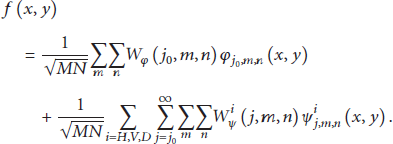

The discrete wavelet transform. Here,

The inverse discrete wavelet transform. Here,
Four coefficient matrices can be obtained by the first wavelet transform of an image; one is the coefficient matrix of low frequency by the scaling function expansion and the other three coefficient matrices are generated by the translated basis functions. Wavelet threshold denoising is to modify these four coefficient matrices with a threshold and then use the four coefficient matrices after modification to reconstruct the image.
2.2. Wavelet Threshold Principle
Donoho and Johnstone proposed the theory of wavelet threshold shrinkage in 1992; the main theoretical basis of this theory is as follows [16, 19, 20]. The energy distribution of the signal in Besov space is mainly concentrated in the limited coefficients in wavelet domain, whereas the noise's energy is distributed throughout the wavelet domain. Therefore, the transform coefficients of signal are greater than that of noise after wavelet decomposition. We can find a suitable threshold. When the amplitudes of wavelet coefficients are less than the preset threshold, it is considered that the amplitude is caused by the noise and the amplitude is set to zero; when the amplitudes of wavelet coefficients are greater than the threshold, it is considered that the amplitude is caused by signal and the amplitude is preserved or revised. The image is reconstructed by the processed wavelet coefficients in the steps above to achieve the purpose of image denoising. This algorithm is simple, has better visual effects, and can keep the edge information.
Assume that the original image is

The steps of wavelet threshold denoising are as follows from the analysis above.
Select a suitable wavelet base and decomposition levels to decompose the image Select an appropriate threshold to process the high frequent wavelet coefficients of the noise image in each layer, and obtain the new coefficients Reconstruct the image with the original low frequency wavelet coefficients and
3. Wavelet Threshold Denoising Function
3.1. Several Common Denoising Threshold Functions
The function is
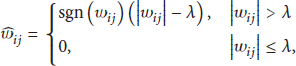
The function is
The function is
The function is



The images of threshold denoising functions above.
The soft threshold function and hard threshold function of Donoho have been widely used, but it remains inadequate. The edges of the image are blurred because the wavelet coefficients of the noisy image that are greater than the threshold are shrunk in the soft threshold denoising function [21]. The hard threshold denoising function can keep the local information of the image. However, the image will show the visual distortion caused by pseudo Gibbs phenomena because the hard threshold denoising function is not continuous at the threshold [22]. In addition, highlighting the details of the image is not particularly obvious in the hard threshold and soft threshold denoising function. A new threshold function will be introduced in the following paper.
3.2. The Improved Wavelet Threshold Function
The new function is

In the new threshold function, if
4. Matlab Simulation Experiment and Results
4.1. Simulation Experiment
In order to show the superiority of the proposed algorithm, soft threshold and hard threshold denoising were selected as contrast. In this section, simulated experiments are performed with “kids.tif,” “mir.tif” (a medical image), and “105_7.tif” (an image in FVC2004 fingerprint database). This experiment has been performed using Matlab programming language (Matlab R2012b). The specific experimental steps are as follows.
Add Gaussian white noise that the mean is 0 and the variance is 0.01 into the selected images. Decompose all the noisy images with wavelet base “sym4” to obtain the wavelet coefficients of each layer of all the images. Denoise the noisy images with the soft and hard threshold denoising method. Denoise the noisy images with the improved denoising method in this paper. Reconstruct image with the wavelet coefficients processed by soft, hard, and the new threshold denoising method, and compare the performance of the three methods. Use the peak signal to noise ratio (PSNR) as the evaluation criteria to evaluate each algorithm. Here, PSNR is defined as
where

4.2. Experimental Results
The original image, noisy image, and the image after denoising processing are shown in Figure 4.

Images denoising. (a) Original image. (b) Image corrupted by Gaussian white noise that the mean is 0 and the variance is 0.01. (c) The denoising result of hard threshold. (d) The denoising result of soft threshold. (e) The denoising result of improved algorithm.
Local enlarged images of denoising images are shown in Figure 5.

Local enlarged denoising images. (a) The hard threshold denoising algorithm. (b) The soft threshold denoising algorithm. (c) The improved wavelet threshold algorithm.
We set
Comparison of PSNR (dB): kids.tif.

Comparison of PSNR (dB): mir.tif.

Comparison of PSNR (dB): 105_7.tif.

4.3. Selection of Threshold
Selecting the threshold is critical in the wavelet threshold denoising method. The suitability of it affects the denoising effect of image directly. In the VisuShrink algorithm proposed by Donoho, Universal threshold expression [19] is
The threshold value used in this paper is a modification of [2]. The threshold expression in [2] is
5. Conclusion
Wavelet transform has a good time-frequency characteristics. Because the frequency distributions of noise and image signal are different, wavelet transform for image denoising has obvious advantages. In this paper, we proposed a new threshold function to improve inadequacies of the soft threshold and hard threshold based on the original threshold function by analyzing the characteristics of wavelet threshold function. Under different noise conditions, the new threshold function can retain more image details and get a higher PSNR. Improved threshold denoising function has a good application prospect in the face and fingerprint denoising and medical imaging denoising.
Footnotes
Conflict of Interests
The authors declare that there is no conflict of interests regarding the publication of this paper.
Acknowledgment
This work is supported by the Project of Education Department of Heilongjiang Province (Grant no. 12541177).