




Abstract
This paper endeavors to investigate the security and energy issues in wireless sensor networks from prior art such as game theory and various embodiments of methods like public-key cryptography. Due to the needs of interacting with the physical world, thanks to a plethora of innovative applications, the state of the art in wireless sensor networks (WSNs) is focusing on multiple purposes such as monitoring, tracking, and security while relying upon some assumptions about distributed data, whereas these assumptions may not hold in a real scenario. The content herein models homogeneous WSN environment of highly linked nodes, in a theoretical game with synchronized actions, where, in order to transmit their readings securely across the network in some level of hierarchy, using the technique of data aggregation, sensor nodes with communication and computational resources constraint should establish trusted and direct links between their neighbors for the privacy and integrity of their data against faulty nodes, while ensuring energy saving. The study considers the ZigBee known as IEEE 802.15.4 standard for its high trustworthiness and low power consumption in wireless sensor network and compares different topology models.
1. Introduction
Wireless sensor network (WSNs) have drawn researcher's attention in multiple disciplines related to pervasive computing since sensor devices are helping people to interact with the physical world through a plethora of innovative applications for multiple purposes like monitoring and tracking in military, security, health, farming, industry, factories, mining, houses, and sports. These sensor devices with the ability to provide genuine and important knowledge of specific occurrences of events needed in their surroundings [1] are suffering from resources constraint amongst them, limited processing speed and small communication bandwidth. Because the nodes residing on each network segment are communicating with each other through the wireless channel known to be vulnerable to malicious forgery of external attacks [2], different users can exchange information securely as long as they established a secured collusion-free link, which is requiring that nodes be synchronized and able to cooperate with each other. Game theory [3] is one of the secure and energy efficient mathematical methods, used to address these issues with respect to privacy, accuracy, integrity, and efficiency [4], with security as the most important issue to consider prior to using the WSNs [5]. And it is said that game theory analyses and models the security issues in WSN, as it considers multiple scenarios where players are competing with each other [3]. This paper focuses on secure and energy efficient data aggregation in wireless sensor networks, which consists of securing data first, while passing it over amongst sensor nodes from the source to the final destination, and proposes a game-based secure and energy efficient data aggregation model (GABs), with the aim of securing information and minimizing energy expenses during data exchanges in a distributed network of homogeneous sensor nodes.
We investigated the security aspects by modeling the cryptographic criteria of secure communications from the pairwise key establishment between pairs of sensors with Nash equilibrium [6] as the solution of the mathematical complexity of two players’ theoretical game in decision making, leading to a highly secure network strategy.
The study considers the ZigBee known as IEEE 802.15.4 standard for its high accuracy and low power consumption in wireless sensor network. Because coupling routing and security together are a very complicated operation, most solutions are either addressing security-related issues or are energy-related only, but not tackling both problems at the same time, amongst them the RSA [2] and Elgamal [7]. In fact, each node needs to establish a secure private link in order to be able to receive data from its one-hop neighbors or transmit data toward a given base station (sink) securely. Hence, the same game theory approach [8] was used to investigate the energy expenses of WSNs, from each sensor node as a finite part of the whole, considering that for their interactions, each player has only three strategies, including the sensing (S), collecting (C), and the transmitting (T) but using only one specific strategy at a time, as they have a half-duplex transceiver which shares a common channel. Since node are synchronized with cooperative manners, the Nash equilibrium (NE) with unstable outcome in terms of the overall performance might not be an appropriate solution, what rings the bell to “whether a Nash equilibrium must be used as all purpose treatment without taking into consideration additional factors [6].” We believe this paper's main contributions could be summarized as follows.
We first proposed a trivial game-based secure model using symmetric cryptography pairwise key establishment.
From game theory perspective, we proposed a game-based secure and energy efficient algorithm to solve the issues regarding a reliable and secure wireless medium communication for data aggregation against possible forgery and external influences, by preserving the integrity and in-depth energy efficiency analysis for the system lifetime.
The remaining part of this paper is organized as follows. The main objectives of the study and system model are presented in Section 2, followed by a detailed description of the GABs model in Section 3. We draw back prior studies in Section 4, whereas the simulations are presented in Section 5 and discuss their results in Section 6. Finally, Section 7 concludes the paper and opens new room for researches.
2. System Model and Problem
The comprehensive data infrastructure, proposed in this paper, which is based on end-to-end capabilities, aims to meet specific needs such as the wireless collusion-free communication for easy and fast data exchanges and security oriented for privacy and integrity preservation and energy efficient for network life time. Hence, a secure data aggregation model that is reliable, highly available, and scalable while being extensible must be provided. We investigate the game theoretical approach in terms of securing data for aggregation on a wireless medium network considering asymmetric links between pairs of sensors cooperating based on key aspects achieving a perfect secrecy of Claude Shannon's information theory [9] and this aims to avoid possible malicious forgery (e.g., eavesdropping), what is compelling with data privacy, accuracy, integrity, and efficiency as defined in [4]. The data aggregation is a known energy efficient method [5], widely discussed in this paper.
2.1. The System Model
The terms “player” and “user” are referring to a “sensor node” while using these terms along this experimental investigation. We consider a simple secure wireless sensor network
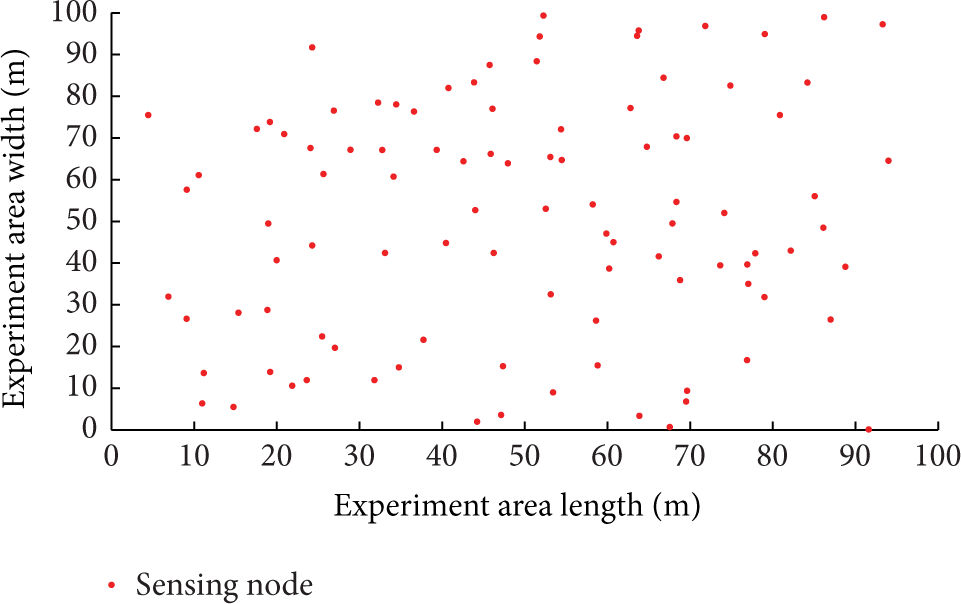
A sample secured data wireless sensor network.
For a sensor node
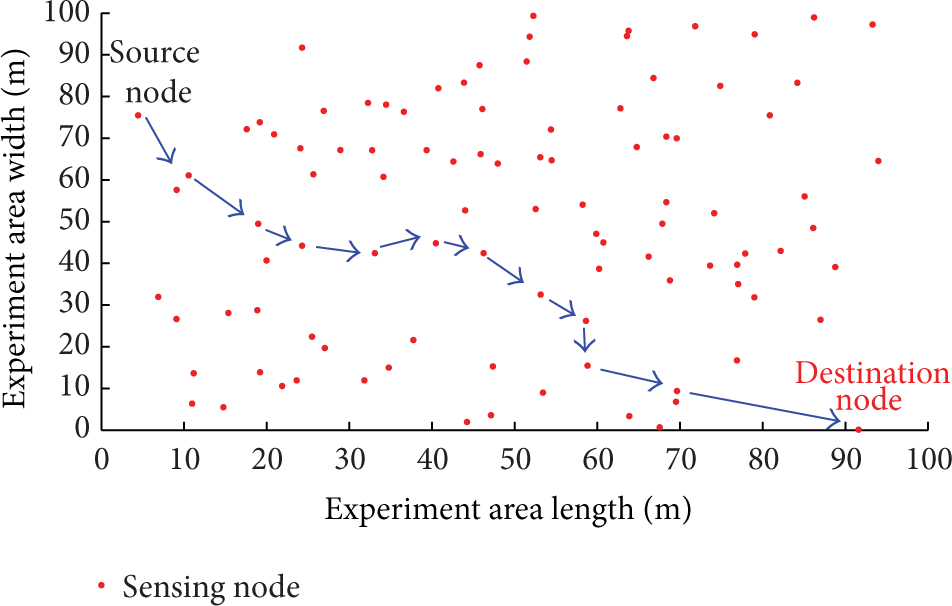
Node conveying data to others on a Hamiltonian path from source node to destination final destination node.
In addition, because switching from sleep to transmitting mode is expensive, we choose not to consider it when transmitting a packet, assuming that there is always data available for shipping. There are several operational states for each sensor node: sensing (detect), receiving (collect), transmitting (send), and forwarding the data (transfer).
Sensing or detecting: a sensor has the capability to sense some multivalue of their environment and detect incoming data as a packets format broadcasted by a given neighbor node.
Receiving: a node receives data transmitted as a packet format from a neighbor node sharing the network.
Transmitting or sending out: a node sends data as a packet format to a neighbor node sharing the network.
Forwarding or transferring: an intermediary node sharing the network transfers data received from its lower layer node (child) via its In
Furthermore, because it is not in the scope of this paper, we do not consider the radio interference from other systems nor from node to node within the system impacting the system performance (e.g., abortion, additive noise, attenuation or interference, path loss, reflections, scattering, and shadowing).
2.2. The Problem Statement
The major task of a sensors node
When referring to sensors’ resources constraints, energy and security are considered as the most crucial issues. Also we needed to tackle these two parameters jointly, but, the security issues are wireless links communications related, whereas we consider the energy to be overall network-related; also a more secured and energy saving data aggregation model could lead to solving our problem, thus “killing two birds with one stone” [12].
3. Game-Based Secure and Energy Efficient Data Aggregation
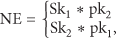
In this section we are investigating the security issues from prior art such as the game theory [6, 13], and various embodiments of methods like public-key cryptography denoted RSA [10]. Hence, the content herein models these issues in a game of two players with synchronized actions. The game only considers the one-hop relationship between players of each pair of nodes that constitute the overall system network, which means, as the data flows from a given source of event occurrence to its final destination in a given hierarchical tree structure, every step on its way; we could say that every intermediate node will form two directs, secure links, respectively, one in each direction (In-links to collect incoming data from other nodes and Out-links to transmit data out to other nodes) while collecting and forwarding data to node at higher layer (e.g., child, parent). Also each different case referring to different topologies of the game is detailed, leading to the proposed game-based secure and energy efficient data aggregation model. We used Nash equilibrium in the game's theory perspective to solve the above mentioned crucial constraints despite its unstable outcome in terms of the overall performance [6], which are justified by the fact that NE aim is noncooperative interaction between nodes. A strategy profile (
3.1. The Cooperative Game Theoretical Model Formulation
Based on the self-fulfilling belief (SFB), each player believes that everyone will play their best strategies; also they should play their own best strategies as well, because their NE is the best strategy against everyone else.
3.1.1. A Pairwise Key Security Game
A given node, say i uses the link l to flow data with


3.1.2. Game 1 Statement
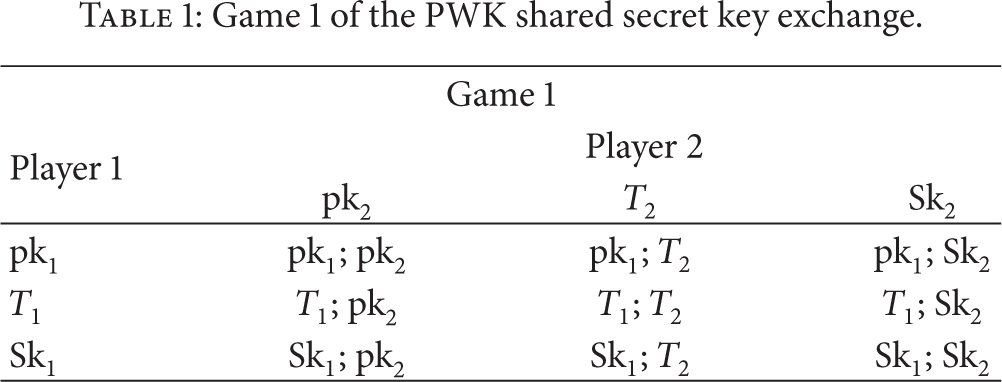
We modeled the exchange in a game between each pair of sensors, where each player has only 3 strategies, including the public key
Game 1 of the PWK shared secret key exchange.

Detailed exchange between a pair of nodes.
In addition, let us consider


3.2. Game-Based Energy Efficiency Approach
We consider two different topologies-based scenarios to illustrate our approach in terms of energy cost, assuming Game 1 results.
The single direct link between two nodes (one-hop) is shown in Figure 4.
The double links with intermediary node (two-hop) are shown in Figure 5.
Intuitively, we say that by studying expenses of one single pair, we could determine the overall network cost in terms of energy, which makes our solution trivial.

The single direct link (one-hop) between a given source node 1 and a given destination node 2.

The double links (two-hop) with node 2 as the intermediary node, which aims at conveying data from source node 1 to final destination node 3.
3.2.1. Game 2 Statement
Game 2 assumes the secure aspect of game 1, with the particularity to have three strategies for each player, amongst them sensing or detecting all incomes (public key, ciphertext, etc.), collecting (or receiving) the packet sent by another player, and transmitting or sending a packet out to nodes sharing its direct link of communication under one-hop topology. There is no egoism act in this game, but a full cooperation is assumed between players, and there is no similarity with the Prisoner's Dilemma game, because the common goal for both players is to communicate securely. Table 2 shows game 2 results, where a given sensor node i has a throughput demand of average rate

with
Game 2 energy consumption's payoff.

3.2.2. Game's Payoff from Energy Consumption
Let us consider the following values
From Table 2, we can consider the following NE existing in game 2 with full cooperation between partners given in (6) and it is obvious that the each player's power consumption is relative to its tasks (or strategy) as in (7). In addition, Figure 3 shows that, prior to proceed with any data exchange, the secure link establishment requires that each node performs two sending tasks (


Because users are decisions makers from a game theoretic perspective [16], they should be synchronized. For that matter [16] proposed to use a proper time slot to ensure the collision free transmissions, whereas the duty cycling by scattering of wakeup times is introduced in [17]. The ambiguity in game 2 results is shown in (5) and (6); thus we may not consider these as Nash equilibrium (NE), which leads us to give some exceptions conditions to Game 2. In fact Nash equilibrium is been reported to have unstable outcomes regarding the overall performance and thus might not be a suitable solution. In addition, the efficient usage of the scarce energy resource is required for the overall system lifetime and computing the payoff of a node shall be done once, due to these WSNs characteristics. We argued that our data preserving and energy saving model is an efficient strategy. And the energy efficiency is at the heart of our game theoretic problem, the common good of each player, and the main feature of our game is based on the very significant changes, because it is repeated, and the players will always interact with each other in the future. And from their relation in energy consumption, computing is cheaper than communicating. The ZigBee technology is preferred to numerous existing prototypes such as Berkeley mica mote. And ZigBee technology is able to supply a current of about 1200 mA-hours with a current draw of 35 mA when transmitting data and also 35 mA when receiving data, whereas the current consumed by the CPU is 2 μA on standby. Also the energy resulting from the PWK data exchange is as shown in Table 2. In addition, when considering each direct link's energy cost denoted by

3.2.3. Multihop Extension
This section's endeavour provides the second scenario of our study in which, we now extend our approach to more than two players, with
In fact, the two games discussed earlier are directly considered here, as the packet is forwarded from node to node toward its final destination (multihop), it will remain a two players’ game, and thus the relationship between players is exactly as described previously. This means a given node
3.2.4. Game's Payoff from Triad Perspective
Because the energy consumption is proportional to work load, one has to receive or collect first prior to perform the forwarding task; hence its overall expense includes the cost of both receiving and forwarding tasks as in (7).
In this scenario, we assume a transitive triad of nodes including node 1
3.2.5. Game 3 Statement
The exception rules as listed in Table 3 and results from game 1 and game 2 are highly considered. Also from Table 4 results, we get confirmation of Nash equilibrium's unstable outcomes. Hence we refer to (7) defining each player's energy expense accordingly to their tasks in the path such as the source, receiver, and the intermediary node or forwarder, assuming a secure link between the adjacent players.
List of exception rules for game 2.

Two players’ game with forwarding option.

Moreover, with full cooperation and collision free objective, the receiver at destination may detect the data prior to collecting it, and because an intermediary node is performing both roles, like receiving (as destination) and transmitting (as source) in the triad, thus its energy consumption is the sum of both tasks.
We know that in each pair, the relation is like a source to sink, where the source node in-degree

Also knowing that our network is homogeneous,
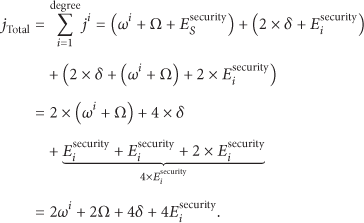
From this we could write

3.3. The GABs Algorithm
This section provides algorithmic complexity of all the overall system's computations in which, each source node i of a set
Additionally, we could compute one intermediary node payoff in order to get the basic information related to the relationship with its one-hop neighbour; then from the size of the network, we could determine the exact number of intermediary nodes thanks to PWK, in fact the payoff of an intermediary node is the sum of the payoff of the source node (its sending task) and the payoff of the final destination node (its receiving task). Also by multiplying that number of intermediary nodes by the payoff of a given intermediary, we obtain the total payoff of all intermediary nodes in a given Hamiltonian path. Algorithm 1 shows the GABs algorithm's code.
Input: Create a network with Output: The energy consumption (1) Define the source node (2) Define the neighbour node (3) Set (4) PWK = (5) If PWK = 0, then (6) End if; (7) While (8) (9) For (10) Perform Game 2 between each pair of sensor nodes and compute respect on the following rules defined in Game 2 (11) rule1; (12) rule2; (13) rule3; (14) Return (15) End Game 2 (16) For (17) Perform Game 3 between each pair of sensor nodes and compute respect on the following rules defined in Game 2 (18) rule1; (19) rule2; (20) rule3; (21) Repeat step (17)–(20) of game 3 for next pair of sensors until reaching final destination, (22) If no value changed in this iteration, then end the algorithm (23) End Game 3; (24) End while; (25) Return
4. Related Drawbacks
The study [17] proposes the wakeup scattering as a solution to lifetime issues, a model designed to generate low communication overhead with easy implementation in real WSN. Here the authors focused on the epoch period and the wakeup interval, which is related only to sensor activation time, where based on their relation, it is argued that minimizing the latency could be done with the condition to wake a parent node up in the epoch, right after its child, but not a sibling. Hence, if this solution seems somewhat energy efficient, nevertheless data are exposed to forgery which lack to ensure data privacy and integrity. The AMHED [5] proposes a star topology-based secured data aggregation which implements the elliptic curve cryptography's mathematical hardness, which values securing the data but does not emphasize network lifetime. The same observation is on another work that considers the game theory approach, but only deals with possible attacks faulty node (intruders). Because users are decision makers from a game theoretic perspective [16], they should be synchronized. Also [16] proposed to use a proper time slot to ensure the collision free transmissions, whereas the duty cycling by scattering of wakeup times is introduced in [17]. Additionally the trusted data aggregation with low energy model (TDALE) is introduced in [10] considering the energy usage and code size and performance with ECC in a tree-based topology, to satisfy the data privacy, accuracy, integrity, and efficiency discussed in [4].
5. Simulations
The simulations are opening door to interactions between the experimental observations and the theoretical framework from a simulator or modeler (e.g., OPNET modeler), which is able to interpret a given experiment using specific parameters (e.g., the parameters can be set according to a specific network topology). Also, the simulations are helping to gain the statistic of data collected from a given wireless sensor network experiment using an open source wireless sensor network simulator like OPNET discussed is this section; hence advancing the step of science is this particular field of research. In addition, these network simulators (software) give to the whole scientists community the possibility to collect and analyze qualitative and quantitative data, determining the cause-effect relationship between the network topology, the node types, the technology (e.g., ZigBee 82.15.4 MAC), the throughput, the energy, and so forth. Hence, we could defined our experimental networks adding agents (nodes), and experiment the cooperation between linked nodes aiming at energy saving, with a perfect reception at a given radius range of the sender.
5.1. The Simulation Tool
Due to different assumptions and approximations included in simulations, it is mandatory to test each of these simulations, so that we could demonstrate their respective limitations accordingly and settle their comparison characterize (e.g., we could compare the prior works AMHED and TDALE with our new approach GABs). There exist numerous network simulators (e.g., NS2, TinyOS) but we prefer to use the OPNET Modeler 14.5 (Educational version), which is an open source network simulator that offers a simulation environment for wireless sensors, as we could proceed with these simulation-based studies and do the testing mathematically. For analysis purpose, our study considers one type of node (homogeneous environment), but 3 roles defined of ZigBee devices that make a small difference between there outputs, including the following.
ZigBee Coordinator (ZC). One ZigBee coordinator in needed per network, as it is the root of the network that might bridge to other networks. And by setting up the sensible parameters for establishing a network, it stores information about the network, for example, radio-channel, and repository for security keys.
ZigBee Router (ZR). This device acts as an intermediate router, passing data from other devices and its main purpose is to extend the range of the network by acting as the relays and can act also as ZigBee end device.
ZigBee End Device (ZED). This is the very basic device, requiring very limited resources, and known cheaper than ZR and ZC and its basic functionality is to talk to its parent node (either the coordinator or a router), but it cannot relay data from other devices.
The ZED will be used as leaf nodes while ZR will be the intermediary node and the ZC assimilated to the sink.
Our goal is to reduce the energy consumption of our wireless sensor network (WSN) while ensuring its security and our study consists in comparing two different related works including the AMHED, characterized by its centric STAR topology network as illustrated in Figure 6 and the TDALE, which is a default TREE Topology-based as illustrated in Figure 7, with our MESH topology-based GABs approach, shown in Figure 8.

WSN simulation model AMHED with centric star topology.

WSN simulation model TDALE with a tree-based topology.

WSN simulation model GABs with a mesh-based topology.
5.2. The Simulation Model
Our study considers the above mentioned networks models including the MESH topology-based (GABs), and the STAR topology-based (AMHED) and the TREE Topology-based (TDALE). And we could be generating their simulations individually, prior to comparing their assessments accordingly. In fact these simulations provide us with insight into the throughput of each node which gives the increasing energy consumption of given nodes. We know that, due to its force-task relationship, reducing each node's battery usage increases the network life time and ensures its readings security.
5.3. The Simulation Settings
We consider deploying 42 nodes in a 100 m × 100 m area, in which the physical location of the center node communicating with outside world is (

Transmitters (Tx) and receivers (Rx) incorporated in a node, acting as a bundle of one of more communication channels for each node unicast.
5.3.1. Configuration of the AMHED, TDALE, and GABs Networks
Thanks to the options in the OPNET simulator environment, we could run the discrete event simulation (DES) for the Star topology-based network scenario (AMHED), for the tree-topology-based network scenario (TDALE), and for the mesh-topology-based network scenario (GABs), and their details of the reports are given, respectively, in Tables 5, 6, and 7, whereas the simulations progress reports, respectively, an average simulation speed of 969.447 event/sec for the AMHED, an average simulation speed of 751.171 event/sec, for TDALE, and an average simulation speed of 449.159 event/sec. In addition, the simulations’ results are related to the configuration of each different topology as given in Table 8.
Discrete event simulator run table report for AMHED model network.

Discrete event simulator run table report for TDALE model network.

Discrete event simulator run table report for GABs model network.
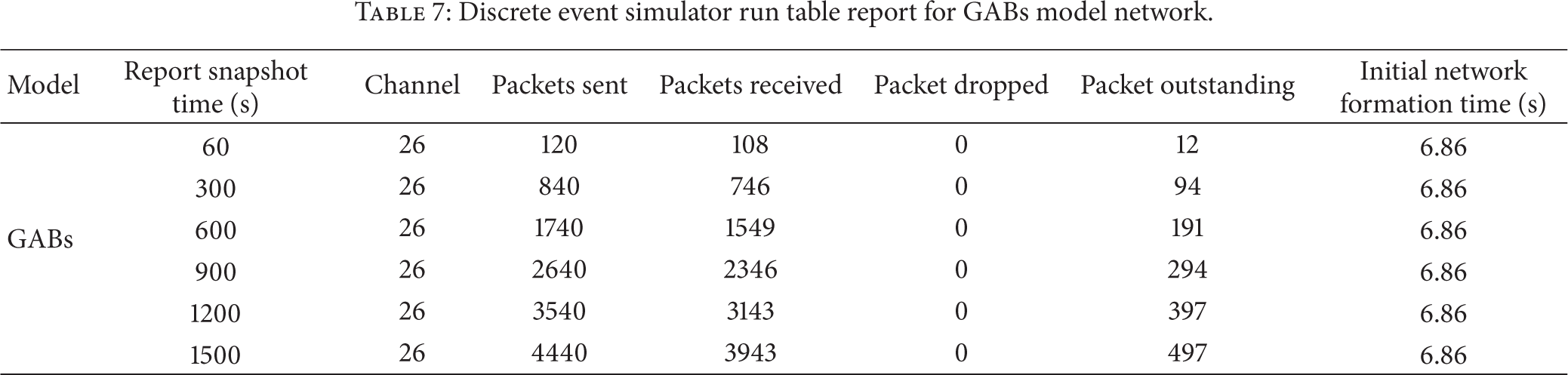
Configuration details of AMHED, TDALE, and GABs network coordinator node.

6. Simulation Assessments, Results, and Discussion
6.1. The Simulation Assessment and Results
We pay special attention to seven (7) particular assessments and their results collected from our simulations are provided accordingly, with respect to each studied network topology including star-based AMHED [5], tree-based TDALE [10], and mesh-based GABs. We used the open source OPNET modeler 14.5 to simulate all networks topology as detailed earlier, and we exported all the results in spreadsheet excel files, to ease the data analysis, and we could verify and confirm that the diagram output obtained using the OPNET simulator is identical with the diagram output obtain using the plot function in matlab. Hence, the paper presents all result regenerate by MATLAB, using data from spreadsheets excel.
6.1.1. Control Traffic Received (bits/sec)
This statistics represents the control traffic that comprises the ACKs and that is successfully received by the MAC from the physical layer in bits/sec. as shown in Figure 10.

Comparison of the control traffic sent (bits/s) between TDALE and GABs.
In fact, Figure 10 shows that the traffic received (bit/sec) by the ZigBee 82.15.4 MAC coordinator node is higher for the star-based topology of AMHED with average of 145 kbps. Here all nodes are communicating directly only with the center coordinator node (AMHED). This measured value decreases in the tree-based topology TDALE model with 22 kbps, for the communication is gradual from lower leaf node through intermediary nodes up to the coordinator node (TDAL). The lowest records 3.6 kbps are given in the mesh-based topology network GABs as shown in Figure 11. We could say that this is because as nodes are interconnected (mesh topology), only the radius coverage could limit the direct exchange between peers.
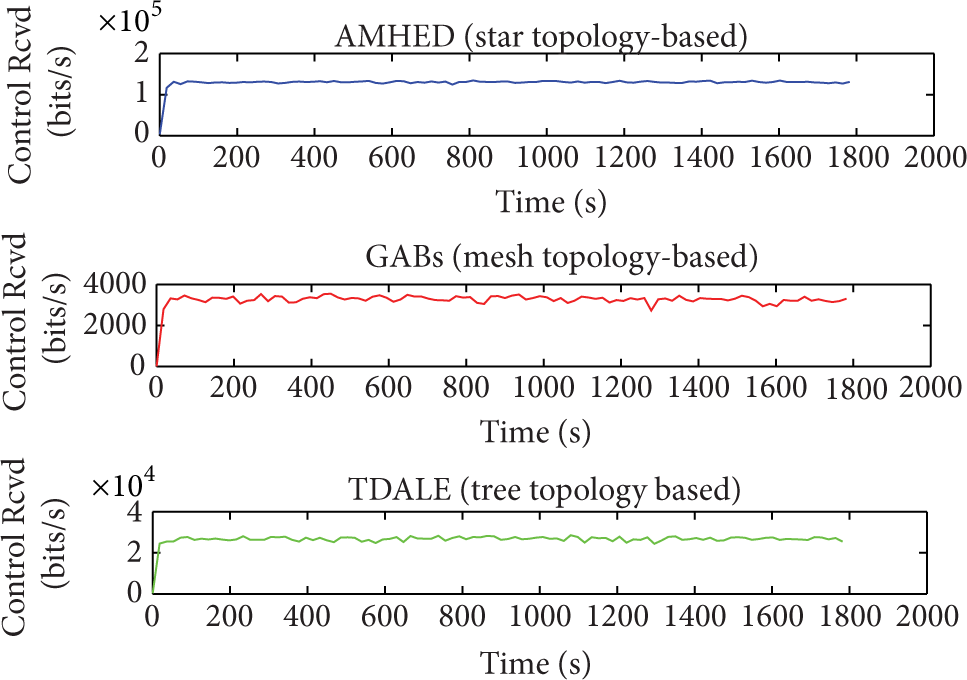
The stacked view of the control traffic sent (bits/s) between TDALE and GABs.
6.1.2. Data Dropped (Retry Threshold Exceeding) (bits/sec)
This statistic represents the parent node, or higher layer data traffic (in bits/sec), dropped by the 802.15.4 MAC due to consistently failing retransmissions. This statistic reports the number of the higher layer packets that are dropped because the MAC could not receive any ACKs for the (re)transmissions of those packets or their fragments, and the packets’ retry counts reached the MAC's retry limit. And its comparison is given in Figure 12.
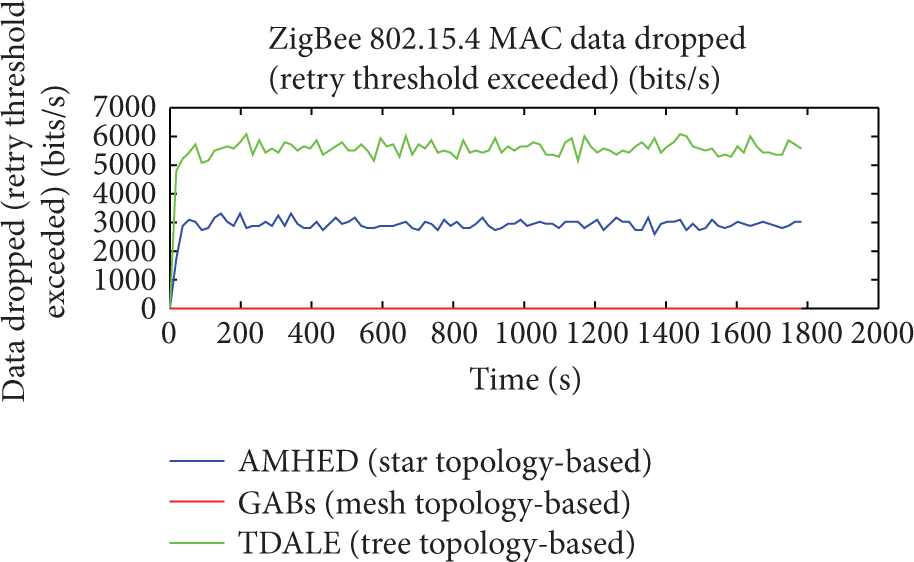
Comparison of the data dropped (retry threshold exceeded) (bits/sec) between AMHED, TDALE, and GABs; overlaid statistics presentation.
In this case, Figure 12 shows that the data dropped (retry threshold exceeding) (bit/sec) by the ZigBee 82.15.4 MAC coordinator node is higher in AMHED, but is neglected in both TDALE and GABs and value (

Comparison of the data dropped (retry threshold exceeded) (bits/sec) between AMHED, TDALE, and GABs stacked statistics presentation.
6.1.3. Data Traffic Rcvd (bits/sec)
It is essentially the traffic successfully received by the MAC from the physical layer in bits/sec, including retransmissions. The results obtained by running the discrete events simulations (DES) are compared based on each topology as shown in Figure 14 and proper numeric values are shown in Figure 15 that represents the stacked statistics presentation.

Comparing the data traffic Rcvd (bits/sec) between AMHED, TDALE, and GABs; overlaid statistics presentation.
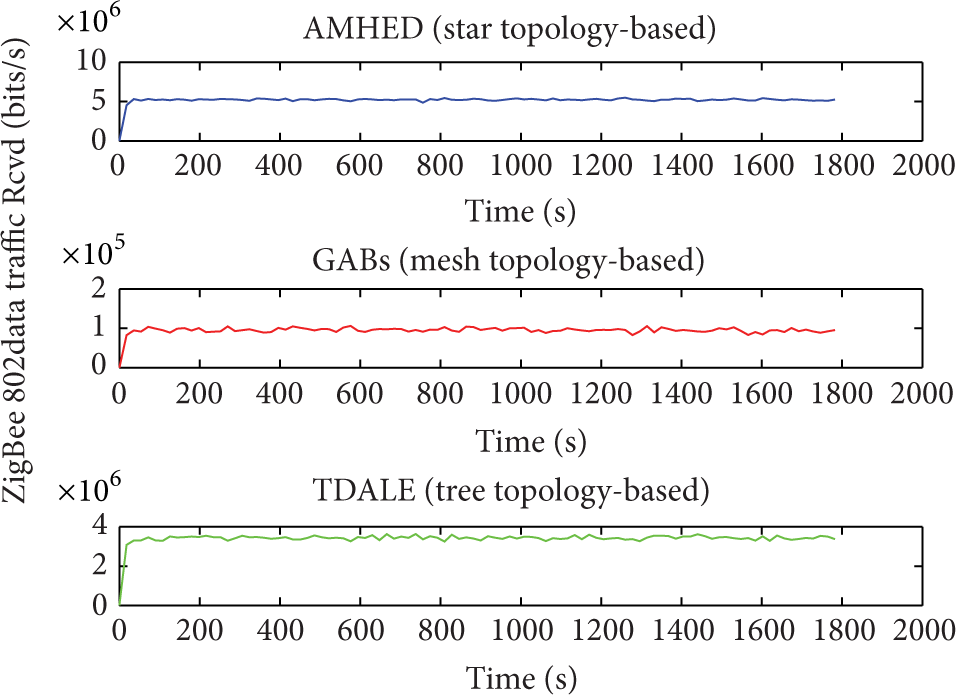
Comparing the data traffic Rcvd (bits/sec) between AMHED, TDALE, and GABs; stacked statistics presentation.
Figure 14 shows that the data traffic received (bit/sec) by the ZigBee 82.15.4 MAC coordinator node is higher in AMHED, as all nodes communicate directly only with the center coordinator node (AMHED); then referring to the tree topology-based (TDALE), Figure 15 shows that the data traffic Rcvd (bits/sec) is equal to zero that means that the communication is handled in the Hamiltonian path. But we make a different observation when referring to the mesh topology-based scenario (GABs) as the data traffic Rcvd (bits/sec) has an average value of 105 bits/sec. This is normal, because as nodes are interconnected (mesh topology), only the radius coverage could limit direct exchange between peers, thus reducing considerably the traffic on the particular coordinator node. The stacked statistics presentation of the results of these simulations as shown in Figure 15 gives the exact value of this rate including 5.000 kbps for AMHED; then it is getting about 1000 kbps in TDALE, which is 10 times higher than in GABs with 100 kbps.
6.1.4. Data Traffic Sent (bits/sec)
Traffic transmitted is by the MAC in bits/sec. While computing the size of the transmitted packets for this statistic, the physical layer and MAC headers of the packet are also included. These statistics include all the traffic that is sent by the MAC via CSMA-CA; it does not include any of the management or the control traffic, or ACKs. The comparative study of this value is given in Figures 16 and 17 representing, respectively, the overlaid statistics presentation and the stacked statistics presentation.
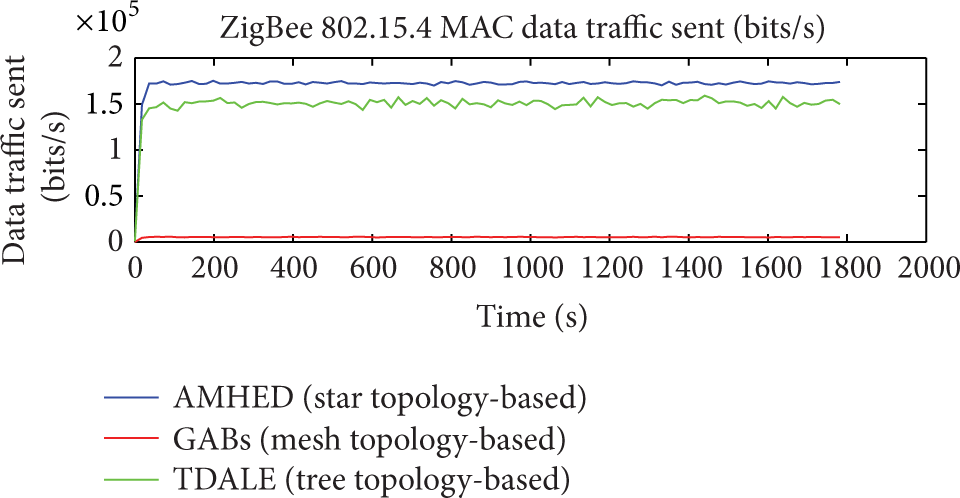
Comparing the data traffic sent (bits/sec).
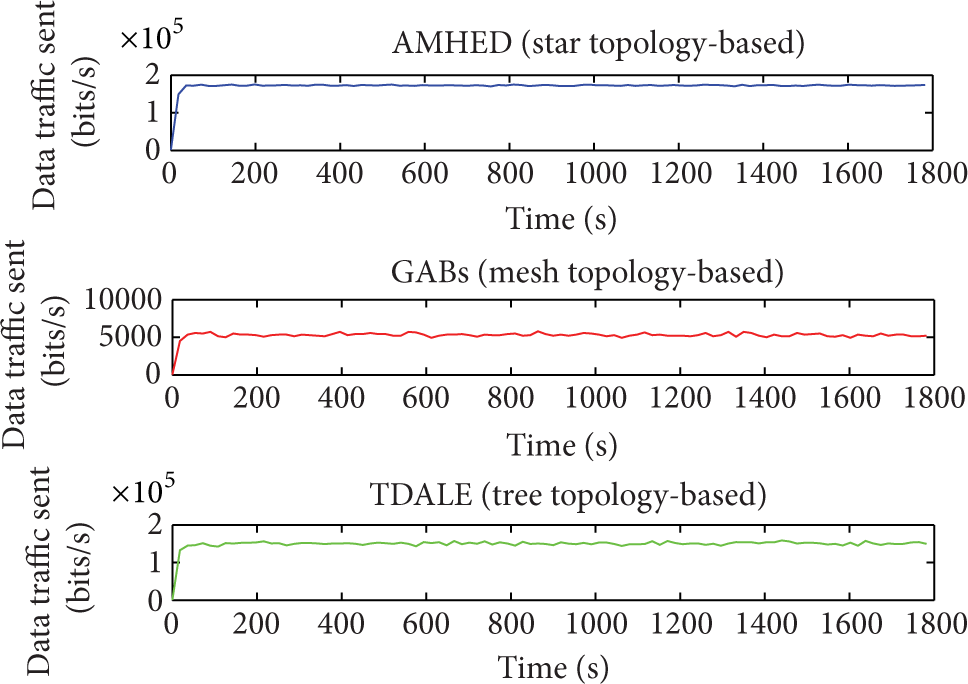
Comparing the data traffic sent (bits/sec) stacked statistics presentation.
Figure 16 shows that the broadcast rate of packets (bits/sec) by the ZigBee 82.15.4 MAC coordinator node is higher in AMHED and then in TDALE prior to giving a lowest value in GABs. In fact this rate increases considerably in AMHED reaching 175 kbps and then in TDALE with only the average of 59 kbps, which is almost 10 times the rate in GABs but it is far less important than 6 kbps as in Figure 17. This could be explained as the communication is handled gradually from lower leaf node through intermediary nodes, up to the ZigBee coordinator device.
6.1.5. Delay (sec)
The delay resent the end to end delay of all the packets received by the 802.15.4 MAC of this wireless personal area network (WPAN) node and forwarded to the higher layer. Each network model result is compared to others as shown in Figures 18 and 19.

Comparing the MAC delay (sec) between overlaid statistics presentations.

Comparing the MAC delay (sec) stacked statistics presentation.
Figure 18 reveals that the time (sec) is mostly delay by the ZigBee 82.15.4 MAC coordinator node in AMHED model at average of 0.20 s, which is almost 100 times the time delay in GABs, with 0.02 s; but there is less time delay in TDALE, that hardly reaches 0.015 s as shown in Figure 19.
6.1.6. Throughput (bits/sec)
The throughput is known as the total data traffic (in bits/sec) successfully received and forwarded to a parent node at higher layer (e.g., traffic received and forward by the 802.15.4 MAC). We consider this task force value to evaluate the energy consumption at a given node. Thanks to OPNET, the discrete event simulator (DES) was run for the Star-based, Tree-based and the Mesh-based topology and their details of the reports are given, respectively, in Tables 5, 6, and 7. In fact, Figure 20 shows that the throughput (bit/sec) by the ZigBee 82.15.4 MAC coordinator node in AMHED is exponentially elevated with a peak at 1.500 kpbs as shown in Figure 21, compared with the ZigBee 82.15.4 MAC coordinator node in the tree-based topology TDALE with a less throughput value of 49 kbps and that represents 10 times the value of the ZigBee 82.15.4 MAC coordinator node in the mesh-based topology GABs of 4.8 kbps. This is due to the fact that, in the MESH topology-based scenario, the in-degree and out-degree of a given node are up to (

Throughput (bits/sec) overlaid statistics presentations.

Throughput (bits/sec) stacked statistics presentations.
6.1.7. End to End Delay (Seconds)
The end to end delay as shown in Figure 22 represents the total delay between creation and reception of application packets as data structures generated by the given node using a ZigBee technology in the OPNET modeler environment supporting the message-oriented communications. Each packet exists as a single structure that can be modified if needed (e.g., created, modified, examined, copied, sent, received, and destroyed).
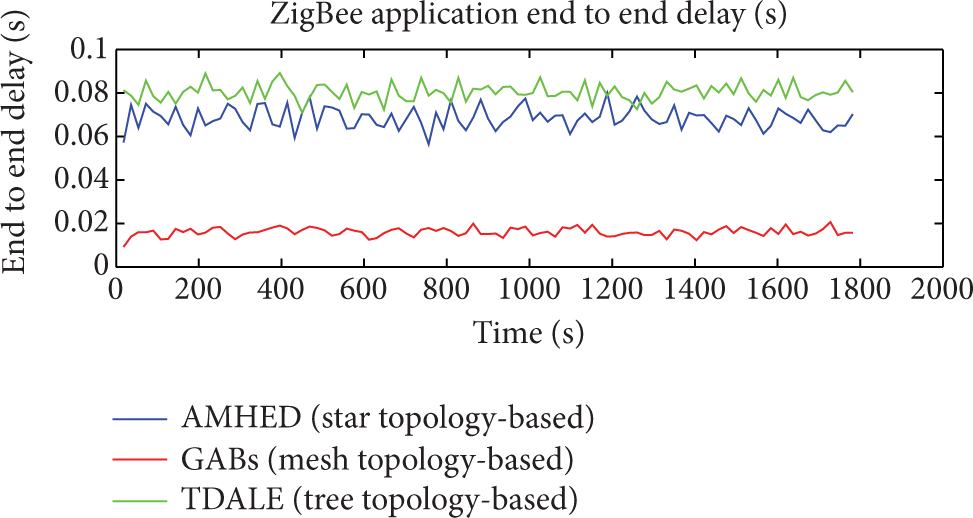
The end-to-end delay (in seconds) overlaid statistics.
In addition, the end to end delay is higher in AMHED model (min = 0.056 s; max = 0.080 s) but a bit lower in TDALE (0.040 s), and the lowest value is observed in GABs model (min = 0.010 s; max = 0.020 s), as shown by the average output result shown in Figure 23.

The end-to-end delay (in seconds) average.
6.2. Discussion
The radio signals in ZigBee 802.15.4's physical layer are modulated using the offset quadrature phase-shift keying (OQPSK) and the direct sequence spread spectrum which spread spectrum [19], consisting of “spreading” the original bandwidth of the signal into a much wider frequency range. In contrary to the multicast (one-to-many or many-to-many distribution) scenario in which data will be received by multiple nodes forming a cluster, this communication in this study is from a single node to another single node, also, our unicast model of two ZigBee players needs to be private to those two, and we represent the interaction between those two players (neighbors) by a bidirectional link

Furthermore, referring to (15) for this symmetrical case, in each path, the distance from node u to node v, each edge is counted once in one single path (e.g., it is a Hamiltonian path [10]), as given in (16). Consider


where

Substituting (1) and (15) to this leads to the following PWK probabilistic result:

In addition, each node is assumed of low degree but we highly consider hubs (highly linked nodes of high degree), with the average input voltage of 3 V on a ZigBee node (ZC, ZR, and ZED) supplying a current of about 1200 mA-hours, assuming that there is always data to transfer; we can easily verified the energy consumed for transmitting and receiving a size θ-bit of data (

Substituting these to (9) leads to

Considering that each node has the same initial battery value at deployment time, thus in a triad, the ZR forwarding data seams to run short of energy before the ZC receiving data (destination) and the ZED sending node (source). Hence it is obvious that a node at source may still be able to send data as packets, whereas the intermediary node that is supposed to relay data could die, while the node at destination is still expecting data packets, thus ending the communication as shown in Figure 24, as the transmission of data in 10 s simulation.

Energy level over 10 s per node's role.
7. Conclusion
The study considers the ZigBee known as IEEE 802.15.4 standard, thanks to its high trustworthiness and low power consumption in wireless sensor network. The paper endeavors to provide a secure and energy efficient data aggregation modeled in a two player's game theory (The GABs), and this study analyses, from a context background of various embodiments of methods (such as the AMHED and the TDALE) cited in the references. In addition, the game theory highlighted, has been previously utilized in others works (such as in [3] and in [8]), that we considered as prior art, unless stated otherwise. Also, the game theory is a trivial method for security and energy efficiency studies. The study compares the mesh-based GABs with other studies like the star-based topology AMHED and the tree-based topology TDALE. And it has shown that data privacy is ensured while being aggregated in the network, where the cooperation between players is mandatory to ensure complete secrecy. We know that the energy consumption by a given node is related to its tasks or it status (e.g., sending, receiving, and forwarding). More importantly, the results from the discrete event simulator run in OPNET show that star-based topology networks AMHED appears more energy expensive than the tree-based topology TDALE, which is also more expensive than the mesh-based topology GABs. This is because the intermediary node within a given Hamiltonian path from a source node to destination runs short of energy before their parent and their child nodes. We claim that a proper routing based on node's energy level to determine a sender next hope could solve considerably the overall network lifetime.
For future works, one could consider repeating this study to undergo the secured routing in data aggregation by modeling it, in a game-based approach, introducing the receiving node's energy level as an important parameter, which may determine in the path the next hope of the data being sent.
Footnotes
Conflict of Interests
The authors declare that there is no conflict of interests regarding the publication of this paper.
Acknowledgments
The work presented in this paper is supported by Beijing Science and Technology Program under Grant Z121100007612003, Beijing Natural Science Foundation under Grant 4132057. This work is also supported by the Agence Nationale des Bourses du Gabon (ANBG) under Grant OP 890/2014.