




Abstract
Comprehensive evaluation of energy efficiency of protocols under certain cost conditions is a relatively new and ill-defined concept for collaborative wireless sensor networks (CWSN). In this paper, multicriteria decision making (MCDM) theory is introduced into comprehensive evaluation of energy efficiency of clustering protocols, which is the predecessor of collaborative protocols. Parameters about energy efficiency of total network, including cost and benefit parameters, are selected to construct a metrics system for the comprehensive evaluation. Technique for order preference by similarity to ideal solution (TOPSIS) without criterion weight is proposed as the method of MCDM, and it can be used to select most efficient scheme among many schemes. The experimental results show that the proposed method is effective and can be used in CWSN protocol selection and deployment of nodes.
1. Introduction
Energy efficiency is a major challenge for CWSN [1]. The energy of nodes is strongly limited [2] and battery charging is uneasy. Thus it is of great importance to improve the energy efficiency of CWSN. Energy efficiency of CWSN depends on routing protocols [3] to a large extent, and clustering protocols are original collaborative protocols. We limit our discussion only to the analysis and evaluation of energy efficiency of clustering protocols with certain deployment and energy.
Previously, energy efficiency of CWSN clustering protocols was discussed by parameters, respectively, under the same cost condition and mostly by the curves of parameters. Heinzelman et al. presented the advantages of LEACH and LEACH-C by the curve of amount of data over amount of energy dissipation, the curve of amount of data over time, the curve of number of alive nodes over time, and the curve of number of alive nodes over amount of data [4]. The metrics of energy efficiency [5] included energy consumption, average energy, standard deviation of energy, throughput, and energy balance, but these metrics were analyzed, respectively. Network size, message overhead, energy overhead, residual energy, and convergence time were also, respectively, used to discuss the energy efficiency of clustering protocols [6]. Darabkh et al. investigated how the sensor density affected the performance of clustering algorithms [2]. Georgios et al. showed the comparison between SEP protocol and other protocols by parameters such as number of alive nodes and number of throughput [7]. Younis and Fahmy, respectively, selected number of nodes, round when all nodes die, and distance from sink to describe the energy efficiency of HEED protocol [8]. Network lifetime and network size were important parameters for energy efficiency comparison, and every comparison was implemented by parameters, respectively, under the same cost conditions [9, 10].
Comprehensive evaluation of energy efficiency of clustering protocols is a novel concept, and it could evaluate energy efficiency of clustering protocols comprehensively. This evaluation is different from analysis based on certain parameters, respectively, under the same cost condition. In this paper, energy efficiency is comprehensive performance concerning parameters such as lifetime, energy consumption, and valid data received by base station for clustering protocols. Also, energy efficiency in this paper is different from the ratio between total energy consumption over the number of packets received by the sink-node [5], ignoring the lifetime of network. Parameters that can easily quantify energy efficiency of clustering routing protocols are selected for comprehensive evaluation. Some physical parameters such as latency, fault tolerance [11], and delay [12] applied in complex protocols are not considered in this paper. The selected parameters could be classified into cost parameters and benefit parameters. Moreover, these parameters may be conflicting criteria.
Multicriteria decision making (MCDM) has been widely used in evaluating, selecting, or ranking a finite set of decision schemes characterized by multiple and usually conflicting criteria [13]. Chamodrakas and Martakos [14] introduced fuzzy set representation TOPSIS into access network selection, and the evaluation schemes were access technologies running in one terminal (sensor node). Shi and Zhu put forward a network selection algorithm, intending to select access network technology by multiple attribute decision making (MADM) and group decision making (GDM) [15]. TOPSIS method, one of MADM or MCDM methods, was used to select cluster heads [16], and the schemes were sensor nodes. Comprehensive evaluation of energy efficiency based on MCDM theory for clustering protocols is a fairly new study. Multiple parameters about energy efficiency of clustering protocols are considered as multicriteria in MCDM. One clustering protocol running in network with certain cost parameters is taken as one scheme. We use a novel TOPSIS method without criterion weight to select best efficient scheme. This method is different from the ones based on TOPSIS with criterion weight in [13, 14].
Clustering protocols such as LEACH [4], LEACH-C [4], SEP [7], and HEED [8] are original collaborative protocols, whose energy efficiency can be presented easily. There are obvious differences between the four protocols: cluster heads are selected by comparing a generated number with threshold in LEACH, LEACH-C uses a centralized clustering algorithm, then SEP consumes the extra energy of advanced nodes, and cluster head selection for HEED is determined by residual energy of each node and intracluster communication cost. The four protocols are pioneering clustering routing approaches for wireless sensor networks (WSNs). Their basic ideas have inspired many subsequent clustering routing protocols. Therefore, we select them as examples for energy efficiency comprehensive evaluation of clustering protocols in this paper. These clustering protocols will run in all network nodes, not in one sensor node as [14]. Thus, comprehensive evaluation schemes in our research are totally different from access technologies in [14].
Comprehensive evaluation of energy efficiency can be used to find which protocol is the best scheme regarding the energy efficiency among many selected clustering protocols under the same cost conditions, under which cost condition among selected conditions one protocol is optimal on energy efficiency, and which scheme is the best among different clustering protocols under different cost conditions. This paper will mainly focus on the above three works.
The main contributions of this paper could be summarized as follows:
The rest of this paper is organized as follows: a metrics system for comprehensive evaluation is constructed in Section 2. Section 3 introduces MCDM theory into comprehensive evaluation and proposes a method based on TOPSIS without criterion weight for the comprehensive evaluation of clustering protocols. Simulations and discussion for the novel comprehensive evaluation of clustering protocols based on TOPSIS without criterion weight are shown in Section 4. And conclusions are drawn in Section 5.
2. Metrics System for Evaluation
The sensor nodes are randomly distributed under the conditions described by different cost parameters in this paper. The simulation time is divided into rounds as [4]. The radio energy dissipation model [4] is used in this paper. And the values of parameters about energy dissipation for simulations are listed in Table 1.
Parameter about radio energy dissipation model.

The radio energy dissipation model and parameter values in Table 1 are also used in Section 4.
2.1. A Parameter to Measure Fluctuation of Clustering Protocols
In the applications of the clustering protocols such as LEACH, LEACH-C, SEP, and HEED, massive sensor nodes are deployed in the region randomly, leading to the fluctuation of network. The fluctuation refers to the variation of benefit parameters in repeated experiments. Cluster heads are selected by comparing a randomly generated number with a threshold for LEACH, LEACH-C, SEP, and HEED. The randomness in cluster head selection also aggravates the fluctuation of a protocol in the network.
To study the fluctuation of a certain protocol, we simulate LEACH three times under the same conditions. The parameters are set as in Table 2.
Parameters used in 3 repeated simulations of LEACH.

Figure 1 shows the curve of number of alive nodes over rounds for LEACH in three simulations under the conditions described in Table 2.

Fluctuation of number of alive nodes for LEACH in 3 repeated simulations.
The fluctuation of benefit parameters for LEACH protocol under the same cost conditions described in Table 2 is presented in Figure 1. Number of alive nodes in several sampling rounds is shown in Table 3. The numbers vary between simulations, especially after the first dead node appears in Figure 1.
Some of the results in three simulations for fluctuation of number of alive nodes.

Figure 1 and Table 3 show the fluctuation of parameters in three multirounds simulations. The larger the number of simulations is, the more accurately the simulation results present the fluctuation.
The standard deviation of benefit parameters (SDP) in multirounds simulations is helpful in describing the fluctuation performance of parameters, and it can describe the fluctuation performance of a protocol running under certain conditions. We choose standard deviation of round at which the first dead node appears (SDRFDN) to represent the fluctuation performance of a protocol under certain conditions. The larger the SDRFDN is, the worse the protocol performs with a heavier fluctuating.
In Figure 1, the first dead node in the first simulation for LEACH appears at round 105, in the second simulation it appears at round 103, and in the third simulation it appears at round 109. Thus we can calculate that the SDRFDN for the three simulations is 3.0551. This SDRFDN represents the fluctuation performance of LEACH in the three simulations under the cost conditions described as Table 2. The larger the SDRFDN is, the more aggravated the fluctuation is.
2.2. Metrics System for Comprehensive Evaluation of Clustering Protocols
The comprehensive evaluation intends to select optimal scheme among different protocols with certain initial energy and nodes deployment. Same as the flood risk analysis [17], a system of metrics for comprehensive evaluation will be constructed as in Figure 2. And the parameters in Figure 2 are as follows.
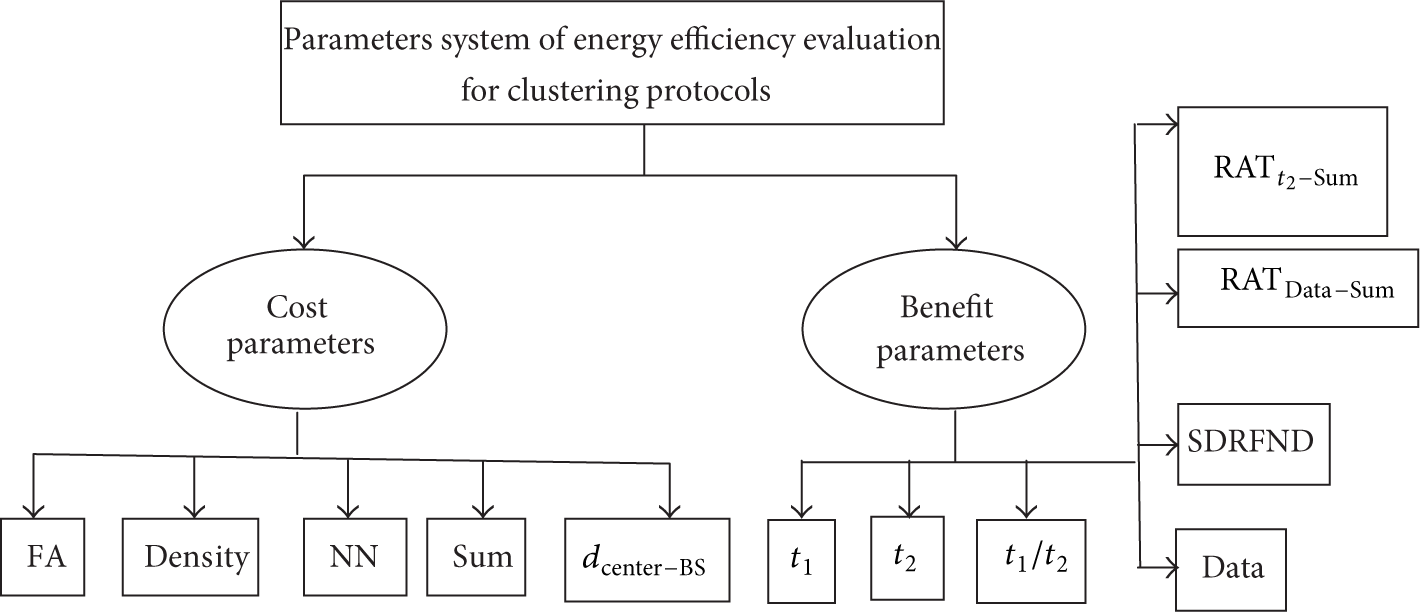
A metrics system for comprehensive efficiency performance of clustering protocols.
FA is the area of the rectangular field in which sensor nodes are distributed. It is a cost parameter.
Density is density of sensor nodes distributed in the field. It is a cost parameter.
NN is the number of all nodes distributed in the field at the beginning of network lifetime. It is a cost parameter.
Sum is the sum of all nodes' initial energy. It is a cost parameter.
Data means the total bits of effective data received by the base station at
SDRFDN is the standard deviation of the round at which the first dead node appears (standard deviation of
We can consider one protocol under certain cost conditions as one scheme or objective for evaluation, and take its corresponding parameters as criteria in MCDM. Therefore, the comprehensive evaluation of clustering protocols' energy efficiency performance could be MCDM problems.
3. Method of Comprehensive Evaluation for Collaborative Protocols
3.1. MCDM Methods for Comprehensive Evaluation
Currently, a number of practical MCDM methods are employed for comprehensive evaluation in existing researches. Synthetic scored method, analysis hierarchy process (AHP), gray correlation method, fuzzy evaluation method, and TOPSIS are in the list. Synthetic scored method is based on experts grading method. Indexes are selected and graded by scores. Objectives are selected by accumulative score. This method has very simple procedures but can only be applied to static evaluation. Analytic hierarchy process (AHP) is a structured technique for organizing and analyzing complex decisions. Based on mathematics and psychology, it was developed by Thomas L. Saaty in the 1970s and has been extensively studied and refined since then [17]. The gray relational analysis [18] is based on the degree of difference of development trends between one scheme and the ideal scheme. If the trend of change between the scheme and the ideal scheme is consistent, they have a strong relationship. Otherwise, the relational grade is small. Fuzzy evaluation method is a method of comprehensive evaluation based on fuzzy mathematics. According to fuzzy membership degree theory, a comprehensive evaluation for the objectives restricted by various factors can be made. Technique for order preference by similarity to ideal solution (TOPSIS) was firstly proposed by Hwang and Yong in 1981. It is a common decision making method for finite schemes, contained in multiple criteria decision making (MCDM) [17–19] methods. TOPSIS is widely applied in multiobjective decision problems.
Comparing with other methods, TOPSIS is simple and has no special requirements on the data. Therefore, TOPSIS is chosen for comprehensive evaluation of energy efficiency of protocols in CWSN in this paper.
3.2. Procedure of Method Based on TOPSIS without Criterion Weight for Evaluation in WSNs
Data processing in TOPSIS without criterion weight employs normalization and direction modification to eliminate the effect of different dimensions and make full use of primary information of data. The processed data could sufficiently reflect the difference on performance of each scheme. TOPSIS has advantages of reality, intuition, and reliability. Moreover, the method has no special requirement on sample data. Therefore, TOPSIS without criterion weight could satisfy the comprehensive evaluation of clustering protocols in CWSN. And the procedure of proposed method is as follows.
Step 1 (construct the decision matrix).
Assume that the problem of evaluation is based on m schemes 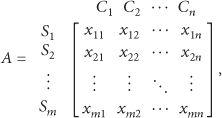
Step 2 (direction modification).
The less the cost parameters are, the better the energy efficiency is. Conversely, the larger the benefit parameters are, the better the energy efficiency is. Cost parameters are transformed into benefit parameters, as well as SDRFDN. Consider

Matrix
Step 3.
Normalize the decision matrix B, because dimensions for each parameter are different and difference on magnitude may be huge. Matrix B is normalized to 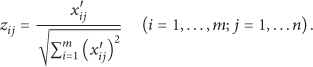
Step 4.
Determine the positive ideal and negative ideal solutions, respectively, [19]:


Step 5.
Compute the distances of the existing schemes from the positive ideal and negative ideal solutions as [20]. 

Step 6.
Calculate the relative closeness to ideal schemes [20]:

Step 7.
Rank the schemes according to relative closeness to the ideal schemes. The bigger the
4. Experiment Results
In previous researches, analysis of energy efficiency performance of clustering protocols employs parameters commonly and respectively. In this paper, the analysis in previous work is regarded as traditional analysis. The comparison between comprehensive evaluation and traditional analysis will be made.
We assume that the sensors are randomly distributed in the field and are not mobile, and the coordinates of the sink and the dimensions of the sensor field are known. The experiments will be divided into three parts, as mentioned in Section 1. The three parts are organized as follows: evaluations for different protocols under the same cost condition are proposed in Section 4.1; evaluations for one protocol under different cost conditions are introduced in Section 4.2; and evaluations for different protocols under different cost conditions are described in Section 4.3.
The parameters about radio energy dissipation model in Section 4 are the same as Table 1 in Section 2 [4]. The parameters in metrics system proposed in Section 2 are applied in comprehensive evaluation. Regarding the radio energy dissipation model [4], we set the length of rectangular region longer than
We simulate every scheme 100 times by Matlab. The average of 100 values of one parameter in 100 repeated simulations is considered as the result of the parameter. And then the comprehensive evaluation of one scheme could be developed by the method based on TOPSIS in Section 3 from these cost and benefit parameters.
4.1. Evaluation for Different Clustering Protocols under the Same Cost Conditions
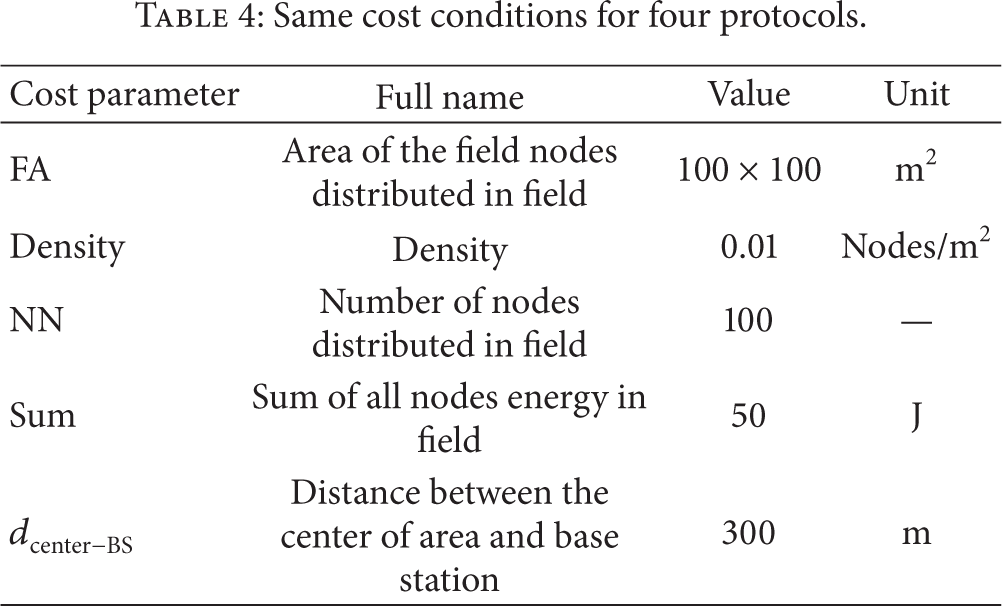
We evaluate the energy efficiency of three protocols LEACH, LEACH-C, and HEED with the same cost parameters to find the most efficient one. Every protocol under certain conditions is simulated 100 times by Matlab. And values of cost parameters are in Table 4.
Same cost conditions for four protocols.
SEP protocol could not be used for this evaluation, because a percentage of the population of sensor nodes is equipped with additional energy resources [7]. It is difficult to equip the cost conditions of SEP same as LEACH, LEACH-C, and HEED.
m schemes (objectives) mean three different clustering protocols under the same cost condition, and n criteria include total of twelve parameters of cost and benefit. The values of seven benefit parameters in Figure 2 are from simulations by Matlab.
The conditions for simulation could be described as Table 4. Value of parameter FA describes the size of the field in which the sensor nodes are distributed. Both its length and width are 100 meters.
4.1.1. Traditional Analyzing
The traditional analyzing of the energy efficiency performance of clustering protocols is based on the curves of respective benefit parameters under the same cost condition.
Curves of number of alive nodes over rounds are shown in Figure 3. Curves of amount of data received by base station over rounds are shown in Figure 4. Curves of amount of energy consumption over rounds are shown in Figure 5. And curves of amount of data received by base station over amount of energy consumption are shown in Figure 6.

Number of alive nodes over time for LEACH, LEACH-C, and HEED.

Amount of data received by base station over time for LEACH, LEACH-C, and HEED.

Amount of energy consumption over time for LEACH, LEACH-C, and HEED.

Amount of data received by base station over amount of energy consumption for LEACH, LEACH-C, and HEED.
We can see that LEACH and HEED are better than LEACH-C from the round when first invalid node appears in Figure 3. Accordingly, from the round when all nodes die in Figure 3, we can see LEACH is better than LEACH-C and LEACH-C is better than HEED. Another point can be spotted that each curve intersects one another at least once in Figure 3.
Figure 4 shows the curves of data received by base station over rounds, which also intersect each other. As it is shown in Figure 4, LEACH performs better than HEED, and HEED performs better than LEACH-C.
According to curves of amount of energy consumption over rounds in Figure 5, amount of energy consumption of LEACH is least, and curves for HEED and LEACH-C intersect each other too. Therefore, it is difficult to find which protocol outperforms others.
Figure 6 shows the curves of bits of effective data received by base station over energy consumption for three protocols. According to Figure 6, LEACH is better than HEED, and HEED is better than LEACH-C.
The conclusion can be presented that protocols' efficiency evaluation based on respective parameters is unilateral and one-sided, from analysis and comparisons above. Hence, it is with great difficulty to select the most efficient protocol among these protocols under the same conditions because of the conflict among different criteria. It is extremely necessary to put forward the comprehensive evaluation of energy efficiency performance of protocols in network. This evaluation could select the most efficient scheme among many schemes as per multicriteria decision marking theory.
4.1.2. Comprehensive Evaluation Based on Proposed TOPSIS
Values of benefit criteria.

We can see that LEACH performs better than others on some parameters but worse than LEACH-C and HEED on the parameter
Calculation procedure is as steps of TOPSIS without criterion weight in Section 3.2. Relative closeness for each scheme and the ranking of schemes are presented in Table 6.
Relative closeness for each scheme and its ranking.

In Table 6, the relative closeness of LEACH is the biggest and nearest to positive ideal solution. So LEACH is the best among three protocols. LEACH is better than HEED, and LEACH-C is the worst regarding the comprehensive performance of energy efficiency of protocols.
We can see from the comparison that the most efficient protocol can be selected out from many protocols under the same cost conditions via comprehensive evaluation method based on TOPSIS without criterion weight, which cannot be achieved via the traditional analyzing. Therefore, the comprehensive evaluation proposed outperforms traditional analysis on protocol selection.
4.2. Evaluation for the Same Protocol under Different Cost Conditions
LEACH, LEACH-C, SEP, and HEED protocols are selected as examples for the comprehensive performance evaluation, intending to find the optimal condition for one protocol among different cost conditions. Every protocol under certain conditions is simulated 100 times by Matlab.
SEP protocol could be used for this evaluation. And 10% of all nodes are equipped with one time more energy resources than other nodes.
m schemes mean m conditions for one clustering protocol, and n criteria include total twelve parameters on cost and benefit.
Although the parameter
Different cost criteria for one protocol.

Because the cost conditions are different, the traditional analysis based on respective parameters has difficulty in finding the optimal cost condition, under which the protocol could obtain the best comprehensive performance of energy efficiency. The comprehensive evaluation based on TOPSIS without criterion weight is an effective method to select the most efficient cost condition for one protocol.
Different cost conditions are described by the parameters such as NN, Density, FA, and Sum in Section 2. And the values of these parameters are listed in Table 7.
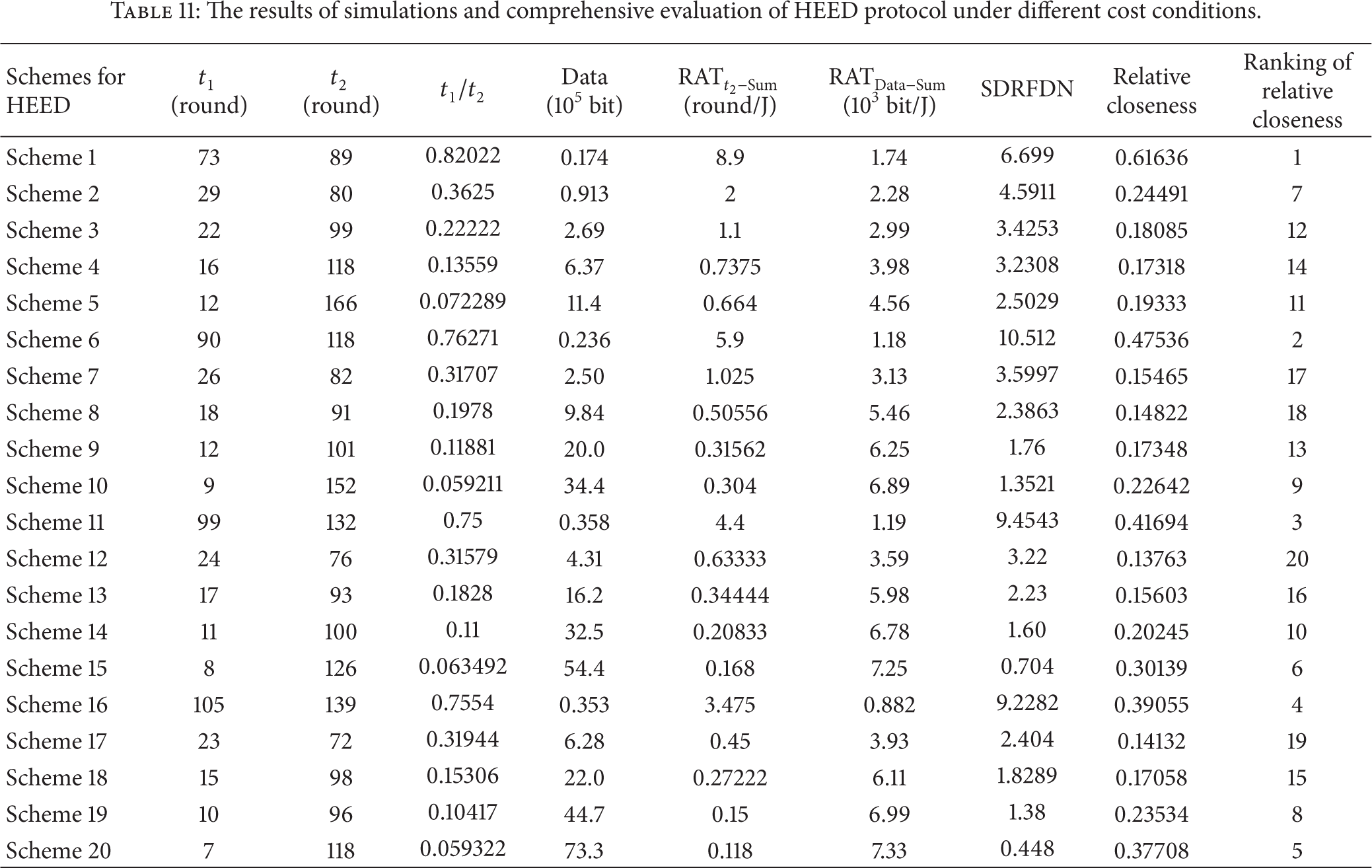
Relative closeness is calculated by TOPSIS without criterion weight. Under cost conditions described in Table 7, the values of benefit parameters, relative closeness, and the ranking of relative closeness are listed in Table 8 for LEACH protocol, in Table 9 for LEACH-C protocol, in Table 10 for SEP protocol, and in Table 11 for HEED protocol.
The results of simulations and comprehensive evaluation of LEACH protocol under different cost conditions.

The results of simulations and comprehensive evaluation of LEACH-C protocol under different cost conditions.

The results of simulations and comprehensive evaluation of SEP protocol under different cost conditions.

The results of simulations and comprehensive evaluation of HEED protocol under different cost conditions.
In Table 8, we could find that scheme 1 is the best on parameters such as
The comprehensive evaluations of other clustering protocols are the same as LEACH protocol.
We can find that scheme 1 is the best condition for LEACH-C protocol among 20 schemes, and scheme 8 is the worst from ranking of relative closeness in Table 9.
We can find from ranking of relative closeness in Table 10 that scheme 1 is the best condition for SEP protocol on energy efficiency performance among 20 schemes, and scheme 13 is the worst.
We can find from ranking of relative closeness in Table 11 that scheme 1 is the best condition for HEED protocol among 20 schemes, and scheme 12 is the worst.
The conclusion that the method based on TOPSIS without criterion weight is preferable in selecting the best cost conditions for one protocol's energy efficiency performance can be gotten from the results of simulations and comprehensive evaluation of LEACH, LEACH-C, SEP, and HEED protocols. Therefore, the proposed algorithm can be used in node deployment.
4.3. Evaluation for Different Clustering Routing Protocols under Different Cost Conditions
It is a new study to find which scheme is the best among different clustering protocols under different cost conditions. This study introduces a method based on TOPSIS without criterion weight into comprehensive performance evaluation of different clustering protocols under different cost conditions.
SEP protocol could be used for this evaluation too, and 10% of the nodes are equipped with one time more energy resources than other nodes.
m schemes include different protocols under respective cost condition, and n criteria include total twelve parameters on cost and benefit. We select 20 schemes for this evaluation. And the values of cost parameters are listed in Table 12. The values of seven benefit parameters are from simulations by Matlab.
Schemes' cost conditions setting for evaluation of different protocols under different cost conditions.

Because the cost conditions are different for evaluation of schemes, the traditional analysis could not comprehensively describe the performance of clustering protocols, which means it is incapable to find the optimal scheme among different protocols under different cost conditions. The comprehensive evaluation based on TOPSIS without criterion weight is an effective method to select the best scheme among different clustering protocols running under different cost conditions. The cost conditions of 20 schemes are listed in Table 12. Each scheme is one protocol under some variable cost conditions.
Relative closeness of these schemes is calculated by the method of TOPSIS without criterion weight. The values of benefit parameters, relative closeness, and the ranking of relative closeness are listed in Table 13.
The results of simulations and comprehensive evaluation of different protocols under different cost conditions.

We could find the best scheme among 20 schemes presented in Table 12 by comprehensive evaluation for different clustering protocols under different cost conditions in Table 13. Scheme 21 is the best among 20 schemes, and scheme 37 is the worst. So the method based on TOPSIS without criterion weight is a useful way to find the best scheme among all candidate schemes, which are different clustering protocols under different conditions. Therefore, the proposed algorithm can be used in scheme selection.
5. Conclusions
Energy limitation is a focal point for CWSN applications. Protocols have significant affection on energy efficiency of CWSN. This paper proposes a new concept of comprehensive evaluation for energy efficiency of protocols and introduces an approach based on TOPSIS without criterion weight into this comprehensive evaluation. Original collaborative protocols LEACH, LEACH-C, SEP, and HEED are selected to comprehensively evaluate the energy efficiency under certain cost conditions. Simulation results show that this approach based on TOPSIS without criterion weight is effective and can be taken into full use in three kinds of applications:
Footnotes
Conflict of Interests
The authors declare that there is no conflict of interests regarding the publication of this paper.
Acknowledgments
This research is supported by the National Natural Science Foundation of China (NSFC) (Grant no. 51079057) and the Key Project of National Natural Science Foundation of China (Grant no. 51039005).