There is an increasing demand of an anonymous authentication to secure communications between numerous different network members while preserving privacy for the members. In this study, we address this issue by using an ID based authenticated and key agreement protocol to improve the recent protocol proposed by Xue et al. They claimed that their protocol could resist masquerade and insider attacks. Unfortunately, we find that Xue et al.'s protocol is not only really insecure against masquerade and insider attacks but also vulnerable to off-line password guessing attack. Therefore, a slight modification to their protocol is proposed to improve their shortcomings. Moreover, our protocol does not use timestamps, so it is not required to synchronize the time. As a result, according to our performance and security analyses, we can prove that our proposed protocol can enhance efficiency and improve security in comparison to previous protocols.
1. Introduction
With the rapid growth of network technology, user authentication plays an important role in achieving the dependable network environments. When we enjoy online shopping, online game, on line documentation, data exchange, and so forth, identity authentication is a basic protection measure to authenticate the identity of remote users [1]. Since Lamport [2] first protocol was shown in 1981, numerous protocols have been proposed and used in many communication systems [3–7]. In 2000, Hwang and Li [8] proposed a new remote user authentication scheme using smart card based on ElGamal's public key cryptosystem. However, their scheme is inefficient because of high communication and computation costs. In order to remedy the security problems and to reduce the communication and computation costs, a large number of smart cards based authentication schemes using one way hash function have been investigated [9–14].
Traditionally, password authentication is mostly considered in single server environment where it has not been efficiently solved in a multiserver based environment. In addition, not only does each user need to log into different remote servers repetitively but also it needs to remember many various sets of identities and passwords if he wants to access these services. In order to solve this problem, different protocols have been suggested to access the resources of multiserver environments. In 2009, Hsiang and Shih [15] proposed a one-way hash function based remote authentication protocol for multisever environment. Later, Sood et al. [16] showed that Hsiang et al.'s protocol could not resist stolen smart card and replay and impersonation attacks and then they proposed an improved protocol. Unfortunately, Li et al. [17] pointed out that Sood et al.'s protocol was susceptible to stolen smart card and replay attacks and was not able to provide key agreement phase. Li et al. also proposed a modified version of Sood et al.'s protocol so as to remedy the security deficiencies. Recently, Xue et al. [18] showed that Li et al.'s protocol was still vulnerable to eavesdropping and replay and forgery attacks. To remedy the weaknesses of Li et al.'s protocol, they proposed a one-way hash based authentication and key agreement protocol for multiserver architecture, which was claimed to resist many kinds of attacks. However, through careful analysis, we found that Xue et al.'s protocol had some critical security pitfalls and is insecure for practical applications.
In this paper, we analyze a novel multiserver authentication protocol proposed by Xue et al. We show that the protocol suffers from masquerade, off-line password guessing, and insider attacks. In order to overcome these security weaknesses, a slight modification to their protocol is proposed to improve their shortcomings. Moreover, our protocol employs random numbers instead of timestamps to avoid time synchronization. As a result, according to our performance and security analysis, we can prove that our proposed protocol is able to enhance efficiency and improve security in comparison to previous protocols.
The rest of paper is organized as follows. In Section 2, we review Xue et al.'s protocol and Section 3 shows the security weaknesses of Xue et al.'s protocol. In Section 4, we propose a new enhancement authentication protocol for multisever environment to overcome these security weaknesses. In Section 5, we present analysis of our protocol. Section 6 shows the performance and functionality comparison among the proposed protocol and other related ones. We conclude in Section 7.
2. Review of Xue et al.'s Protocol
In Xue et al.'s protocol, there are three participants, user , service providing servers , and control server , and four phases, namely, registration, login and authentication, password updating, and identity updating. The notations used throughout this paper are summarized as follows.
user, service providing server, and control server;
identity of and ;
hash function;
password of ;
secret key selected by ;
exclusive-OR operation and concatenation operation;
random number selected by , , and .
The login and authentication phases are shown in Box 1.
Box 1: Login and authentication phases of Xue et al.'s protocol.
(1) Input, , () Check, () Check,
, , ,
Check, ,
Generate, , , , ,
, . ,
,
, ,
. Generate,
,
,
.
(9) , (7) ,
Check.
Check.
2.1. Registration Phase
firstly chooses two security elements x and y.
(1) selects a password and a random number b. Then, computes and sends to through a secure channel.
(2) computes and and sends to via a secure channel.
(3) computes and and stores into the smart card.
2.2. Login and Authentication Phases
(1) inserts his smart card into the terminal and inputs his identity and password .
(2) computes and and checks whether . If it is true, is viewed as a legitimate user. Otherwise, the terminal rejects the login request. Then, computes , , , , and and transmits to .
(3) generates a random number d and sends to . Finally, obtains from and stores into its database. When receiving the message from , checks whether is valid and where is the current time. If it is true, chooses a number and computes , , , and and transmits to .
(4) checks whether is valid, where is the current time. If it is true, chooses a random number , computes , , and and checks whether . If it is true, continues to calculate , , , and and checks whether . If it is true, chooses a random number and calculates , , , and . Then, delivers to .
(5) computes and and checks whether . If it follows, transmits to .
(6) computes and and checks whether . If it follows, and are authenticated by . Finally, the common session key can be shared among , , and .
2.3. Password Updating Phase
(1) computes and and updates corresponding value in the smart card.
(2) submits with a new password to . Then, updates user's stored in its verification table.
2.4. Identity Updating Phase
(1) chooses a random number and computes . Then, submits to .
(2) computes and and submits to .
(3) computes and . Finally, the smart card is updated to .
(4) selects a random number and submits to .
(5) computes and . Then, sends to . updates in its database.
3. Cryptanalysis of Xue et al.'s Protocol
Although Xue et al. claimed that their protocol can resist many types of attacks, the actual situation is not the case. In this section, we analyze the security weaknesses of Xue et al.'s protocol. Through careful analysis, we find that Xue et al.'s protocol is vulnerable to two kinds of masquerade, insider and off-line password guessing attacks. The detailed analyses are described as follows.
3.1. Masquerade Attack against a Legitimate User
We here assume that a malicious attacker can totally control communication channels among , , and since the messages are transmitted via a public channel in the login and key agreement phase. Therefore, can intercept, insert, or delete any messages at his will [2]. Once steals user's smart card, he can masquerade as through the following steps.
(1) steals 's smart card containing the information [19, 21], where and .
(2) can intercept a request message of from the public communication channel. Then can calculate , , and . can select a random number and calculate , , , and , where is a new timestamp generated by . Now can deliver valid request message by masquerading as to .
(3) This valid request message from is verified by if , after passing authentication by , calculates , , , and and transmits the message to .
(4) When receiving the message from , checks whether . If it is true, calculates , , , , , , , and and checks whether . If it is true, continues to compute , , , and and verifies whether and are equal with the received corresponding values. If they follow, selects a random number and computes , , , and . Then sends to .
(5) After receiving the message from , computes and and checks whether . Then, directly transmits to who is masquerading as .
(6) The masquerading user can verify the received value of by . Finally, is masquerading as , , and agree on the common session key and access the services provided by .
3.2. Masquerade Attack against a Legitimate Service Providing Server
Assume a malicious attacker has broken . Then, can get the secret number and perform the following masquerade attack.
(1) has intercepted a valid request message sent from to in the public communication. Then, computes , , , and , where is a random number generated by . Then transmits the message to .
(2) Upon receiving the message, carries out a series of computations and verifications according to his original protocol without being detected since has no operation to validate the correctness of . Finally, sends to who is masquerading as .
(3) The masquerading sever can verify the received value of through . Then the masquerading sever delivers the message to .
(4) When receiving the message from who is masquerading as , computes and and verifies with the received value of . will notify that the attacker who is masquerading as the sever is the service providing server. Therefore, can further establish a session key with and .
3.3. Off-Line Password Guessing Attack
A malicious attacker stealing user's smart card can gather information from the memory of the stolen smart card [19, 21].
(1) intercepts a request message delivered from to in the public communication channel.
(2) guesses a password to compute and checks whether . If it is true, has guessed the correct password. Otherwise, repeatedly guesses a new password until he succeeds.
(3) can also launch an off-line guessing attack on to obtain the identity of since knows the value of b from the stolen smart card of .
(4) possesses the valid smart card of and knows the identity and the password corresponding to and hence can login to any service server.
3.4. Insider Attack
In general, the password is human memorable short strings. That is, password is not high-entropy keys [20]. Therefore, the following attack is feasible in practice.
(1) In the registration phase, sends to , where ; is the password of . Then, a malicious insider attacker can guess a password and therefore it is not difficult for to find out user's exact password from by performing an off-line password guessing attack.
(2) tries to use identity-password pair of , following the password authentication of Xue et al.'s protocol and can successfully login to the other servers.
4. Our Improved Protocol
In this section, we propose an enhanced and simple ID based authentication protocol to remedy the weaknesses of Xue et al.'s protocol. Our protocol has three phases; that is, registration, login, and authentication are shown in Box 2, and password update.
Box 2: Login and authentication phases of our improved protocol.
(1) Input, , () Generate, () Check
, , ,
Check,
, , .
, . ,
Generate, ,
. ,
Generate,
,
).
. ,
. .
4.1. Registration Phase
The registration phase of is as follows.
(1) generates a random number b and computes . Then, submits to control sever .
(2) Upon receiving message from , first generates a random number d and computes and . Then, stores into a smart card and returns it to .
(3) computes and stores the information into the smart card.
The registration phase of is as follows.
(1) submits his identity to .
(2) When receives a registration request from , generates a random number e and computes . Then, sends to .
(3) stores by computing , where z is the secret key of .
4.2. Login and Authentication Phases
(1) inserts his smart card into device and enters his identity and password . Then, the smart card validates the entered and by checking whether is equal to the stored . If it holds, the smart card generates a random number and computes , , and . Finally, submits to .
(2) Upon receiving the message from , first extracts from by using his secret key z and generates a random number . Then, computes , , and and transmits to .
(3) first checks whether . If it is true, generates a random number and computes , , , , , and . Finally, delivers to .
(4) directly verifies . If it holds, calculates and sends to .
(5) Upon receiving the message from , first checks whether and then computes . Finally, a session key is established among , , and .
4.3. Password Updating Phase
When changes original password by simply inserting the smart card into a device and he can finish this process without any assistance from .
generates a random and a new password ; then computes . Then, the smart card will compute and replace with .
5. Security Analysis of Our Improved Protocol
In this section, we first adopt Burrows-Abadi-Needham (BAN) logic [22] to prove that a session key between communicating parties can be correctly generated within authentication process. Then, we conduct a security analysis of the improved protocol to show that the improved protocol can withstand all possible security attacks. The following attacks are based on the assumptions that a malicious attacker has completely monitored the communication channel in login and authentication phases. So can eavesdrop, modify, insert, or delete any messages transmitted via public channel [2].
5.1. Verifying Authentication with BAN Logic
BAN logic has been highly successful in analyzing the security of authentication schemes [23]. We introduce some notations of BAN logic as follows:
A believes a statement X;
share a key K between A and B;
X is fresh;
A sees X;
A controls X;
A said X;
X and Y are hashed with the key K;
X is XORed with the key K.
We introduce logical postulates of BAN logic that we used into our protocol as follows.
BAN logical postulates are as follows.
Message-meaning rule: Consider ; if A believes that the key K is shared by A and B and sees X encrypted with K, then A believes that B once said X.
Nonce-verification rule: Consider ; if A believes that X could have been uttered only recently and that B once said X, then A believes that B believes X.
The belief rule: Consider ; if A believes X and Y, then A believes .
Fresh conjuncatenation rule: Consider ; if A believes freshness of X, then B believes freshness of .
Jurisdiction rule: Consider ; if A believes that B has jurisdiction over X and A trusts B on the truth of X, then A believes X.
Introduction of the session key: Consider ; if A believes that the session key is fresh and B believes X, which are the necessary elements for a key, then A believes that he/she shares the session key with B.
Establishment of security goals:
;
;
;
;
;
;
;
;
;
;
;
.
Idealized protocol:
, ;
, ;
, , , .
Initiative premises:
;
;
;
;
;
;
;
;
;
;
;
;
;
.
Protocol analysis:
By and , we obtain ;
by and , we apply the message-meaning rule to derive ;
by , we apply the freshness conjuncatenation rule and the nonce-verification rule to derive ;
by , , and introduction of the session keys, we get ;
by and , we apply the nonce-verification rule to derive ;
by and , we obtain ;
by and , we apply the message-meaning rule to derive ;
by , we apply the fresh conjuncatenation rule and the nonce-verification rule to derive ;
by , , and introduction of the session keys, we get ;
by and , we apply the nonce-verification rule to derive ;
by and , we apply the message-meaning rule, the fresh conjuncatenation rule, and the nonce-verification rule to derive ;
by , , and , we apply the jurisdiction rule and the belief rule to derive ;
by , , and , we apply the fresh conjuncatenation rule and the nonce-verification rule to derive ;
by , , and introduction of the session keys, we get ;
by and , we apply the nonce-verification rule to derive ;
by , , and , we apply the message-meaning rule, the fresh conjuncatenation rule, and the nonce-verification rule to derive ;
by , , and introduction of the session keys, we get ;
by and , we apply the nonce-verification rule to derive ;
by , and , we apply the belief rule to derive ;
by and , we apply the message-meaning rule, the fresh conjuncatenation rule, and the nonce-verification rule to derive ;
by , , and introduction of the session keys, we get ;
by and , we apply the nonce-verification rule to derive ;
by and , we apply the message-meaning rule, the fresh conjuncatenation rule, and the nonce-verification rule to derive ;
by and , , we apply the belief rule to derive ;
by , , and introduction of the session keys, we get ;
by and , we apply the nonce-verification rule to derive ;
As a result, analyzing the security of our protocol with BAN logic, we can now be sure that the proposed protocol is truly capable of achieving the goals.
5.2. Masquerade Attack
Assume a malicious attacker has extracted [19, 21] the information stored in the smart card. Furthermore, intercepts a request message and tries to masquerade the legal user to compute the session key . However, it is impossible for to forge a valid login request because does not know the identity and the random number b of , which will result in incorrectly computing the value of . The identity and of are all protected by the one-way hash function, and thus it is computationally infeasible to derive and from the values and , respectively. Thus, masquerade attack as is infeasible to the proposed protocol. On the other hand, suppose intercepts a message and and tries to masquerade as to authenticate by , he will fail because he cannot compute the correct . Besides, it is also impossible to forge without the knowledge of secret key z of . Thus, masquerade attack as is also infeasible to the proposed protocol.
5.3. Insider Attack with Smart Card
Our proposed protocol provides user registration using cipher code over a secret channel. Even if a malicious attacker has gotten [19, 21] the information stored in the smart card, he cannot guess the parameter b which avoids the inherent risk of stolen passwords. Thus, our protocol resists insider attack.
5.4. Replay Attack
Replay attack means a malicious attacker must not obtain sensitive information by replaying previously transmitted messages [24]. If a malicious attacker wants to replay the same messages of the sender or the receiver, it is clear that user cannot succeed because , , and chooses different random numbers in each new session. Besides, cannot compute the session key correctly since the parameter is not directly exposed in public channel. Thus, has no opportunity to successfully replay used messages.
5.5. Mutual Authentication
Our protocol can provide mutual authentication among , , and .
(1) authenticates by computing the message with its own memory comparing with the receiving message , where both of and come from . Furthermore, the authentication of to is completely dependent on the authentication of to since obtained of is directly derived from .
(2) is authenticated by verifying the computed and with the received and , respectively. At the same time, the authentication of to is completely dependent on the authentication of to since transmitted by is headed from .
5.6. Off-Line Password Guessing Attack
Assume a malicious attacker has stolen the smart card and extracted [19, 21] the information from it. Moreover, has eavesdropped the request message . If tries to obtain the identity and password correctly at the same time, first should obtain . It is obviously impossible to get from since it is protected by a one-way hash function and a random number d. Thus, the proposed protocol is secure against the off-line password guessing attack.
5.7. The Session Key Perfect Forward Secrecy
Even if a malicious attacker obtains all of participants’ secret keys and previous session keys, he still cannot compromise session key . Since in each session a fresh session key is generated depending on and the secret differs in every session. Thus, the proposed protocol can provide the session key perfect forward secrecy.
5.8. Stolen Smart Card Attack
Even though has read [19, 21] the information from the stolen smart card, cannot get real identity and the password correctly at the same time since they are protected by a one-way hash function and two random numbers (). Thus, it is not possible to guess these two parameters correctly at the same time in polynomial time. Therefore, the proposed protocol is secure against the stolen smart card attack.
5.9. Not Requiring Clock Synchronization
In timestamps authentication protocols, the clocks of all devices must be synchronized [25]. In our protocol, we provide random numbers based authentication mechanism, instead of the timestamps that cause serious time synchronization problems.
6. Performance and Functionality Analysis
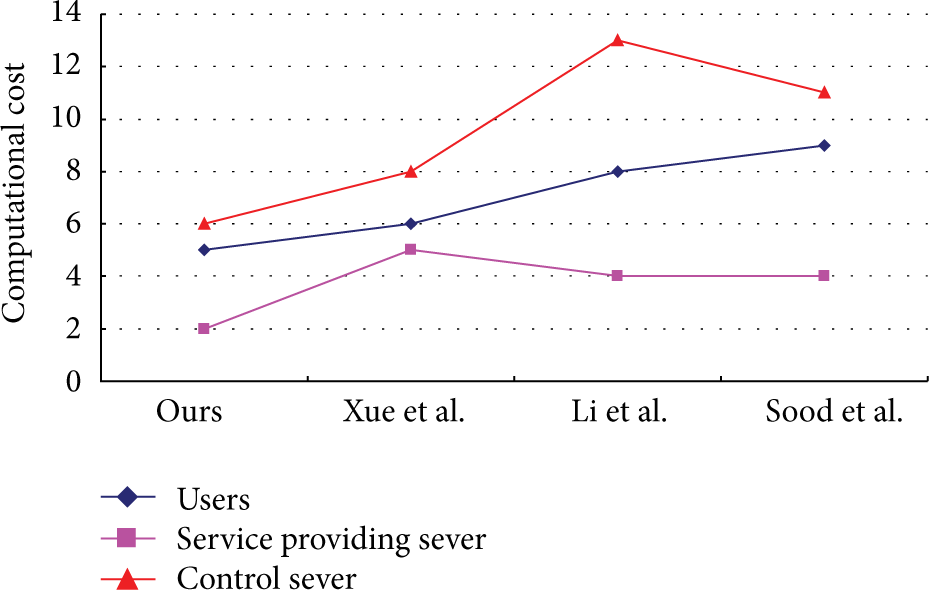
In this section, we compare our protocol with other related protocols regarding performance and security. It is crucial for smart card based schemes to provide low computation cost due to the smart card possesses the power constraints and small flash memory [26]. We take the login phase and authentication phase into consideration since these two are the principal part of an authentication protocol. To analyze the computational complexity of the protocols, we use hashing operation as the time complexity since xor operations require very little computations. Figure 1 shows comparison regarding the performance. From this comparison, we can see that our proposed protocol has almost the least computation costs compared with other's protocols. Hence, our proposed protocol is very useful in environments of limited computation and communication resources to access remote information systems.
Performance comparison.
Table 1 lists the functionality comparisons of our proposed protocol with Sood et al.'s protocol [16], Li et al.'s protocol [17], and Xue et al.'s protocol [18]. We can see that the proposed protocol not only provides proper mutual authentication and perfect forward secrecy but also can prevent masquerade attack and other attacks. As a result, the proposed protocol is more secure and has many functionalities compared with these related protocols.
In this paper, we have shown that Xue et al.'s protocol cannot really protect against masquerade attack, off-line password guessing, and insider attacks. In order to avoid these security weaknesses, a slight modification without using timestamps to their protocol is proposed to improve their shortcomings. Moreover, we discussed the security of the proposed protocol and showed that it conforms to all desirable security attributes. Finally, we compared the proposed protocol and existing competitive protocols regarding efficiency and security and showed that the proposed protocol is more secure and has the least computation costs. Therefore, our protocol is able to satisfy all of the essential requirements for multiserver environments. In the future, we will propose a cryptanalysis scheme [27] to prove that our authentication mechanism is secure. Moreover, we will evaluate our scheme for the energy and communication overheads using some network simulator for practical implementation. In addition, we will continue to extend our study to combine a user's biometrics [28] and discuss the biometrics matching issue in detail.
Footnotes
Conflict of Interests
The authors declare that there is no conflict of interests regarding the publication of this paper.
Acknowledgments
The authors are grateful to the anonymous referees for their valuable comments and suggestions to improve the presentation of this paper. This paper is supported by the National Natural Science Foundation of China (Grant nos. 61472045 and 61121061), the Beijing Higher Education Young Elite Teacher Project (Grant no. YETP0449), the Asia Foresight Program under NSFC Grant (Grant no. 61411146001), and the Beijing Natural Science Foundation (Grant no. 4142016).
References
1.
KhanS. U.LavagnoL.PastroneC.SpiritoM. A.Online authentication and key establishment scheme for heterogeneous sensor networksInternational Journal of Distributed Sensor Networks201420141171828610.1155/2014/718286
2.
LamportL.Password authentication with insecure communicationCommunications of the ACM1981241177077210.1145/358790.3587972-s2.0-0019634370
3.
AwasthiA. K.LalS.An enhanced remote user authentication scheme using smart cardsIEEE Transactions on Consumer Electronics200450258358610.1109/TCE.2004.13094302-s2.0-4043089982
4.
XuJ.ZhuW.-T.FengD.-G.An improved smart card based password authentication scheme with provable securityComputer Standards and Interfaces200931472372810.1016/j.csi.2008.09.0062-s2.0-64249125305
5.
LiX.QiuW.ZhengD.ChenK.LiJ.Anonymity enhancement on robust and efficient password-authenticated key agreement using smart cardsIEEE Transactions on Industrial Electronics20105727938002-s2.0-7544910698510.1109/TIE.2009.2028351
6.
ZhaoD.-W.PengH.-P.LiL.-X.YangY.-Y.A secure and effective anonymous authentication scheme for roaming service in global mobility networksWireless Personal Communications201478124726910.1007/s11277-014-1750-y2-s2.0-84897351558
7.
KhanM. K.KumariS.An improved user authentication protocol for healthcare services via wireless medical sensor networksInternational Journal of Distributed Sensor Networks201420141034716910.1155/2014/3471692-s2.0-84901008838
8.
HwangM.-S.LiL.-H.A new remote user authentication scheme using smart cardsIEEE Transactions on Consumer Electronics2000461283010.1109/30.8263772-s2.0-0034140374
9.
FanC.-I.ChanY.-C.ZhangZ.-K.Robust remote authentication scheme with smart cardsComputers & Security200524861962810.1016/j.cose.2005.03.0062-s2.0-28044451335
10.
HwangM.-S.ChongS.-K.ChenT.-Y.DoS-resistant ID-based password authentication scheme using smart cardsJournal of Systems and Software201083116317210.1016/j.jss.2009.07.0502-s2.0-71649104505
11.
LeeS.-W.KimH.-S.YooK.-Y.Efficient nonce-based remote user authentication scheme using smart cardsApplied Mathematics and Computation2005167135536110.1016/j.amc.2004.06.111MR21709212-s2.0-24944502757
12.
LiuJ.-Y.ZhouA.-M.GaoM.-X.A new mutual authentication scheme based on nonce and smart cardsComputer Communications20083110220522092-s2.0-4454908664010.1016/j.comcom.2008.02.002
13.
LiC.-T.HwangM.-S.An efficient biometrics-based remote user authentication scheme using smart cardsJournal of Network and Computer Applications2010331152-s2.0-7034979218210.1016/j.jnca.2009.08.001
14.
SongR.Advanced smart card based password authentication protocolComputer Standards and Interfaces2010325-632132510.1016/j.csi.2010.03.0082-s2.0-77955312905
15.
HsiangH.-C.ShihW.-K.Improvement of the secure dynamic ID based remote user authentication scheme for multi-server environmentComputer Standards and Interfaces20093161118112310.1016/j.csi.2008.11.0022-s2.0-68849128250
16.
SoodS. K.SarjeA. K.SinghK.A secure dynamic identity based authentication protocol for multi-server architectureJournal of Network and Computer Applications201134260961810.1016/j.jnca.2010.11.0112-s2.0-79251600218
17.
LiX.XiongY.-P.MaJ.WangW.-D.An efficient and security dynamic identity based authentication protocol for multi-server architecture using smart cardsJournal of Network and Computer Applications201235276376910.1016/j.jnca.2011.11.0092-s2.0-84856217617
18.
XueK.-P.HongP.-L.MaC.-S.A lightweight dynamic pseudonym identity based authentication and key agreement protocol without verification tables for multi-server architectureJournal of Computer and System Sciences201480119520610.1016/j.jcss.2013.07.004MR31059162-s2.0-84884990326
19.
KocherP.JaffeJ.JunB.Differential power analysisAdvances in Cryptology—CRYPTO' 99: 19th Annual International Cryptology Conference Santa Barbara, California, USA, August 15–19, 1999 Proceedings19991666Berlin, GermanySpringer388397Lecture Notes in Computer Science10.1007/3-540-48405-1_25
20.
HeD.-J.MaM.-D.ZhangY.ChenC.BuJ.-J.A strong user authentication scheme with smart cards for wireless communicationsComputer Communications201134336737410.1016/j.comcom.2010.02.0312-s2.0-78751648745
21.
MessergesT. S.DabbishE. A.SloanR. H.Examining smart-card security under the threat of power analysis attacksIEEE Transactions on Computers2002515541552MR190100410.1109/tc.2002.10045932-s2.0-0036566408
22.
BurrowsM.AbadiM.NeedhamR.A logic of authenticationACM Transactions on Computer Systems1990811836
23.
TsaiJ.-L.LoN.-W.WuT.-C.Novel anonymous authentication scheme using smart cardsIEEE Transactions on Industrial Informatics2013942004201310.1109/TII.2012.22306392-s2.0-84886653936
24.
DasA.-K.A secure and effictive user authentication and privacy preserving protocol with smart cards for wireless communicationsNetworking Science201321-2122710.1007/s13119-012-0009-8
25.
YangY.WangS.BaoF.WangJ.DengR. H.New efficient user identification and key distribution scheme providing enhanced securityComputers and Security200423869770410.1016/j.cose.2004.08.0052-s2.0-10644225185
26.
JuangW.-S.Efficient multi-server password authenticated key agreement using smart cardsIEEE Transactions on Consumer Electronics200450125125510.1109/TCE.2004.12778702-s2.0-1942455353
27.
AlomairB.PoovendranR.Efficient authentication for mobile and pervasive computingIEEE Transactions on Mobile Computing20141334694812-s2.0-8489456558210.1109/TMC.2012.252
28.
LiJ.-P.DingY.-M.XiongZ.-G.LiuS.-Y.An improved biometric-based user authentication scheme for C/S systemInternational Journal of Distributed Sensor Networks20142014927534110.1155/2014/2753412-s2.0-84901049661