




Abstract
A novel direction of arrival (DOA) estimation technique based on data level and order recursive Multistage Nested Wiener Filters (MSNWF) which is used in adaptive beamforming for subarray signal is proposed in this paper. The two subarrays using the same array geometry are used to form a signal whose phase relative to the reference signal is a function of the DOA. The DOA is estimated by calculating the phase-shift between the reference signal and its phase-shifted version. The performance of this DOA estimation technique is significantly improved due to the application of order recursive MSNWF for the rejection of interference signals. The computation of the proposed method is simple, and the number of detectable signal sources could exceed the number of antenna elements.
1. Introduction
In the last two decades, smart antenna has been widely used in many applications such as radar, sonar, and wireless communication systems [1]. It is also utilized in tracking [2, 3], localization [4, 5], intelligent transportation [6], ultra-wideband wireless sensor networks [7], array calibration [8], scatter cluster model [9], and antijamming [10]. For example, the multiple input multiple output (MIMO) radar utilizes multiple sensor array antennas to simultaneously transmit and receive diverse waveforms, which estimates the signal parameters to locate and track the target [2]. Distributed sensor networks have been used for enhancing signal to noise ratios for space-time localization and tracking of remote objects using phased array antennas [4]. Radio frequency identification (RFID) is widely used for electronically identifying, locating, and tracking products, animals, and vehicles as a very valuable business and technology tool [5]. Vehicular ad hoc networks (VANETs) could be a benefit to the traffic safety and efficiency [6]. The performance of array processing algorithms is improved by the sensor array location error calibration, which made the algorithms insensitive to the model uncertainties and deterministic signals with unknown waveforms [8]. The performance of the wireless communication system is evaluated based on scatter cluster models by estimating the corresponding parameters [9]. Array sensor and subarray adaptive beamforming techniques obtain the best antijamming performance widely used in GNSS receivers [10], active radar, and sonar [11]. In these sensor networks implication systems and scenarios, direction of arrival (DOA) is an important parameter that is needed to be estimated to determine the direction of the located and tracked target or the position of the sensor nodes.
Considerable research efforts have been made in the DOA estimation and various array signal process techniques for DOA estimation have been proposed [12–18]. The most commonly used DOA estimation techniques include (1) spectrum based methods, such as Bartlett [14] and Capon [15]; (2) subspace-based algorithm, such as multiple signal classification (MUSIC) [16]; (3) parametric methods, such as estimation of signal parameters via rotational invariance technique (ESPRIT) [17]. In Capon techniques, the DOAs are determined by finding the directions in which their antenna response vectors lead to peaks in the spectrum formed by the covariance matrix of the observation vectors. Thus, the capacity of this DOA estimation technique is less than the number of antenna elements bounded by the covariance matrix of the observation vectors. In MUSIC techniques, the DOAs of target signals are determined by finding the directions in which their antenna response vectors lead to peaks in the MUSIC spectrum formed by the eigenvectors of the noise subspace. Thus, the capacity of this DOA estimation is equal to the rank of the reciprocal subspace of the selected noise subspace and is also less than the number of the antenna elements. In ESPRIT techniques, two virtual subarrays structures are proposed to obtain two signal subspaces. The eigenvectors of the relevant signal subspaces are rotated for the DOAs of the signals. As a result, the capacity of DOA estimation using ESPRIT is bounded by the number of subarrays. The application of the above techniques is limited to cases where the number of signal sources is less than that of antenna elements. These techniques require subspace estimation, eigendecomposition, and the computation of covariance matrix inversion which leads to high computational complexity, and they are thereby limited to the applications where fast DOA estimation is required. Furthermore, in the presence of interference, these techniques need to estimate the DOAs of all the target signals and interference, which decreases the accuracy of DOA estimation.
The application of adaptive beamforming in DOA estimation has become the research focus on interference existence [18]. In [18], Wang et al. developed a new structure of DOA estimation based on subarray beamforming. This technique has clear advantage on the DOA estimation when interference exists, but it still needs the computation of matrix inversion which is not easy to be applied to a practical system. Based on this structure, a DOA estimation technique based on Multistage Nested Wiener Filter (MSNWF) [19–25] is proposed in [26]. In [26], Yu stated an original MSNWF algorithm [27] to estimate the DOAs, which used a filter and blocking matrix to avoid the calculation of covariance matrix inversion. In this technique, however, it cannot calculate the coefficients of Wiener filter in backward recursion if the forward recursion does not finish the calculation of the match filter and blocking matrix. And the mean squared error (MSE) can not be determined when adding a new stage, except for the last stage.
In this paper, a data level order recursive MSNWF DOA estimation technique that uses a reference signal is proposed in detail. This DOA estimation technique uses two subarray adaptive beamformers based on the data level order recursive MSNWF to construct the same array geometry for forming the phase-shift and rejecting interference at same time. The DOAs of the target signals are estimated from the phase-shifts by using reference signal after the rejection of interference. Therefore, the performance of DOA estimation is significantly improved. This technique can be widely used for the implementation of hardware systems such as wireless communication system, active radar, sonar, and space-time adaptive process (STAP) systems [28, 29].
The advantages of the data level order recursive MSNWF DOA estimation are as follows. (1) Since the use of data level order recursive MSNWF in this DOA estimation technique realizes the subspace eigendecomposition, computation of inversion of covariance matrix becomes unnecessary and thus reduces the complexity of computation; the data level MSNWF DOA estimation technique can be easily applied in hardware platform. (2) An orthogonal basis for the Krylov subspace spanned cross correlation vector and covariance matrix improves the computational efficiency when calculating the weight vector of the match filter. And the order recursion could update the weight vector of the match filter and the MSE at new stage.
The paper is organized as follows. In Section 2, the signal model is described. In Section 3, the structure of the data level order recursive MSNWF DOA estimation system, MSNWF based adaptive beamforming including data level recursion of match filters and order recursion, and DOA calculation of the proposed method are presented. Design examples and simulation results are given in Section 5, and conclusions are drawn in Section 6.
2. Signal Model
Consider a uniform linear array (ULA) system that uses M elements with adjacent element spacing d, deployed at a base station. Assume that K narrowband signals and P unknown interference sources are received at the ULA with different DOAs
Using complex envelope representation, the received signals can be expressed by


Suppose that the received vector


And

3. MSNWF DOA Estimation
Compared with the SBDOA estimation technique stated in [8], the proposed MSNWF DOA estimation technique in this paper uses the same uniform linear antenna array at the receiving end and the geometry of the array is similar to that used in ESPRIT techniques. The antenna array is decomposed into two equal-sized subarrays, where the two subarrays are used in conjunction with two subarray MSNWF adaptive beamformers to obtain an optimal estimation of a phase-shift reference signal whose phase relative to that of the reference signal is a function of the target DOA. The target DOA is then computed from the estimated phase-shift between the reference signal

Block diagram of the MSNWF DOA estimation system.
3.1. Subarray Signal Formation
Consider that the array is composed of a ULA of M element as a receiver and decomposed into two sets of

The vectors of the
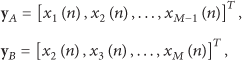


Sampling

3.2. Recursion Algorithm of MSNWF
3.2.1. Data Level Recursion of Match Filters
In the Wiener filter, the estimation of the desired signal

The assumed full-rank prefilter matrix can be chosen as

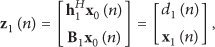
The solution of the Wiener-Hopf equations relative to the transformed system is
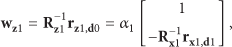
This process produces a new vector Wiener filter, which estimates the signal
In the original MSNWF, the new desired signal

According to (18), a filter

First stage of the original MSNWF.
The new observation vector in Figure 3 is expressed as


Match filter bank structure of MSNWF.
Therefore, the new desired signal

The filter

Using Lagrange multipliers, the solution of (21) is

Herein, if
At ith stage, let


In the recursion calculation process, the filters
3.2.2. Order Recursion
At the stage

The new observation vector obtained from the recursion calculation can be written as

The covariance matrix can be written as

The recursion coefficients are the components of Wiener filter coefficients as (28) which is used to estimate

Then, the coefficients of MSNWF can be expressed as

The MSE of the coefficients is

According to (19) and its property, the tridiagonal covariance matrix can be rewritten as

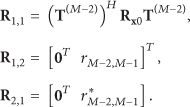
The cross correlation vector between the new observation vector and desired signal

Given

According to (26), the (34) can be rewritten as

Consider the property that only the first element of the cross correlation vector
Let the inverse of

The various quantities in (36) are defined as in the following equation:

Therefore, the column vector

It can be seen from (38) that
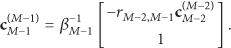
It can be seen from (39) that the last column vector
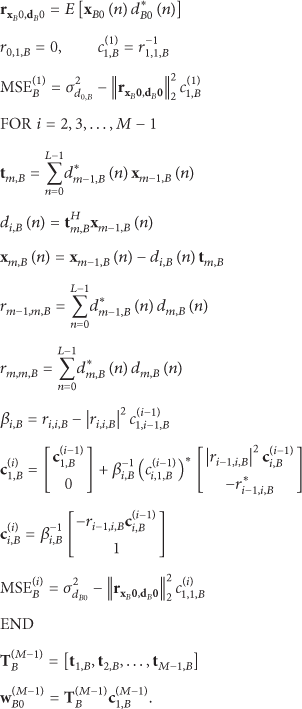
According to (38) and (39), it can be seen that, in recursive calculation process, only
As for the MSE expressed as in (30), it can be simple and can be updated with

According to recursive algorithm about the calculation of the coefficients of the match filters and the nest order, the data level order recursive MSNWF DOA estimation structure can be drawn as in Figure 4.

The structure of data level order recursive MSNWF.
4. MSNWF DOA Estimation System
4.1. Calculation of Weight Vector
In the MSNWF DOA system, the optimal estimation of the phase-shifted reference signal
In the adaptive beamformer
In the adaptive beamformer

The optimal weight vector of adaptive beamformer
The flow diagram of calculation of weight vectors in adaptive beamformer

In the adaptive beamformer

And the optimal weight vector of adaptive beamformer
The flow diagram of the calculation of weight vector in adaptive beamformer
Substituting (11) and (13) into (44), we have
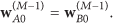
Therefore, the weight vector
4.2. Calculation of DOA
The adaptive beamformer

Thus,

Let

In [18], Wang et al. give the optimum solution of
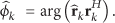
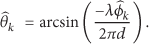
According to (12), an estimation of the target DOA can be obtained then as
5. Simulation Results
In this section, the performance of the proposed method, including the resolution, capacity, and accuracy of the data level order recursive MSNWF DOA techniques, will be evaluated through numerical simulations. In Sections 5.1 and 5.2, the resolution and the capacity of the DOA estimation using the data level order recursive MSNWF DOA techniques will be illustrated and compared with other techniques, such as MUSIC, ESPRIT, SBDOA, and original MSNWF DOA estimation techniques. In Sections 5.3 and 5.4, the effects of snapshot length and stage of data level order recursive MSNWF on the estimation accuracy will be investigated, respectively.
5.1. Resolution of DOA Estimation
Assume that a ULA of 10 elements, with a spacing of
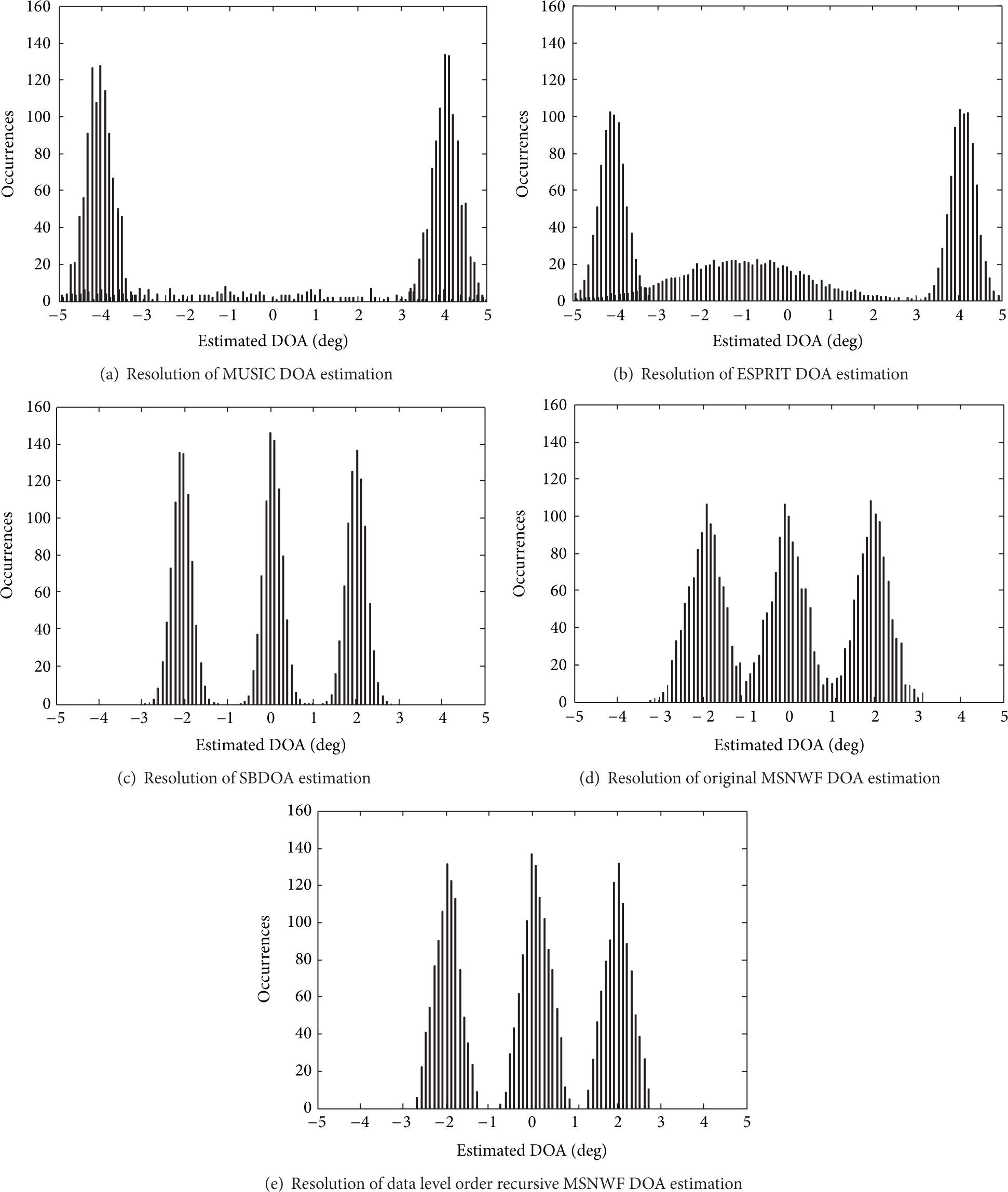
Comparison of the resolution of DOA estimation for signal sources that are closely distributed.
The histograms of the resolution of DOA estimation obtained for these five techniques are shown in Figures 5(a)–5(e). The histogram depicts the number of occurrences estimated DOA as a function of DOA degrees. In Figure 5(a), the histogram of MUSIC technique shows two peak values which deviate from the DOAs of the target signals. In Figure 5(b), although the histogram of ESPIRT technique shows three peak values, the peak values deviate from the DOAs of the target signals. It is seen that the MUSIC technique or ESPRIT technique cannot offer the desired results when the DOAs of target signals are very close. Correspondingly, in Figures 5(c), 5(d), and 5(e), the histogram shows three peak values, indicating that, using the SBDOA, original MSNWF DOA, and the data level order recursive MSNWF DOA techniques, all three DOAs are successfully estimated. Therefore, it proved that the data level order recursive MSNWF DOA technique could obtain a better resolution than MUSIC and ESPRIT techniques. However, the SBDOA requires
5.2. Capacity of DOA Estimation
This simulation deals with a case where the number of target signals and interference is larger than that of antenna elements. The simulation conditions are kept the same as those in Section 5.1 except for the number of signal components considered. The DOAs of 9 target signal components are set from −40° to 40° with interval 10°, and the DOAs of 6 interference components are set from −25° to 25° with interval 10°. The simulation results are shown in Figure 6.

Comparison of the capacity of DOA estimation when the number of signal and interference sources exceeds the number of antenna elements.
Histograms of the obtained estimated DOAs are shown in Figures 6(a)–6(e). In Figures 6(a) and 6(b), the histograms show the deviated peak values and demonstrate that these two techniques cannot provide acceptable DOA estimation when the number of antenna elements is less than the total number of target signals and interference. In contrast, in Figures 6(c), 6(d), and 6(e), the histograms show that all 9 target DOAs are successfully estimated when using the SBDOA, original MSNWF, and data level order recursive MASNWF DOA techniques. As can be seen, the successful probability of DOA estimation in data level order recursive MSNWF DOA technique is the same as that in the SBDOA and original MSNWF DOA estimation techniques.
5.3. Effects of Snapshot Length of MSNWF on DOA Estimation Accuracy
In the simulation of snapshot length effects, the snapshot length for adaptive beamformer

RMSE of the estimated DOA for different snapshot length L and the SNR.
As can be seen in Figure 7, both the original MSNWF and the data level order recursive MSNWF DOA techniques lead to a RMSE of less than 5°,when using a small snapshot length such as 50. The simulation results show that when the snapshot length is 500, the data level order recursive MSNWF DOA estimation method will have estimation accuracy similar to that of the SBDOA technique. However, the RMSE of the data level order recursive MSNWF DOA technique is better than that of original MSNWF DOA technique under various snapshot lengths, which is due to the update of MSE at each stage to obtain the optimal weight vector. The RMSE obviously decreases as the snapshot length increases, such as the RMSE which will be less than 1° when using one thousand snapshot length of the signal. This demonstrates that the fast DOA tracking can be implemented by using the data level order recursive MSNWF DOA technique and that the estimation accuracy will be improved when using more sample data. And the simulation also proved that the capacity of data level order recursive MSNWF DOA estimation technique can be larger than the number of the sensor elements.
5.4. Effects of the Stage of MSNWF on DOA Estimation Accuracy
In the simulation of the stage effect, both stages of original MSNWF and data level order recursive MSNWF for adaptive beamformer
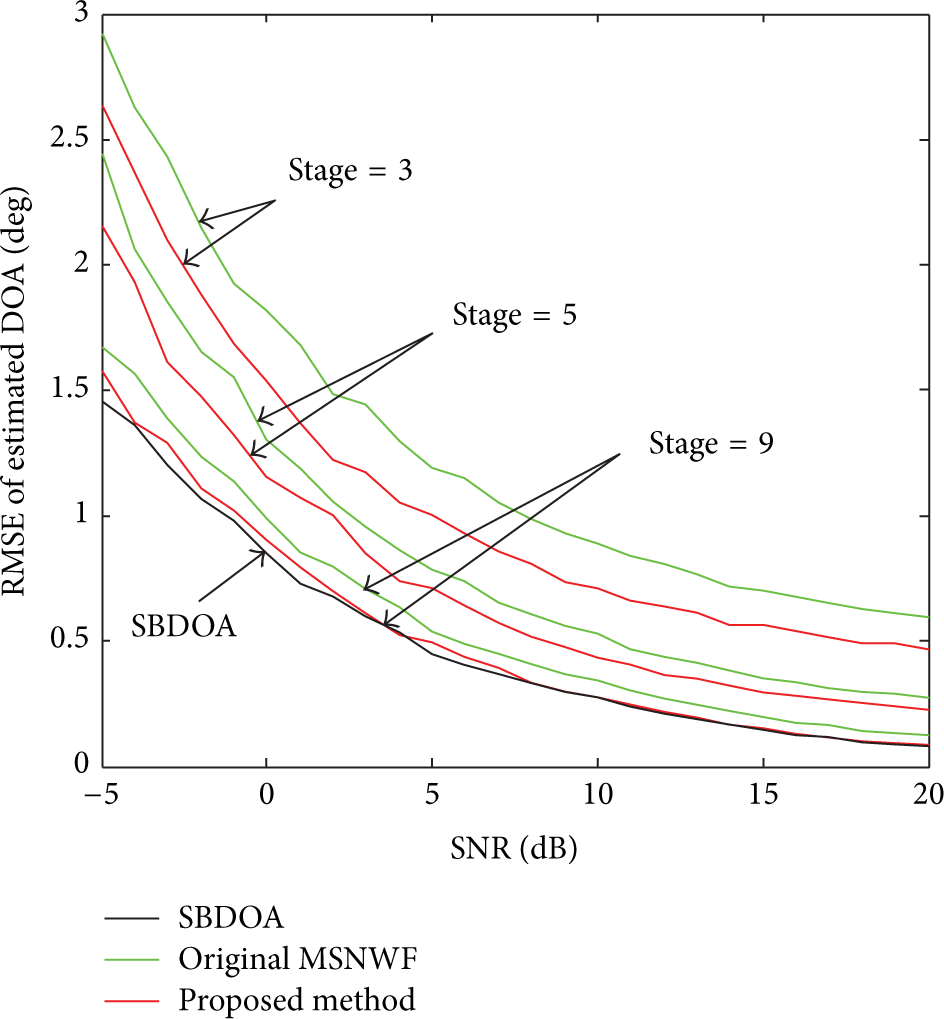
RMSE of the estimated DOA for different MSNWF stages and SNR.
As can be seen from Figure 8, both the original MSNWF and the data level order recursive MSNWF DOA techniques lead to a RMSE of less than 3°, when using different stages of MSNWF, and the RMSE decreases as the MSNWF stage increases. However, the RMSE of the data level order recursive MSNWF DOA estimation technique is better than that of original MSNWF DOA estimation technique under various stages, which is mainly due to the update of MSE at each stage.
Moreover, in the same simulation conditions, the RMSE of SBDOA estimation technique is less than 1.5°. In contrast, the RMSE of data level order recursive MSNWF DOA estimation technique is almost equal to that of SBDOA when using 9 stages. However, the original MSNWF DOA estimation technique requires more stages to obtain similar estimation accuracy.
6. Conclusion
A novel DOA estimation method based on data level order recursive MSNWF has been proposed in this paper. In this technique, two subarray adaptive beamformers based on the MSNWF are used to form the phase-shift and reject interference at the same time. The DOAs of target signals are estimated from the phase-shift by using reference signal after interference rejection. Therefore, the performance of DOA estimation such as resolution, capacity, and accuracy is significantly improved. And the complexity of computation is also significantly reduced by avoiding the calculation of covariance matrix inversion when getting the optimal weight vector of the beamformer. This technique can be widely used for the implementation of hardware systems such as wireless communication system, active radar, sonar, and STAP systems. Numerical simulations demonstrating the effectiveness and advantage of this technique are presented.
Footnotes
Conflict of Interests
The authors declare that there is no conflict of interests regarding the publication of this paper.