




Abstract
Due to the limited energy of wireless sensor nodes, the energy efficiency of data collection is a key issue in wireless sensor network (WSN). Dynamic clustering is a scalable and energy efficient solution for data collection in WSN. However, it suffers from the imbalanced energy consumption in the intercluster communication. To solve this problem, in this paper, we propose a distributed and adaptive routing protocol for cluster-based wireless sensor networks (DARC). In DARC, an adaptive energy threshold is proposed for the cluster head to control its intercluster routing mode, and a tunable cost function is designed for relay selection. Simulation results prove that DARC effectively balances the energy consumption in the intercluster communication and hence improves the energy efficiency and prolongs the network lifetime.
1. Introduction
Due to the advantages of easy deployment and low cost, wireless sensor network (WSN) has been widely used for collecting data in many applications such as emergency response [1, 2], environment monitoring [3, 4], and industrial control [5, 6]. Most wireless sensors are powered by batteries with limited energy; thus the energy efficiency is an essential issue in the data collection of WSN [7].
Dynamic clustering provides a scalable and energy efficient solution for data collection in WSNs [8–10]. The operation of dynamic clustering is divided into rounds. At the beginning of every round, some nodes are selected as the cluster heads (CHs) to build up the backbone of network, while the others become cluster members (CMs) and select their own CHs. The CH collects data from CMs in its cluster and then forwards the data to the base station (BS). At the end of each round, the cluster-based topology breaks up, and new clusters will be formed in the next round. The CHs generally consume much more energy than the CMs; hence, the periodic cluster reorganization in dynamic clustering can balance the energy consumption among CHs and CMs.
However, the imbalanced energy consumption among CHs can hardly be solved by cluster reorganization. It is because the difference of node location has great impacts on the energy consumption of intercluster routing. Generally, the intercluster routing can be classified to single-hop routing (SHR) [8, 11] and multihops routing (MHR) [12, 13]. In SHR, all CHs communicate with BS directly. On the other hand, in MHR, CHs forward their data to the BS via several hops. However, the imbalance of energy consumption is inevitable in both SHR and MHR. In SHR, the node that is far away from BS suffers from long transmission range and consumes more energy. While in MHR, the node close to the BS dies faster due to the heavy relay burden.
To solve this problem, in this paper, we propose a distributed and adaptive routing protocol for cluster-based wireless sensor networks (DARC). The basic idea of DARC is to adaptively adjust the routing mode of CHs to balance the intercluster energy consumption. The major contributions of this paper are given as follows.
Simulations are executed to study the distribution of energy consumption in both SHR and MHR. There are two important results derived from the simulations. At first, the energy consumption is imbalanced in both SHR and MHR due to the difference of node location, and this problem can not be solved by cluster reorganization. Secondly, SHR and MHR have opposite distribution of energy consumption. It motivates us to design a new protocol that can adaptively adjust the routing modes of CHs to balance the energy consumption. We propose a distributed and adaptive routing protocol for cluster-based wireless sensor networks (DARC). In DARC, an adaptive energy threshold is designed for CHs to select intercluster routing modes. Moreover, a tunable cost function is proposed for CHs to select proper relays. All the algorithms are executed based on the distributed information exchanged during the process of dynamic clustering, which ensures that DARC has low overhead. The guideline of setting the parameters in DARC is provided based on the simulations. Moreover, the analytical and numerical results prove that DARC effectively balances the energy consumption among CHs and thus has better energy efficiency and longer network lifetime.
The rest of this paper is organized as follows. The related works are summarized in Section 2. Section 3 presents the network models and states the problem addressed in this paper. Section 4 provides the details of DARC protocol, and the simulations are executed in Section 5 to evaluate the performance of DARC. Finally, Section 6 makes the conclusion of this paper.
2. Related Works
Clustering provides a scalable solution for data collection in WSN [9, 14]. Observing the fact that the energy consumption of CHs is much larger than that of CMs, dynamic clustering is proposed in LEACH [8] to balance the energy consumption among nodes. The basic idea of dynamic clustering is to periodically rotate the cluster heads (CHs) and reorganize the cluster-based topology based on the new set of CHs. In this case, the heavy energy burden of CHs can be dispersed all over the network. Due to the advantages of scalability and energy efficiency, dynamic clustering becomes a popular research topic that attracts considerable attentions from various research communities.
Many works focus on the algorithm of cluster head selection in dynamic clustering. HEED [12] is an iteration-based algorithm that considers both residual energy and communication cost in cluster head selection. It improves the CHs distribution in the network and hence has better efficiency than LEACH. However, HEED suffers from considerable overhead due to the iteration in the algorithm. To solve this problem, BSC [11] adopts the random backoff scheme to control the process of CH selection. The node with smaller backoff time has higher probability to be CH. BSC can generate well-distributed CHs with low overhead. In [15], the vice-cluster head is proposed to alleviate the traffic load of cluster head, such that the network lifetime is significantly improved. The authors in [16] consider the collaborative data processing between nodes and propose an efficient cluster head selection approach for collaborative data processing.
Cluster formation is another popular research topic in dynamic clustering. In EECS [17], a novel cost function is proposed for CMs to select proper CHs by considering the distance between CH and the BS. The energy consumption is balanced by intracluster communication in EECS and the network lifetime is significantly improved. In IDUC [18], a radius competition scheme is proposed to generate unequal clusters that can balance the energy consumption among CHs in the network with heterogeneous energy. On the other hand, some research works provide mathematical analysis on how to assign the range of clusters in various scenarios [13, 19]. In [19], the authors provide a mathematical framework to determine the optimal number of clusters by minimizing the energy consumption in both single-hop and multihops scenarios. EC [13] considers the multihop data collection scenario and formulates an optimization problem that determines suitable cluster ranges depending on the hop distance to the BS.
For the intercluster communication, many dynamic clustering protocols are developed based on the assumption that the CHs can communicate with the BS directly [8, 11, 17]. On the other hand, some research works have considered the multihops routing among CHs [12, 13, 18]. For example, HEED [12] uses the greedy routing algorithm for intercluster communication, and EC [13] uses a routing algorithm that considers the load balance among CHs. Nonetheless, due to the difference of node location, the imbalanced energy consumption among CHs can hardly be solved by these routing algorithms. Moreover, these algorithms are not tailored for dynamic clustering that may generate considerable overhead during cluster reorganization. It motivates us to study this problem in Section 3.3 and provide a distributed solution named DARC in Section 4.
3. Preliminaries
3.1. Network Model
In this paper, we consider a typical data collection scenario in WSN. A great number of sensor nodes are randomly deployed in a square area. The network is assumed to have the following properties.
There is a base station (BS) located in the network area to collect sensing data from sensor nodes. Hence, the destination of every sensing data is the BS. Sensor nodes have homogeneous hardware capabilities. They are powered by batteries which have limited energy. It motivates the requirement of improving energy efficiency and prolong the network lifetime. Every node can use power control to adjust its transmission range, and it has sufficient power to transmit its data to the BS directly. Links are symmetric, and every node can estimate its distance to another node based on the received signal strength indication (RSSI). The network is organized into clusters which includes one cluster head (CH) and some cluster members (CMs). Each CH has the ability to aggregate intracluster data packets into one single packet, while the intercluster packets can not be aggregated.
3.2. Energy Consumption Model
The energy consumption model is adopted from LEACH [8]. The energy consumed for transmitting l-bit data over distance d is


Simulation parameters.

3.3. Problem Statement
In dynamic clustering, periodical cluster reorganization can distribute the energy consumption of CHs among all nodes. However, the imbalance of energy consumption still exists due to the difference of node location. Every node has different distance to the BS that leads to different energy consumption in the intercluster communication.
To further study the imbalance of energy consumption caused by node location, simulations are executed to demonstrate the location distribution of the first dead node. The first dead node is defined as the node that runs out its energy first in the network. The backoff-based clustering scheme [11] is used to generate the cluster-based topology. Based on the selected CHs, two routing algorithms are used in the intercluster communication: the single-hop routing (SHR) and the multihops routing (MHR). In SHR, all CHs transmit data to the BS directly. On the other hand, in MHR, CHs forward their data to the BS via multihops relay. In this paper, a greedy routing algorithm is used in MHR [20]. The CH i selects the closest CH which is closer to BS than itself as its relay. The algorithm can be formulated as

The network area is set as
The distance from first dead node to BS.
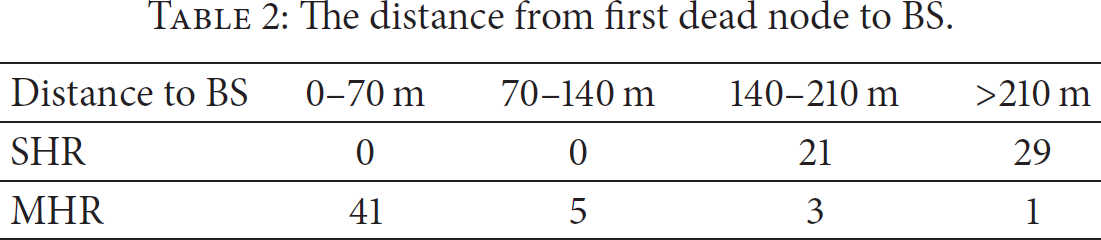
In SHR, the distances from all first dead nodes to BS are over 140 m. On the other hand, in MHR, 82% first dead nodes are located within 70 m to the BS. It indicates that the locations of first dead nodes are different in SHR and MHR. In SHR, the node that is far away from the BS consumes more energy due to the long transmission range. While, in MHR, the node closer to the BS suffers from the heavy load for relaying and dies faster than other nodes.
The results demonstrate that the energy consumption is imbalanced due to the difference of node location, and this problem can not be solved by cluster reorganization. On the other hand, the results also depict that SHR and MHR have opposite distribution of energy consumption. It motivates us to design a new protocol that can adaptively adjust the routing modes of CHs to balance the energy consumption.
3.4. Design Goals
To solve the problem stated above, we propose a distributed and adaptive routing protocol in cluster-based wireless sensor networks (DARC). The basic idea of DARC is to adaptively adjust the intercluster routing modes of CHs based on distributed information exchanges among CHs. Specifically, the design goals of DARC are given as follows.
The routing modes of CHs can be adaptively selected based on their residual energy, such that the energy consumption of intercluster communication can be balanced in different rounds. The relays of CHs should be selected with joint consideration of the balance of energy consumption and energy efficiency, since both of them are critical to prolong the network lifetime. The algorithm should be distributed with low overhead due to the limited hardware resources of sensor nodes.
4. DARC Protocol
DARC is designed based on the framework of dynamic clustering which uses periodical clusters reorganization to distribute the energy consumption among all nodes. Different from existing dynamic clustering protocols, in DARC, every node collects the information of neighbors during the process of cluster head selection and uses the information to make the clustering and routing decision distributively. Once a node decides to be a CH, it should determine the routing mode by comparing its residual energy with neighboring CHs. Moreover, it uses a cost function, which considers both the energy efficiency and the load balance, to select CH or BS as its next-hop nodes.
The details of DARC are described in the following sections. To clarify the statement, the variables using in DARC are summarized in Table 3.
Variables list.

4.1. Cluster Head Selection
The random backoff strategy [11, 21] is used in DARC to select CHs with low overhead. The network operation is divided into rounds. At the beginning of every round, each node sets a backoff timer 
After setting the backoff timer
Based on received packets, every node updates the following data lists:
JOIN list: it records the CHs within range ENERGY list: it records the CHs within range
When the node receives AC packet, it records the information of transmitter CH to the JOIN list. The JOIN list will be used for the node to select its CH when it decides to be CM. When the node receives AR packet, it records the information to the ENERGY list which will be used for the CH to make intercluster routing decision.
When the backoff timer
After determining its status, the node should continue listening to the channel until
4.2. Cluster Formation
When
4.3. Adaptive Routing
The basic idea of DARC is to adaptively switch the routing modes of CH to balance the energy consumption of intercluster communication. To realize this idea, we define two kinds of routing modes for every CH: CH-L and CH-H. The CH-L denotes the CH with relatively low energy that requires a closer relay to forward its data. While the CH-H denotes the CH with relatively high energy that can serve as a relay and transmit its data to the BS directly.
At the beginning, each CH has to determine its routing mode based on the ENERGY list. A CH i estimates the average residual energy 
The CH-H selects the BS as its next-hop node since it has sufficient energy. Then it broadcasts AR packet in
When it receives a AR packet from CH j, it should compare its distance to the BS, which is denoted by
When
According to the energy model given in Section 3.2, the energy consumption for CH-L i to transmit l-bit data to its relay CH j can be estimated by


Based on the analysis given above, the energy efficiency of intercluster communication can be achieved by minimizing the following cost function:


4.4. Properties of DARC
In this section, we provide the basic properties of DARC protocol that prove its effectiveness.
Lemma 1.
After executing the cluster head selection algorithm of DARC, each node is either a CH or a CM.
Proof.
Assume that a node is neither a CH nor a CM after executing the cluster head selection algorithm. Since the node does not become CH, it implies that the JOIN list is not empty when its
(1) Node i sets up random backoff timer (2) (3) (4) Records CH j to JOIN list; (5) (6) (7) Records CH j to ENERGY list; (8) (9) (10) (11) (12) Broadcasts AC packet in (13) Broadcasts AR packet in (14) (15) (16) (17) (18) (19) Records CH j to JOIN list; (20) (21) (22) Records CH j to ENERGY list; (23) (24) (25) (26) Selects its CH with maximum RSSI from the JOIN list; (27) Transmits a JC packet to its CH; (28)
Lemma 2.
The distance between any pair of CHs is longer than
Proof.
Assume that the distance between CH i and CH j is shorter than
Lemma 3.
After executing the cluster formation algorithm of DARC, each CM has selected a CH and joined its cluster.
Proof.
In DARC, the CM selects its CH from the JOIN list. If the CM does not select a CH, it means that its JOIN list is empty. According to the algorithm of cluster head selection, the node will become a CH if its JOIN list is empty, which is a contradiction.
Lemma 4.
In DARC, the CH transmits its data to the BS in 1 or 2 hops.
Proof.
There are two kinds of CHs in DARC: CH-H and CH-L. The next-hop node of CH-H is destined to be the BS; thus, the hop count is 1. For the CH-L, if its RELAY list is empty, it will transmit data to the BS directly. Otherwise, it has to select its next-hop node from the RELAY list. According to lines 15 and 16 given in Algorithm 2, only the CH-H can be recorded in the RELAY list. Therefore, the hop count from CH-L to the BS is at most 2 hops.
(1) Given a CH i after the cluster head selection algorithm; (2) Calculates (3) (4) (5) Select the BS as its next-hop node; (6) Broadcasts AR packet in (7) (8) (9) (10) (11) (12) Records CH j to RELAY list; (13) (14) (15) (16) (17) Select the BS as its next-hop node; (18) (19) Selects the CH with minimum (20) (21)
Theorem 5.
The DARC protocol generates a connected network topology.
Proof.
According to Lemma 1, each node is either a CH or a CM after running the cluster head selection algorithm. Combining Lemmas 3 and 4, every node can transmit its data to the BS with limited hops. Therefore, the network is connected.
Remark 6.
The DARC protocol is completely distributed.
Proof.
In DARC, every node determines its status (CM or CH) and selects its next-hop node based on its backoff timer
Theorem 7.
Given the number of nodes N and the number of CHs
Proof.
In DARC, every CH broadcasts two packets (AC and AR) in the cluster head selection algorithm, and each CM transmits a JC packet to its CH in the cluster formation algorithm. According to Lemma 1, the number of CMs can be calculated by
For comparison, we analyze the complexity of SHR and MHR which have been described in Section 3.3.
Theorem 8.
Given the number of nodes N and the number of CHs
Proof.
In SHR, every CH broadcasts AC packets in the cluster head selection algorithm, and each CM transmits a JC packet to its CH in the cluster formation algorithm. According to Lemma 1, the number of CMs can be calculated by
Theorem 9.
Given the number of nodes N and the number of CHs
Proof.
In MHR, every CH broadcasts AC packets in the cluster head selection algorithm, and each CM transmits a JC packet to its CH in the cluster formation algorithm. According to Lemma 1, the number of CMs can be calculated by
The properties given above prove that the DARC can generate reliable cluster-based network topology with low overhead. The efficiency of DARC will be further studied by simulations in the next section.
5. Simulation Results
In this section, the simulations are executed to study the performance of DARC. At first, we study how does the parameters setting in DARC impact the network performance. Then, the performance of DARC is compared with that of SHR and MHR to prove its efficiency. For fairness, both SHR and MHR adopt the backoff strategy [11] that is described in Section 4.1 for the cluster head selection. Network lifetime is the major metric for evaluating the energy efficiency of DARC. The network lifetime is defined as the rounds when the first node dies (FND), since a certain area may not be monitored once a sensor node exhausts its energy. The basic parameters used in simulations are summarized in Table 1. Each simulation runs 100 times with different node deployment to obtain the statistic results.
5.1. Parameters Setting
In DARC, there are three important parameters: the clustering range

Impact of DARC parameters (α,
As shown in Figure 1,
Then, we evaluate the impact of
For
According to the results given above, in the rest of simulations,
5.2. Network Lifetime Analysis
To prove the efficiency of DARC, in this section, the simulations are executed to compare the network lifetime of DARC with that of SHR and MHR in different network scenario. We also compare the residual energy ratio, which is defined as the ratio of residual energy, to the initial energy when the first dead node appears.
At first, we compare the network lifetime and the residual energy ratio with different network area. The side length of the network area varies from

Network lifetime with different network area.

Residual energy ratio with different network area.
As shown in Figure 2, the optimal network lifetime of DARC is longer than that of SHR and MHR in both small-scale and large-scale networks. In a small-scale network of 100 m × 100 m, the improvement of network lifetime in DARC is about
The advantages of DARC increase with the growth of network area. It is because as the area of network enlarges, the nodes in SHR suffer from the growth of transmission distance, while MHR generates greater amount of relay burden for the nodes close to the BS. It leads to severe energy imbalance and shortens the network lifetime. On the other hand, by adaptively controlling the routing modes of CHs, DARC successfully balances the energy consumption in intercluster routing and hence prolongs the network lifetime. Therefore, the DARC has longer network lifetime and better scalability than SHR and MHR.
The residual energy ratio also proves the energy efficiency of DARC. As shown in Figure 3, when the first dead node appears in DARC, only
In DARC, the residual energy ratio monotonously increases with the growth of
Then we study the network performance with different node density. The network area is fixed at

Network lifetime with different node density.

Residual energy ratio with different node density.
Figures 4 and 5 show that DARC outperforms SHR and MHR with different node density. Specifically, in a sparse network with 200 nodes, the improvement of network lifetime in DARC is about
As shown in Figure 4, the maximum network lifetime slightly increases with the growth of node density. Moreover, the optimal value of
5.3. Energy Consumption Analysis
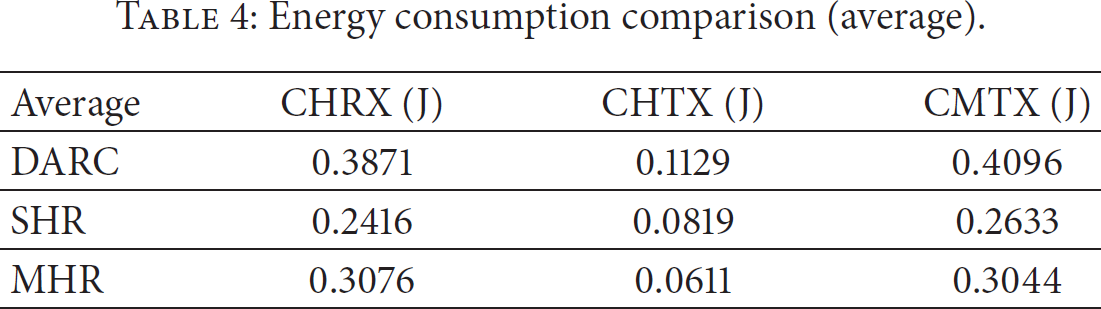
In this section, we evaluate the energy consumption of DARC to exploit how does DARC prolong the network lifetime. The energy consumption is categorized into three groups: the energy of CH for transmitting data (CHTX), the energy of CH for receiving data (CHRX), and the energy of CM for transmitting data to its CH (CMTX). Simulations are implemented in a scenario where 400 nodes are deployed in a
The simulation results are given in Tables 4 and 5. Since DARC provides longer network lifetime, the average energy consumption of DARC is larger than that of SHR and MHR. On the other hand, for the first dead node, its energy consumption in CHTX is significantly reduced in DARC due to the adaptive routing algorithm.
Energy consumption comparison (average).
Energy consumption comparison (first dead).

To clarify the difference between the energy consumption of the first dead node and the average energy consumption of all nodes, we illustrate them with SHR, MHR, and DARC separately in Figure 6. In SHR, the CHTX dominates the energy consumption of the first dead node. The CHTX of the first dead node is over 6 times compared with the average CHTX. According to the results given in Table 2, the first dead node of SHR generally locates far away from the BS; hence, it suffers from the long transmitting distance when it becomes a CH. In MHR, the CHTX is smaller than that of SHR due to the multihops routing. However, both CHTX and CHRX of the first dead node are more than the average ones. It is because, in MHR, the CH that is close to the BS suffers from the burden for relaying intercluster packets.

Energy consumption comparison.
On the other hand, the CHTX of the first dead node is greatly reduced in DARC. In DARC, the CHTX of the first dead node is only
5.4. Hop Count Analysis
In this section, we compare the hop count from the CHs to the BS among SHR, MHR, and DARC. The hop count presents the transmission latency and the routing complexity of the protocol. Simulations are implemented in the scenario where 400 nodes are randomly deployed in a

Hop count of CHs.
As shown in Figure 7, the hop count of SHR is fixed at 1, and the hop count of MHR drops from 8.88 hops to 2.57 hops with the growth of
Moreover, since the CH in DARC transmits its data to the BS in either one or two hops (Lemma 4), the hop count also presents the percentage of the CHs that have a relay. According to the results given in Figure 7, nearly
6. Conclusion
In this paper, we analyze the energy consumption in dynamic clustering algorithms and find that the cluster reorganization can not balance the energy consumption in the intercluster communication. To solve this problem, we propose a distributed and adaptive routing protocol for cluster-based wireless sensor networks (DARC). The DARC protocol uses an adaptive energy threshold to select a suitable intercluster routing mode for CHs, and a tunable cost function is proposed for relay selection. Simulation results prove that DARC effectively balances the energy consumption among CHs in various network scenarios and hence has better energy efficiency and longer network lifetime.
In future works, we will study how to use the DARC protocol in a large-scale network where most nodes can not transmit their data to the BS directly. Moreover, the impact of α,
Footnotes
Conflict of Interests
The authors declare that there is no conflict of interests regarding the publication of this paper.
Acknowledgments
This work is supported in part by the NSF of China under Grants U1405251, 61304260, 61301096, 61221003, 61290322, and 61273181, in part by the NSF of Fujian Province of China under Grants no. 2014J05072, in part by the Ministry of Education of China under Grants NCET-13-0358, and in part by the Science and Technology Commission of Shanghai Municipality (STCSM), China, under Grant 13QA1401900.