




Abstract
A dual-wavelength pulse strategy is proposed to reduce the fading phenomenon in a phase-sensitive optical time domain reflectometer (ϕ-OTDR). The theoretical basis behind this dual-wavelength pulse strategy is presented and an experimental setup is described to help validate the proposed strategy. Through the experimental tests, a 37.79% improvement in detection for available points along the fiber is achieved when 1550.000 nm and 1550.138 nm wavelength signals are applied. The different wavelength tests show that at least a 0.012 nm or 1.498 GHz difference should be applied in a dual-wavelength pulse and an average 30% detecting improvement can be achieved when one wavelength changes from 1549.950 nm to 1550.100 nm. In addition, the dual-wavelength strategy makes the system response more stable and consistent along the sensing optical fiber.
1. Introduction
The phase-sensitive optical time domain reflectometer (ϕ-OTDR) was first proposed by Lee and Taylor in 1993 [1]. It was primarily developed for dynamic detection and precision positioning. With the help of the interference phenomenon among Rayleigh backscattering light, the ϕ-OTDR is sensitive to vibrations and can be used for security applications, pipeline monitoring, and interpretation of seismic measurements. However, a few problems are associated with this interference phenomenon, and one of them is known as coherent fading.
Coherent fading causes the intensity of backscattering light to consist of valleys and peaks [2]. The spatial points which are in the peak state will acquire a strong sensitivity for vibration, but the spatial points which are in the valley state will have a low intensity, even close to zero, and lose the ability to sense vibrations. As a result, the response of the ϕ-OTDR along the fiber will be unequal and nonuniform if vibration appears along the whole fiber length.
In previous publications, a phase demodulated technology was applied in the ϕ-OTDR to solve the coherent fading problem [3–6]. Posey, Masoudi, and Farhadiroushan utilized a symmetric 3 × 3 optical coupler with an unbalanced Mach-Zehnder interferometer to demodulate the backscattering light and avoid coherent fading [3–5]. These works needed careful thermal stabilization of the sensing Mach-Zehnder interferometer, and they needed at least two equal optical detectors with a fully synchronized operation regime. Alekseev used phase modulated probe pulses to perform quadrature signal processing and also avoided the coherent fading problem [6]. The system used 3 pulse groups to achieve pulse modulation and demodulated the 3 pulse groups after receiving all of them. The weaknesses of this work are the need to regard the 3 asynchronous pulse groups as 3 synchronous ones and the extremely strict precision required for intensity and phase modulation. If the condition of the sensing optical fiber changes within the 3 pulse groups' period, the demodulating process may fail. Furthermore, the system also needs three original backscattering traces to form one final backscattering trace, which decreases the frequency response 3 times.
In this paper, a dual-wavelength method is presented to help reduce the impact of coherent fading in a ϕ-OTDR and make the response along the sensing optical fiber smoother and more uniform.
2. Operating Principles
A ϕ-OTDR uses an ultranarrow line width laser as a source and launches probe pulses along a sensing optical fiber. When the propagating pulse is subjected to vibrations, the Rayleigh backscattered light pulse can be divided into 2 parts,

If we launch another different wavelength (
3. Experiment and Results Analysis
The experimental arrangement is shown in Figure 1. Laser 1 and laser 2 are ultranarrow line width lasers (line width is less than 3 kHz). Laser 1's wavelength is fixed at 1550.138 nm and laser 2's wavelength can be tuned from 1549.950 nm to 1550.150 nm. The two variable optical attenuators (VOA1 and VOA2) are used to adjust the optical power launched into an acoustic-optic modulator (AOM). The optical pulse width is 100 ns and its repetition rate is 1 kHz. The modulated optical pulse is amplified and launched into a sensing optical fiber through a circulator (Cir.2). Circulator 1 (Cir.1) and fiber Bragg grating 1 are used to filter the spontaneous radiation created by the Erbium-doped fiber amplifier (EDFA1). Then the backscattering light is amplified by EDFA2. The backscattering light is also amplified and detected by an avalanche photodiode detector (APD) with a bandwidth of 50 MHz. The electrical signal is sampled by a data acquisition card (DAQ, NI5112) with a 50 MHz sample frequency.
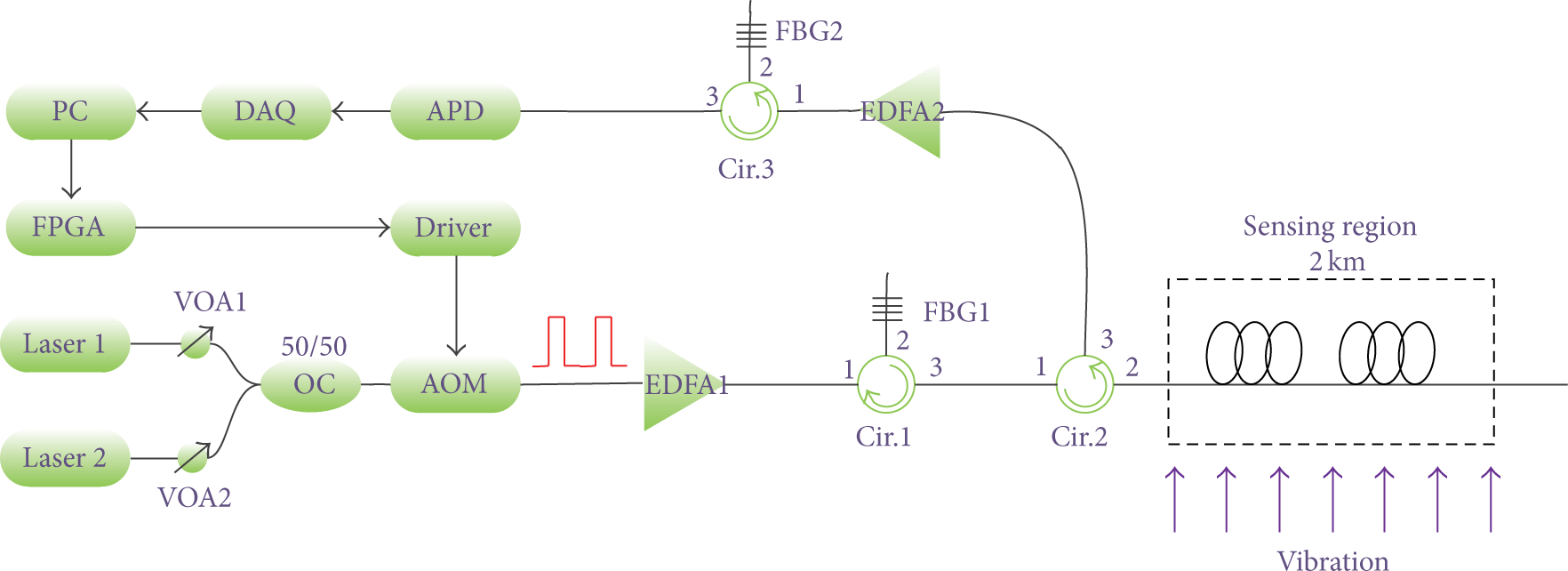
The setup of a dual-wavelength phase OTDR.
Firstly, laser 1 was turned off and only laser 2 was used. Tuning VOA2 will help to adjust the continuous waveform (CW) light power of laser 2 to 34.8 mW with the peak optical power reaching 200 mW after EDFA1. Then a 2 km long sensing optical fiber was placed in a foam box to minimize the effect of any unwanted vibrations. In order to keep the same vibration intensity in all experiments, a 500 g object falling from a certain height (3 cm) was used as the vibration source. The falling object then hit the foam box and produced vibrations in the entire length of the sensing optical fiber. The wavelength of laser 2 was then varied from 1549.950 nm to 1550.150 nm with an interval of 0.050 nm each time. This falling test was repeated 6 times for each wavelength state and the associated vibration data was collected.
In the second experiment, both laser 1 and laser 2 were turned on. Tuning VOA1 and VOA2, it is possible to ensure that the CW light power from laser 1 and laser 2 is the same and ensure that the total power launched into the AOM is 34.8 mW. Then the tests in the first experiment were repeated. Table 1 summarizes the parameters used for the experimental testing.
The wavelength change in the experiment.

Figure 2 shows the test results from the experimental setup. Figure 2(a) shows the result of the one wavelength only test at a wavelength of 1550.000 nm and Figure 2(b) shows the result of the dual-wavelength test at wavelengths of 1550.000 nm and 1550.138 nm. The blue lines in Figure 2 are the responses of the sensing optical fiber when there is no vibration and the red lines are the responses of sensing optical fiber when the vibration appears. In order to compare the results along the whole fiber equally, the light intensity attenuation caused by the optical fiber has been compensated by software compensation. From the blue lines we can see that when the optical fiber is not subjected to any vibrations, the background noise is very low. The green lines in Figure 2 represent the thresholds used in the experiments. If the response of a point is higher than the threshold, we regard the point as an available point. If not, the point is regarded as a fading point. As can be seen, the responses of the dual-wavelength test have less fading points than the one wavelength test and the responses of the total fiber length are more uniform. The number of available points in the dual-wavelength test is 796 while the one wavelength test has 558 points, and hence the detection ability is improved by 37.79%.
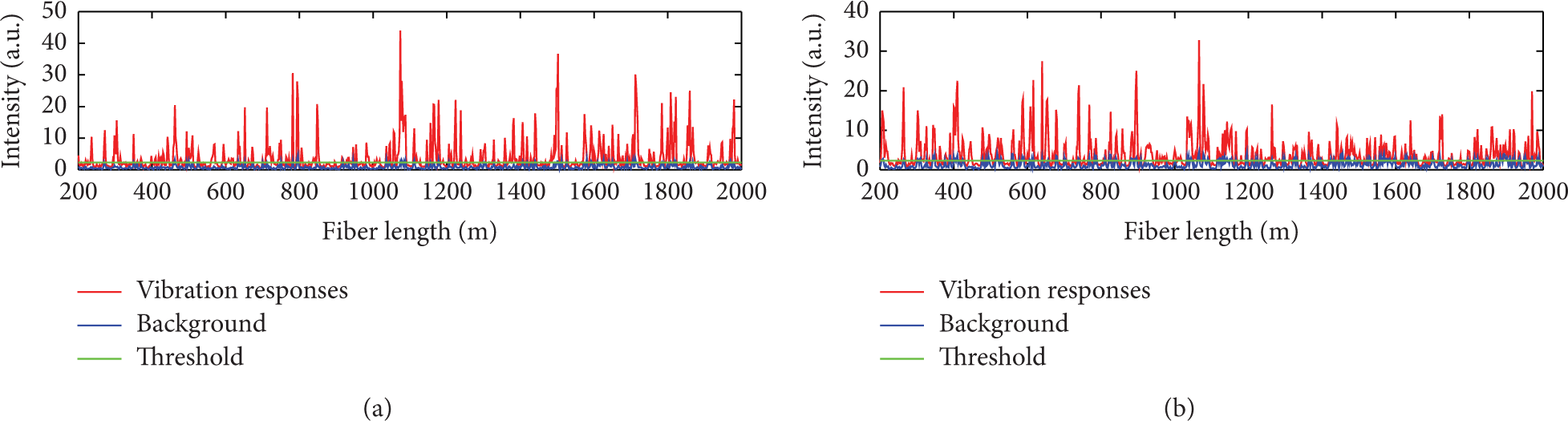
The result of the vibration tests. (a) Only 1550.000 nm is applied. (b) Both 1550.000 nm and 1550.138 nm are applied. Blue lines are the background responses, red lines are the vibration responses, and the green lines are the threshold used to pick up the available points.
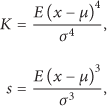
Figure 3 presents the probability distribution of the responses along the fiber where the red line is the fitted curve. Calculations show that the distribution fits the generalized extreme value distribution. In order to compare the difference between the response probability distribution of the one wavelength test and the dual-wavelength test, we calculated the kurtosis and skewness of the corresponding curve, and the results are shown in Figures 4 and 5. The kurtosis and skewness are defined by the following expressions [8]:
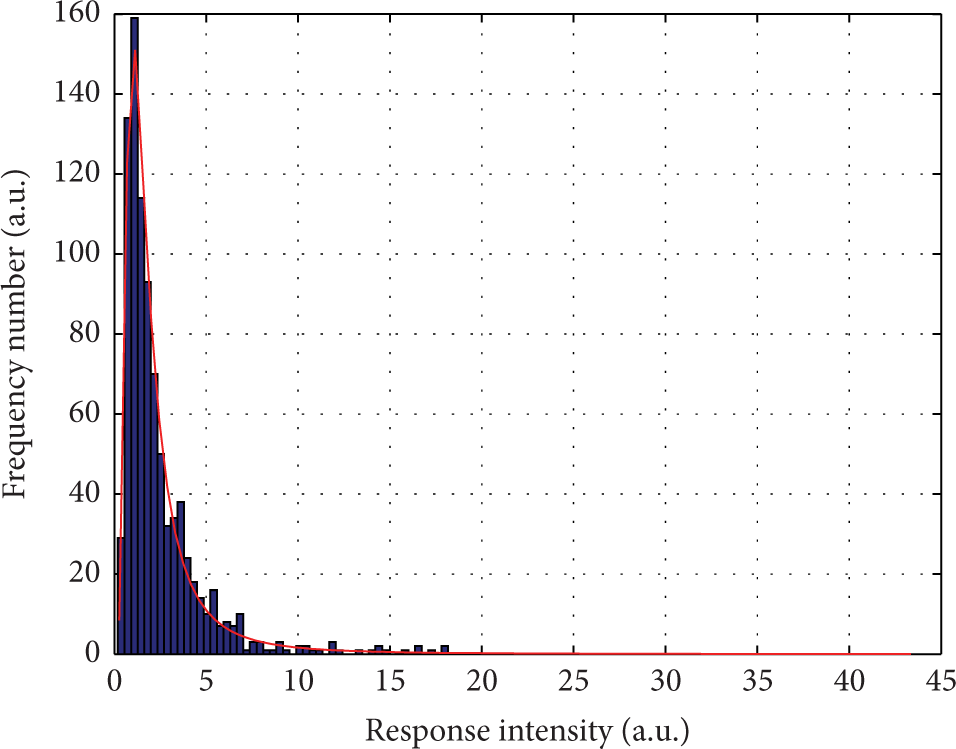
The probability distribution of the responses along the fiber (the red line is the fitted curve).

The kurtosis of each test in the experiment.

The skewness of each test in the experiment.
In statistics, the kurtosis is used to describe the “peakedness” of the probability distribution. When the kurtosis is high, the distribution peak is sharp. The skewness of a distribution is used to describe the asymmetry of the probability distribution. A positive skew indicates that the distribution has a longer or fatter right tail in comparison with its left tail. From Figures 4 and 5, when the dual-wavelength strategy is applied, the kurtosis becomes lower and so does the skewness. This means that the probability distribution of responses along the whole fiber becomes less peaked and more uniform. Furthermore, the range of the kurtosis and skewness for the dual-wavelength strategy is smaller than the ones of the one wavelength strategy. This means that the dual-wavelength is more stable and repeatable. This is because the responses come from the two wavelength light sources rather than a single source. When one component of this dual light source, having a certain wavelength, is at the low level state then the other component of this light source (e.g., the other wavelength source) can compensate the response and make it stable. However, as the peak positions of the two light components are also not a coincident, the absolute response intensity will decline and in this case it drops from 40 to 30 according to Figure 2. But even with this decline, the system still has an excellent signal to noise ratio without affecting the system vibration detection.
In addition, from Figures 4 and 5, when the wavelength of laser 2 is 1550.10 nm or 1550.15 nm, the kurtosis and the skewness are at the same state level whether we use a dual-wavelength strategy or a one wavelength strategy. This is because the additional wavelength is 1550.138 nm, which is close to 1550.10 nm and 1550.138 nm, and the difference between the two optical light sources is not enough to form a considerable deviation at the fading points. So it can be concluded that the difference between the two lights should be larger than 0.012 nm or 1.498 GHz.
Figure 6 shows the change of available points between the two strategies. Figure 7 shows the improvement of the dual-wavelength strategy with the change in wavelength. An improvement of 30% more available points can be achieved with the dual-wavelength strategy with more than 0.03 nm wavelength difference.
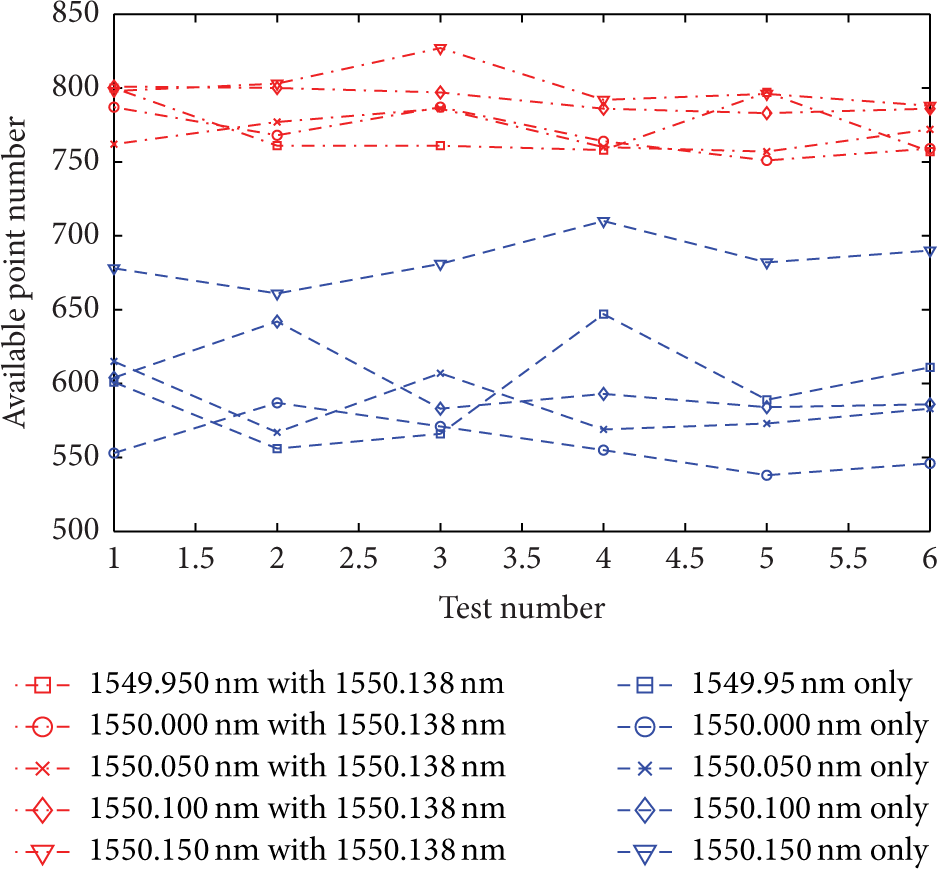
The available points of each test in the experiment.
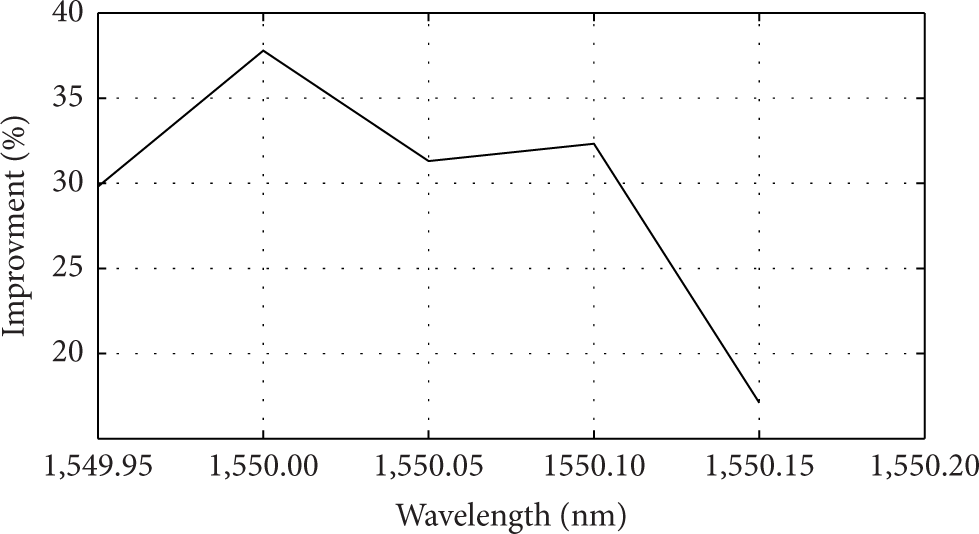
The available points' improvement versus wavelength.
In order to test the frequency response of the dual-wavelength system, the repetition rate of the optical pulse was set at 48 kHz and the acquisition time was 1 s. The vibration source was a Piezoelectric Transducer (PZT) tube at the position of 955 m along the fiber and the electric frequency was varied from 4 Hz to 24 kHz. Figure 8 presents the FFT spectra of the optical power variation recorded by the system. The recorded spectrum shows clearly visible peaks at all test frequencies with a high SNR. We also observed that when a certain frequency was applied to the system, the fundamental frequency and its second harmonic can be recorded. This is because the detection formula is
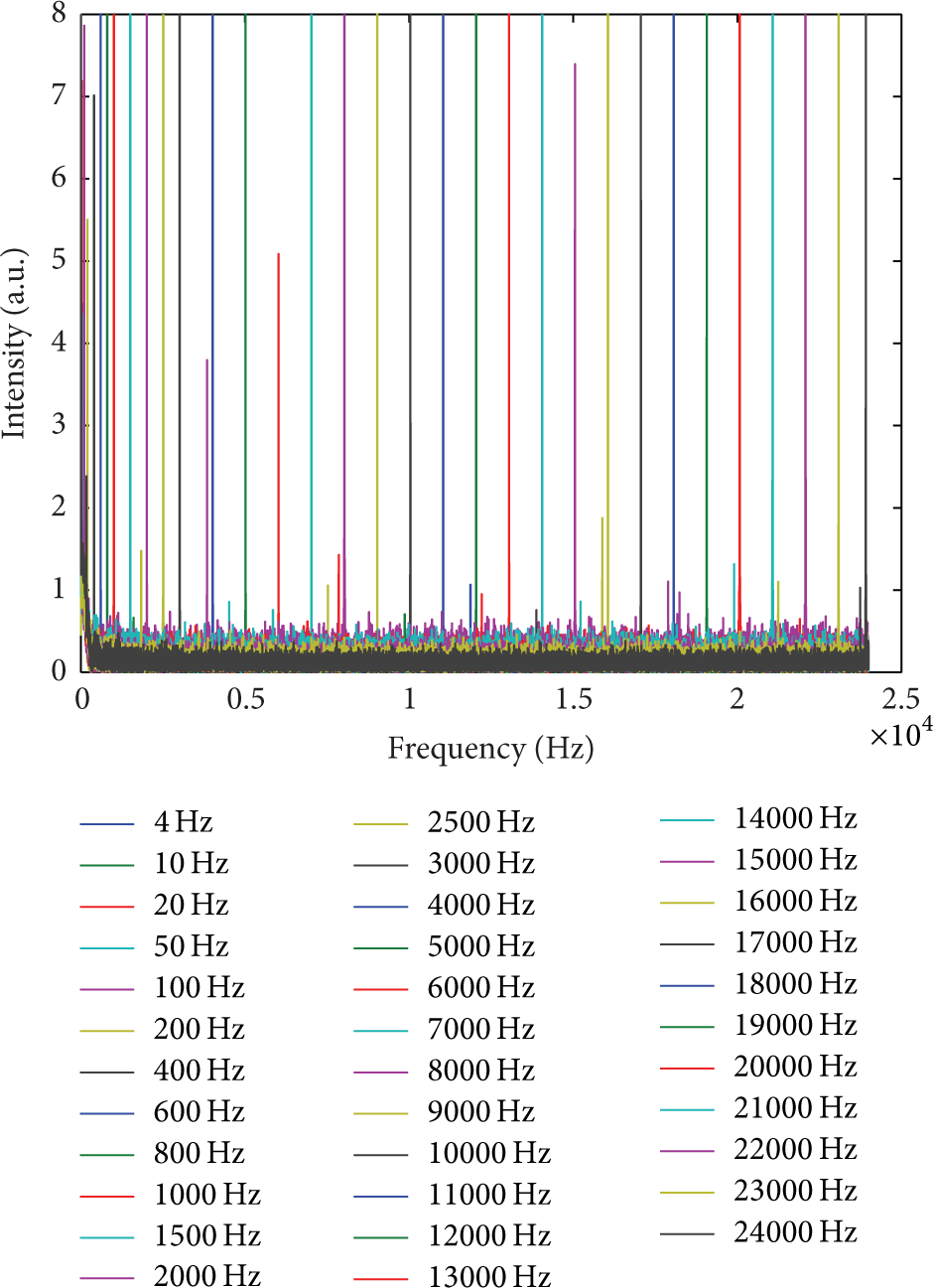
FFT spectrum of optical power at position 955 m with vibration frequencies varying from 4 Hz to 24 kHz.
4. Conclusion
In this study, an experimental and theoretical description of a dual-wavelength strategy was presented to reduce the fading phenomenon in a ϕ-OTDR and improve the equality of the response along the whole sensing optical fiber. An increase of 37.79% in the number of available points has been achieved when the wavelengths of 1550.000 nm and 1550.138 nm are employed. The experiment shows that a more than 0.012 nm wavelength difference in the dual-wavelength system will ensure that the improvement can be practically realized. On average, a 30% improvement in detection is achieved when the wavelengths change from 1549.95 nm to 1550.10 nm.
Footnotes
Conflict of Interests
The authors declare that they do not have any commercial or associative interest that represents interests in connection with the paper they submitted.
Acknowledgment
This work is funded by the National Natural Science Foundation of China (no. 61304244).