




Abstract
In 6LoWPAN networks, several mobility management schemes have been proposed based on Mobile IPv6 (MIPv6) and Proxy Mobile IPv6 (PMIPv6). However, the existing schemes are centralized, and thus they have many serious drawbacks such as nonoptimal data route, injection of unwanted data traffics into core networks, increased cost of network engineering, and large registration and handover delays. To overcome these limitations, we propose new distributed mobility management schemes for 6LoWPAN networks. In the proposed schemes, Home Agent (HA), Local Mobility Anchor (LMA), and Mobile Access Gateway (MAG) functions are implemented in 6LoWPAN gateways, and the handover operations are performed directly between two neighboring 6LoWPAN gateways. By numerical analysis, we show that the proposed distributed schemes can significantly reduce the registration and handover delays, compared to the existing centralized mobility schemes.
1. Introduction
Currently, some sensor network protocols do not use TCP/IP [1], such as ZigBee [2]. However, future sensor networks may be connected to others network via the Internet. Hence, an Internet Protocol (IPv6) [3] is the best solution for the future sensor network because of efficient addressing mechanism.
Recently, the IPv6 over Low power Wireless Personal Area Network (6LoWPAN) has been discussed by IETF [4, 5], which uses the IEEE 802.15.4 interfaces [6]. The protocol enables the wireless sensors on a physical object to be connected to IPv6 networks efficiently. However, to deliver data packets over mobile wireless networks, the sensors need a support from the mobility management scheme.
Many IPv6-based mobility management protocols have attracted much interest in 6LoWPAN networks. We can classify the protocols into the host-based schemes and the network-based schemes. For example, Mobile IPv6 (MIPv6) is a host-based protocol [7] and Proxy Mobile IPv6 (PMIPv6) is a network-based protocol [8]. In host-based mobility schemes, when a Mobile Sensor Node (MSN) moves from one mobility domain to another, the protocols require the exchange of Binding Update (BU) and Binding Acknowledgement (BA) messages with its Home Agent (HA) in order to continue the session. On the other hand, in network-based mobility schemes, when an MSN changes the domain, the protocols do not require any mobility-related signaling. Instead, a Mobile Access Gateway (MAG) is responsible for detecting movement and exchanging signaling messages on behalf of the MSN.
The protocols explained are Centralized Mobility Management (CMM) approaches, in which HA and/or Local Management Anchor (LMA) plays the role of a centralized mobility agents that process all the control and data packets. The centralized agents allow an MSN to be reachable from other nodes even when it is away from the home domain, by forwarding the data packets to and from the MSN. However, CMM schemes are vulnerable to many problems. First, the centralized mobility agents induce undesired control and data traffic into the core network, which can be a big burden to network service providers increasing the operational cost. In addition, a single point of failure problem can incur a serious performance degradation of the overall system and raise the network engineering cost. Further, the centralized schemes suffer from large registration and handover delays. To resolve the limitations of CMM schemes, IETF has begun to discuss the Distributed Mobility Management (DMM) recently [9–11].
In this paper, we propose the IPv6-based DMM schemes for the 6LoWPAN wireless sensor networks. In our proposed schemes, HA, LMA, and MAG functions are combined into the 6LoWPAN gateway, denoted as 6LoWPAN-GW, and the handover operation is directly performed between the two neighboring 6LoWPAN-GWs. Our schemes provide the optimal data routes and reduce the registration and handover delays.
The rest of this paper is organized as follows. In Section 2, we review the existing CMM schemes for 6LoWPAN networks and in Section 3, we describe the proposed DMM schemes in detail. The performances of the considered schemes are analyzed in Section 4 in terms of the registration delay and the handover delay. We provide the numerical results and discuss them in Section 5. Finally, we conclude this research in Section 6.
2. Related Work
In this section, we illustrate the previous CMM schemes for 6LoWPAN wireless sensor networks, which are classified as the host-based CMM (HCMM) and the network-based CMM (NCMM), respectively.
2.1. Host-Based CMM in 6LoWPAN Networks (HCMM-6LoWPAN) [12]
We denote the host-based CMM in 6LoWPAN networks as HCMM-6LoWPAN. In this scheme, when an MSN moves from one mobility domain to another, it sends a Router Solicitation (RS) message to the new gateway, n-6LoWPAN-GW, as in Figure 1. Upon the reception of the RS message, the n-6LoWPAN-GW responds with Router Advertisement (RA) message to the MSN (Step 1). As the next step, the MSN exchanges the Binding Update (BU) message and the corresponding Binding Acknowledgement (BA) message with HA (Step 2). The messages between MSN and 6LoWPAN-GW (or HA) are exchanged via the Full Function Device (FFD) rather than directly. Now the MSN can communicate with the Corresponding Node (CN) over the Internet.
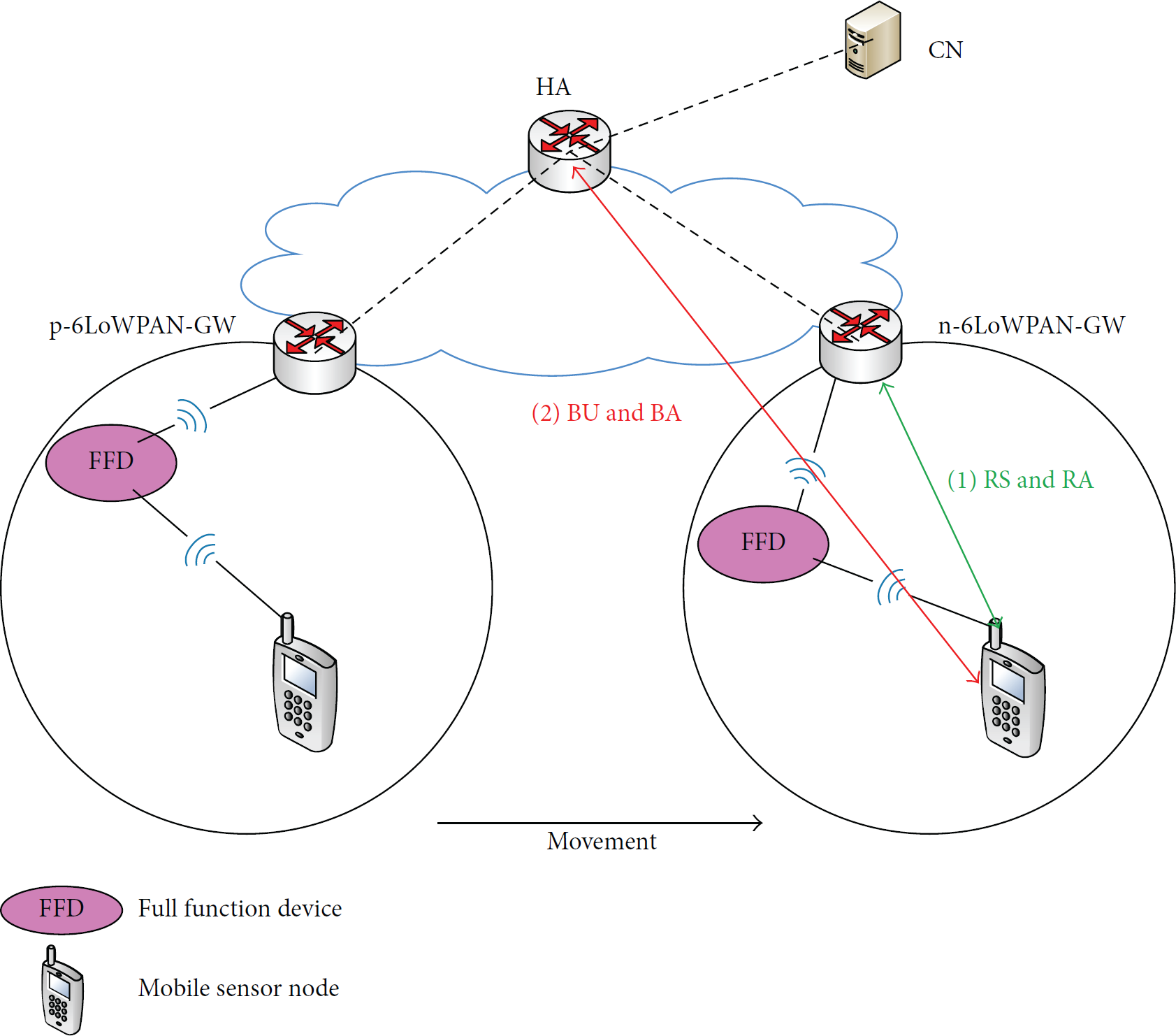
Overview of host-based CMM in 6LoWPAN networks.
In the similar context, Hierarchical Mobile IPv6 (HMIPv6) has been proposed to reduce the mobility-related signaling messages [13, 14]. It introduces a new mobility entity called Mobile Anchor Point (MAP), which acts as a local HA and improves the network performance, especially the intradomain handover and signaling delays. However, as a cost, it increases the signaling overhead substantially because each MSN should perform both local binding with MAP and the global binding with HA. So in the interdomain mobility scenario, we consider the MIPv6-based scheme as the basic one instead of the HMIPv6-based scheme.
2.2. Network-Based CMM in 6LoWPAN Networks (NCMM-6LoWPAN)
As an alternative to HCMM, we can consider the network-based CMM scheme, which will be denoted as NCMM-6LoWPAN. The NCMM scheme is more suitable for wireless networks because it does not consume the scarce wireless bandwidth by mobility-related signaling messages and does not require the duplicate address detection procedure to configure the care-of-address, the temporary identifier for the current mobility domain.
The conventional PMIPv6 [8] did not support the multihop based 6LoWPAN. If MSN enters the multihop based Personal Area Network (PAN) area, then there is no way for MSN to inform the MAG for PAN attachment. In order to solve the multihop communication problem, [15] proposed the intra-PAN mobility schemes for 6LoWPAN network by using the static nodes within an intra-PAN area. However, this solution only supports intra-PAN mobility. The works in [16] proposed both intra-PAN and inter-PAN mobility scenarios by using the 6LoWPAN gateways (6LoGWs). Each 6LoGW acts as MAG and has a unique PAN identifier (PAN ID). The 6LoGWs manage the mobility-related signaling on behalf of MSN.
In the NCMM scheme [16], if an MSN moves from one mobility domain to another as in Figure 2, the MSN sends an RS message to the new 6-LoWPAN-GW/MAG, denoted as n-6LoWPAN-GW/MAG (Step 1). When the n-6LoWPAN-GW/MAG receives the RS message from the MSN, it sends an AAA request message to the AAA server to authenticate the MSN. If the authentication is successful, the server responds to the n-6LoWPAN-GW/MAG by an AAA reply message, which contains the address of LMA (Step 2). Then, the n-6LoWPAN-GW/MAG sends a Proxy Binding Update (PBU) message to the LMA for the MSN, and the LMA returns Proxy Binding Acknowledgement (PBA) message (Step 3). Finally, n-6LoWPAN-GW/MAG responds to the MSN with an RA message (Step 4).
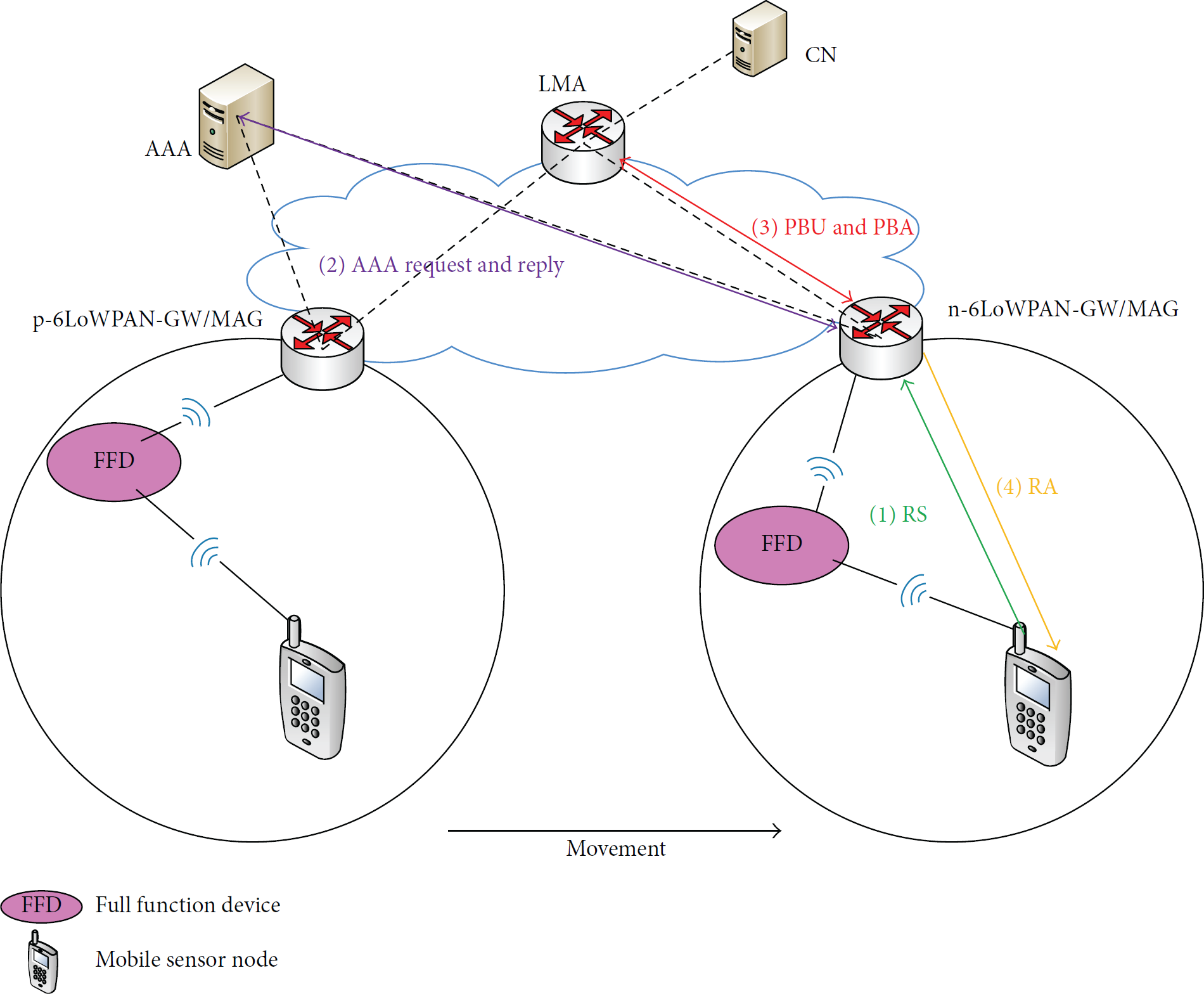
Overview of network-based CMM in 6LoWPAN networks.
3. Proposed Schemes
In this section, we describe the proposed distributed mobility management schemes. To this end, first we need to specify the network model.
3.1. Network Model
Figure 3 shows the network model for the proposed schemes. We assume that an MSN is attached to the FFD. Each 6LoWPAN-GW incorporates the functions of HA for the host-based scheme and the functions of MAG/LMA for the network-based scheme, respectively. In this sense, we denote the new entity as 6LoWPAN-GW/MAG/LMA/HA temporarily. In the considered scenario, MSN initially communicates with CN via the previous 6LoWPAN-GW/MAG/LMA/HA, denoted by p-6LoWPAN-GW/MAG/LMA/HA, and then it hands over to the new n-6LoWPAN-GW/MAG/LMA/HA.

Network model for the proposed schemes.
3.2. Comparison of CMM and DMM
Before describing the proposed schemes in detail, we compare the considered mobility management schemes in the architectural perspective in Table 1.
Comparison of mobility management architectures.

In the viewpoint of the mobility management, MIP and PMIP are the CMM architectures, in which all the control and data traffic are processed by a centralized agent such as HA and LMA. Data packets are delivered to the centralized agents first and forwarded to the corresponding host. The centralized agents, HA and LMA, manage the mobility of MSNs. On the other hand, in the proposed schemes, such centralized agents are not used any more. Instead, each 6LoWPAN-GW acts as HA and MAG/LMA as described in the subsequent sections.
3.3. Host-Based DMM in 6LoWPAN Networks (HDMM-6LoWPAN)
3.3.1. Initial Registration
The initial registration procedure of the host-based DMM scheme is shown in Figure 4.

Initial registration procedure of HDMM-6LoWPAN.
In this scheme, HA function is implemented in the 6LoWPAN-GW together, so we denote the entity as 6LoWPAN-GW/HA. When an MSN is attached to a 6LoWPAN-GW/HA, the MSN sends a Router Solicitation (RS) message to the 6LoWPAN-GW/HA (Step 1). As soon as the 6LoWPAN-GW/HA receives the RS message, it returns a Router Advertisement (RA) message to the corresponding MSN (Step 2). Subsequently the MSN sends a Binding Update (BU) message to the 6LoWPAN-GW/HA (Step 3), and the 6LoWPAN-GW/HA responds with a Binding Acknowledgement (BA) message to the MSN (Step 4).
3.3.2. Handover Operation
When an MSN is detached from the previous 6LoWPAN/HA (p-6LoWPAN/HA) and attached to the new 6LoWPAN/HA (n-6LoWPAN/HA) as Figure 5, the MSN sends an RS message to the n-6LoWPAN/HA (Step 1). As a response, the n-6LoWPAN/HA returns an RA message to the MSN (Step 2). Then, the MSN sends a BU message to the n-6LoWPAN-GW/HA (Step 3). Note that the BU message carries the address of MSN configured at the previous gateway and the address obtained at the new gateway. The n-6LoWPAN-GW/HA exchanges the BU and BA messages with the p-6LoWPAN-GW/HA while setting up the handover tunnel (Steps 4 and 5). Finally, the n-6LoWPAN-GW/HA responds to the MSN with the BA message (Step 6).

Handover operation of HDMM-6LoWPAN.
Figure 6 shows a HDMM-6LoWPAN procedure of 6LoWPAN-GW/HA. When a 6LoWPAN-GW/HA receives a BU signaling message from MSN, the 6LoWPAN-GW/HA determines whether the MSN is in the binding update list or not. If the MSN is a new one, the 6LoWPAN-GW/HA creates a new entry for the MSN in the binding update list. After that, the location of the MSN should be determined and updated. If the MSN is not a new one, then 6LoWPAN-GW/HA will only update location of MSN in the binding update list.

HDMM-6LoWPAN procedure of 6LoWPAN-GW/HA.
3.4. Network-Based DMM in 6LoWPAN Networks (NDMM-6LoWPAN)
3.4.1. Initial Registration
Figure 7 illustrates the initial registration procedure of the network-based DMM scheme. When an MSN is attached to a 6LoWPAN-GW/MAG/LMA, the MSN sends an RS message to the 6LoWPAN-GW/MAG/LMA (Step 1). Receiving the RS message, the 6LoWPAN-GW/MAG/LMA sends an AAA request message to the AAA server to authenticate the MSN. After completing the authentication, the server returns an AAA reply message to the 6LoWPAN-GW/MAG/LMA (Steps 2 and 3). Then, 6LoWPAN-GW/MAG/LMA provides an RA message to the MSN for the initial RS message (Step 4).

Initial registration procedure of NDMM-6LoWPAN.
3.4.2. Handover Operation
When an MSN is detached from a previous p-6LoWPAN-GW/MAG/LMA and attached to a new n-6LoWPAN-GW/MAG/LMA as Figure 8, the MSN sends an RS message to the n-6LoWPAN-GW/MAG/LMA (Step 1). Triggered by the RS message, the n-6LoWPAN-GW/MAG/LMA exchanges the AAA request and reply messages with the AAA server (Steps 2 and 3). After authentication, the n-6LoWPAN-GW/MAG/LMA exchanges the Proxy Binding Update (PBU) and Proxy Binding Acknowledgement (PBA) messages with the p-6LoWPAN-GW/MAG/LMA for handover control (Steps 4 and 5). The n-6LoWPAN-GW/MAG/LMA reads the address of the p-6LoWPAN-GW/MAG/LMA from the initial RS message and, using the information, it establishes the handover tunnel with p-6LoWPAN-GW/MAG/LMA. As a final step, n-6LoWPAN-GW/MAG/LMA sends an RA message to the MSN (Step 6).

Handover operation of NDMM-6LoWPAN.
Figure 9 shows a NDMM-6LoWPAN procedure of 6LoWPAN-GW/MAG/LMA. When a 6LoWPAN-GW/MAG/LMA detects MSN movement, the 6LoWPAN-GW/MAG/LMA determines whether the MSN is in the binding update list or not. If the MSN is a new one, the 6LoWPAN-GW/MAG/LMA creates a new entry for the MSN in the binding update list. After that, the location of the MSN should be determined and updated. If the MSN is not a new one, then 6LoWPAN-GW/MAG/LMA will only update location of MSN in the binding update list.

NDMM-6LoWPAN procedure of 6LoWPAN-GW/MAG/LMA.
4. Performance Analysis
We compare the registration delay and the handover delay of the four considered mobility management schemes, that is, HCMM-6LoWPAN, NCMM-6LoWPAN, HDMM-6LoWPAN, and NDMM-6LoWPAN, because the delays are the key performance metrics.
4.1. Analysis Model
We define several notations for the analysis and summarize them in Notations section. We illustrate the considered network model in Figure 10.

Network model for performance analysis.
In Figure 10, we denote by
4.2. Analysis of Registration Delay
4.2.1. HCMM-6LoWPAN
As shown in Figure 1, when an MSN is attached to a 6LoWPAN-GW, it sends an RS message to the 6LoWPAN-GW via FFD, and the 6LoWPAN-GW responds with an RA message to the MSN. Then, the MSN exchanges the BU and BA messages with HA. Accordingly, the registration delay of HCMM-6LoWPAN is given by

4.2.2. NCMM-6LoWPAN
When an MSN is attached to a 6LoWPAN-GW/MAG, it sends an RS message to the 6LoWPAN-GW/MAG via FFD (See Figure 2). Then, the 6LoWPAN-GW/MAG performs the AAA request and reply operations with the AAA server. As a next step, the 6LoWPAN-GW/MAG exchanges the PBU and PBA messages with LMA. Right after receiving the PBA message, the 6LoWPAN-GW/MAG returns an RA message to the MSN. Thus, the registration delay of NCMM-6LoWPAN is given by

4.2.3. HDMM-6LoWPAN
As Figure 4, if an MSN is attached to a 6LoWPAN-GW/HA, the MSN sends an RS message to the 6LoWPAN-GW/HA via FFD, and the 6LoWPAN-GW/HA replies to the MSN by an RA message. Then the MSN performs the BU and BA operation with 6LoWPAN-GW/HA, and the registration completes. So we get the registration delay of HDMM-6LoWPAN as

4.2.4. NDMM-6LoWPAN
As shown in Figure 7, when an MSN is attached to a 6LoWPAN-GW/MAG/LMA, it sends an RS message to the 6LoWPAN-GW/MAG/LMA via FFD. Then, the 6LoWPAN-GW/MAG/LMA performs the AAA request and reply operation with the AAA server. After authentication, the 6LoWPAN-GW/MAG/LMA responds to the MSN as an RA message. Thus, the registration delay of NDMM-6LoWPAN is written as

4.3. Analysis of Handover Delay
The handover delay is defined as the interval between the time when an MSN cannot receive the packets from p-6LoWPAN-GW/MAG/LMA/HA and the time when the MSN receives the first packet from n-6LoWPAN-GW/MAG/LMA/HA.
4.3.1. HCMM-6LoWPAN
An MSN is attached to an n-6LoWPAN-GW and sends an RS message to the n-6LoWPAN-GW via FFD. The n-6LoWPAN-GW responds with an RA message to the MSN. To ensure the uniqueness of the configured care-of-address, the MSN needs to perform the duplicate address detection procedure with the n-6LoWPAN-GW [17], which spends the time of 
4.3.2. NCMM-6LoWPAN
When an MSN is attached to an n-6LoWPAN-GW/MAG, it sends an RS message to the n-6LoWPAN-GW/MAG via FFD. The n-6LoWPAN-GW/MAG exchanges the AAA request and reply messages with the AAA server, and it performs the PBU and PBA operation with LMA. Based on the received PBA message, the n-6LoWPAN-GW/MAG builds and returns an RA message to the MSN. Data packets are now delivered to MSN via n-6LoWPAN-GW/MAG. The handover delay of NCMM-6LoWPAN is written as
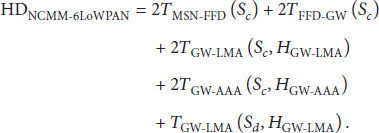
4.3.3. HDMM-6LoWPAN
Suppose that an MSN is attached to an n-6LoWPAN-GW/HA. The MSN sends an RS message to the n-6LoWPAN-GW/HA via FFD, and the n-6LoWPAN-GW/HA responds with an RA message to the MSN. To ensure that a configured care-of-address is unique on the new link, the MSN performs the duplicate address detection procedure, spending the time of 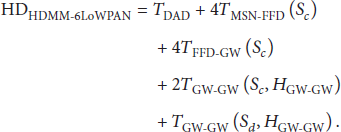
4.3.4. NDMM-6LoWPAN
In the NDMM-6LoWPAN scheme, the MSN attached to an n-6LoWPAN-GW/MAG/LMA sends an RS message to the n-6LoWPAN-GW/MAG/LMA via FFD. In the following, the n-6LoWPAN-GW/MAG/LMA exchanges the AAA request and reply messages with the AAA server. Moreover, the n-6LoWPAN-GW/MAG/LMA performs the PBU and PBA operation with the p-6LoWPAN-GW/MAG/LMA to establish the handover tunnel. So, the handover delay of NDMM-6LoWPAN is written as

5. Numerical Results and Discussion
Based on the analytical equations given in Section 4, we compare the performances of the considered mobility management schemes. In the numerical results, the default value of each parameter has been configured as follows: referring to [18]; that is,
5.1. Registration Delay
We show the impact of the delay of wireless links (

Impact of
Figures 12 and 13 compare the registration delay of each scheme varying the average queuing delay (
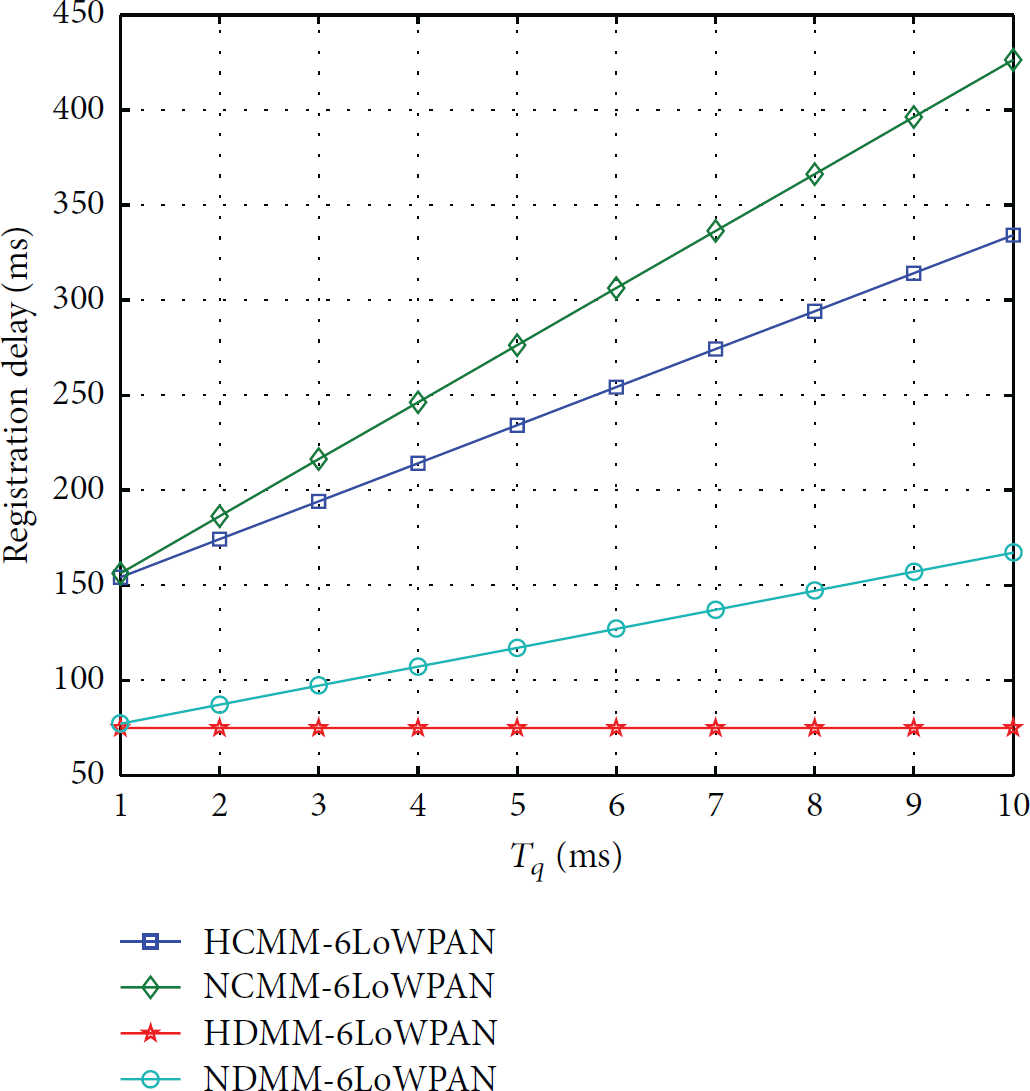
Impact of

Impact of
We next illustrate the registration delay for different hop counts between GW and LMA/HA (

Impact of
5.2. Handover Delay
The delay of wireless links (
Impact of
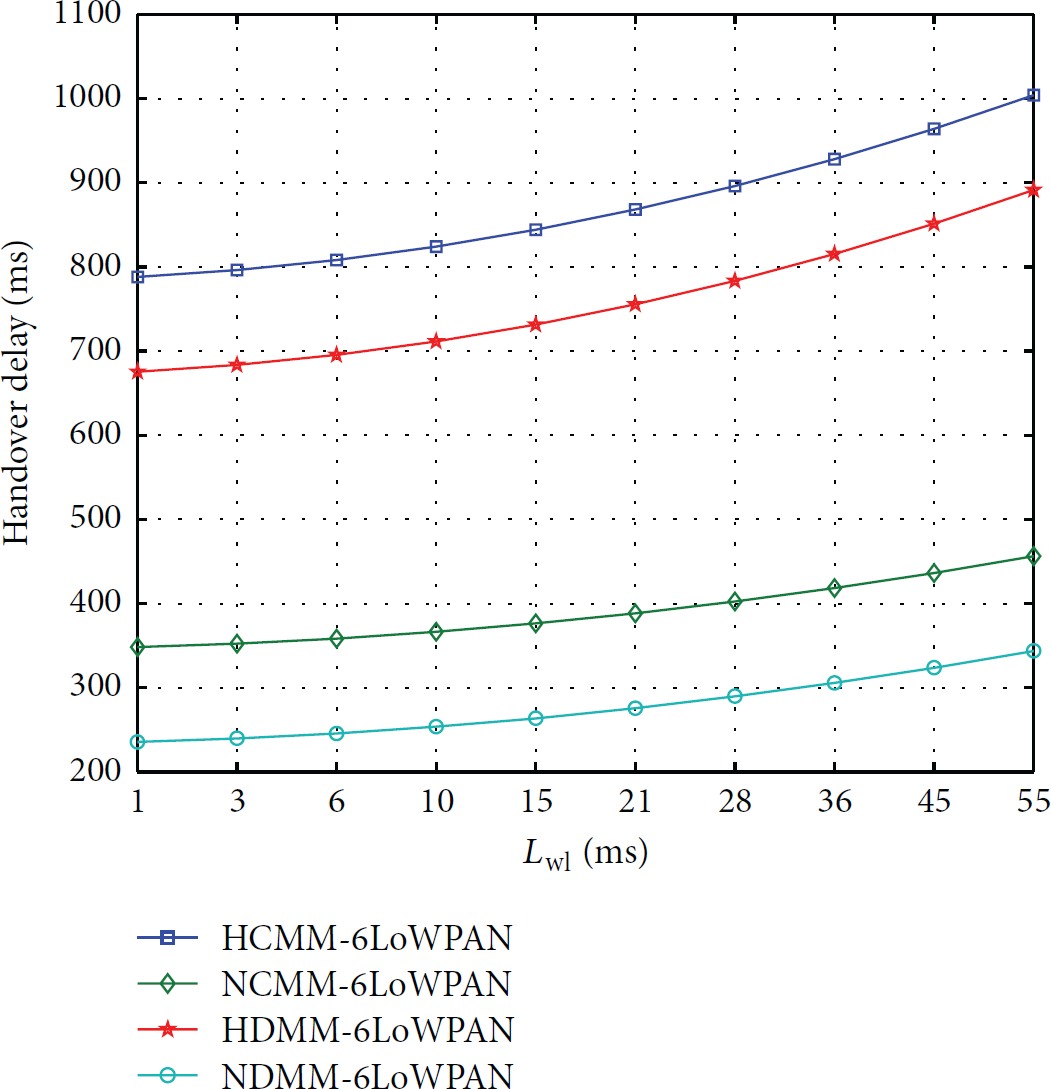
Figure 16 shows the impact of the average queuing delay (

Impact of
We illustrate the handover delay for different hop counts between GW and LMA/HA (

Impact of
Figure 18 shows the impact of the number of gateways (

Impact of
6. Conclusions
In this paper, we proposed two distributed mobility management schemes for 6LoWPAN networks: (1) Host-based Distributed Mobility Management in 6LoWPAN (HDMM-6LOWPAN) and (2) Network-based Distributed Mobility Management in 6LoWPAN (NDMM-6LOWPAN). In the proposed schemes, Home Agent, Local Mobility Anchor, and Mobile Access Gateway functions are incorporated in the 6LoWPAN gateway, and the handover operation is directly performed by two neighboring 6LoWPAN gateways.
The numerical analysis shows that the proposed schemes reduce the registration delay and the handover delay significantly, compared to the existing mobility schemes. The HDMM-6LoWPAN performs poor over wireless links on the registration delay while it performs well over wired links. The NDMM-6LoWPAN gives the best performance among the considered mobility schemes on the handover delay. The proposed scheme may be incorporated for ameliorating the performance of routing algorithms in mobile wireless sensor. Some recent novel related ideas are given in [19, 20].
Footnotes
Notations for Numerical Analysis
Conflict of Interests
The authors declare that there is no conflict of interests regarding the publication of this paper.
Acknowledgment
This research was supported by Basic Science Research Program through the National Research Foundation of Korea (NRF) funded by the Ministry of Science, ICT and Future Planning (NRF-2012R1A1A1005972).