COSB-128 (Moldovyan et al., 2002) is a block cipher with 128-bit and 256-bit secret keys, which use key and data-dependent operational substitutions in fast controllable permutation blocks (CPB) concept. It is designed with a simple key schedule to ensure a high speed of data transformation by fast block encryption algorithms and expected to be high stability to all known methods of cryptanalysis, especially differential and linear attacks. In this paper, we show that the COSB-128 block cipher still remains weaknesses to differential related-key cryptanalysis, by constructing two full 10-round related-key differential characteristics (DCs) of COSB-128 with high probabilities, and thence propose our two related-key differential attacks. The attacks require about 224 data and time complexities to recover 63-bit key information and 222 data and time complexities to recover 6-bit key information. This study is the first known cryptanalytic result on COSB-128 until now. From this study, the new potential for the cryptanalysis on these types of block cipher will be further revealed.
1. Introduction
Recently, the use of network-based devices and services has increased gradually. Thence, the security becomes an essential interest, which is required not only to be strong with most known attacks but also to be optimized on software-hardware implementations [1, 2] or specialized applications. With these criteria, designing cipher using in which data-dependent controllable operations is a cryptographic primitive approach in modern applied cryptography.
When the best known algorithms using controllable permutations (RC5, RC6, etc. [3]) showed their limitations in protective transformation, the operational substitutions offer promise for fast block encryption algorithms with better performance.
Recently, there are some designs of block ciphers which are presented, such as CIKS-1 [4], CIKS-128 [5], Cobra-H64, Cobra-H128 [6], SCO-1, SCO-2, and SCO-3 [7] which aim to enhance the security of the DDP- (data-dependent permutation-) based ciphers structure. Although there are many well-known ciphers, with different specifications and characteristics, the security of them is still under consideration. All of them use a very simple key scheduling for high speed encryption algorithms, which enables the cryptanalysis exploit by applying related-key attacks concept.
COSB-128 [8] is a 128-bit block cipher with a 256-bit key; the number of round is 10. It uses controlled operational substitution (COS) with the concept of fast controllable permutation blocks (CPB) [9]. This cipher is expected to have high performance in hardware-software implementations and high stability to all known cryptanalysis, especially differential attacks and linear attacks.
Related-key differential cryptanalysis was introduced in 1994 by Biham [1, 2] and has become an effective and popular method for attacking many types of block ciphers. This attack researched on CIKS-cipher family [10], Cobra-cipher family [11], or SCO-cipher family [12]… has given a reasonable result with better performance.
In this paper, we show that this type of block cipher is still vulnerable to related-key differential attack, by constructing two full 10-round differential characteristics (DCs) of COSB-128 with high probabilities; thence, we present our two related-key differential attacks on it. The attack allows us to recover 63-bit key information with about 224 data related-key chosen plaintexts and 224 encryptions and 6-bit key information with about 222 data related-key chosen plaintexts and 222 encryptions. This study is the first known cryptanalytic result on COSB-128 so far.
This paper is organized as follows: in Section 2, we present the COSB-128 block cipher; in Section 3, the related-key differential characteristics and our related-key differential attack on COSB-128 are proposed. Finally, we give the conclusion of this paper in Section 4.
2. Description of COSB-128 Block Cipher
In this section, the structure of COSB-128 block cipher is reviewed. Firstly, we notice some notations using through the whole paper. The cipher is assigned with and being the most significant bit and the least significant bit, respectively:
: the input difference in round r;
: the round-key difference in round r;
: the output difference in round r;
: the ith bit and jth bit are ones; the others are zeros within a cipher (e.g., ).
COSB-128 [8] is a 128-bit block cipher using 256-bit secret key; the number of round is 10. The ciphers do the same iterative structure with the round function (: encryption, : decryption).
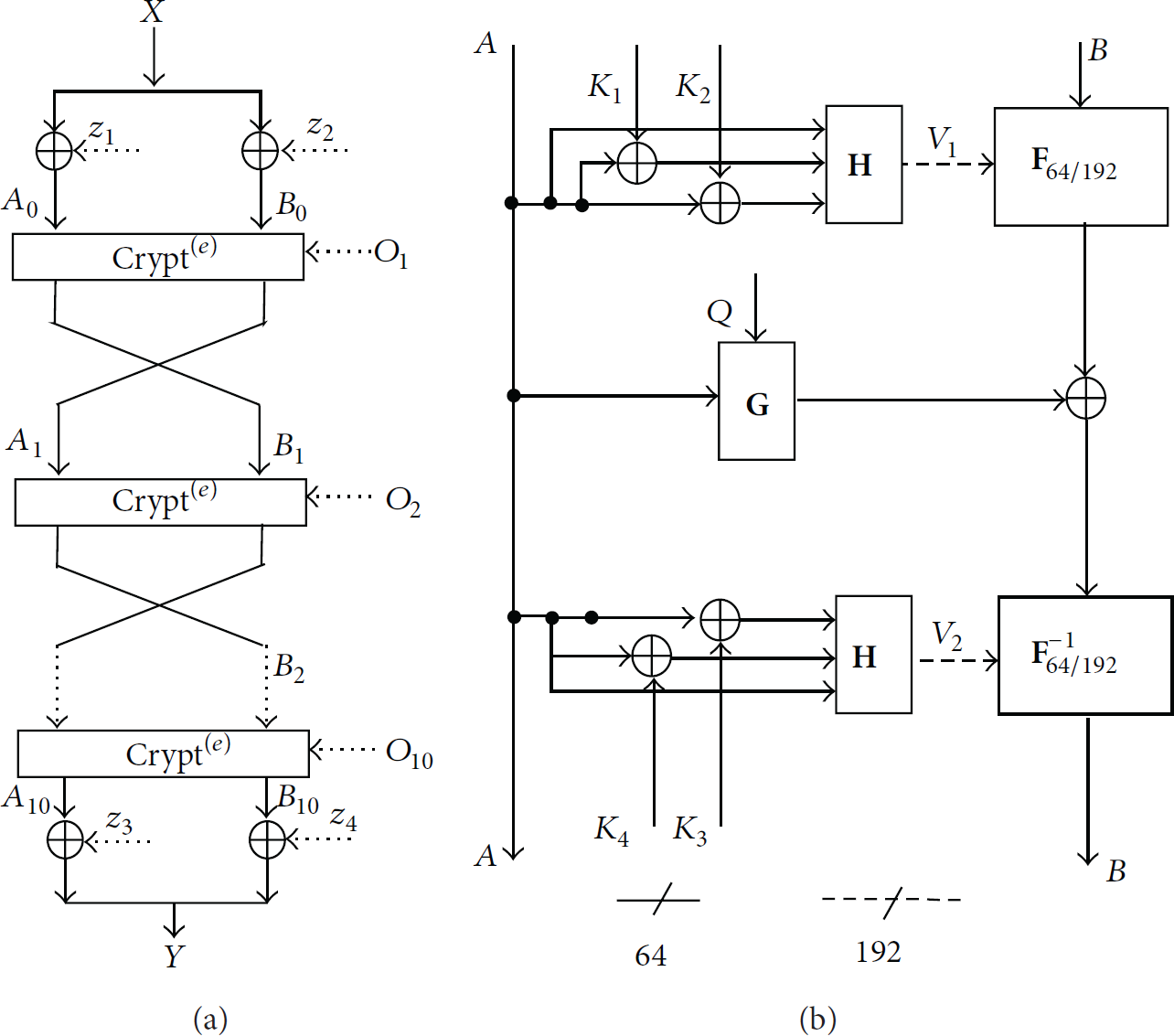
The round function consists of basic arithmetical operations: ×, multiplication, ⊕, modulo 2 addition, a transformation of control vector H, a substitution transformation G, and two CPB-Boxes, and .
The encryption procedure of COSB-128 is as follows.
128-bit plaintext is divided into two 64-bit subblocks A and B:
Perform initial transformation as follows:
For to 9 do the following:
Perform transformation as follows:
Perform final transformation as follows:
The round function Crypt(0) is given in Figures 1 and 2. For more detailed description of COSB-128, see [8].
Round function of COSB-128.
(a) and , (b) , (c) , (d) , (e) , and (f) .
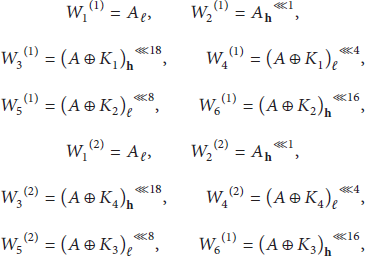
The control ciphers are performed through the transformation of control vector H, with the ciphers , . Consider the following:
The output values of are defined as
where , is 32 lower-order digits, and h is 32 higher-order digits.
The substitution function G uses output vector , in which Q depends on round cycles; for odd rounds and for even rounds; A, . Consider the following:
where
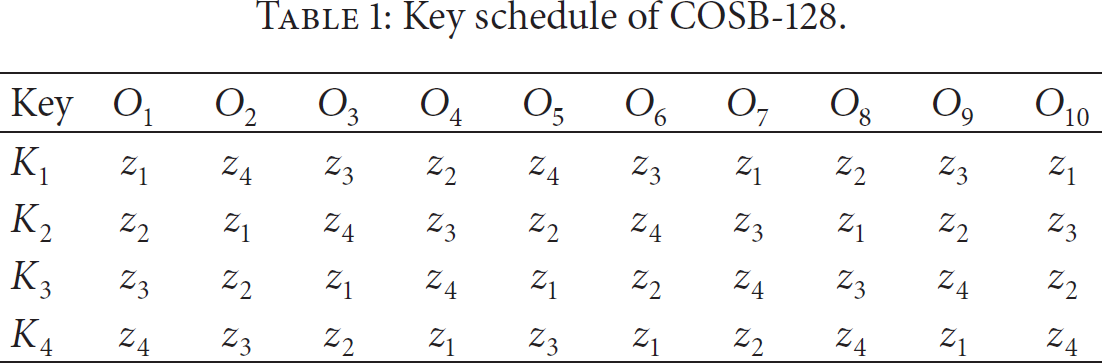
The key schedule of COSB-128 is constructed in such a simple way, where 256-bit secret key Z is split into four 64-bit subkeys; . The procedure of key scheduling is specified as in Table 1.
Key schedule of COSB-128.
Key
K
1
z
1
z
4
z
3
z
2
z
4
z
3
z
1
z
2
z
3
z
1
K
2
z
2
z
1
z
4
z
3
z
2
z
4
z
3
z
1
z
2
z
3
K
3
z
3
z
2
z
1
z
4
z
1
z
2
z
4
z
3
z
4
z
2
K
4
z
4
z
3
z
2
z
1
z
3
z
1
z
2
z
4
z
1
z
4
3. Key Recovery Attacks on COSB-128
In this section, we construct a full 10-round related-key differential characteristic (DC) of COSB-128 with high probabilities using some properties of function and thence propose our related-key differential attack on COSB-128 block cipher.
3.1. Properties of COSB-128
We obtain some appropriate properties of function of COSB-128 that enable us to construct related-key differential characteristics.
3.1.1. Properties with
We assume is a probability to have the output difference of , with and being the input difference and the controlling vector difference, respectively. Then we can calculate the probability as the following.
.
.
.
.
.
.
,
where ΔY = , , and .
3.1.2. Properties with
Extensively, we let be a probability to have the output difference of , with being the input difference and being the controlling vector difference. We have the following.
.
, with .
, with
3.1.3. Properties with
Similarly, we can get the probability of , , with -output difference, -input difference, and -controlling vector difference. Consider the following.
.
.
, for any fixed i, j.
(both and have 6 active layers within structure)
, for any fixed i, j.
(both and have 6 active layers within structure).
3.1.4. Properties with Transformation H and G
Let A, , and be the inputs of transformation H, respectively:
With the control vector of , we have and . Similarly, and of the control vector of .
Let A be the input of G with key-dependent metric Q; then we can get the probability and .
3.2. Related-Key Differential Characteristics of COSB-128
With the properties defined in Section 3.1 combined with such a simple key schedule of COSB-128 structure, we are able to construct the related-key differential characteristics (DCs) for COSB-128 with high probability.
We assume that the plaintext pairs are encrypted under the key pairs , respectively, in which and , to get the corresponding ciphertext pairs .
Then, as Table 2 shows, we can construct a 10-round related-key differential characteristic , where , for rounds 1~10 of COSB-128 with probability .
Related-key differential characteristics (DCs) of a full 10-round COSB-128.
Round(r)
()
Probability
IT
(0, ) = α
(0, )
1
1
(0, 0)
(0, , 0, 0)
2−2/1/1
2−2
2
(0, 0)
(0, 0, , 0)
1/1/2−2
2−2
3
(0, 0)
(0, 0, 0, )
1/1/2−2
2−2
4
(0, 0)
(, 0, 0, 0)
2−2/1/1
2−2
5
(0, 0)
(0, , 0, 0)
2−2/1/1
2−2
6
(0, 0)
(0, 0, , 0)
1/1/2−2
2−2
7
(0, 0)
(0, 0, 0, )
1/1/2−2
2−2
8
(0, 0)
(, 0, 0, 0)
2−2/1/1
2−2
9
(0, 0)
(0, , 0, 0)
2−2/1/1
2−2
10
(0, 0)
(0, 0, , 0)
1/1/2−4
2−4
FT
(0, )
(, 0)
1
Output ()
(, ) = β
Total
2−22
We describe the way to construct the DCs in detail as follows.
The first rounds with the input and round key differences are and , respectively, so the output difference of the first H is with probability 1 (Section 3.1.4(a)). Thence, since the input difference and the control vector difference of are 0 and , the output difference of is 0 with probability (Section 3.1.3(b)). The output difference of G is 0 with probability when the input and the round key differences are 0 and 0, respectively (odd round cycle, ). Plus, the output difference of is 0 with probability since output difference of the second H is 0 with probability 1 (Section 3.1.4(b)). Finally, we can get that the output difference of function is 0 with probability in case the input differences are under the round key differences which are . Apply the method () for the fifth round and ninth round to find the DC of them.
The second round with the input and round key differences are and , respectively; so the output difference of the first H is 0 with probability 1. Thence, since the input difference and the control vector difference of are 0 and 0, the output difference of is 0 with probability (Section 3.1.3(a)). The output difference of G is 0 with probability when the input and the round key differences are 0 and 0, respectively (even round cycle, ). Plus, the output difference of is 0 with probability (Section 3.1.3(b)) since output difference of the second H is with probability 1 (Section 3.1.4(b)). Finally, we can get that the output difference of function is 0 with probability in case the input differences are under the round key differences which are . Apply the method () for the sixth round to find the DC of it.
Similarly, we can get the methods () and () with probabilities since the input is and round key differences are , , respectively.
With the last round, we change a little the difference characteristics for the output of support to our related-key differential attacks. The input and round key differences of are and . The output difference of is 0 with probability (the output difference of the first H is 0). Thus, the output difference of G with the input and the round key differences being 0 and 0 is 0 with probability (Section 3.1.4(b)). Plus the output difference of the second H is with probability 1 (Section 3.1.4(a)); in this case, the input difference and the control vector differences of are 0 and ; we get that the output difference is with probability (Section 3.1.1). Finally, for the last round, the related-key differential characteristic holds the probability .
See the Appendix for more description.
3.3. The First Related-Key Differential Attack on COSB-128
Based on the related-key DC we have constructed, we can recover a part of master key of COSB-128.
At first, we encrypt 223 plaintext pairs and to get 223 corresponding ciphertext pairs under an unknown key and an unknown related key . While the probability of related-key differential characteristics of COSB-128 is , we expect there are at least 2 ciphertext pairs with the difference for each j, where . So, with the DC described in Table 2, we can infer the jth one-bit difference where the ciphertext pairs are given from the output differences of in at the last round (refer to Figure 3). Thence, it can be expected that the differential route given is unique and we are able to retrieve 6 bits of controlling vectors for this route.
The possible routes of the on the last round.
The related-key differential attack on the full-round COSB-128 is as follows.
Choose a pool of 223 plaintext pairs with difference . Then, with the chosen plaintext attack, we encrypt the plaintext pairs using to get the ciphertext pairs , in which .
For each i and j, check if , where .
We assign j-BPO the bit-one positions of j. Then, with the number of ciphertext pairs satisfying the conditions at (2), we can extract some bits of the control vector through the difference route of the j-BPOs and the position of the 64th input bit of (see Figure 3). From this point, because the control vector of in last round is in form of , , and , we are able to find some corresponding bits of and .
The data complexity of this attack is 224 related-key chosen plaintexts. The time complexity of (1) is about 224 full round COSB-128 encryptions and the time complexities of (2) and (3) are much less than that of (1). Also, each ciphertext pair passes (2) with probability of at least ; thence, the ciphertext pairs with difference are expected to be at least 2. It means, for each j (), we have at least one ciphertext pair meets the difference. So, we expect to retrieve 56-bit keys information of and 7-bit keys information of with the data and time complexities of 224.
3.4. The Second Related-Key Differential Attack on COSB-128
For increasing the differential probability, we propose the second attack by constructing another related-key differential characteristic on COSB-128 with probability . In fact, we assume the probability of differential patterns of the 2nd, 3rd, 4th, 5th, and 6th layers in the box at the last round is 1. It means the bit-one input difference of the 32th always gets the direction to the j-bit output difference of the 6th layer. Also, the probability is 1 because when the input difference is and controlling vector difference is 0 of , the corresponding hamming weight of output difference is always 1. Then, we can recover a 6-bit key with data complexity being about 222 related-key chosen plaintexts with time complexity of about 222 full round COSB-128 encryptions.
The second related-key differential attack on COSB-128 is as follows.
This step is same as the algorithm applied on the Step (1) of the first related-key differential attack on COSB-128 in Section 3.3.
For each i, check if , where .
Thus, we can extent this attack to retrieve the whole of master key pair by applying an exhaustive search for the remaining keys. The exhaustive search takes a running time of 2250 encryptions and recovers the full key with the same data complexity and time complexity of about 2250 full-round COSB-128 encryptions.
4. Conclusion
The network-environment devices and services have increased rapidly in recent years. It leads the cryptography to new way; it does not only offer protection for stability to all known attacks, but also needs to be optimized on software-hardware implementations and suitable for most constrained environment applications in communication networks nowadays. In order to construct fast block encryption algorithms for ensuring high speed encryption in data transformation, the data-dependent controllable operations have been highly used.
While the operational permutation blocks (RC5, RC6, etc. [3]) still remain limitations in protective data transformation, COSB-128 [8] is a 128-bit block and 256-bit key, which uses the controllable operational substitutions in the concept of CPB [9], is proposed to give a good performance and be stable to most known cryptanalyses.
In this paper, we constructed the two related-key differential characteristics of a full 10-round of COSB-128 cipher with high probabilities based on some differential properties combined with the simple key schedule within COSB-128 structure. Then, it enables us to propose the two related-key differential attacks on COSB-128. Our attacks require 224 and 222 related-key chosen plaintexts, respectively, with the time complexities of 224 and 222 full-round COSB-128 encryptions, to recover 63 bits and 6 bits key information, respectively. This research is the first known cryptanalytic result on COSB-128 so far. Furthermore, it is hoped it will extend a new potential with better performance for cryptanalysis on this algorithm with type of ciphers in further research.
Footnotes
Appendix
The differential characteristics in function at several rounds of COSB-128 structure are shown in Figure 4.
Conflict of Interests
The authors declare that there is no conflict of interests regarding the publication of this paper.
Acknowledgment
This study was supported by Korea Internet Security Agency.
References
1.
BihamE.New types of cryptanalytic attacks using related keysAdvances in Cryptology—EUROCRYPT ‘931994765Springer398409Lecture Notes in Computer Science
2.
BihamE.New types of cryptanalytic attacks using related keysJournal of Cryptology199474229246
3.
IzotovB. V.MoldovyanA. A.MoldovyanN. A.Controlled operations as a cryptographic primitiveInformation Assurance in Computer Networks20012052Berlin, GermanySpringer230241Lecture Notes in Computer Science10.1007/3-540-45116-1_23
4.
MoldovyanA. A.MoldovyanN. A.A cipher based on data-dependent permutationsJournal of Cryptology2002151617210.1007/s00145-001-0012-9MR18809352-s2.0-0141755484
5.
GootsN.IzotovB.MoldovyanA.MoldovyanN.Modern cryptography: Protect Your Data with Fast Block Ciphers2003Wayne, Pa, USAA-LIST Publish
6.
SklavosN.MoldovyanN. A.KoufopavlouO.High speed networking security: design and implementation of two new DDP-based ciphersMobile Networks and Applications200510121923110.1023/b:mone.0000048556.51292.312-s2.0-17444420720
7.
MoldovyanN.On cipher design based on switchable controlled operationsComputer Network Security: : Proceedings of the Second International Workshop on Mathematical Methods, Models, and Architectures for Computer Network Security, MMM-ACNS 2003, St. Petersburg, Russia, September 21-23, 200320032776Berlin, GermanySpringer316327Lecture Notes in Computer Science10.1007/978-3-540-45215-7_27
8.
MoldovyanN. A.MoldovyanA. A.EremeevM. A.Protective data transformations in ACSs on the basis of a new primitiveAutomation and Remote Control200263121996201310.1023/a:10216516174322-s2.0-0036924919
9.
MoldovyanN.MoldovyanA.A Rapid Transformation Method for the Protection of Information in ACSsAvtomatika i Telemekhanika20004151165
10.
KoY.LeeC.HongS.SungJ.LeeS.Related-key attacks on DDP based ciphers: CIKS-128 and CIKS-128HProgress in Cryptology—INDOCRYPT 200420043348Springer191205Lecture Notes in Computer Science10.1007/978-3-540-30556-9_16MR2147925
11.
LeeC.KimJ.HongS.SungJ.LeeS.Related-key differential attacks on Cobra-S128, Cobra-F64a, and Cobra-F64bProgress in Cryptology—Mycrypt 200520053715Springer244262Lecture Notes in Computer Science
12.
JeongK.LeeC.KimJ.HongS.Security analysis of the SCO-family using key schedulesInformation Sciences200917942324242