




Abstract
With the development of semiconductors and the resulting effect on manufacturing costs, wireless interface platforms have become increasingly powerful and popular. This has resulted in widespread applications ranging from daily life activities to military services. In large-scale applications of wireless sensor networks such as military surveillance, there are two important issues that determine the success of network services. The first is sensing coverage, the data collection process from the target that directly affects network traffic. The second is network lifetime which is based on the optimization of energy consumption. Power optimization for mobile platforms can be classified into two categories: efficient power based on protocol and extended interface. In this paper, we suggest an energy model for wireless sensor networks that is based on the first issue; it can be called Coverage and Energy Strategy for wireless sensor networks (CESS). The scheme will attempt to achieve optimal coverage of the sensing area and energy balanced scheduling for all sensors. It can reduce redundancy of working sensor nodes by defining minimal number of active nodes in a sensing area. Thus the network lifetime will be maximized by reducing redundancy power consumption.
1. Introduction
During the past century, the development of semiconductors led to sensor networks being among the most successful technologies, affecting many aspects of our daily lives. Increasingly low-cost sensor motes are used in large-scale applications of wireless sensor networks (WSNs). Most applications focus on monitoring services such as climate, habitation, observation, and target tracking. Military sensor networks are a typical application of WSNs. Monitoring the target in an area of interest area is very important duty so full coverage should be guaranteed. However, sensors mostly are not deployed uniformly because areas of interest are of inaccessibility of human. Therefore, random distribution deployment using resource such as helicopters or automatic vehicles has emerged as a strategy. To guarantee adequate coverage, sensors in the area of interest will be deployed with high density. However, some areas end up with many overlapping sensors and some remain out of coverage. With fault-tolerance, the highly dense nodes can increase the precision and collision of information, thus decreasing the lifetime of the networks. Reducing the unnecessary working nodes in dense deployment by efficient scheduling is a promising approach and a key factor for extending the network lifetime. “The maximization of the network lifetime with limited battery capacity” and “how to maximize the sleeping motes to conserve energy while maintaining coverage” are important factors and fundamental challenges that have been the focus of many researchers and projects. Some approaches based on efficient scheduling have focused on this issue. These studies consider one of the important concerns for network function to be the energy balance between sensor motes in the network. If sensor nodes can maintain their energy level more equally with the others, the probability of network fragmentation will decrease. Nodes that drain their energy earlier than others will be partitioned at a high probability.
The energy efficiency is one of the fundamental considerations for mobile wireless terminals. Network energy lifetime is related to many factors including protocol, architecture, topology, routing, and QoS. However, the main factor is the energy consumption of each sensor. Unlike other networks, WSNs mostly work using an ad hoc topology based on multihop transmission. Therefore, the network will be fragmented if some nodes die before others [1, 2]. Thus energy efficiency relies on the specific characteristics of WSNs and is one of the fundamental considerations for mobile wireless terminals. Compared to other technologies, battery development has not kept up with the demand for high-bandwidth service such as multimedia applications, which continue to grow rapidly. Mobile devices can quickly drain their own batteries and become useless to their owners. Therefore, power optimization approaches have been an important consideration in system design for wireless networks. Under such battery-based constraints, energy consumption must be thoroughly considered when designing and deploying a WSNs application or service. Power optimization schemes are not only essential in operation and protocol, but are also important for interference management. The effect of aggressive spectral reuse and transmission power is an important factor in system performance evaluation.
For the energy problem, protocols and standard have been proposed with different scenarios and models, including IEEE 802.11, SMAC [3], TMAC [4], ZMAC [3], and SD-MAC [5]. From operation configuration to sleep scheduling and overhearing avoidance, these protocols are intended to set performance standard from analysis to practical deployment. In this paper, we propose an energy balanced scheme for random deployment of a WSN by reducing the redundancy of sensors while guaranteeing coverage and sharing network functions efficiently. The research mainly focuses on military sensor network applications in which power constrains and QoS are two most important requirements for target monitoring. It is not difficult to monitor a given area with a group of sensors. The collected data will be perfect, and scheduling transmission to base stations will be easy. However, with the limitation of power, the demand for quality of monitoring is a problem with a complex solution.
Our approach will try to select out the minimum set of sensor motes which guarantee the full of coverage requirement in interest monitoring area. The redundancy nodes will go to sleeping mode and exchange duty in latter time. The suggestion is a full protocol in detail for coverage calculation and duty exchange strategies of sensor modes. The duty scheduling of proposed protocol uses five messages to control the wake-up time: DUTY, HELP, CHECK, REDUNDANCY, and EXCHANGE. These five control messages indicate four operation mode of sensors: INITIAL, WORKING, SLEEPING, and CHECKING through two operation phases. These messages will be sent at the beginning of working state of MAC protocol and periodically to assure that all remaining nodes in-coverage can receive, respectively. At the initial operation, all sensor nodes will work in WORKING state. Based on the location information exchanged among nodes, every node will estimate the coverage of its neighboring nodes. If its coverage contribution is independent, it will go to SLEEPING mode. After that our network will go to second phase which tries to exchange the duty between SLEEPING node and WORKING node together. Nodes in SLEEPING state will wake up and go CHECKING state periodically. They try to get a chance duty exchange with the WORKING node. WORKING node will go to SLEEPING mode if its neighbor can satisfy the coverage and connectivity conditions. Conversely, a SLEEPING node will try to exchange duties with a current WORKING node in a future round. This is the approach for all sensors to maintain a balance of energy power through the network.
This paper will further describe the proposed scheme by performance analysis and experimentation with following sections. Section 2 covers the summary of existing research related to energy and coverage issues in sensor networks. Section 3 details the strategy for balanced energy and guaranteed coverage from deployment to protocol. An analysis of the mathematical model of the proposed scheme is also given. The evaluation of performance based on simulations is provided in Section 4. Section 5 discusses the issues to be considered in future approaches to WSNs with software-defined-networking (SDN). Finally, Section 6 concludes the paper.
2. Related Works
Most sensor motes have limited energy; therefore efficient power consumption is a primary issue affecting network lifetime. Along with the development of electronic design [6], node scheduling is an essential strategy for energy-efficient network solutions. Optimization of the redundant network functions nodes while maintaining the coverage guarantee [7, 8] for dense military sensor networks has been an area of research interest for years. This is accomplished by scheduling and swapping the duty of redundant nodes. The existing research focuses on density optimization or the transmission optimization range for the nodes to achieve the optimal energy balance. The network can achieve the maximum lifetime with minimum network function cost based on node density and the transmission range consideration [9, 10]. Most approaches to the energy problem considered the static case of the network. However in dynamic or harsh environments, the area of interest may have adverse conditions with high levels of humidity, temperature, or intentional destruction from malicious entities, in addition to node power depletion. Because nodes are not rechargeable, unexpected node failures are likely to become the norm rather than the exceptions. Some nodes may also shift from one place to another in a storm or flood because the nodes are light-weight.
In [11], the network lifetime is considered by balancing and varying the radio transmission range. Every sensor node will reach the cluster node through multihops using a hybrid communication mode with specific scheduling during the operation time. The balance of energy remains in all clusters. Sensor nodes in S-MAC are scheduled with a fixed duty cycle in a cluster to maintain the connection. However, this method shows some disadvantages in terms of energy waste and throughput for variation of the network environment. The transmission collisions can be increased during the synchronization process.
T-MAC, P-MAC, and DS-MAC enhance the performance of S-MAC by using an extended duty cycle dynamically. In T-MAC, nodes work in two modes: listening period and transmission period. If there is no transmission event for during the specified time threshold, sensor node will finish its listening duty and go to sleep. Thus it can achieve better energy efficiency than S-MAC. In DS-MAC, the duty cycle of the sensor node is adjusted based on traffic condition, and DS-MAC can improve the latency performance and thus the network lifetime by minimizing the redundancy relative to S-MAC. The problem with synchronization by listen-sleep scheduling is one of the most considerations. P-MAC determines the working state for every sensor node with an adaptive listen-sleep schedule [12]. Each node will broadcast the listen-sleep plan based on the current data traffic and its neighbor's schedules. However, the duty cycle of the sensor node is defined based on the traffic load of the connection link. The receiver node will be set to a low duty cycle even if it has a large number lot of packets in queue. This increases the probability collision when S-MAC is used in a high traffic or dense deployment topology.
Most of the above research is based on the MAC layer design. If we consider the power efficiency of the sensor network based on network topology, there are two approaches. The first is based on the scheduling of data transmission and receiving via single hop or multihop. The second one is the upper MAC layer approach. Tian and Geogranas [13] suggested a coverage strategy with an efficient duty scheduling scheme that achieved better performance in terms of overall energy consumption. The scheme can increase the network lifetime by turning off redundant nodes. A random sleep schedule with coordinated synchronization is applied to achieve energy efficiency in [3]. The protocol in [14] featured a new algorithm to select the redundant nodes among working nodes using a Voronoi diagram. However, there is a drawback pertaining to the calculation of a node's coordinates; it is necessary to apply GPS or an algorithm to estimate the coordinates’ of the sensor nodes. PEAS [15] provides an approach for harsh environments by probing range with dynamic transmission scheduling. However, they did not mention the coverage issue. Sensors wake up in round robin method in [16]. They proposed approximate coverage based on triangulation and prediction thresholds, with a schedule to periodically turn on and off redundant coverage nodes. Their proposed protocol has simple calculations, but total coverage is not guaranteed.
Our main contribution is an improvement of the previous weakness to build a new protocol for an energy balanced sensor network. The proposed idea is a strategy for energy efficiency WSNs from analysis to deployment. In this protocol, nodes maintain the balance of power level over the network by exchanging duties. Every sensor will switch between working and sleeping states based on remaining power and guaranteed coverage throughout the network.
3. Proposed Scheme
The proposed scheme will schedule the operating state for every sensor node based on the coverage guarantee estimation of the sensing area and the balancing power level. The main contributions of the proposed protocol are based on two enhancement advantages for power efficiency in sensor networks. The first is the redundancy of working nodes by selecting the best set of sensors in one duty cycle. The second is a coverage guarantee mechanism for sharing the responsibility of the working state among sensor motes. The protocol can ensure that a group of sensor motes guarantees coverage throughout the lifetime of the monitoring network. The protocol works as an enhancement of the control function for the upper MAC layer with extension scheduling functions. Therefore, it can be easily implemented in any MAC protocol. The scheme is presented by wake-up scheduling and coverage calculation as follows.
3.1. Energy Consumption Analysis Model
In most sensor network services, sensor nodes are limited by their constrained energy supply. Thus, innovative techniques based on eliminating energy inefficiencies can increase the network lifetime and ensure an efficient bandwidth for QoS service. Consideration of these constraints combined with the deployment strategy for dense sensor nodes is essential from design and scheduling for the energy-awareness over cross-layers of the networking stack. Energy consumption depends on the wireless data exchange among sensor nodes and the sensing operation. For a simplified power consumption model of wireless communication [17], the energy consumed per second for transmission process


The multihop communication model was used for the proposed protocol. In a multihop WSN, the distance across a subnetwork with one base station for data collection is represented by d. The sensor nodes are uniformly distributed with density

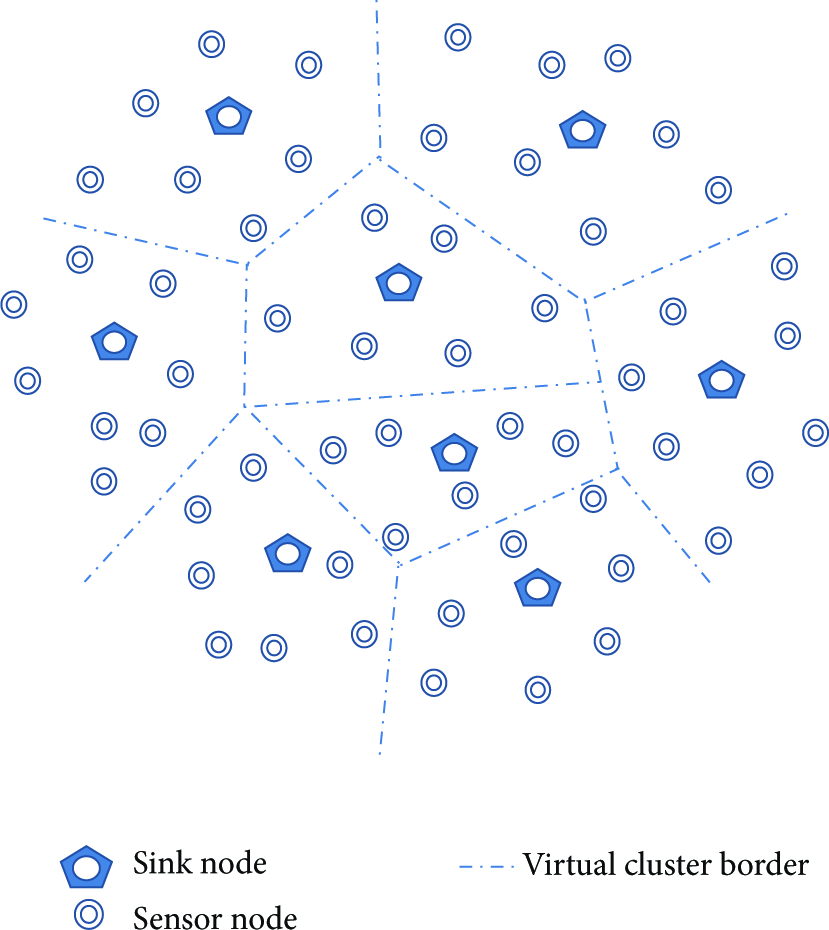
Network model.
From (1), (2), and (3), the total energy consumed by every sensor in a subnetwork is defined as

Routing in WSNS is one of the most challenging issues owing to the factors of energy, QoS, and mobility characteristics, which distinguish with WSNs from other wireless networks such as mobile ad hoc networks. Among researches, there is an ambitious desire to find the best energy-efficient route discovery method for forwarding the sensor data to the base station and thus maximizing the network lifetime. Nodes that consume the least energy in a subnetwork will be selected as relay nodes to the base station.
From the calculation in (4), the energy consumption is different at every hop layer of the sensor network. Assuming that the sensing probability of all sensors is similar, nodes near the base station must perform the work of a forwarding mote and a sensing mote. They must work as both sensor and relays for neighbor nodes. Relative to outlying nodes, these nodes will be easily exhausted. Node selection for routing depends on routing protocol strategies. Most routing protocols are based on one reference factor such as fast transmission, low energy consumption, or high reliability. If we consider the energy consumption for sensing and communication as listed in Table 1, the energy consumption can be calculated by a framing model as follows. Assume that all sensors are applied to the same schedule for energy efficiency in idle and sleeping modes. The energy consumption for one data frame at the start hop of the network is

Sensor power consumption states.

The energy consumption at the ith hop is

In practice, the packet is not always successfully sent on the first transmission because of interference, collision, or fading. A packet is successfully transmitted after r retries. Assume that 
Equation (6) can be rewritten as

Most of the research on energy balancing in WSNs focuses on the energy consumption of one-hop transmission, which depends on the distance between the sensor and the sink or the energy balance of the routing mechanism. The energy balance in hop by hop transmission should be considered when formulating the deployment and management strategy. An area in the lower layer of the routing map should be given more power or more deployments than other areas. Our proposed scheme to cover this issue is a cross-layer design of the network layer and application layer. There will be two tiers in the deployed network. The first layer performs the sensing coverage function. In this layer, all sensors will work as data sensors, and they can exchange the duties with other nodes by scheduling their sleep and wake-up cycles. The second layer is the connectivity layer, which is defined by the best route for routing functionality. The process of layer classification is based on the experienced operation of the sensor motes. A node that is selected for routing will be switch to routing mode. In this mode, it will turn off its sensing function to extend its lifetime for relay functionality. The detail of layer configuration is shown in Figure 2.
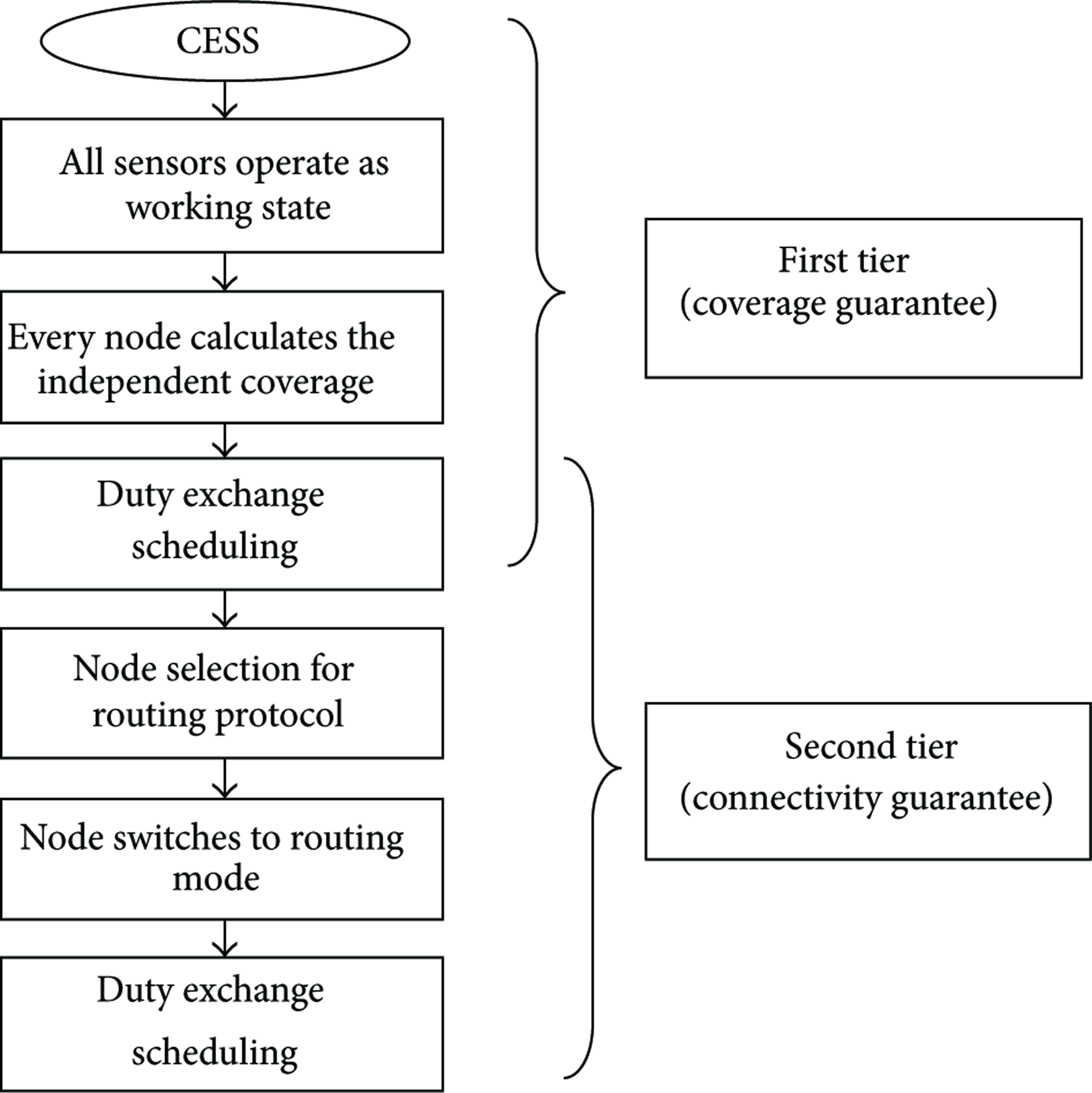
Two-tier model for CESS.
3.2. Wake-Up Scheduling
In this protocol, all nodes will try to keep the balance of energy over the network by exchanging the duty together. Every sensor mote will switch to working state or sleeping state based on their status of residual energy and the coverage guarantee throughout the network. Proposed scheme operates based on the following considerations: first, nodes are densely deployed. Secondly, nodes can estimate the distance to neighboring nodes using a simple algorithm such as RSSI, time difference of arrival, angle of arrival, or beacon node [18, 19].
Every sensor node will have four operation states: INITIAL, WORKING, SLEEPING, and CHECKING. Depending on the energy level, coverage guarantee, and status of neighboring nodes, a sensor mote will switch to another state to maintain connectivity with the sink, sensing coverage, and energy conditions. The scheduling of state transitioning in the proposed scheme is illustrated in Figure 3. The strategy of scheme for network monitoring shows by two phases. The first phase operates when the network is first initialized or periodically after a network reset. All deployment sensor nodes will be activated at INITIAL state. By using localization techniques, all nodes can define their location information based on neighboring distance estimation and reference coordinates. After they exchange location information, every node will calculate its coverage contribution within the sensing area by scanning its neighboring motes. If its coverage is independent of its neighbor sensor motes, it will broadcast REDUNDANCY messages to inform the neighboring nodes and go to SLEEPING state. After the synchronization process among all nodes, the network will have achieved maximum coverage with the minimum set of sensor motes. The operation functions of INITIAL state are shown in Figure 4.

State diagram of the proposed protocol.

Initial mode operation.
Nodes in WORKING state active sensing function and the network functions are performed as data are collected by the sensors and forwarded to the base station. When the power level reaches a threshold, node will attempt to find another node with which to exchange duties. There are two situations for energy reduction. If a node has a depleted battery, it will broadcast DUTY message and go to SLEEP state immediately. The CHECKING node which received DUTY message and in-coverage of sender will change into INITIAL mode. This is emergency situation, so there is no time for WORKING node to calculate the coverage list. All available SLEEPING nodes will do it by themselves. In second case, when the energy level is partially depleted, it will broadcast a HELP message to find available nodes. The details of SLEEPING state and WORKING state operation are shown in Figures 5 and 6.

Working mode operation.
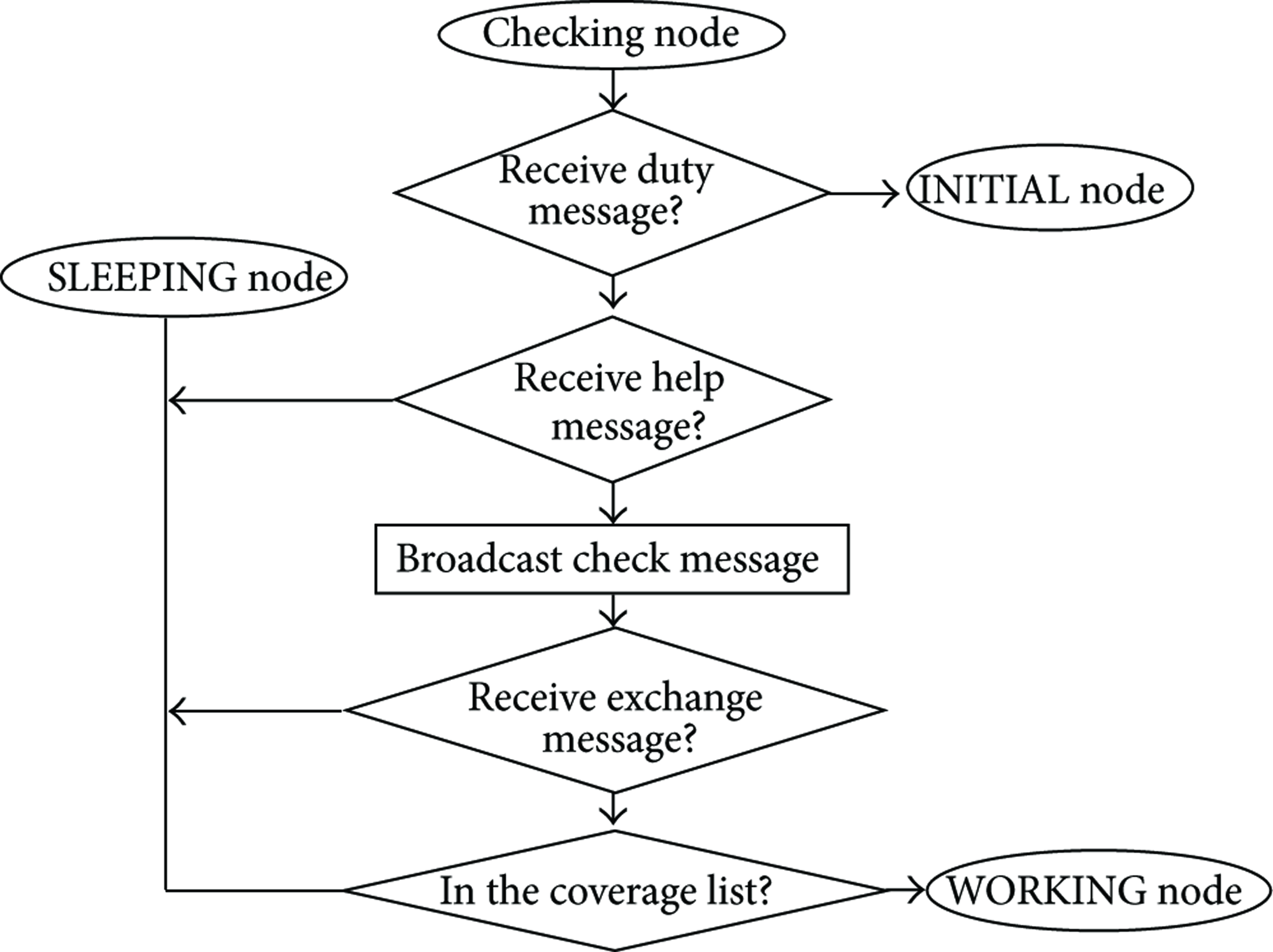
Checking mode operation.
When nodes are in CHECKING state, firstly they will wait the HELP message and DUTY message from WORKING nodes. If it receives DUTY message, it will wake up and go INITIAL mode to replace depleted node. For HELP message, it will broadcast CHECK message. The CHECK message includes current energy and coordinates. WORKING nodes try to get all CHECK messages and check the contribution conditions from CHECKING nodes. They will compare its power strength and the guaranteed coverage with volunteer nodes and list out the helper candidates. The helper list will be broadcasted by EXCHANGE message. After that they will go to SLEEPING state. CHECKING nodes which are in helper-list will go to WORKING state. The details of CHECKING state are provided in Figure 6.
The description and format of the control message are as follows:
DUTY message: WORKING nodes indicate the depleted power condition. It is going to die for lack of power. HELP message: WORKING nodes want to exchange responsibilities with their neighbors. this message is a request command to all CHECKING nodes. CHECK message: A CHECKING node uses this message to inform the availability to neighbor nodes. the residual energy level and coordinators will be broadcasted in this message. EXCHANGE message: this message will be broadcasted by a node in WORKING state. A node in WORKING state will send EXCHANGE message when it gets CHECK message. This is the list of neighbor nodes which are candidates for exchanging the duty. REDUNDANCY message: this message is sent by a node in INITIAL state to indicate that its contribution of coverage is not necessary. This node will then switch to SLEEP mode.
3.3. Coverage Guarantee Protocol
One of the main approaches of the proposed scheme is the coverage calculation to guarantee all events an area interested. Sensors will be scheduled for WORKING mode or SLEEPING mode based on the minimum set of nodes to achieve full coverage. The guaranteed coverage calculation must satisfy three conditions: perimeter test, center test, and distance test [13]. Moreover, this calculation takes some overhead in terms of computation, energy, and determining the location information of neighboring nodes. Assume that all sensor nodes have the same communication range
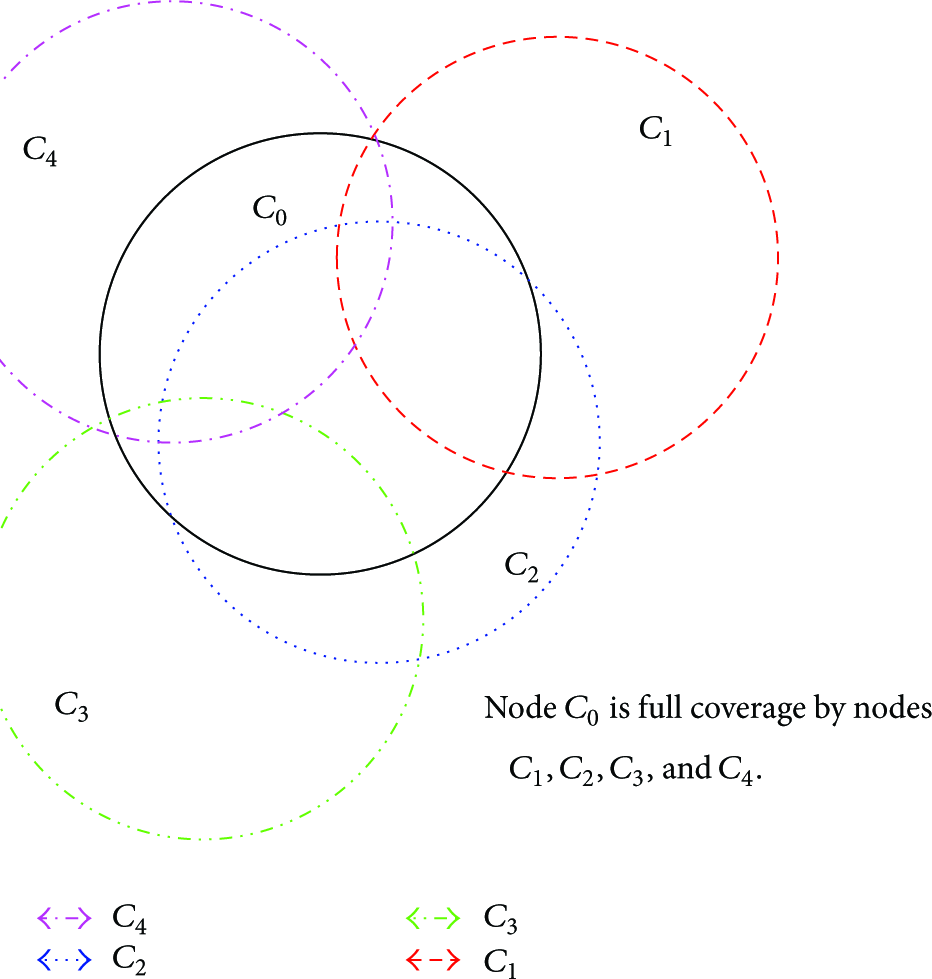
Perimeter test condition.
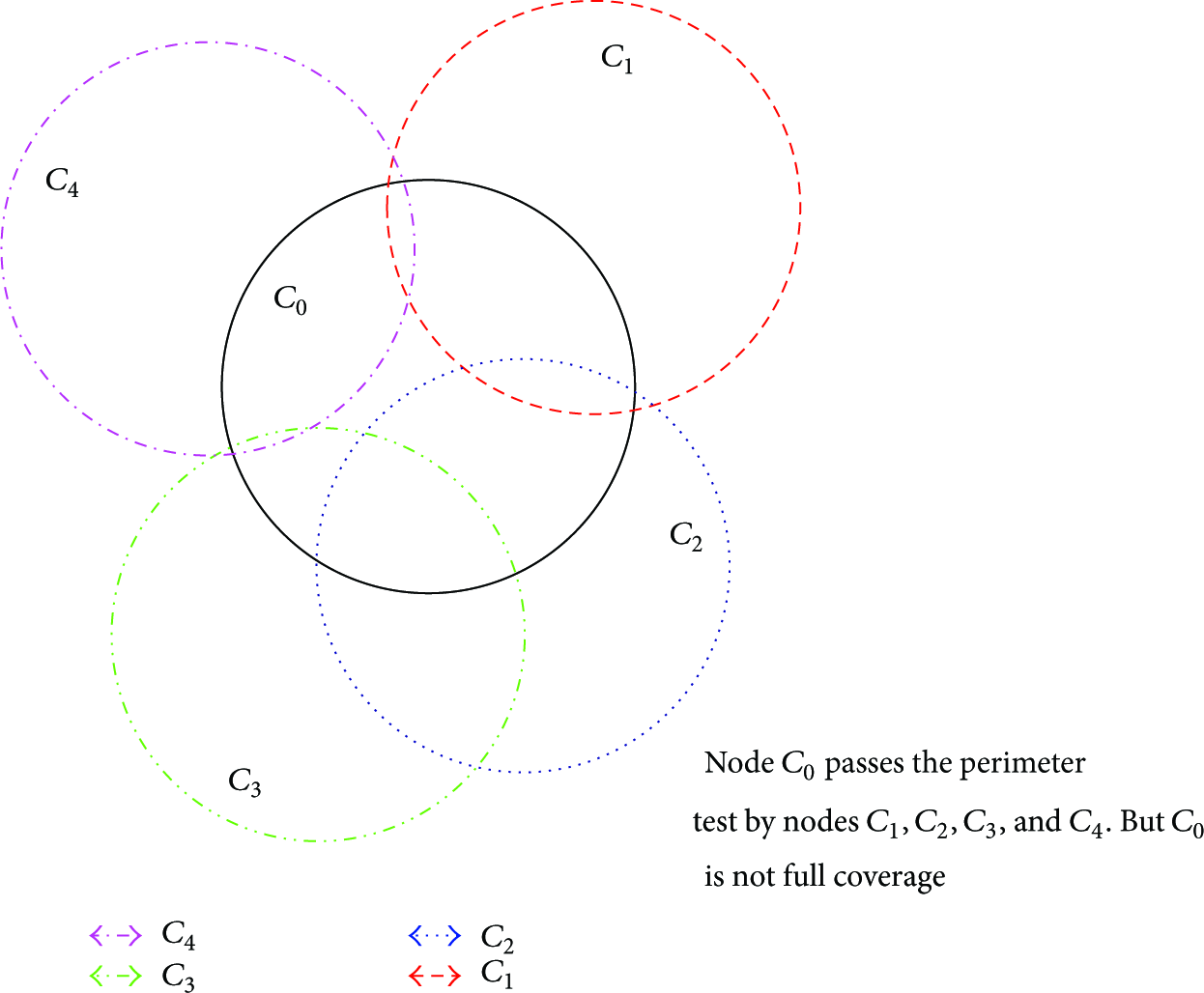
The perimeter test checks whether sensors are in an area sufficiently covered by their neighbors. This test will be such that all sensors in the perimeter should be within sensing range of one neighboring node. This is an essential condition based on the assumption of dense deployment. In Figure 7, node

Limitation of perimeter test.
The second test is the center test which determines whether the center of a node's coverage can be covered by at least one of its neighbors. This test illustrated in Figure 9 (node 
Center test condition.
The general condition for the center test is defined

However there is also a limitation of the center test as shown by Figure 10. In this scenario, node 

Limitation of center test.
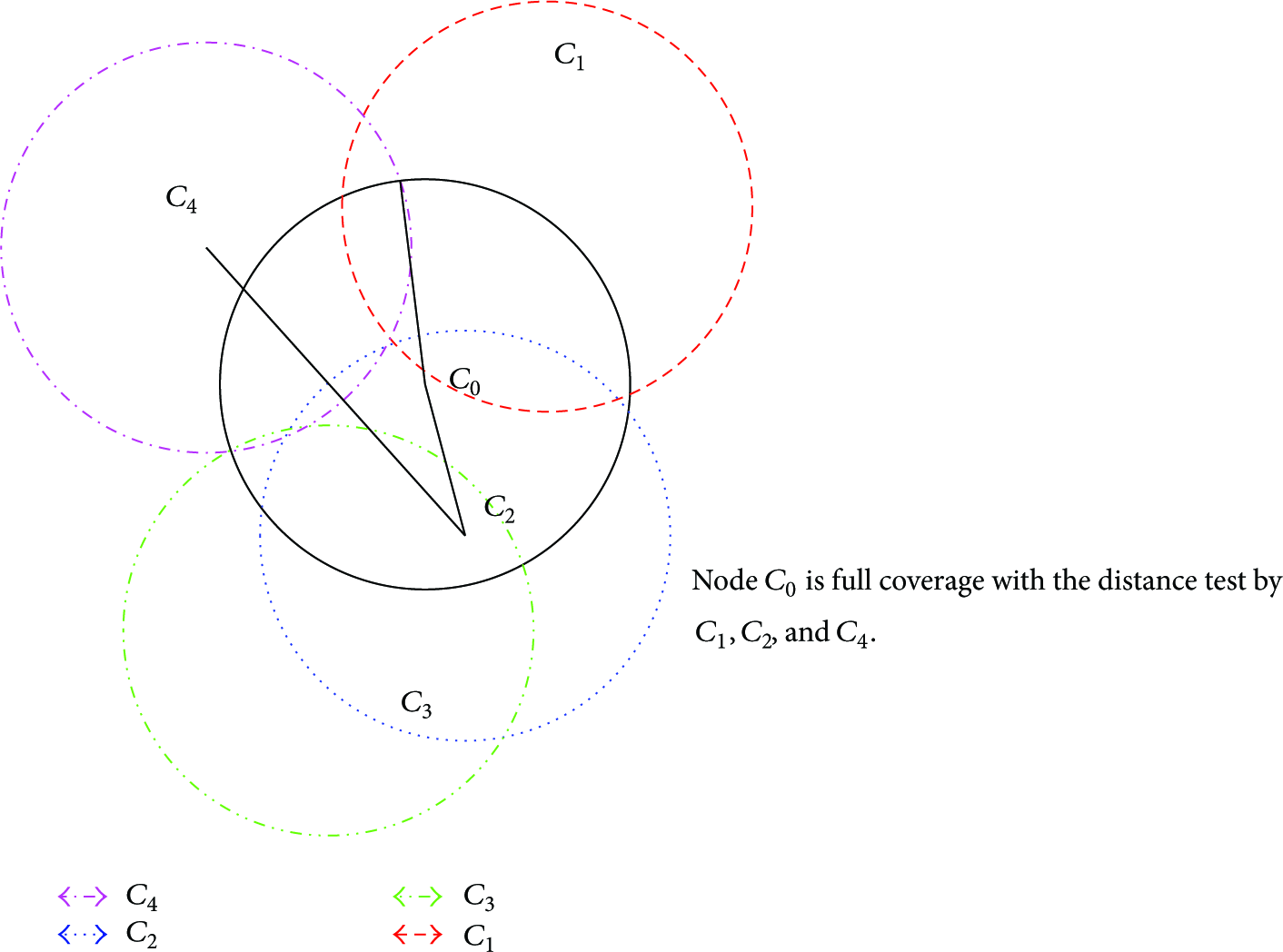
Distance test condition.
The condition for the distance test is defined as

4. Performance Evaluation
Based on the proposed scheme and analysis from the previous section, we evaluate the performance of the suggested scheme based on a well-known MAC protocol for sensor networks, S-MAC. Comparisons are then made with the “Redundancy Reduction Protocol with Sensing Coverage Assurance in Distributed Wireless Sensor Networks” [16]. As explained above, all sensor nodes will operate on using S-MAC when they are in WORKING state. S-MAC is a typical energy-efficient AC protocol for WSNs. It supports a dynamic listening period and sleeping cycle time for reducing the idle listening time. The system will be idle in SLEEP mode to save energy. The data transfer will be processed in listening time. Node will listen and forward the received data to the next hop via a routing protocol. The data guarantee is managed by control messages of the data link layer and MAC layer such as RTS, CTS, or ACK. Every node is configured for one virtual cluster, so they all can synchronize with others on the same listening and sleeping schedule.
We used C++ and NS-2 simulation for evaluation to test the performance of the proposed scheme. The node configuration for communication and sensing is given in Table 2. All nodes are deployed at random. Figure 12 shows the advantage of the proposed scheme over S-MAC with the original protocol. Our scheme can increase the network lifetime by 40% with full guarantee coverage. The number of working nodes for data sensing is optimized efficiently as shown in Figure 13. The proposed scheme can maintain the minimum number of sensors for optimal coverage.
Simulation parameters.

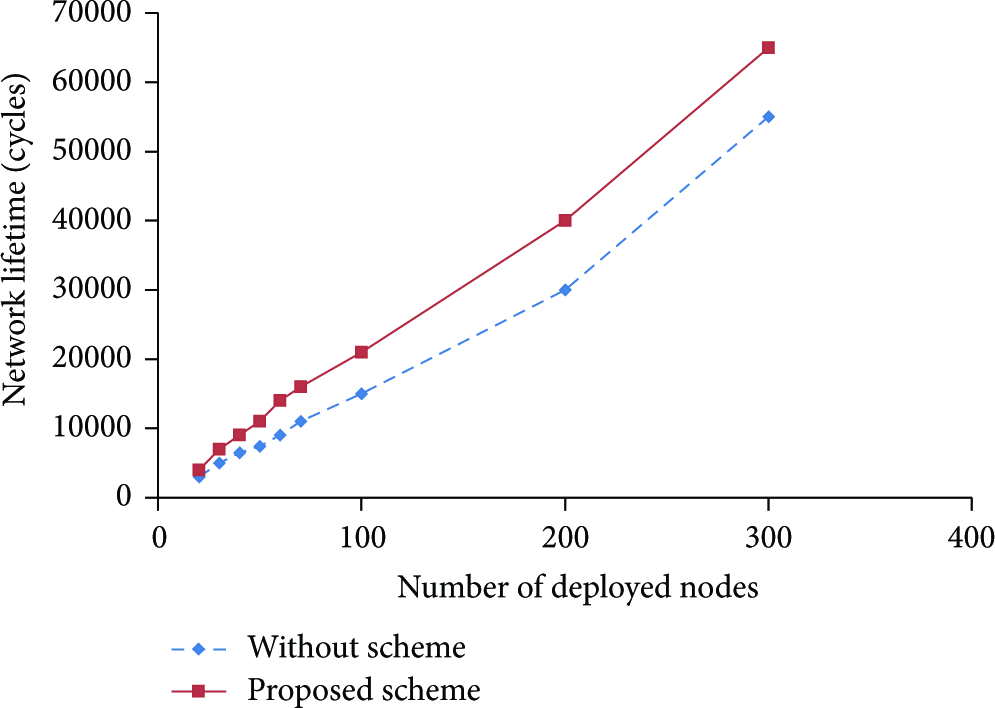
Network lifetime of proposed scheme on S-MAC.
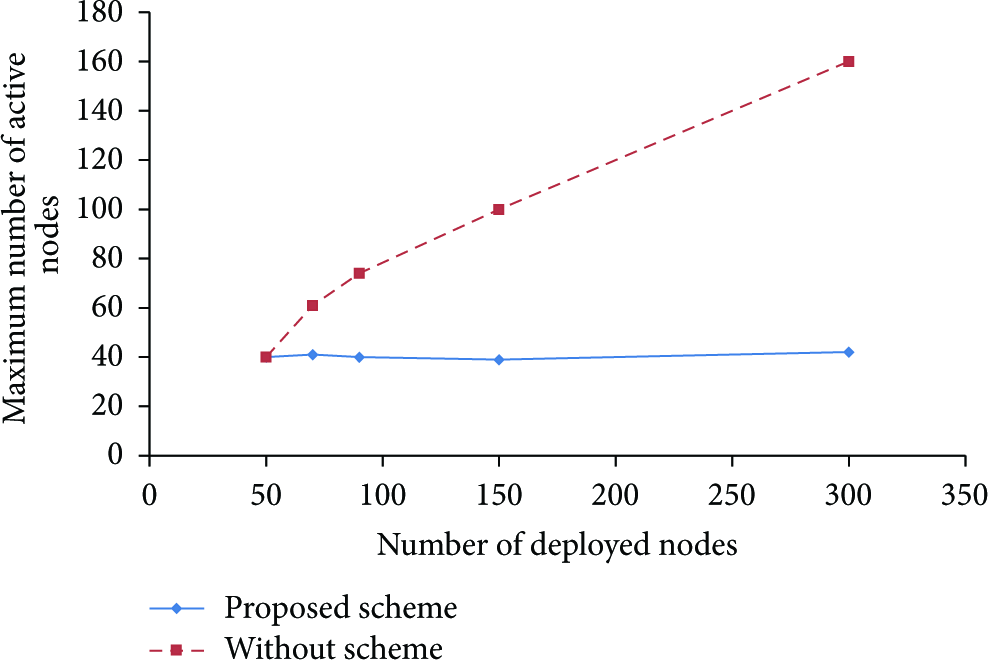
Activated nodes of the proposed protocol.
To evaluate the performance of the new scheme with a related research result, we selected the “Redundancy Reduction Protocol.” The protocol achieves energy-efficient scheduling by switching nodes between ON and OFF modes. Nodes will synchronize using control messages. The three control messages are CHECK, REPLY, and WAKE UP. Nodes perform within three states of operation: SLEEPING, CHECKING, and WORKING. The percentage of overlapped sensing area λ which can be calculated using the distance between nodes and the sensing range is important parameter for coverage estimation. Each node will calculate λ for all neighboring nodes in WORKING state and compare the sum of the λ values to a predefined threshold value. Based on this information, the node can determine whether it is within coverage of other nodes. By using control messages and coverage estimation, the proposed protocol can maintain a small number of WORKING nodes and balance the energy consumption among different nodes to guarantee the remaining coverage. Their scheme is based on some assumptions:
A node inside the sensing range of another working node cannot go to working state. So, the minimum distance between two working node is A node calculates λ for each neighbor WORKING nodes based on coordinate information. The communication range of sensor nodes is more than double the sensing range for connectivity throughout the network.
We tested the sensing coverage that can be achieved by random distribution, our protocol, and the “Redundancy Reduction Protocol.” We used the same topology and deployed different numbers of nodes.
Figure 14 shows the coverage performance of our scheme and the Redundancy Reduction Protocol for the first simulation. Figure 15 shows the average result of ten simulations using the coverage expectation through the network lifetime. It can be seen that our scheme can guarantee better coverage than “Redundancy Reduction” protocol because the “Redundancy Reduction” protocol is based on the approximation of coverage based on λ coverage distribution. The proposed protocol shows an excellent result to reduce the number of redundant WORKING nodes while preserving the coverage in a dense topology.

Coverage performance comparison.

Coverage performance comparison.
For the enhancement of the routing protocol in the proposed scheme, we measured the performance of hop power distribution with the scenario shown in Figure 16. In this scenario we randomly deployed 130 sensing nodes, including one sink base station. The result from Figure 17 shows the energy distribution from hop to hop of the AODV routing protocol over the full network lifetime. The performance of the proposed protocol based on routing enhancement is shown in Figure 18. By reducing the sensing density and segment fragmentation probability of the back-bone traffic we can greatly increase the network lifetime.
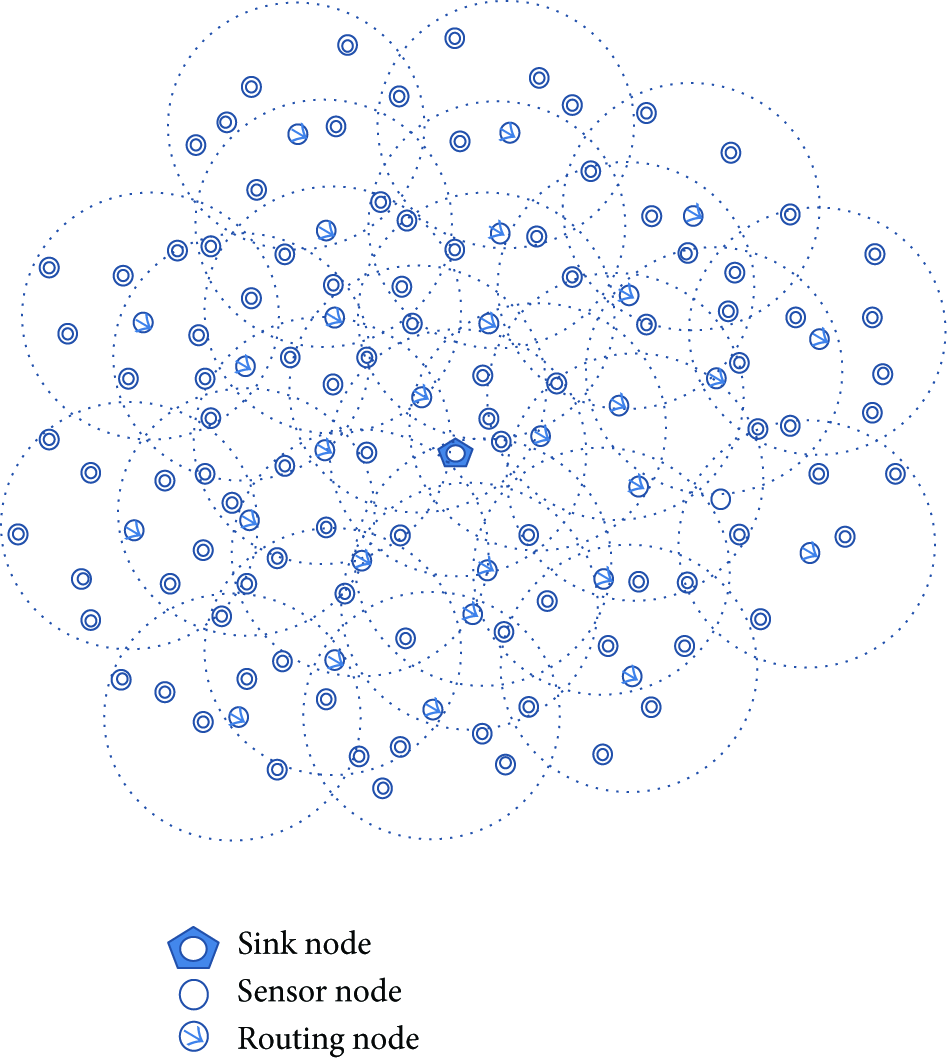
Simulation scenario.

Energy hop distribution.
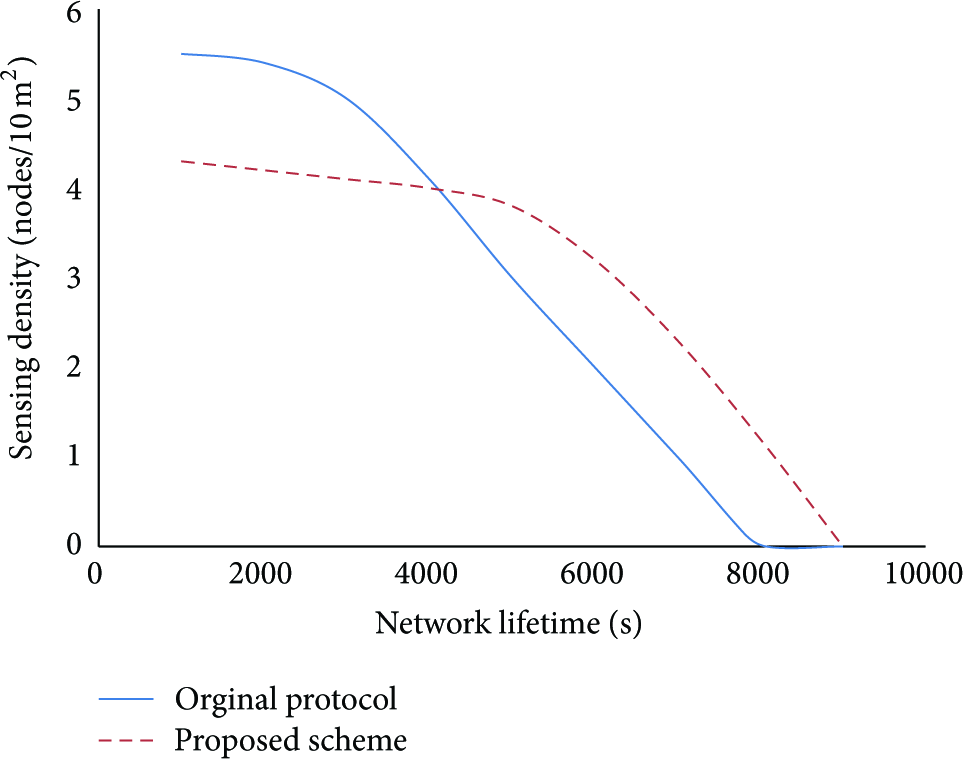
Coverage density of the enhancement routing protocol.
5. SDN Issue for Energy and Coverage
SDN is a new network paradigm that was developed to facilitate innovative programmatic control of network data-paths. The key principle of SDN is to provide programmable networks with more flexible and dynamic customization. The advantage is based on the separation of control and forwarding planes. The network traffic in the interconnection link is based on a rule set defined by external entities called controllers. The control plane routes for the traffic load are based on a rule set defined by an abstraction of lower-level functionality for network management. By decoupling the system with traffic decisions in the control plane from the underlying systems that forwards traffic to the selected destination in the data plane, SDN promises to dramatically reduce the complexity of network configuration and management. In WSNs, the research for SDN can focus on its potential, to provide functions that can allow better collaboration between the base station and the forwarding nodes. By applying the SDN model for management centralization, we attempt to generate an intelligent network that maintains a global view of control functions.
The proposed SDN architecture for efficient WSNs management transfers the control of forwarding traffic loads, and sleep scheduling from sensor motes to the base station. The controller can determine the best routing decisions for data transfer to the base station from the current status of network and inject these decisions in the form of flow rules into all nodes. It can reduce the overhead of calculation for routing selection for every node when the topology of the network is changed. It is assumed that the controllers will be running at special base stations that have more power than the average sensors. The example topology of control plane and data plane for SDN model of the network is shown in Figure 19. The control node will collect the data plane node's information based on control messages transmitted during the working time. It then calculates the coverage and traffic route to the base station for all nodes.

SDN architecture.
6. Conclusion
The main contributions of this paper are the analysis of power consumption, routing protocol, deployment strategy, and proposed scheme for an efficient WSNs. The proposed scheme for energy balance and guaranteed coverage scheduling demonstrates an efficient protocol for WSNs. The computation and scheduling process can be applied in sensor motes without too excessive complexity. By using extended control messages, the proposed scheme can select the best of working nodes to preserve the coverage, reduce the redundancy, and maintain the network backbone. For future work, we suggest that open-approach on SDN be investigated to improve WSNs.
Footnotes
Conflict of Interests
The authors declare that there is no conflict of interests regarding the publication of this paper.
Acknowledgment
This research was supported by Basic Science Research Program through the National Research Foundation of Korea (NRF) funded by the Ministry of Education (no. 2013057922).