




Abstract
With recent advances in wireless sensor networks and embedded computing technologies, body sensor networks (BSNs) have become practically feasible. BSNs consist of a number of sensor nodes located and deployed over the human body. These sensors continuously gather vital sign data of the body area to be used in various intelligent systems in smart environments. This paper presents an intelligent design of the body sensor network based on virtual hypercube structure backbone termed as Smart BodyNet. The main purpose of the Smart BodyNet is to provide resilience for the BSN operation and reduce power consumption. Various experiments were carried out to show the performance of the Smart BodyNet design as compared to the state-of-the-art approaches.
1. Introduction
Nowadays wireless body sensor networks (WBSNs) are used to enable a broad variety of assisted living applications such as human biophysical/biochemical control and activity monitoring for health care, e-fitness, emergency, emotional recognition for social networking, security, and highly interactive games. It is therefore important to define design methodologies and programming frameworks which enable rapid prototyping of WBSN applications. Thus, current improvement in wireless technology has led to the growth of body sensor networks (BSNs), a specific class of wireless sensor networks (WSNs). BSN is capable of continuous monitoring of vital sign data of a person for the purpose of managing chronic conditions and detecting health emergencies. Moreover, BSNs contain low power sensor nodes, which are located on body area and allow interaction with each other. These sensor nodes have sufficient intelligence to continuously sense and gather various health-related data from the body area and efficiently route and exchange these data with intended party [1–9].
Based on their inheritance of WSNs, BSNs are limited in memory, energy, computation, and communication capabilities [10]. The capability of batteries that are attached to sensor nodes is very limited because of the designs concerns of the sensors which are tiny due to its wearability feature around body area. The approaches concerning the design and architectures of network and protocols must ensure that the nodes could complement the data traversal at a maximum level and minimum energy exhaustion. The network topology is yet another major factor of the system performance attributes like the energy utilization, traffic capacity, and node strength [1, 3]. These requirements arouse the need of a system architecture where challenging functions such as above are addressed.
This paper proposes a novel body sensor network architecture termed as Smart BodyNet that meets the ever increasing demands to minimize transmission to the BS and decrease the overall amount of transmitted data in order to decrease power consumption capacity. The proposed architecture is based on the virtual hypercube backbone structure which contains a number of controlled sizes of the intelligent sensor nodes ISNs. The total number of ISNs is usually around a few tens [1, 11], which satisfies the functionality with hypercube topology. The hypercube structure provides selection of routing technique and maintenance rules that can be implemented efficiently [12, 13]. Additionally, smart phone interoperability, portability, mobility, and intelligent sensors nodes capabilities can be easily extended by using the Smart BodyNet [3, 8, 11]. The application area of the Smart BodyNet includes healthcare, exercise instruction, training, smart gaming, smart military operations, temperature sensor, smart industrial, file transfer, social networking and smart robot controlling, and other varied application domains [3, 5]. There are a number of ongoing researches on the hypercube routing approaches within WSNs [12, 14–17]. Our methodology targets the improvement of hypercube attributes which enables the Smart BodyNet to operate without losing any sensor nodes for a maximum time, reduce the overhead, and ensure a smoother functionality despite the sensor faults and failures. Several experiments are carried out to show the performance of the Smart BodyNet design as compared to the state-of-the-art approaches such as star topology in terms of energy consumption, fault tolerance, and data gathering delay.
The remainder of this paper is structured as follows: Section 2 presents the related works, Section 3 introduces the Smart BodyNet architecture, Section 4 describes the experimental results, and finally Section 5 concludes the paper by presenting summary and future directions.
2. Related Works
Very few works in the literature focus on BSNs network architecture. Rather, most of them concentrated on the whole health care system as a single BSN architecture combined with two or more integrated network architectures. Generally, BSN nodes are essentially distributed over the human body area, so persons' actions account for numerous changes of network topology. In particular, sensor nodes location can be divided into two types, firstly, the implant node which is positioned in the interior of the human body [11, 18, 19]; the second type is the body exterior node that is geo-positioned on the human skin or usually two cm apart [9, 20]. Examples of such sensor nodes are PV that measures electrical actions within the heart and registration of these actions; EKG which measures electrical actions within diverse portions of brain and registration of these actions; and EEG that measures the pressure of the blood within the circulatory system [1].
Thus, researchers are inspired to utilize the WSN [3, 21] architecture in BSN information exchanges or offer novel approach to fulfill the desired BSN communications. The network structure in addition to protocols assures that sensor nodes possibly will accomplish the exchange of the gathered data with maximum features and with lowest possible power exhaustion. Furthermore, BSNs [9] must ensure consistency in energy consumption management and allocation to load balance the energy for the small number of sensor nodes. The most widespread network topologies involve Bus, Ring, Mesh, and star [22]. Together Ring and Bus topologies do not qualify to be backbone on a complicated dynamic body area [1]. However, star topology is very popular topology and extensively used as a backbone in BSN [1, 23, 24]. In star topology BS is frequently used to exchange, collect, process, and send data to other ISNs as well as making some sort of decision judgment. All the ISNs immediately transmits data to BS. The network routing protocol is relatively simple, and sometimes there is no need for communication protocol for data transmission. Nonetheless, star topology has a number of demerits in BSNs; one of them is the distance between ISNs and BS for the exchange and power restrictions. In addition, the ISNs positioned within diverse surfaces of body region will be unsuccessful during construction links due to the low data reception rates. Thus, the ISNs on the diverse surfaces have a greater susceptibility to failure due to rising connection failure. Also star topology is not appropriate for a shorter radio spread domain [1].
In addition, there are some works in the literature which focus on protocol-based communication architecture for BSN. For example, Zhu et al. suggested MB-Star, a MAC-protocol used in BANs. MB-Star is a TDMA-based MAC-protocol also utilized for encoding the protected or classified communications. The main target of this work is to get high data rate devoid of power consumption [25].
Chen et al. provided scheme which divided the architecture of BAN communications into three tiers: first tier called intra-BAN communication, second tier being inter-BAN communication, and third tier called beyond BAN communication. These parts of architecture capture numerous sides that scope the two levels low and high, minimum scale to rising standard designing situations, to support the construction [26]. The target is to offer a wide variety of data rates at a very lower power level consumption than present and existing standards. The architecture should optimize the system for a substantial battery life and fault tolerant system operation [9].
Raveendranathan et al. suggest a multilayer function scheme to develop structural design. The presented model is utilized in wearable sensors nodes and developed to a (SPINE-2-based) logical sensors architectural design and experimental estimate. The outcome reinforces the notion that extreme efficiency can be realized within the scheming as well as BSNs performance of functions over the scheme as a means of support to further ensure efficiency and brevity [27].
Mitra et al. have introduced the “KNOWME” platform which is an end to end BANs method which combines off the shelf sensor nodes among a smart cellphone to constantly analyze and examine the biometric signals of an issue. “KNOWME” was developed by an interdisciplinary team and in-laboratory, as well as in-field, employment examines, utilizing pediatric obesity as a case study to monitor and observe the physical parameters [28].
Zhong et al. suggest that the platform contains a single smart phone and several intelligent sensor nodes. These sensor nodes are interacting directly with the smart phone by Bluetooth. These intelligent sensor nodes provide robust input to the smart phone. The platform offers a group of APIs for applications on the smart phone to control the network and gather information from the sensor nodes. There is mobile software available to procure the data from sensor nodes for any update or change; then it sets sensor nodes into sleeping mode. The collected data is then sent to a dedicated server that provides analysis capability. Moreover, the smart phone has the ability to perform its own analysis [29].
Several effective application development frameworks have been already proposed for BSNs designed for TinyOS-based sensor platforms, for example, CodeBlue, SPINE, and Titan. The architecture of these systems is a typical star based BSN that is composed of a coordinator node and two sensor nodes located, respectively, on the waist and the thigh of the monitored assisted living. Typically, the coordinator manages configuring sensors, receiving their data and recognizing predefined human activities. On the other hand, each sensor node runs an agent that performs sensing of the 3-axial accelerometer sensor, computation of significant features on the acquired data, feature aggregation, and transmission to the coordinator [30].
3. The Proposed Smart BodyNet Architecture
In this section, the proposed Smart BodyNet architecture is presented in detail. We show the different levels of communication and routing. Figure 1 describes a typical architecture [31] of Smart BodyNet. It is divided into three tiers:
Tier 1: the intelligent sensor nodes (ISNs) or biosensors [8] are presented in white circles. They are responsible for monitoring, measuring, and gathering the sensed data from the human body area. It uses the hypercube master (donated in black circles) to exchange this useful information with other ISNs or transmit it to the Base Station (BS). Tier 2: the Base Station (BS) (e.g., smart phone or wearable watches) is presented in black circles. They are responsible for receiving the sensed useful gathered information from the ISNs. The role of BS is to work as a gateway to efficiently exchange the key information to the intended party in Tier 3 as depicted in Figure 2 [11, 32–34]. Tier 3: the Communication Network is responsible for disseminating the gathered data to the right target. Throughout this process, the smart device can integrate two different types of network structures within the Smart BodyNet and the outside smarter environment [7, 8]. The communication standard connected with the outside smarter planet relies on the particular accomplishment of the gateway services within the smart device through the wireless local area network or additional wireless technologies [8, 9]. Smart phones are interoperable devices which do not require an advanced configuration and work as gateways for different network architectures with capability to connect several types of network technologies as WBANs and access the Internet [3, 6–8, 11, 29, 35, 36].
An n-cube is a graph containing

Basic architecture of BSNs.
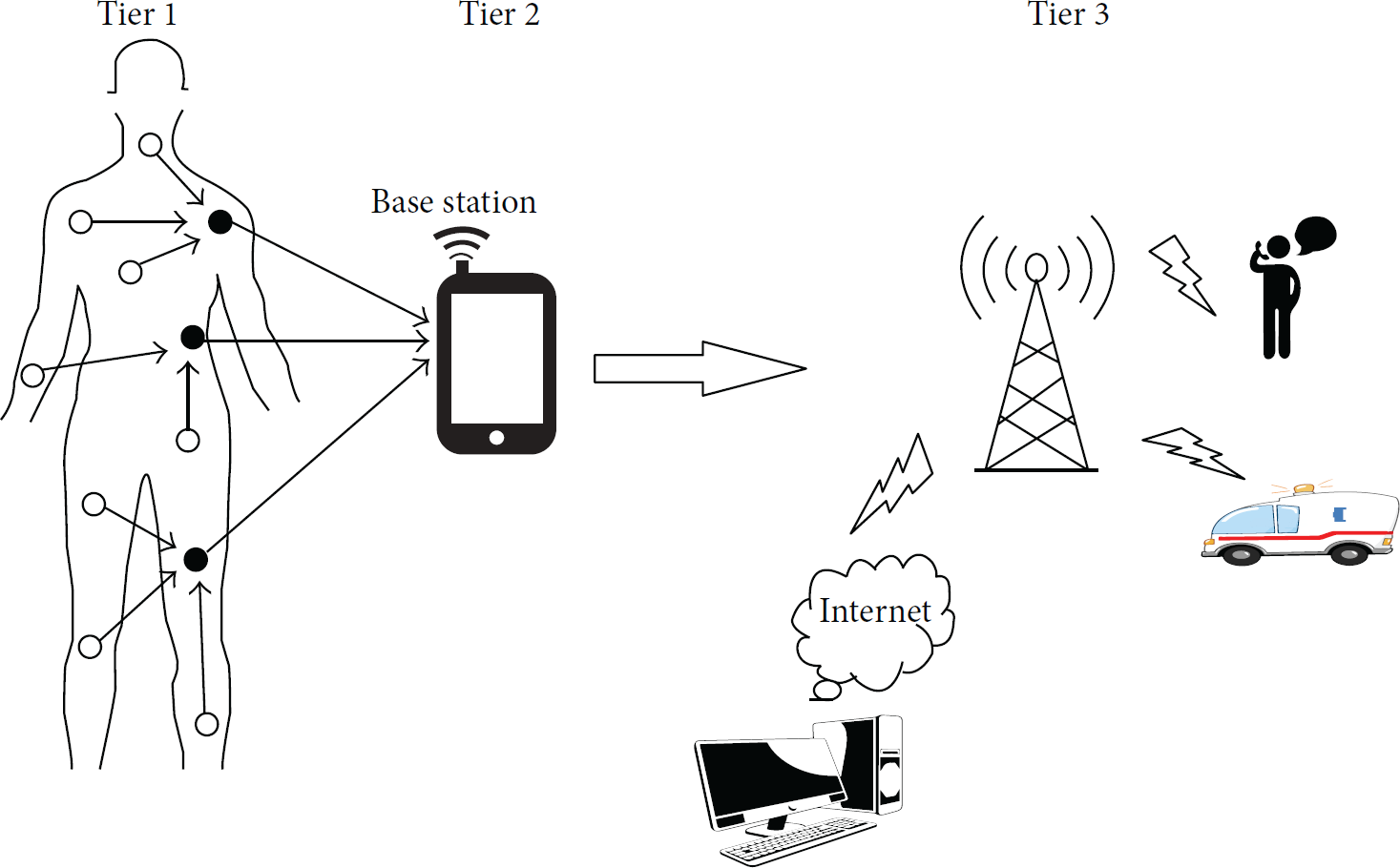
Body sensor network tiers.
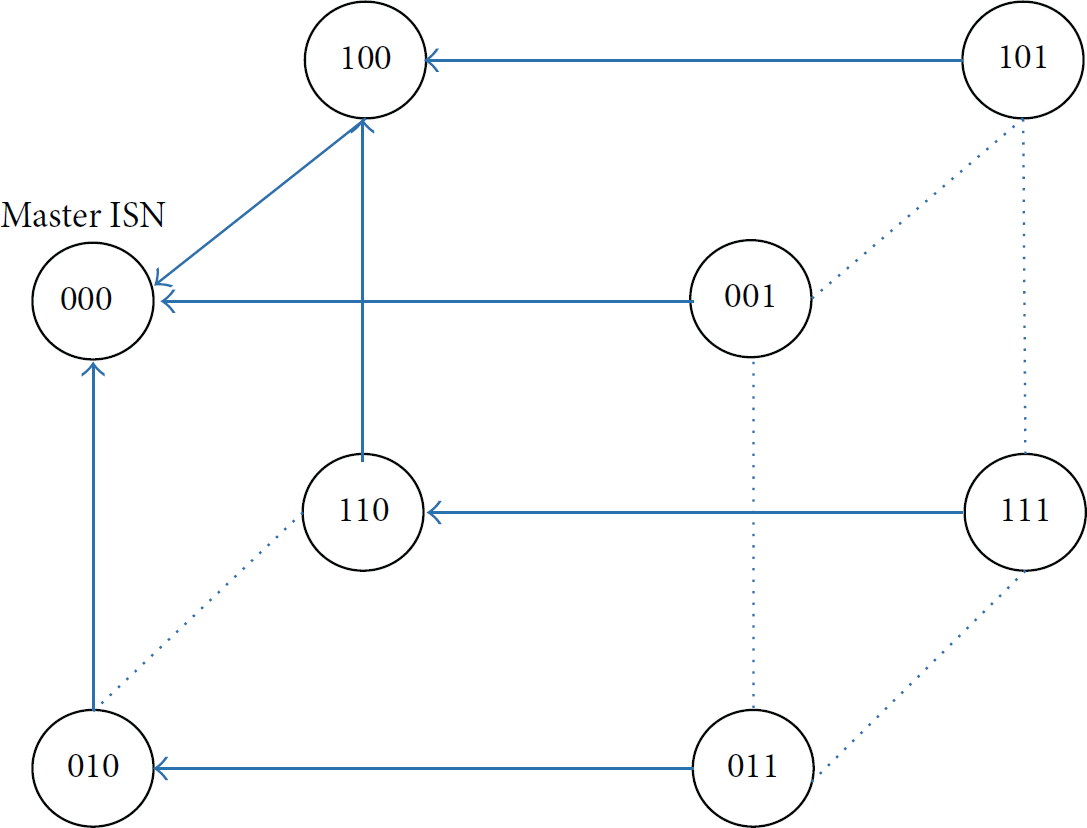
Smart BodyNet with 3-dimensional complete hypercube (3-cube interconnection network).
3.1. The Superiority of the Hypercube
The hypercube has the following important specifications:
In any network based in hypercube, the data gathering delay time is Every ISN sends gathered data in one push at every turn. ISNs are selected as heads (root or master) with the same probability ensuring more balanced energy (load) distribution. Multipaths and connections for each couple of ISNs within the hypercube are linked by numerous links. This guarantees fault tolerance with load balancing, if the link connecting pair of ISNs is not working or improperly packed [12, 38]. Symmetric-graph and regular-graph: the symmetry and the regularity structure of hypercube allow classifying every node within the hypercube and provide it with an address [38]. Small diameter: the configuration of the hypercube allows a node to link every farther located ISN in the hypercube over a few number of hops [38].
3.2. The Binary Tree Methodology for Communication
To collect data by the distributed hypercube method, every ISN requires to have a single direct ISN to conduct tree communication. If there is no ISN in the adjacent region of a node, it searches for the single direct ISN in the farther region to solicit support for data collection and thereby consuming additional energy. To improve this, we can leverage the distributed binary tree which is more flexible for the number of allowed single direct ISN nodes to collect data. This flexibility allows us to save considerable power within the data gathering process [37]. The distributed binary tree method allows each ISN to have at most the double direct ISN nodes. To build a binary tree, the BS initially chooses the adjacent ISN as the root. At every tour, data is gathered over the tree to the root which is then exchanged with the BS. The topology must be reconstructed when an ISN is down (probably the root because the down ISN will constantly show in the neighboring region of the BS). Each ISN will pass the data received from its direct ISN nodes. After collecting data from all direct ISN nodes, the top (root) will transmit the fused data to the BS. To gather data by such a distributed hypercube approach, it takes a total of
3.3. Transmission Scheme for Smart BodyNet
In order to gather the sensed data, we have the interconnection network hypercube with the total system as a
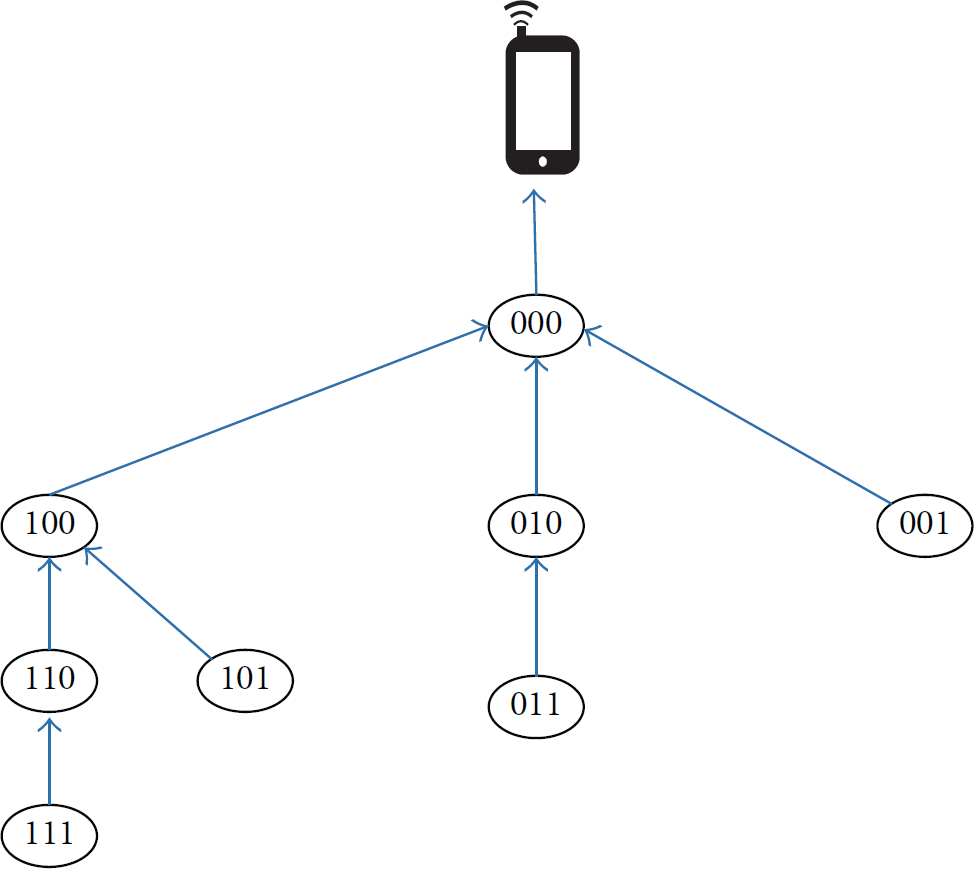
Communication-tree transmission example for a 3-cube interconnection network.
3.4. Transmission Scheme Example
Data can be transferred over the embedded communication tree. For example, the transmission scheme for a simple 3-cube interconnection network is shown in Figure 5. In order to start transmission, a head root node is first chosen by turns. In this example the root (master) is (000). Each of the other ISNs compares its own tag address with the root. The tag address begins from the Least Significant Bit (LSB) to Most Significant Bit (MSB): between the different bits. In our example the chosen ISNs are (100,010,001) which will transmit data to the BS. Transmission completes at (

ISNs routing example for a 3-cube interconnection network.
3.5. Smart BodyNet Routing
It is evident that the Smart BodyNet ISNs have capabilities for routing and disseminating the sensed data between each other. This implies that any ISN can send and receive the sensed data from any other ISN based on the virtual hypercube. The extremely significant advantage of the hypercube is the adjacency of nodes. Indeed hypercube has an important attribute of multiple virtual links between any given two nodes; this feature aides the routing performance along with flexibility; this implies that if one link fails, the backup link will take charge ensuring continuity. The routing mechanism can be achieved by comparing the tags addresses of source and destination and shifting the diverse bits one at a time. The source sends the sensed data to neighbors nearer to the destination node (evoke that a node is an adjacent if the tagged addresses only are different on single bit). The clearest instance, in Figure 6, shows that the source ISN with tag address (011) wants to send data to the destination ISN with tag address (100) by comparing bits starting from the LSB to the MSB.

ISNs with tag address (000) broadcasting sensing data example for a 3-cube interconnection network.
3.6. Smart BodyNet Broadcasting
Data can be broadcasted over the embedded communication tree. For instance, the ISN with tag address (000) wants to broadcast sensed data to all other ISNs. Thus, each of the other ISNs compares its own tag address with the root tag address from LSB to MSB: between the different bits, in our example, the chosen ISNs will be (100, 010, 001) to which the ISNs transmit data.
4. Performance Evaluation
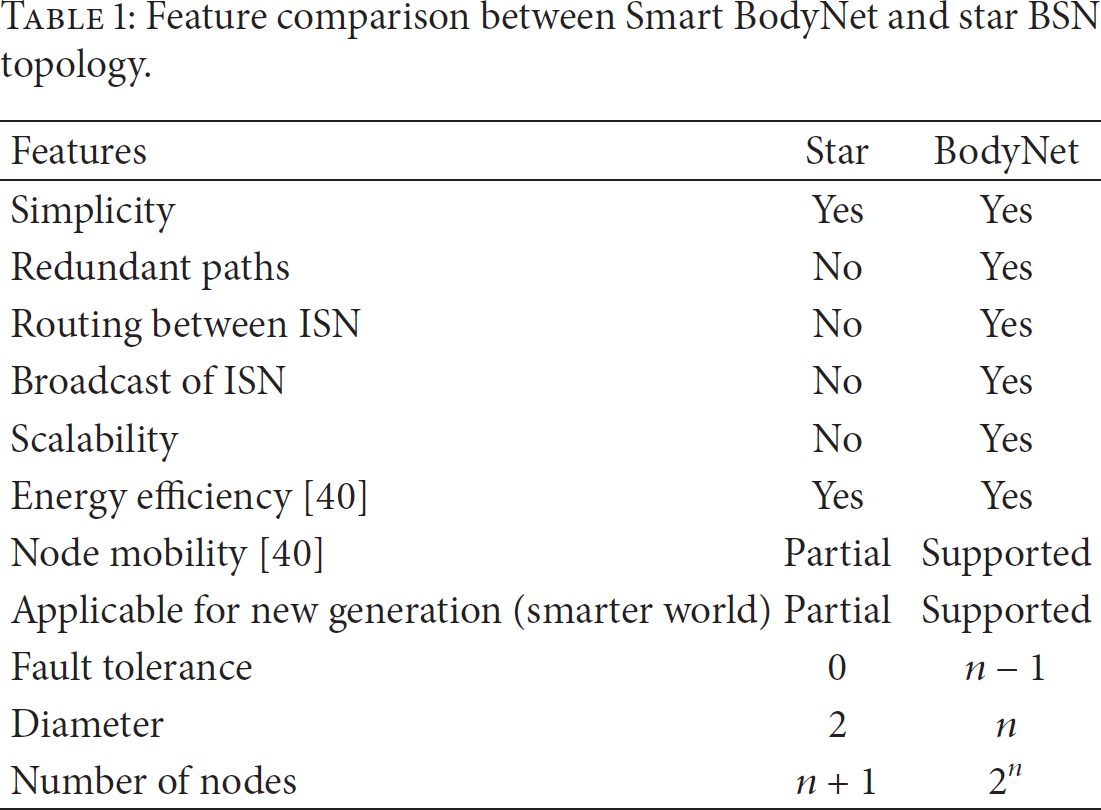
In this section, we compare the performance of the proposed Smart BodyNet with the star topology which is commonly used for BSN architecture in CodeBlue, SPINE, and Titan. At first, Table 1 shows the difference between the two architectures in terms of various features.
Feature comparison between Smart BodyNet and star BSN topology.
In addition, we compare the performance of the star topology and the proposed smart BodyNet in terms of energy consumption. The proposed data gathering scheme adopts the popular first order radio model [37]. It is deduced that the energy consumption is within the limits stipulated in the power formula [41]. Consider
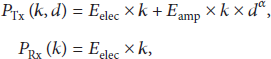
And
The power consumption formula for our Smart BodyNet scheme is

The power consumption in Smart BodyNet versus star topology.
With regard to the required transmission stages (the data gathering delay time) at each round for various schemes, the hypercube based method takes less stages

Date gathering delay.
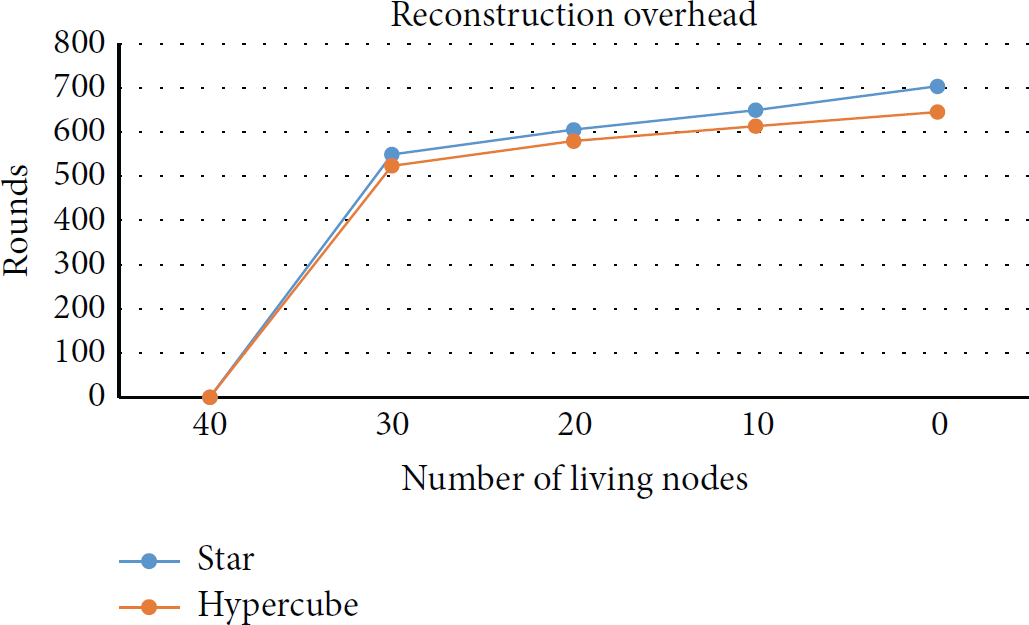
Reconstruction overhead.
5. Conclusions and Future Works
This research suggests a novel architecture for the BSNs based on virtual hypercube structure backbone termed as Smart BodyNet. The proposed architecture allows efficient data collection approach to satisfy several BSNs network design challenges. The performance of the Smart BodyNet is validated and compared to the popular star BSN topology. The results show that the smart BodyNet topology is more energy efficient as compared to the star BSN topology. In addition, the smart BodyNet inherits the interoperability, portability, mobility, and intelligence from a smart phone that can be easily integrated with the surrounding smarter world. In the future, we plan to develop a new version of the Smart BodyNet to be Smart ThingNet which will contain various ISNs and use Virtual Graycube backbone that has half of hypercube diameter. We may use this on sensor networks to aid temporary gathering of data from sources that are not covered by the ubiquitous and pervasive computing units such as vehicles, trucks, and buildings. Critical natural emergency situations like earthquake and tsunami will be closely investigated.
Footnotes
Conflict of Interests
The author declares that there is no conflict of interests regarding the publication of this paper.
Acknowledgment
This work was supported by the Research Center of College of Computer and Information Sciences, King Saud University. The author is grateful for this support.