




Abstract
This paper firstly investigates the problem of uplink power control in cognitive radio networks (CRNs) with multiple primary users (PUs) and multiple second users (SUs) considering channel outage constraints and interference power constraints, where PUs and SUs compete with each other to maximize their utilities. We formulate a Stackelberg game to model this hierarchical competition, where PUs and SUs are considered to be leaders and followers, respectively. We theoretically prove the existence and uniqueness of robust Stackelberg equilibrium for the noncooperative approach. Then, we apply the Lagrange dual decomposition method to solve this problem, and an efficient iterative algorithm is proposed to search the Stackelberg equilibrium. Simulation results show that the proposed algorithm improves the performance compared with those proportionate game schemes.
1. Introduction
The high energy consumption and exponential growth in wireless communication networks face serious challenges to the design of more energy efficiency and spectrum efficiency green communications that should deal with the scarcity of radio resources. A promising approaches technique called cognitive radio networks (CRNs) is proposed as a key design to improve spectral efficiency of the LTE-advanced standard. Game theory is an effective tool for resource allocation in multiuser communication systems, which has been applied to CRNs, and [1] summarized the advance of game theory for CRNs. Recently, Stackelberg game has been formulated for resource allocation which addresses the relationship between PUs and SUs in [2–9]. In these two-tier femtocell networks, the PUs were served by the mobile operators, whereas the SUs are deployed by indoor users for their own interests. Their different service requirements and design objectives motivate us to adopt the framework of hierarchical game to the power allocation problem with the leader-follower structure, which is actually a multiple-leader multiple-follower Stackelberg game. Specifically, the PUs compete with each other in a noncooperative manner to maximize their utilities, all the time anticipating the response of the followers. This subgame is referred to as the upper subgame, while after the PUs apply their strategies, the SUs update their power allocation strategies in response to the PUs' strategies. The SUs also compete with each other in a noncooperative manner to maximize their own utility function. Moreover, this subgame is referred to as the lower subgame.
Reference [2] presented a joint pricing and power allocation scheme for CRNs with Stackelberg game; PUs and SUs can benefit from the channel sharing model by achieving the Stackelberg equilibrium (SE). In [3, 4], a Stackelberg game is used to study the joint utility maximization of the PUs and the SUs with a maximum tolerable interference power constraint (IPC) at the primary base station (PBS). However, the algorithm is suboptimal because it does not consider how to control the IPC among PBS. Therefore, [5] proposed an optimal price-based power algorithm for the PBS and SUs maximize their revenues by Stackelberg game with IPC. To maximize users' energy efficiency of CRNs, a new green power control scheme was studied in [6], where PUs and SUs aim at maximizing their energy efficiency with Stackelberg game. In [7], the authors formulated a Stackelberg game model to maximize the payoff of both SUs and PUs by jointly optimizing transmission powers of SUs and subband allocations of SUs. Moreover, in [8], the authors analyzed the cooperation interaction between the PUs and SUs transmitters from a Stackelberg game theoretic perspective with secrecy constraints. Moreover, [9] proposed a game theoretic framework to model the interactions among multiple PUs and multiple SUs under different system parameter settings and under system perturbation.
However, the above papers aim to maximize users' revenue without considering the outage probability of multi-PUs and multi-SUs. It is clear that both PUs and SUs need to update their transmission power frequently to maintain their Signal to Interference plus Noise Ratio (SINR) level (usually referred to as QoS) due to channel fading and interferences from other users when they transmit on the same channel. Therefore, in CRNs, the fundamental performance traits of multiple SUs power control should be investigated with multiple PUs; also the issues of multiple PUs power control should be studied in the presence of multiple SUs in fading channels and interferences. In the game problem formulation, the outage probabilities of both PUs and SUs represent their own utility below the required target SINR used to guarantee their desired QoS. Hence, the channel outage probabilities with respect to both PUs and SUs transmissions should be required in the multiple users' game framework, if users' SINR falls below a certain threshold.
In this paper, we proposed a new Stackelberg game to model the hierarchical competition between PUs and SUs in CRNs with global interference and outage constraints. We theoretically prove the existence and uniqueness of robust Stackelberg equilibrium for the noncooperative approach. Then, we employ the Lagrange dual decomposition method to solve the game problem by decomposing the game problem into independent suboptimal solution. Furthermore, we develop an efficient iterative algorithm to converge the SE.
2. System Model
We consider a CRN composed of a single PBS with a set of PUs

System model.
The SINR at the kth PU receiver on the nth channel can be defined as

The SINR at the lth SU receiver on the channel n can be expressed by

The required target SINR threshold

Therefore, the above equation shows the outage probability of one user in the presence of multiple SUs and/or PUs. Accordingly, the goal of each PU k is to transmit with the minimum target SINR


For each PU k, taking (3) into (4), we can get

After rewriting (6), we can obtain

Similarly, taking (3) into (5), rewrite (5) as follows:

In addition, the global aggregate interference from all SUs to each channel should not be larger than the maximum interference threshold

3. Stackelberg Game Theoretic Approach
The PUs (leaders) price the SUs (followers) to control the interference power made by the SUs under the IPC. Each PU will offer a suitable price to maximize its revenue by selling resource to SUs. Based on the interference price provided by PUs, each SU will adjust its transmission power to maximize its revenue. PUs have higher priority than SUs, we use Stackelberg game to model the strategy between the PUs and SUs.
Then, as the leaders, PUs will maximize their utility (SINR performance plus the payment from the SUs occupying the channels). The utility function of the PU k is as follows:

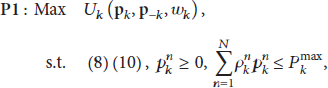
Hence, the revenue utility optimization problem for the PU k is as follows:
Then, for SUs (followers), we set the revenue utility of the lth SU with two parts: the first one is the income from the SINR achieved from the PUs. The second one is the payment for the PUs. Then, the revenue utility function of the lth SU is as follows:

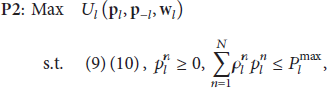
Hence, the optimization problem for the SU l is as follows:
4. Solution of the Proposed Stackelberg Game
The optimization problems
4.1. Global Efficiency of the RSE
In noncooperative games, the existence and uniqueness of equilibrium are not always achieved [11] due to multiple players' competition. Hence, for the multifollower subgame, we should study the existence and uniqueness of the global SG response to the leaders' price. In particular, a variational equilibrium (VE) [12] is applied to analyze the global SG for our case. This is because a VE is more stable than any other generalized Nash equilibrium under parameter uncertainty [13]. Particularly, a number of SUs aim to achieve their QoS requirement through applying the resource from PUs in cognitive radio networks; VE is regarded as an appropriate solution.
For a market fixed price at the PUs, all the SUs aim to maximize their own utility by buying the resource through PUs. Thus, we formulate a new objective function for all SUs; the new utility is the sum utilities of all SUs and can be expressed as follows:

Therefore, in order to achieve the actable outcome of the proposed SG, our goal is guarantying the existence and uniqueness of the SG when maximizing (14). The corresponding Lagrangian function and the KTT conditions for the SU l expressed in and the KTT conditions for the SU l are given by

We note that the robust followers' game shows a jointly convex generalized SE problem; therefore, the solution of the SE problem with constraints in (13) is a variational inequality
In this paper, we only focus on the power control in cognitive radio networks by assuming the channel assignment has already been done. Then, we can divide the variational inequality
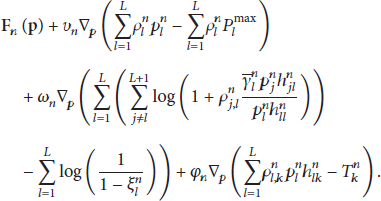
Now from the definition of [12], we have
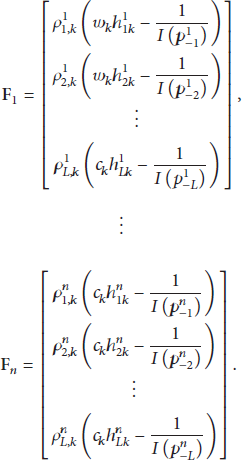
Therefore, the Jacobian of

Each
4.2. Solution of the Optimization for SUs (Followers)
For the
For the problem in (13), the corresponding Lagrangian function for the SU l on the subchannel n can be expressed as
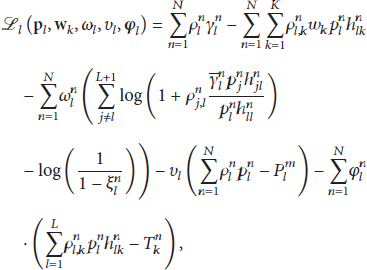
We decompose the optimization problem into N independent subproblems. Then, on the subchannel n, taking the Karush-Kuhn-Tucker (KKT) condition [4],
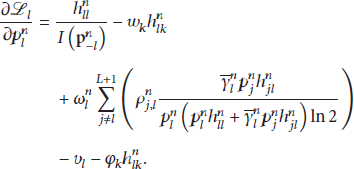
Simply, in (20), we assume that the jth user causing the interference power

Set (21) to zero and get the optimal transmission power of the SU l if it transmits on the channel n:

The transmission power of the SU l is zero if the interference price for it is larger than payoff threshold

From (23), if the price
4.3. Solution of the Optimization for PUs (Leaders)
In order to maximize its own utility, each PU needs to adaptively offer an interference price to SUs based on transmit power response of the SUs.
Thus, for

Similarly, in (24), we assume the lth SU causing the interference

Since
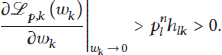

Through the above analysis,
4.4. Iterative Algorithm to Find the SE
For the above discussion, we propose an iterative algorithm to search the SE. Due to the fact that computation of the dual variables is a complicated task, the subgradient method (SM) [14] is applied to obtain the global optimum SE of this problem. Then, dual variables are updated as follows:

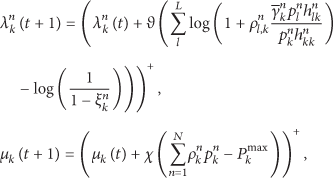
We then design the iterative algorithm to achieve the SE shown in Algorithm 1.
Set τ, where τ is positive and sufficiently small. (02) (03) Use SM to find the optimal step sizes (04) For the given (05) If (06) (07) (08) Use SM to find the optimal (09) For the responded (10) Each PU k updates its price by the solution of (11) (12) For each PU k, if repeat steps (02) and (11) until the condition is satisfied.
5. Simulation Results and Their Analysis
In this section, several numerical examples are presented to evaluate the performances of the proposed SG by comparing the optimal price-based SG considering global interference in [5] and the nominal SG without considering global interference and outage constraints. The cell radius of 500 m with the PBS centered at the original CRN. The simulation parameters are as follows:
Firstly, we illustrate the convergence of the proposed algorithm for achieving an SE of the proposed game. From Figure 2, the three PUs and five SUs iteratively update their utilities and obviously converge to the SE. The proposed algorithm converges quickly in terms of PUs, only about ten times. In addition, due to the larger number of SUs, the convergence of the SUs is slower than that of the PUs.
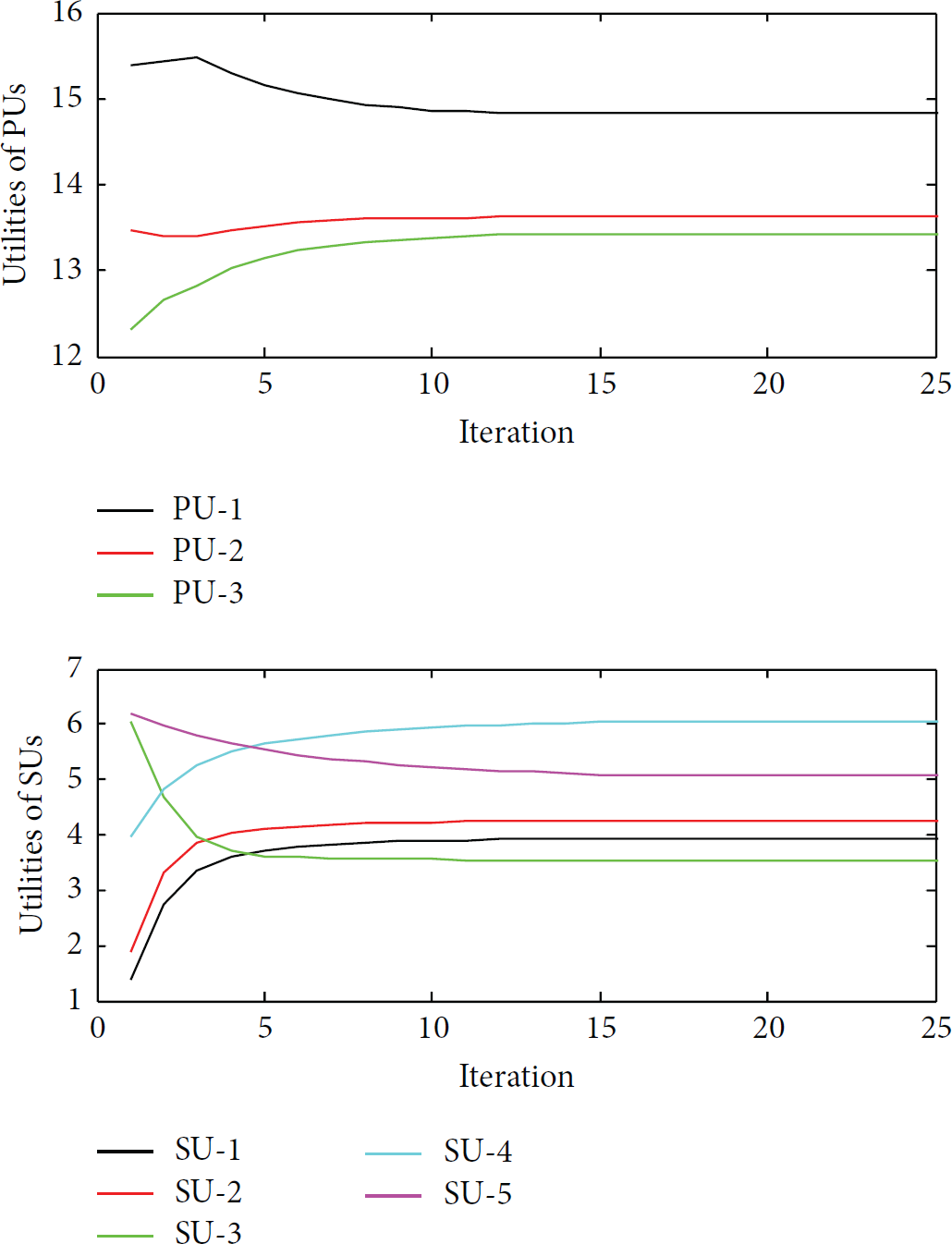
The convergence of utility of PUs (leaders), setting price of PUs, and utility of SUs (followers).
5.1. Impact of INR
In this subsection, we set the number of PUs and SUs as 3 and 5, and INR changes from −20 dB to 20 dB which means that IPC changes from
We then consider the sum rate of PUs and SUs for the three solutions with different tolerant interference constraints shown in Figures 3 and 4. For the performance of sum rate of SUs, Figure 3 shows the nominal SG scheme outperforms other two schemes when the interference temperature level is stringent but is inferior to the two schemes when it is loose. The proposed SG performs the worst, because of the demand of satisfying the outage probability constraint. Once the interference constraints are loose enough to be not active, accordingly, our proposed solution works better than the others. For the leaders, the sum rate of the nominal SG performs the worst because of not including the global interference constraints. This is because the performance of PUs may be degraded with the increases of the interference.
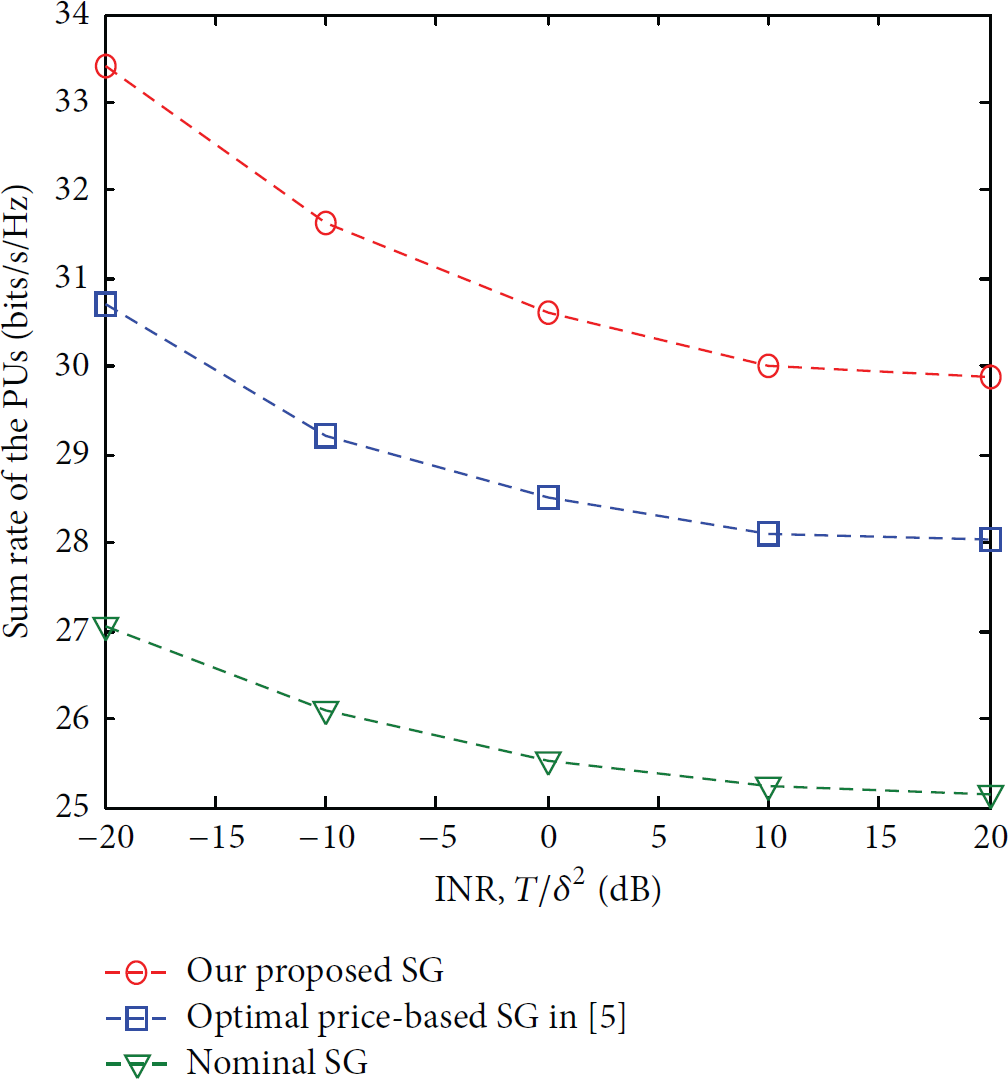
Sum rate of PUs versus INR.

Sum rate of SUs versus INR.
Figure 5 presents the outage probability of the system with different INR. It is observed that the proposed scheme achieves much lower outage probability than other schemes; in particular, the performance gap becomes larger with the increase of INR. This is because our proposed algorithm works best by considering the outage probability constraints of users, which prevents the outage events well.
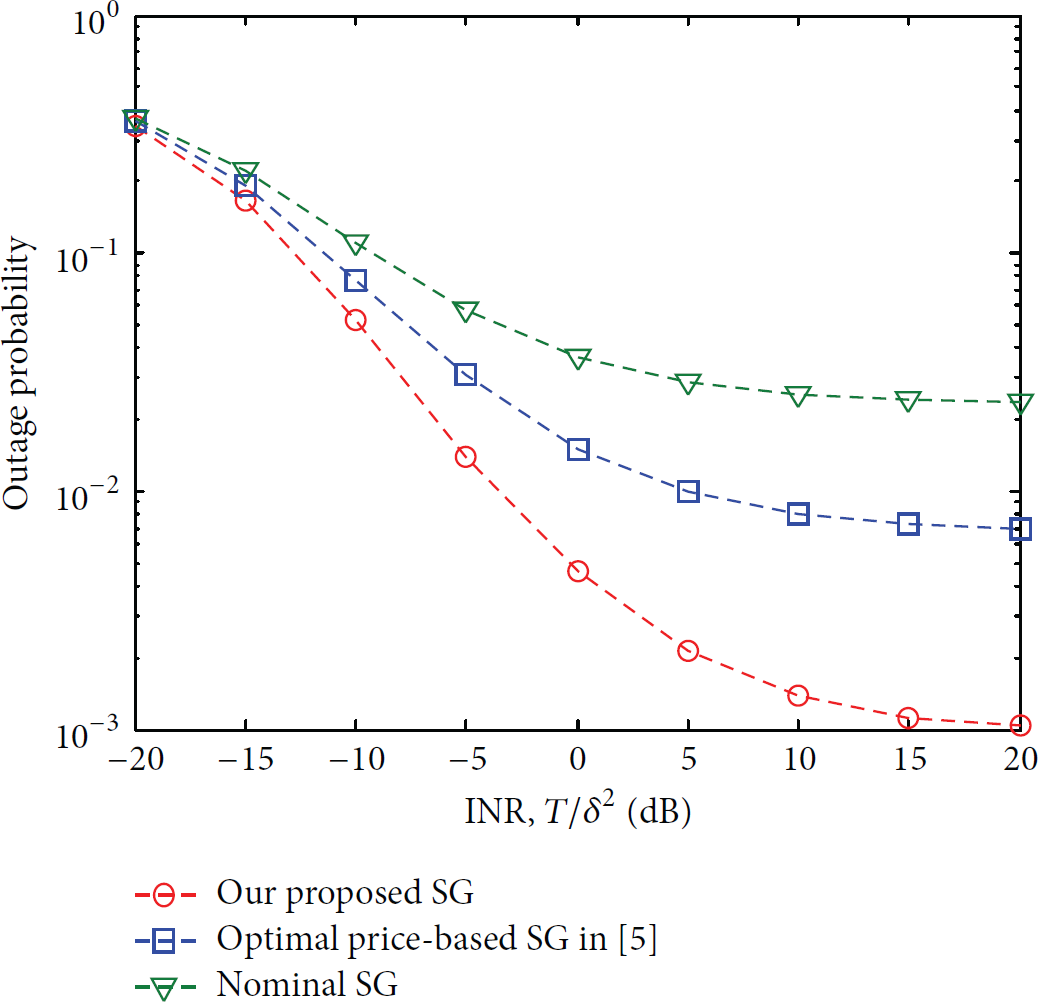
Outage probability versus INR.
5.2. Impact of Different Number of SUs
In this subsection, the INR is set to be 10 dB. The number of SUs changes from 2 to 20. All the other simulation parameters are the same as the beginning part of this section.
For the PUs, from Figure 6, the sum rate of the SG solution performs the worst because of not including the global interference constraints. So the PUs may refuse to sell more spectrum resource because of protecting their own communication QoS. The proposed scheme outperforms most in terms of sum rate of SUs because the algorithm allows more SUs to share their radio resource so that it increases PUs' utilities with considering the channel uncertainty and global interference constraints.

Sum rate of PUs versus number of SUs.
Figure 7 shows the sum rate of SUs versus the number of SUs. The sum rate of SUs performance of our proposed algorithm works better than other two schemes; this is because the proposed scheme is able to support more SUs at the BS shown in Figure 7, so that more SUs have opportunities to transmit, which increase the sum rate. In addition, the performance gap between the proposed scheme and the other algorithms increases when the network grows larger, by which it can be concluded that the proposed scheme is more suitable for application in larger networks. Because the scheme sets the adaptive punishment parameter among all served SUs to control their behavior, more SUs can be served at the BS, thus achieving a higher sum rate.

Sum rate of SUs versus number of SUs.
Figure 8 shows the number of outage probability comparison versus the number of SUs for different algorithms. The proposed algorithm is able to support more SUs than other schemes. This is because we develop the channel assignment scheduling scheme to decrease the probability of the unserved SUs, so more SUs are admitted to serve at the BS without causing unendurable interference to PUs. In addition, the interference among SUs is taken into the revenue utility function to void serious interference for some SUs who have bad channel condition.

Outage probability versus number of SUs.
6. Conclusion
In this paper, we propose a Stackelberg game for power control problem in CRNs with channel outage constraints and global interference constraints. We employ LDDM to solve the problem by decomposing it into independent subproblems and develop an iterative algorithm to achieve SE. Simulation results show that the proposed algorithm improves the performance compared with other game algorithms.
Footnotes
Conflict of Interests
The authors declare that there is no conflict of interests regarding the publication of this paper.
Acknowledgments
This work was supported by the National Nature Science Foundation of China (61271259 and 61301123), the Special Fund of Chongqing Key Laboratory (CSTC), the Program for Changjiang Scholars and Innovative Research Team in University (IRT2129), and the Graduate Student Research Innovation Project of Chongqing University of Posts and Telecommunications (Chongqing) (CYS14143).