




Abstract
In Smart Grids, the real-time information measured by distributed sensors is transmitted through communication networks to create an automated energy delivery network. The communication reliability of communication networks in Smart Grids is of great importance, especially under the impact of natural disasters, which are the most common threats to the reliability of power grids. In this paper, the seismic impacts on communication networks in Smart Grids are analyzed, including the modeling of earthquakes, the fragility probability computing of power grids, and the seismic impacts on power line communication (PLC) channel. Based on these analyses, the network capacity is analyzed and the postearthquake network capacity is obtained through the formulations based on an arbitrary network model. The achievable data rates of a practical network are obtained through simulations on a simulated random topology according to practical parameters. To enhance the communication robustness of Smart Grids against earthquakes, a robust routing protocol based on greedy perimeter stateless routing (R-GPSR) is proposed. The simulation results show significant improvements in the reliability and expectation channel capacity of the communication network under the impacts of earthquakes with different magnitudes.
1. Introduction
The Smart Grid refers to the next-generation electrical power grid that aims to create a widely distributed automated energy delivery network [1]. Real-time information derived by distributed sensors is shared through the communication network. The modern communication infrastructure plays a vital role in managing, controlling, and optimizing different devices and systems in the Smart Grid [2]. From a technical view point, the communication infrastructure of the Smart Grid covers two subsystems: the smart information subsystem, which is responsible for advanced information metering, monitoring, and management; and the smart communication subsystem, which is responsible for communication connectivity and information transmission among systems, devices, and applications.
The Smart Grid has used several protocols and systems for the smart information and communication subsystems including automatic meter reading (AMR), precision time protocol (PTP), distribution management system (DMS), supervisory control and data acquisition systems (SCADA), and wide area monitoring system (WAMS) [3]. The SCADA is one of the vital systems applied across the communication and information subsystem in the Smart Grid. Based on the sensor network throughout the Smart Grid, the data obtained by sensors are aggregated into the nearby substations to the SCADA system. The SCADA system is aimed at feeding data that constantly update the state estimation and system identification at the level of substations in order to optimize the power system operation and make sure the system is working in a stable condition [4].
For the communication subsystem, Smart Grids adopt different communication technologies in various scenarios for different types of networks including the power line communication (PLC), the cellular communication, and the satellite communication. The cellular communication system easily achieves data communications with the coverage over a large geographic area; and the satellite communication is suitable for the communication between remote substations and generating plants. The PLC technology plays a pivotal role in the Smart Grid communication subsystem due to the advantages of low deployment cost, direct and low latency communication route, and the combination of sensing and communication [4]. Hence PLC is more suitable for the communication between substations and the distributed grids, especially for the communication network in SCADA system, than other technologies.
Meanwhile, electrical power system is a vital lifeline system when earthquakes happen. As the next-generation power grid, the Smart Grid, including its communication subsystem, needs to improve its reliability and have its emergency countermeasures against earthquakes. According to the statistics in [5], 30% of the communication subsystems of the surveyed power companies had been affected by earthquakes; 20% of the surveyed companies had experienced severe damages caused by earthquakes; and 20% of them had experienced system-level breaking downs due to earthquakes. The earthquakes can destroy the components of the power grid, cause changes in the topology, and change the performance of communication channels resulting in severe damage to the communication network in Smart Grids. However, the current power gird lacks emergency countermeasures against unpredictable extreme disasters and mainly relies on the postdisaster restoration. The current researches mainly focus on the structural reliability [6] and topological reliability [7] of traditional power grid. None of them have considered the reliability of the communication subsystem in the Smart Grid when earthquakes happen.
In this paper, the seismic impacts on communication networks in Smart Grids are modeled, the channel capacity and network capacity are analyzed, and a robust routing protocol (R-GPSR) is proposed. Firstly, we apply a seismic ground motion model, estimate the fragility probability of substations, and analyze the topology change of power grids. We model the seismic impacts on the communication network of Smart Grids by analyzing the channel capacity and network capacity changes of the PLC network of the SCADA system in the Smart Grid communication subsystem. We utilize a multipath channel model of PLC to analyze the postearthquake channel capacity changes due to the varied surviving number of substations. The network capacity is obtained through formula derivation based on an arbitrary network topology. The achievable data rates of practical systems are simulated using GPSR protocol based on a simulated random topology which can represent the topological characteristics of practical power grids. To enhance the communication robustness of Smart Grids against earthquakes, based on the impact analysis, we propose a robust routing algorithm (R-GPSR) that can dramatically improve the reliability of the communication networks in Smart Grids when an earthquake happens.
The remainder of this paper is organized as follows. Related works are discussed in Section 2. In Section 3, the seismic impacts on power grids are modeled, including the seismic ground motion model and fragility probability model of substations. Then in Section 4, the seismic impacts on the communication channel capacity in the PLC network are investigated. In Section 5, the network capacity and achievable data rates of the communication network are obtained through analyses and simulations. In Section 6, the robust routing protocol is developed and simulation studies are performed. Finally, the paper is concluded in Section 7.
2. Related Work
In the area of lifeline engineering research, which mainly focuses on the modeling of natural disasters and structural reliability, the research in [8] proposes a new methodology combining hurricane damage predictions and topological assessment is developed to characterize the impact of hurricanes upon power system reliability. In [6, 9], the methods to compute the fragility probability of the substations are introduced under a certain seismic ground motion model. In [7], system performance and reliability of the power grids are evaluated under the seismic impact scenario using concepts from complex network theories. However, none of them have considered the communication reliability of the Smart Grid against earthquakes.
As for the network capacity analysis, in [10] a methodology for analyzing the capacity of wireless network is introduced. Based on that research, [11] studies the network capacity of hybrid wireless networks which includes n nodes and m base stations. The research in [12] analyzes the network capacity of multiple-input-multiple-output (MIMO) systems including cooperative base stations and mobile terminals. The current researches on network capacity mainly focus on the wireless networks. In the area of Smart Grids, the network capacity analysis of the communication network needs to be proposed.
To meet the communication requirements of Smart Grids, a lot of efforts have been made in the PLC routing protocol area. The work in [13] proposes an improved on-demand distance vector (IPODV) routing protocol. The work in [14] proposes a geographic routing protocol (GPSR) from WSNs as the routing protocol for PLC networks due to the fact that the network nodes in PLC network are static and their locations are known a priori. In [15], powerline multipath routing (PMR) is proposed as an on-demand source narrowband PLC routing protocol. Although various efforts have been made in improving the reliability and physical security of the smart gird communications, none of these researches have considered the reliability analysis against natural disasters, like earthquakes.
3. Modeling the Seismic Impacts on Power Grids
In this section, the modeling of seismic impacts on power grids is discussed, including the seismic ground motion model and fragility probability model of substations. We use the ground motion model, also called attenuation relation model, to simulate an earthquake to obtain the peak ground acceleration (PGA) value of an exact location. Based on the PGA values, the fragility probabilities of substations can be computed.
3.1. Seismic Ground Motion Model
The seismic ground motion model from [16] is adopted in this paper. It is an empirical model for peak ground acceleration (PGA), valid for magnitudes ranging from 4.0 up to 7.5 or 8.5 (depending on fault mechanism) and distances ranging from 0 to 200 km. The PGA estimation of ground motion model can be calculated with the general equation:


PGA estimation of ground motion model.
3.2. Fragility Probability Model of Power Grid
Based on the estimated PGA values, the fragility probabilities of the components in power grids can be computed. In this paper, we focus on the SCADA system of the Smart Grid. When the sensors obtain the data, the data are aggregated into the substations. Hence the communications are mainly between substations including the transmission substations and the distribution substations, we utilize methodology of structural fragility probability models developed in [6, 9]. Structural fragility probability curve represents the conditional probability that the condition of a structure exceeds the prescribed structural state

With the fragility probabilities of basic structural type obtained and the structure of substations confirmed, the surviving and fragility probabilities of substation can be computed:


Figure 2 shows the relation of the fragility probability of a transmission substation given a PGA value ranging from 0.01 g to 0.5 g. It can be found that the substation is totally damaged with the PGA larger than 0.3 g. According to IEEE Std 693-2005, the substations with medium perform level of earthquake-resistance should be capable of enduring the PGA value within 0.25 g. Hence the numerical result of the estimation is considered to be credible and representative. The results of Figures 1 and 2 infer that the substations in the region of 15 km to epicenter are most likely affected by earthquakes. The substations within 5 km to epicenter are almost collapsed. An earthquake can cause a damaged hole in the topology of the power grid, which is a great threat to the communication subsystem of the Smart Grid.
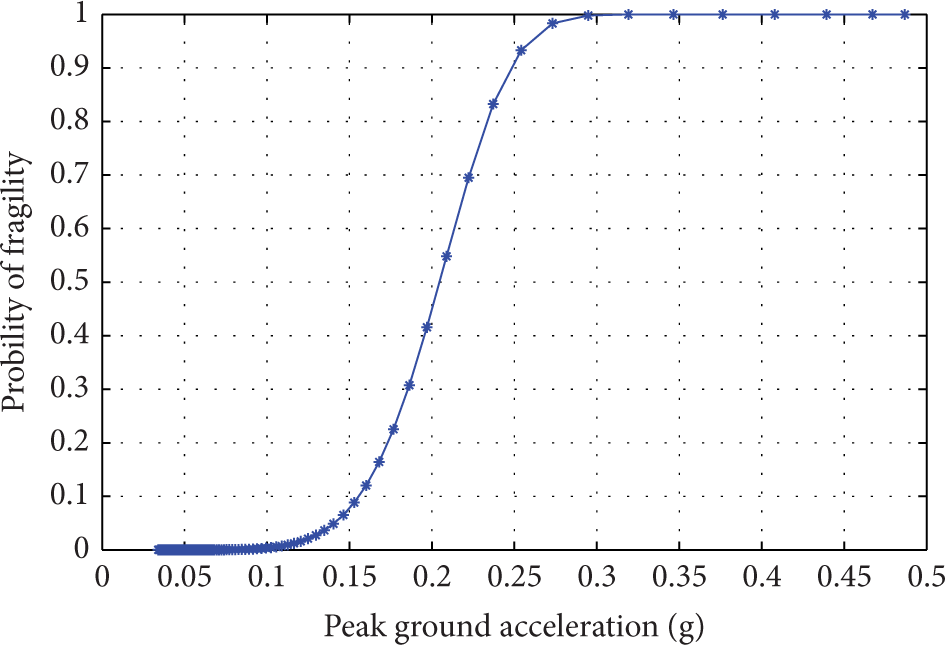
Fragility probability of a transmission substation given a a PGA value.
4. Seismic Impacts on Communication Channel
The PLC communication channel capacities of the transmission line can vary dramatically since earthquakes may damage the substations, which changes the topology of the PLC network. In this section, by utilizing the generalized multipath channel model from [19], the postearthquake impact on the channel capacity of the PLC network is analytically modeled.
4.1. A Multipath Channel Model
The multipath model from [19] is used in this paper for its applicability to LV and MV outdoor power transmission systems. Equation (5) presents a parametric model, describing the complex frequency response of typical power line channels

4.2. The Seismic Impacts on Channel Capacity
We use channel capacity as the link quality measure for the PLC network, which can be derived by the Shannon theory:

The seismic impacts on the communication channel in power grids are determined by the surviving number of the distribution substations along a transmission line that is, the number of the signal paths. Figure 3 shows the changes in the channel capacity of a typical 1320 m MV power line given the PSD ranging from −90 to −30 dBm/Hz and different surviving number of the distribution substations on PLC CENELEC A band. This is a typical example sampled from a topology of the MV power grid which can represent the characteristics of other power lines of a grid. It shows that the surviving number of distribution substations in the network can have significant influence on the channel capacity of any single link. As it shows the ordering of the line does not follow the increasing number of survivors, that is, because the results reflect the combination of the multipath effects, random weighting factors, and branch lengths which make the results nonlinear.

The seismic impact on the channel capacity of a typical 1320 m MV power line.
5. Seismic Impacts on Network Capacity
The network capacity depends on many factors including network topologies, power and bandwidth constraints, routing protocol, and radio interference, and so forth. The network capacity analyses, especially the upper and lower bonds of network capacity, are valuable to the network designers. In this section, the upper bond of network capacity of Smart Grids communication networks are analyzed. To obtain the upper bond of network capacity, we apply an arbitrary topology to make the communication network to function to the utmost. The postearthquake bond of network capacity is analyzed combing analyses of seismic impacts above. Besides the upper bond analyses, the achievable data rates of the network is obtained through simulations based on a simulated random topology with the same node amount which can represent the topological characteristics of the practical power grid.
5.1. The Postearthquake Network Capacity
To analyze the upper bond of the network capacity, we need to make the network function to its utmost based on the arbitrary network model. In an arbitrary network, nodes are arbitrarily located in the plane. Each node has an arbitrarily chosen destination with an arbitrary traffic rate and traffic pattern. Each node can also choose an arbitrary range or power level for each transmission. In this paper, we apply a hexagonal topology for the arbitrary network which needs to increase its the number of communication channels that is, the number of the power line links. However, the practical power lines can not be intercrossed and overlapping randomly. According to Euler characteristic of planar graphs and Euler's formula [21], in a planar graph with crossing number is 0 and vertices number is more than 3 like this scenario, to obtain the most number of links and also perfectly cover the plane, the nodes can only be connected regular triangularly and regular hexagonally, that is, the nodal degree is 6.
Meanwhile, three kinds of MV topologies exist in the practical power girds which are radial, ring, and networked topology, respectively [19]. The radial topology has many advantages in fault current protection, control of power flows and lower cost, and so forth. In a ring topology, the substations of the network are interconnected composing a loop. A more complex radial topology is the form of a tree-shaped topology. The ring topology can be seen as an improved radial topology that creates redundancies and overcomes the weakness of radial topology.
Hence, we combine the advantages of the radial and ring topologies with the Euler characteristic of planar graphs, to apply an arbitrary regular hexagonal topology. We consider the scenario where N transmission substations, M power line links, and L distribution substations are located in an infinite plane. The transmission substations are connected regular triangularly and hexagonally through power lines which compose ring topologies. The distribution substations are uniformly connected to the backbone transmission power lines as tree-shaped topologies which can balance the multipath effects of the PLC channel according to the PLC channel characteristics. Figure 4 displays the concept of the regular hexagonal topology.

The regular hexagonal topology for the arbitrary network.
To analyze the network capacity, we use the model for successful reception of a transmission as (7) which is based on a situation where a minimum signal-to-interference ratio (SIR) is necessary for successful receptions. Node (Substation)
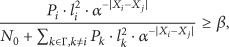

We analyze the upper bond on network capacity of Smart Grids communication network based on the following set of assumptions.
N transmission substations, M power line links, L distribution substations are located in an infinite plane. The transmission substations are connected regular hexagonally through power lines with equal lengths, and the length range of the transmission power line is known as The distribution substations are uniformly connected to the backbone transmission power lines, which means the number of the branches along every transmission power lines, The network transports The average distance between the source and destination of a bit is Each node can transmit W bits per second over the PLC link channel.
For bit b, where
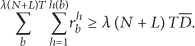

Hence
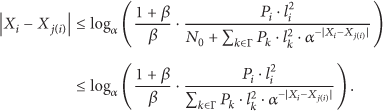
Summing over all the transmission power line of the network

Since the distribution substations are uniformly located along the backbone transmission power line, the number of the branches of each transmission power line is equal. Hence

Since the communication process is between two substations, including the transmission and distribution substations, hence

Hence (12) can be rewritten as

Since the N transmission substations are arbitrarily located and connected as regular hexagons with M power lines, the following relation can be obtained:

The nodal degree
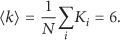
Hence

Summing over all the slots gives

Combining (9), the network capacity of Smart Grids communication network is bonded as follows:

When an earthquake happens, the substations are damaged to varied extent. According to previous analyses on seismic impacts on substations and communication channels, the different surviving number of the distribution substations can result in the change of channel capacity and network topology. Hence the network capacity would obvious change after an earthquake happens. According to the previous analyses, when an earthquake happens, the location of epicenter and the magnitude of the earthquake can be measured by the earthquake warning system. The fragility probability P of the substations can be computed by the seismic motion model and fragility probability model which are mentioned above. Hence the surviving probability
We introduce the average surviving probabilities of transmission and distribution substations,
Hence (18) can be rewritten as

Use the same deduction process from (18) to (20), the postearthquake upper bond on Network capacity of the communication network in Smart Grids can be obtained as

5.2. The Achievable Data Rates of Practical Network
We study the achievable data rates of the network, because the theoretical lower bond on network capacity represents the harshest situation that the numerical results can be near zero. Meanwhile, unlike wireless network, the practical topology of power grids can be analyzed neither totally randomly nor arbitrarily. However it should be analyzed according to practical topology characteristics. Hence the theoretical lower bond on network capacity can be less meaningful than the results of a lower bond which can represent the practical network characteristics.
To have a more obvious result of the network capacity analyses, we stimulate the achievable data rates of the random topology with the same node amount which can represent the topological characteristics of the practical power grid. The topology is displayed in the Section 6 using GPSR protocol based on TDMA (slot number is 10). Figure 5 displays the simulation results under the earthquake impacts with magnitude ranging from 4 to 7.5. The blue line is the result of the achievable data rates of a simulated practical network. The green line is the simulation result of the system which has the same transmission substation amount, but with the regular hexagonal topology for the arbitrary network, that is, network capacity of arbitrary network.

The network capacity and achievable data rates simulation results.
As Figure 5 shows, there exists a large numerical gap between the network capacity and the achievable data rates which is more than 1000 times. Many reasons contributes to this gap, and the main of which is we use the mean surviving probability to represent the nodes surviving situation of the whole grid. The practical seismic impacts cause the node to be either damaged or survived due to probabilities, which can be more severer than the average probability. In the simulation of magnitude 6, the nodes can be damaged to near 67% to the utmost (transmission substation survivors: 9/30, distribution substation survivors: 123/362) in the random topology, however in the arbitrary topology the average fragility probability is just near 41% due to the topology changes. Hence the 26% more nodes among the amount 392 survive in the arbitrary network. Different numbers of power lines due to the difference between arbitrary network and the simulated network can contribute to this gap. Because in the random topology, the transmission lines amount is 60 while in the arbitrary topology is 90 which means 30 more channel links. Since the upper bond should be the situation of the utmost probability, every link has 26% more nodes survived and the whole network has 126% capacity with the exponent of 30 which results in 1026 times. Moreover, the achievable data rates are simulated with full contentions and interferences on the limited surviving links which can also contribute to this gap. Meanwhile, reasonable omissions of some power line parameters in the formula deduction can also be a factor in this gap.
6. Robust Routing Protocol Based on GPSR
In this section, to reduce the seismic impacts and enhance the robustness of the communication subsystem of Smart Grids against earthquakes, also to avoid the potential packets loss and the topological routing voids caused by the damage of substations, a robust routing protocol based on Greedy Perimeter Stateless Routing (GPSR) is proposed for a PLC-based communication network in the Smart Grid SCADA system. The R-GPSR routing metric is developed based on the fragility probability, the channel capacity, and the distance to the destination. GPSR is a routing protocol originally proposed for wireless networks. GPSR makes greedy forwarding decisions using location information about a routers immediate neighbors in the network topology [22]. The reason why GPSR is selected among the existing protocols is for the extension to consider the impact of earthquakes. It is a well-developed technology on PLC network based on geographic positions knowledge of nodes which can easily combined with earthquake warning system and the impact models we analyze above. In this paper, we keep the original forwarding rules of GPSR. Based on the location information of neighbors known as a priori, the next hop with the minimum routing cost is determined until the destination is reached. However, we design a new robust GPSR routing metric based on the impact analysis of natural disasters in this paper to replace the original routing metric that is the minimum distance to destination. The new routing metric is defined as follows:

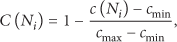

As (23) shows, the routing metric E of the neighbor substation
The current earthquake early warning system can provide tens of seconds of warning time before an earthquake strikes [23]. Although the warning time is short, it is sufficient to inform the substations of the epicenter and magnitude information to implement earthquake prevention measures and enable R-GPSR when an automatic mechanism is founded in future. After the earthquake information obtained, since the R-GPSR is geographic routing protocol, the fragility probabilities of the substations in power grid can be estimated based on their location information using the models in this study. And the channel capacity of their interlinks can also be computed. Combining the distance to the destination, the substation with the minimum routing cost is chosen as the next hop.
To obtain available topological data to verify the algorithm proposed in this paper, we the use a larger scale power grid, as shown in Figure 6. It should be noted that the power gird is generated according to the same topological characteristic analyses in [4, 19], including the number of nodes and branches, the average node degree, the Pearson correlation coefficient, the algebraic connectivity, and the average shortest path length, and so forth. It is a MV power grid composed by 30 transmission substations and 362 distribution substations connected to transmission substations with radial lines and tree-shaped lines in an area of 900 km2.
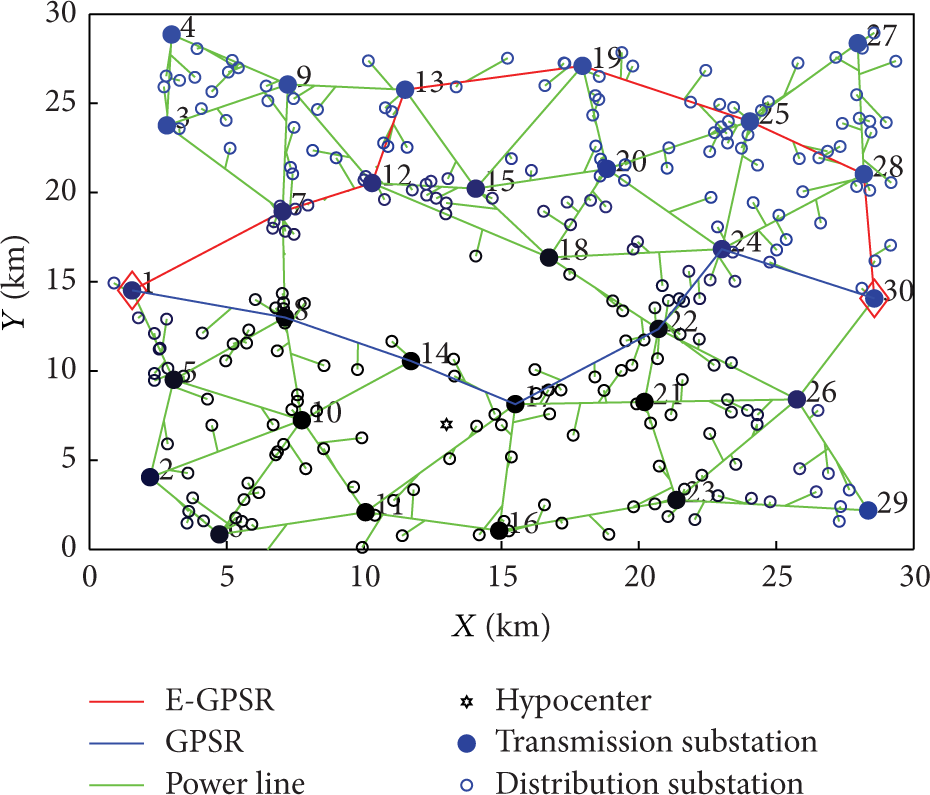
Routing simulation on a typical MV power grid.
We simulate an earthquake with the magnitude of 6 and the packets are forwarded from
To have an obvious numerical result of the performance improvement of the proposed robust routing protocol, we use the expectation channel capacity and packets loss rate of the route as the measures of the performance of these protocols. Based on the power grid we adopt above, we run simulations to test the two measures.
The expectation channel capacity of the route is a concept in graph theory that is widely applied in expectation-maximum capacity route searching, network capacity computing and data flow analyses, among others. It represents the maximum data transport ability of the route that combines the reliability probability and the channel capacity of the route. It is the product of the minimum channel capacity and reliability probability of the route:

In Figure 7, we use the Monte Carlo simulation running for 1000 times and each time the source and destination are randomly chosen with a fixed epicenter in the middle of the grid. The numerical results are shown with the earthquake magnitude ranging from 4 to 7.5. The red line is for R-GPSR protocol that proposed in this paper, while the blue line is for original GPSR protocol. It is clear that the R-GPSR has an obvious improvement in the performance of the expectation channel capacity of route especially within the magnitude ranging from 5 to 6 (more than 80% higher than the original GPSR when the earthquake magnitude is 5.5). The mean ratio of the expectation channel capacities of R-GPSR to GPSR is 1.8. Similarly, in Figure 8, the packets loss rate is used as the performance measure of the protocols. We run the simulation for 1000 times. Each time the source and destination are randomly chosen and 1000 packets are send. The surviving situations of substations are generated according to the probabilities obtained from the seismic models during each transmission and the packets loss rate is then computed. As expected, the performance of R-GPSR is much better than GPSR especially within the earthquake magnitude ranging from 5 to 6. The mean packets loss rate of the R-GPSR is 22.8% less than the GPSR.

The curves of the expectation channel capacity of route.
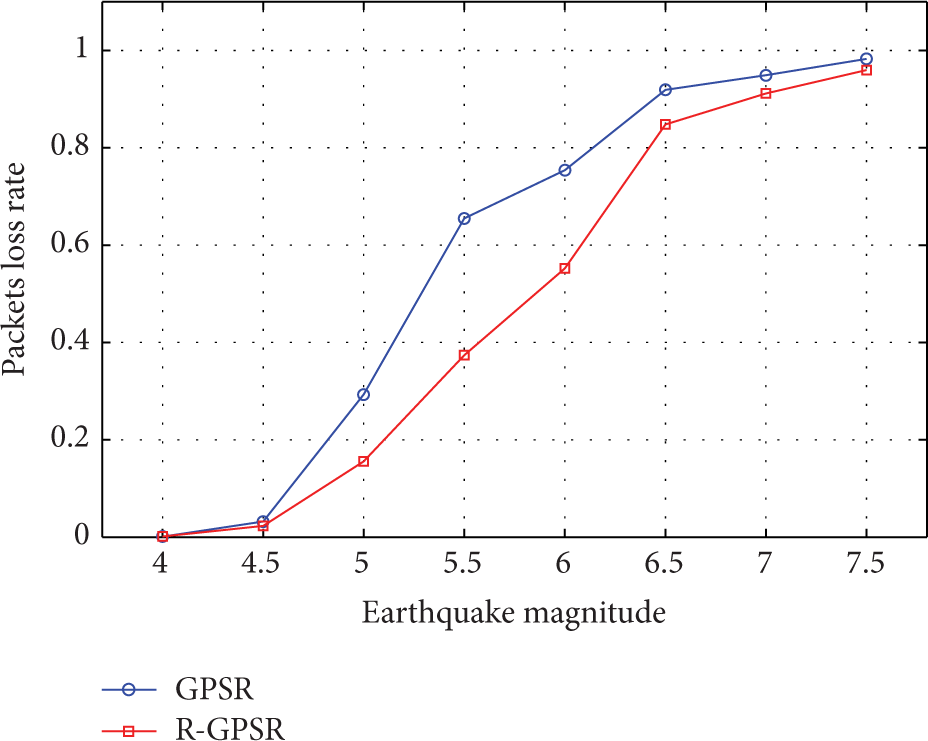
The curves of the packets loss rate.
7. Conclusion
Currently few researches have covered the reliability against earthquakes for the communication subsystem of Smart Grids. This paper models the seismic impacts on the communication networks of Smart Grid using a seismic ground motion model as an example. The fragility probability of the power grid is obtained by using the structural fragility probability model. Based on these, the seismic impacts on communication channels are analyzed. Besides these, the network capacity is analyzed and the postearthquake network capacity upper bond is obtained through formula derivations based on an arbitrary network model. Meanwhile, based on a simulated random topology which can represent the topological characteristics of the practical power grid, the achievable data rates are obtained through simulations. Finally, to reduce the seismic impacts and enhance the robustness, a robust routing protocol (R-GPSR) is proposed based on the classic GPSR protocol, which shows obviously better performances on the expectation channel capacity and the packets loss rate of the route, especially within the earthquake magnitude ranging from 5 to 6. In future work, small-scale scenarios of the Smart Grid can be studied, including home area networks (HAN) and neighborhood area networks (NAN) which cover both LV and MV power networks. More robust protocols working across the communication, information and energy subsystems of the Smart Grid can be proposed. A seismic emergency response and recovery system for the Smart Grid can be systematically studied combining the earthquake early warning system with this research.
Footnotes
Conflict of Interests
The authors declare that there is no conflict of interests regarding the publication of this paper.
Acknowledgment
The first author is sponsored by the China Scholarship Council for his studies in United States.