




Abstract
The increasing demand for real-time applications in WSN has raised the requirement of protocols considering both energy efficiency and end-to-end delay. A PSM is proposed in the IEEE 802.11 protocol to reduce the power consumptions of wireless nodes. Wireless nodes can stay in doze mode and periodically wake up to retrieve the frames buffered in the APs. However, the 802.11 PSM is not such energy efficiency for WSN. First, in the process of the node's transmitting polling frames to AP, channel contentions may cause sensor nodes to deplete power quickly. Second, the mechanism of retrieving buffered frames can be inefficient since a polling frame is able to pick up only one data frame. Third, a prioritized service for urgent needs is not supported. In this paper, we propose a prioritized reservation scheme to enhance the IEEE 802.11 PSM. The concept of PSCW is suggested, during which PSM sensor nodes can retrieve the buffered frames using the reserved SPs, where the priorities of the PSM nodes are considered in scheduling the SPs. Through analytic models and discrete simulations, we show that our proposed mechanism outperforms the existing PSM schemes in terms of energy efficiency and prioritized services.
1. Introduction
The energy efficiency has been an important issue in WSN (Wireless Sensor Network), since the sensor nodes operate on a limited battery supply [1]. In the recent years, the increasing demand for real-time applications in WSN has made the QoS (quality of service) based communication protocols a hot topic [2]. This development in WSN raises the requirement of designing the protocols considering both energy efficiency and end-to-end delay. In IEEE 802.11 MAC (medium access control), a PSM (Power Saving Mode) has been designed in order to reduce the power consumption of sensor nodes. According to it, sensor nodes can turn off their radios during inactive periods, incoming packets for a PSM sensor node are buffered in the central controller node, usually is an AP (Access Point), and the PSM node periodically wakes up and checks if it has data to receive via TIM (Traffic Indication Map) in beacon frames [3].
It has been noted that the 802.11 PSM mechanism has a couple of problems [4–9]. First, in order to retrieve buffered traffic, the PSM sensor node polls the AP with a PS-Poll frame. Since PS-Poll frames can be sent using DCF (distributed coordination function) access method, the contentions among nodes in heavy load network may lead to collisions which cause unnecessary power consumptions [4–8]. Second, if an AP sends a frame to a PSM node and more frames remained in the buffer for the node, then the AP sets More Data field of the frame to 1. Upon receiving the frame, the sensor node keeps polling the AP until it retrieves all the remaining frames. Thus, if many frames have been buffered for the PSM node, it can be very inefficient that one polling is able to retrieve only a single data frame from the AP.
Additionally, 802.11 PSM has no prioritized services and thus any urgent needs cannot be supported. Reference [9] has provided a priority scheme for 802.11 PSM such that high priority nodes can transmit the PS-Poll frames earlier than low priority ones. However, the contentions among nodes still exist in their scheme. Moreover, low priority nodes may waste their energy, since they keep sensing the channel while a high priority node retrieves a frame.
In this paper, we propose a prioritized reservation scheme to enhance the IEEE 802.11 PSM. The concept of PSCW (PSM Communication Window) is suggested, during which PSM nodes are allowed to retrieve the buffered frames using the reserved SPs (service periods). In order to mitigate the contentions among PSM nodes, AP is allowed to average the numbers of contending nodes during different BIs (beacon intervals). Also the priority of the PSM nodes is considered in scheduling the service periods; that is, the channel access time is allocated to PSM nodes according to their priority.
The rest of this paper is as follows. We outline previous works to improve the 802.11 PSM in Section 2, and our proposed scheme is explained in Section 3. In Section 4, mathematical models are built to analyze the buffering delay and average power consumption. Simulation works and the results are followed in Section 5, and finally concluding remarks are given in Section 6.
2. Related Works
The IEEE 802.11 PSM offers an opportunity for sensor nodes to preserve their powers [10]. Based on it, the nodes having no traffic to transmit for a certain period can enter into doze mode. AP buffers the incoming packets for the PSM sensor nodes, and via broadcasting a beacon frame at the beginning of each BI, announces which node has frames buffered [3]. The PSM sensor nodes wake up periodically according to their LIs (listen intervals) which are equal to one or several BIs, to check the TIM (Traffic Indication Map) in the beacon frame. If a sensor node confirms that there is data buffered in the AP, it will stay active to retrieve the buffered data by delivering a PS-Poll frame to the AP. On receiving the PS-Poll, the AP delivers the buffered data frame to the sensor node. If still more frames are buffered for the node, the AP sets the More Data field of the ongoing frame to 1. Upon receiving the frame, the node keeps polling the AP until it retrieves all the remaining frames.
In order to receive the broadcast and multicast traffic, a DTIM (delivery TIM) period, which consists of fixed numbers of BIs, is defined in 802.11 PSM. All the nodes associating with a same AP share the same DTIM period, and the LI of each node can be smaller or equal to the DTIM period. The DTIM periods are separated by the DTIM BIs, a special BI during which all PSM nodes keep active, and a DTIM beacon frame is sent by the AP. After the DTIM beacon, the buffered broadcast and the multicast traffic will be transmitted in the DTIM BI.
Because the 802.11 PSM utilizes 802.11 DCF channel access method, it may suffer inefficiency especially in heavy-traffic networks. The contentions among nodes may cause PSM nodes to stay active for a long period of time and waste their energy. Unsuccessful transmissions (collisions or error channel) lead the PSM nodes to retransmit several times, which can deplete their powers quickly. To alleviate this problem, various solutions have been reported in previous literatures [4–8]. Manweiler and Choudhury [4] design a SleepWell system for the densely deployed wireless networks. Nodes keep a sleeping window, and the APs regulate the sleeping windows of their associated nodes. As different APs are active/inactive during nonoverlapping time windows, by reducing overlap nodes can download traffic uninterrupted and enter into doze mode when the channel is occupied by other transmissions. However, this scheme is based on the assumption that APs can communicate with each other. If the nodes associate with APs that cannot overhear each other, their wakeup timers can probably overlap.
Rozner et al. [5] present NAPman, a network-assistant power management solution in their work. They first conduct simulations to prove that the competing background traffic can significantly increase the nodes’ energy consumptions and decrease the network capacity due to unnecessary retransmissions. And then an energy-aware scheduling scheme for AP is proposed, which enables the AP to manage the active periods of nodes based on their remaining energies. For mitigation of contentions among nodes, an AP virtualization scheme is also applied, which can lead nodes to download traffic isolated from each other. However, this approach can result in long delays for the PSM nodes with much power left.
Both of the above proposals are based on the same approaches allowing the AP to manage the wakeup/sleep time of nodes, using the designed scheduling mechanisms. Different from their approaches, He and Yuan [6] propose a TDMA-based MAC protocol for alleviating the contentions among nodes. AP divides a beacon period into a number of equal time slices, each of which is allocated to a single node or a group of nodes. Therefore, instead of contending for channel access, node wakes up according to its allocated time slot for data retrieving. This method effectively reduces energy consumption of PSM nodes by removal of channel contention. However, if a PSM node does not wake up in its time slot, the slot will be wasted. Also, as all the time slots have a same length without considering packet length or traffic load, the allocated time slots may be inefficiently used in case of short packets or light traffic.
Lin et al. [7] design a DeepSleep scheme to improve IEEE 802.11 PSM for machine-to-machine networks deploying energy harvesting devices. Because the energy levels of energy harvesting devices differ from time to time and also the harvesting rates of devices vary each other, in order to optimize the energy expenditure to improve the overall network performance, an energy-aware sleeping algorithm and a high priority algorithm are applied. The low power devices can enter into doze mode for a certain period to save power, and then when they wake up, they can access channel with high priority, while other devices without energy shortage access channel under low priority.
In [8], a balanced power saving strategy is presented, for determining the appropriate number of active nodes in each BI based on a tradeoff between energy consumption and MAC service delay. Through decreasing the number of the active nodes, contentions for channel access are mitigated, and thus PSM nodes can download their buffered traffic with low delay and consuming less power. The main idea of this approach is similar to ours; however, we can find the power consumed for idle channel and channel access is still existing in [8], while it is saved by channel reservation in our protocol. Moreover, there is no consideration of prioritized service in this scheme.
In order to provide prioritized services, two power saving approaches have been proposed for 802.11e and 802.11n standards [3]. In 802.11e, the APSD (automatic power save delivery) is defined to take advantage of QoS mechanisms in 802.11e. Nodes having no traffic for delivery can enter into doze mode for power saving like in the 802.11 PSM. Instead of waking up periodically, nodes can wake up for traffic download at any moment by transmitting trigger frames like Null data frames or QoS data frames to an AP. As each frame carries its priority, nodes can contend for channel access under the supported priorities. However, the APSD suffers from the drawbacks that its uncoordinated triggering scheme for retrieving buffered traffic can cause high delays due to nodes do not transmit enough trigger frames, or else too many triggers may introduce power waste [11]. Moreover, the priority mechanism applied in 802.11e can introduce unfairness problem, because the contention windows of low priority nodes are usually set to large values making the nodes have less opportunities for channel access.
IEEE 802.11n has proposed PSMP (power saving Multipoll) to enhance the APSD. A multipolling mechanism is implemented in AP for scheduling the transmissions of nodes, with a consideration of the different QoS requirements, for example, delay or bandwidth constraints. Nodes wake up for traffic download according to the scheduling information broadcast by the AP. The PSMP improves both energy efficiency of PSM nodes and channel utilization of WLANs [12]. However, the overhead of the management frames in PSMP can be very heavy, and its implementation has a high complexity.
In [9], a simple priority scheme is given to support the interuser QoS. The AP utilizes the newly defined PUN packet to broadcast the number of nodes in each priority level, and the nodes with high priority can transmit PS-Poll first while the low priority nodes stay active. Nodes in the same priority level contend to access channel according to the DCF scheme. Although this scheme makes the high priority nodes retrieve the buffered traffic with low delay, the low priority nodes have to keep on sensing the channel while other nodes retrieve their traffic, which can deplete their powers quickly.
Investigating previous works as described above, in this paper, we propose a prioritized reservation scheme to improve the performance of 802.11 PSM for WSN. Our proposed protocol reduces the sensor nodes’ power consumptions in sensing and contentions for channel access through channel reservation. Also it provides a prioritized service for PSM nodes. We give more details on our proposal in the next section.
3. Prioritized Reservation in 802.11 PSM
3.1. Overview
In this paper, we consider a wireless network where an AP serves as a controller, and many sensor nodes are associated with the AP for data services. For an explanation of our proposed scheme and also for simplicity, we assume that three levels of priority are supported in the network, and each node is assigned its priority while a node having urgent need is with high priority. The algorithm for assigning priority to nodes is outside the scope of this work.
In legacy PSM, nodes wake up according to their own LIs, therefore some BIs may be full of contending nodes while others may have only few active nodes. In order to improve this drawback, we enable the AP to reschedule the wakeup BIs of sensor nodes. The modified DTIM beacon is utilized to store the rescheduled information: in legacy PSM, if the AID (association ID) of the PSM node is 3, for example, then the third byte of PVB (partial virtual bitmap) in TIM records whether there is data buffered. Here we use the bytes to store the number of a BI in which a node should wake up. For example, if a node with AID of 3 should wake up at the second BI during a DTIM period, then the third byte of the DTIM will be set to 2. Because all the sensor nodes stay active in the DTIM BI for receiving the broadcast/multicast data, by broadcasting the DTIM beacon, AP can acknowledge nodes of their wakeup information. In such way, sensor nodes wake up not according to their LIs but to the information stored in DTIM, and the number of contending nodes in each BI can be averaged.
At the start of a BI, AP initiates one PSCW for transmission of PS-Poll frames and another PSCW for data frames. The duration of the PS-Poll PSCW depends on the number of PSM sensor nodes staying awake in that BI, and the whole PS-Poll PSCW is split into equal time slots with a period of exchanging one PS-Poll frame. The duration of data PSCW is determined based on frame lengths and traffic load of the active PSM nodes. With a consideration of fairness, a certain period of channel access time during a BI can be allocated to each group.
After PSCWs are initiated, AP broadcasts the related information via the beacon frame. When the PS-Poll PSCW starts, the active sensor nodes transmit PS-Poll frames in turn. Here, the nodes transmit PS-Polls in the order of their AIDs, that is, a node with a larger AID transmits earlier than the node with a smaller one. This method is reasonable because the PVB of the beacon TIM element has a full illustration of the state of the nodes’ buffered traffic related to their AIDs. On receiving a PS-Poll, AP answers with a PACK which includes the start time of an allocated SP for the node. PACK is a slightly modified ACK frame and the details will be presented in the next section. If a node receives a PACK and has much time until the start time, it enters into the sleep state immediately; otherwise, the node stays active. In case a node does not wake up in its PS-Poll time slot, the SP allocated for the node will be canceled. During data PSCW, sensor nodes keep active during their allocated SPs for traffic download. If the reserved SP is not enough for retrieving all buffered traffic, AP sets the More Data field in the last packet to 1, which makes the node wake up again in next BI.
3.2. Modification of TIM and ACK
In order to include the information on PSCWs, we modify TIM as in Figure 1. Two fields, PSCW1 and PSCW2, are added so that the start times of PS-Poll PSCW and data PSCW are recorded, respectively.

TIM element in proposed scheme.
PACK that is used to announce the start time of a reserved SP is depicted in Figure 2. Since the duration field of ACK is usually set to 0, we use this field to include the start time information; note here the start time for each sensor node has already been scheduled by the AP at the start of the BI based on nodes’ priorities, using the proposed scheduling scheme which will be explained later. Moreover, in the proposed scheme, only when AP receives a PS-Poll frame, it answers with a PACK; otherwise, the normal ACK will be transmitted.

PACK in proposed scheme.
3.3. SP Allocation in Data PSCW
The SP allocated to a sensor node is based on the traffic type and load buffered in AP. If we define PreambleTime as the time needed for transmitting the preamble signals before data and ACK frames, define DateRate and ACKRate as the transmit rate for data and ACK frames, respectively; we can get the expected time for exchanging one data frame is


3.4. SP Scheduling at AP
Note that the efficiency of scheduling the allocated SPs determines that of power utilization and delay. In this section, we propose two scheduling policies. (1) Arrange the channel time allocated to groups according to the group priority. (2) In each group, schedule all the SPs in the order of nonincreasing length.
One can see that the longer the previous SP is, the longer the next scheduled sensor node can stay in sleep. Also a short transmission time makes the next scheduled node change its status between sleep and active frequently. For example, let us assume that there are 5 nodes in a group that have 1, 2, 3, 4, and 5 packets queued, respectively, at AP. If the nodes transmit in a short time period first fashion, then, during the first node's transmission, the second node will continue to stay awake because of the short transmission time. Although the third node may turn into sleep, only 3 packets later it has to wake up. It should be noted that frequent state changes may result in power waste. On the other hand, if nodes transmit in the long time period first fashion, when a previous node processes its transmission, the other scheduled nodes can stay in doze for certain duration, which can preserve their powers.
3.4.1. An Example
For an example in this section, we assume a WSN consisting of 32 sensor nodes, and DTIM BI equals 4. AP groups all nodes based on their priorities as shown in Table 1 and makes them wake up into different BIs. The active nodes and PSCW distributions in each BI are shown in Figure 3, where the transmission orders of the nodes are scheduled by the proposed scheduling policy.
Nodes grouped by priority.

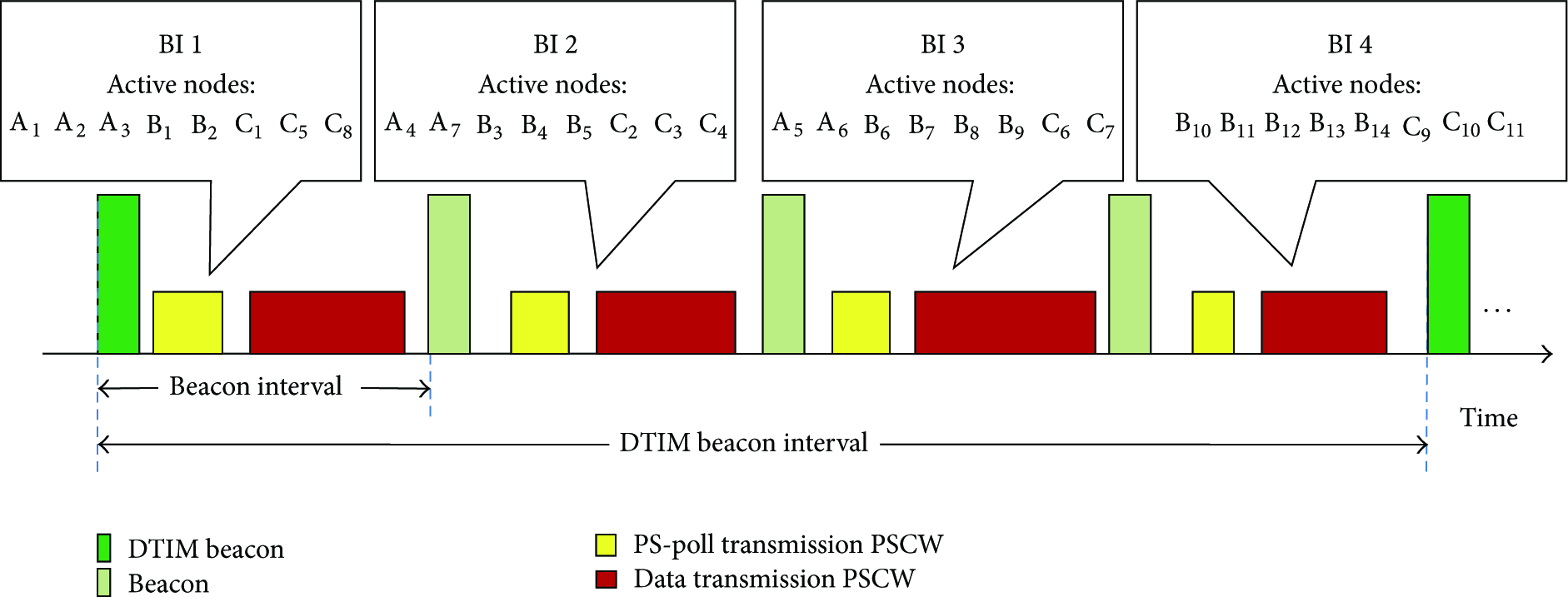
Nodes’ transmission order in each BI.
The details of transmission process of the sensor nodes are explained in Figure 4, which is a detailed figure of the first BI in Figure 3. At the beginning of the BI, after AP initiates a PS-Poll PSCW and a data PSCW, the PS-Poll PSCW is divided into a number of slices and allocated to nodes. In the figure, A1, A2, and A3 are in group P1, B1 and B2 are in group P2, and C1, C5, and C8 are in group P3, and time slots are allocated to them. AP records the information on PS-Poll PSCW and data PSCW into the beacon frame. Upon receiving the beacon, nodes get the information on their allocated time slots. In PS-Poll PSCW, nodes A1, B2, C5, C1, A3, C8, B1, and A2 wake up in sequence to deliver PS-Poll frames. By receiving PACKs, they can get the start time of the allocated SPs.
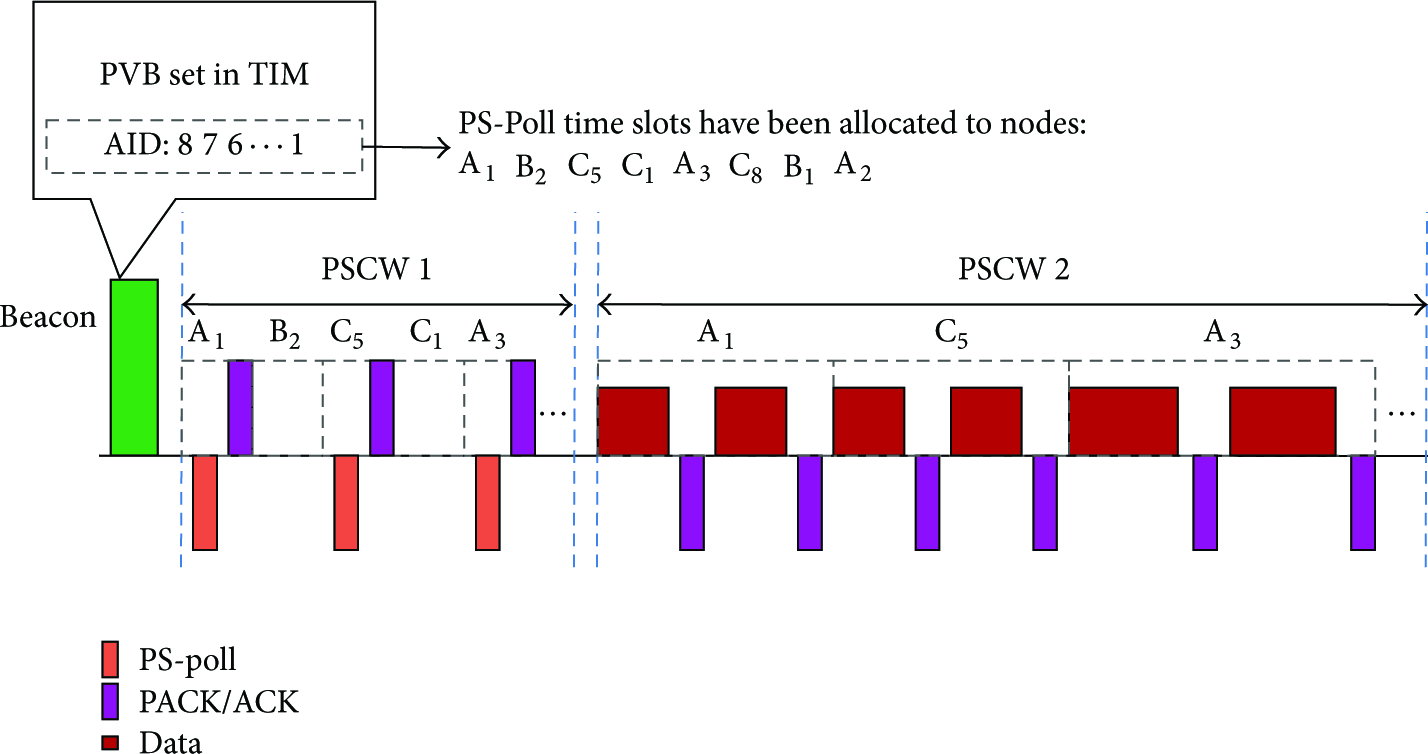
Transmission process.
Because the sensor nodes B2 and C1 do not wake up during their allocated time slots, the SPs allocated for them are canceled. During the data PSCW, when node A1 receives the first data, as More Data field is set to 1, it stays active continually. After the second packet is received, SP for A1 terminates, and A1 enters into the sleep state until the next LI. Now nodes C5 and A3 wake up in turn to download their buffered packets, and they perform the same process as A1.
3.5. Synchronization
Our mechanism is required for the synchronization between PSM nodes and their associated AP. In 802.11, the synchronization is realized by the TSF (timing synchronization function). An AP broadcasts a beacon frame at each BI, which includes a timestamp; all the associated nodes can adjust their TSF timers according to the timestamp. In this way, the nodes can keep synchronization with the AP and with each other. However, this method is not perfectly guaranteed, and loose-synchronization with AP may lead nodes to waking up at wrong time which results in packet loss and power waste. To improve the performance of proposed scheme, guaranteed synchronization mechanism is required for support. However, it is outside the scope of this paper.
4. Performance Analysis
In this section, we evaluate the performance of our proposed scheme analytically. We assume that, in legacy PSM, the contention windows of AP and nodes all keep the minimum value (
4.1. Downlink Delay
We model the average delay D of a frame first, which is incurred by the power saving mechanism at AP. Thus, the delay in this section means the sojourn time of a frame at the AP's buffer. Scheduled SP for node i in group k is denoted as
Now the time spent in delivering one PS-Poll frame can be written as


Numerical results of
In legacy 802.11 PSM, the nodes and AP transmit via channel contention. Based on [13], let 

4.2. Power Consumption
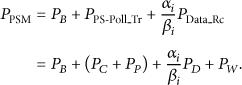
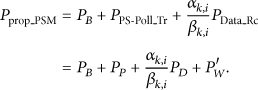
Using the methodology introduced in [13], next we build an analytical model to study the power consumptions of PSM sensor nodes during a BI. In the IEEE 802.11 MAC, a wireless network interface can be either awake or in doze state. There are three different modes in the active state: TX (transmit), RX (receive), and IDLE (idle), and the power consumed in each mode is different. In the doze state, two different modes have been designed, SLEEP (sleep) and OFF (power-off). The wireless network interface consumes much less energy in sleep state than in the awake state. In this model, we use
Now if we let 

Applying the methodology discussed in [9], let M be the total number of sensor nodes in network, let 




System parameters.


Numerical results of power consumption.
5. Simulations
In this section, simulations are performed to verify the efficiency of our proposed scheme using the OPNET simulator. The performance of the proposed scheme is compared with that of the power management scheme which considers interuser QoS [9] and with the legacy PSM. The simulated results will be also compared with the numerical results obtained in the previous section.
5.1. Environment and Parameters
The network topology consists of an AP and 50 sensor nodes, among which 20 nodes have priority 3, another 20 have priority 2, and the others have priority 1. The duration of BI is set to 100 ms, and in each BI half the channel time is allocated to PSM nodes. And the portions of channel time allocated to each group are set by
The LIs of all nodes are set to 1, and the wireless protocols are configured according to 802.11b standards. The traffics arrived at AP are UDP (User Datagram Protocol) flows with a fixed packet size, and frame arrivals are based on Poisson process. The power model used in the simulation and other details on the parameters are the same in Table 2.
5.2. Results
In the first simulation, we use various values of the frame arrival rates, in order to get different values of traffic density. Figure 7 presents the power consumptions of different schemes. We find the simulation and analysis results match each other quite well. Comparing to legacy and interuser QoS PSM scheme, proposed scheme reduces power consumption effectively. The decrement of power consumption results from the reduction of idle channel and the removal of contentions. In addition, when the sensor node with a high priority retrieves traffic, the node with a low priority can stay in sleep mode; therefore, the power consumptions of nodes with different priorities have a little difference. However, in the interuser QoS scheme, a node with a low priority has to sense the channel during other nodes’ transmissions, which causes an energy waste.
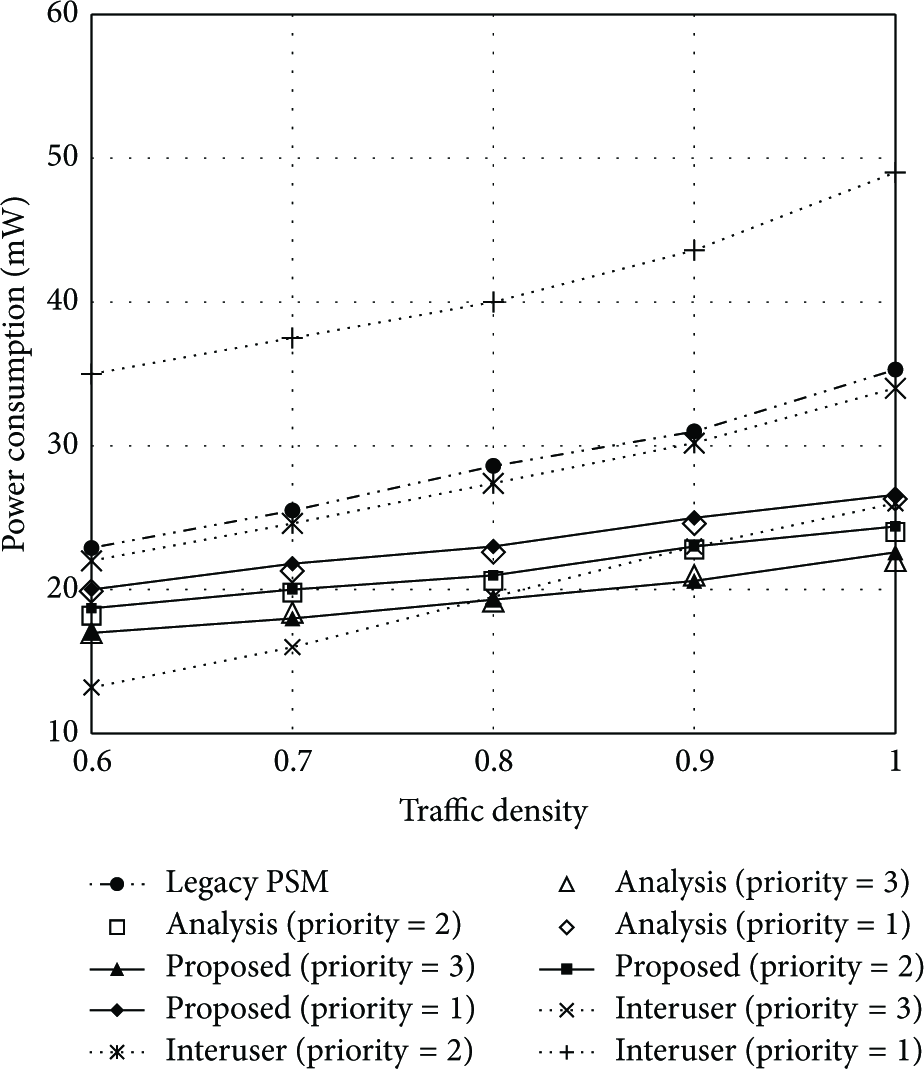
Power consumption versus traffic density.
Figure 8 depicts the delay of the three methods, that is, the legacy PSM, interuser QoS, and our proposed scheme, while varying the traffic density. One can see that, in a low density situation, the interuser QoS scheme performs much better than the other methods. However, as the traffic density increases, the contentions among nodes increase seriously, and the performances of both the legacy PSM and interuser QoS scheme degrade. Since the proposed method is a scheduling based scheme, the network load does not affect the performance much. The legacy PSM and interuser QoS suffer from high delays in a heavy load situation because both methods cause the backoff delay and retransmission delay. We find that our proposed scheme enables nodes belonging to different groups to have different delays; that is, the delay of a sensor node with a high priority is lower than that of the node with a low priority.

Delay versus traffic density.
Another simulation is performed to study how the position of a scheduled SP affects the performance of proposed scheme, in comparison with analytical results. We use the simulation scenario given in [6]. Downlink streams are set up from AP to three PSM nodes with different priorities, and the positions of the scheduled SPs within a beacon period are varied. We find from Figure 9 that the simulation result matches the analysis result quite well. The delay grows as the scheduled position moves toward back, and a node with a high priority has a low delay. The simulation results validate the analytic model developed in the previous section.

Queue buffer delay.
6. Conclusions
We have designed a prioritized reservation scheme for enhancing the performance of the IEEE 802.11 PSM. By rescheduling the wakeup BIs of PSM nodes, the number of contending nodes during each BI can be averaged. As the PSM nodes can reserve SPs for retrieving the buffered traffic by PS-Poll frames, the overhead caused by the inefficient PS-Poll mechanism of the legacy PSM is reduced. Moreover, a prioritized scheduling method with consideration of fairness is adopted to arrange the orders of allocated SPs, and thus the nodes with a high priority can retrieve their traffic earlier than the low priority nodes, while the low priority nodes allocated their own channel access time. Compared to the scheduled scheme in [6], our proposed method allows the node really active in current BI to reserve channel, which avoids long period of empty channel. And compared to the power saving strategy proposed in [8], our scheme eliminates the power consumed in idle channel and channel contentions by channel reservation, which can save power more efficiently. Also compared to the interuser QoS scheme [9], our scheme let each node retrieve the traffic at their allocated time slot. This solution enables a low-priority node to stay in sleep state while other nodes retrieve traffic, which can save the power consumption of the node. Using analytic models and discrete simulations, we can conclude that our proposed scheme effectively reduces power consumptions while supporting the nodes’ priorities and outperforms both the legacy PSM and other power saving protocols.
Footnotes
Conflict of Interests
The authors declare that there is no conflict of interests regarding the publication of this paper.
Acknowledgments
This work was supported by Basic Science Research Program through the National Research Foundation of Korea (NRF) funded by the Ministry of Education, Science and Technology (2013008855) and in part by the Research Grant of Kwangwoon University in 2014.