




Abstract
Cognitive radio has emerged as a promising solution to address the problems posed by coming spectrum scarcity for the inherently resource-constrained sensor networks. Reliability and energy consumption are key objectives for spectrum sensing in cognitive sensor networks. In this paper, a fast differential evolution algorithm is proposed to optimize the energy consumption and spectrum sensing performance jointly. By constructing a comprehensive performance metric, the joint optimization is transferred to a multiobjective optimal problem, in which the sleeping schedule and censoring mechanism are taken into consideration. The main objective of the proposed algorithm is to minimize the network energy consumption subjected to constraints on the detection performance by optimally deriving the censoring and sleeping probabilities. To accelerate the convergence speed and maintain the diversity, the algorithm utilizes the advantages of opposite-based learning for generating the initial population and a tournament scheme in mutation step. In the crossover step, a control parameters dynamic adjustment scheme is applied to make a trade-off between exploration and exploitation. Finally, a selection mechanism is introduced for generating a well-distributed Pareto optimal front. The simulation results show that the proposed algorithm can reduce the average energy consumption of cognitive sensor node, while improving the global probability of spectrum sensing.
1. Introduction
Wireless Sensor Network (WSN), as an important information acquisition technology, is a basic method to realize the fusion of physical world and information world [1–3]. However, the traditional fixed spectrum allocation cannot be able to meet the rapid development of wireless sensor network. A number of spectrum measurements [4–6] have shown that licensed spectra are underutilized and there exist spectrum portions unused over space and time. Therefore, to improve the utilization of such spectrum portions, dynamic spectrum access models based on cognitive radio have been proposed recently [7, 8]. Cognitive radio technology makes secondary users able to access the vacant spectrum with limiting harmful interference to licensed primary users. To avoid causing interference to primary users, spectrum sensing is employed to determine whether the channels are vacant or not. Therefore, reliable spectrum sensing for the determination of vacant channels is a critical problem.
Incorporating cognitive radio technology into wireless sensor network yields the cognitive radio sensor network. By dynamically changing operating parameters, the cognitive radio sensor node could sense the vacant spectrum and makes use of these available spectra in an opportunistic manner to improve the overall spectrum utilization [9, 10]. Spectrum sensing technology plays an important role to improve the reliability for the determination of vacant channels. Nevertheless, wireless communication, characterized by multipath fading and adjacent channel interference, may be greatly influenced by surrounding environment. What is more, as for the communication and processing resource-constraint of sensor nodes, the stand-alone spectrum sensing by using the traditional approaches, such as matched filtering, energy sensing, and feature detection, may not be reliable.
Based on the traditional spectrum sensing approaches, a variety of cooperative spectrum sensing technologies have been proposed for improving the spectrum sensing performance in cognitive radio sensor network. For example, a consensus scheme between the secondary users has been introduced to design an optimal sensing selection mechanism to improve the performance by predicting the primary users' action [11]. In [12], an efficient one-bit decision based on three-phase spatiotemporal sensing algorithm, which is suitable for large-scale distributed wireless sensor network, is proposed by sensing vacant spectrum in both time and space domain. Similarly, a parallel cooperative spectrum sensing mechanism is proposed to maximize the throughout of data [13].
Nevertheless, many existing research efforts on improving the spectrum efficiency neglect the energy-constraint of cognitive wireless sensor nodes. The increasing energy consumption will reduce the lifetime of sensor node. Therefore, a distributed spectrum-aware clustering mechanism is proposed in [14], which can reduce the energy consumption by optimizing the number of clusters. Based on the censoring scheme, [15] proposed a cooperative spectrum sensing scheme by utilizing a Takagi-Sugeno fuzzy inference system to make a decision about the presence of primary users. These methods save the energy by reducing the information transmission.
Works presented in [16–18] make further efforts to optimize the energy efficiency by combining sleeping schedule. However, the decreasing energy consumption may degrade spectrum sensing performance and directly affects the accuracy of spectrum decision.
In this paper, we consider the energy-efficient optimization for cooperative spectrum sensing in cognitive radio sensor network with a combination of sleeping schedule and censoring scheme. The objective is to minimize the energy consumption for spectrum sensing as well as guaranteeing the performance. The optimization problem is formulated as a multiobjective optimization problem by analyzing the global probability of spectrum sensing and the global probability of false alarm. Typically, multiobjective optimization problem is often converted to a single-objective optimization problem [19, 20] by predefining weighting factors for different objectives, describing the relative importance of each objective. However, the optimal solution of a multiobjective optimization problem is generally a set of optimal solutions (largely known as Pareto optimal solutions), which is not the same as in single-objective optimization. If a classical optimization method is used for finding the solutions, it may take much time to converge and may not converge to optimal solutions [21].
During the past decade, evolutionary algorithm has gained popularity in solving difficult multiobjective optimization problem since it is capable of dealing with objective functions, which are not mathematically well behaving, being, for example, discontinuous, nonconvex, multimodal, and nondifferentiable [22–25]. Differential evolution (DE) algorithm, introduced by Storn and Price in 1997, is one of the most popular evolutionary algorithms [26] and may be used in a wide variety of highly nonlinear and complex optimization problems. This algorithm is simply structured and is easy to use, while demonstrating great robustness and fast convergence in solving single-objective global optimization problems [27, 28]. Recently, there are several attempts to extend the DE to solve multiobjective problems [29, 30], with superior performance to other multiobjective algorithms widely reported and verified [31].
Based on the aforementioned discussion, a fast multiobjective differential evolution algorithm is proposed to solve the multiobjective optimization problem formulated in this paper. Different from classical DE, this proposed algorithm applies an opposition-based learning technique for population initialization operation. Opposition numbers are used to improve the exploration and convergence capabilities of the optimization process. Besides, the performance of the DE algorithm is highly dependent on the control parameters. Therefore, to further accelerate the convergence rate without losing solution diversity on the Pareto front, this paper introduces a tournament scheme in mutation step and a control parameters dynamic adjustment scheme in crossover step. Finally, a selection mechanism is introduced for generating a well-distributed Pareto optimal front.
The remainder of the paper is organized as follows. In Section 2, the cooperative spectrum sensing system model and optimization problem are presented to incorporate the sleeping schedule and censoring scheme. In Section 3, the optimization problem is analyzed and a fast multiobjective differential evolution algorithm is proposed to solve it. A comprehensive performance evaluation is given in Section 4 to show the performance of the proposed algorithm. Section 5 gives conclusion and future work.
2. System Model and Problem Formulation
We consider a cognitive radio sensor network that shares a common frequency band with primary users. This paper is of interest to formulate the energy-efficient cooperative spectrum sensing as a multiobjective optimization problem. In this section, we present the models for cooperative spectrum sensing energy-efficient optimization in cognitive radio sensor network to analyze sensing performance and the energy consumption including spectrum sensing model and global sensing model.
2.1. Spectrum Sensing Model
As shown in Figure 1, we consider a cognitive radio sensor network with a fusion center and N cognitive sensor nodes. Each node senses the licensed spectrum by energy sensing and then makes its own local decision for the spectrum utilization and sends the decision to the fusion center. The fusion center collects these local decisions using a certain rule and makes the final decision [32, 33]. The fusion can be soft fusion or hard fusion [34]. We pay attention to hard fusion because hard fusion scheme only needs to send one bit per decision. This mechanism can save the energy consumption for transmission. The fusion center receives the results from sensor nodes and makes the final decision that will be sent back to the sensor nodes.

The network structure of cooperative spectrum sensing.
The local decision made by cognitive sensor node can be regarded as a binary decision between 0 and 1, where 0 denotes that the spectrum is available to secondary nodes and 1 represents otherwise. Cognitive sensor node senses the licensed spectrum under binary hypotheses


Afterwards a censoring policy is employed at each sensor node [35]. The censoring thresholds

In the real environment, for each cognitive sensor node, the average received signal-to-noise ratio (SNR) is different. Therefore, it is difficult to design the system parameter. For analytical tractability, we assume that the received signal-to-noise ratio (SNR) at each radio is the same, denoted by γ. It is reasonable that the probability of spectrum sensing


2.2. Global Spectrum Sensing Model
For the purpose of minimizing energy consumption, we integrate sleeping schedule and censoring scheme into cooperative spectrum sensing. The status of each cognitive sensor node is determined by two schemes: (1) a sleeping schedule scheme determines whether or not the node is awake and (2) a censoring scheme determines whether or not it transmits its local decision to fusion center. The sleeping rate, that is, the probability that a node is turned off, is denoted by μ. It means that only part of nodes sense the primary spectrum and the others will turn into the sleeping state with low energy consumption. Correspondingly, denote ρ to be the censoring rate, that is, the probability which is adopted to filter those less-than-ideal decisions for reducing unnecessary data transmission. Sensor nodes, which are not in the sleeping state, sense the channel signal energy at the specialized time slot and make a local decision for the spectrum occupancy. The local decision can be regarded as a binary decision between 0 and 1, where 0 denotes that the spectrum is available to secondary nodes and 1 represents the opposite. In the end, the local decision will be sent to the fusion center.
The reported local decisions are combined at the FC and the final decision regarding the presence or absence of the primary user is made according to a certain fusion rule. However, several fusion schemes have been proposed in literature [37–39]. We consider a hard fusion scheme due to its improved energy and bandwidth efficiency. Among them, the OR and AND rules have been studied extensively in literature [40–42], since these rules are easily implementable by simple logics. And [42] shows that the OR rule outperforms the AND rule in terms of energy efficiency; thus, we employ the OR rule to combine the local binary decisions sent to the FC which makes a final decision denoted by


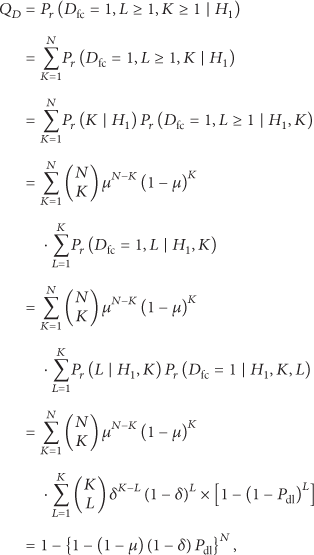
In a similar way, the global probability of spectrum sensing can be derived as
2.3. The Energy Consumption and Multiobjective Optimization
In the process of spectrum sensing, the energy consumption of sensor node mainly includes spectrum sensing and data transmission. For the entire cognitive radio sensor network, the average energy consumption is given by

We describe the probability that the spectrum is available as

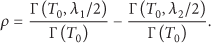
In order to guarantee the spectrum sensing performance, our main objective is to optimize the global probability of spectrum sensing and the global probability of false alarm. In practice, it is desirable to have the global probability of spectrum sensing close to zero and the global probability of false alarm close to unity. In such cases, the spectrum can be fully utilized and will not cause interference to the primary user. Nevertheless, it is difficult to balance the energy consumption and global sensing performance. Therefore a joint optimization of energy consumption, global probability of false alarm, and spectrum sensing is built to balance the energy consumption and sensing performance. This multiobjective joint optimization problem can be described as follows:

3. Proposed Algorithm
In this section, we first illustrate the relationship between the Pareto solutions and the multiobjective optimization and then provide a fast multiobjective differential evolution algorithm to solve the multiobjective optimization problem. To accelerate the convergence rate and maintain the diversity, a dynamical adjustment scheme with a crossover parameter and a new population selection scheme based on the concept of Pareto optimum solutions are proposed, which could minimize the energy consumption under the performance constraint.
3.1. Multiobjective Optimization and Pareto Solutions
The traditional single objective optimization problem is to seek the optimal solution for a certain objective. The mathematical description can be described as follows:

However, for the multiobjective optimization problem, the objective function will no longer be a scalar function, but a multidimensional vector. It is Assumed that the multiobjective optimization problem has n decision variables and m objective functions, it can be expressed as follows:

Definition 1 (feasible solution).
Assuming that a certain solution
Definition 2 (feasible solution set).
The collection which consists of all the feasible solutions is defined as a feasible solution set
Definition 3 (Pareto dominance).
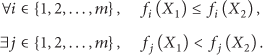
If two feasible solutions
Definition 4 (Pareto optimal solution).
If the feasible solution X satisfies 18, then X is the Pareto optimal solution. Consider

Definition 5 (Pareto optimal solution set).
All the Pareto optimal solutions compose the Pareto optimal solution set. It can be defined as

Definition 6 (Pareto front).
The Pareto front

3.2. Differential Evolution Algorithm
Differential evolution (DE) algorithm is a kind of effective stochastic parameter optimization algorithm [26]. Like other evolution algorithms, the differential evolution algorithm is population based evolution search strategy. For the purpose of reducing the algorithm complexity and improving its practicability, this algorithm is different in some respects, such as real-number encoding, simple differential mutation, and the tournament scheme. Differential Evolution is a parallel direct search method which utilizes P D-dimensional parameter vectors as a population for each generation G. The parameter P does not change during the minimization process.
The initial vector population is chosen randomly and must cover the entire parameter space. As a rule, the initial population should be a uniform probability distribution. By adding the weighted difference between two population vectors to the third vector, the differential evolution algorithm generates a new parameter vector. This operation is called mutation. The mutated vector's parameter then is mixed with the parameters of another predetermined target vector to yield the trial vector. This operation is called crossover.
Finally, comparing the value of the trial vector and the target vector, the vector that yields a lower cost function is chosen to replace the target vector in the following generation. This last operation is called selection.
The process can be described as follows.
3.2.1. Initial Population Vector
The initial parameter vector, which follows the uniform probability distribution, is chosen randomly from the entire parameter space. We denote the parameter as
3.2.2. Mutation
For each target vector

3.2.3. Crossover
In order to increase the diversity of the perturbed parameter vectors, crossover is introduced. The crossover operation is used to generate new solutions by shuffling competing vectors, and it can also increase the diversity of the population. The main objective is to generate the trial vector as follows:


Illustration of the crossover process for
3.2.4. Selection
To make a decision for whether or not it should become a member of generation
3.3. Fast Multiobjective Differential Evolution Algorithm
There are some limitations for using the traditional differential evolution algorithm directly to solve the multiobjective optimization problem. Therefore, we need to improve the convergence speed and maintain the diversity.
As mentioned above, the differential evolutionary optimization method starts with the initial population and tries to improve them toward some optimal solutions. The computation time is related to the distance of these initial random solutions from the optimal solutions. We can improve our chance of starting with a fitter solution by simultaneously computing its opposite solution. In fact, according to probability theory, an individual will be further from the solution than its opposite individual 50% probability. Therefore, starting with the closer of the two guesses has the potential to accelerate convergence. The same approach can be applied not only to initial solutions, but also continuously to each solution in the current population [44]. As introduced in [45], the opposite point has a straightforward definition as follows.
Definition 7 (opposite number).
Let

Similarly, the definition is generalized to higher dimensions as follows.
Definition 8 (opposite point).
Let

Opposition-Based Optimization. Let variable
From the above analysis in Section 3.1, we need to solve the multiobjective optimization problem with three objective functions
3.3.1. Initial Population Vector
In the case of no prior knowledge, initial population vector is generated according to the uniform random distribution. In order to accelerate the convergence and optimize the solutions, we take advantage of the opposition-based learning for initializing the population considering stochastic and opposite solutions simultaneously. By utilizing opposite-based learning, we can obtain fitter starting candidate solutions even when there is no a priori knowledge about the solution. The procedure of opposition-based initialization is presented as the following steps.
Initialize the population P randomly. Calculate opposite population Select the

3.3.2. Mutation
In the traditional differential evolution algorithm, the base vector

3.3.3. Crossover
The target of the crossover is to generate the trial vector. Crossover operation is to find a better solution and maintain the diversity by exchanging components of the target vector and the mutant vector to diversify the current population by constant updating and exploring. For traditional binomial crossover process, the crossover parameter

3.3.4. Selection
The careful selection of candidate solutions facilitates the generation of a good Pareto front. In the selection process, we used a similar selection mechanism and the entropy crowding technique proposed in [43] to generate the next generation. The selection mechanism uses two populations for the selection process in each generation. They are the current population with If the trial vector is dominated by a member(s) of advanced population, the trial vector is rejected. If the trial vector dominates some member(s) of the advanced population, then the dominated members are deleted from advanced population and the trial vector enters advanced population. The trial vector does not dominate any members and none of the advanced population member dominates the trial vector, which implies that the trial vector belongs to the Pareto front and it enters the archive.
In order to have a good diversity among generated nondominated solutions in the advanced population of fixed size, the crowding entropy [43] is utilized to evaluate the crowding degree around each nondominated solution. The procedure of the proposed algorithm is described as follows.
Step 1 (initial population operation).
Set the generation number
Step 2.
Generate the opposite individual
Step 3.
Select the
Step 4.
While the maximum number of generations
Step 5 (mutation operation).
Calculate
Step 6 (crossover operation).
Generate a trial vector
Step 7 (selection operation).
Evaluate the trial vector
If
If
If
Step 8.
When
Step 9.
Consider
3.4. Computational Complexity Analysis
We consider the complexity of one iteration of the entire algorithm. Basic operations and their worst case complexities are as follows.
To select the To check tournament best of three solutions for mutation operation for one iteration, the complexity is To check the domination status of new solution with target solution for one iteration: To select of
Therefore, the overall complexity is
4. Performance Evaluation
In this section, we present numerical simulations to demonstrate the effectiveness of the proposed fast multiobjective differential evolution algorithm. A cluster is formed by several cognitive sensor nodes to sense the vacant spectrum cooperatively and the cluster head is designed as the fusion center. In order to compute the sensing energy
The energy consumption for spectrum sensing mainly includes two parts: channel monitoring to make decision and processing the signal to be sent to fusion center. The first part depends on the spectrum sensing time. We assume the sampling times
In order to demonstrate the performance of the proposed fast multiobjective differential evolution (FMODE) algorithm, we evaluate the performance of the optimization algorithm using convergence and diversity metrics. Comparisons with widely used multiobjective evolutionary algorithms NSGA-II, DE, and ODE are shown to verify the efficiency and effectiveness of the proposed algorithm. For all conducted experiments, parameter settings have been chosen according to reported setting in the previous literature [46]. That is, the population size
4.1. Convergence and Diversity
There are three goals in a multiobjective optimization: (1) convergence to the Pareto optimal set, (2) maintenance of diversity in solutions of the Pareto optimal set, and (3) maximal distribution bound of the Pareto optimal set. In order to evaluate the performance of the proposed fast multiobjective differential evolution algorithm, we define the convergence criteria and diversity criteria.
In convergence metric, we use the generational distance, which is introduced in [47], to evaluate the convergence criteria. The generational distance is used to measure how far the elements are in the set of nondominated vectors found so far from those in the Pareto optimal set. It is defined as

In diversity metric, the diffusion range between the nondominated solutions, this value implies the extent of spread between the Pareto optimal solutions. A smaller value indicates a better distribution and diversity of nondominated solutions. Pareto optimal solution set is uniformly distributed when this value is 0. We define the diversity criteria introduced in [47] as follows:

In order to know how competitive the proposed approach is, we compare the differential evolution algorithms by convergence and diversity metrics. Figure 3 presents the comparison of the convergence metric. It shows that FMODE obtains better values for the convergence metric than the other three algorithms. This means that the resulting Pareto fronts from FMODE are closer to the optimal Pareto fronts than those computed by NSGA-II, DE, and ODE. This supports that the convergence performance of the FMODE is superior to that of the three other algorithms. ODE obtains a competitive result compared to NSGA-II and DE. The reason is that opposition numbers are used to improve the exploration and convergence performance of the optimization process for both FMODE and ODE. Besides, a tournament scheme is utilized in mutation operation to accelerate the convergence.

Comparison of the convergence metric.
Figure 4 illustrates the comparison of diversity metric for different algorithms. It shows that the diversity metric of fast multiobjective differential evolution algorithm is lower than the traditional differential evolution algorithm which indicates a better distribution and diversity of nondominated solutions. NSGA-II obtains competitive results to DE and ODE. That is because a diversity preservation method based on crowding distance is adopted in the selection operation of ODE, and a crowding entropy diversity measure tactic is proposed to preserve the diversity of Pareto optimality in FMODE.

Comparison of the diversity metric.
4.2. Energy Consumption
As it is shown from Figure 5, for the spectrum sensing with no optimization, the energy consumption increases rapidly with the number of cognitive sensor nodes. All of the four differential evolution algorithms could obtain more stable energy consumption with sleeping schedule and censoring scheme integrated. And the proposed algorithm can implement lower energy consumption than the other compared algorithms.

Comparison of the energy consumption.
4.3. The Global Probabilities of Spectrum Sensing and False Alarm
Figures 6 and 7 present the comparison of the global probabilities of spectrum sensing and false alarm. It shows that in both Figures 6 and 7 the global probabilities of spectrum sensing and false alarm are at a relatively ideal region. With the increase of cognitive sensor nodes, the global probability of spectrum sensing will increase, and the global probability of false alarm will reduce. It is different from the traditional ad Hoc scenario. The reason is that the network may be modeled in terms of clusters in an ad Hoc scenario. Each cluster may have its particular decision process. Using this, the average decision of each cluster may be combined to produce the net total decision in the network. Though the OR rule produces a very high

Comparison of the average global probability of spectrum sensing.

Comparison of the average global probability of false alarm.
For a reasonably large intensity, that is to say, a particular sensor is surrounded by at least 8 closest neighbors. Such a network can now be tested for effects with the logical OR rule [41]. The parameters are constant including the probability of spectrum sensing and SNR in the sampling time
Likewise, we can also come to a conclusion that both the global probability of spectrum sensing and the global probability of false alarm increase slowly with the increase of cognitive sensor nodes. The reason is that the number of sleeping nodes and censoring information increase at the same time. Thus, the sensing performance changes slower. From the results obtained from Figures 6 and 7, it is observed that the global spectrum sensing performance and the global probability of false alarm are better than NSGA-II, DE, and ODE to balance the sensing performance and energy consumption.
5. Conclusion
In this paper, we investigated the problem of how to balance sensing performance and energy consumption. With sleeping schedule and censoring scheme integrated, we formulated the energy-efficient cooperative spectrum sensing as a multiobjective optimization problem to derive the optimum sleeping and censoring probabilities. Based on the traditional differential evolution algorithm, we applied the opposition-based learning to initial the population and introduced a tournament scheme in the mutation operation. In order to converge faster and maintain the diversity, we proposed a control parameters dynamic adjustment scheme and a novel population selection scheme to get Pareto optimum solutions. In addition, the performance evaluation shows that the proposed fast multiobjective differential evolution algorithm can not only reduce the average node energy consumption, but also improve the global probability of spectrum sensing.
In the future, to apply the algorithm to the large-scale wireless cognitive radio sensor network and further prolong the lifetime of the network, we take the actuators into consideration. Using the actuators to collect the sensor nodes' local decision and sensing data can make this algorithm adapt to large-scale sensor network and further decreases the node's energy consumption.
Footnotes
Conflict of Interests
The authors declare that there is no conflict of interests regarding the publication of this paper.
Acknowledgment
The authors would like to acknowledge that this work was partially supported by the National Natural Science Foundation of China (Grant nos. 61379111, 61202342, 61402538, and 61403424) and Research Fund for the Doctoral Program of Higher Education of China (Grant no. 20110162110042).