




Abstract
A cognitive radio based hybrid data-type clustering (CR-HDC) algorithm is proposed to maximize network energy efficiency of cognitive radio (CR) sensor networks (CRSNs). By analyzing the overall energy consumption of CRSNs under various conditions, the optimal transmission range of a sensor node can be obtained for both when spectrum handoff (SHO) is applied and when it is not. Simulation results show that CR-HDC achieves performance enhancements in terms of network lifetime and the number of packets received at the base station (BS) compared to when applying the centralized low energy adaptive clustering hierarchy (LEACH-C) or hybrid data-type clustering (HDC) to CRSN environments.
1. Introduction
In internet of things (IoT) networks, all IoT devices are connected to the Internet and can be accessed anytime and anywhere [1]. One of the major challenges of IoT support is lack of radio spectrum that can be allocated to the massive number of IoT devices. IoT wireless networks generally operate in the unlicensed Industrial, Scientific, and Medical (ISM) bands, which are also used by various other networks. There is an intense competition for spectrum access among IoT networks, which include various overlapped ISM band wireless protocols (e.g., Wi-Fi, ZigBee, and Bluetooth). Cognitive radio (CR) sensor networks (CRSNs) [2–7] are envisioned to support various IoT networks. In particular, CR related standards such as the IEEE 802.22 Wireless Regional Area Network (WRAN) [8], IEEE 802.11af Wi-Fi over TV white-space (TVWS), and WhiteFi [9] enable CR devices to communicate locally in the same TVWS. CRSNs are a promising solution for dynamic channel access, reducing power consumption, and overlaid deployments in large-scale sensor networks that wirelessly communicate for mission-cooperation and transmit sensed data to base stations (BSs). In a CRSN, licensed wireless users act as primary users (PUs) using assigned channels to support mobile services with priority. On the contrary, each sensor node (which uses CR transmission) has the role of a secondary user (SU) that can attempt to transmit over a channel only if it is not used by a PU. When an incoming PU is assigned to a channel that is being used by an SU, the SU needs to quickly move to an empty channel before the PU begins transmission, which is called spectrum handoff (SHO).
CRSNs commonly employ optimized clustering and routing algorithms and data aggregation techniques to extend the network's lifetime. CRSNs commonly consist of hundreds or thousands of small multifunctional devices and sensors (that are commonly battery-operated) to monitor environmental conditions periodically (e.g., humidity, temperature, and illumination). In order to manage various sensors efficiently and transfer data from each sensor to a data collecting BS, there are various well-known clustering protocols which concern cluster size optimization and focus on maximization of network lifetime in sensor networks [10–12]. In particular, a hybrid data-type clustering (HDC) algorithm is proposed to maximize network lifetime and support various data packet types [13], while the other algorithms only consider homogeneous data-type transmissions.
In a CRSN, sensor nodes communicate through CR technology and form clusters to report sensed data to the clusterheads (CHs). Figure 1 presents a cluster-based CRSN where licensed mobile users are the PUs while cluster members (CMs) transmitting data to their CHs are SUs. Existing research on clustering in CRSNs has only investigated intracluster channel assignment schemes [14–16]. Moreover these papers do not consider channel blocking and forced termination events of SUs as well as the characteristics of heterogeneous sensor data types, which have different data aggregation ratios. In realistic CRSNs, nodes have diverse types of sensed data and experience blocking and forced termination events. In addition, researches on SHO are on flat (i.e., nonhierarchical) CR networks [17–19] and do not consider SHO support in cluster-based CRSNs. However, for scalable control and management of large-scale CRSNs, clustering is essential. In addition, a scheme that can efficiently support various sensor data types (which include basic sensor data types, encrypted/nonencrypted data, sensor images, and streaming video) is needed. Therefore, in this paper, a CR based hybrid data-type clustering (CR-HDC) algorithm is proposed by calculating the optimal transmission range of each node (which supports multihop transmission) to maximize the network lifetime of the CRSN. The CR-HDC considers a given sensed data type and its corresponding data aggregation ratio, blocking and forced termination probabilities (which are common to all CR systems), and also whether the node supports SHO or not.
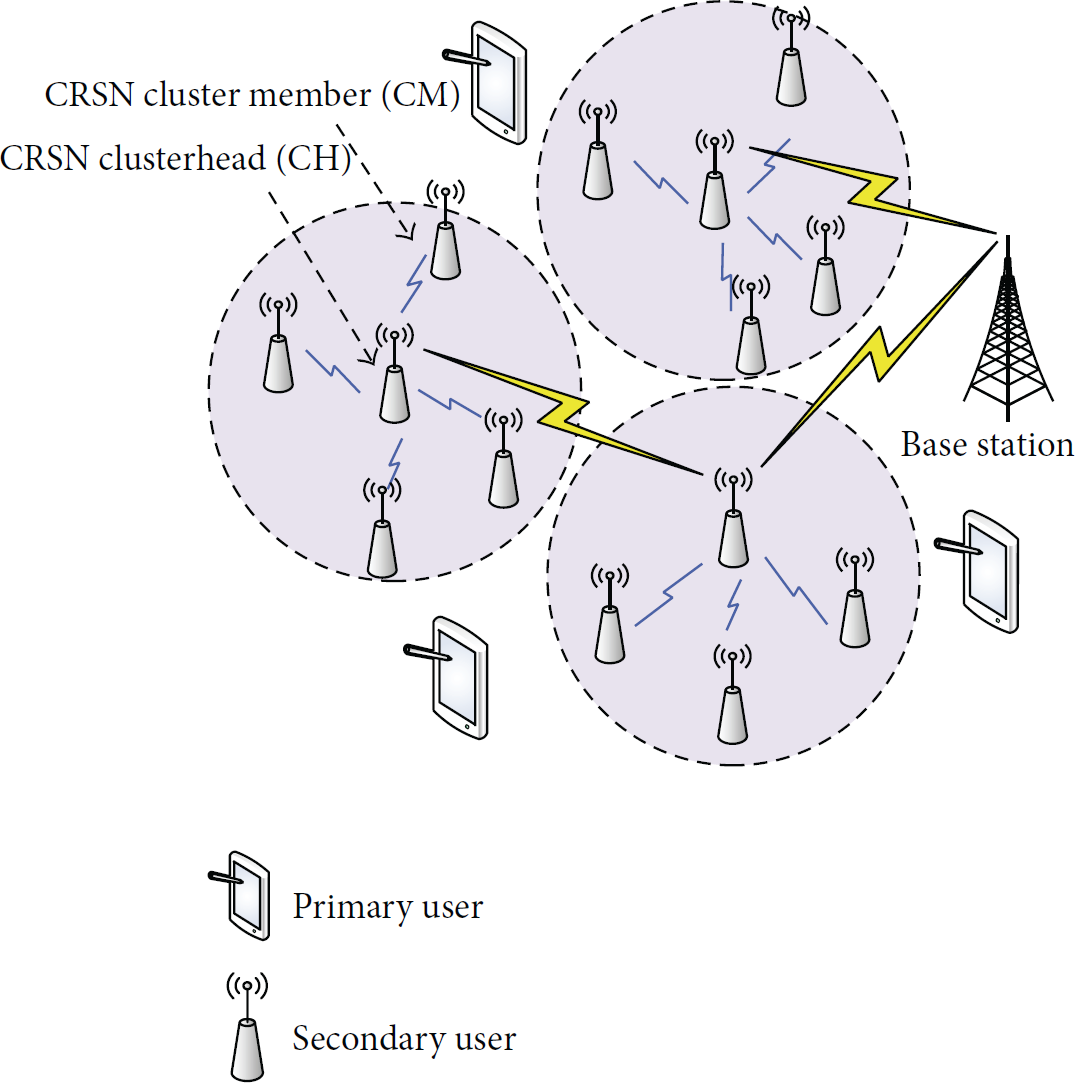
A cluster-based CRSN.
The original contributions of this paper can be summarized as follows.
The proposed CR-HDC scheme can support various sensor data types considering data aggregation. The proposed CR-HDC scheme can analyze blocking probability and forced termination probability in realistic CRSNs whether the node supports SHO or not. The proposed CR-HDC scheme maximizes the lifetime of sensor nodes in a multihop clustering CRSN.
2. System Model
2.1. Network Model
In the proposed cluster-based CRSN, the MAC frame structure employs the IEEE 802.22 standard frame [20, 21] as shown in Figure 2. IEEE 802.22 supports a Time Division Duplex (TDD) frame structure where each frame consists of a downstream (DS) subframe and an upstream (US) subframe. The number of slots in an US subframe is composed of

The frame structure.
If SHO is allowed, the preempted CM can move immediately to an idle channel, if available. This reallocation of spectrum can be carried out in a centralized or distributed manner. Therefore, if the cluster-based CR network system can perform SHO, then the forced termination probability would decrease considerably.
2.2. Energy Consumption Model for CRSN
Nodes in a CRSN (which are commonly equipped with a battery) will need to consume energy to operate their radio modules and time amplifier when sending data via the transmitter and to run the radio electronic circuit when receiving packets from another node. The energy consumption model follows the radio model used in [13] to transmit and receive a packet and aggregate packets received from CMs.
In the data transmission phase, the CH receives an L-slot message from each CM and then performs data aggregation and sends its compressed sensing data to the BS through a multihop path. The data aggregation degree is variable for different sensing data types, where the average data aggregation ratio is defined as A (i.e.,
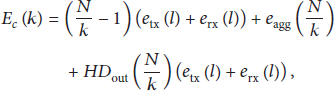
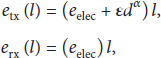
The overall network energy consumption is derived by multiplying the number of clusters to the energy consumed in the cluster

By equating the derivative of
2.3. Channel Behavior Model for CRSN
In a CRSN, active CMs can use the channels not occupied by PUs. Thus it is important for the CH to monitor the channel condition. The channel transition probability that the channel will be idle or busy can be obtained by deriving the steady state probabilities of the Markov model for channels, which are presented in Figure 3 [7]. It is assumed that the transition probabilities are equal for all M channels (i.e.,



A two-state Markov model for channel m (
3. Optimization of Cluster-Based CRSN with Spectrum Handoff
3.1. Cluster-Based CRSN without SHO
All data packets of the CMs are assumed to be the same size and use L slots, where some sensor data types may be divided into multiple packets. If the CH detects the channel as idle state in the channel assignment slot, the channel is considered as an available channel for CM sensors. Then, the CH receives all the request messages from the active CMs and carries out channel assignment. If the channel is assigned to an active CM, the CM will start transmission in the next time slot. However, if the number of active CMs is larger than the number of available channels, the CH needs to select CMs based on the number of available channels. In this paper, it is assumed that the probability to choose one of the active CMs is identical and independent. Blocking occurs when the number of active CM sensors is larger than the number of idle channels. Therefore, the blocking probability is the rate of the number of active CM sensors who fail to access the channel to the number of all active CM sensors in a cluster. In other words, the blocking probability is defined as the probability that an active node cannot transmit due to the channels being in full usage. The blocking probability
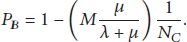
The forced termination probability is derived in (7), where the connection of a CM that transmits a packet for l slots is forced to prematurely terminate transmission due to the detection of a PU:

The probability that a CM can successfully transmit a packet is identical to the probability that the selected channel remains in idle state for L consecutive time slots. In other words, a nonblocked active CM does not experience forced termination for L time slots. The probability that the selected CMs (without SHO) can successfully transmit a packet is presented in

3.2. Cluster-Based CRSN with SHO
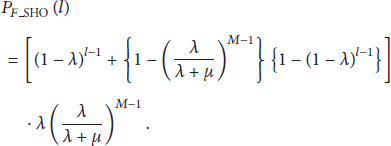
In a system where SHO is allowed, even if a PU arrives at a channel during a CM transmission, the CM can migrate to one of the other idle channels, assuming an idle channel exists. The forced termination of a CM using SHO occurs when the CM sensor which needs to transmit a packet for l slots is forced to prematurely stop transmission due to an arriving PU and there is no other available channel to conduct SHO to. The forced termination probability of the system with SHO is presented in the following equation:
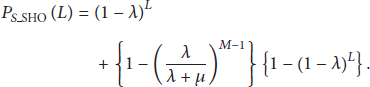
The successful transmission probability of a CM increases significantly due to SHO. The successful transmission probability of a CM in a CRSN supporting SHO is presented in
3.3. CR-HDC Optimization
In cluster-based networks, all nodes send their packets to the BS (i.e., CRSN coordinator node), which include the information of their location, residual energy, and sensing data type. After all information is received, the BS predicts the overall network energy consumption
In [10], the expected energy consumption for a CM is presented (i.e., (5) of [10]). However, because the scheme in [10] does not consider any CRSN characteristics and SHO, the energy model cannot be used in the comparison. For the CR-HDC, the expected energy consumptions for transmitting and receiving a packet are expressed in (11) and (12), respectively:
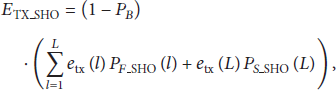

For a CRSN without SHO, the expected energy consumptions for transmitting and receiving a packet are (13) and (14), respectively:


From (1), (11), and (12), the total energy dissipation of a CRSN depends on the number of CM sensors in a cluster. In addition, the number of CM sensors in a cluster is dependent on the radius of a cluster. The larger the radius of a cluster is, the higher the probability that more CMs will exist in a cluster. It is assumed that the energy consumption of the channel assignment request packet from the CM and the reply packet from the CH are negligible. The average energy consumption of a cluster is expressed as in

To calculate the optimal transmission range, it is assumed that each cluster is nonoverlapping and a CH's cluster range is a circle with radius d. The average number of active CMs (i.e.,


In a pseudocode form, the CR-HDC algorithm can be expressed as follows:
COMPUTE
COMPUTE
COMPUTE COMPUTE
SET
COMPUTE SET
Initially, the blocking probability, forced termination probability, and successful transmission probability are calculated (Step (1)). Next, the average energy consumption in a cluster (i.e.,
To determine the optimal number of CHs among all
The transmission range to minimize energy consumption considering hybrid data-type transmission can be derived by the proposed CR-HDC algorithm. If the transmission range is reduced, the number of hops to deliver the sensed data to the BS becomes larger and the amount of energy consumption increases. On the other hand, if the transmission range is set too large, the amount of energy for transmission becomes larger and the amount of energy consumption also increases. Therefore, the optimization of transmission range is important to minimize the energy consumption. In this paper, the optimal transmission range can be derived from (15)–(17). The network lifetime also can be maximized by using the optimal transmission range.
The CR-HDC algorithm is different from HDC [13] because it considers both forced termination and blocking events as well as the effect of SHO of CR nodes. The HDC algorithm of [13] calculates the optimal number of clusters and transmission range without considering any properties of a CR, and therefore HDC is not optimal when applied to CRSNs. For cluster-based CRSNs, the proposed CR-HDC was designed to achieve an optimized minimum energy consuming cluster topology, which will be confirmed through simulation in the following section.
4. Simulation and Results
In the simulations, each sensor node uses the radio model described in [13] and two channel assignment approaches are applied, which are CR without SHO and CR with SHO. The performance of the entire CRSN is measured based on the data transmission range and the number of channels. Table 1 presents the parameter values used in the simulation experiments.
Simulation parameters.

Figure 4 shows the performance of the proposed CR-HDC scheme compared to the HDC scheme of [13] when both are applied to the same CRSN without SHO support. The simulation results of Figure 4 show the network lifetime when all nodes in the network transmit the sensed data using the HDC scheme and the proposed CR-HDC scheme. The network lifetime is defined as the time frame when all nodes in the network expire their own initial energy and cannot transmit or receive data. The result shows that the CR-HDC scheme results in a 20%~40% extended network lifetime compared to the HDC of [13]. This is because CR-HDC considers the blocking probability, forced termination probability, and successful transmission probability of CRSN nodes.
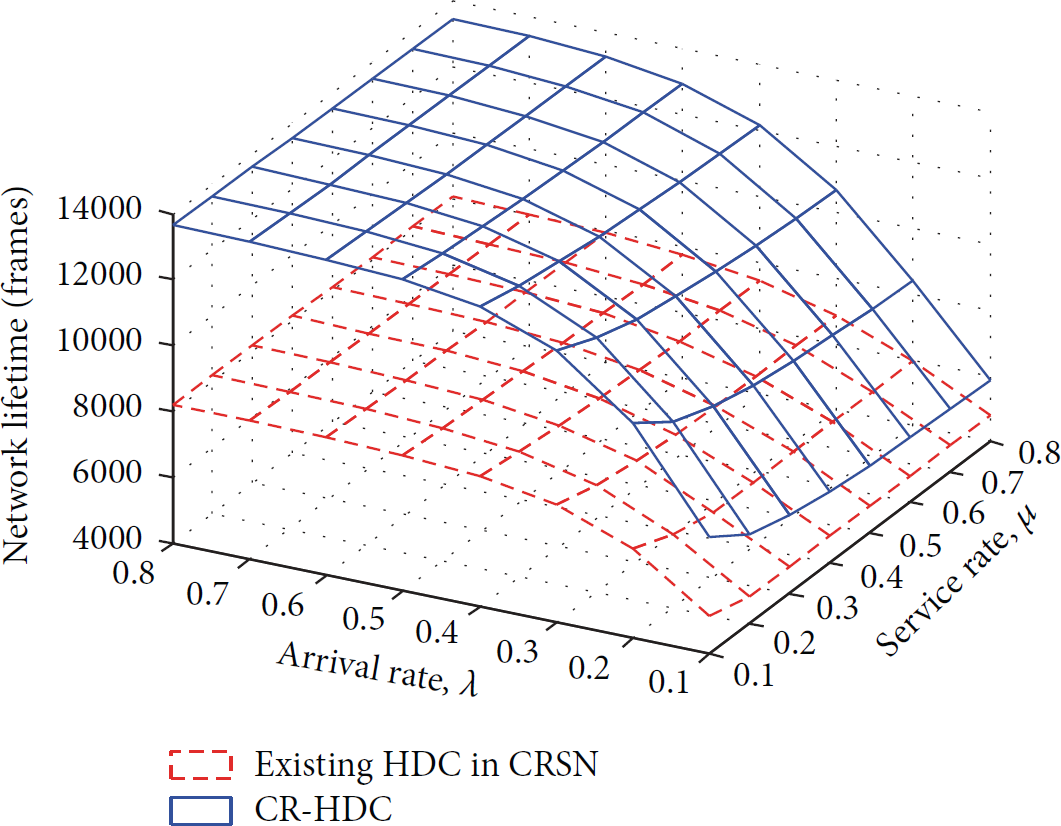
Average network lifetime of CR-HDC compared to HDC of [13] in the same CRSN.
Figure 5 presents the CRSN energy consumption per frame for different transmission ranges of a node. Energy is consumed when a node sends data, receives data, or conducts data aggregation, which is all included in the cluster formation process. By equating the derivative of

Overall network energy dissipation per frame.
Figure 6 presents the total amount of sensed data received at the BS over frames based on PU packet transmission rate λ and assuming that each node is energized by a battery and cannot send data when the battery runs out of energy. In the simulation, the data transmission performance of CR-HDC is compared with HDC of [13] and the centralized low energy adaptive clustering hierarchy (LEACH-C) [10] based on a CRSN. LEACH-C calculates the minimum energy consuming number of clusters for wireless sensor networks and is therefore one of the most important clustering schemes. Hence, many papers analyzed LEACH-C as a comparable clustering scheme [11–13]. When λ increases from 0.1 to 0.3, the CR-HDC results in a 2.59% to 22.06% and a 45.57% to 114.21% performance gain compared to HDC and LEACH-C, respectively.
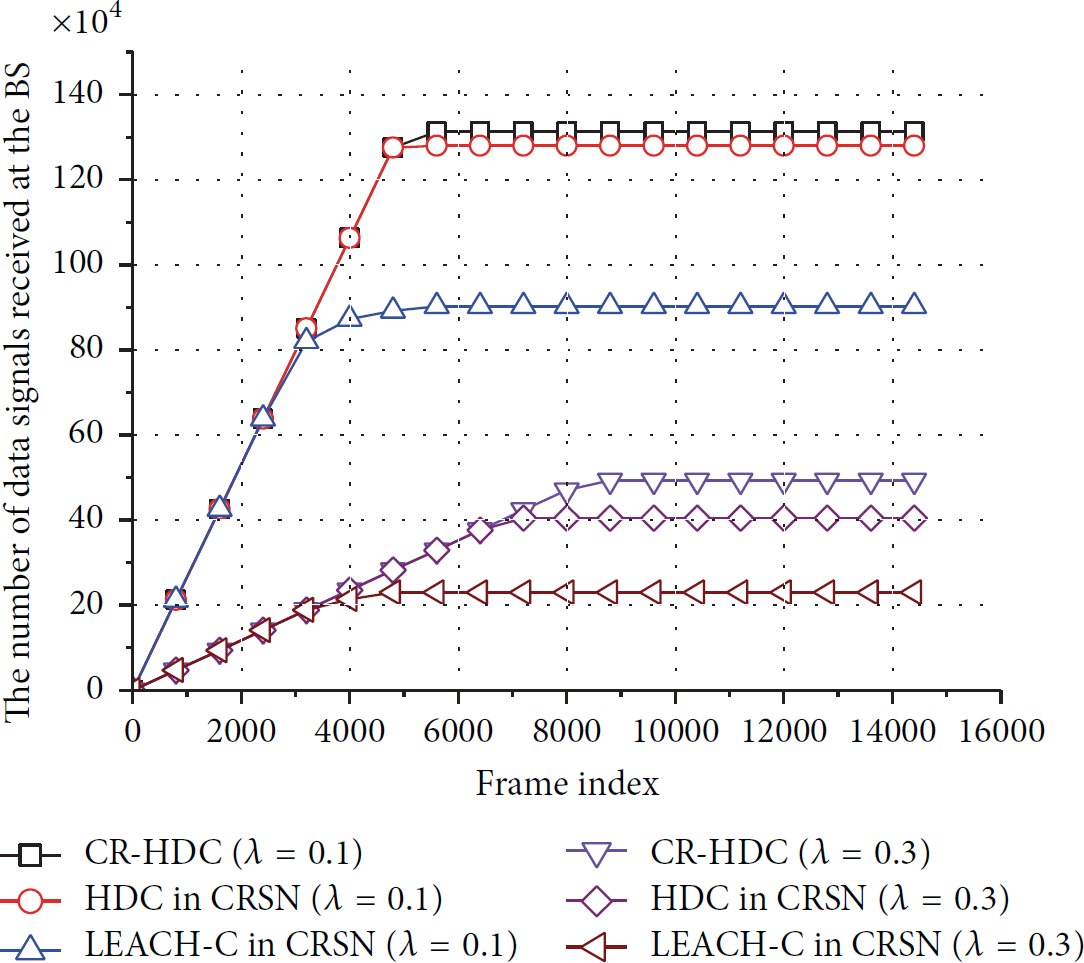
Total amount of data received at the BS over frame.
The simulation results of Figures 5 and 6 show that when the transmission range of the CH is small, then the number of CMs per cluster will be small enabling more transmission opportunities. However, if the transmission range of the CH is too small, then too many clusters will be formed and more control packets will be needed to control/manage the CRSN, which will result in a waste of energy of the CRSN. On the other hand, if the transmission range of the CH is large, the energy consumed in amplification of the RF signal for a lengthier transmission may result in a waste of energy of the CRSN. Therefore, it is important to determine the optimal data transmission range (which results in the optimal number of nodes per cluster) to maximize the CRSN's lifetime. Based on the characteristics of CR transmission, the optimal CH transmission range needs to be derived considering the influence of blocking and forced termination, which is why the proposed CR-HDC outperforms the HDC of [13] in CRSN environments.
5. Conclusion
In this paper, a method to maximize the lifetime of a CRSN based on CH (power control based) cluster formation is proposed. The proposed method incorporates the blocking and forced termination probabilities of CR nodes in determining the CH's transmission range, channel occupancy, and vacancy probabilities based on using a two-state Markov model of the channel spectrum of the CR channel. Using the proposed CR-HDC scheme, the simulation results show that the proposed CR-HDC scheme is effective in finding the optimal transmission range of a CH node to minimize energy dissipation for maximized CRSN lifetime. The simulation results show that the proposed CR-HDS will outperform the HDC of [13] in CRSN environments for a wide range of arrival and services rates, as well as for various CH transmission ranges. In future work, multiple variable optimization to maximize network lifetime and minimize forced termination probability and blocking probability in cluster-based CRSNs will be conducted.
Footnotes
Conflict of Interests
The authors declare that there is no conflict of interests regarding the publication of this paper.
Acknowledgments
This research was supported by the Ministry of Science, ICT and Future Planning (MSIP), Korea, under the Information Technology Research Center (ITRC) support program (IITP-2015-H8501-15-1007) supervised by the Institute for Information & Communications Technology Promotion (IITP), the ICT R&D program of MSIP/IITP [B0101-15-1276, Access Network Control Techniques for Various IoT Services], and Basic Science Research Program through the National Research Foundation of Korea (NRF) funded by the Ministry of Education, Science and Technology (no. 2013R1A1A2012082).