




Abstract
Owing to the increasing interest in the integration of the medical technology and the information and communications technology, research on wireless body area networks (WBANs), which apply a sensor network to the human body, is being actively conducted. Existing sensor network technology has the potential to be used in a WBAN; however, it has some limitations. In particular, a WBAN has a very different network environment compared to a sensor network that uses free space, because wireless sensors in a BAN transmit through parts of the human body. Therefore, research on WBANs involves a variety of research areas that differ slightly from those of conventional sensor networks and take into account the characteristics of the human body. This study investigates the environmental characteristics of a WBAN that differ from conventional sensor networks and examines the areas that have been studied in academia to realize more efficient WBANs. From studies published since 2001, when the concept of the WBAN was introduced, research trends in WBANs were investigated using the systematic literature review (SLR) technique. The investigation in this study includes the classification of research and research fields in line with research content. Further, survey results are presented and the outlook for further study is summarized.
1. Introduction
A wireless body area network (WBAN) is a collection of wireless sensor nodes that are located either inside or outside the human body to monitor the surrounding environment and functions of the body. The sensor nodes are small, lightweight, and consume low power [1]. The network of these small, intelligent devices allows users and medical staff to continuously monitor the health of patients and obtain real-time feedback [2]. The WBAN may also be defined as a wireless network technology that can be connected to sensors and actuators in the body, on the body, and off the body, based on radio frequency [3]. Ever since the concept of a WBAN was introduced by Van Dam et al. [4], considerable research has been actively carried out, owing to the increasing interest in the integration of the medical technology and the information and communications technology.
Many protocols and algorithms for wireless sensor networks (WSNs) have been developed; however, because of the unique environment of the human body, such techniques cannot be used effectively in a WBAN [5]. A wireless network environment for the body has several specific properties [1]. First, the bandwidth is limited because of the characteristics of the body, and this bandwidth is variable because it is prone to more interference, fading, and noise, compared to that in free space. Accordingly, there is a limit to communications that the protocol is used. Second, node devices forming the network are heterogeneous devices and are energy-dependent. Third, each node should consume minimal transmission power, because there should be no harm to the human body. Finally, the devices that are attached to the body have some movement. Considering the characteristics of the network environment described above, techniques different from that used for existing WSNs are required in the case of WBANs. Table 1 provides a comparison of the characteristics of a WBAN and that of a conventional WSN [2].
Comparison between WSNs and WBANs.

This survey investigates the research trends in WBANs, which have a characteristic environment that is markedly different from that of existing WSNs. Reviewing the studies published since 2011, WBAN studies are classified, and the characteristics of the studies and the research trends are extracted using the systematic literature review (SLR) technique. Based on the results of the survey, a variety of analyses was performed, providing an outlook for further study.
Related works are investigated in Section 2. Section 3 presents the processes of the SLR technique. Section 4 analyzes the survey results and summarizes the research trends. Finally, Section 5 presents challenges for future research.
2. Related Works
2.1. Main Technologies of WBANs
Because WBAN characteristics are vastly different from that of existing WSNs, several techniques that have been used for WBANs have been studied. Different WBAN techniques employed for various network layers and features are listed in Table 2. A few types in the classification of WBAN technology can be found in surveys or analysis papers that introduce the WBAN.
Main technologies for WBANs.
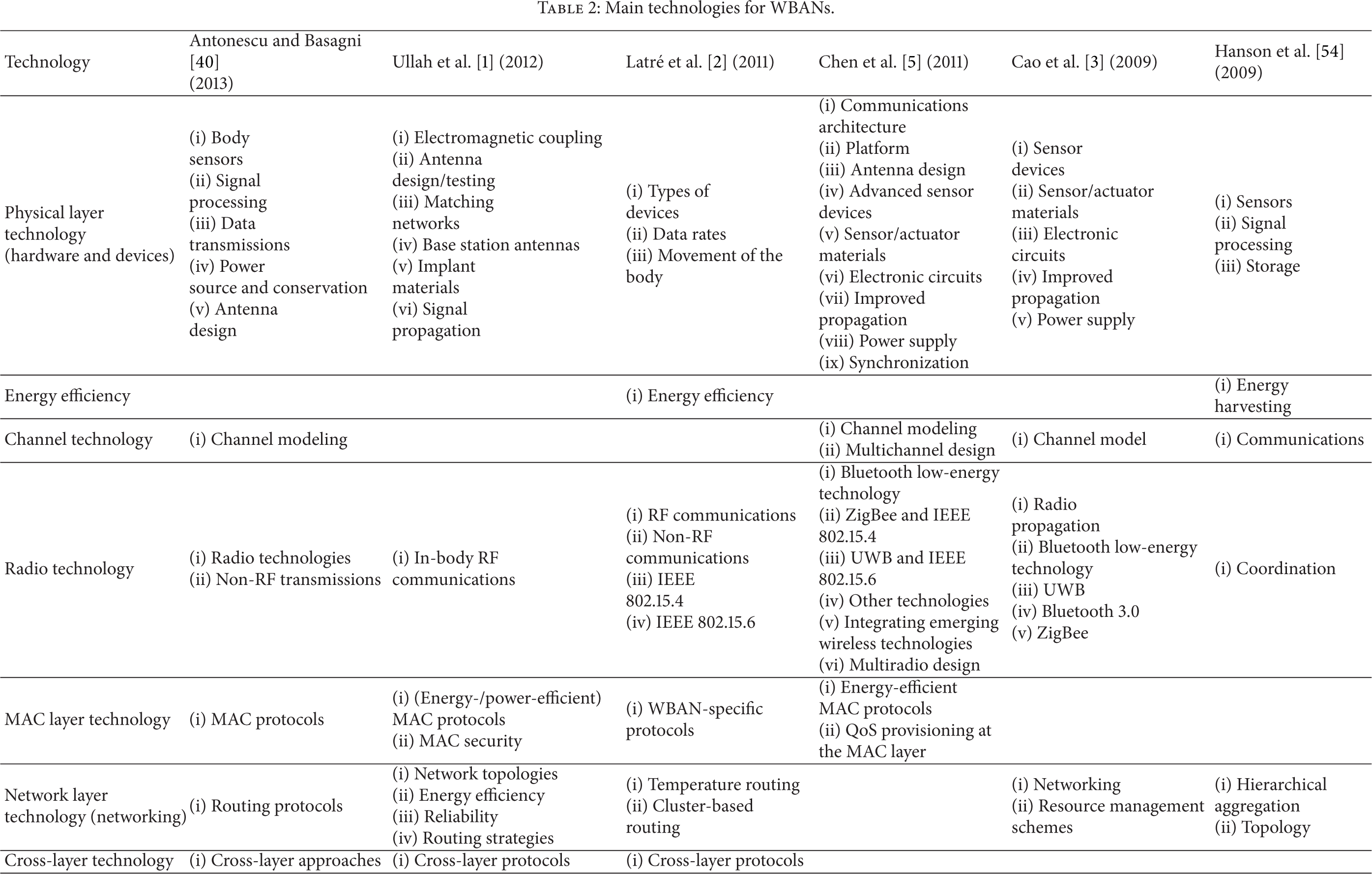
Studies on the WBAN physical layer are associated with topics relating to the sensor, actuator, and transmitter for detecting and transmitting the data of the body and on the physical devices used in WBANs. There are studies about electromagnetic coupling and signal processing as well as research on the means of data transfer and methods of supplying sufficient power to the network. Antenna design for efficient data transfer is a major research topic. Because the sensors that make up the WBAN need to operate on the skin or within the body, a constant energy supply for the sensor is essential. Therefore, studies consider the methods of improving energy efficiency in WBANs using technology related to the reduction of energy consumption or energy harvesting. Channel technology is used for signaling of sensor data. Channel research that considers the high energy-efficiency requirements of the network and the characteristics of the body are underway. Radio technology is related to the wireless signal. The radio frequency range used by existing WSNs is not suitable for a WBAN, because the range has not been determined considering the characteristics of the human body. Therefore, the use of several new technologies for WBANs such as Bluetooth, IEEE 802.15.4 (ZigBee), and IEEE 802.15.6 (ultrawideband (UWB)) has been studied.
The medium access control (MAC) layer technology includes techniques employed for efficient data transfer. This is one of the most common research themes in WBANs, and several researches on MAC protocols with high energy-efficiency have been carried out. Network layer technology for WBANs has also been one of the most important research themes until now, and energy-efficient routing methods have mainly been studied. Cross-layer technology is a field of study into techniques employed across a plurality of layers, not only one of the network layers. Efficient cross-layer protocols to be applied across multiple hierarchies have been studied extensively. Localization and mobility techniques have been proposed for measuring the position and movement of the sensor nodes constituting the network. Considering the characteristics of the WBAN, ensuring the privacy and security of data transmitted over the network is more important than in a WSN. Hence, methods for ensuring security and privacy of data have been actively researched. Certification and standardization relates to the standardization and QoS of the network.
WBAN technologies have significant potential for applications in a variety of fields. Key applications include remote medical diagnosis, interactive gaming, and military applications [1]. Ullah et al. [1] divided key applications into three types: in-body applications, on-body medical applications, and on-body nonmedical applications. In-body applications include glucose sensors, pacemakers, and endoscope capsules. On-body applications include monitoring blood pressure, body temperature, and respiration. On-body nonmedical applications include monitoring forgotten things and social networking. Chen et al. [5] presented the following as key applications of a WBAN: remote health/fitness monitoring, military and sports training, interactive gaming, personal information sharing, and secure authentication. Some research groups and commercial vendors have developed prototypes of WBANs such as CodeBlue [6], AID-N [7], and ASNET [8]. Those prototypes mainly focus on remote health monitoring and deal with the system architecture and service platform instead of the development of specific network protocols between nodes [2, 5].
2.2. SLR Method
SLR is a well-known method used to extract and classify research documents. According to Kitchenham [9], SLR is a method for identifying, evaluating, and interpreting research literature that is relevant to all kinds of research issues, phenomena, and areas of interest. Initially, SLR included three main stages: planning, conducting, and reporting. Subsequently, Lucas et al. [10] expanded SLR to five stages. Our study expands the SLR process to seven stages to review research literature, adding an extraction planning stage and an analyzing stage. The stages of the expanded SLR process are listed in Table 3. SLR is commonly used to review a variety of literature. For example, Lucas et al. [10] used it to survey and analyze Unified Modeling Language- (UML-) related literature in the software engineering field. Budgen et al. [11] used SLR to investigate and study the research trends in UML studies. Further, Ha et al. [12] used it to present the various research trends in Twitter studies.
Stages in the expanded SLR process.

3. Literature Review by the SLR Method
3.1. Question Formation Stage
For systematic review according to the SLR method, the research was conducted with the following questions. What are the differences between WBANs and WSNs, and what major WBAN techniques are being studied?
What are the differences and distinguishing features of a WBAN compared to the existing WSNs? What are the key technologies of a WBAN, considering the environmental characteristics? What technologies are being studied in academia in connection with WBANs? What author details are available?
What characteristics do the authors have as to areas of study, and what are the countries of origin? What is the research trend in each country?
3.2. Extraction Planning Stage
In this stage, items and the rules for extracting information are selected to facilitate exact data extraction.
During the information extraction planning stage, information to be extracted from the selected papers was determined on the basis of the questions presented in Section 3.1. From each paper, the following data were extracted: title, author's name, number of citations, year of publication, the paper's type, main abstract, main research theme, research subthemes, keywords, author's country, affiliations, and so on.
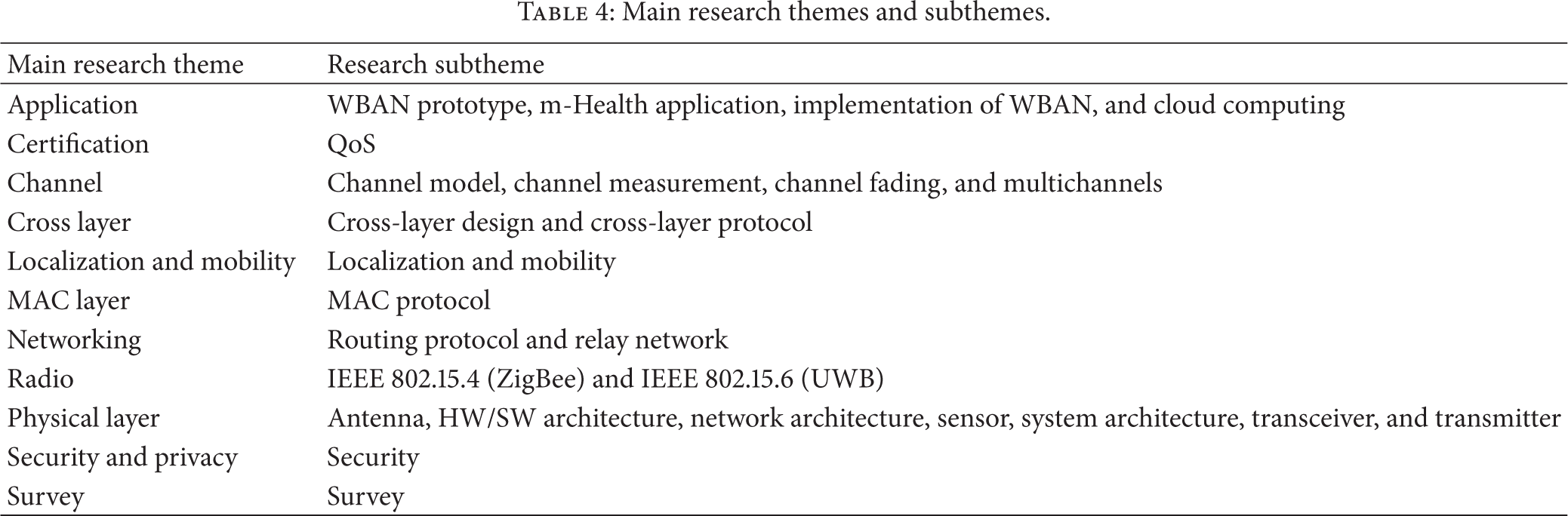
One of the main objectives of this study is to identify the research trends related to WBANs. In order to identify the research trends, technologies studied in each paper were classified into several main research themes. The main research theme was divided into several subthemes. The main research themes were derived from the major technologies for WBANs listed in Table 2. Classified main research themes and research subthemes are summarized in Table 4.
Main research themes and subthemes.

The Application classification includes studies on the implementation [13] and application [14] of WBANs. Researches that have investigated and introduced WBAN-related technologies since 2009 were included in our review. Under channel (a classification of channel models for efficient signal transfer), there are detailed studies on the channel model [15, 16], measurement [17, 18], and fading [19]. The cross-layer classification of research includes studies on efficient data transfer for a plurality of layers. There are studies on cross-layer protocols such as CICADA [20, 21] and WASP [22]. The efficient transfer of data in the MAC layer is one of the research areas that have been studied the most. There are detailed studies associated with MAC protocols, such as Marinković et al. [23] and Omeni et al. [24]. Networking is related to data transfer, and there are detailed studies on topics such as routing protocols [20, 25]. Radio is a classification of research associated with the radio signal used in the WBAN. There are detailed studies of ultrawideband [26–28] and ZigBee [29]. Under the physical layer, there are several study topics such as antennas [30, 31], sensors [32, 33], transmitters [34], and hardware/software (HW/SW) architecture [35]. Localization, security and privacy, and certification relate to the position measurement of sensor nodes [36], to data security [37, 38], and to quality assurance [39], respectively, in WBANs. The survey classification is a summarization of WBAN technology surveys. Ullah et al. [1] and Chen et al. [5] are key researchers. Antonescu and Basagni [40] have summarized recent WBAN technologies very well.
3.3. Source Selection Stage
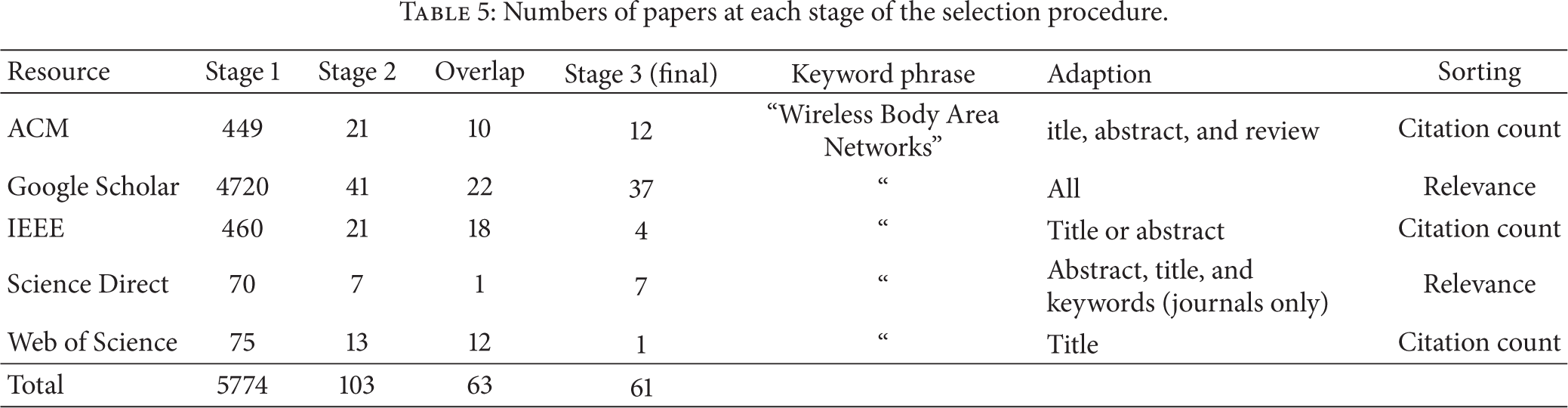
Resource sites were selected from candidate sites from the “List of academic database and search engines” entry in Wikipedia [1] by considering the wealth of data, ease of approach to the literature, and cost of the approach. The selected resource sites are ACM Digital Library [41], Google Scholar [42], IEEE Xplore [43], Science Direct [44], and Web of Science [45]. The keyword string that produced the most appropriate results from the literature provided on each site is “Wireless Body Area Networks.” Performing search using the Boolean OR relationship in each search engine (i.e., “Wireless” or “Body” or “Area” or “Networks”) causes too many results to be returned from each site. Therefore, search was conducted for literature that matches the exact string “Wireless Body Area Networks” in the title, summary, or keywords. The first search results of each site are presented in the Stage 1 column in Table 5.
Numbers of papers at each stage of the selection procedure.
3.4. Study Selection Stage
The papers obtained from the literature resources were selected as literature survey papers through a three-step selection procedure. The first search of the literature was conducted on August 28, 2014. The three-step procedure is as follows.
Step 1.
By entering the phrase “Wireless Body Area Networks” into the search engine of each literature resource, the first search was performed. Results of the first search of each site are provided in the Stage 1 column of Table 5. The first search was applied mainly to the title of the literature, summary, and keywords. The scope of the search that was applied to each site is presented in the Adaption column of Table 5.
Step 2.
The primary filter operation was implemented by considering the number of papers selected in the first search of each site, number of citations of the paper, and the paper's relevance. Results of the filtering are provided in the Stage 2 column of Table 5.
Step 3.
Some retrieved papers are duplicated in more than one resource. In such cases, the papers were included in the scope of the literature review as important papers. The number of duplicated papers is given in the Overlap column of Table 5, and the number of papers finally selected is shown in the Stage 3 (Final) column. Therefore, the number of papers finally selected for the literature review is 61.
3.5. Data Extraction Stage
In this stage, the selected literature was carefully read to extract the necessary information. A data sheet was used for the calculation and extraction of accurate information.
4. Analysis of the Results from SLR
4.1. Trends in Main Research Themes according to Year of Publication
Figure 1 shows the trends of main research themes on WBANs according to the year of publication since 2003. As shown in the figure, the physical layer and the MAC layer have been major subjects for much of the research on WBANs since 2004. Recently, the application, radio, and survey research fields have been largely studied. Figures 2 and 3 show the trends in research subthemes for each main research theme. It can be readily seen that studies on MAC protocols under the MAC layer main research theme and surveys under the survey main research theme have been studied extensively. There are also many studies associated with m-health applications, the channel, routing protocols, and UWB. There is considerable research about the physical layer; however, no detailed research themes were found under that main theme.

Trends in main research themes according to the year of publication.
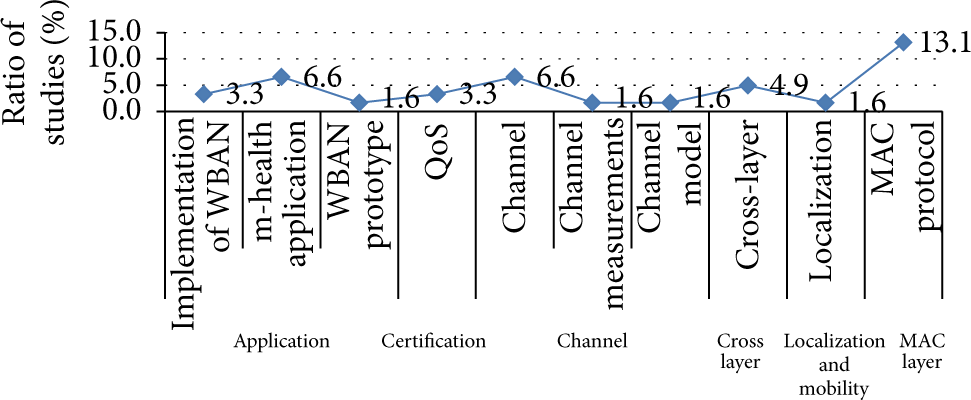
Trends in research subthemes for each main research theme (Part 1).

Trends in research subthemes for each main research theme (Part 2).
4.2. Trends according to the Importance of the Paper
In general, for citation indexes such as Science Citation Index (SCI) and Science Citation Index Expanded (SCIE), the impact factor (which is a proxy for the relative importance of a journal within its field [46]) is a measure reflecting the average number of citations of recent articles published in the journal [46]. Therefore, the impact factor generally can be calculated with
However, there are some differences between the impact factor of a journal and the importance of a paper. The impact factor is an index that shows the importance of a journal, whereas the importance of a paper is an index to show the level of importance of a paper. Therefore, in this paper, the importance of a paper is referred to as IMP. By considering various factors, it is possible to determine the importance of each paper that was selected.
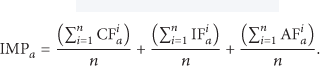
Up to now, various methods for measuring the importance and ranking of publications have been proposed. PageRank [47] was proposed to rank web pages by considering both high usage and a collaborative notion of trust. Hyperlink-induced topic search (HITS) [48] was developed for web mining, using the link structure of publications. Stochastic approach for link structure analysis (SALSA) [49] is a combined method of PageRank and HITS. PaperRank [50] is an extended model of the HITS and PageRank models that focuses on relative functions and weights. However, these models are based on the citation relationship of the publications. In this paper, three factors (citation counter factor, impact factor, and appearance factor) are used in calculating the IMP, as seen in 
Therefore, the importance of paper “a,” m is the number of the selected studies in a resource site.


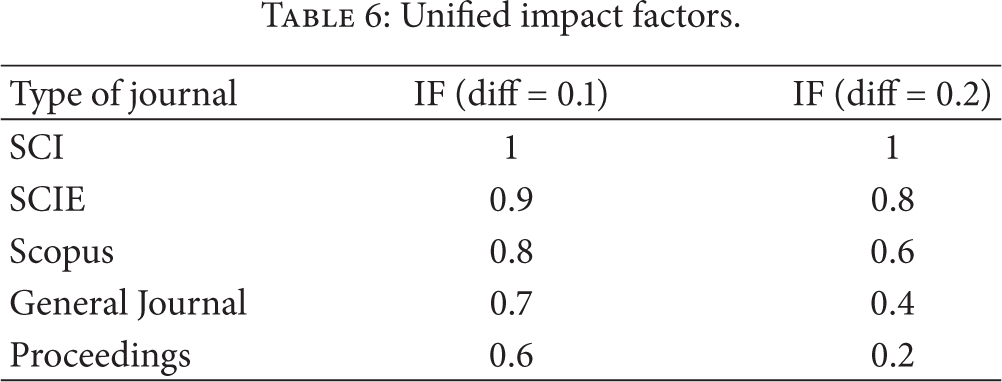
There are several types of papers included in the selected studies, such as SCI papers, SCIE papers, Scopus papers, general journal papers, and proceedings papers. SCI, SCIE, and Scopus have impact factor indexes of themselves, but most other general journals and proceedings do not have impact factors. Therefore, a criterion that can count the impact factor for all kinds of papers is required. In this study, the unified impact factor (IF) of Table 6 is used to compute the IF with (6).
Unified impact factors.
Figures 4 and 5 show the trends in the research subthemes according to the importance of the papers. The importance of research related to implementations, HW/SW architectures, transmitters, and surveys is relatively high. The trends according to the importance of the papers do not match up exactly with the trends according to the ratio of studies, as seen in Figures 2 and 3. However, the trend in some research subthemes, such as the channel, MAC protocols, and surveys, is similar to that of the previous results. A point worth noting is that when calculating the IF of paper “a,” two IF difference values were used; the first difference value is 0.1, and the second difference value is 0.2. However, the results of the trends, according to the importance of the papers, show no significant differences between the two cases.

Research trends according to the importance of the paper (Part 1).

Research trends according to the importance of the paper (Part 2).
4.3. Characteristics and Research Trends of Major Research Subthemes
In this section, the characteristics and research trends of major research subthemes that have been studied in great detail are examined. Research themes were selected in the order of the ratio of studies in Section 4.1. The examined major research subthemes are MAC protocol, survey, UWB, and routing protocol.
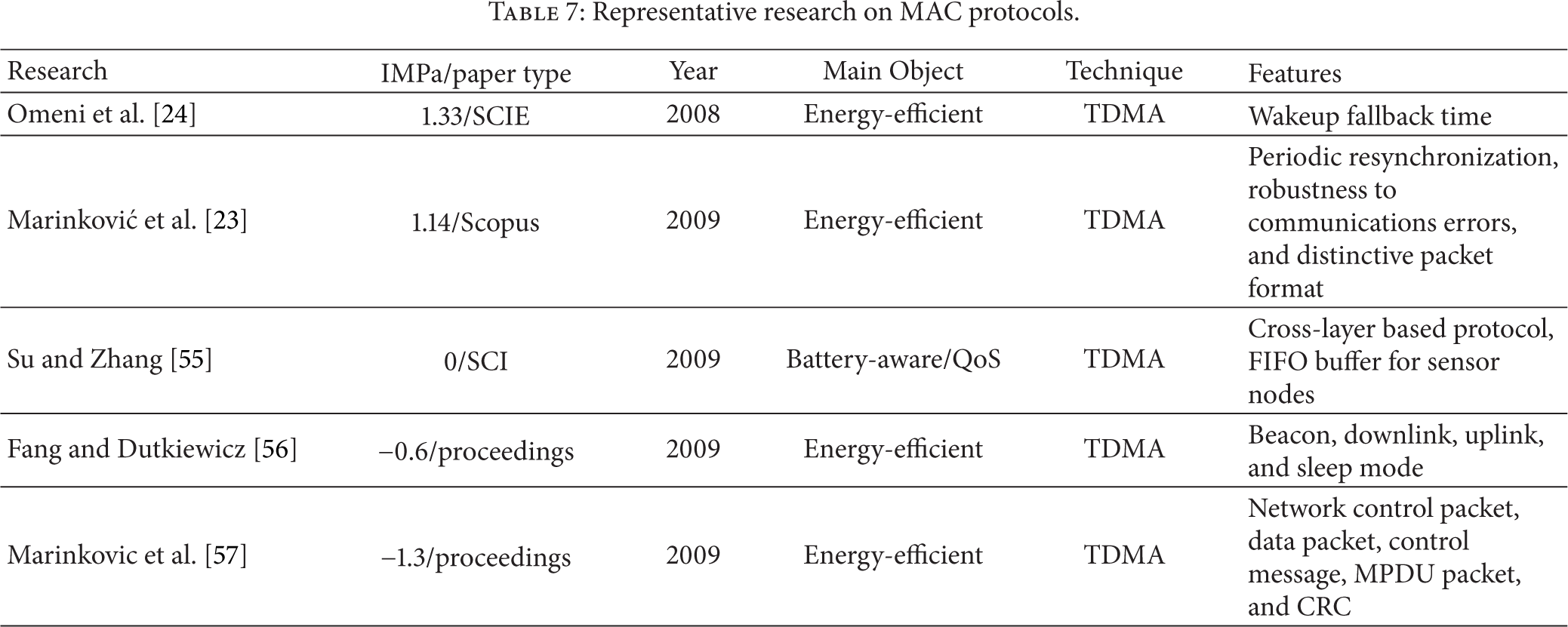
First, the characteristics and research trends of MAC protocols are explained. A MAC protocol is at the core of any communications protocol and affects the quality of service (QoS). One of the most important roles of the MAC protocol is to attenuate the effect of collisions and to achieve the maximum possible throughput with minimum latency [40]. The main objectives of a MAC protocol include collision-free transfer, robustness against communications errors, energy efficiency, and real-time patient monitoring [23]. Extensive research on MAC protocols for WBANs has been conducted until now. Table 7 lists some representative research that has been largely cited by other related studies.
Representative research on MAC protocols.
Second, surveys are also a major detailed research subtheme. The survey studies usually introduce recent advances, useful solutions, and proposed technologies for WBANs at the physical, MAC, network, and other layers. A significant amount of survey research has been conducted since 2008. Representative and key studies under the survey classification are listed in Table 8.
Representative survey research.
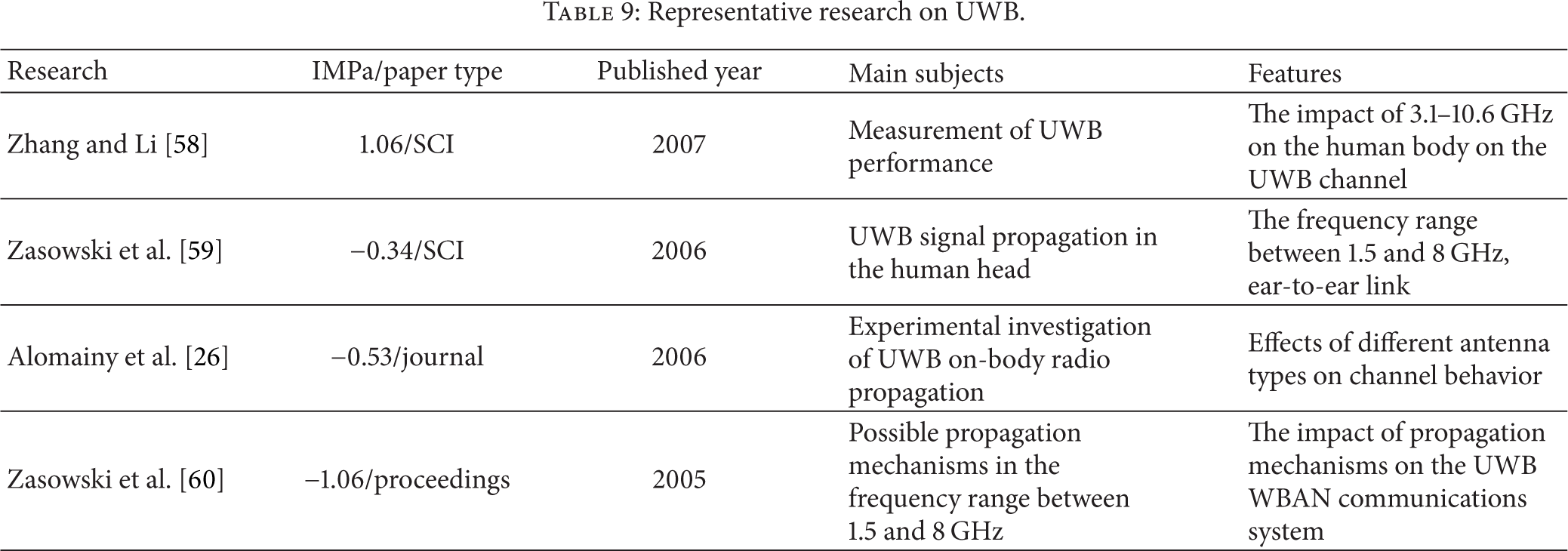
Third, the next major research subtheme is UWB. UWB is a radio technology that may be used at a very low energy level for short-range, high-bandwidth communications [46]. The Federal Communications Commission regulates license-free use of UWB in the 3.1 to 10.6-GHz band to have relatively low-power spectral density emission [5]. Therefore, a number of UWB applications in short-range and indoor environments, which are suitable for WBANs, have been developed. UWB also has many advantages with respect to a variety of other aspects, such as the measurement of exact location and minimizing electronic and magnetic energy absorption by the human body [5]. For these reasons, researchers have given much attention to UWB technology. There have been many studies on other UWB applications until now. Representative studies are listed in Table 9.
Representative research on UWB.

Finally, the last major research subtheme is routing protocols. A routing protocol is also one of the core components of an energy-efficient WBAN. Recently, a study by Bangash et al. [51] classifies routing protocols for WBANs into five categories, as listed in Table 10. The table lists the various types of routing protocols proposed in studies on routing protocols based on the classification of Bangash et al. Table 11 lists representative studies on routing protocols for WBANs.
Routing protocols for WBANs.
Representative research on routing protocols for WBANs.

4.4. Other Research Trends
Other research trends in WBANs were also investigated. Figure 6 shows the paper types of the selected literature. SCI journal and proceedings are the majority. In particular, under the channel and physical layer main research themes, there is a lot of SCI journal research. Figure 7 shows the research trends in various countries. The physical layer field has mainly been studied in Belgium and Singapore. The application, channel, and cross-layer fields have been studied well in the USA, the UK, and Belgium, respectively. Figure 8 shows the overall research trends in the main countries where researches were carried out. It can be readily seen that many studies of WBANs are conducted in the USA, Belgium, the UK, and Korea. The nationality for each document is based on the nationality of the first author.
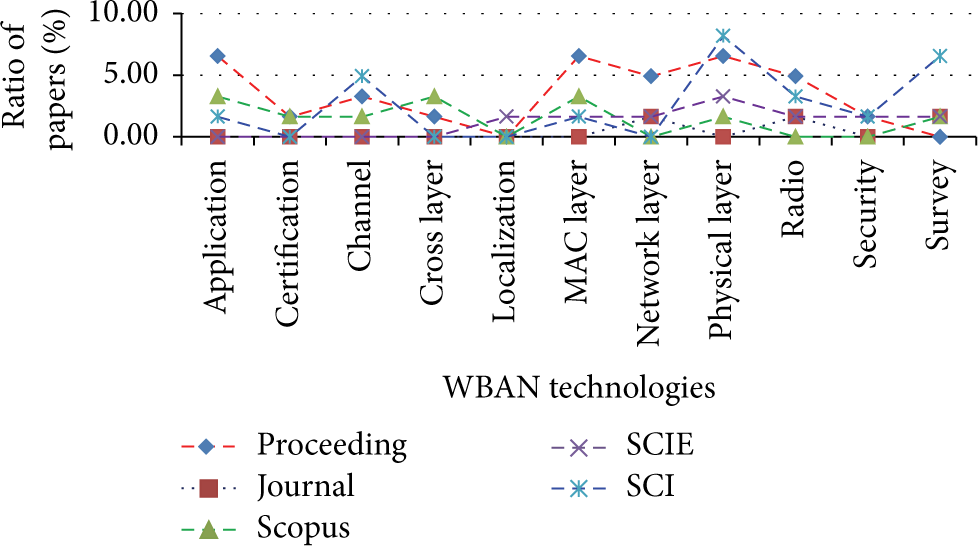
WBAN technologies and paper type.
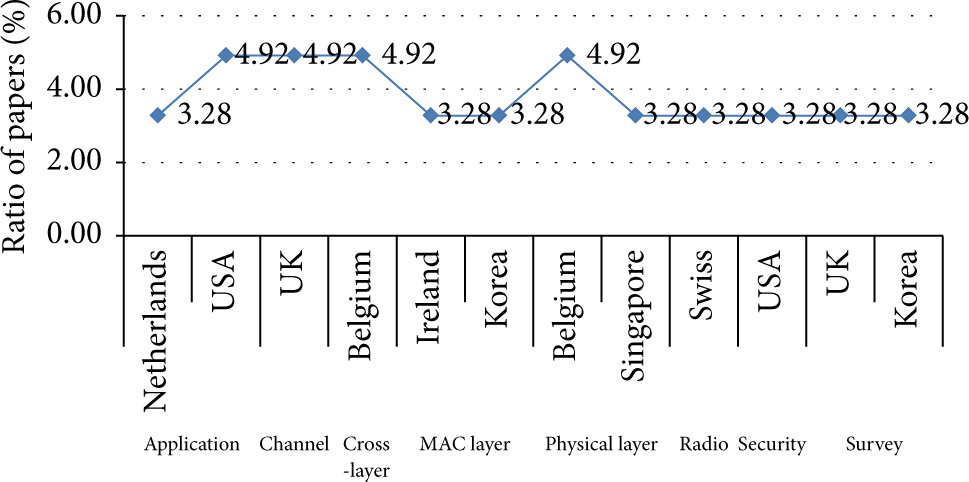
Country-wise research trends.

Country-wise WBAN research.
4.5. Conclusion of Research Trends in WBANs
Through the analysis of the results of the systematic review using the SLR method, it is possible to figure out the following trends in the research on WBANs.
(1) Research associated with the physical layer and the MAC layer under WBAN main research themes have been studied at length since 2005. In recent years, research related to applications, radio, and surveys has been conducted more than other fields.
(2) Many studies on MAC protocols under the MAC layer main research theme and on surveys under the main survey research theme have been conducted. Many studies associated with m-health applications, the channel, routing protocols, and UWB as research subthemes have been conducted.
(3) As for the importance of the research, the importance of research related to implementations, HW/SW architectures, transmitters, and surveys is relatively high. The trends, according to the importance of the papers, do not match up exactly with the trends according to the ratio of the studies. However, the trends in some research subthemes, such as the channel, MAC protocols, and surveys, are similar to the ratio of studies.
(4) For paper types among the selected literature, SCI journals and proceedings constitute the majority. In particular, under the channel and physical layer main research themes, there is considerable SCI journal research. For research trends in each country, the physical layer field has been studied mainly in Belgium and Singapore. The application, channel, and cross-layer fields have been studied extensively in the USA, the UK, and Belgium, respectively.
4.6. Discussion
The results of the review of WBAN study trends suggest that more studies on the physical layer and MAC layer of WBANs, as well as applications, radio technology, and surveys of WBANs will be conducted than on other research themes. This section presents the future challenges and research problems concerning these themes. In the physical layer of the WBAN, sensor devices and radio technology are more important. For sensor devices, sensitivity, energy efficiency, and data acquisition efficiency are key parameters to be considered [52]. In radio technology, bandwidth and interoperability are main research problems. For example, the integration of several sensing devices operating at different frequencies can cause an interoperability problem [52]. In the MAC layer of a WBAN, energy efficiency and low latency are important. Their challenges in WBAN MAC protocols were presented by Gopalan and Park [53]. These include collisions, overhearing, and idle listening techniques [40]. In the application layer of a WBAN, organizing the data and producing meaningful information that evolves into knowledge are important challenges, according to Alemdar and Ersoy [52]. These authors focused on reviewing WBAN studies and surveys on research trends in WBANs. Their work can be classified as a survey. In early times, most survey studies focused on all technologies in WBANs, but most of the main technology and research problems have been revealed through previous studies. Therefore, it is necessary to focus on surveys of more detailed research themes, as seen in Table 4. The works of Ullah et al. [1], Gopalan and Park [53], and Bangash et al. [51] are a few examples.
5. Conclusion
Because the WBAN has environmental characteristics vastly different from that of WSNs, the existing technologies for conventional sensor networks cannot be applied to the WBAN. This study examined the characteristics of WBANs that are different from that of existing WSNs and classified WBAN-related technologies that have been studied recently. In addition, a systematic review was performed via SLR in order to understand recent research trends in WBANs. Through analysis of the results of the literature review, it was possible to identify several research trends in the studies, as described in Section 4.5.
Footnotes
Conflict of Interests
The author declares that there is no conflict of interests regarding the publication of this paper.
Acknowledgment
This work was supported by a 2015 Kyungil University research grant.