




Abstract
An important problem in many P2P applications is how to efficiently disseminate massive contents from multiple sources to multiple receivers on the Internet. A successful model used for analyzing this problem is a graph that consisted of nodes and edges, with a capacity assigned to each edge. However, a scheme that can flexibly deal with the extreme network dynamic is required in order to realize the massive contents streaming service, because P2P networks are mostly formed in random fashion without good control of their topology. In this paper, we design and implement a scheme for the problem of efficient massive contents dissemination in a sensor smart network system.
1. Introduction
Rapid improvement of network technologies and the increase in the demand for massive contents service have been significant challenges in the area of efficient contents dissemination, service research. The improvement of PCs and infrastructure, such as network devices, which is regarded as one of the most promising services, will provide TV services over the Internet.
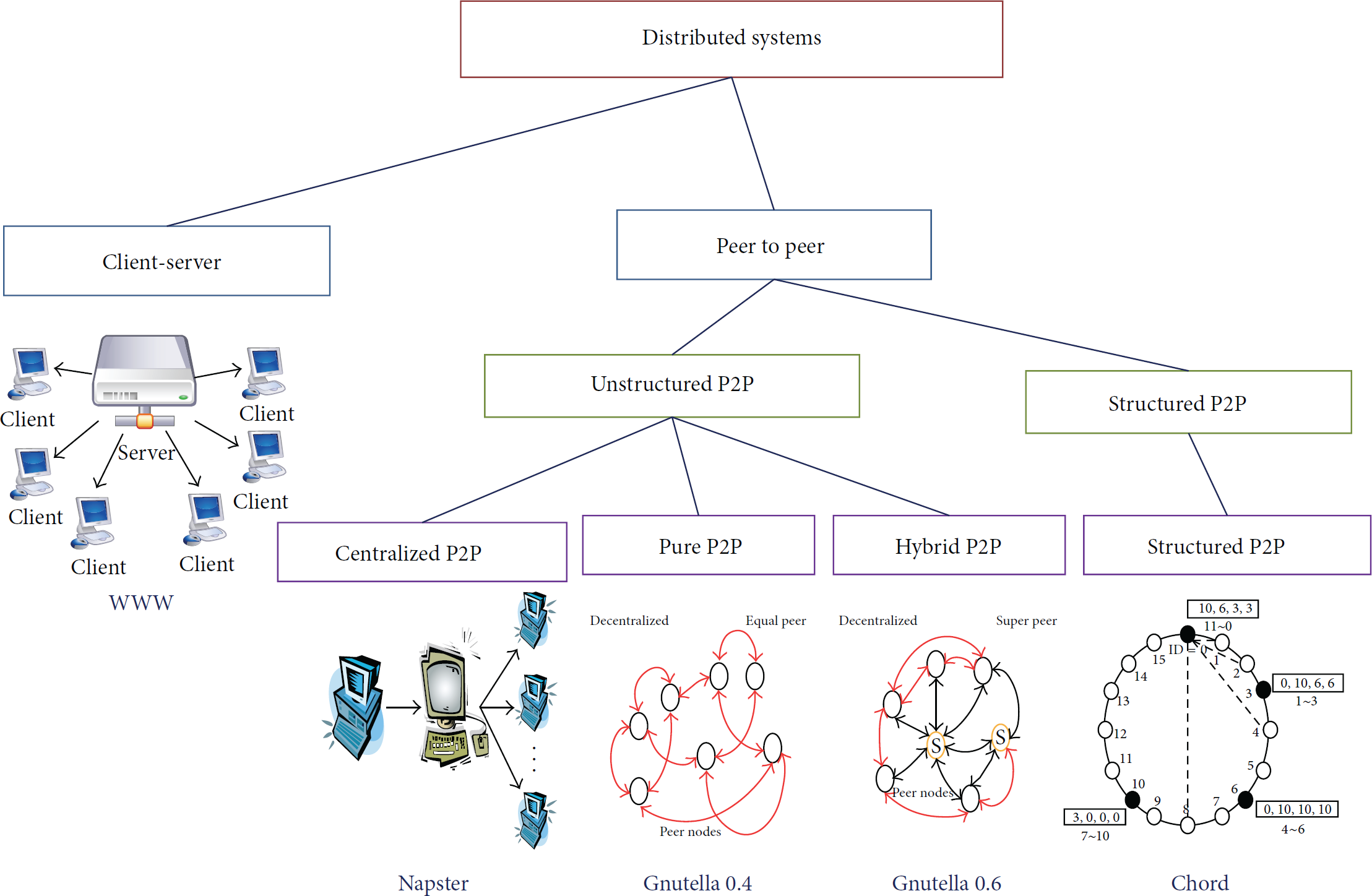
Several studies have been conducted on methods for providing IPTV through the Internet. The conventional server-client model is no longer adequate to support these types of services because of the extremely heavy traffic load they generate and the stringent time requirement they demand. Server-client topology places the entire traffic on a single link connecting the server and all requesting clients (see Figure 1). Therefore, the server-client model may not be a good option for the massive contents dissemination service.
Client-server versus P2P.
The IP multicast [1–3] has been proposed to support the exchange of efficient intergroup data over the Internet.
Reducing the required bandwidth and providing minimum network stress are critical when the network supports a large number of clients. The overlay multicast [4–7] has been introduced for IP multicast, but it still has some drawbacks when deployed over the Internet.
Supporting massive contents dissemination on the Internet without making changes to the existing infrastructure requires the addition of a suitable overlay multicast scheme.
However, a drawback of the overlay multicast system is that a leaf peer does not contribute to available bandwidth since by definition it does not forward data to any other peer.
On the other hand, the new peer-to-peer (P2P) network, derived from the BitTorrent distributed file sharing system, is more appropriate for massive contents dissemination, due to its high scalability and better tolerance.
Unfortunately, P2P overlay networks are usually formed freely without consideration of either the balance of peer load or the depth of the spanning tree.
In this paper, we design and implement a sensor smart network system based on minimum traffic overhead to obtain the contents information and to show how to use locally maintained network information to improve the performance of contents searching. Our main findings are as follows.
The environment that consisted of peers and super-nodes, the super-gateway, is defined as the sensor smart network. The super-node as a server with a fixed routing function is provided by the service provider of the sensor smart network system, and the basic structure of the super-node can have multiple controls. The environment that consisted of peers and super-nodes, the super-gateway, is defined as the sensor smart network.
Existing research on peer-to-peer network services could be classified into several areas. Napster is frequently considered to be the first peer-to-peer search system. It uses centralized indexes for routing queries. Centralization ensures relatively consistent coverage and speed, but also a single point of failure. Gnutella was among the first pure peer-to-peer (P2P) architectures. Gnutella 0.4 uses the flooding technique for query routing, which is robust but also inefficient and not very scalable [8].
The Gnutella 0.6 protocol [9] adopts the hybrid P2P architecture to overcome the weaknesses of Gnutella 0.4. For systems using the Gnutella 0.6 and similar protocols, leaf nodes generate descriptions of the identifiers of their own documents, and directory peers use these descriptions to select leaf peers for query routing.
In this paper, we design and implement a sensor smart network system able to tolerate the massive contents dissemination required, whereby the packet loss is a minimized scheme at the application layer and has a cumulated delay scheme (Figure 3).
The remainder of this paper is organized as follows. In Section 2, we describe the proposed scheme, a sensor smart network system based on massive contents dissemination, and we describe two methods: the notion of throughput efficiency and maximizing the throughput efficiency while maintaining a reasonable trade-off between delay and node management.
In Section 3, the sensor smart network system is discussed and the experiment results are presented in Section 4. The related work is shown in Section 5 and a conclusion is drawn in Section 6.
2. Sensor Smart Network System Based on Massive Contents Dissemination
2.1. System Outline
Most A mechanism to reduce packet loss and delay is needed in the Internet because it only offers simple quality of service (QoS) and effort services.
While changing the network equipment working at the lower layer could be an efficient solution, it is also expensive. The proposed system attempts to improve QoE by implementing a QoS control scheme at the application layer without the change of lower layers.
Although the proposed sensor smart network system can be built in a completely distributed way, we believe that sensor smart network system architecture offers many more benefits. The structure of the sensor smart network topology, which adopts a dynamic feedback adaptive scheduling algorithm, is shown in Figure 2. The super-node peers in a system are divided into several cluster networks according to their different locations in the network and according to each cluster network.

Concept of the proposed system.

Sensor smart network system model.
To communicate with the super-gateway peer, all the requests from peers should be first sent to the super-gateway peer, which designates logging super-node peers for peers according to the immediate updated super-node peer scheduling sequence.
The sensor smart network P2P architecture enables scalable contents data dissemination among the peers and at the same time provides other benefits such as flexibility due to the distributed management. In our proposed sensor smart network system, a peer is classified as a super-node, super-gateway, or a peer, as described below.
(I) Super-Node. A super-node is the controller of the system as it performs all necessary routing functions. It is a special peer which handles requests from peers for joining or leaving a session. Its task is to maintain an accurate global view of the topology of a session. The super-node also has an obligation to register the contents data with their super-gateway. In this case, the information the optimal MST received from the super-gateway contents data is sent to the content request peer.
(II) Super-Gateway. A super-gateway can handle multiple sessions. The proposed algorithm (CRRP) running on the super-gateway is responsible for producing a list of affected super-nodes and the corresponding actions when requesting contents of a new peer. The super-gateway then uses the outputs from the contents retrieval routing path (CRRP) to send out appropriate messages to other super-nodes or peers to instruct them with appropriate actions as follows.
Super-gateway manages the content of the information super-node. Super-gateway sends a list of the super-nodes that have the requested content to the requested peer content. Super-gateway sends the requested peer content to the super-node which can be reached in the most optimal routing table information to the requested peer content. At this point, the most optimal routing table information is performed by the proposed algorithm contents retrieval routing path (CRRP).
(III) Peer. A peer is a node that is part of a session which is managed by a super-node. A peer is connected to other peers to form the topology. Once the peer receives a list of sessions from the super-gateway, it can decide whether it wants to join a session, host a session, or not do anything. Once it joins a session, it becomes a peer. This peer can refer to a published list of super-nodes to obtain access to a particular super-node.
3. Measurement of Required Massive Contents Permission
Routing algorithm is the process of determining a message path from a source to multiple destinations in a network. The algorithm is responsible for finding a suitable path tree from the source to the destinations.
To find a suitable path, the status information among a group of nodes is required. The suitable path is generally defined by a graph
In the graph theory, finding a suitable path means finding a good tree path for routing from a graph.
Routing algorithms can be grouped into two major classes: the shortest path tree (SPT) routing algorithms and the minimum spanning tree (MST) routing algorithms.
In this paper, the super-gateway on the MST table information for each super-node is responsible for transmission.
The content the user needs to find when searching for resources between super-node query messages will be flooded.
In this case, the minimum spanning tree (MST) table information is used.
The super-node for the real-time service continuously sends contents packets through the peer to peer while clients are in service.
In this case, the MST derived path information CRRP algorithm of the shortest routing path (SRP) is used to deliver contents to the end user.
By using the proposed architecture, large-scale user generated content can request delay and bandwidth efficiency.
MST routing algorithms find a tree from a graph with the minimum cost. Thus, MST routing algorithms are suitable when all the nodes are group generating packets.
When a node generates a packet, all other nodes in the group receive these packets. Examples of the well-known MST algorithms are Floyd's algorithm [10], Prim's algorithm [11], and Kruskal's algorithm [12].
The distance vector, which is used in the Internet, is the most popular dynamic routing method, in which each router maintains a distance vector table that contains the best distance to each destination. The router updates the table by exchanging the distance vector table with its neighbors and by sharing the new delay costs. A router can update the routing table with its neighbors based on the current status of the network, and this updated information is eventually propagated to all routers in the network. This method required a longer time to adjust all the routers, but it generates a minimum overhead.
In this paper, a sensor smart network structure, the peer-to-peer (P2P) environment, was used. With the P2P environment, the sensor smart network P2P architecture enables scalable contents data dissemination among the peers and at the same time provides other benefits such as flexibility due to the distributed management.
Figure 4 shows the requested content sent to the end user to transfer content to the service.

The CRRP algorithm model.
In this case, the super-node transfers content by using the proposed protocol CRRP.
4. Adaptive Research Scheme for P2P Network Using Sensor Smart Network
4.1. Analysis Routing Algorithm for the Contents Service
The multicast routers that are required to maintain per group status are insecure, causing the increased complexity of implementing and maintaining these routers.
Thus, an alternative method known as application layer multicast has been introduced [13, 14]. In application layer multicast, the hosts not only perform data transmission and reception, but also take part in the multicast tree building process. Therefore, the application layer multicast does not request changes at the infrastructural level, and it can easily provide higher level features. However, application level multicast has the disadvantages of performance degradation, caused by transmitting duplicate data to the same physical link, and the overhead that is caused when the hosts forward data.
Super-nodes generally have high capacity system resources for supporting several users, but they have limited network bandwidth and processing resources to support a higher number of users. This limitation is the reason why super-nodes cannot support unicasting and why a multicast router is used to support multiple peers. In the application level multicast, each peer receives the contents stream from its parent and then forwards the contents stream to its peers. Super-nodes also have limited network bandwidth and processing resources to support a certain number of peers and for defining each peer's degree.
For providing peer-to-peer (P2P) service for massive contents, SPT routing algorithms can be used for extending the sensor smart network architecture.
This will provide the best path for multicast when all the members of the group are known in advance and they are joined together. However, the use of the SPT routing algorithm is not popular because any peer can join n order to use the services at any moment. When a peer wants to join a specific contents service session, a new peer must be researched to receive the contents stream. Consequently, this scheme generates a large overhead.
In this paper, we explore content retrieval in P2P networks that adopt sensor smart network architectures. In particular, we apply content resource selection and retrieval algorithms to a P2P network using a sensor smart network.
Previously, the proposed directory nodes model the contents of neighboring nodes based on their resource descriptions or responses to past queries and use these models to route query messages. Leaf nodes use a probabilistic information retrieval algorithm to determine which documents to retrieve for queries.
In this paper, we show that using content retrieval in P2P networks using a sensor smart network can greatly reduce the average number of query messages per query and increase precision while causing little degradation in recall.
4.2. The Shortest Path Detection with Contents Retrieval Routing Path (CRRP)
The SPT algorithm exploits three steps to prepare the shortest routing path for application level multicast.
We assume that a source super-peer provides contents services. The source super-peer is the first member of the sensor smart network group, and the peers consecutively require contents for a sensor smart network group to receive contents data.
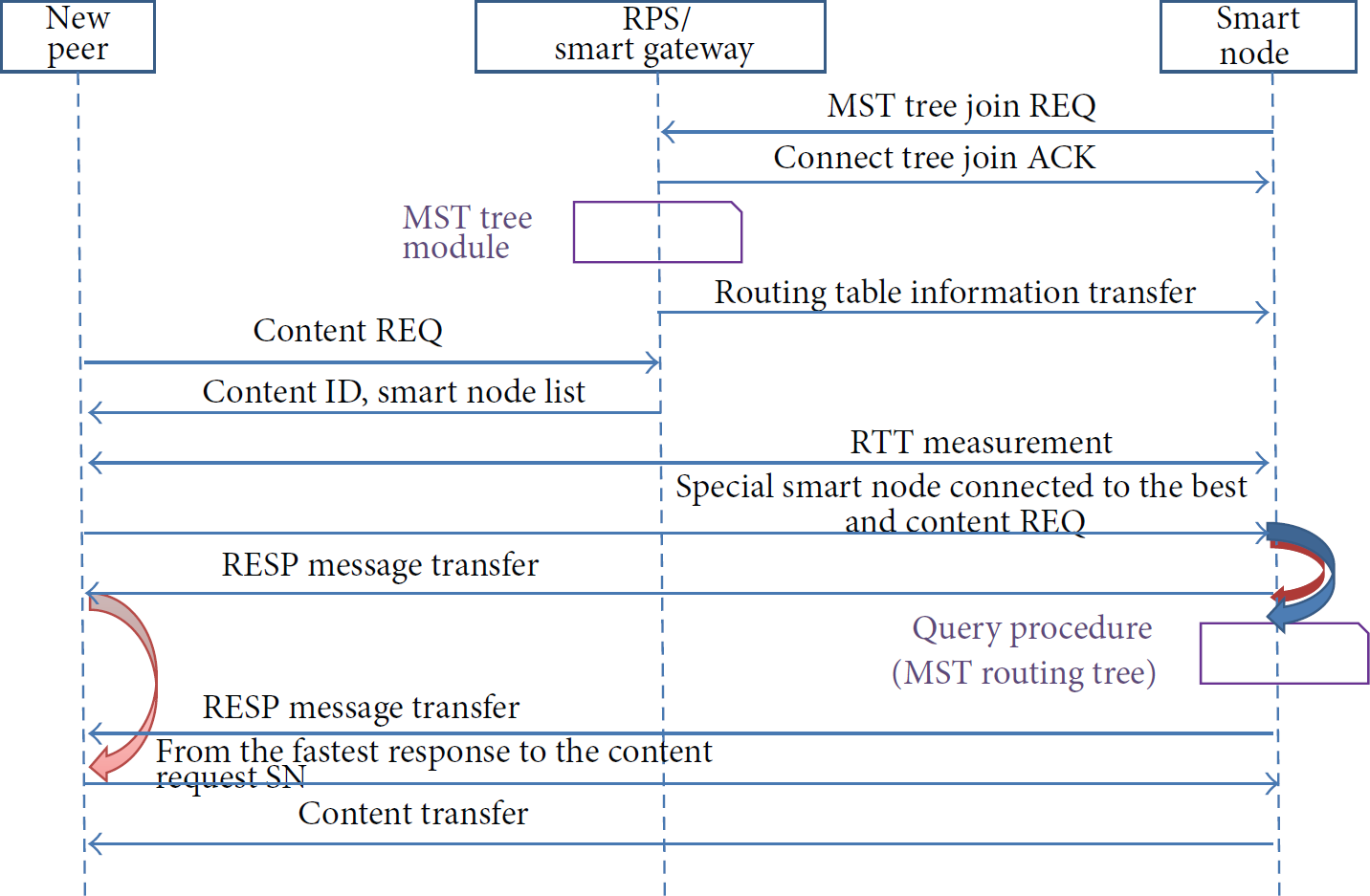
When a new peer requires content, a sensor smart network group with super-peers, the new peer sends a “join request” message to a super-peer of the sensor smart network (Figure 6).
A new routing tree
Dijkstra's algorithm for out-degree of a node is not considered. Therefore, the bandwidth of each node cannot solve the problem.
We can use Prim's algorithm or Kruskal's algorithm, but these generate the minimum spanning tree instead of the shortest path tree. Consider


In (1), the MST algorithm builds graph
In (2), it creates a path routing tree
In (3), it distributes the routing information to all routing super-peers.
4.3. Designing a Scalable Research Scheme for P2P Using Sensor Smart Network
The super-node for the real-time service continuously sends contents packets through the peer to peer while clients are in service (Figure 5).

The scenario of research scheme using sensor smart network.
Flowchart of real-time level encoding.
These real-time contents packets must be delivered to peer-to-peer nodes without packet loss. This is especially important when the group size is large. The recovery of lost packets by retransmission will significantly increase network traffic, and the recovered packets may not be used for real-time services. The CRRP algorithm builds with less delay and less control packets.
Our goal is to offer a design that will further reduce delay and will generate less control packets for building a tree.
We named this new method the content retrieval routing path (CRRP) algorithm.
In the CRRP algorithm, we tried to reduce the number of control packets that are generated for finding round trip delays. The super-node for the real-time service continuously sends contents packets through the peer to peer while clients are in service. If we use these packets to deliver control information, then the generation of control packets will be reduced.
When a new peer tries to request the contents, it sends a join request packet to a special super-node of sensor smart network group
In other words, content of which the user must search for (when looking for resources between the super-node query messages) will be flooded.
In this case, the MST table information is used.
With content resources super-node that sent the content to the user node Are.
In this case, the MST derived path information CRRP algorithm of the shortest routing path was used to deliver contents to the end user.
Thus, the ACKnowledgement code (ACK) information will be delivered to all peers in sensor smart network group
The new peer node will receive these response packets from all peers in the sensor smart network group
The response packet that takes the shortest path arrives first at the destination.
Equation (4) will take

Equation (5) will take

In the first step, the peer node that sends the first response packet becomes the special super-node of the new peer. The advantage of using the CRRP-F algorithm is that the new peer discards all other response packets that are received later, and the shortest path does not need to be calculated.
In the second step, the new peer now knows the special super-node, and it sends this information to the special super-node.
4.4. Analysis Procedure of Increasing Trend
In providing the real-time contents service requires continuous real-time delivery of consecutive packets for a long duration.
The purpose of our design is to reduce delay and generate fewer control packets to build the routing path.
If we can reduce the number of sent data packets, the network stress will be greatly reduced.
However, P2P has predictable performance degrading factors such as when no hosts grasp the physical network topology.
However, we can easily see that two nodes are in the same LAN by using an IP address and a netmask. The super-node gathers the IP addresses and netmasks of all super-nodes in the tree.
5. Experiment
5.1. Basic Experiment
In simulation, we can generate network topologies by using random distance values between peers, but the performance evaluation is very difficult and time-consuming when the number of peers increases.
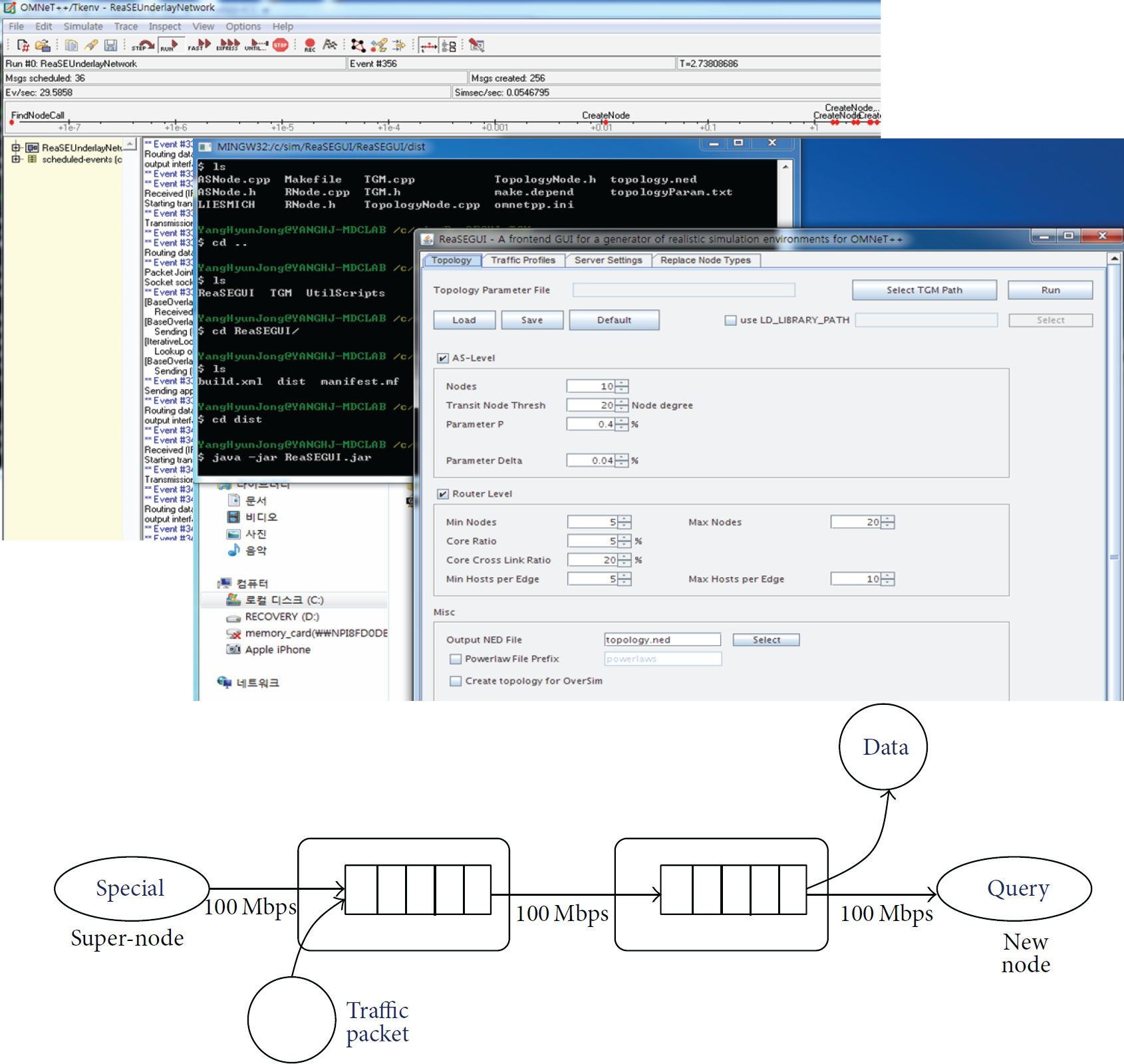
We implement the network simulator (OMNet++) application-layer module of the sender (special super-node) and the receiver (query new node) for the sensor smart network.
Figure 7 shows a topology for simulation. Each link's bandwidth is 100 Mbps, while 50 Mbps of traffic passes between the two intermediate nodes, and the buffer size of each node is set to be large enough for reflection of the buffer shaping policy.
Simulation topology.
The measurement result shows a clear difference between the two methods due to the average delay time. Using the CRRP, the cost taken to measure the available bandwidth, except the required bandwidth, can be reduced considerably, since it rapidly returns the possibility of use in terms of the required bandwidth.
5.2. Experimental Results
We construct the test bed using the FTTH network to verify the quality of the received data at the new node. The FTTH network consists of the streaming special super-node supporting 100 Mbps transmission, the peer, and a traffic generator.
First, we assume that the average delay between the super-peers is d, which is used for all values of i and j, such as
Time delays that occur when preparing all super-nodes' routing can be simply approximated. Consider

The time complexity required to find the shortest path is
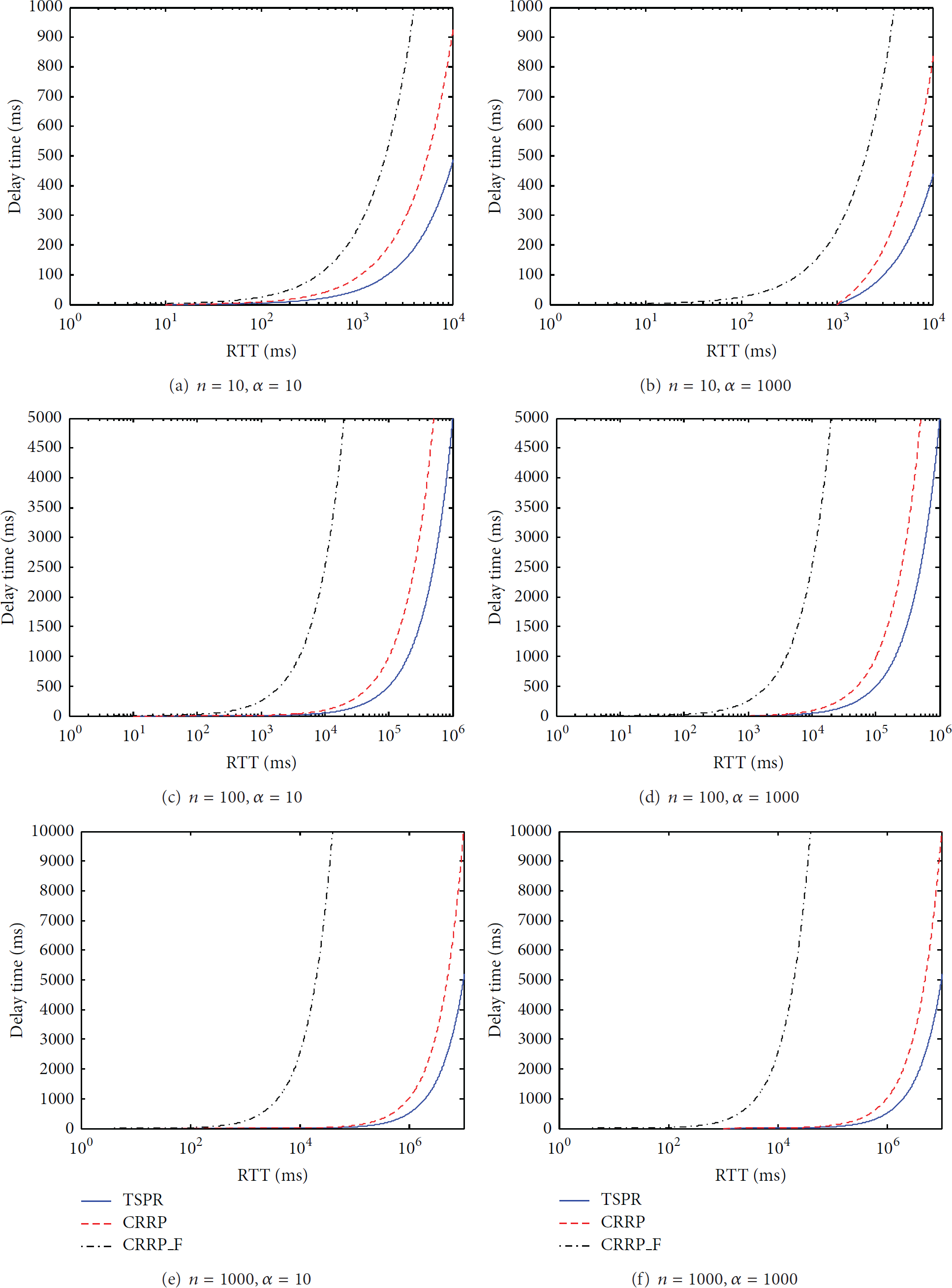
Figure 8 shows the time delays from preparing routing in all super-nodes when the number of peers grows from 10 to 1000. The value of α changes from 10 to 1000. The delay quickly increases as the number of peers increases by applying the SPT scheme or CRRP scheme. However, when the CRRP_F scheme is applied, the delay is very short and it does not proportionally increase according to the number of peers.
Delays when preparing routing in all super-nodes.
The purpose of our design is to reduce delay and generate fewer control packets to build the routing tree. If we can reduce the number of contents delivery packets that are sent, the network stress will be greatly reduced. However, P2P has inevitable performance degrading factors such as when no peers grasp the physical network topology.
However, we can easily find that peers are within the same LAN by using an IP address and a netmask. The special super-node gathers the IP addresses and netmasks of all peers in the tree.
Figure 9 shows the sensor smart network environment that has been configured, the smart node configuration (depending on the number of new participants to the content of the request to minimize the latency), and the high-quality content that can be stably supported.
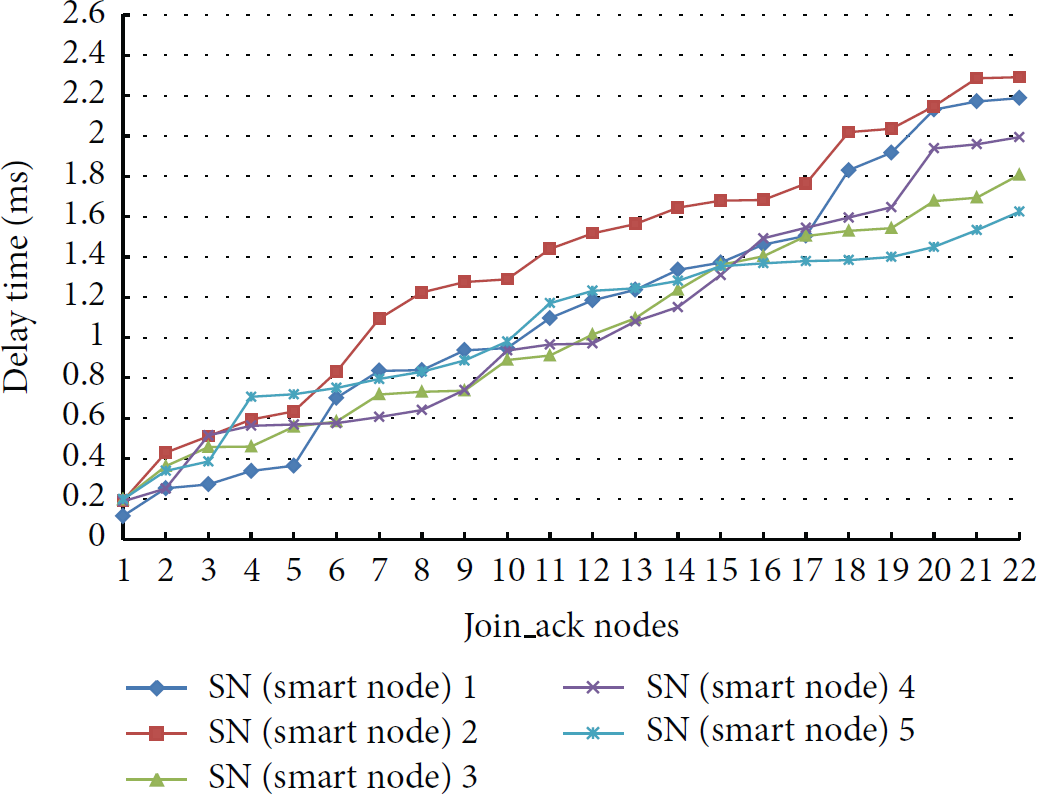
Join ACK nodes versus super-nodes number.
6. Conclusion
Many peer-to-peer solutions already exist [10–16] and can be roughly classified into two categories. In mesh-pull based systems, the contents are divided into small clips for distribution. A peer sends messages to neighbors to request clips of the content. After receiving positive responses, the peer retrieves these clips from the possessing neighbors. The control messages not only create some traffic overhead, but also induce extra delay.
In tree-push based systems, the content data also distributes in clips. Peers simply receive data from their parents after they demand it. The overhead caused by the large number of messages is avoided.
In this paper, we design and implement data contents delivery system that adapts the real-time to the network status by determining whether or not the network allows the required bandwidth of the contents dissemination. The required bandwidth measurement scheme used in the proposed system can be applied to the high quality contents delivery service in the near future and is expected to contribute to the improvement. In particular, the required bandwidth measurement scheme has advantages in terms of the system implementation of real-time applications.
Traditional routing algorithms can be applied to P2P but are not efficient for providing real-time contents services by P2P.
The requirements for a new algorithm are as follows. First, P2P for contents service is built into the application layer, and it uses the IP layer services but does not have the network topology information. Second, members of a P2P group are not predefined. It is natural for contents delivery groups to be formed by new joining members.
We proposed a CRRP-A scheme which can be used to build a P2P routing tree for real-time services. Our scheme provides seamless data contents real-time services without advanced knowledge of the number of clients and their locations. Performance evaluation shows that our proposed scheme provides better performance than the existing schemes in terms of time delays when preparing routing in all peers and the total network traffic.
Footnotes
Conflict of Interests
The authors declare that there is no conflict of interests regarding the publication of this paper.
Acknowledgment
This research was supported by the MKE (the Ministry of Knowledge Economy), Korea, under the ITRC (Information Technology Research Center) support program (NIPA-2013-H0301-13-1006) supervised by the NIPA (National IT Industry Promotion Agency).