




Abstract
Biometric verification has been included in remote user authentication schemes recently. In this paper, we have proposed the use of heartbeat biometrics for its liveness property as a possible defense against spoof attacks in remote authentication. Sensor embedded mobile computing devices such as smart phones could be used to capture biometric signals and to replace the use of traditional smart cards. For the remote authentication, we have adopted the state-of-the-art scheme. We have described the biometric verification method instead of using cryptographic hash function for feature matching. We have used the piecewise aligned morphology (PAM) of heartbeat signal as a biometric feature. The biometric verification method was tested with ECG records of 100 individuals and 1.34% of equal error rate (EER) was obtained. This feature could be computed and transmitted efficiently using mobile computing devices. The proposed scheme offers more security and convenience to users. Additionally, it becomes robust against noisy biometric input. The proposed scheme should be feasible for remote authentication using sensor embedded computing devices in many practical applications such as remote healthcare.
1. Introduction
Remote authentication is becoming increasingly important with the growing popularity of cloud and mobile computing. For example, in the remote healthcare service, information is collected over sensor-enabled smart phones [1]. Hence, user authentication plays an important role to ensure that the right person is getting the right services. It can be envisaged that in the near future biomedical signal captured from a sensor network could be used for authentication in addition to providing diagnostic information. In other words, sensors will be attached to mobile computing devices, creating a sensor network used for remote authentication.
Different types of biomedical signals are used for diagnosis of a patient. Heartbeat signal is one of the commonly used signals. In this paper, we have investigated the potential use of heartbeat signal for remote authentication. In fact, a heartbeat signal can be proposed as a biometric modality in remote authentication for several inherent qualities. First, the heartbeat signal holds a unique signature for each person and is stable over a long period of time [2–4]. Second, every living person must have a heartbeat signal and it can be captured from the hands for biometric applications [4–7]. Third, liveness is an inherent property of this modality [8–10], as it cannot be captured from deceased body parts or false modalities, such as a gummy finger or a high-resolution video image. Finally, unlike fingerprint, iris, or face signals, it is difficult to steal or mimic a heartbeat signal [9, 11].
Traditional password and ID based remote authentication schemes [12] were supplemented by a smart card [13] to avoid dictionary attacks. In the latest attempt, biometric verification [14–17] is also suggested together with password, ID, and smart card to prevent several other attacks such as stolen mobile device attacks, replay attacks, and man-in-the-middle attacks. Different types of biometrics such as fingerprints, faces, and irises are considered as potential modality. However, we have noticed that the use of these biometrics in these remote authentication schemes has several limitations: (i) vulnerable to spoof attacks, (ii) sensitivity of hash function for biometric matching, and (iii) inconvenience to users as multifactor (password, smart card, and biometrics) authentication requiring additional hardware (card reader and biometric device) which incurs the risk of being lost and stolen.
For remote authentication, a sensor (attached to a mobile computing device), used to capture a biometric signal, should be available for all users. This unattended situation will provoke imposters for spoof attacks with fake biometric samples for obtaining undue access to the genuine users account. Existing biometric modalities, such as fingerprint, iris, and face, are vulnerable [18] in such unattended scenarios, as an imposter will have sufficient opportunity to spoof a target client. For example, it has been shown that it is possible to spoof varieties of fingerprint technology by gummy fingers [19]. In face and iris recognition systems, the use of high-resolution still images or videos is sufficient to fool the systems [20, 21].
In previous works [14, 15, 22], cryptographic hash function is used for biometric matching. However, this one-way hash function is very sensitive to small perturbations of inputs. Biometric inputs can be considered as noisy in the sense that there may be differences between the input biometrics each time. Hence, legal users will be unable to pass biometric verification. In fact, because of the sensitivity of hash functions, it is hard to use it straightforwardly in biometric matching.
In this paper, we have proposed a remote authentication scheme using sensor embedded computing devices (SECD) which is capable to capture heartbeat signals. The feasibility of this scheme lies in the fact that mobile computing devices (e.g., smartphone) are becoming popular with additional computing power day by day. Hence, the smart card could be replaced by a SECD and hence the card reader will not be required. During the registration phase, SECD will store the feature computed from the heartbeat signal together with other information. During the login or password change phase, the captured data from the sensor will be used to match with the stored feature. In order to avoid the use of hash function for biometric matching [14, 22], we use the feature extraction and matching method for biometric verification. The process will be helpful to avoid the limitation of the hash function applied to the biometric feature. For remote authentication, we have adopted the scheme described by Li et al. [14] and improved by Das [22]. This scheme possesses many security features such as security of secret key, security of session key, resists stolen device attacks, proper mutual authentication, resists replay attacks, and resists man-in-the-middle attacks. Moreover, due to the use of heartbeat signal, it will be possible to avoid spoof attack as it cannot be captured from deceased body parts or false modalities and it is difficult to steal or mimic a heartbeat signal [9, 11].
The rest of this paper is organized as follows. In Section 2, we discuss different phases of the remote authentication scheme. In Section 3, we describe the steps of biometric verification method using heartbeat signal. Section 4 concludes the paper with an outline of our possible future work.
2. Remote Authentication Scheme
In this scheme, a sensor embedded computing device (

Remote authentication scenario.
2.1. Registration Phase
In the initial stage, the user ( R computes the biometric feature R stores
2.2. Login Phase
In order to login Otherwise if Finally, the message (
2.3. Authentication Phase
After receiving the login message ( Now, After receiving the message, If it holds, the validity of
2.4. Password Change Phase
If
3. Biometric Verification
In this section, we describe the biometric verification method using heartbeat signal required for different steps of the remote authentication process discussed in the previous section. The heartbeat signal is the reflection of the heart's electrical activity measured on the body's surface. A signal consists of a sequence of heartbeats. Durations of an individual's heartbeats may vary within a short period of time due to heart-rate variability (HRV) [23], making the heartbeat signal semiperiodic. For authentication purposes, different types of biometric features [3, 8, 9, 24] are extracted from the morphology of a heartbeat signal. In several methods, the signal is first segmented into heartbeats and each of them is then resampled to yield an equal number of samples [8, 9, 24]. Resampling has also been found helpful to improve verification performance [25]. However, uniform resampling of all parts of a heartbeat may cause morphology deformation [26, 27], yielding inferior verification performance. Fatemian and Hatzinakos [9] and Fatemian [28] have investigated a nonuniform resampling technique for morphology regularization. In this method, resampling frequency of heart-rate dependent (i.e., the T wave) and independent (i.e., the P-wave and QRS complex) segments may become nonuniform in different heartbeats. In our previous work [26, 27], we found that piecewise-uniform resampling of different segments of a heartbeat improves the morphology alignment significantly with respect to other uniform and nonuniform resampling methods.
In this work, we use the Piecewise-Aligned Morphology (PAM) of heartbeat signal as a biometric feature. The PAM feature is computed from a given signal in four steps. These steps are shown in the block diagram in Figure 2. In the first step, the heartbeat signal is preprocessed, as discussed in Section 3.1. A preprocessed signal is then segmented into heartbeats, as discussed in Section 3.2. The morphology alignment method is discussed in Section 3.3. The feature is then formed by averaging the morphology of a few consecutive heartbeats that were captured in a reasonably short period of time. The feature formation method is discussed in Section 3.4. In Section 3.5, we describe the feature matching method. This feature is evaluated by a simple verification method using heartbeat records of 100 individuals obtained from a publicly available database known as the PTB diagnostic ECG database or “ptbdb” [29]. In Section 3.6, we describe the experimental results.
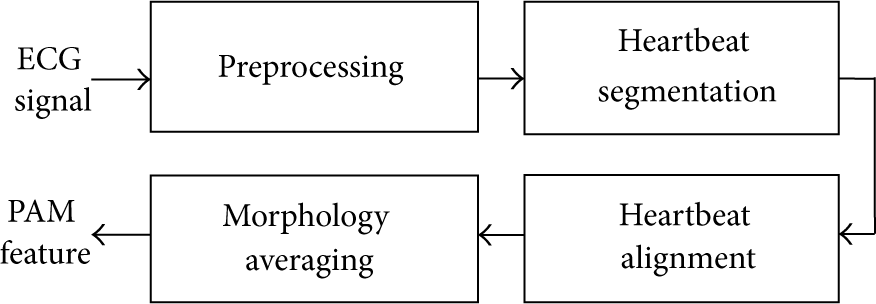
Block diagram of the feature extraction method.
3.1. Preprocessing
The heartbeat signal is often contaminated with different types of noise, such as power-line interface, baseline wander, and patient-electrode motion artefacts [11, 23]. In the preprocessing step, noise is removed by a band-pass Butterworth filter [11, 30] of order four with cut-off frequencies of 0.25 to 40 Hz.
3.2. Heartbeat Segmentation
To extract the PAM feature, we use a preprocessed heartbeat signal with several regular heartbeats. Such a regular heartbeat contains six segments, such as the P wave, P-R segment, QRS complex, S-T segment, T wave, and T-P segment, as shown in sequential order in Figure 3. The first three of these segments (P-wave, P-R segments, and QRS complex) are less affected by heart-rate variability [23, 28]. These segments together are named as the stable segment. The heart-rate variability strongly affects the duration of T wave and T-P segment. Moreover, the S-T segment is often deformed by different cardiac conditions. These three segments together are named as the flexible segment. Considering the difficulties in identifying the onset of P-wave and offset of QRS complex [23], we defined [26] P-S as the stable segment and S-P as the flexible segment of a P-P heartbeat, as shown in Figure 3.

Six segments of regular P-P heartbeats and stable (P-S) and flexible (S-P) segments.
We first detect the QRS complex by a curvature-based method [7, 31] which requires linear computational time. R is detected as the peak of this complex. Then, Q-peak and S-peak are detected as the minima before and after, respectively, within a window of 75 milliseconds from the R-peak. Finally, P-peak is located before the Q-peak as the maximum within a window of 170 milliseconds. We obtain a P-P heartbeat by concatenating the consecutive P-S and S-P segments. Figure 4 shows the result of the heartbeat delineation process of a ten-second heartbeat signal obtained from “ptbdb.”
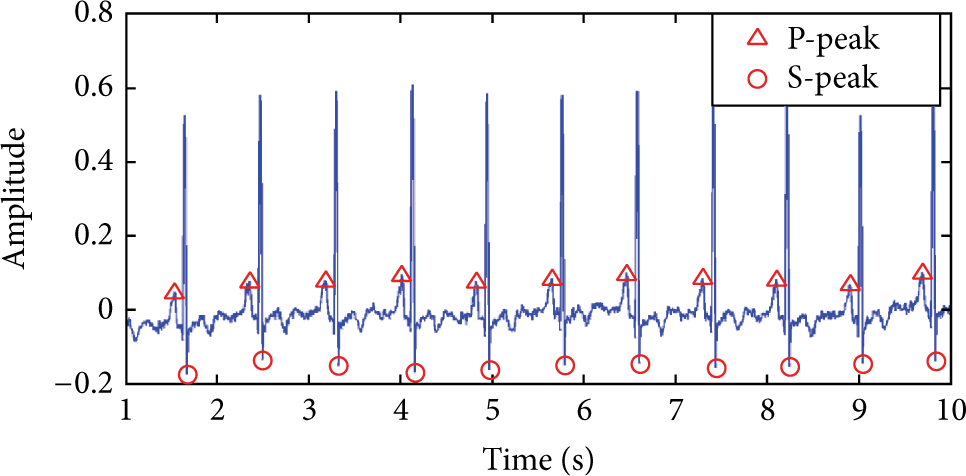
Result of heartbeat delineation of a ten-second heartbeat signal obtained from the patient007_s0026lre record of “ptbdb.”
3.3. Heartbeat Alignment
It is observed that the change of a heartbeat due to the heart rate variability (HRV) is not uniform all over a heartbeat [26]. The flexible segment is more affected than the stable segment. Thus, in the piecewise-uniform alignment method [26], stable and flexible segments of the heartbeat are resampled with two different rates such that the resampling rate becomes uniform for the same segments in all heartbeats. We obtain resampling rates

Srikanth et al. [32] investigated different time and frequency domain resampling methods. It was found that polynomial interpolation is preferable to the FIR filter-based method in terms of simplicity, speed, and accuracy. This method is especially suitable for the piecewise alignment method, as we further divide a heartbeat into smaller segments. This is because polynomial interpolation does not distort the waveform at the start and end of the signal, as does a FIR filter. The resampling of a heartbeat segment with n samples can be carried out by determining a unique polynomial of degree

We prefer to use a lower-order polynomial as it depends on the smaller neighborhood of the interpolating point. In fact, in different biometric applications, the cubic (i.e.,
3.4. Morphology Averaging
After segmentation and alignment, we obtain a sequence of isolated heartbeats, each with an equal number of samples (i.e., r samples). The amplitude of each of the heartbeats

In this way, the dimensionality of a feature becomes equal to the resampling rate r for any length of the heartbeat signal. We also extract features from heartbeats aligned by two other methods (such as uniform and nonuniform), so that we can compare their performance in biometric verification experiments.
3.5. Matching
Suppose that we have p persons for a verification system. For each person in the system, we construct a gallery feature

In the testing phase, a single probe feature

3.6. Experimental Results
We tested the biometric verification method on digital heartbeat signals obtained from “ptbdb” [29]. This database contains ECG records of persons in the age range of 17–87. We used 100 records [26] of sixty seconds in which most of the heartbeats are regular in the sense that they contain all six segments. The sampling frequency of the ECG records is 1000 Hz. In our experiment, each of these records was divided into five signals of twelve seconds. Each signal was segmented into heartbeats that were aligned with three methods: uniform, nonuniform, and piecewise-uniform. The resampling rate for alignment is a predefined constant (integer) which should be in the range of 60%–70% of the original sampling rate to keep the root-mean-squared (RSM) error at a minimum level [26]. In all three methods, we used the resampling rate
In order to evaluate the performance the proposed feature, we repeatedly tested the verification method with five different gallery sets. We selected one of the five signals as the gallery signal and the remaining four as probe signals for each person, and we computed the EER. The experiment was repeated five times for a given number of heartbeats (e.g.,

Average verification EER with different number of heartbeats.
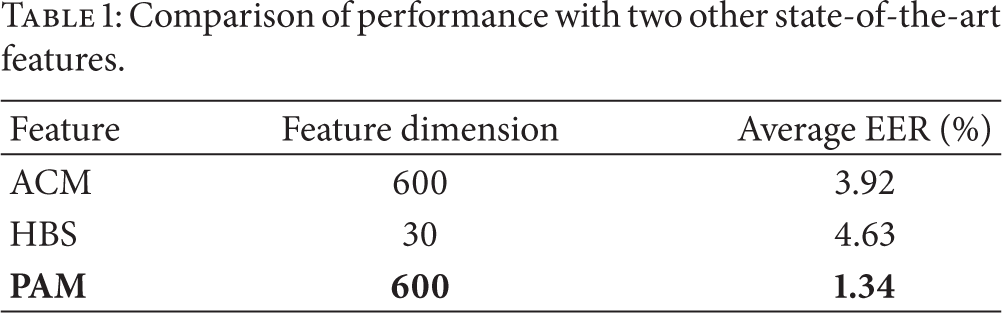
We also compared performance of PAM feature with those of two other morphological features: (i) autocorrelation of morphology (ACM) [10, 33] and (ii) heartbeat shape (HBS) [24]. In this work, we considered the autocorrelation of the piecewise-aligned heartbeats for use in verification. Normalized autocorrelation of a heartbeat is defined as

The thirty-dimensional HBS feature [24] was computed from nine consecutive piecewise-aligned heartbeats. The resampling step of the HBS feature computation method was replaced by the piecewise-uniform resampling method. The steps to compute the features from piecewise-aligned and normalized morphology were as follows. We computed the second derivative of the heartbeats and smoothed it with a Gaussian kernel. We computed the average of smooth derivative for nine consecutive heartbeats. We formed a thirty-dimensional feature vector by dividing r samples into thirty bins according to the amplitude of the average of smooth derivative.
We used the Euclidean distance for the PAM and ACM features and the
Comparison of performance with two other state-of-the-art features.
4. Discussion and Conclusion
Remote authentication is important for many applications such as distance health care services. Inclusion of biometric verification in the remote authentication scheme has introduced the vulnerability to spoof attacks by fake biometric samples. In this work, we proposed the use of heartbeat signal for remote authentication as a possible defense against such spoof attacks. A distributed network of sensor embedded mobile computing devices is considered for capturing and processing biometric signals. Such a device can also reduce the requirement of a traditionally used smart card which has very limited computing power. So the authentication process becomes more convenient for the users. For the remote authentication, we have adopted the state-of-the-art scheme having many security features. Hence the proposed method offers additional security. Moreover, we have described the biometric matching method for user verification instead of just using cryptographic hash function for feature matching. So this method becomes more robust against noisy biometric input.
We considered the use of heartbeat signal as a biometric modality for its liveness property as it cannot be captured from fake biometric modalities or deceased body parts. A piecewise-aligned morphology of the heartbeat signal is used as a biometric feature. This feature was tested for verification of 100 users whose records were obtained from a publicly available database. It can be observed from Figure 5 that the piecewise alignment improves verification performance significantly compared to uniform and nonuniform methods. This is because in the piecewise alignment method, the resampling of one part is not affected by the nonuniform change in other part and hence it helps to preserve the intraindividual similarity of different heart beats. We have also tested the verification performance for increasing number of heartbeats. It can be observed that with nine regular heartbeats, we obtained credible verification EER. We also compared the verification performance for two other existing features on the same dataset. The verification performance of the proposed PAM feature outperforms those two features as shown in Table 1. Due to the use of the curvature based segmentation (Section 3.2) and cubic polynomial interpolation (Section 3.3), this feature becomes efficient enough to be computed by mobile devices. Due to the use of the average heartbeat (Section 3.4), the data size for the gallery and probe feature is also sufficiently small to be stored in mobile devices and transmitted via wireless media.
As a future work, we consider setting up a test-bed to evaluate the proposed remote authentication scheme for its robustness against spoof attacks and noisy biometric inputs. Using this test-bed, it will be also possible to compare the performance of heartbeat biometrics with traditional biometric modalities. In this work, we tested the proposed biometric verification method on selected ECG records with regular heartbeats. However, morphological irregularities can occur due to different cardiac conditions. In future, we also plan to extract robust features from heartbeat signals captured in different cardiac conditions.
Footnotes
Conflict of Interests
The author declares that there is no conflict of interests regarding the publication of this paper.
Acknowledgment
This work has been supported by the Research Center, College of Computer and Information Sciences, King Saud University, Riyadh, Saudi Arabia. The author is grateful for this support.