




Abstract
From reflectometry methods, this work aims at locating accurately electrical faults in complex wiring networks. Increasing demand for online diagnosis has imposed serious challenges on interference mitigation. In particular, diagnosis has to be carried out while the target system is operating. The interference becomes more even critical in the case of complex networks where distributed sensors inject their signals simultaneously. The objective of this paper is to develop a new embedded diagnosis strategy in complex wired networks that would resolve interference problems and eliminate ambiguities related to fault location. To do so, OMTDR (Orthogonal Multi-tone Time Domain Reflectometry) method is used. For better coverage of the network, communication between sensors is integrated using the transmitted part of the OMTDR signal. It enables data control and transmission for fusion to facilitate fault location. In order to overcome degradation of diagnosis reliability and communication quality, we propose a new sensor clustering strategy based on network topology in terms of distance and number of junctions. Based on CAN bus network, we prove that data fusion using sensor clustering strategy permits to improve the diagnosis performance.
1. Introduction
In the era of Internet of Things, the presence of wired networks remains a fundamental pillar for the transmission of electric energy or information. Whether they are used in aerospace, automotive, telecommunications, or even energy distribution, cables are victims of their environment. In fact, they often face aggressive conditions such as mechanical vibration, thermal stress, and moisture penetration. These conditions cause the appearance of faults with different severity levels ranging from a simple fissure in the cable sheath to the crack of the cable. This has led to several researches related to diagnosis methods for fault detection and location such as X-ray, visual inspection, infrared thermal imaging, and continuity measurement [1]. Moreover, the complexity of wired networks has increased due to the appearance of the “X-by-Wire” technology, replacing mechanical and hydraulic components by programmable electronic systems for steering, braking, suspension, and so forth. This trend is also present in avionics known as “Fly-by-Wire” where the embedded electrical power has moved from 320 kilo Watts (kW) in an Airbus 320 to 800 kW in an Airbus 380. The increasing number of embedded electronic systems has led to the increase of the length of the cables that connect them: up to 530 km in an Airbus 380. Indeed, the increase of the complexity of wired networks leads to the increase of the difficulty of their maintenance that becomes not only problematic but also expensive. The loss in efficiency of maintenance may result in the appearance of serious faults in cables.
Cable faults can have tragic consequences when the cables are part of critical systems such as aircrafts and nuclear plants. For example, cables have been considered responsible for the crash of TWA Flight 800 (1996) and Swissair 111 (1998). This has led to the need of permanent diagnosis for detecting and locating the first signs of weakness in the cables as soon as possible in order to avoid dramatic accidents. This need for a permanent diagnosis involves the integration of the diagnosis function in the system where wired networks operate, called embedded diagnosis [2]. It implies serious constraints related to the diagnosis performance optimization (i.e., fault location precision), integration difficulty, and the diagnosis system (or sensor) reliability. To do so, the most appropriate method is reflectometry. It consists in injecting a test signal at an extremity of the wired network under diagnosis. This signal propagates along the network and each impedance discontinuity encountered (junction or fault) sends a part of its energy back to the injection point. Finally, the analysis of the reflected signal permits to detect, locate, and determine the nature of the fault(s).
The interest of the embedded diagnosis is that it performs network diagnosis concurrently to the normal operation of the target network (i.e., communication, energy distribution, etc.). This is called online diagnosis. This implies additional constraints related to the diagnosis harmlessness [3]. In fact, test signals must not interfere with the useful signals. To do so, the choice of the injected signals must be judicious to avoid the frequency bands used by the target system and called prohibited bandwidth. In the literature, several methods have been proposed to resolve interference problems such as Sequence Time Domain Reflectometry (STDR) [4], Spread Spectrum Time Domain Reflectometry (SSTDR) [5], Noise Domain Reflectometry (Noise Domain Reflecometry) [6], and Multi-Carrier Time Domain Reflecometry (MCTDR) [7]. Recently, a new method called Orthogonal Multi-tone Time Domain Reflecometry (OMTDR) has been proposed [8]. It applies the principles of Orthogonal Frequency Division Multiplexing (OFDM) to wired network diagnosis. The idea is to divide the bandwidth into multiple subbands using orthogonal and then overlapped subcarriers which permits to maximize the spectral efficiency and total spectrum control. Then, the prohibited frequency band may be avoided by canceling the corresponding tone of the OMTDR signal.
Even if reflectometry has proven its efficiency in detecting and locating faults in simple wired networks (i.e., transmission line), it may suffer from ambiguity problems in the case of complex wired networks. In fact, using a single sensor is no longer possible to cover the whole network. This may be explained by the signal attenuation due to the traveled distance and multiple junctions. Although the distance between the injection point and the fault may be determined, the identification of the faultive branch remains ambiguous. As a solution, a distributed diagnosis is used. The idea is to implement several sensors at different extremities of the network in order to maximize the diagnosis coverage. However, as multiple sensors are making measurements simultaneously, specific signal processing methods are required to avoid interference between concurrent sensors [9, 10]. To do so, we propose a new subcarriers allocation method using OMTDR reflectometry. This solution permits to offer the same perspective of the network to all the sensors and then enhance the diagnosis reliability.
In the context of distributed diagnosis, we propose to integrate communication between sensors via the transmitted part of the test signal which has never been done with conventional methods [9, 10]. For this reason, the test signal must be capable of carrying information which is the case of OMTDR method [11]. The fusion of all this information, based on master/slave protocol, provides unambiguous location of the fault in complex wired networks. Moreover, it may provide information about the health state of the sensors in the network. However, we may also be facing diagnosis reliability and communication quality degradation due to the signal attenuation during its propagation. As a remedy, we propose a new sensor clustering strategy based on the distance and number of junctions. The data fusion using sensor clustering permits to improve the diagnosis performance in complex wiring networks.
The remainder of this paper is organized as follows. In Section 2, wiring fault diagnosis using reflectometry is introduced. In Section 3, OMTDR method is described. Even if OMTDR has proven its efficiency in simple topology, it may suffer from ambiguity problems in complex wiring networks as shown in Section 4. As a solution, distributed diagnosis is applied. However, this imposes serious challenges related to interference mitigation. For this reason, we propose in Section 5 a new subcarrier allocation method using OMTDR method. After interference mitigation, we propose in Section 6 to integrate communication between sensors based on OMTDR method to enable data fusion. In the case of complex wiring networks, we propose in Section 7 a sensor clustering strategy based on the distance and number of junctions in the network. Finally, experimental results are presented in the next section in order to evaluate the performance of the proposed strategy using real signals.
2. Wiring Faults Diagnosis Using Reflectometry
For many years, a wire has been considered as a system that could be installed and run for the life of the system in which it operates. However, this practice has rapidly changed with the observation that wires are victims of wear and can experience some failures. These failures can cause the appearance of serious faults such as loss of electrical signal, distortion of information, system malfunction, smoke, and fire. Unfortunately, these faults can have dramatic consequences if the wires are part of critical systems. Based on collected data by the Air Force Safety Agency (AFSA) between 1989 and 1999, cables are responsible for many accidents in aircraft [12, 13]. The problems in the cables can also implie huge costs. In 2004, the US Navy had to abort more than 1400 missions because of wiring problems and keep about 2% to 3% of its fleet grounded for the same reasons [1]. The cost of maintaining an aircraft on ground was estimated by several airlines at 150 000 dollars per hour. In fact, the most frequent causes of fault appearance are insulation aging, mechanical stress, thermal stress, moisture, and so forth. According to NASA [14], 80% of faults are caused by human intervention. Indeed, a maintenance operator may have to use cables as ladders to reach inaccessible areas during maintenance operation. These factors cause considerable changes in the intrinsic parameters of the cable and result then in the appearance of faults. Depending on their severity, faults in cables can be divided into two major groups: hard faults and soft faults. On the one hand, hard faults are characterized by an interruption of the energy or information circulation in the damaged cable. They include open circuit and short circuit. On the other hand, soft faults result in a small variation in the characteristic impedance of the cable caused by sheath crack, conductor degradation, and so forth. These faults do not always lead to catastrophic incident as they do not interrupt energy or information circulation, but can generate hot spots and hard faults in over the long term due to mechanical stress, moisture penetration, thermal stress, or even cable aging. An efficient diagnosis system is mandatory to detect and precisely locate the fault(s).
In this context, various methods have been studied such as visual inspection, X-rays, capactive and inductive methods, and reflectometry. While the visual inspection is commonly used, it is inefficient in complex wired networks. It can detect only 25% of faults present in an aircraft [14] when a large portion of the wired network is hidden by huge structures such as electric panels, components, or other cables. The X-ray inspection requires the use of heavy equipment, direct access to cable, and human intervention for data analysis. Both methods, capacitive and inductive, are efficient in the case of of point-to-point cable diagnosis but remain limited in the case of complex wired networks. In addition, they can be used only if the cable is offline. Table 1 summarizes the main advantages and disadvantages of those methods. Among all known diagnosis methods, reflectometry appears to be the most promising one.
Comparison of diagnosis methods: The white smiley face: the method detects the fault. The black smiley face: the method detects the fault under conditions. The white sad face: the method does not detect the fault.

Reflectometry includes two main families: Time Domain Reflectometry (TDR) and Frequency Domain Reflectometry (FDR). On the one hand, TDR injects periodically a probe signal and the reflected signal is basically made of multiple copies of this signal delayed in time. For each copy, the delay is the round trip time necessary to reach the discontinuity from the injection point. This signal is called “reflectogram” [15]. So, the knowledge of the propagation velocity and the time delay of each copy permits to locate the corresponding impedance discontinuity. On the other hand, FDR injects a set of sine wave called chirp [16–18]. Then, the analysis of the standing wave permits to give information about the fault location. This analysis becomes difficult to interpret in the case of complex wiring network. For this reason, TDR is more interesting than FDR in complex wiring networks.
3. Orthogonal Multi-Tone Time Domain Reflecometry
The multicarrier modulation Frequency Division Multiplexing (FDM), used by reflectometry MCTDR, divides the bandwidth into several subbands using subcarriers. These subcarriers must be separated by a guard band to avoid interference problems. This leads to nonoptimal use of the available bandwidth. Indeed, up to 50% of the bandwidth is used by the interband intervals [19, 20]. Orthogonal Frequency Division Multiplexing (OFDM) is an interesting modulation technique permitting reducing those guard intervals and then bandwidth loss. This technique is well known in the fourth generation cellular networks such as Long Term Evolution (LTE) and Worldwide Interoperability for Microwave Access (WiMAX) 802.16, thanks to its capacity to achieve a very high data rate transmission. The idea is to divide the total bandwidth using orthogonal and then overlapped subcarriers which permits to maximize the spectral efficiency and interference mitigation.
3.1. Modeling and Functional Description of OMTDR Signal
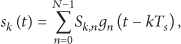
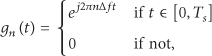
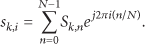
The OFDM technique consists in dividing the bandwidth B using N subcarriers modulated independently by a Quadrature Amplitude Modulation with M states (M-QAM). The M-QAM modulation is a digital modulation that changes the amplitude and the phase of each subcarrier according to binary information to be transmitted on it. In the OMTDR method, the test signal injected down the wiring network is defined as


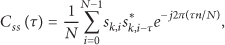
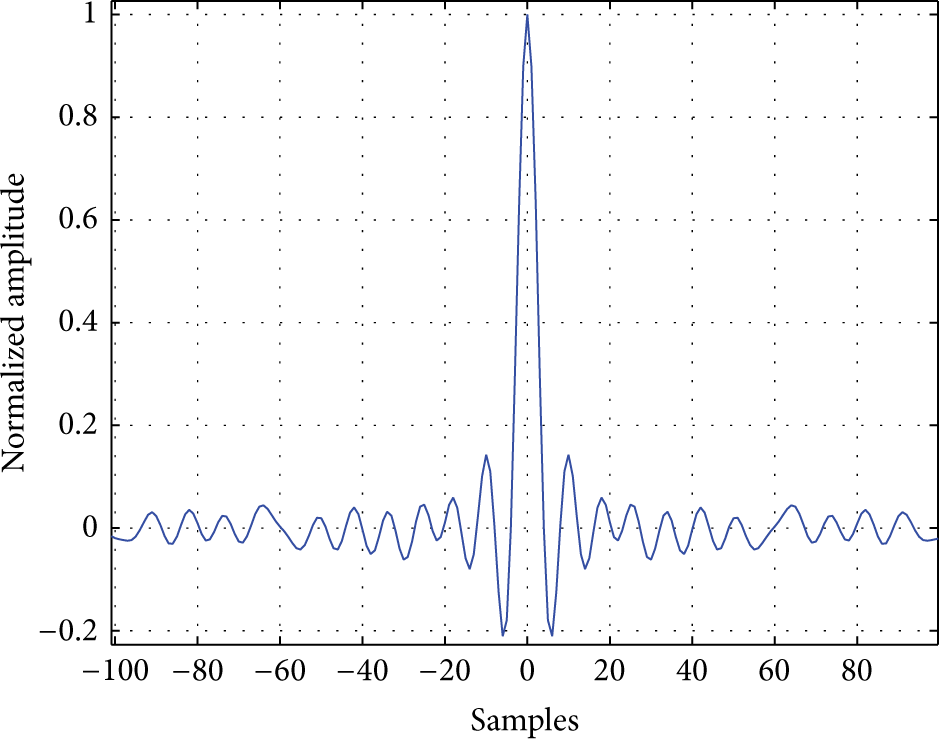
Autocorrelation function of the OMTDR signal in the case of 512 samples and 4-QAM modulation.
Online diagnosis provides the possibility of performing the diagnosis concurrently to the normal operation of the network. However, it imposes serious challenges related to Electro-Magnetic Compatibility (EMC) constraints. When the energy of the test signal should be limited in some frequency bands, the corresponding coefficients 
3.2. Analysis of the Measured Signal Using OMTDR Method
The received signal is represented as the convolution between the test signal and the channel impulse response 


Obtained reflectogram where samples
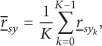
The estimation of this missing information requires a specific postprocessing. To do so, we propose here to introduce an averaging step for multiple OFDM symbols as follows:

Obtained reflectogram after averaging where samples
As mentioned above, the presence of side lobes (Figure 1) is unsuitable to detect and locate soft faults mainly in complex wiring networks. To improve the analysis of the reflectogram, we propose to introduce a convolution between the measure 

Obtained reflectogram after postprocessing where samples
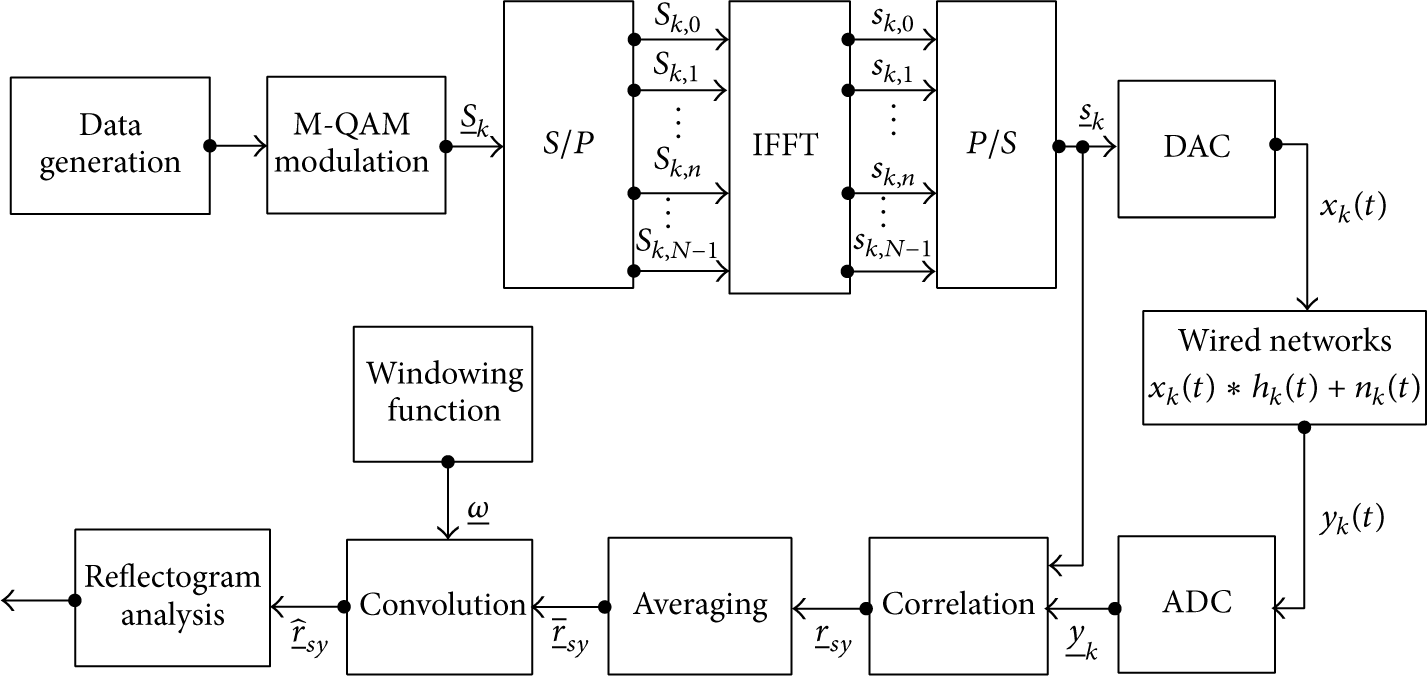
Principle of OMTDR reflectometry for online diagnosis.
4. Fault Location Ambiguity Problems in Complex Branched Networks
In complex wiring network, using a single sensor is no longer possible to cover the whole network. This may be explained by the signal attenuation due to the distance and multiple junctions. Although the distance between the injection point and the fault may be determined, the identification of the defected branch remains ambiguous. To illustrate this, Figure 7 shows the computed reflectogram for the branched network of Figure 6 with an open circuit fault at 25 m from the injection point. Only one reflectometer is placed at the extremity of
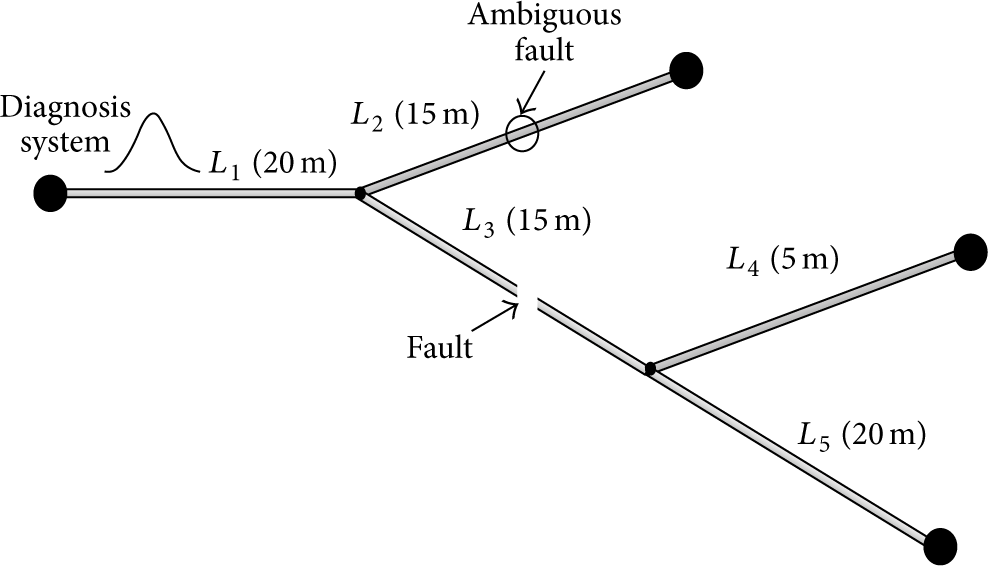
Fault location ambiguity in a branched network.

Reflectogram using TDR method.
5. A New Subcarrier Allocation Method for Interference Mitigation
The use of OMTDR signal made of orthogonal subcarriers allows the avoidance of an interference by allocating a different set of available subcarriers to each sensor. The conventional method is to allocate to each sensor a set of adjacent subcarriers. Figure 8 shows a spectrum of OMTDR method whose subcarriers are divided into three sensors

Example of adjacent subcarriers allocation.
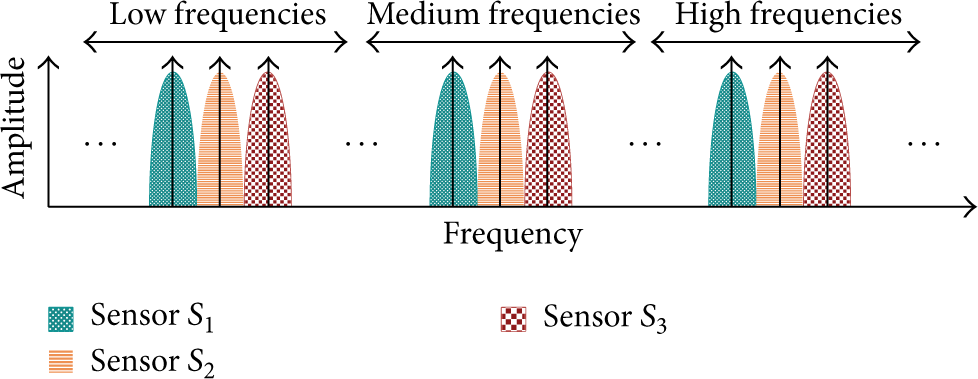
Example of distributed subcarriers allocation.
In the example in Figure 9, the subcarriers are alternately allocated to one of three reflectometers

Reflectogram of

Reflectogram of

Reflectogram of
After interference mitigation in distributed reflectometry, we propose now to integrate communication between sensors via the transmitted part of the test signal which has never been done with conventional methods [9, 10]. For this reason, the test signal must be capable of carrying information which is possible thanks to the OMTDR method [11]. The fusion of all this information, based on master/slave protocol, provides unambiguous location of the fault in complex wired networks as shown as follows.
6. Data Fusion for Wire Fault Location
In this section, we propose to integrate communication between sensors to enable data fusion in the context of distributed diagnosis. For this reason, we propose to use not only the reflected part of the diagnosis signal, but also the transmitted part. A signal carrying information is then used as test signal to enable reflectometry measurement and communication through the OMTDR technique. To do so, let us begin with the structure of the test signal.
6.1. Frame Description
As the test signal is carrying information, the data is formatted into frames themselves subdivided into 9 fields. The frame is delimited by a Start Of Frame (SOF) (8 bits) and an End of Frame (EOF) (8 bits) field. Each sensor is identified in the network by an ID (16 bits). Then, the field CMD (8 bits) reveals the nature of the frame (data or request). The field DLC gives the length of the transmitted data that may vary between 21–53 bytes. Cyclic Redundancy Check (CRC) is used for error detection as shown by Figure 13 and ACK to acknowledge the good receipt of the message.

A frame structure.
After having described the frame structure, we propose now to classify the distributed sensor into two groups: master and slave.
6.2. Classification of Sensors
In master/slave protocol, the choice of the master is crucial to ensure the efficiency of the proposed diagnosis strategy. To do so, we propose to assign a weight of eligibility to each sensor for sensor classification. In fact, the reflectogram's quality depends strongly on the network topology in terms of distance and number of junctions [1]. The same remark holds for the communication quality. We propose now to study the impact of network topology on communication quality. We focus only on the number of junctions in the network. Recall that a junction causes the reflection of a part of the energy of the transmitted signal. Figure 14 shows the different topologies considered in order to calculate the BER. For this, the distance between the transmitter and the receiver is set to 10 m and the SNR is 10 dB. Figure 15 shows the evolution of the BER versus the number of junctions in the network. It may be noted that the BER depends on the complexity of the network topology in terms of junctions number. Indeed, the increase of the number of junctions causes the increase of the attenuation of the signal during its propagation.

Evolution of the topology of the network.

Evolution of bit error rate in terms of junctions number.
Based on these findings, the weight of eligibility may be calculated by the following parameters.
The sum of distances The number of junctions
The weight of eligibility for sensor 
In fact, the minimization of the weight of eligibility reduces firstly the bit error rate and increases the diagnosis accuracy since it minimizes the attenuation of the test signal. Then, the sensor with the lowest weight of eligibility is designated as the master while other sensors are considered as slaves. Besides network diagnosis (signal injection, received signal processing, fault detection, etc.), the master must ensure the management of its slaves (synchronization, resource allocation, routing table, etc.), the information collection, data analysis, and decision making. For their part, slaves must do their diagnosis, identify the fault position, and send it to their master.
6.3. Automation of Fault Detection and Location
In this section, we propose to develop an algorithm to automate the detection and location of a fault. We propose firstly to generate a reference measurement obtained when the network is healthy. We propose to save in sensor memory only the position of the local extrema of the corresponding reflectogram to avoid the saturation of the embedded memory. The number of extrema in the reference is noted 

Algorithm for detecting and locating faults in a single measurement.
The algorithm described above allows automatic detection and location of a fault in a single reflectometry measurement. Indeed, saving only local extrema permits to optimize both processing time and memory capacity. Thereafter, the position of the detected fault is encapsulated in the field data of the frame to be sent to the master if the actual sensor is a slave.
6.4. Description of the Communication Protocol
The master noted

Scenario of the communication protocol.
Considering a soft fault with
When master
The data fusion, based on master/slave protocol, provides unambiguous location of the fault in complex wired network. Moreover, it may provide information about the state (i.e., out of service) of the sensors in the network. We propose to verify the efficiency of data fusion strategy in a CAN bus system.
6.5. Validation of the Strategy in a CAN Bus System
In this section, we consider the CAN bus system described in Figure 18. The network consists of six sensors

CAN bus system.
Firstly, we calculate the weight of each reflectometer using (13). Table 2 shows the weight of eligibility of each sensor.
Weight of eligibility of each sensor.

It may be noted that both sensors

Reflectogram of
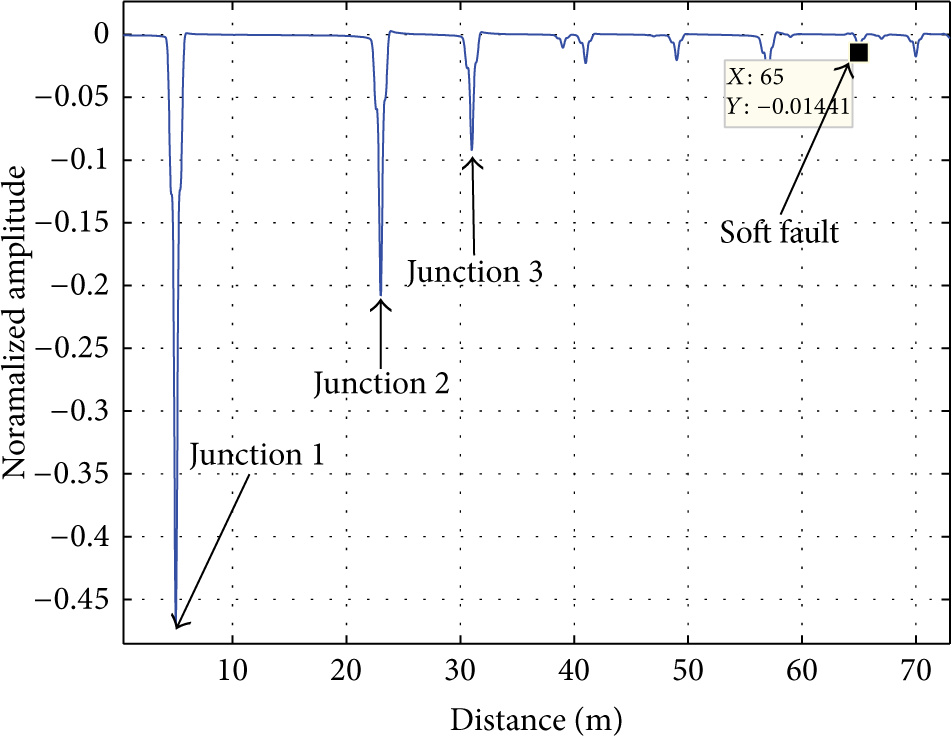
Reflectogram of
Table 3 shows the available data at master
Fault location on branch
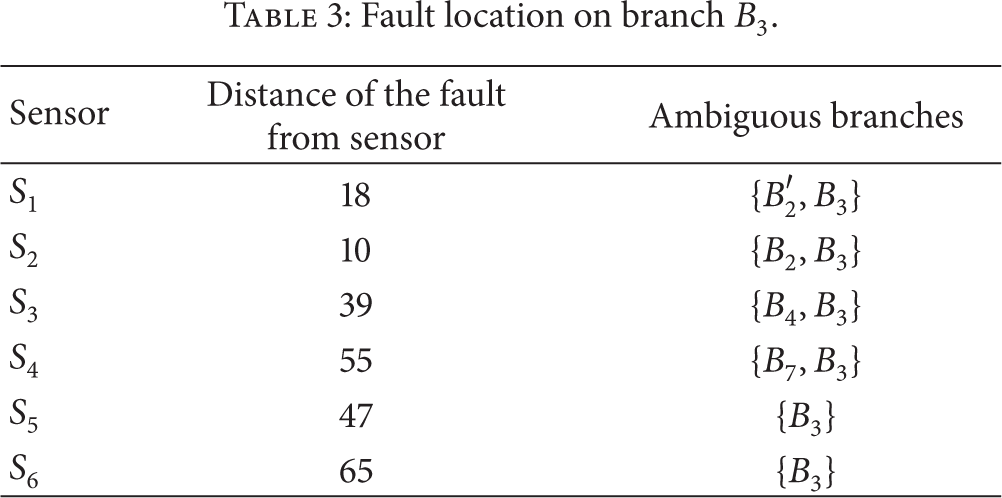
Sensor fusion is an innovative solution in the field of reflectometry. This can be achieved through the use of a signal carrying information thanks to the OMTDR method. The sensor fusion allows the centralization of information and facilitates decision-making about the fault location in the whole network.
We consider now the presence of a new soft fault on branch
Ambiguity of fault location.

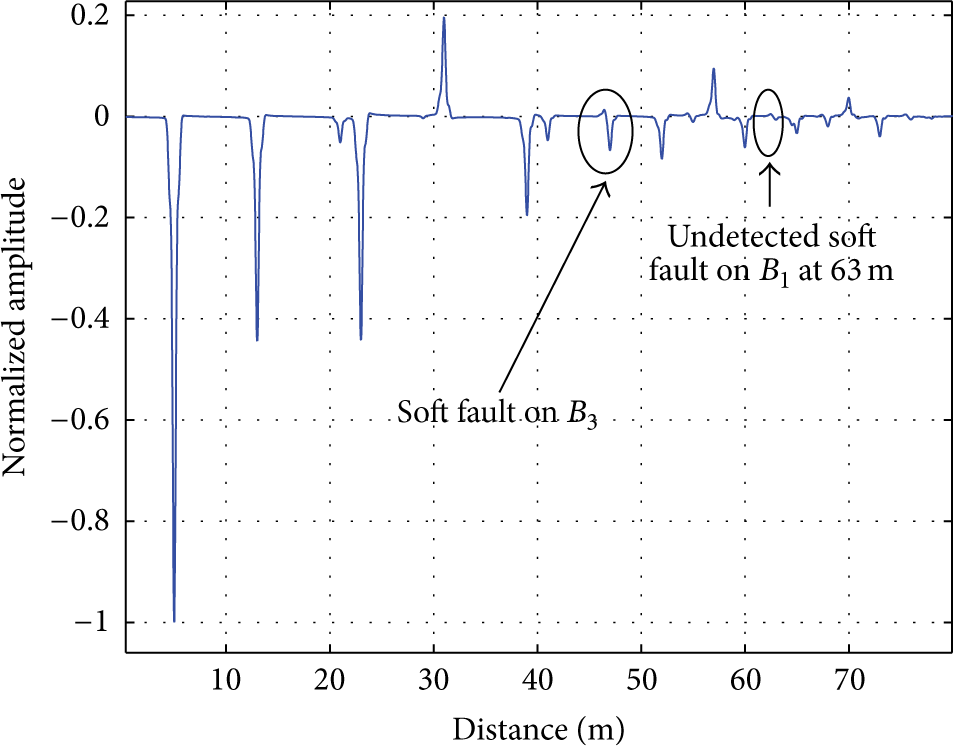
Reflectogram of

Reflectogram of
In the context of complex wiring networks, data fusion strategies suffer from signal propagation phenomena (attenuation and dispersion) which affect the diagnosis reliability for reflectometry measurement and data credibility for communication. In addition, the increase of complexity of the network topology comes with the increase of the amount of information, the time of information analysis and decision making. When a hard fault (open circuit or short circuit) appears, the master may be unreachable. As a solution, we propose a sensor clustering strategy.
7. Sensors Clustering in Complex Networks
In the case of complex topology, the network is divided into subnetworks with simpler topologies. We are talking here about sensor clustering. It consists in the network partition into clusters of one or more specific metric(s). Each cluster is controlled by a master to manage its slaves (synchronization, resource allocation, routing table, etc.), collect information, and make a decision on the fault location. Each slave is responsible for communication within the cluster but must also maintain information corresponding to neighboring clusters (e.g., the identifier of the master of a neighboring cluster, the path to join, etc.).
In fact, the communication and diagnosis qualities depend strongly on the distance and number of junctions. For this reason, we consider these two parameters in the clustering strategy. To do so, we consider that the maximum number of junctions between two sensors of the same cluster must be less or equal to 3. First of all (step 1), for each sensor, one or many set(s) of possible sensors satisfying the above condition is/are defined. In step 2, we propose to compute for each sensor the sum of distances between sensors of the same set. The list that presents the lowest distance is selected for each sensor in step 3. Finally, clusters may be defined based on the obtained sets.
To demonstrate the interest of sensor clustering in a complex network, we consider the CAN bus system shown on Figure 18. In order to define sensor clusters, we define for each sensor the set of sensors where the number of junctions is equal to 3. Then, we use the sum of distances for each set in order to choose the best set of each sensor. Based on the sum of distances in each set, it is possible now to select the best set of sensors for each sensor. Table 5 summarizes the strategy previously described.
Sensor clustering in CAN bus using the proposed strategy.

By considering the intersection between the different sets, we are able to divide the network into two clusters noted
Allocation of sensors and branches to clusters.

After sensors clustering, we propose now to identify the master for each cluster. Here, we consider only cluster
Calculation of the weight of eligibility of sensors of cluster

Table 8 shows the diagnosed branches of cluster
Diagnosed branches by

Figures 23 and 24 (top) show reflectograms obtained by
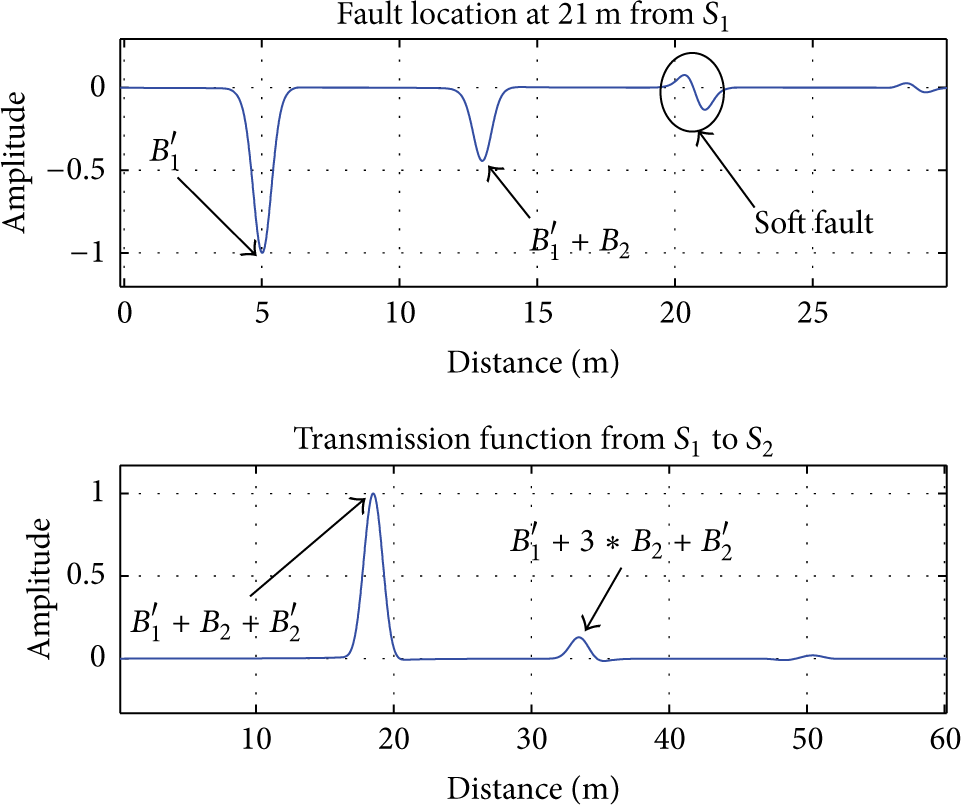
Fault location at 21 m from

Fault location at 10 m from
Based on its own information and that sent by its slaves

We consider now the presence of a second soft fault on
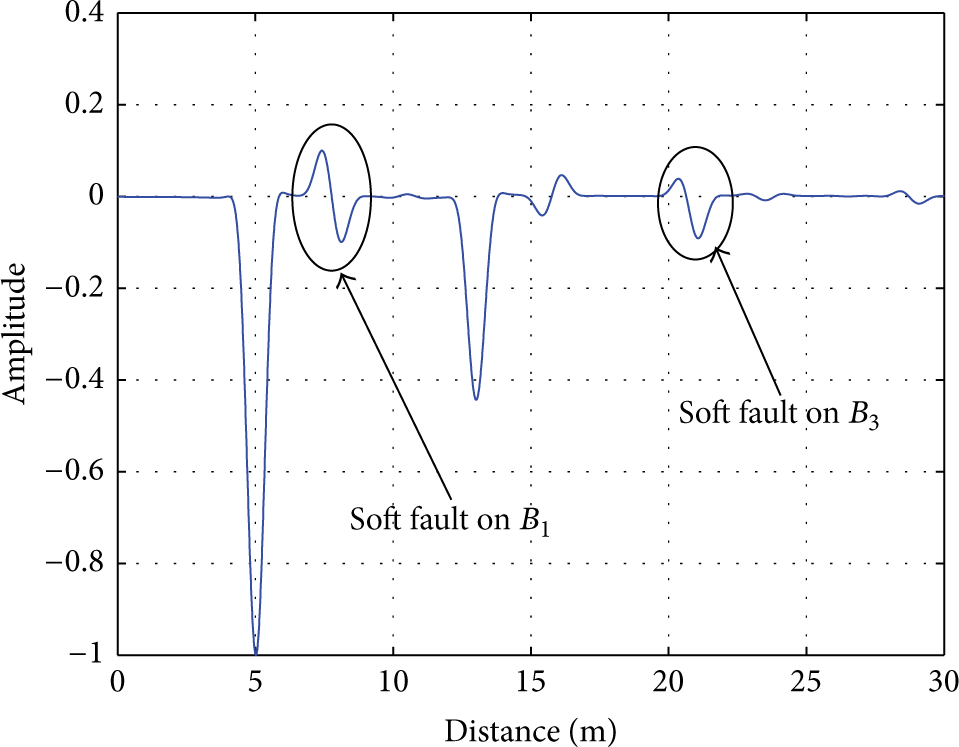
Fault location at 8 m from

Fault location at 29 m from
Based on its own information and that sent by its slaves
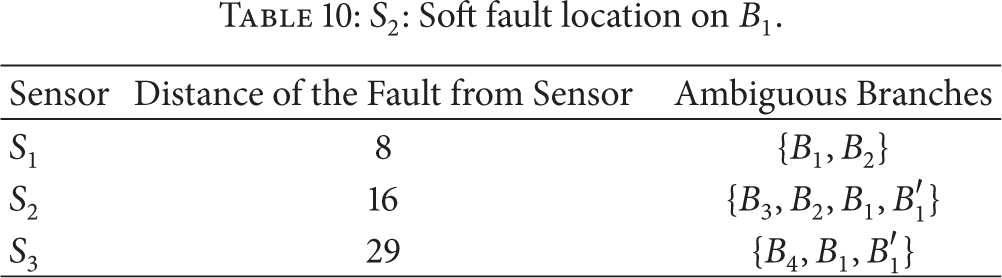
The sensor clustering strategy reduces the amount of information to analyze and consequently and decreases the processing and decision-making time. The clustering also reduces the communication quality degradation due to the increased bit error rate in the case of complex wired network.
8. Experimental Results
In this section, we propose to evaluate the performance of the clustering strategy using real networks. Figure 27 shows the considered system design. The OFDM signals are calculated offline in MATLAB and downloaded to a Tektronix AWG7122C Arbitrary Wave Generator. We should notice that real OFDM signals are obtained by constraining the input frequency symbols to the IFFT block to have an Hermitian symmetry [23]. The reflected signals and the corresponding reflectograms are obtained using an oscilloscope (LeCroy Waverunner 204MXi-A 2 GHz). The reflectogram is constructed using correlation function between the injected and reflected signals.
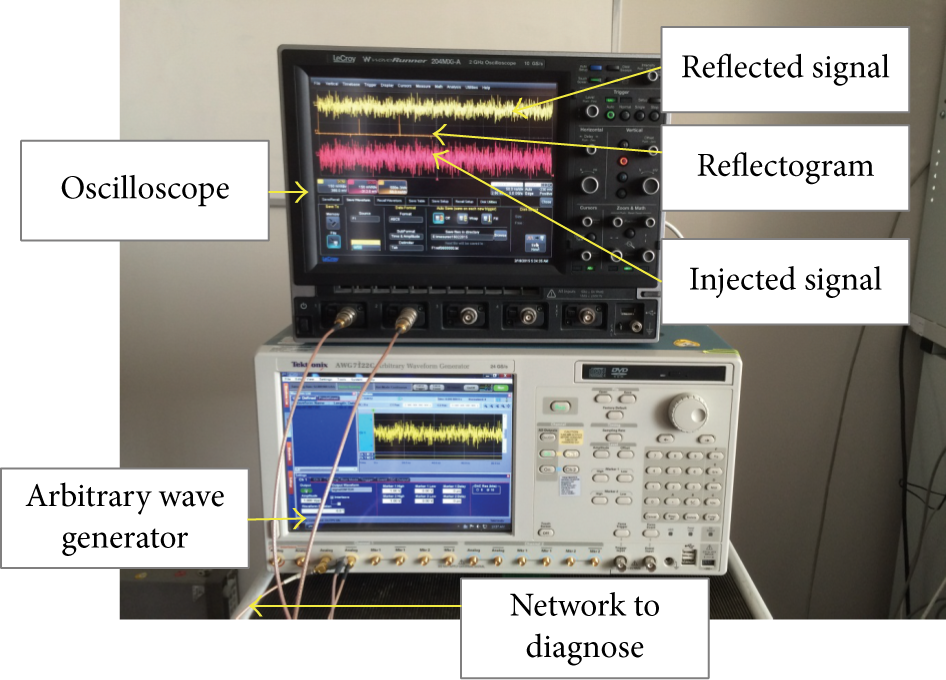
Experimentation system design: arbitrary wave generator (Tektronix AWG7122C) and oscilloscope (LeCroy Waverunner 204MXi-A 2 GHz).
In order to evaluate the performance of clustering strategy, we propose to consider the complex network topology described in Figure 18. It consists in multiple SMA cables with characteristic impedance 50 Ω noted from
8.1. Network Diagnosis without Clustering Strategy
In this case, we consider that the reflectometers

Diagnosed network by reflectometer
Figure 29 shows the reflectogram obtained by

Soft fault location by
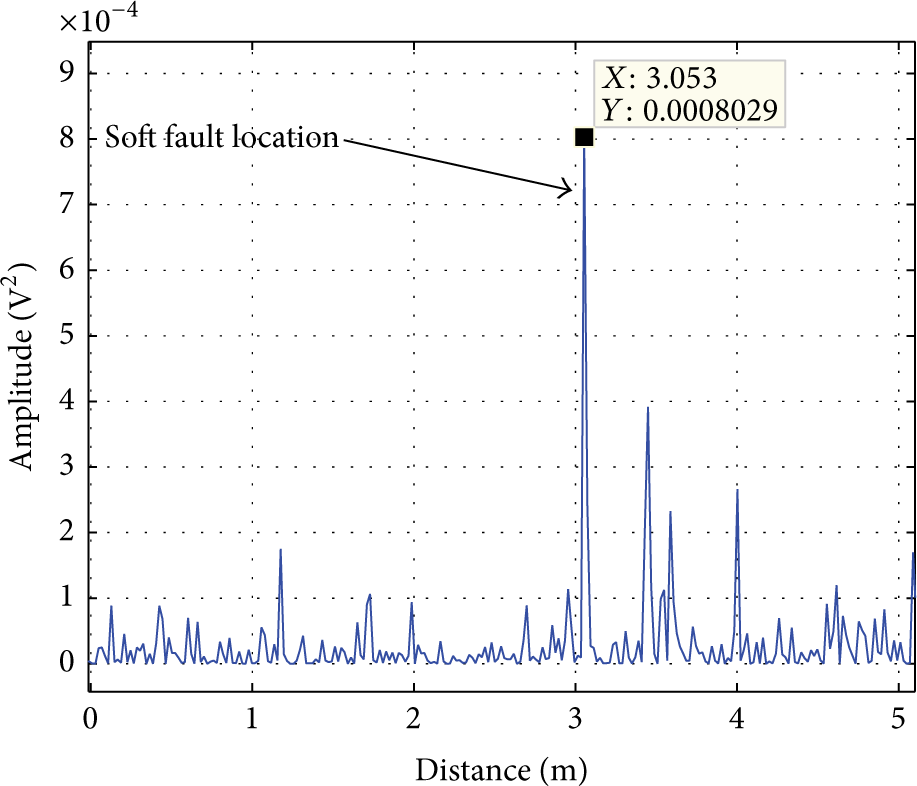
Slave
Figure 31 shows the reflectogram obtained by

Reflectogram of
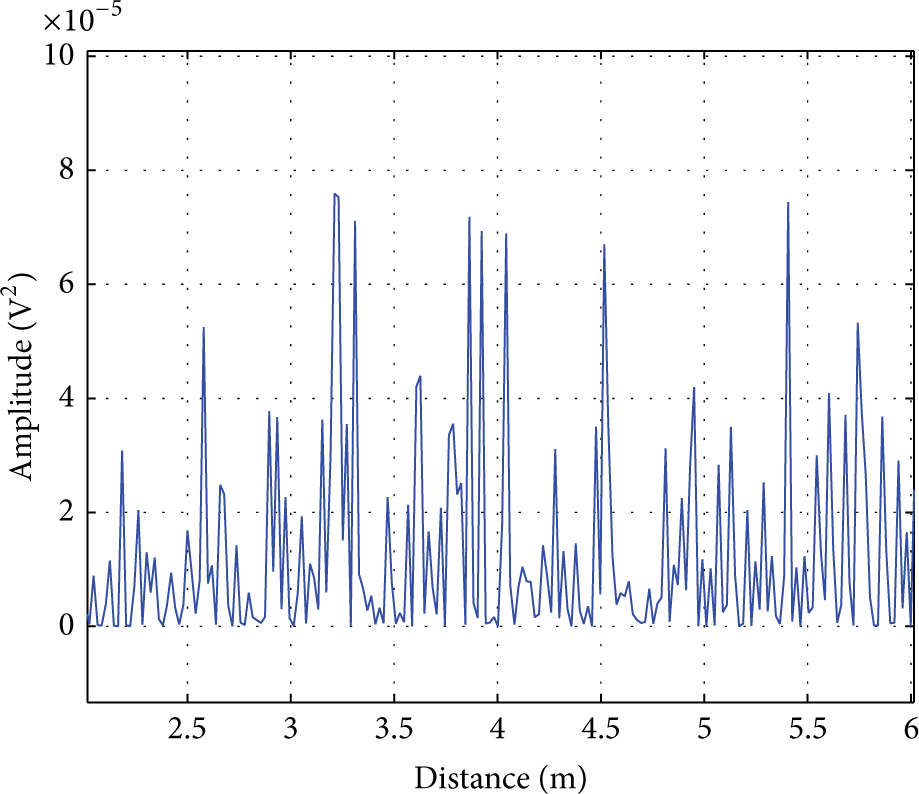
Impossibility of soft fault location by
In the case of complex wiring network (Figure 28), reflectometry method suffers from signal propagation phenomena (attenuation and dispersion) which affect the diagnosis reliability. As a solution, we propose to consider a sensor clustering strategy.
8.2. Network Diagnosis with Clustering Strategy
In clustering strategy, the complex network is divided into subnetworks with simpler topologies where each subnetwork is a cluster. Here, we consider the cluster

Diagnosed network by reflectometer
Figure 34 shows the reflectogram obtained by the slave

Reflectogram of

Slave
Figure 36 shows the reflectogram obtained by the slave

Reflectogram of

Slave
Figure 38 shows the reflectogram obtained by the master

Reflectogram of

Master
Based on its own information and that sent by its slaves

9. Conclusion
The current paper aimed at proposing and developing new strategies to optimize performance, cost, and reliability of diagnosis in complex wired networks. The increase of wired network complexity and its exposure to different aggressive conditions accelerates the appearance of faults on cables. Some faults can sometimes have serious consequences when the cables are part of critical systems. The need of embedded diagnosis to perform continuous monitoring was identified. We chose to use reflectometry for its natural ability to be integrated into an embedded system. In this context, we have introduced OMTDR method to maximize the spectral efficiency and interference mitigation thanks to the orthogonality imposed between subcarriers. To ensure online diagnosis, postprocessing steps have been presented to enhance reflectogram quality. Even if OMTDR has proven its efficiency in fault detection and location, it may suffer from ambiguity problems related to the fault location in the case of complex wiring networks. As a solution, we proposed to integrate communication between distributed sensors for data fusion. Indeed, OMTDR method uses a carrying information signal which permits to transmit data by considering the transmitted part of the test signal. The data fusion, based on master/slave protocol, may provide unambiguous location of the fault in complex wired network. Moreover, it may provide information about the health state of the sensors in the network. However, we may also be facing diagnosis reliability and communication quality degradation due to signal attenuation during its propagation. As a remedy, we proposed a new sensor clustering strategy based on the distance and number of junctions metrics. The sensor clustering permits to improve the diagnosis performance. In future works, a dynamic sensor clustering strategy will be proposed based on other metrics such as network/sensor state and bit error rate.
Footnotes
Conflict of Interests
The authors declare that there is no conflict of interests regarding the publication of this paper.