




Abstract
Wireless sensor networks (WSNs) have been used in the state monitoring and fault diagnosis (SMFD) of mechanical equipment as a new signal collection and transmission technology, which have attracted a lot of attention recently. By applying the WSNs to the SMFD, many problems existing in conventional wired monitoring are solved. This paper attempts to summarize and review the recent researches and developments of the SMFD in mechanical equipment based on WSNs, providing comprehensive references for researchers concerned about this topic and helping them identify further research topics. Firstly, constraints in the conventional wired monitoring and the superiority of using WSNs in fault detection and diagnosis of mechanical equipment are illustrated. The development process of the SMFD in mechanical equipment is briefly introduced. Then, the recent WSNs applications to the SMFD of mechanical equipment in China are reviewed and summarized in terms of the classifications, such as monitored parameters, monitored objects, and data fusion methods. Finally, the potential future research directions are identified. WSNs are the effective technology to overcome the current bottleneck of the application in the SMFD of mechanical equipment.
1. Introduction
With modern production scale expanding unceasingly, the structures and functions of all kinds of mechanical equipment become more and more complex. Since the degree of automation is higher than before, safe and trouble-free mechanical operation becomes more and more important in modern industrial production. Any fault or failure could cause serious consequences and great economic losses and even lead to catastrophic loss of life and the bad social influence [1]. Therefore, the state monitoring and fault diagnosis (SMFD) for equipment are of great significance to operate the machines.
Mechanical equipment fault diagnosis is referred to as judging the proper operation of the mechanical equipment being, determining the causes of failure and its location, and forecasting the state of the equipment under certain working conditions, depending on all kinds of information during the mechanical equipment running process. Figure 1 shows the basic principle of mechanical equipment fault diagnosis. Firstly, the measured mechanical equipment should be determined. Sensor nodes are placed at the specific point of the mechanical equipment to collect the data of vibration, noise, temperature, humidity, and so forth. These data are transmitted to the control center where signal processing is done. Some fault features are extracted from the signals. Secondly, the fault features are compared with those in the feature knowledge database which has been built up through mass historical fault data. If both of them are consistent, state recognition is executed to judge the type of the fault and find out where the fault point is. If the fault features are not included in the feature knowledge base, execute the task of diagnosis and decision. Diagnosis and decision are the last step. Its task is to deal with the faults by different measures according to different causes of faults.

The basic principle of mechanical equipment fault diagnosis.
The data of traditional fault diagnosis is transmitted by cables. There are some difficulties and potential troubles in cable placement, switches, and field equipment, such as wiring difficulties, large reroute engineering, immovable and vulnerable cable, and undesirable switch contact, which, to some extent, restrict the development of mechanical equipment SMFD. The merits and defects in cables and WSNs monitoring are listed in Table 1.
The comparison between wired and wireless data transmission.
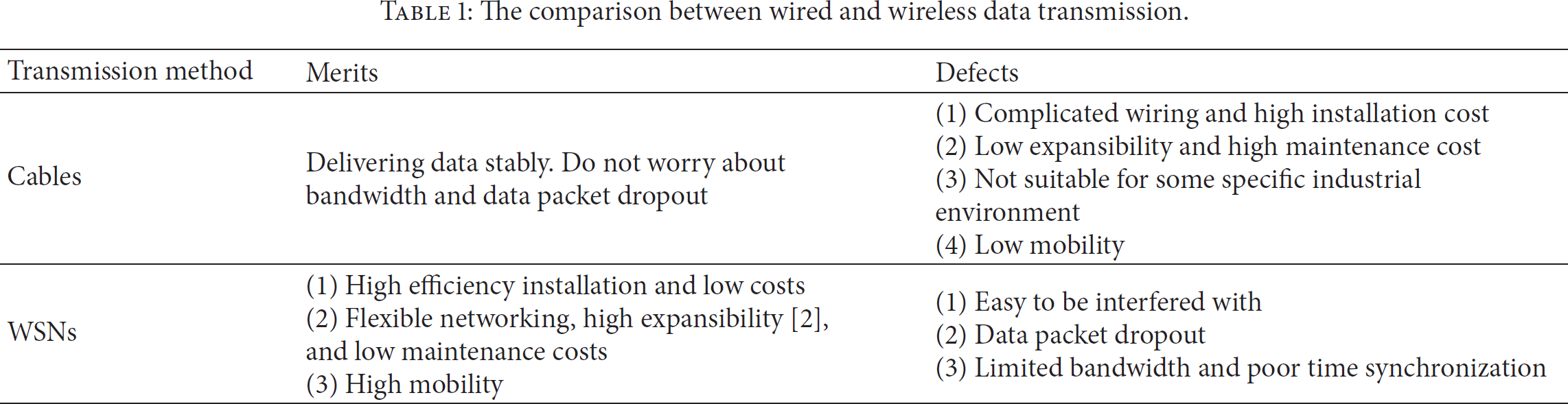
(1) Complicated Wiring and High Installation Cost. There are some factors that make the construction work more difficult, such as potholing and pipe laying to bury cables and wall bushing, broken off by power failure. A lot of cables and optical fibers are needed when placing transmission networks of the traditional equipment, which takes great efforts to wire and costs high expense in building and maintaining the monitoring network.
(2) Low Expansibility and High Maintenance Cost. When the reserved ports in the wiring can not meet the new demands, it had to add a new user. When signal attenuation phenomenon occurred in aged cables, these aged cables need to be replaced. The construction work in new wiring and replacement is very complicated; particularly the aged cables are difficult or importable to be replaced.
(3) No Suitability for Some Specific Industrial Environment. For example, in petrochemical equipment work fields, some wired network is limited by cables. In some extremely severe industrial circumstances the cables are incapable of being placed and cables should be completely shielded to prevent external interference. Moreover, data should not be transmitted from some equipment by cable for its high-speed rotating.
(4) Low Mobility. The monitored equipment in the traditional method can be moved only in local space because of the cables. It is hard to move monitored equipment to new mechanical equipment.
Acting as the developing focus of communication technology, WSNs technology is quite suitable for application in the industrial field due to its low cost, low power, dynamic route, free agreement, easy application characteristics, and so on. Applying WSNs in mechanical equipment SMFD has great advantages (as listed in Table 2) compared to traditional methods which are described as follows.
Categories of methods for FDD.

(1) High Efficiency Installation and Much Lower Comprehensive Cost. WSNs solve the problems in the wired network, such as cable placement and wall bushing. They improve installing speed and save the installation costs of the monitoring system. However, for its new things, WSNs equipment costs are relatively high in comparison with wired equipment. But on the whole, WSNs show benefits for the low installation costs and maintenance costs.
(2) Flexible Networking, High Expansibility, and Low Maintenance Costs. WSNs do not need any support from the fixed networks and have the characteristic of swift expansion and strong survivability [2]. They improve installing speed and save the installation fee of the system. When expanding the monitoring scope, some receiving and transmitting equipment can meet the demand. Countless wireless sensors can be arranged flexibly. The maintenance costs are relatively low. To some extent, it solves the problem of multisensor arrangement in wired monitoring.
(3) High Mobility. It can change the monitored positions flexibly according to the monitored demand because WSNs are not restrained by cables. Whole monitored equipment can even be moved to another similar piece of equipment easily.
However, WSNs technology has shortages such as easiness to be interfered with, poor data security, limited bandwidth, and poor time synchronization. However, WSNs show great advantages in mechanical equipment SMFD.
Certainly, diverse applications of wireless sensor networks (WSNs) in mechanical equipment SMFD have solved the problems of using cable technology on equipment condition monitoring. It not only is an effective supplement of wired technologies, but also helps to expand device monitoring range, improve the level of monitoring, and reduce the monitoring cost. The use of WSNs technology has opened up a new field of integrated application of the network technology, state monitoring, and fault diagnosis. Therefore, it is meaningful to further explore and renovate the methods of the mechanical equipment SMFD based on WSNs technology. We can predict that, in the near future, wireless transmission technology will be implanted in most of the industrial instruments and automatic system. Besides, development of WSNs technology will make great contribution to promoting revolution of industrial monitoring model [3].
The contributions of this paper are listed as follows:
This paper has collected the existing achievements of mechanical equipment SMFD using WSNs technique, especially in China. The achievements are summarized into three categories: the monitored parameters, monitored objects, and data fusion methods. It summarizes the existing problems of each kind in the researches. It predicts the research trend in the field of mechanical equipment SMFD based on WSNs. We hope to provide some ideas for people who are interested in the research of fault diagnosis based on WSNs.
The rest of paper is organized as follows. In Section 2, related studies of mechanical equipment are presented. We introduce the foreign research progress and Chinese research progress of mechanical equipment SMFD based on WSNs, in Sections 3 and 4, respectively. We discuss the achievements and problems in those studies in Section 5. Section 6 provides the potential research trends. Finally, Section 7 presents concluding remarks.
2. Related Studies of Mechanical Equipment SMFD
2.1. Major Theories in SMFD
Mechanical equipment SMFD are an important research aspect in advanced control area. This technology integrates the theory of control, mathematical statistics, pattern recognition, and artificial intelligence together, monitoring the processing status to find out where the faults are so as to do fault source separation. So far, fault detection and diagnosis (FDD) methods used in the industrial system have been primarily classified into three categories [64–69]: analytic model based method, artificial intelligence based method, and historical data based method. Table 2 lists the three methods including their representative types, pros, and cons.
(1) Analytic Model. Diagnosis method based on the analytic model has achieved abundant theoretical research results, which is one of the main streams at present and in the future. Analytic model includes deterministic model, stochastic model, and deterministic-stochastic model. Among them deterministic model is studied more frequently. However, stochastic model works better under the circumstance of correlated disturbances and dynamic interferences. Analytic model, which is based on the well-known accurate models, compares measuring information of the process and prior information. Then the residual error is analyzed and handled during the comparison procedure. Based on the residual error, diagnosis methods based on models can be classified into state estimation algorithm, parameter estimation algorithm, and parity space algorithm. Diagnosis method based on the analytic model takes full advantage of process running principal or experience and can detect and analyze faults better. However, it takes considerable time and effort to differentiate mathematical model and produce gap between model and real complicated problems.
(2) Artificial Intelligence. Diagnosis method based on artificial intelligence is a hot topic at present. It combines artificial intelligence and fault diagnosis, introduces qualitative information of diagnosis objects, and takes full advantage of expertise and experience including expert system approach algorithm, FAT algorithm, and SD algorithm. Diagnosis method based on artificial intelligence can imitate the function of the human brain and realize the fault diagnosis intelligence. This method has a bright and huge stage in the application of the complex nonlinear process. However, it still has the following defects: bottleneck for gaining knowledge, insufficient utilization of the dynamic information of the process, limited ability of handling unknown and mix faults, low speed, and large searching space which affect its real-time performance.
(3) Historical Data. Diagnosis methods based on historical data reflect the characteristics of process running status, extract input and output data according to the a priori information of the process system, and detect and diagnose faults based on the changes of the characteristic quantity. This method cannot work without historical data and is incapable of recognizing new faults. Diagnosis method based on historical data includes ANN, PCA, and wavelet transform algorithm. Due to high automation and instrumentation of the modern industrial systems, plenty of processing data has been preserved, and those data can be used by diagnosis method. This method is based on historical data to extract characteristic quantity of fault from mechanical equipment and build fault diagnosis model so as to accomplish fault forecasting and online monitoring for mechanical equipment.
2.2. Development Situation of Mechanical Equipment SMFD
Mechanical equipment fault diagnosis is roughly concluded in the following three stages [70]. Firstly, the original stage of fault diagnosis is based on the different fault events. The main drawback is that this method cannot prevent losses caused by the faults. The second stage is the fault prevention stage which prevents faults by planned maintenance or periodic testing. Its main drawback is that it cannot monitor online. The third stage is the fault prediction stage. Centered on the signal acquisition and processing, it evaluates the state of the mechanical equipment using multiple levels and multiple angles and takes different measures for different equipment.
The earliest countries that began to research mechanical equipment SMFD technology are the United States, England, Sweden, Denmark, and Japan [1]. All these countries have experienced the development process from offline to online monitoring, from planned maintenance and breakdown maintenance to predictive maintenance, and from artificial diagnosis to automatic diagnosis. They have also achieved remarkable progress in theory and application technology. Authorities in America, such as ASME and NASA, have participated and invested a great amount of funds in this field. Also, universities and corporations have established many diagnosis technology research centers. Corporations in America such as Bentley, HP, and Scientific Atlanta, whose diagnosis products basically represent the highest level of the modern diagnosis technology, are integrated not only with sophisticated detective features but also with better diagnostic function. This technology has been widely applied in space navigation, military, chemical industry, and so forth [71]. Diagnosis technology in Japan is developing rapidly and has achieved a higher level in the steel, chemical, railway, and other civilian industrial departments. Denmark has also achieved a remarkable level in terms of mechanical vibration monitoring and acoustic emission monitoring facilities, while England is advanced in friction diagnosis. A large number of scientific researchers and industrial enterprises have paid attention to the equipment faults diagnosis technology. With the development of technologies in different areas, various new technologies and theories will be continuously applied in mechanical faults diagnosis.
WSNs were firstly introduced in the 1990s and developed rapidly with microelectromechanical system, sensor technology, wireless communication, and digital electronic technique. WSNs are a new information acquisition and information processing model, which have become the leader of the current fashion trend and a new hotspot technology after field-bus industrial control field [37]. At present, each country is expanding the application fields of WSNs including the research and application of military security, environmental monitoring, medical care, structural health monitoring, intelligent transportation, and industry. Applications of WSNs are introduced in the literature [72, 73].
Although WSNs technology has been applied in many areas and achieved some results, the mechanical equipment SMFD are still in their initial stage. There are some challenges in the basic theory and engineering technology when applying WSNs in mechanical equipment SMFD [74]. However, due to the reason that the advantages of WSNs overwhelm the shortages in traditional fault diagnosis of mechanical equipment, it will be the strong impetus of further development in the research field of mechanical equipment SMFD.
3. Foreign Research Progress
Many universities and research institutions abroad have made great efforts to propel the research of WSNs system of hardware and software [12, 29]. Some organizations are quite prominent, such as the University of California, Berkeley, and its NEST and BWRC Laboratory, Massachusetts Institute of Technology (MIT), University of California, Los Angeles, Cleveland State University Mobile Computing Laboratory, Northern Arizona University, Rice University, Stanford University, New Jersey City University, Western Michigan University, and other famous universities abroad [75]. The WSNs which applied to monitor industrial motors have jointly been developed from 2004 by the US Department of Energy and the Institute of General Electric Company [7]. I.D. Systems Inc. joining National Steel and Shipbuilding (NASSCO), Pennsylvania State University, and so forth started to study the wireless equipment monitoring and controlling system.
Some research results are presented in Table 3. Nejikovsky and Keller [4] used wireless sensors to monitor the dynamic behavior of the trains and their state of the structure. This system can monitor the acceleration speed, velocity, rotating speed, and temperature. Famous British Petroleum Company applied WSNs products of Crossbow Company that successfully monitored and diagnosed the vibration of rotating equipment for oil tankers and verified the security of WSNs in the harsh environment and the veracity and reliability in data transmission as well [6]. Korkua and Lee [12] designed the motor condition monitoring scheme based on ZigBee and discussed the design of hardware and configuration of multiple nodes. Also, they studied the motor faults mechanism and built a simulation model by monitoring the three-phase current and the vibration signals. Hou and Bergmann [14] applied the industrial WSNs to SMFD for industrial equipment. The program greatly reduced the amount of data transmission and improved the quality of the fault diagnosis through using the methods of neural network and evidence theory for data fusion when they analyzed the motor stator current and vibration signals. It is a feasible method to extract features in the nodes chip. The other researches are listed in Table 3.
Foreign research results about WSNs in SMFD.
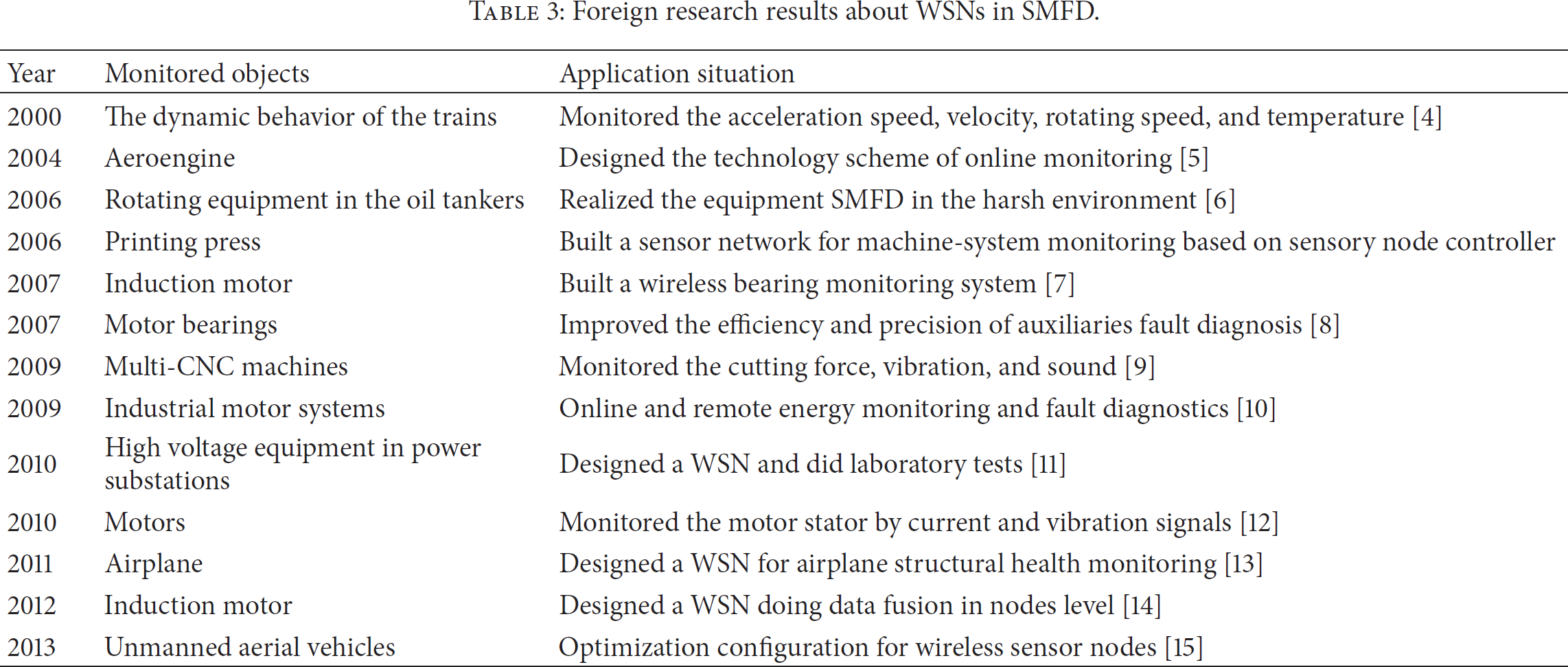
From the process of the data collection and the above research results, foreign research mainly focused on WSNs research and application in military security, environmental monitoring, medical care, intelligent transportation, and so forth [76–78]. However, research achievements are relatively less in the mechanical equipment condition monitoring and fault diagnosis.
4. Chinese Research Progress
China is relatively late in the research and application of mechanical fault diagnosis technology. The Research Institute of Fault Diagnosis was established in the 1980s. It has experienced the process from simple diagnosis to the precise diagnosis, from general diagnosis to the intelligent diagnosis, and from stand-alone diagnosis to the network diagnosis. Compared with the developed countries abroad, although China is following closely in theory, in some aspects such as the reliability and application of the mechanical equipment diagnosis, China generally still cannot keep pace with them. In recent years, mechanical equipment SMFD have achieved many developments. Diagnostic technology continuously improves and some new technologies are constantly emerging under the efforts of experts, scholars, and engineering and technical personnel for many years.
The birth of the WSNs technology has attracted extensive attention of scholars in China. Some early researches of WSNs began at Shenyang Institute of Automation, Institute of Software, Chinese Academy of Sciences, Tsinghua University, Zhejiang University, Huazhong University of Science and Technology, Harbin Institute of Technology, Northwestern Polytechnic University, Heilongjiang University, and so forth [79]. The National Natural Science Foundation of China began to sponsor the research of WSNs since 2003, and in 2004 the project was listed as key projects. In recent years, there are many research achievements in the use of mechanical equipment SMFD in China.
Then it will be introduced from the monitored parameters, monitored objects, and data fusion technology. The importance of the above three categories is indicated as follows.
(1) Monitored Parameters. The state information of mechanical equipment is the information carrier in studying mechanical equipment SMFD. Meanwhile, it is the precondition of analyzing mechanical equipment SMFD. The selection of monitored parameter types is important to mechanical equipment SMFD. However, predictive accuracy and reliability differ from different monitored parameters. When making equipment SMFD, it is best to select the monitored parameters which can effectively show the state features.
(2) Monitored Objects. The research objects are the foundation of research innovation. The research status can be summed up and sorted out by monitored objects, which helps researchers quickly acquire the information when they focus on one monitored object. In the mechanical equipment SMFD, the selection in sensors and analytical methods varies depending on the type of monitored objects.
(3) Data Fusion Technology. In the condition monitoring of equipment, there are amounts of data produced by high sampling rate signals acquisition. The data from the adjacent nodes often show different signal characteristics while with high similarity. Transmitting all data collected by all sensors to sink node will consume too much energy, even affecting the network lifetime. Data fusion can effectively reduce the amount of information and data and hence save the resources and energy of the measuring or processing units. In order to enhance the effect of mechanical equipment SMFD, data fusion must be applied in WSNs to reduce network congestion and improve the efficiency of data transmission.
4.1. Monitored Parameters
The sensor module in WSNs nodes contains various types of sensors, such as vibration, electromagnetism, heat, image, infrared, voice, and radar, which can monitor various environmental parameters, including vibration, temperature, humidity, movement speed, light intensity, pressure, noise level, and target tracking. The current researches can be divided into three types according to the monitoring vibration signal, the combination of the vibration signal and other signals, and nonvibration signal.
4.1.1. Single Vibration Signal
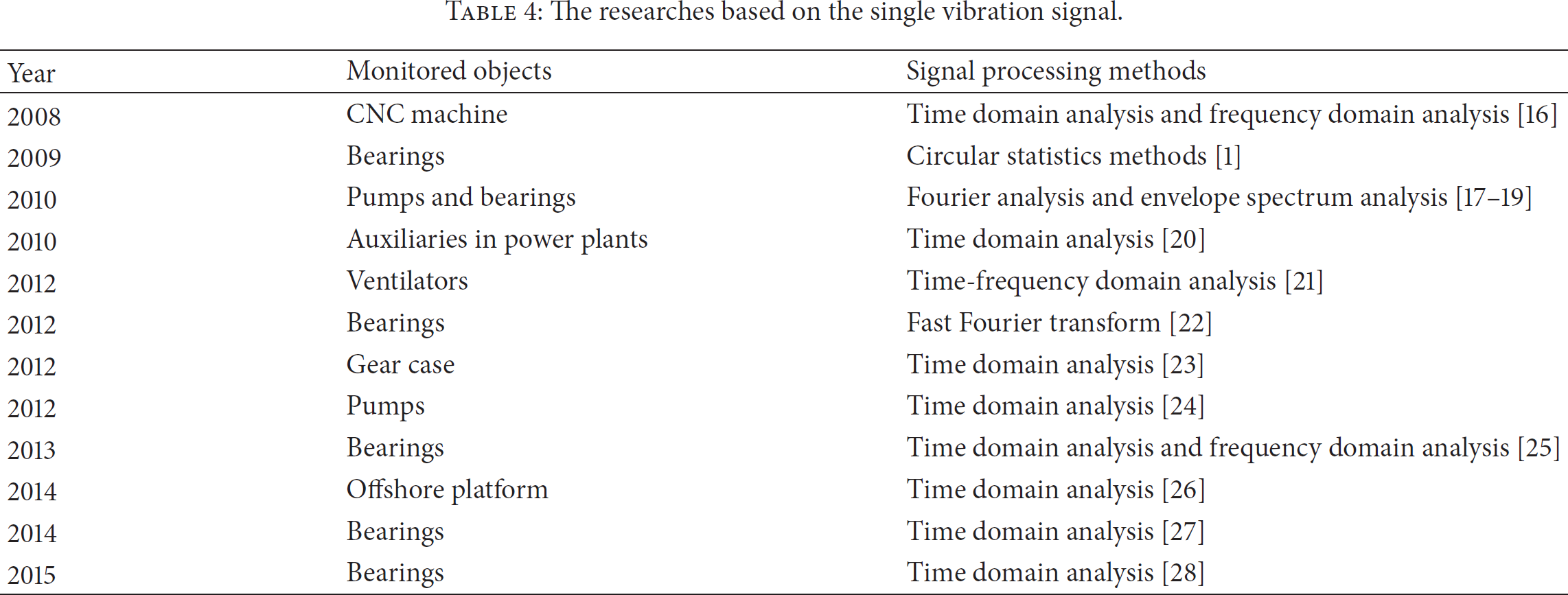
Mechanical vibration signal contains abundant machine status information, which is a good carrier for machinery fault feature information. The vibration characteristic is unique to the special fault. Through analyzing and processing the signal vibration, we can identify the cause of the malfunction. Recently, researchers are highly proficient in the vibration characteristics of rolling bearing and the signal processing methods are relatively diverse; hence, the vibration diagnosis technology is relatively mature. Common analysis methods of vibration signal include time domain statistical analysis, Fourier analysis, time-frequency analysis, Hilbert-Huang transform, independent component analysis, and fanaticism separation. Some research results have been obtained by using WSNs to monitor the vibration signals of the mechanical equipment.
As listed in Table 4, Xie [16] made an exploratory research on the CNC machine fault diagnosis system based on WSNs. Some acceleration sensors were installed on the spindle and the tool carrier to get the vibration signals. The vibration signals were transmitted by WSNs. The parameter values were analyzed and contrasted in both normal and abnormal conditions, such as time domain waveform, frequency spectrum distribution, average value, mean square value, skewness, kurtosis, and peak-to-peak value. A monitoring system based on WSNs was built for the CNC machine tool after getting the fault characteristics. Feng [1] studied the bearing fault monitoring and diagnosis process by vibration signals. Circular statistics methods were proposed and applied to separate modulation signal and carrier signal effectively. The failure characteristics contained in the signal were extracted and the fault monitoring model was established. Qi [17] and Yuan [18, 19] built the WSNs by ZigBee or Wi-Fi to collect the vibration signals of pumps in the laboratory. They extracted the fault signals by the method of Butterworth high-pass filtering and then analyzed the fault signals with spectrum envelope analysis. Then, fault diagnosis standards were established for the pumps and bearings.
The researches based on the single vibration signal.
4.1.2. Compound Vibration Signals
Although vibration signals can greatly reveal the operating state of the single mechanical equipment, it is somewhat inefficient in monitoring the complex mechanical equipment. More multiple mechanical signals are needed besides vibration, such as noise, temperature, pressure, and other signal sources. We called them compound vibration signals.
As listed in Table 5, Lin et al. [29] proposed monitoring the overall safety of the nuclear power plant by using WSNs to monitor sound, vibration, temperature, and nuclear radiation. It presented the construction scheme of the whole WSNs; however, it was only an idea that was not realized. Liu et al. [31] built the wireless monitoring program for the draught fan through collecting vibration signals of the reduction gearbox, electric current of the motor, and temperature of the lubricating oil by WSNs. The vibration signals were transformed, amplified, and compressed and the noise signals were wiped off. He [37] proposed the monitoring program for the motor stator by monitoring the vibration and temperature signals with ZigBee. An experiment was done in the laboratory to simulate the motor stator running of a nuclear power plant. Liu [38] designed a portable data collector that could collect vibration signals and temperature signals based on ZigBee and USB technology. The tool was implemented in the SMFD of rotating machinery. Fu and Wang [40] developed a new type of online monitoring system of mine ventilator to overcome the disadvantages of traditional ventilator monitoring mode. This system is developed with ARM-Linux architecture and wireless sensor network technology of ZigBee to realize the real-time monitoring of running status of the mine ventilator. However, it only did the system design and data test, without applying to the actual fault diagnosis of rotating machinery.
The researches based on the compound vibration signals.

4.1.3. Nonvibration Signals
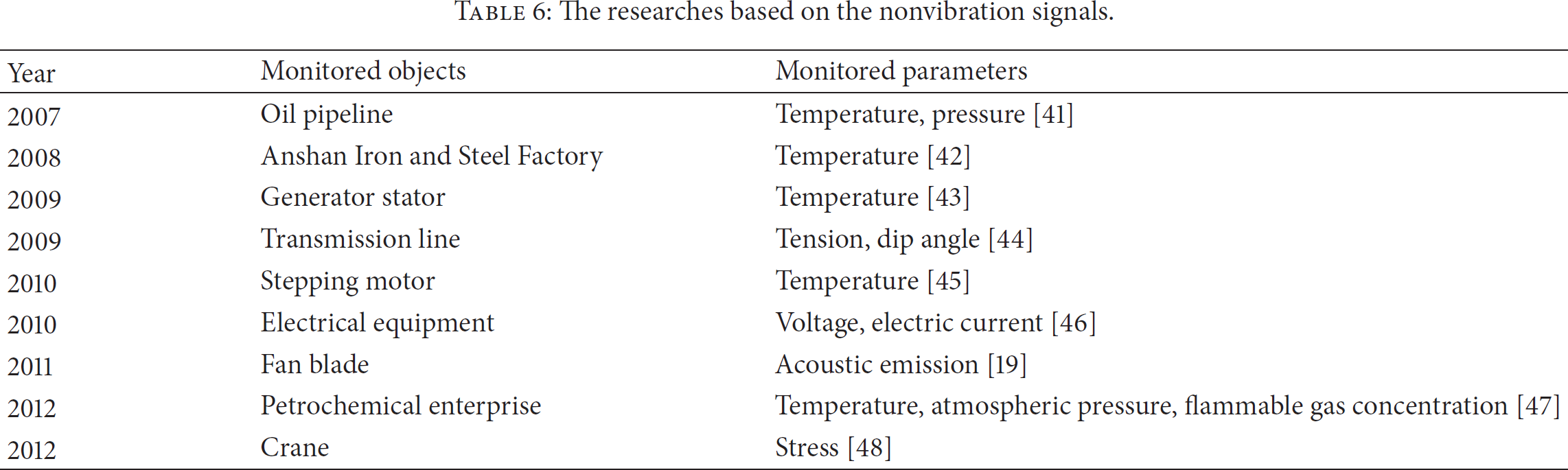
Some researches established the fault diagnosis system without vibration signals. Running temperature is an important index of mechanical equipment monitoring, such as the temperature of motor stators and bearings. If the running temperature exceeded the normal value, some accidents might occur. Wan et al. [42] built WSNs which included 406 nodes for monitoring the temperature of rollers in a continuously annealing line and detecting equipment failures in the Anshan Iron and Steel Factory. Yuan et al. [19] further studied the SMFD of the fan blade which used the acoustic emission testing technology and feature extraction methods, after the WSNs were applied in pumps [18, 19] to monitor the vibration signals. Wang and Tian [44] proposed monitoring transmission lines by tension sensors and angle sensors, so as to detect transmission lines icing situation. Cai et al. [33] did the research on monitoring the electrical equipment by voltage and electric current. Gao et al. [35] designed a stress collecting system by WSNs for mechanical equipment. The system was applied to the 4 crawler cranes to get all stress signals when the cranes are loading and then did a safety assessment and life evaluation for the cranes. Other researches were listed in Table 6.
The researches based on the nonvibration signals.
4.2. Monitored Objects
As judged from the monitored objects, there are more researches about bearing, pumps, motors, and other rotating equipment. The traditional fault diagnosis of rotating equipment has been widely investigated by researchers, so it has a high feasibility to build the equipment SMFD system based on WSNs for the rotating equipment. The current researches can be divided into four classes according to the monitored objects, bearings, pumps, motors, and other types of equipment, which are presented in Table 7.
Research results based on the monitored objects.

4.2.1. Bearings
Bearing is a typical rotating machinery. There are a lot of researches in online monitoring and fault diagnosis aiming at bearings through wiring, while less in WSNs. Feng [1] and Gao [35, 36] analyzed the fault diagnosis mechanism of single row deep groove ball bearings and verified the reliability of signal transmission in WSNs through some experiments. Song [21] studied the fault diagnosis mechanism of the mine ventilator based on WSNs and validated the feasibility by building up a testbed for bearings. Xu et al. [22] built up a WSNs model for monitoring bearings. Wei et al. [23] proposed a fault diagnosis program for wind turbine gearbox based on ZigBee technology and presented an experiment method for the N205 bearings.
In summary, most of the researches were still at the stage of system design and laboratory research. Only a few of them have been applied in factories. The research of the bearings SMFD based on WSNs is transiting from the experimental stage to the application.
4.2.2. Pumps
Pumps are common equipment and have been widely used, especially in the petrochemical industry. The pumps often cause faults or even serious accidents for the operating continuity and severe working environment, which attracts researchers attention.
Qi [17] designed an intelligent monitoring unit for pumps based on ZigBee and built a test platform to verify the efficiency and feasibility of the unit. Yuan [18, 19] studied the experimental model of pumps and proposed a set of intelligent pump monitoring schemes based on ZigBee. Huang [49] introduced an intelligent monitoring system based on WSNs for pumps group in the Refinery Department of Tianjin Branch Company, China Petroleum & Chemical Corporation. The system realized the predictive maintenance mode for the pumps based on fault forecast technology. Wang [24] proposed an online monitoring system through WSNs for pumps group in high hub port. The system solved the problem of pumps monitoring.
When most of the above researches remain at the stage of experiment or simulation, the Refinery Department of Sinopec Co. Ltd. has realized intelligent wireless monitoring for pumps group. That means petrochemical industry began to do online monitoring for petrochemical equipment based on WSNs. It will certainly promote the implementation of WSNs in the fault diagnosis area of petrochemical equipment.
4.2.3. Generators and Motors
Generators and motors are also a kind of typical rotating machines with more researches in traditional wired monitoring and fault diagnosis. Li et al. [2] put forward a design scheme to monitor the running state of the turbo-generator set based on WSNs, by recording the signals of vibration, noise, temperature, and pressure. However, it just was a program which was verified by experiment or simulation. Hu et al. [50] designed and developed a new type of low cost online SMFD system for motors which used the technology of industrial wireless and noninvasive fault diagnosis of motors. It provided a new solution to the condition monitoring of the small- and medium-sized motors. Huang et al. [45] designed a new wireless method to monitor stepper motors and gave a simulation experiment. Xu et al. [51] proposed hardware and software solutions of WSNs which could monitor the temperature of motor stator online.
In summary, there are plenty of WSNs researches in generator and motor. However, most of them are at the stage of laboratory test.
4.2.4. Other Types of Equipment
In addition to the above rotating equipment, WSNs are also applied to other mechanical equipment. Zhang et al. [52] designed a fault diagnosis system for the large-scale complex equipment, which combined several technologies, such as WSNs, embedded system, and multilevel intelligent fault diagnosis. Yuan et al. [19] and Zhao [55] studied the SMFD of fans. Ai [41] built the WSNs system to monitor the pipelines for oil production and crude oil conveying by collecting temperature and pressure signals. The problem of oil stealing and oil leaking was well solved by this system. Cai et al. [33] studied the wireless monitoring scheme for the hydraulic system of heavy weapon equipment. Zhang [54] designed communication networks within oildom based on ZigBee and communication networks from oildom to the monitoring center based on GPRS. It proposed a new type of fault monitoring method with the integration of ZigBee and GPRS. Cao and Jing [56] designed the WSNs to monitor the state of large-scale equipment and verify the reliability of data transmission by an experiment, which took the CNC gantry milling machine and the turning center as the research object. Yan et al. [80] applied the ZigBee technology and 3G networks in elevator monitoring system by considering the reasons prone to elevator failures. The wiring and high costs problems are solved through capturing collected data of elevator terminal by ZigBee wireless sensor network.
Besides, there are researches aiming at the overall enterprise application, such as communication monitoring of the electric power system [30], nuclear radiation monitoring of nuclear power plant [29, 64], and petrochemical intelligent explosion-proof system [47].
4.3. Data Fusion
Data fusion is an information processing technology which uses computer to automatically analyze and synthesize the observed data obtained by timing sequence under certain rules and finish the required decisions and assessment tasks. Data fusion is a comprehensive data processing for sensors on multiple levels. Each processing level reflects a new abstraction for the original data and produces new meaningful information. Data fusion has been applied in WSNs to reduce the network transmission congestion and improve the accuracy and credibility of information.
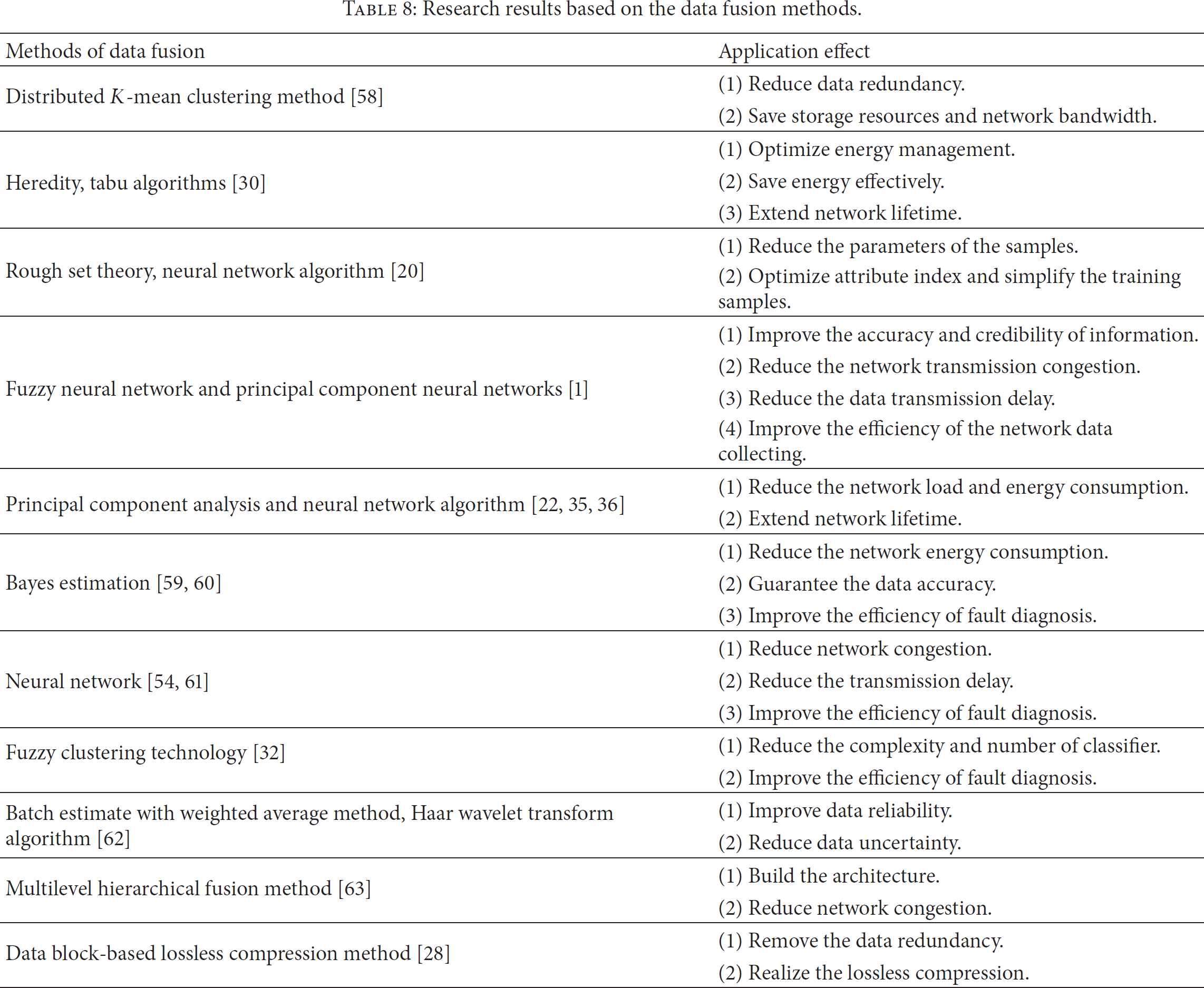
Kong [58] presented the distributed K-average clustering algorithm to reduce data redundancy in WSNs. It can save storage resources and reduce network bandwidth. The algorithm made the sensors data group quickly and reasonably. The data fusion based on adaptive weighted method could judge the weighted value according to the data after grouping and get a more reasonable conclusion. Feng [1] proposed the prim data fusion algorithms and the integration tree generation algorithm, which took the graph center as the fusion node where data fusion was made. The algorithms combine routing technology, data fusion with graph theory. The researcher further studied the way to demodulate the autocorrelation function of the vibration signal and used PCA neural network in data fusion to build rolling bearing fault diagnosis model based on vibration signal. Shao [59, 60] applied the Bayes estimation algorithm to complete data fusion in dissolved gas monitoring parameters of the transformer oil, which obtained a more accurate feature vector. Zhu et al. [61] separated the monitoring signals and extracted the fault characteristic signal using the method of three-level wavelet analysis and neural network. The method improved the fault diagnosis efficiency of the air handling units. Huang et al. [28] proposed a data block-based lossless compression method, aiming at the problem of the low performance of current data lossless compression methods in machine vibration wireless sensor networks. Experiment results indicate that the lossless compression of machine vibration signals in the resource constrained wireless sensor network node can be effectively realized with this method. Other researches are listed in Table 8.
Research results based on the data fusion methods.
5. Achievements and Problems
There are a lot of researches in mechanical equipment SMFD based on WSNs. Some achievements and problems are presented in Table 9.
Achievements and problems.

In the monitored parameters point of view, most researchers developed monitoring systems based on WSNs through monitoring one or multiple parameters. The vibration signal was widely used in mechanical equipment SMFD because most of the special faults can be detected by the vibration signals. Besides, the vibration signals showed advantages in convenient acquisition, cheaper price, and comparatively mature technology. But the WSNs are only applied in low and medium frequency vibration signals of mechanical equipment. There were deficiencies in high sampling, time synchronization, and continuous-reliable transmission [74]. For some complex mechanical equipment, it is necessary to monitor multiple signals at the same time so as to obtain accurate fault diagnosis effect. Because it is difficult to accomplish experiments for the complex mechanical equipment, most of the researches only propose system design schemes or stay at the experimental stage. Few researches are applied to factories.
In the monitored objects point of view, China has already got further research in WSNs theory at present, especially the research in the monitoring and tracking field. Some application results have been verified through enterprise production. However, most of the papers only show the fuzzy conclusion in the experiments. The comprehensive and feasible data analysis was not given, which indicated that the application of WSNs on enterprise needs a long period of time. Hence, there is a bottleneck in WSNs application and a lot of researches still stay at the experimental stage.
In the data fusion point of view, data fusion technology in WSNs has become the focus and achieved a series of research findings. Several certain effects have been caused when applying data fusion technology to optimize the wireless transmission network in mechanical equipment SMFD. It makes sense in reducing the data transmission and improving the efficiency of fault diagnosis. However, most of the WSNs data fusion technologies were combined network layer with application layer, which destroyed the integrity of each protocol layer and led to poor connection between upper and lower protocols. When getting the maximum data compression according to the application demand, it may result in excessive data loss of original information and time delay. Besides, most of the researches just stay at the theoretical level or experimental stage with few researches applied to factories. WSNs data fusion technology still needs to be further studied. New artificial intelligence algorithms would be introduced, such as Kalman filtering, Bayesian reasoning model, D-S reasoning, neural network, genetic algorithm, evolutionary algorithms, multiagent technology, fuzzy theory, expert system, and rough set.
6. Research Trend Prediction
The promotion and application in the mechanical equipment SMFD technology were restricted by the traditional cable technology. The WSNs have solved some restrictions in the traditional technology, which will surely push mechanical equipment SMFD research to a new level. However, there are many deficiencies in WSNs due to its immaturity. At present, most of the monitored parameters in sensors were slow varieties, such as temperature, pressure, and humidity. For some high sampling frequency parameters, for example, vibration signal, a majority of papers just stay at theoretical research or simulation stage. Further researches in the mechanical equipment SMFD are listed as follows.
(1) The Problems on How to Collect Mechanical Parameters under High Sampling. The present WSN nodes are only applied to low sampling frequency in collecting data, which could not apply to the high sampling frequency. Moreover, the traditional wireless sensors are unable to meet the requirements of low-power dissipation and small size in wireless sensors. It needs to develop new wireless sensors for high sampling mechanical signals, for example, [81].
(2) The Problems on How Multiple WSN Nodes Sample Signals Synchronously. In mechanical equipment state monitoring, it often needs to deploy multiple sensors to sample signals synchronously. As for modal analysis, the time difference which results from diverse nodes collecting vibration signals will lead to serious phase error. It is difficult for different nodes in the WSN to sample data synchronously due to the reason that the WSNs belong to a distributed system and different nodes have their own local clock. Paper [82] proposed a lightweight secure global time synchronization protocol, and [83] proposed a maximum time synchronization protocol, for WSNs. However, how to realize the protocols in data processing system needs to be further studied.
(3) Further Study on the WSNs Software and Hardware Design. The WSNs are needed to be improved so as to satisfy online-data collection and transmission requirements. These technologies need to be further researched, such as energy conservation, data transmission stability, communication protocol, fault-tolerant mechanism, nodes coverage, and reliability. How to realize the rapid reorganization and allocation of the monitoring nodes in data collecting layer adapting to monitoring environmental change, how to build routing protocols for WSNs adapting to the flexible characteristic of rapid reorganization, and how to build the fault diagnostic center architecture in the reorganization environment [31] have become the hot topic in the future study.
(4) Data Transmission and Data Fusion Technology in WSNs. The mechanical equipment SMFD is a long-term continuous operation which requires sufficient energy to supply for the monitoring sensors. In the data transmission process, the nodes data ceaselessly converges to base station. When it is closer to the sink nodes, more congestion appears, which easily leads to packet loss. It is a challenge for WSNs data transmission. In WSNs some sensors may collect similar data in a long time which is not important for equipment monitoring. The nodes data fusion technology which does data processing and data filtering in node layer can save energy, enhance data accuracy, and improve the efficiency of data collection.
(5) Research New Fault Diagnosis Model Based on Multiple Nodes at WSNs for the Mechanical Equipment. Fault signal characteristics in mechanical equipment are getting more and more complex, such as nonlinearity, time-variation, much hysteresis, fuzziness, and uncertainty. When faults occur, they often show multiple fault characteristics which could not be collected by only a single node. It is difficult to make accurate fault diagnosis only by single information and method. The traditional cable fault diagnosis for mechanical equipment does not deploy plenty of nodes due to their wiring complexity and high monitoring costs, which result in failing to obtain comprehensive fault signals. For low price and flexible arrangement of WSNs nodes, plenty of nodes can be arranged to obtain comprehensive information according to monitoring demand. Hence, multiple nodes deployment strategies are important to mechanical equipment SMFD based on the WSNs.
7. Conclusion
In this paper, we provide a review of WSNs applications to the SMFD of mechanical equipment in China. All reported applications of the SMFD of mechanical equipment based on WSNs are collected and divided into a few main aspects, namely, the monitored parameters, monitored objects, and data fusion methods. Monitored parameters include single vibration signals, compound vibration signals, and nonvibration signals; monitored objects include bearing, generators, pumps, motors, and other equipment. At the end of each part, it points out the existing problems in the current research and introduced the actual application situation.
From the above WSNs research results, foreign research mainly focused on military security, environmental monitoring, medical care, intelligent transportation, and so forth. Research achievements are relatively less in the mechanical equipment condition monitoring and fault diagnosis. However, the application fields of WSNs are more and more wide; integrating the WSNs technique into the research fields of mechanical equipment SMFD is the inevitable trend of science and technology development. It has already achieved further research in WSNs theory in China, especially in the field of monitoring and tracking. However, a bottleneck still exists in the application. A lot of research results still stay at the experimental stage and are not commonly used in the enterprise production. Achievements and problems have been summarized in the paper.
In addition, the core problems of WSNs in fault diagnosis of mechanical equipment are pointed out and future trends are discussed. We hope that this review would provide comprehensive references to researchers in this field.
Footnotes
Conflict of Interests
The authors declare that there is no conflict of interests regarding the publication of this paper.
Acknowledgments
This work is supported by the State Administration of Work Safety Accident Prevention and Control Project (no. guangdong-0007-2015AQ), the Maoming Science and Technology Planning Project (no. 201324), the Open Fund of Maoming Study and Development Center of Petrochemical Corrosion and Safety Engineering (no. 201509A01), Educational Commission of Guangdong Province, China Project (no. 2013KJCX0131), Guangdong High-Tech Development Fund (no. 2013B010401035), 2013 Special Fund of Guangdong Higher School Talent Recruitment, Educational Commission of Guangdong Province, China Project no. 2013KJCX0131, 2013 Top Level Talents Project in “Sailing Plan” of Guangdong Province, National Natural Science Foundation of China (Grant nos. 61401107 and 61174113 and 21576102), and 2014 Guangdong Province Outstanding Young Professor Project.